
By John Gruber
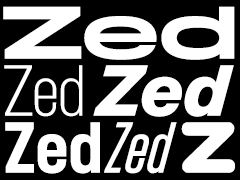
Zed — A font superfamily with extraordinary number of styles and extraordinary language support.
Linked List: July 1, 2011
Friday, 1 July 2011
- Billings Pro 1.5 with Marketcircle Cloud ★
-
My thanks to Marketcircle for sponsoring this week’s DF RSS feed to promote Billings Pro 1.5. Billings Pro is a multi-user time tracking and invoicing solution for the Mac and iPhone, and it includes a web app for time keepers. With Marketcircle Cloud, you get the Mac and iPhone experience with the convenience of online storage and syncing. They handle the hosting, setup, and backups, you get to focus on actual work.
I would have given my left arm for something like Billings back when I was doing freelance design work. Try it free for 30 days.
- Revising the Definition of ‘Pro’ ★
-
Ken Segall:
In the world of Apple, a Pro product used to mean “designed for high-end professionals with needs far beyond those of mortal men.” Now it simply means “the high-performance model.”
Exactamundo.
- ‘Windows. Windows. Windows. Windows.’ ★
-
Paul Thurrott, quoting Steve Ballmer at, of all places, a meeting of the Seattle Rotary Club:
“If you cut me open and saw what was inside,” he continued, “[It’s] Windows. Windows. Windows. Windows. Our company was born on the back of Windows. Windows underpins a huge percentage of all of our success, all of our profitability, all of the important things that we do. So, how important is it? ‘Very’ would be a very fair answer.”
- MacRumors: OS X Lion License Permits Virtualization ★
-
Arnold Kim:
The Golden Master version of OS X Lion (10.7) just released to developers includes the final end-user licensing agreement (EULA) which reveals that users can run up to two additional instances of OS X Lion on their same machine without a need for extra licenses.
This is welcome news to developers, for one thing. They want to run multiple versions of Mac OS X under VMware or Parallels for compatibility testing.
- Andy Hertzfeld on His Role in Google+ ★
-
Andy Hertzfeld:
One thing that I learned during the launch of the original Macintosh in 1984 was that the press usually oversimplifies everything, and it can’t deal with the reality that there are many people playing critical roles on significant projects. A few people always get too much credit, while most people get too little, that’s just the way it has always worked. But luckily, it’s 2011 and I can use the service that I helped to create to clarify things.
- TwUI — Core Animation UI Framework for Mac ★
-
New open-source framework from Twitter engineers Loren Brichter and Ben Sandofsky:
TwUI brings the philosophy of UIKit to the desktop. It is built on top of Core Animation, and it borrows interaction ideas from AppKit. It allows for all the things Mac users expect, including drag & drop, mouse events, tooltips, Mac-like text selection, and so on. And, since TwUI isn’t bound by the constraints of an existing API, developers can experiment with new features like block-based drawRect and layout.
- Kodak Plunges 19%: Patent Suit Against Apple, RIM Remanded to Judge ★
-
Remember when Kodak was a great product company?
- ‘Designed by HP in California’ ★
-
Nice catch by Shawn Blanc on the TouchPad packaging.
- ‘Killer Elite’ ★
-
Robert De Niro, Jason Statham, Clive Owen. Count me in.
- A Preview of Gmail’s New Look ★
-
Google and good design. This is going to take some getting used to.
- ‘Own a Shape’ ★
-
Clayton Miller:
Microsoft’s Metro UI owns the square. Apple has a corner on the roundrect, from the Springboard launcher to the iPhone hardware itself. Nokia, despite its late entry with MeeGo’s Harmattan UI, found the squircle unclaimed and ran with it beautifully. Palm has used the circle from the early days of PalmOS, and in WebOS, HP continues the tradition with care (one might even note that both Palm and HP structure their wordmarks around the circle).
Great observation.
- Sachin Agarwal on Why Apple Built Final Cut Pro X ★
-
Sachin Agarwal:
I worked on Final Cut Pro from 2002 to 2008. It was an amazing experience. The Final Cut Pro X project was just getting started when I left Apple. It was an ambitious and controversial move, but it made sense for Apple. Here’s why:
Apple doesn’t care about the pro space.
The goal for every Apple software product is to sell more hardware. Even the Mac operating system is just trying to get people to buy more Mac computers. The pro market is too small for Apple to care about it. Instead of trying to get hundreds or even thousands of video professionals to buy new Macs, they can nail the pro-sumer market and sell to hundreds of thousands of hobbyists like me.
Hard to argue with that, in broad strokes. But if Apple doesn’t care, period, about the pro space, why keep “Pro” in the app’s name? Why preview it at NAB in February, to an audience of the very pro-y-est editing pros?
I think Apple plans for Final Cut Pro X to grow from where it is today to eventually meet the needs of high-end pros. What this release shows is not that Apple doesn’t care about the pro market at all, but rather that they don’t care enough to prevent Apple from releasing a version that pros can’t yet use.
- Apple and Microsoft Beat Google for Nortel Patents ★
-
Chris V. Nicholson, reporting for the NYT DealBook:
Nortel Networks, the defunct Canadian telecommunications equipment maker, said that it had agreed to sell more than 6,000 patent assets to a consortium made up of Apple, Microsoft and other technology giants for $4.5 billion in cash.
The group of companies — which also included Research in Motion, Sony, Ericsson and EMC — beat out Google and Intel for the patents and patent applications that Nortel had accumulated when it was still one of the largest telecom equipment makers in North America.
I’d sure love to know how the sides got drawn in this. How did Google get excluded from that consortium?


