
By John Gruber
WorkOS: How SSO works and the fastest way to add it.
Linked List: October 21, 2011
Friday, 21 October 2011
- VueScan Mobile ★
-
My thanks to Hamrick Software for sponsoring this week’s DF RSS feed to promote VueScan Mobile. VueScan Mobile is a powerful, easy-to-use app that lets you use your Wi-Fi printer/scanners from HP, Epson, and Canon on your iOS device.
VueScan Mobile works with a long list of popular Wi-Fi-enabled scanners, saves scanned images to your photo library, and can send images to any other app that reads PDFs or JPEGs, including iBooks, Dropbox, and GoodReader.
VueScan Mobile’s big sibling VueScan is great desktop scanning software for the Mac, Windows, and even Linux. Hamrick does one thing and they do it incredibly well: they make great scanning software.
- Jon Stokes on Next-Gen ARM CPUs, and Apple’s Switch to Intel ★
-
Jon Stokes:
Years ago, I heard the back-story on Apple’s switch to Intel first-hand from some folks on the IBM side of things, and what I learned was that Steve Jobs agonized over this decision and waited until the morning of the keynote before pulling the trigger on this move. He actually went into that day with two keynote presentations prepared: one for a PowerPC-based product line, and one for The Switch. When he pulled out The Switch presentation, the IBM team was absolutely as stunned as the rest of the world, as was the P.A. Semi team who had been separately assured by Jobs that their dual-core PowerPC part would find its way into Apple portables.
I believe it, but this sort of conflicts with reporting by CNet and The Wall Street Journal — both of which reported Apple’s surprise switch to Intel for the Mac a few days before the WWDC keynote. Of course, it’s entirely possible that Apple “decided” to switch to Intel a few days before WWDC, but that nothing had been signed in ink until the morning of the keynote.
Anyway, good stuff on next-gen ARM technology, as usual from Stokes.
- Maybe Microsoft Should Get Into the Concert Ticket Business? ★
-
Some camp-out-all-night-outside-the-store lines are not alike.
- This Is Not a Cheesesteak ★
-
Splendid new blog documenting sandwich atrocities.
- Newsstand Is Driving a Surge in Magazine, Newspaper iPad App Subscriptions ★
-
Jeff Sonderman, Poynter:
A couple weeks ago I predicted that Apple’s virtual Newsstand for iPads and iPhones would provide “a little more convenience for the user, and a little more discoverability for the publisher — but nothing here is a game-changer.”
I stand by the first part of that diagnosis, but it’s now clear there is something game-changing about Newsstand. Since Apple launched it last week in the latest version of its iOS operating system, its impact has been immediate and significant. Many Newsstand apps now rank among the top free apps overall, and magazine and newspaper apps are benefiting from a surge of downloads and subscribers.
I think it’s all about prominence and visibility. The iOS home screen is prime real estate. It’s up there with the Google home page. There is no clutter, and Apple is judicious when adding new items. People notice Newsstand. It was the first thing my mom asked me about after she upgraded her iPad to iOS 5.
For power users the Newsstand seems stupid and annoying, I suspect though that for many non-power users it is more of a “finally” type system. It makes searching for, downloading, paying for periodicals very easy.
- Undocumented APIs and Android ★
-
Tim Bray on the Android Developers Blog, in a post euphemistically titled “New Public APIs in ICS”, which is really about widely-used undocumented APIs (a.k.a. private APIs, in Apple parlance) that have changed in Android 4.0:
And we also think that most developers know that when they use undocumented APIs, they’re making a commitment to doing the right thing when those APIs change.
Interested to see how this goes.
- AT&T Seeing ‘Tremendous, Tremendous Demand’ for iPhone 3GS ★
-
Peter Cohen, quoting AT&T Mobility CEO Ralph de la Vega:
I also mentioned in my notes that we have another device that I think is going to dramatically change those people that are on smartphones and quick messaging devices, the 3GS, which is free with a 2-year contract. We’ve seen a tremendous, tremendous demand for that device even though it’s a generation old. And actually, we’re getting more new subscribers coming on the 3GS on the average than other devices.
That’s the power of “free*”, even when the asterisk is a requirement that you sign a two-year contract that costs like $1,500, minimum. Also, worth keeping in mind: the 3GS is an advantage AT&T still has over Verizon and Sprint — there is no CDMA iPhone 3GS.
Update: Interesting point from a DF reader on Twitter:
Wondering how many of those free 3GS’s are the third (teenager!) phone on a family plan. That can be as low as $25/mo.
I hadn’t really thought about family plans, but that makes sense — “free*” is a lot closer to no-asterisk-just-plain-free in that case.
- AnandTech on Mobile Display Pixel Density ★
-
Brian Klug and Jason Inofuentes compare the pixel density of the Galaxy Nexus with other leading Android handsets and the iPhone 4(S).
- Why the QR Code Is Failing ★
-
Sean Cummings:
People will not adopt a technical solution that serves to replace a manual task, if that solution is less efficient than the manual task it replaces. How could we think that QR codes for marketing would work any better than CueCat? Did we not learn the first time?
QR codes are built for machines, not humans. And they’re ugly.
Update: Mikey-San nails it:
Robot barf looks like QR codes.
- Kindle Format 8 ★
-
At a glance, this seems like a richer format — giving more control to designers — than ePub.
- ‘What the Fuck Is Wrong With You People?’ ★
-
Jon Stewart on Republicans’ “thank America last” stance regarding the Obama administration’s success in Libya.
- This Is How Science Works ★
-
Kevin Drum:
Physicists are notorious for believing that other scientists are mathematically incompetent. And University of California-Berkeley physicist Richard Muller is notorious for believing that conventional wisdom is often wrong. For example, the conventional wisdom about climate change. Muller has criticized Al Gore in the past as an “exaggerator,” has spoken warmly of climate skeptic Anthony Watts, and has said that Steve McIntyre’s famous takedown of the “hockey stick” climate graph made him “uncomfortable” with the paper the hockey stick was originally based on.
So in 2010 he started up the Berkeley Earth Surface Temperature project (BEST) to show the world how to do climate analysis right. Who better, after all?
- I’d Vote for Them ★
-
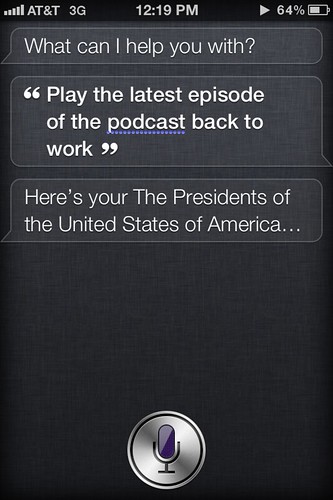
Anyway, speaking of podcasts, great episode of Back to Work this week, talking about iCloud.
- Skyping a Deuce ★
-
This week’s episode of America’s favorite game show, The Talk Show. Topics include: Siri, Apple’s earnings announcement, Roboto, Dropbox, iOS Twitter integration, the Çingleton Symposium, Badger Face, the Galaxy Nexus, iPhone cases, and a bunch of other nonsense. Brought to you by some of the finest sponsors in the world: Sourcebits, RE:minder, and Shopify.
- Great Artists Steal the Future ★
-
The T.S. Eliot quote at the end really nails it.
- James Kendrick: ‘After the iPhone 4S, Android Just Feels Wrong’ ★
-
Long-time Android user James Kendrick:
This realization hit me hard, as I found that as I used the Nexus, a phone I absolutely love, the user experience was jangling my nerves. The inconsistencies in the interface between apps and the occasional lag doing simple things like scrolling in windows just screamed at me. I hadn’t really noticed it before, but after using the iPhone these things jump out at me. […]
The biggest area of discontent is in web browsing, one of the primary things I do with a smartphone.
- iPhone 4S Commercial ★
-
Great music, great pacing. Love the framing of the faces. Better than most movie trailers.
- Pre-Order ‘Steve Jobs’ From Amazon ★
-
Call me old-fashioned, but a book like this, I get in hardcover.
- ‘I’m Going to Destroy Android, Because It’s a Stolen Product’ ★
-
The AP, quoting from an advance copy of Walter Isaacson’s imminent Jobs biography:
“I will spend my last dying breath if I need to, and I will spend every penny of Apple’s $40 billion in the bank, to right this wrong,” Jobs said. “I’m going to destroy Android, because it’s a stolen product. I’m willing to go thermonuclear war on this.”
Jobs used an expletive to describe Android and Google Docs, Google’s Internet-based word processing program. In a subsequent meeting with Schmidt at a Palo Alto, Calif., cafe, Jobs told Schmidt that he wasn’t interested in settling the lawsuit, the book says.
“I don’t want your money. If you offer me $5 billion, I won’t want it. I’ve got plenty of money. I want you to stop using our ideas in Android, that’s all I want.” The meeting, Isaacson wrote, resolved nothing.
I’m pretty much in no-spoiler mode on this book, but I had to post this.