By John Gruber

We’re just out
here a-havin’ fun
In that warm
California sunnn…
Linked List: July 6, 2023
Thursday, 6 July 2023
- Twitter Is Threatening to Sue Meta Over Threads, Meta Executives Threaten to Piss Their Pants Laughing ★
-
Max Tani, reporting for Semafor:
On Wednesday, Instagram parent company Meta introduced Threads, a text-based companion to Instagram that resembles Twitter and other text-based social platforms. Just hours later, a lawyer for Twitter, Alex Spiro, sent a letter to Meta CEO Mark Zuckerberg accusing the company of engaging in “systematic, willful, and unlawful misappropriation of Twitter’s trade secrets and other intellectual property.”
Good luck with that.
Spiro accused Meta of hiring dozens of former Twitter employees who “had and continue to have access to Twitter’s trade secrets and other highly confidential information.”
He also alleged that Meta assigned those employees to develop “Meta’s copycat ‘Threads’ app with the specific intent that they use Twitter’s trade secrets and other intellectual property in order to accelerate the development of Meta’s competing app, in violation of both state and federal law as well as those employees’ ongoing obligations to Twitter.”
It’s comical to think that Meta needed engineers from Twitter to build Threads. Like Twitter is a model of reliability and stability, and Meta’s platforms don’t serve an entire order of magnitude more users. Even more comical:
Andy Stone, Meta’s communications director, told Semafor that Twitter’s accusations are baseless. “No one on the Threads engineering team is a former Twitter employee — that’s just not a thing,” he said.
Even if ex-Twitter employees were working on Threads, Elon Musk fired them. It’s not illegal to hire people fired by a competitor. Would be kind of wacky if it were. This letter is so transparent: Musk is threatened by Threads and jealous of the mountain of media attention it’s getting, so he’s lashing out. Commanding his lawyer to send a silly letter like this feels like a Trump move, no exaggeration.
- Mastodon’s FAQ on Threads ★
-
Eugen Rochko, founder and CEO of Mastodon:
Today, Meta is launching its new microblogging platform called Threads. What is noteworthy about this launch is that Threads intends to become part of the decentralized social web by using the same standard protocol as Mastodon, ActivityPub. There’s been a lot of speculation around what Threads will be and what it means for Mastodon. We’ve put together some of the most common questions and our responses based on what was launched today.
What strikes me about this FAQ is that nearly every question has no basis in reality. It’s calming the irrational fears of people who view Facebook as a corporate bogeyman. Having written quite a bit recently about Threads joining the open fediverse, I can vouch that these fears are real, insofar as people really do think Threads is somehow going to steal their data, or that Facebook is somehow going to show ads to people on Mastodon servers, but those fears have no more basis in reality than worrying about monsters who live under your bed.
Here’s the one that really matters:
Will Meta embrace-extend-extinguish the ActivityPub protocol?
There are comparisons to be made between Meta adopting ActivityPub for its new social media platform and Meta adopting XMPP for its Messenger service a decade ago. There was a time when users of Facebook and users of Google Talk were able to chat with each other and with people from self-hosted XMPP servers, before each platform was locked down into the silos we know today. What would stop that from repeating? Well, even if Threads abandoned ActivityPub down the line, where we would end up is exactly where we are now. XMPP did not exist on its own outside of nerd circles, while ActivityPub enjoys the support and brand recognition of Mastodon.
- Custom Domain Names as Bluesky Handles – Fun Feature, and Now a Business Model ★
-
From the official Bluesky (pro tip: rhymes with brewski and Russki) blog:
We believe that there must be better strategies to sustain social networks that don’t require selling user data for ads. Our first step in another direction is paid services, and we’re starting with custom domains. While setting up a custom domain to use with Bluesky and the AT Protocol is fairly straightforward, it does require some familiarity with domain registrars and DNS settings. Yet, over 13,000 users have already either repurposed domains they already owned to use as handles, or purchased a domain solely because of Bluesky. Domains have so much potential as a personalized way to customize identities and as a decentralized way to verify reputation that builds off the existing web. For example, U.S. Senators have used the
senate.govdomain to verify their identity on Bluesky without our involvement, and a third-party developer built a web extension that checks if websites are linked to an AT Protocol identity. The possibilities are wide in the domain-as-a-handle space.We’re partnering with Namecheap, a popular domain registrar, to offer a service for easy domain purchasing and management. With this, people can set a custom domain as their handle on Bluesky and the AT Protocol in under a few minutes.
Making it a built-in feature and a source of recurring revenue for the Bluesky company — legally, a public benefit corporation — is a great idea. Using a custom domain name as your handle is one of the best features of Bluesky and the AT Protocol, and it really is rather simple. But by building it in as a feature, Bluesky can make it super simple, and remove the possibility of error.
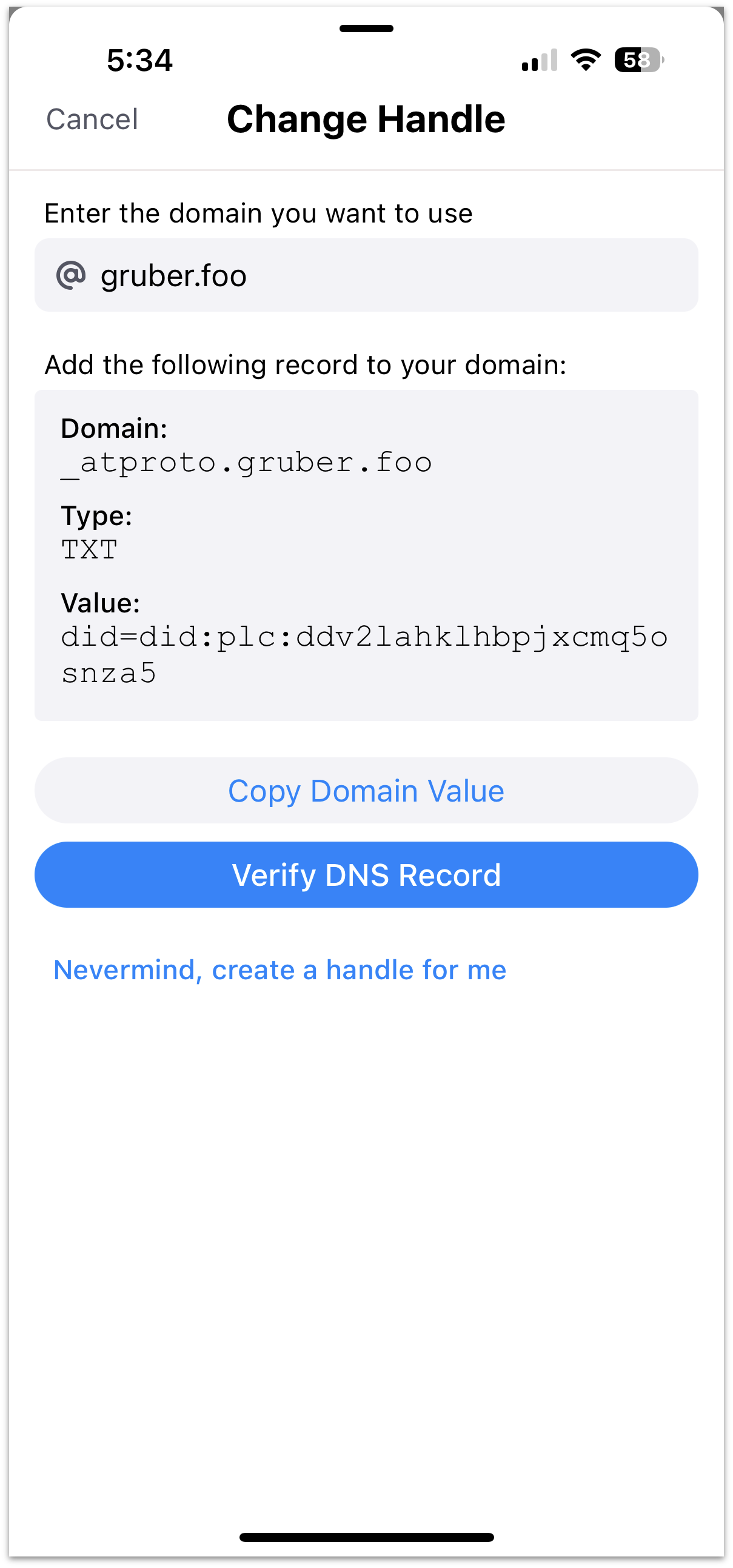
In Bluesky’s settings (which are relatively concise), go to “Change Handle” under “Advanced”. Then tap (or click) “I have my own domain.” On the next screen enter the domain name you own and wish to use in the top field, and Bluesky will show you the domain and value to enter at your registrar. I’m using “gruber.foo”, but you can just as easily use a subdomain like “john.gruber.foo”. The Daring Fireball account on Bluesky will be “daringfireball.net” — I could have used “gruber.daringfireball.net” for my personal account. A publication like, say, The New York Times could allow reporters to each have official Bluesky accounts like “reportername.nytimes.com”. Verification, in a sense, is built in.
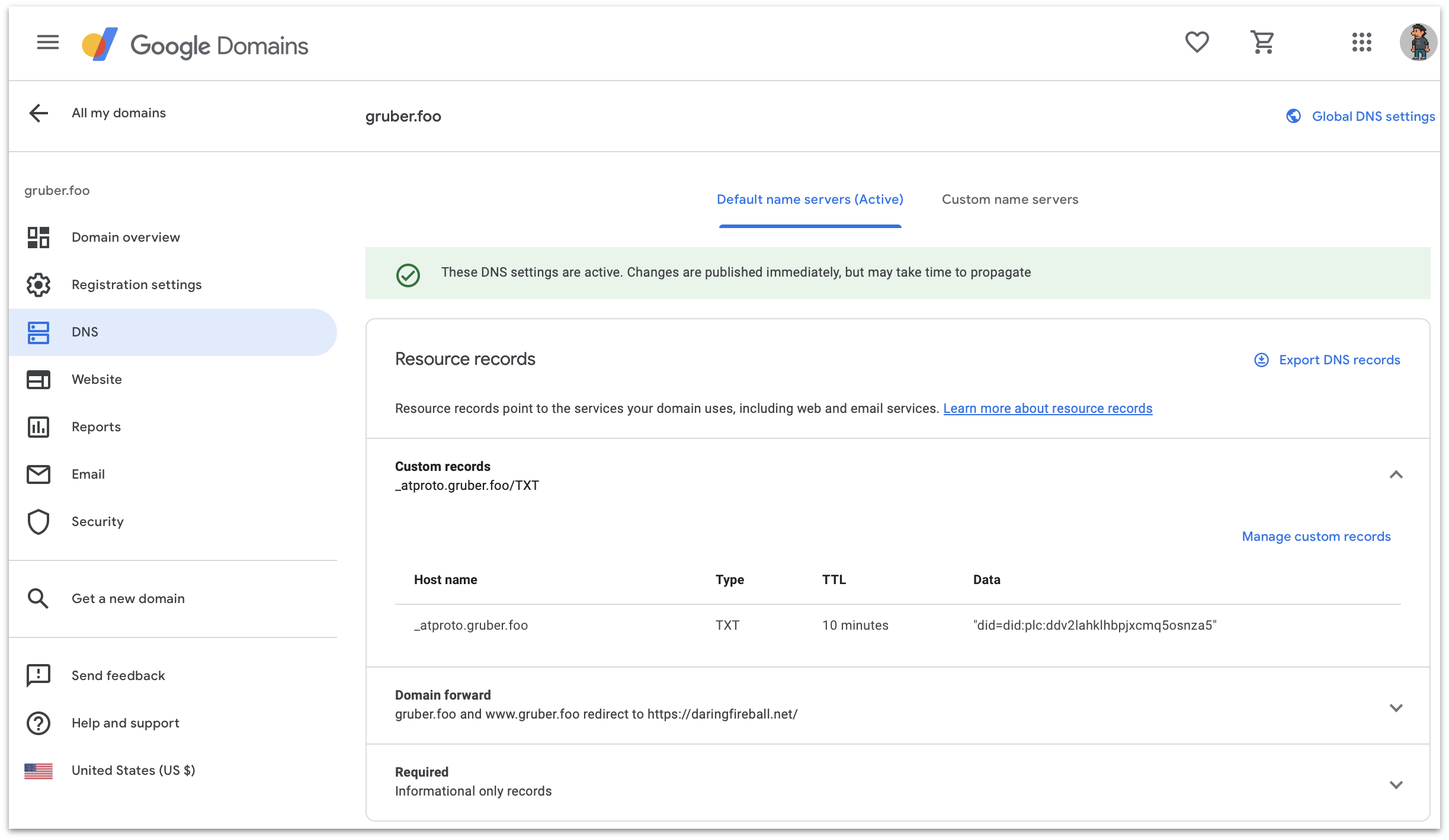
Then just go to your domain registrar and create an entry of type “TXT” using the domain and value you copied from the Bluesky app. Wait a few minutes for the change to propagate and your custom domain is now your Bluesky handle. Here’s a screenshot from my settings at Google Domains.