By John Gruber

We’re just out
here a-havin’ fun
In that warm
California sunnn…
Linked List: January 17, 2024
Wednesday, 17 January 2024
- Apple Will Begin Selling Series 9 and Ultra Watches With Blood Oxygen Sensors Disabled Tomorrow ★
-
Apple, in a statement to Chance Miller at 9to5Mac:
Apple’s appeal is ongoing, and we believe the US Court of Appeals for the Federal Circuit should reverse the USITC’s decision. We strongly disagree with the USITC decision and resulting orders.
Pending the appeal, Apple is taking steps to comply with the ruling while ensuring customers have access to Apple Watch with limited disruption. These steps include introducing a version of Apple Watch Series 9 and Apple Watch Ultra 2 in the United States without the Blood Oxygen feature. There is no impact to Apple Watch units previously purchased that include the Blood Oxygen feature.
Apple Watch Series 9 and Apple Watch Ultra 2 without the Blood Oxygen feature will become available from apple.com starting 6am PT on January 18, and from Apple Stores starting January 18.
Without the feature — not without the sensor, as Aaron Tilley of The Wall Street Journal reported in a story that still has not been corrected.
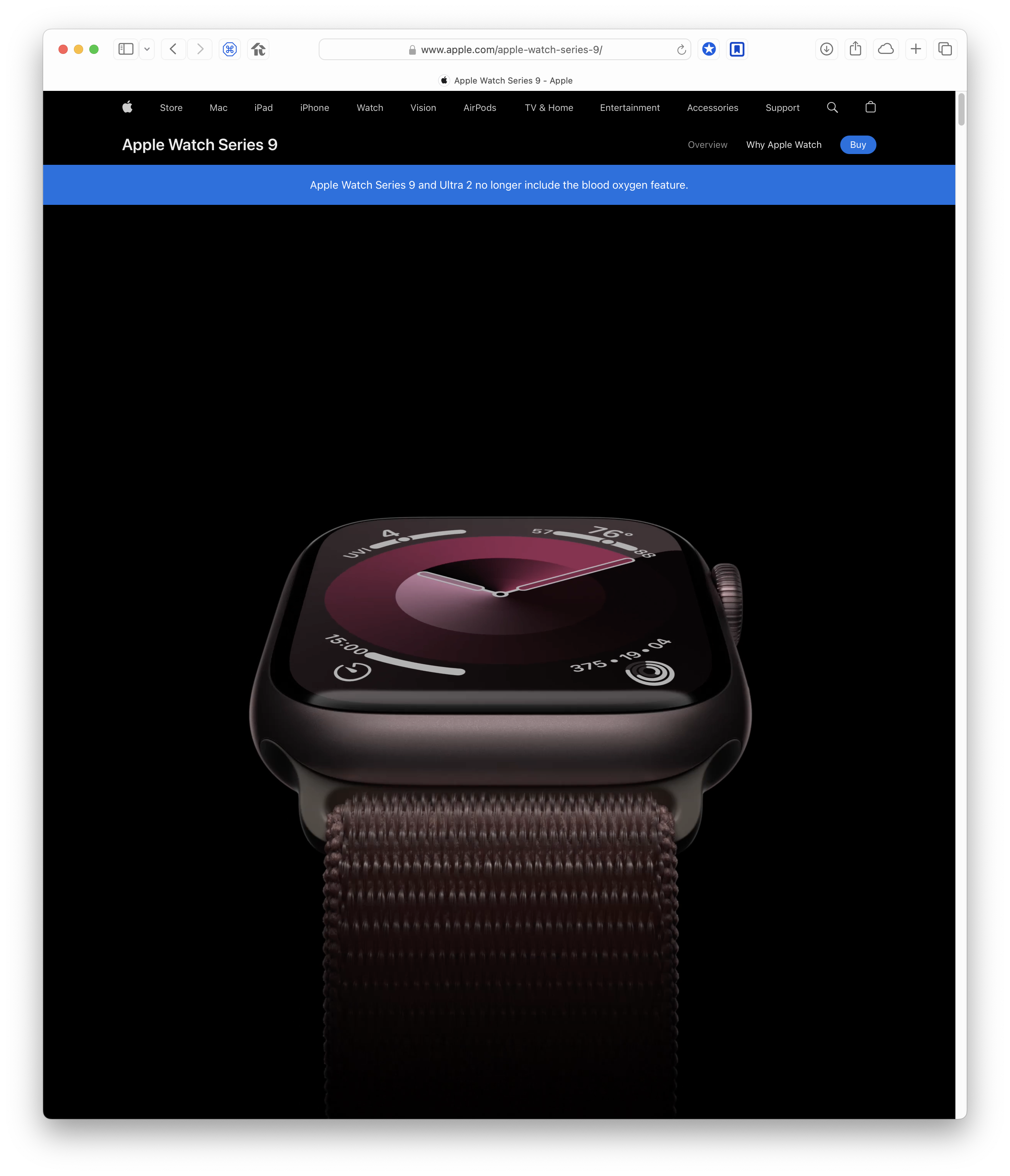
Apple.com’s product pages for Series 9 and Ultra 2 now have a prominent banner at the top that reads “Apple Watch Series 9 and Ultra 2 no longer include the blood oxygen feature.”
- Apple Set to Collect $73 Million in Legal Fees From Epic Games ★
-
Apple, a court filing spotted by Florian Mueller at Games Fray:
Please take notice that on March 5, 2024 at 10:00 a.m., or as soon thereafter as the matter may be heard by the Court, at the courtroom of the Honorable Yvonne Gonzalez Rogers, [...] Apple Inc. (“Apple”) will and hereby does move that this Court, pursuant to the mandate of the Ninth Circuit, enter judgment ordering Epic Games, Inc. (“Epic”) to pay Apple $73,404,326, plus additional amounts Apple is incurring during this ongoing litigation, under the indemnification provision of the Developer Program License Agreement.
This is not simply about Epic having sued Apple and lost; it’s about the fact that this whole saga started with Epic’s Fortnite in-app payment processing stunt, blatantly violating the Developer Program License Agreement. This wasn’t like an edge case or technicality; Epic deliberately violated the clear rules of the DPLA as a publicity stunt to launch their antitrust lawsuit. File under “Fucking Around and Finding Out”.
Mueller writes:
Early into the litigation, Epic accepted that if it loses on its antitrust claims (as it did), it owes damages. If Epic had prevailed on antitrust, the contract clause wouldn’t have been enforceable. [...]
Apple does this as a matter of principle. They won’t leave an amount in the tens of millions on the table. And their overall treatment of Epic, such as not putting Fortnite back, is meant to discourage other app makers from challenging Apple and from breaching the DPLA.
It’s unsurprising but worth noting that Fortnite is seemingly never coming back to iOS, unless Epic sells the franchise to another company. iOS Fortnite players are like the children in an ugly divorce.