By John Gruber

WorkOS: How SSO works and the fastest way to add it.
Linked List: April 17, 2024
Wednesday, 17 April 2024
- ‘Oh the Humanity’ ★
-
Ben Sandofsky:
An ex-Apple designer who went on to startup success once told me, “I wish I could give a workshop for Apple alumni jumping into startups, to help them un-learn The Apple Way.” As someone who strives to build products with the craft and quality of Apple, it pains me to admit that The Apple Way can destroy a lot of startups. Which brings us to Humane.
Great piece. And it brings to mind an observation I’m far from the first to make: There are far fewer startups founded by former Apple employees than one would expect, given Apple’s spectacular run over the past 25 years.
Nest is an obvious exception, but Tony Fadell had a very atypical career at Apple. He was brought in as a contractor in 2001 to help create the iPod, and stayed until 2008. He was more “the iPod guy” not “an Apple person”. And the original Nest thermostat couldn’t be more opposite from Humane’s AI Pin — the Nest did exactly what it promised, very well. Even the fact that it included a screen. Most importantly, Nest’s thermostat took aim at replacing existing dumb thermostats, which were terrible. Nest’s product really was something like 10× better than what it aimed to disrupt. The AI Pin took aim at the iPhone, which is insanely great.
- Ippei Mizuhara, Shohei Ohtani’s Interpreter and Friend, Stole $16 Million to Pay Only a Portion of His Gambling Losses ★
-
Speaking of sports gambling scandals, here’s Tim Arango and Michael S. Schmidt, reporting for The New York Times:
Ohtani has many other accounts, of course — he earns more money from endorsements and business deals than he does from his lucrative baseball salary. But it was this account, solely for Ohtani’s baseball earnings, that Mizuhara would scheme to take control of and then, as he fell deeper into a gambling addiction, pilfer for years, according to prosecutors.
Mizuhara changed the settings of the account so alerts and confirmations of transactions would go to him, not Ohtani. Drawing on phone recordings obtained from the bank, prosecutors said Mizuhara had also impersonated Ohtani to gain the bank’s approval for certain large transactions. And whenever one of Ohtani’s other advisers — his agent, tax preparer, bookkeeper or financial adviser, all of whom were interviewed for the federal investigation — inquired about the account, Mizuhara told them that Ohtani preferred the account to remain private.
Between November 2021 and January this year, Mizuhara stole $16 million from the account to feed his “voracious appetite for illegal sports betting,” according to E. Martin Estrada, the U.S. attorney in Los Angeles.
Sounds like the plot from a Coen brothers movie. At every step where anyone tried to check with Ohtani on this bank account, they went through Mizuhara as a translator.
This being a baseball story, the criminal complaint was stuffed with numbers:
- 19,000 bets.
- $142,256,769.74 total winning bets.
- $182,935,206.58 total losing bets.
That’s 20-some bets per day, for years, for nearly $20,000 per wager on average. Just the frequency alone, setting aside the high stakes, is staggering.
It’s good to know, though, that Ohtani was oblivious to all of it.
- NBA Bars Jontay Porter for Betting ★
-
Joe Vardon, reporting for The Athletic:
The league said that Porter, who spent part of his time in the NBA and part of it in its developmental G League, privately told a sports bettor he was hurt, removed himself from a game to control prop bets on his own play, and placed his own wagers on NBA games.
He is the first active player or coach to be expelled from the NBA for gambling since Jack Molinas in 1954.
According to the results of a league investigation, Porter, 24, gave a confidential tip about his health to a person he knew to be a sports bettor, prior to the Raptors’ game on March 20 against the Sacramento Kings. A third individual, connected to both Porter and the original recipient of Porter’s health information, placed an $80,000 parlay bet to win $1.1 million, betting that Porter would underperform against the Kings.
To make sure that the bet hit, the league found, Porter pulled himself out of that game against the Kings after just three minutes, claiming he was ill. The investigation also showed that from January through March, while either playing for Toronto or the Raptors’ G League affiliate, Porter placed at least 13 bets on NBA games using an associate’s online betting account. While none of those bets were on games in which Porter played, he did bet on the Raptors to lose as part of a parlay bet. The wagers ranged in size from $15 to $22,000, and totaled $54,000. He netted nearly $22,000 in winnings on the wagers, the league said.
Porter is a bench player, but in the NBA bench players do well. Porter’s salary this season was $411,000, and he’s earned close to $3 million since he made the NBA four years ago. But how much do you want to bet he’s not the last player in a major sport to get caught up in a point-shaving scam like this?
- Of Course Regulation Can Work ★
-
Dan Moren, writing last week at Six Colors:
Lately you can’t throw a digital camera without hitting a story on the various regulatory and legal challenges Apple’s been facing. While some have decried these actions as interference in the internal operations of a company, there’s one salient detail that I think those opinions often overlook.
Regulation works.
Here are just a handful of examples from the past few months of Apple changing its policies due to regulations — or, in some cases, the mere threat of regulation.
I’d change “regulation works” to “regulation can work” or “regulation sometimes works”. But there’s no question we’re seeing results. Moren cites three recent examples:
- New rules announced by Apple in January for game streaming services.
- New rules this month eliminating the ban on game emulators in the App Store.
- Changes last week in the Self Service Repair program regarding used components.1
These changes are all wins. But they’re also all low-hanging fruit. Apple has no major self-interested reasons to fight against any of them, and regulatory scrutiny forced the company to stop ignoring them. It’s similar to how the Japan Fair Trade Commission’s investigation led to Apple loosening its anti-steering rules for “reader” apps worldwide in 2021. That might not have happened at all without the regulatory scrutiny, and certainly wouldn’t have otherwise happened when it did. But it was the lowest of low-hanging fruit: Apple, to my eyes, lost nothing by loosening those anti-steering provisions.
The real regulatory rubber hits the road on the issues that are against Apple’s own interests, or detrimental to the experience of users (which issues are, effectively, against Apple’s interests — Apple is in the business of making its users happy).
-
The parts-pairing stuff is complex. Right-to-repair advocates often wrongly assume that Apple’s repair policies are geared toward making money — either turning a profit on the repairs and replacement parts directly, or by implicitly encouraging users to buy brand-new devices to replace broken ones rather than fix them. That’s just not the case. Repairs are not a profit center for Apple. The complexity Apple is trying to manage is guaranteeing that supposedly genuine replacement components are in fact genuine, and that stolen devices can’t be mined for black-market components. Last week’s changes seem to manage a good balance of all these factors. ↩︎
- Delta Game Emulator Now Available From the App Store ★
-
Everything is coming up Milhouse this week for Riley Testut. Juli Clover for MacRumors:
Game emulator apps have come and gone since Apple announced App Store support for them on April 5, but now popular game emulator Delta from developer Riley Testut is available for download. [...]
Delta is an all-in-one emulator that supports game systems including NES, SNES, N64, Nintendo DS, Game Boy, and Game Boy Advance. It works with popular game controllers, and supports cheats, save states, backups, syncing, and more. As this is Testut’s longtime project, it is more polished and feature rich than other emulators that have popped up. [...]
Delta can be downloaded from the App Store for free, and it does not collect information or include ads. The app is available in the United States and other countries, but it is not available in the European Union where it is instead being offered through an alternative app marketplace.
An incredibly polished, high-performance game emulator, available free of charge with no ads. That’s some old-school internet awesomeness. (App Store link.)
The alternative app marketplace for EU denizens to get Delta is Testut’s own AltStore PAL. (Delta is free there, too, but AltStore PAL requires a €1.50/year subscription to cover Apple’s Core Technology Fee.)
Now the questions is: Does Nintendo care? Nintendo recently shut down Yuzu, a popular open source Switch emulator. (David Pierce and Sean Hollister made a great episode of Decoder about this whole saga.) There’s a big difference between emulating the Switch — which is still current — and emulating classic consoles, but Nintendo still monetizes those classic consoles via emulation on the Switch.
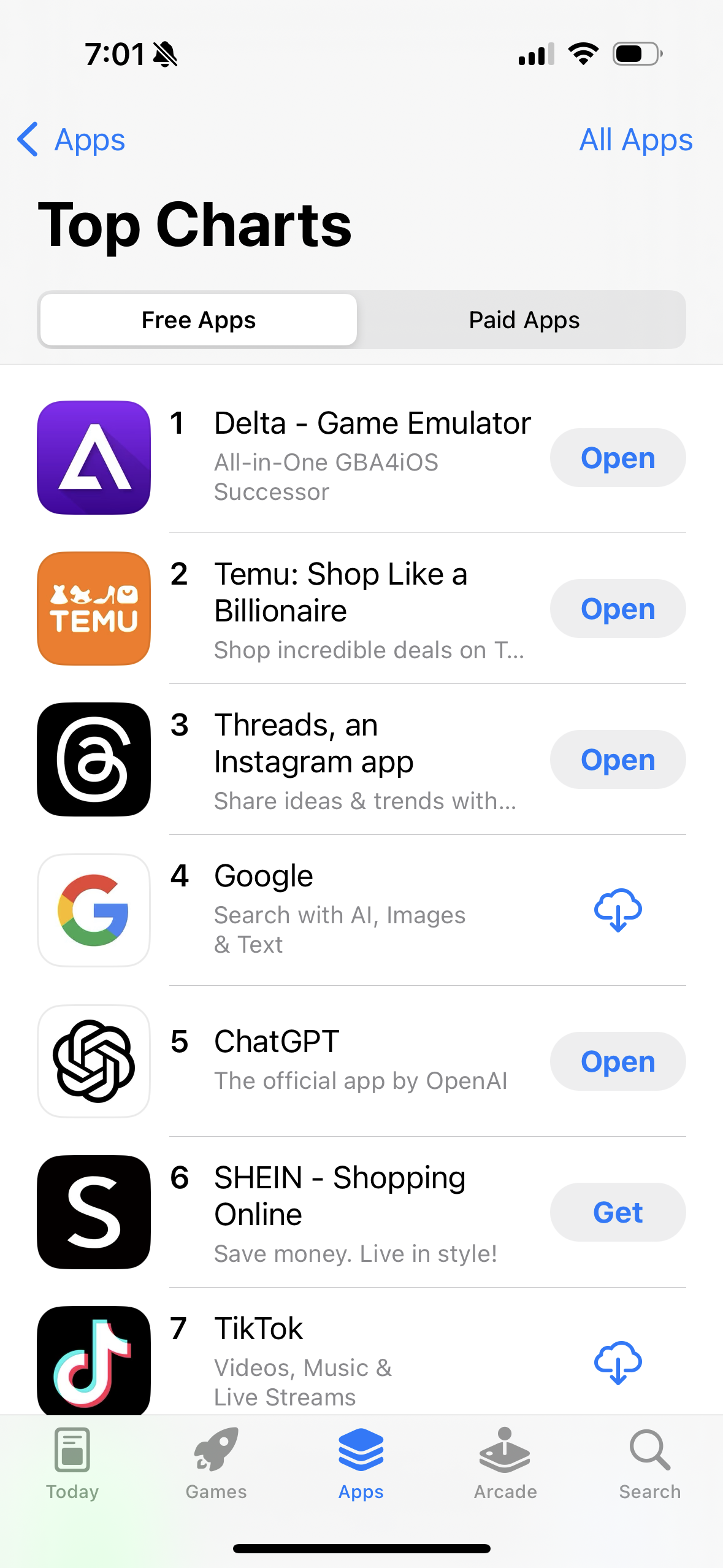
Update: 24 hours later and Delta is the #1 app in the App Store. You love to see it. David Smith:
While the App Store is far from perfect, seeing Delta sustain its position at the top of the App Store is a lovely reminder of its best feature.
That an indie developer can dedicate years honing their craft and then create something so compelling that it beats out apps from trillion-dollar companies, enriching the lives of millions of people along the way.
That’s beautiful. That’s inspiring. And just plain awesome.
- AltStore PAL Launches in the EU ★
-
Riley Testut:
I’m thrilled to announce a brand new version of AltStore — AltStore PAL — is launching TODAY as an Apple-approved alternative app marketplace in the EU. AltStore PAL is an open-source app store made specifically for independent developers, designed to address the problems I and so many others have had with the App Store over the years. Basically, if you’ve ever experienced issues with App Review, this is for you!
We’re launching with 2 apps initially: my all-in-one Nintendo emulator Delta — a.k.a. the reason I built AltStore in the first place — and my clipboard manager Clip, a real clipboard manager that can actually run in the background. Delta will be FREE (with no ads!), whereas Clip will require a small donation of €1 or more. Once we’re sure everything is running smoothly we’ll then open the doors to third-party apps — so if you’d like to distribute your app with AltStore, please get in touch.
Exciting times for iOS users in the EU. Both of these things can be true:
- The DMA is a bad law that, I believe, will result in more harm than good for most users.
- For iOS power users and enthusiasts, alternative app marketplaces are going to be fun and useful. Right now there’s no better place to be an iPhone user than the EU.
(Also: How fun is the name AltStore PAL?)
- Donald Trump Writes and Narrates Documentary Short Film on the Battle of Gettysburg ★
-
Amazing he found time for this amidst his campaigning and legal travails. But like many former presidents, he has a serious interest in history.