By John Gruber
WorkOS: How SSO works and the fastest way to add it.
Linked List: April 19, 2024
Friday, 19 April 2024
- Might Meta Go Pay-Only in the EU? ★
-
Eric Seufert, writing at Mobile Dev Memo, spitballing how Meta might respond if the EU accepts the recommendation from the EDPB that their “Pay or OK” model is illegal:
Charge a nominal fee for the ad-supported versions of Facebook and Instagram
Meta could introduce a small fee to use the ad-supported versions of Facebook and Instagram, rendering them as completely paid products in the EU. By eliminating its free tier, Meta should theoretically sidestep the conditions proposed in the EDPB’s opinion, since the elimination of a free tier supported by personalized advertising renders the Pay or Okay restrictions irrelevant.
As frequent MDM Podcast guest Mikołaj Barczentewicz points out in this blog post, both Netflix and Disney+ target ads behaviorally in their paid, ad-supported tiers. Meta could point to these products as examples of this pricing model being invoked: all options are paid, but the cheapest option is subsidized by behaviorally-supported ads. Of course, the EDPB has given itself latitude with its definition of “large online platform” to only litigate specific instances of commercial strategy.
I didn’t think of this when I spitballed my own ideas for how Meta might respond. Maybe they offer two tiers: €1/month with targeted ads, or €6/month without ads. Maybe they even make the fee for the ad tier truly nominal, say €1/year? The problem with this might be that too few people are willing to pay anything at all for social networking. Because it’s always been free-of-charge, people (not unreasonably!) now think it ought to forever remain free-of-charge.
Regarding the “just exit the EU” option, Seufert writes:
I don’t believe that Meta will respond by exiting the EU market altogether — at least not in the near term. Per above: the EU is 10% of (what I understand to be) Facebook’s global advertising revenue, and GDPR fines aren’t as significant as those incurred under the DMA. The maximum fine under the GDPR is 4% of annual worldwide turnover, whereas the maximum fine under the DMA is 20% of annual worldwide turnover. While I do believe the EU regulatory regime’s intransigence will influence a scaled, US-domiciled tech company to exit the EU market in the medium term, my sense is that Meta won’t take that course of action in immediate response to this decision.
That 10 percent figure is big but not indispensable. And it’s not much bigger than Apple’s 7 percent figure for App Store revenue from the EU. The EU is indeed a big and important market, but it’s nowhere near as big or important as the European Commissioners think.
- Twitter Alternative Post News Is Shutting Down ★
-
Noam Bardin:
It is with a heavy heart that I share this sad news with you. Despite how much we’ve accomplished together, we will be shutting down Post News within the next few weeks.
We have done many great things together. We built a toxicity-free community, a platform where Publishers engage, and an app that validated many theories around Micropayments and consumers’ willingness to purchase individual articles. We even managed to cultivate a phenomenal tipping ecosystem for creators and commenters.
But, at the end of the day, our service is not growing fast enough to become a real business or a significant platform. A consumer business, at its core, needs to show rapid consumer adoption and we have not managed to find the right product combination to make it happen.
Post News was a longshot from the start, going up against (a) the entrenched leader in the space, Twitter/X; (b) the open alternative of Mastodon; (c) Meta-backed and Instagram-derived Threads; and (d) the Jack-Dorsey-funded Bluesky. I’m not sure there’s room for all four of those, let alone a fifth.
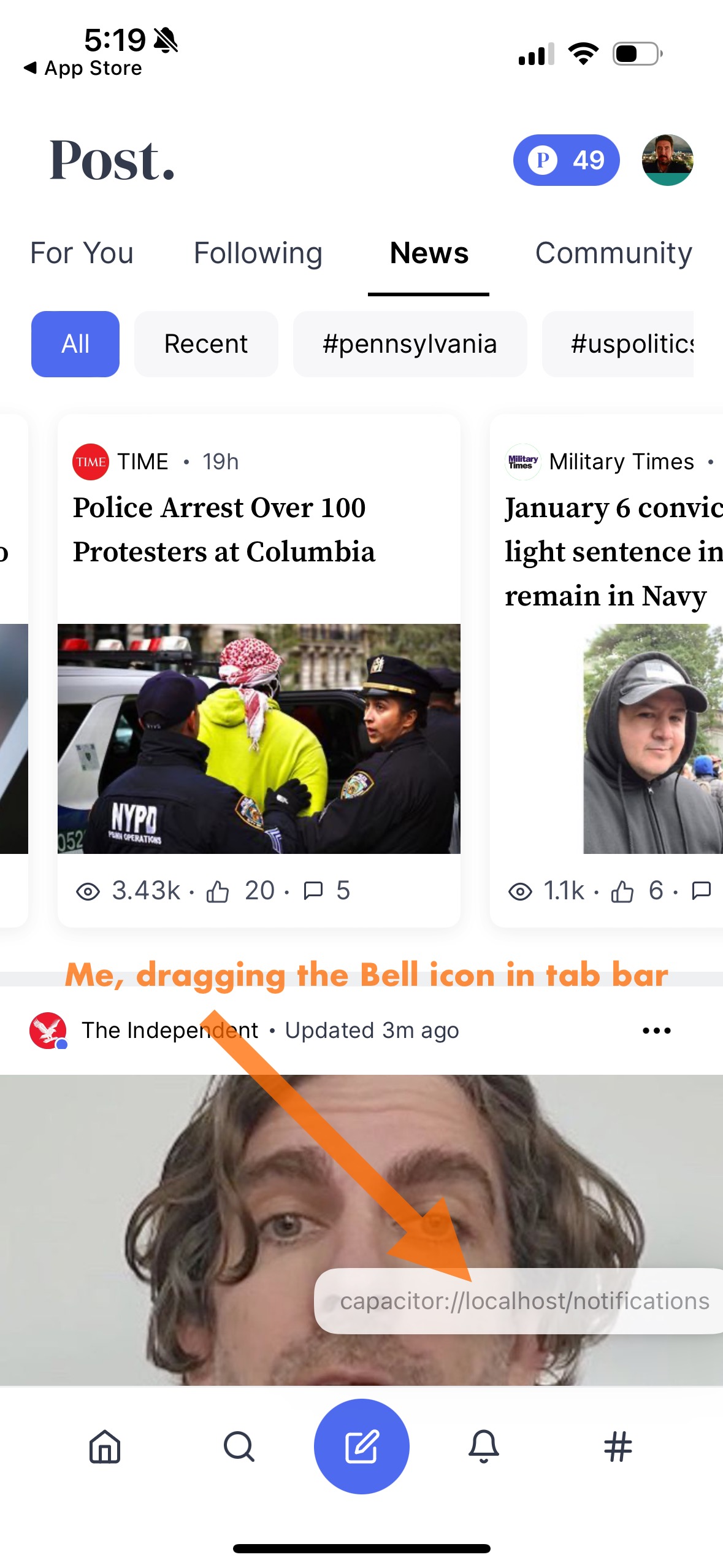
But I think Post shot itself in the foot right out of the gate going web-only. They eventually got around to putting an “app” in the App Store but it’s just a thin wrapper around their website — so thin that you can drag-and-drop the tab controller buttons and see exactly which PWA framework they used from the custom URLs shown in the drag proxy. People don’t want to use PWAs; they want real apps. Native iOS apps are so important to social networking that Threads launched app-only for its first two months before launching its web version.
- China Orders Apple to Remove WhatsApp, Threads, Signal, and Telegram From Chinese App Store ★
-
Aaron Tilley, Liza Lin, and Jeff Horwitz, reporting for The Wall Street Journal (News+):
Meta Platforms’ WhatsApp and Threads as well as messaging platforms Signal and Telegram were taken off the Chinese App Store Friday. Apple said it was told to remove certain apps because of national security concerns, without specifying which.
“We are obligated to follow the laws in the countries where we operate, even when we disagree,” an Apple spokesperson said.
These messaging apps, which allow users to exchange messages and share files individually and in large groups, combined have around three billion users globally. They can only be accessed in China through virtual private networks that take users outside China’s Great Firewall, but are still commonly used.
I’m surprised any of these apps had been available in China until now. Two questions:
Are these apps still on the iPhones of Chinese people who already had them installed? I don’t recall Apple ever using the kill switch that revokes the developer signing for already-installed copies of apps pulled from the App Store. E.g., iGBA, the rip-off Nintendo emulator that briefly rocketed to the top of the charts last weekend — pulled from the App Store early this week, but if you installed it while it was available, you can still use it.
Do Android phones in China offer sideloading?
Update: The answer re: sideloading is yes, and both Signal and WhatsApp offer direct downloads of their latest Android builds.
- The Best Simple USB-C Microphone: Audio-Technica’s ATR2100×-USB ★
-
Joe Fabisevich asked a common question on Threads:
What’s the go to simple USB-C podcast mic that sounds good, but doesn’t have to be top of the line or super expensive? Think more “I need to sound professional on a podcast or two”, not “I make my money by recording podcasts.”
My answer: Audio-Technica’s ATR2100×-USB. It costs just $50 at Amazon. (That’s an affiliate link that will make me rich if you buy through it.) Spend an extra $4 and get a foam windscreen cap. I mean just look at it — it literally looks like the microphone emoji: 🎤. You can just plug it into a USB-C port and it sounds great. No need for an XLR interface, but it does support XLR if you ever have the need.
My main podcasting microphone remains the $260 Shure BETA 87A Supercardioid Condenser, which I connect to a $180 SSL 2 audio interface. But that stays in my podcast cave in the basement. I keep the ATR2100× in my carry-on suitcase, so it’s with me whenever I’m away from home. My Dithering co-host Ben Thompson uses the same ATR2100× when he’s away from home, too. It’s a great simple mic and a fantastic value at just $50.