
By John Gruber
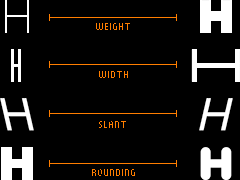
Zed — A font superfamily with extraordinary number of styles and extraordinary language support.
Linked List: June 17, 2024
Monday, 17 June 2024
- Ming-Chi Kuo Says This Year’s Series 10 Apple Watches Will Increase in Size ★
-
Ming-Chi Kuo:
The Series 10 will feature form factor upgrades, including larger screen sizes (increasing from 45mm/41mm to about 49mm/45mm) and a thinner design.
Unlike other devices Apple sells, Apple Watch sizes are given not by screen diagonal but by case height. So what Kuo is claiming is that the current “big” size will become the small size and the new big size will be much bigger. I find this very hard to believe. Since its inception Apple Watch has stood out among smartwatches for making models that are appropriate for people with small wrists.
Anecdotally, almost all women I see wearing an Apple Watch are wearing a small one, and I see a fair number of men who’ve chosen the smaller size as well. As I wrote when reviewing the first Apple Watch Ultra, many people are self conscious about wearing a watch that’s “too big” for their wrist. That concern is often misguided — most people look just fine wearing a bigger watch — but it doesn’t change the fact that people are very reluctant to buy a watch that they fear looks too big on them.
Worth noting that three years ago Kuo, along with Mark Gurman, was completely wrong about the design of the Series 7 watches, with both of them claiming it would have flat sides like the iPhone 12. But it’s also worth noting that back in August, Gurman reported that year’s watches would introduce a new band system that breaks compatibility with existing bands, which, notably, have remained unchanged since Series 0 in 2015. (In fact I’m wearing my space black link bracelet from my own Series 0 on my Series 7 today.)
- Apple Discontinuing Apple Pay Later, Just 8 Months After Rolling Out in the U.S. ★
-
Apple, in a statement to 9to5Mac:
Starting later this year, users across the globe will be able to access installment loans offered through credit and debit cards, as well as lenders, when checking out with Apple Pay. With the introduction of this new global installment loan offering, we will no longer offer Apple Pay Later in the U.S. Our focus continues to be on providing our users with access to easy, secure and private payment options with Apple Pay, and this solution will enable us to bring flexible payments to more users, in more places across the globe, in collaboration with Apple Pay enabled banks and lenders.
This always seemed like a weird offering from Apple. Apple Pay Later did not charge interest, which is great, but it still seemed contrary to the spirit of helping people develop good financial habits. A no-interest loan doesn’t change the fact that in general, you should only buy things you can afford to pay for in full now.
- Financial Times Reports EC to Charge Apple With Non-Compliance Under DMA for CTF ★
-
Javier Espinoza reporting from Brussels, and Michael Acton from San Francisco, for the Financial Times (archive link in case your FT subscription isn’t working):
The European Commission has determined that the iPhone maker is not complying with obligations to allow app developers to “steer” users to offers outside its App Store without imposing fees on them, according to three people with close knowledge of its investigation. The charges would be the first brought against a tech company under the Digital Markets Act, landmark legislation designed to force powerful “online gatekeepers” to open up their businesses to competition in the EU.
The commission, the EU’s executive arm, said in March it was investigating Apple, as well as Alphabet and Meta, under powers granted by the DMA. An announcement over the charges against Apple was expected in the coming weeks, said two people with knowledge of the case. [...]
If found to be breaking the DMA, Apple faces daily penalties for non-compliance of up to 5 per cent of its average daily worldwide turnover, which is currently just over $1bn.
The EC leaks everything to the Financial Times. Reuters points out that EU antitrust chief Margrethe Vestager leaves office in November. Makes me wonder if there’s a clock-running-out aspect to this. Does the incoming regime share her politics regarding US tech companies?
Forget about trying to figure out what the EC wants from reading the DMA. It doesn’t say. I suspect they want Apple to completely forgo monetization of its IP on iOS — to allow the distribution of iOS apps without any charge or fee whatsoever other than the $99 annual developer program fee. I’m not sure, at all, how Apple is going to respond, but I do not think the EC is going to get that. I also don’t think they’re ever going to collect any significant fines from Apple.
My basic theory is that what the EC has wanted all along is to force Apple not merely to open up iOS to other methods of distribution, but to force Apple to allow apps to be distributed through those non-App-Store channels free of charge. But they don’t want to come out and say, flatly, that they seek to forbid Apple from monetizing its IP from all developers on the platform, because that’s so radically anti-capitalist. So instead they wrote the DMA to forbid the way Apple had, heretofore, mandated its cut of App Store revenue, and I suspect they somehow thought that if they banned the current rules — all apps must go through the App Store, all apps must use Apple’s App Store payment processing — then Apple would be forced to allow free-of-charge distribution through other channels and other payment processing. They didn’t foresee the Core Technology Fee as a route to collect a cut from any and all popular applications distributed by large commercial developers. So they’re just going to say that’s not allowed either, even though it seemingly doesn’t violate anything in the DMA. I don’t know where this winds up because I don’t see Apple conceding this point.