By John Gruber
All your customer
data in that nice
California sunnn.
Early access now!
Linked List: January 15, 2025
Wednesday, 15 January 2025
- ‘Twenty Years of Kraft’ ★
-
Bryan Bedell, on the Field Notes Dispatches blog:
The anniversary date of “Field Notes” varies a bit, depending on who you ask. Aaron Draplin first used the name (typeset, of course, in all-caps Futura Bold) on a customized one-off red hardcover notebook in 2002. Our “official line” sets the birth of the company in mid-2007, when Coudal Partners and Aaron first printed a batch of 3-Packs for the “Swap Meat,” followed shortly by the establishment of “Field Notes Brand” as an actual thing.
But a good case can be made that the very first Field Notes were made in “early January 2005,” making this, January 2025, an important 20th anniversary. This was the first “big” run (200 books, big for the time!), hand-printed by Aaron on his desktop Gocco silkscreen rig.* This was the first use of a kraft-paper cover. The general look-and-feel, while a bit narrower, is mostly dialed-in. The body is graph paper, even if it’s trimmed-down letter-size dungeon-mapping blue-ruled graph paper.
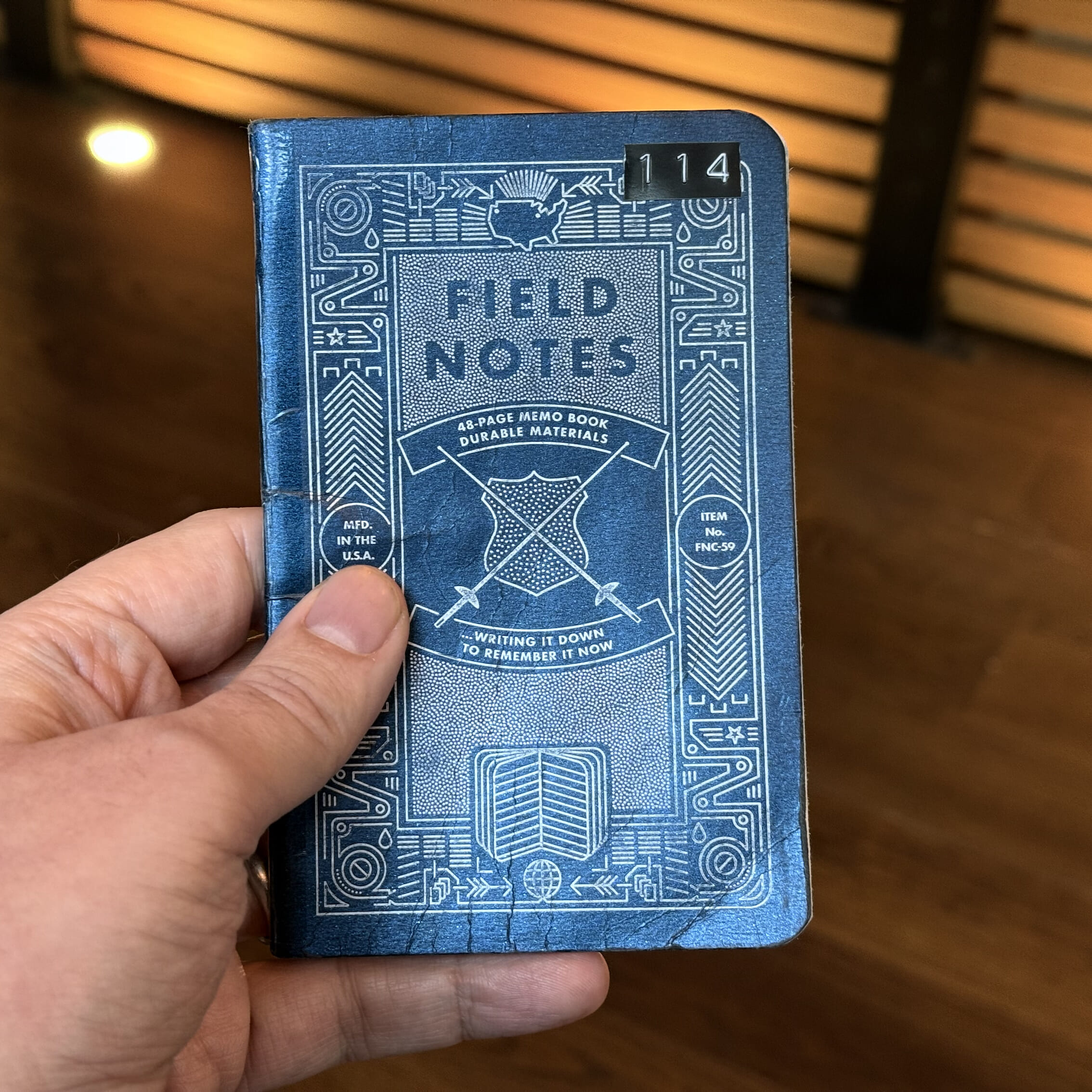
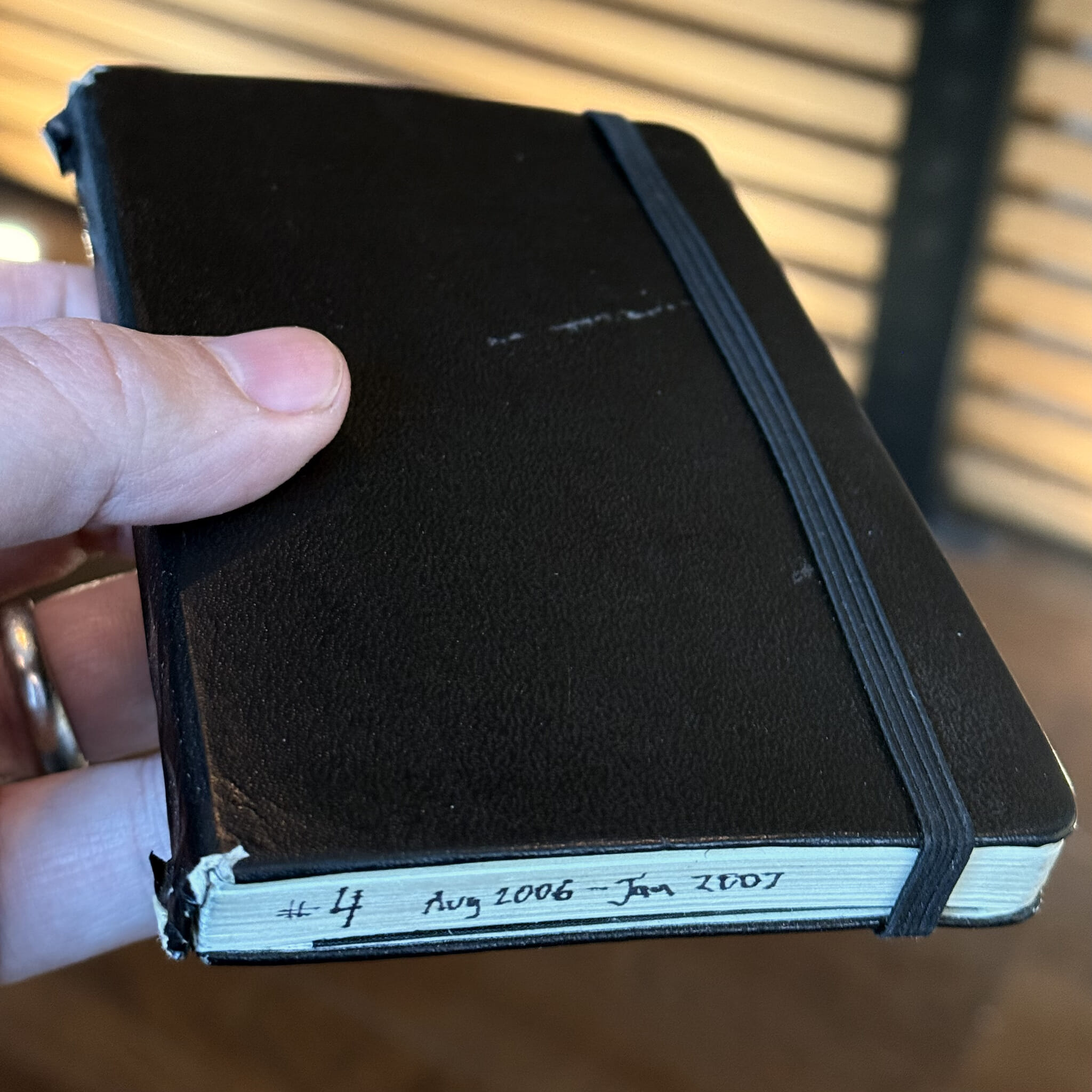
I carry a Field Notes (or at least Field-Notes-sized — I dally with others, but always come home) notebook in my back pocket wherever I go. And because I’m a pack rat, I number, date, and keep them all. I just filled up volume 114 (9 Dec 2024 – 13 Jan 2025) and started volume 115 yesterday.
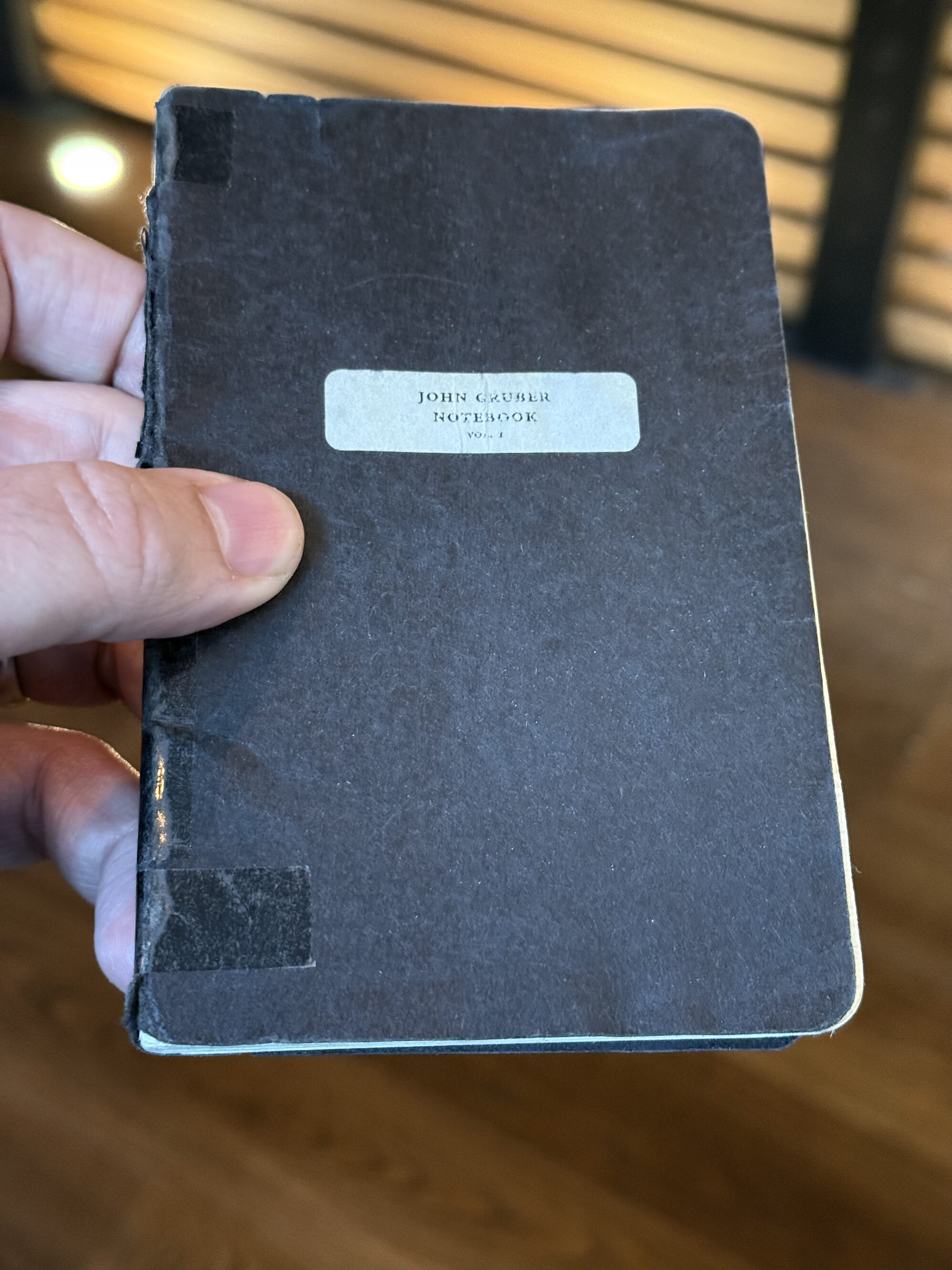
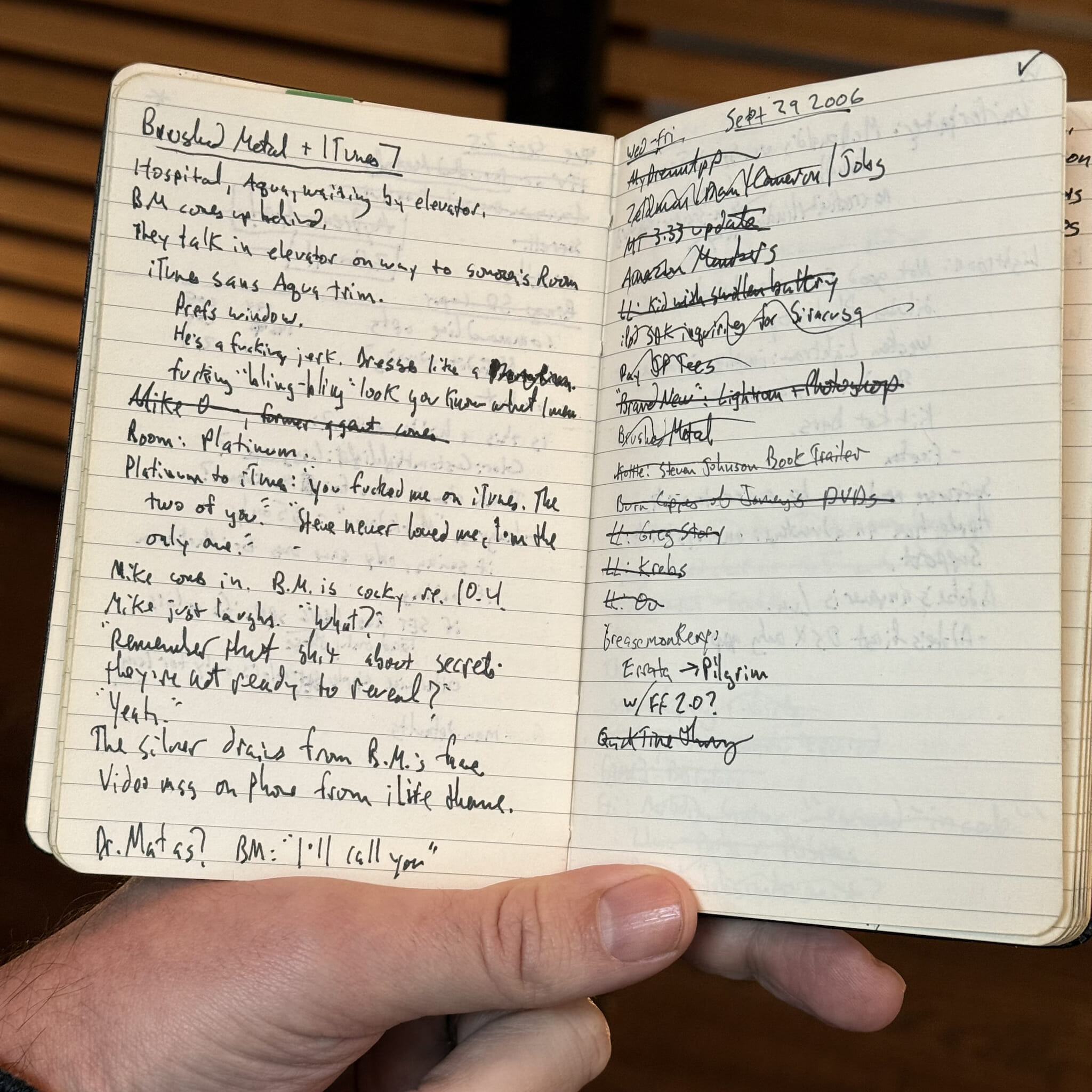
Funny enough, I started my pocket notebook habit in 2006, a year before Field Notes became a thing. And I was greatly dissatisfied with the various notebooks I’d tried prior to Field Notes. Hardcover Moleskines were too thick and uncomfortable to sit on, and their softcover notebooks started falling apart at the seams after just a few weeks. And then in 2007 my friend Jim Coudal offhandedly mentioned that he was starting a project with Aaron Draplin called Field Notes, and son of a bitch if the notebooks they were making weren’t exactly what I craved. The rest is history — a lot of ink, a lot of pages. Mostly nonsense, but some occasional gems and fond memories. The first page of my first notebook has a list of strollers to consider for my then-toddler son; he’s now a junior in college. And flipping through volume 4 just now, I came upon this one-page outline from September 2006 for a never-published episode in the Anthropomorphized Brushed Metal Interface Theme saga, wherein Brushed Metal, Aqua, and the just-released iTunes 7 visit a bitter classic Mac OS 9 Platinum theme on his deathbed in the hospital. (Platinum: “You fucked me on iTunes. The two of you.” And: “Steve never loved me, I’m the only one.”)
When in doubt, write it down.
- Bloomberg: Tim Cook Plans to Attend Trump’s Inauguration ★
-
Marko Parker, reporting for Bloomberg:
Apple Inc. CEO Tim Cook is planning to attend the inauguration of President-elect Donald Trump next week, the latest in a wave of Silicon Valley leaders traveling to Washington for the ceremony.
Amazon.com Inc. founder Jeff Bezos, Meta Platforms Inc.’s Mark Zuckerberg, and Elon Musk, the billionaire CEO of Tesla Inc. who has quickly become one of Trump’s foremost supporters and financial backers, are all also expected to attend.
Rings don’t kiss themselves. But if there’s any consolation in this, it’s that surely none of these guys want to attend this. It’s going to be boring as shit and cold as hell. Imagine Cook stuck sitting between, say, Zuckerberg and Musk all day.
- Apple Pulled a Fun In-Character Promo Stunt for ‘Severance’ Yesterday at Grand Central Terminal ★
-
Juli Clover, MacRumors:
Ahead of the season two premiere of hit TV show Severance, Apple is marketing the show with a fun Severance pop-up at the Grand Central Terminal in New York City.
Apple has assembled a glass cube with workstations that are identical to the setups that Lumon employees use on the show, complete with employees “working,” doing yoga, playing catch, throwing paper airplanes, sipping coffee, and performing other activities that we’ve seen on Severance.
At 4:30 p.m. Eastern Time, Severance director Ben Stiller made an appearance at the site, with some of the show’s actors visiting as well. Adam Scott, Zach Cherry, Patricia Arquette, Britt Lower, and Tramell Tillman were on hand and spent time in the makeshift office space, with the actors in character as their “innies.”
Super fun idea. Season 2 debuts Friday.
My wife and I watched season 1 when it debuted three years ago, and we both really liked it. I’m more of a sci-fi fan than she is. I often enjoy shows where the clever premise itself is the main appeal; she doesn’t. But while Severance definitely has a clever fundamental premise, it’s really not the main appeal of the show. It’s fundamentally an ensemble character-driven mystery. Such a great cast, all of them playing intriguing, interesting characters. And the direction — especially the five episodes directed by Ben Stiller — is phenomenal. Terrific cinema.
Anyway, when season 1 completed in 2022, my wife and I instantly agreed we’d re-watch before season 2. We started that re-watch just after New Year’s, and holy hell was I reminded how much I don’t just like but love this show. If they sustain the same quality for multiple seasons, Severance will wind up in my count-on-one-hand list of favorite shows ever made. It’s that good.
One true test of a great series is that it’s better on the second watch through. That was true in spades for Severance season 1 — knowing some of the answers from the first watch made it all the more enriching. The first time through, you’re in the dark as much as the protagonists are. The second time through, you know things they don’t know, and that knowledge serves as a jolt of sustained suspense. It’s brilliant storytelling.
My second test of a great series is whether, when I consider who is my favorite character, I not only have a hard time answering, but I have a hard time even eliminating characters from consideration. Multiple great lead characters, and multiple supporting characters who are so interesting I find myself wishing they had bigger roles.
(The only three series I’ve watched in their entirety more than twice: The Larry Sanders Show, The Sopranos, and Mad Men. All three of those shows pass both my tests with flying colors.)
- ‘TikTok Is Just the Beginning’ ★
-
Noah Smith, writing at Noahpinion:
As many observers have noted, this tells us two important things. First, it tells us that Chinese officials are the ones calling the shots with regards to TikTok. This should be no surprise, given that ByteDance is legally required to obey CCP directives.
Second, the refusal to sell the app tells us that the Chinese government would rather see TikTok destroyed than see it fall into American hands. Notably, that same government put up little fuss back in 2020 when the U.S. forced a Chinese company to sell the gay dating app Grindr to an American company. Why shut down TikTok and leave untold billions of dollars on the table, instead of just selling the thing like Grindr was sold?
One possibility is that it’s an attempt to make young Americans angry, in the hopes that they’ll demand that Trump and Congress repeal the 2024 law. But a simpler explanation is that Chinese leaders simply think that TikTok, unlike other apps, is so important that they would rather destroy it than see it escape their control.
TikTok is an ingenious propaganda platform. A mass audience — which skews very young — finds it addictively entertaining. But research studies show that the platform squelches topics that aren’t aligned with the CCP. Smith cites two; here’s the abstract of the second one, which was published just last month:
Three studies explored how TikTok, a China-owned social media platform, may be manipulated to conceal content critical of China while amplifying narratives that align with Chinese Communist Party objectives. Study I employed a user journey methodology, wherein newly created accounts on TikTok, Instagram, and YouTube were used to assess the nature and prevalence of content related to sensitive Chinese Communist Party (CCP) issues, specifically Tibet, Tiananmen Square, Uyghur rights, and Xinjiang. The results revealed that content critical of China was made far less available than it was on Instagram and YouTube.
Study II, an extension of Study I, investigated whether the prevalence of content that is pro- and anti-CCP on TikTok, Instagram, and YouTube aligned with user engagement metrics (likes and comments), which social media platforms typically use to amplify content. The results revealed a disproportionately high ratio of pro-CCP to anti-CCP content on TikTok, despite users engaging significantly more with anti-CCP content, suggesting propagandistic manipulation.
Study III involved a survey administered to 1214 Americans that assessed their time spent on social media platforms and their perceptions of China. Results indicated that TikTok users, particularly heavy users, exhibited significantly more positive attitudes towards China’s human rights record and expressed greater favorability towards China as a travel destination.
Back to Smith:
In other words, the Chinese government is actively silencing the views of Americans who try to criticize that government. Somehow I doubt that the First Amendment’s protection of free speech was intended to protect the right of foreign governments to silence American individuals from speaking their mind in popular public forums. That would be a very strange definition of “freedom of speech”. Of course, I am no legal scholar, so I’ll have to wait on the Supreme Court to make that judgement, and abide by what they decide.