
By John Gruber

All your customer
data in that nice
California sunnn.
Early access now!
- Ben Thompson on Tim Cook’s Legacy
-
Ben Thompson at Stratechery, “Tim Cook’s Impeccable Timing”:
Cook was, without question, an operational genius. Moreover, this was clearly the case even before he scaled the iPhone to unimaginable scale. When Cook joined Apple in 1998 the company’s operations — centered on Apple’s own factories and warehouses — were a massive drag on the company; Cook methodically shut them down and shifted Apple’s manufacturing base to China, creating a just-in-time supply chain that year-after-year coordinated a worldwide network of suppliers to deliver Apple’s ever-expanding product line to customers’ doorsteps and a fleet of beautiful and brand-expanding stores. There was not, under Cook’s leadership, a single significant product issue or recall.
That last sentence is something that Cook won’t get enough credit for. A major product defect or recall is just inherently more memorable than the lack of major defects or recalls. Compare and contrast to Samsung: 2016’s Note 7 was recalled for battery combustion; six other Samsung models caught fire in 2016 too; the early Galaxy Fold phones were an outright debacle. Nothing like that ever happened under Cook.
Cook also oversaw the introduction of major new products, most notably AirPods and Apple Watch; the “Wearables, Home, and Accessories” category delivered $35.4 billion in revenue last year, which would rank 128 on the Fortune 500. Still, both products are derivative of the iPhone; Cook’s signature 0 to 1 product, the Apple Vision Pro, is more of a 0.5.
I don’t think it’s worth discounting AirPods or Apple Watch as “derivative” of the iPhone. Yes, Apple Watch requires a paired iPhone, and while AirPods connect with Macs, iPads, and Apple TVs, they are of course primarily used paired with iPhones. But you can just as easily say that the iPhone was derivative of the iPod. And the iPod was derivative of iTunes. And iTunes was derivative of the Mac. And the iPhone was derivative of the Mac too, insofar as iOS and UIKit truly are stripped-down versions of MacOS and AppKit. Better, in my opinion, to simply give Tim Cook credit for overseeing the creation of two massively popular and successful new device platforms.
For Apple’s 2011 fiscal year, which covers the company’s last year under Steve Jobs, the company had $108 billion in total revenue. Inflation-adjusted that’s ~$159 billion in 2026 dollars. 2011 Mac revenue was $22 billion ($32 billion inflation-adjusted) and iPad revenue was $20 billion ($29 billion inflation-adjusted). iPhone revenue was $47 billion ($69 billion inflation-adjusted). So compared to where revenue was when Cook took the helm, the mostly-all-new-under-Cook Wearables category today is bigger than the Mac or iPad were under Jobs, and a very credible half the size of the iPhone.
Cook’s more momentous contribution to Apple’s top line was the elevation of Services. [...]
Last year Apple Services generated 26% of Apple’s revenue and 41% of the company’s profit; more importantly, Services continues to grow year-over-year, even as iPhone growth has slowed from the go-go years.
There was a legitimate widespread concern in the early years of the Cook era that the downside of the iPhone’s unprecedented success was that Apple’s financials were dangerously reliant on that single product. Even today the iPhone generates between 50–60 percent of Apple’s revenue each quarter, but it is quite obviously the growth of Services and Wearables that makes Apple’s overall revenue by product line look as balanced as it does. From Jason Snell’s report on Apple’s most recent quarter (the best in Apple’s entire history):
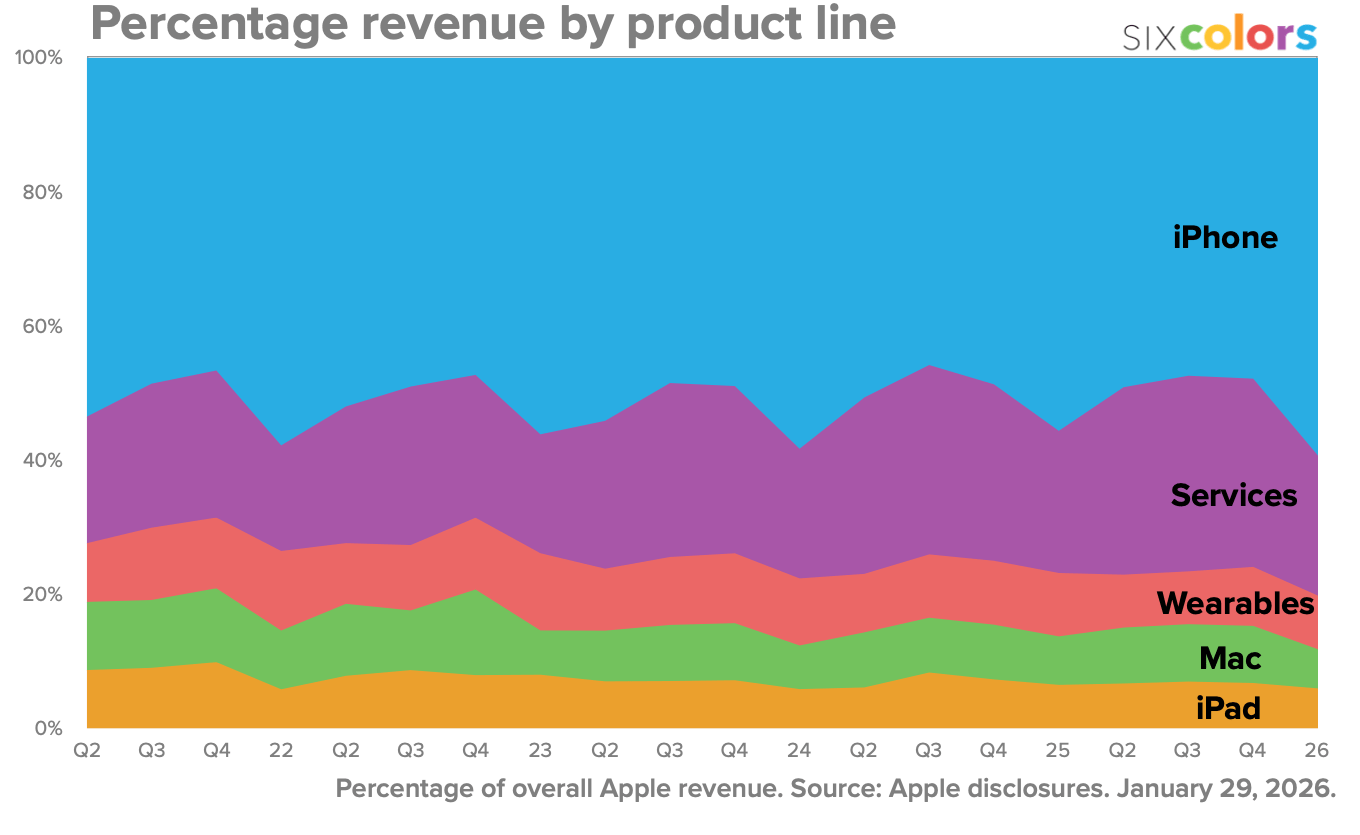
There’s a totally reasonable concern that the growth of Services will pervert Apple’s priorities away from hardware products. I think that’s why naming John Ternus, the head of hardware, as the new CEO is an important statement in and of itself regarding where Tim Cook sees Apple’s North Star: hardware products.
I believe that Cook’s focus on Services over the last decade was in no way about shifting the focus of the company away from its roots. Nor was it about growth for the sake of growth. I think it was about bringing balance to the balance sheet, to protect the company’s core mission of creating devices.
★ Wednesday, 22 April 2026