By John Gruber

WorkOS: How SSO works and the fastest way to add it.
Linked List: June 17, 2026
Wednesday, 17 June 2026
- Snap Unveils Specs, Its $2,200 AR Glasses, and They’re Fugly ★
-
Jay Peters, The Verge (gift link):
Snap is finally launching augmented glasses for the public. Specs, which Snap describes as “a wearable computer built into see-through augmented reality glasses,” will cost $2,195. You can preorder a pair of Specs now at specs.com with a $200 refundable deposit, and Snap says they’re expected to ship “this fall” in the US, UK, and France. [...]
The company says that Specs are “fully standalone, with no puck and no tether.” (Which is perhaps a jab at Apple’s Vision Pro, which is tethered to a separate battery pack.) They’ll be offered in two sizes, a 47mm model weighing 132g and a 52mm model weighing 136g, and will have removable inserts that Snap says will support “a wide range of prescriptions.”
Unlike Vision Pro, Snap is presenting Specs as eyeglasses that users will wear out and about in their daily lives. Viewed perfectly straight-on and photographed by a professional fashion photographer — as presented on the Specs website — they’re a bold look. Viewed from any other angle and captured normally, they look like goggles, not glasses. The frames look orthopedic and the lenses are not even close to clear. They make you look like you forgot to take off your goggles leaving the theater after a 3D movie — goggles that are big enough to wear over regular glasses.
Maybe Specs are useful enough to justify looking so orthopedic, but I doubt it.
- Vehicle Motion Cues – a.k.a. Apple’s Weird Anti-Nausea Dots ★
-
Thomas Ricker, writing for The Verge:
I’ll just work from the car, I thought. But after a few minutes of staring at my screen on quick mountain switchbacks I could feel the first signs of cold, coagulated nausea bubbling up from that sweaty place in my gut. I looked to the horizon for relief, but nothing helped... until I remembered Apple’s magic dots.
Introduced in 2024, Apple’s Vehicle Motion Cues promise to tap into your device’s accelerometer and gyroscope to reduce or, in my case, even eliminate the motion sickness felt when trying to use an iPhone, iPad, or MacBook inside a moving vehicle.
My son has suffered from motion sickness in cars his whole life, and Apple’s Vehicle Motion Cues work like a charm for him too. What a great feature.
- Yours Truly on MacBreak Weekly: Is the New Siri AI Good? ★
-
MacBreak Weekly:
John Gruber of Daring Fireball joins the MacBreak Weekly panel this week! A deep dive into Apple’s new Siri following WWDC. Why Apple Intelligence & the new Siri are not coming to the EU initially later this year. And could the iPhone Ultra’s launch be delayed this year?
It’s fun to be the guest, not the host, of a podcast. I took Jason Snell’s usual panelist spot this week, alongside Leo Laporte, Andy Ihnatko, and Christina Warren. Lots to cover, including a week of real-life experience using the new Siri AI. (It’s really good!)
Also, sometimes you just know what the episode title of a podcast is going to be, the moment a phrase is uttered. This was one of those episodes, with “Intimate Functionalities”.
- Yours Truly on The Vergecast: ‘# the **Epic** Story of Markdown’ ★
-
David Pierce, host of The Vergecast:
So where did Markdown come from? It came from John Gruber. John joins the show, along with Anil Dash, to tell the story of where Markdown came from and how it took over the world.
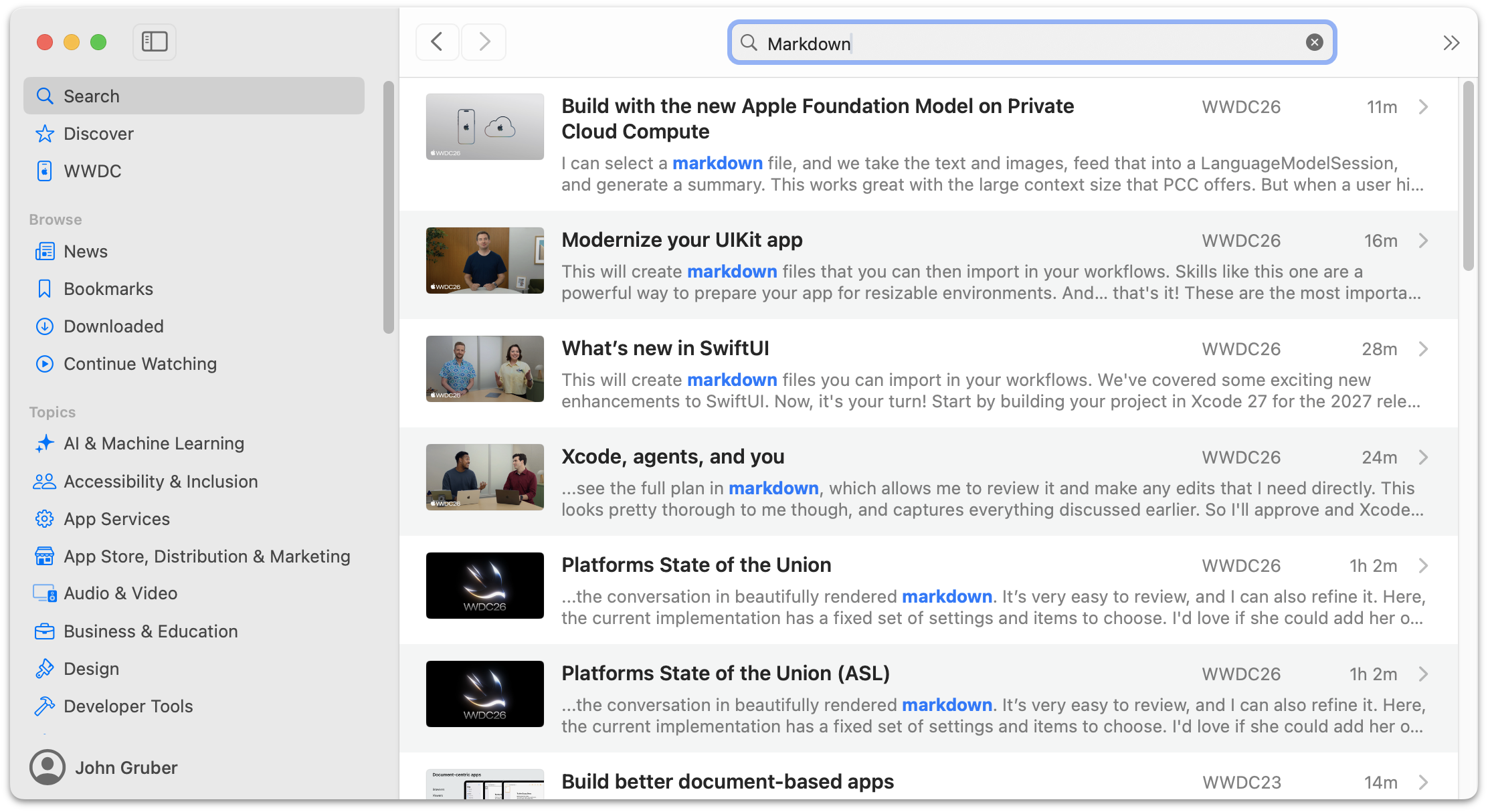
Markdown has been growing steadily for years, but it’s seen a step change in popularity now that it’s been embraced as the lingua franca of LLM agentic systems. I had an interesting all-too-brief chat last week in Cupertino with some people from Apple’s developer tools team about how it feels to see Markdown spread everywhere — including WWDC. In a word, gratifying.
But the biggest reason for Markdown’s continuing success isn’t Markdown itself. It’s the triumph of plain text files, both for system configuration and for the interchange of human-readable (and thus, LLM-readable) prose. Markdown isn’t really a “syntax”. It’s a set of conventions for formatting plain text. If everyone agrees to the same basic conventions, plain text can be significantly more expressive than a string of unformatted characters.
That’s it. So what I find gratifying isn’t that my “language” continues to thrive, because it’s not a language. It’s that the way I like to format plain text when I’m writing, and the way I like to see plain text formatted when I’m reading, has so thoroughly won the world’s mindshare battle. “Ha-ha”, I say, to people who want *this* to mean bold, not italic. (And to Slack and WhatsApp, I say “Fuck you.”)