By John Gruber

All your customer
data in that nice
California sunnn.
Early access now!
Linked List: August 18, 2026
Tuesday, 18 August 2026
- Disney’s ABC Sues Trump’s FCC Over Challenge to Its Broadcast License ★
-
Joe Flint, reporting for The Wall Street Journal (gift link):
Walt Disney’s ABC has sued the Federal Communications Commission alleging the agency’s efforts to challenge its broadcast licenses and regulate its talk show “The View” are illegal and an effort to quash speech the Trump administration finds objectionable.
In a suit filed in federal court in Washington, D.C., on Tuesday, ABC said, “Again and again, the Administration has attacked ABC’s speech — the stories its journalists report and the viewpoints its network programs air. Over time, those attacks have escalated into express demands that ABC be stripped of its broadcast licenses because of its speech.”
This is how you handle a bully: “Fuck you, make me.”
Our local 6ABC affiliate here in Philadelphia is the highest-profile station that the FCC has targeted for a bogus “license review”. It’s impossible for someone who doesn’t live here to understand just how dominant a media presence 6ABC Action News is. The Action News theme song is, effectively, the city of Philadelphia’s theme song. Watch this and you’ll get it, trust me.
- Apple Gives Legal Middle Finger to DOJ Challenge on Apple’s July Discovery Win ★
-
Marcus Mendes at 9to5Mac has a fun update on U.S. v. Apple, the ill-considered antitrust case started by the Biden administration. A bunch of what the DOJ argues are anticompetitive features in Apple’s platforms, Apple argues are in fact privacy and security related.
Back in July Apple won a big discovery ruling — Apple asked for documents from 14 federal agencies — including the CIA, FBI, Department of Defense, NSA, and State Department — to see the reasons why those agencies purchase iPhones, iPads, and Macintosh computers. And in July, Apple won. They get to see what these federal agencies say about those features.
The DOJ filed a longshot “Hey, no fair” complaint trying to overrule that discovery ruling. Now Apple has filed a retort saying the July order should stand, and the DOJ should get ready to argue in court that it’s unlawful for Apple to implement the sort of features that are the very reason why security-minded federal agencies purchase Apple devices.
- Organized Thieves Are Targeting AI Server Chips With Violent Highway Hijackings ★
-
Paresh Dave and Aarian Marshall, reporting for Wired (News+ link in case Wired hits you with their paywall):
The incidents involved two different shipments of high-value technology traveling from Silicon Valley to Southern California, according to Pachuca, who says he learned about the thefts from law enforcement authorities. Each truck was tailed by private security professionals driving unmarked escort vehicles, which were supposed to ensure the goods made it to their destinations safely. But hours into one journey, another driver rear-ended the escort in a hit-and-run, forcing it to stop. In the other case, the escort stopped after another car nudged it into a tailspin, a ploy commonly known as a PIT maneuver, and then fled.
Everyone familiar with the “accidents” believes the escorts were deliberately immobilized, according to Pachuca. Once the semitrucks lost their escorts, the drivers proceeded without halting — but not to their planned destinations. They were never heard from again, Pachua says, and millions of dollars in data center gear remains unaccounted for.
I called it back in March: RAM is the new bearer bond.
- ‘Dickover’ Makes It Into The Guardian ★
-
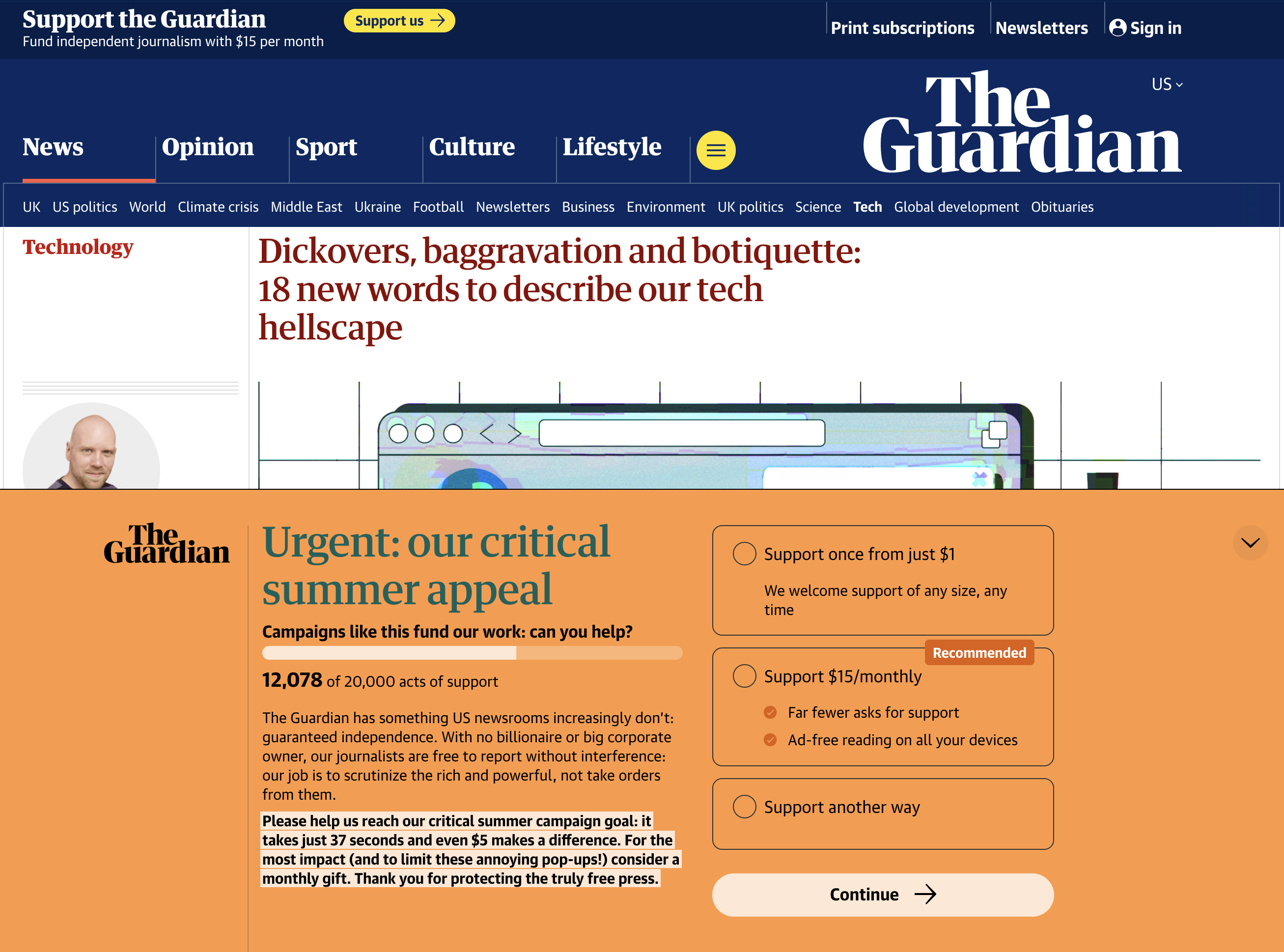
Stuart Heritage, writing for The Guardian, under the splendid headline “Dickovers, Baggravation and Botiquette: 18 New Words to Describe Our Tech Hellscape”:
The “dickover” is the scourge of the modern age. Coined in May by John Gruber, a tech writer, it is defined as “a modal panel, popover, or curtain presented by a website or app, deliberately obscuring its own content to frustrate the user”. Essentially, it is the thing (or more often, things) you have to click away in order to read the thing you wanted to read. It is the “accept cookies” box, the “allow notifications?” box, the “sign in with Google” box, the pop-up video box, etc.
We shouldn’t fool ourselves into thinking that dickovers are the only terrible thing about technology in 2026. Until now, though, we have lacked the vocabulary to describe them, so here are some suggestions.
This was a delight to see, but it would have been nicer if it had included a link. I remain quite fond of my self-exemplifying definition.
Amongst Heritage’s suggested coinages, I like baggravation (maddening self-checkout retail kiosks) and Schrödinger’s Wi-Fi (public Wi-Fi, especially on trains and planes, that simultaneously does and does not exist).
Next stop for dickover: the OED.
Update: Filed under “Shit You Can’t Make Up”, many of you, upon following the above link to The Guardian, are seeing something like this — and, unsurprisingly, it’s worse on a mobile device.
- OpenAI Pot Complains That Google Kettle Is Black ★
-
Thibault Sottiaux, the OpenAI genius in charge of Codex and the new ChatGPT Homer Simpson car, on Twitter/X:
I don’t come often to GMail [sic] (OpenAI is a Slack company), but I swear, every time I do open it, there is a new button somewhere around the top right corner.
I mean, he’s right about Google’s zero-taste just-keep-cramming-shit-in approach to Gmail, but it’s almost hard to believe he could post this without any self-awareness that it’s the exact same approach his Codex team has applied to ChatGPT.
Gmail debuted in 2004 homely but wonderfully simple (which I’d argue was Google’s original, but now long-lost UI brand). It was just your email. Now it’s too complex to explain. ChatGPT’s original incarnation was attractive-in-today’s-minimalist-fad-way and wonderfully simple. It was just AI chat. Now it’s too complex to explain.
(ChatGPT’s original incarnation still exists, in the form of the hard-to-find-if-you-don’t-already-have-it-installed
CokeChatGPT Classic, just like how Gmail, after Google started needlessly complicating it, used to have a “classic” view that many users preferred but Google soon took away.) - Nature Is Healing: MacOS 27 Golden Gate Beta 6 Adds Redesigned Traffic Light Window Controls ★
-
Zac Hall, 9to5Mac:
macOS 27 Golden Gate beta 6 introduces redesigned traffic light window controls. The new look resembles older Mac OS X systems with more detail in each button.
Nice. But these changes can’t improve fast enough for me — I am impatient. The MacOS user interface had been in a slow, steady, sad, no-fun decline for years, and then, a year ago, the bottom fell out with the disaster of 26 Tahoe.
But all the changes in 27 Golden Gate are in the right direction. Golden Gate is not a mixed bag. Designers with taste and talent are clearly back at the helm. And I love that they’re still pushing UI and icon changes in mid-August, entering the home stretch of the .0 beta cycle.