By John Gruber
WorkOS: Let agents use your tools without giving them free rein.
Linked List: November 9, 2026
Monday, 9 November 2026
- Bloomberg Was Onto Megaspeed’s Game a Year Ago ★
-
Mackenzie Hawkins, Andy Lin, and Kari Soo Lindberg, reporting for Bloomberg last year on December 22 (Archive.today link):
In an industry run by titans, a Singapore AI firm called Megaspeed International Pte. is drawing an unusual amount of attention. In less than three years, the once-obscure spinoff of a Chinese gaming enterprise has evolved into the single largest Southeast Asian buyer of Nvidia Corp. chips — a rapid ascent that’s lifted hopes for a regional champion in the lucrative business of AI cloud computing.
Now Megaspeed finds itself a focal point of Washington’s long-held fears about semiconductor smuggling into China, an issue of escalating concern among national security hawks despite Nvidia’s repeated assurances that chip diversion doesn’t exist. [...]
Nvidia, which conducts regular spot-checks of data centers around the world, told Bloomberg that it went to Megaspeed’s facilities multiple times to verify that there’s nothing untoward. “Our visits confirmed that the GPUs shipped to Megaspeed by our partners are where they are supposed to be,” an Nvidia spokesperson said in mid-November.
It turns out these inspections were rather intimately thorough, conducted firsthand by Nvidia’s CEO Jensen Huang. Nothing untoward indeed.
One of several questions I have: When did Jensen Huang break off the relationship with Alice Huang? I get the impression that the affair was still ongoing at least as recently as May, when the whole weird thing happened with Huang being invited to join Trump’s envoy to Beijing mid-flight. It’s possible the affair was still ongoing until this weekend.
But how can Jensen Huang defend continuing the affair even after Bloomberg was reporting the above last December?
- Short-Seller Culper Research Published Information on Jensen Huang’s Affair Back in May ★
-
Culper Research is a short-seller that published a report (PDF and in a thread on X) in May alleging that Nvidia “had a China problem”. From the start of its report:
Nvidia claims that its business in China went to “zero” after April 2025 U.S. trade restrictions. We believe that in reality, over 20% of Nvidia’s FY 2026 compute revenues remained driven by China — supported both by illegal GPU diversion and Southeast Asian intermediaries.
Nvidia has repeatedly vouched for Megaspeed — its single largest Southeast Asian chip buyer currently under investigation by both U.S. Commerce and Singapore authorities — as “wholly owned and operated by a company based and headquartered outside China, with no China shareholders.” Nvidia has also claimed that it has “repeatedly tested and sampled data centers around the world and found no diversion.” Documents we uncovered, however, suggest that Megaspeed has been secretly financed by Alibaba via a series of apparent shell companies. Tellingly, Nvidia’s lawyered phrasing — that Megaspeed holds no Chinese equity — doesn’t seem to preclude Chinese financing.
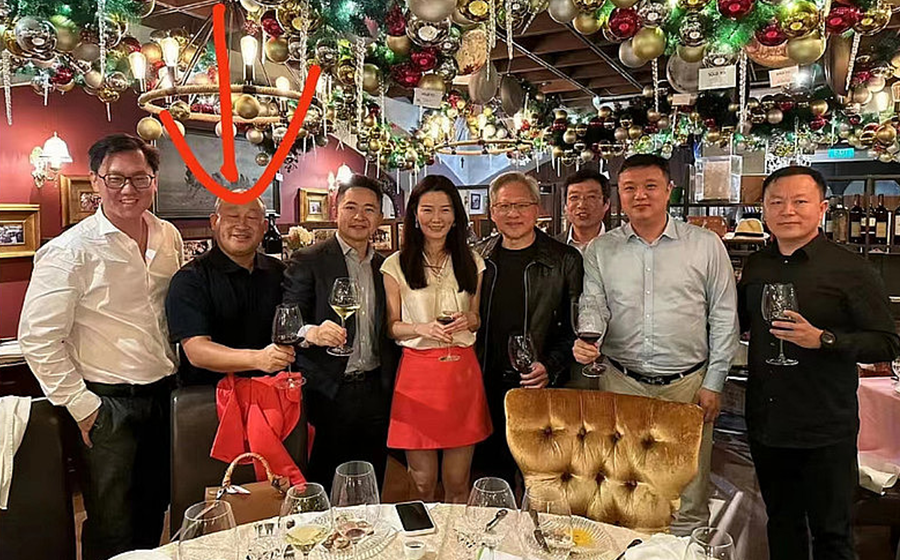
From Culper’s report on X (replete with another photo of Huang and Huang alongside each other at a festive occasion):
$NVDA CEO Huang has walked alongside Megaspeed at every step, and seems to have a close relationship with Megaspeed’s Alice Huang. They partied together in June 2024 — same month as the Apex/Alibaba pledge, then dined together in May 2025 — just after U.S. trade restrictions.
Per a current Megaspeed employee, “every single time” $NVDA’s CEO visits their facility, Alibaba reps come too. One former $NVDA employee told us that internally, Nvidia employees speculated as to the seemingly special nature of the relationship with Jensen.
The jig was clearly up back in May. Short-sellers were hinting at the affair, and the CIA obviously knew about it. That was the time for Jensen Huang to get on top of the story. At that point it was certain that the details were going to come out. The only question was if the details would come out on Huang’s terms or someone else’s.
Remember back in 2019 when the National Enquirer tried to blackmail Jeff Bezos, who at the time was having an affair with Lauren Sanchez (now his second wife), unbeknownst to MacKenzie Scott (now his ex-wife)? Huang should have done something more like what Bezos did: which was just come clean, publicly. Instead, Huang allowed Nvidia spokespeople and legal counsel to make fools of themselves lying on his behalf.
- Tesla Brain Drain ★
-
Fred Lambert, writing for Electrek:
Tesla painted a very different picture just two years ago. At its 2024 shareholder meeting, it showed this slide of its lineup: the Model 3, Model Y, Model S, Model X, Cybertruck, and Semi, plus three vehicles under covers that Musk said were “going to be pretty special.” Of the five consumer vehicles on that slide, three are now dead or on their way out. [...]
At Tesla’s Investor Day at Giga Texas on March 1, 2023, Musk mostly stayed out of the spotlight. Instead, Tesla paraded more than a dozen executives on stage to present its plans, a rare move for a company long criticized for being a one-man show. “We’ve obviously got significant bench strength here,” Musk said at the time.
Of the 14 executives named as presenters that day, seven are gone.
It’s kind of weird for a carmaker that’s currently the 11th-largest market cap company in the world to only have two vehicles in production.
- Rubio Warned Officials About Jensen Huang’s Affair With a Chinese Spy ★
-
Maggie Haberman, Jonathan Swan, Julian E. Barnes, and Tripp Mickle, reporting for The New York Times (gift link):
Mr. Rubio’s memo was circulated to administration officials with high-level security clearances ahead of a trip Mr. Trump took to China in May, the people briefed on the matter said. They spoke on the condition of anonymity to discuss sensitive material.
Despite his status as an A.I. pioneer and head of one of the world’s most valuable companies, Mr. Huang was initially left off the list of major business and tech executives invited to join Mr. Trump in China. It is unclear whether the exclusion was connected to the memo. By that point, a number of people inside the administration were concerned about Mr. Huang’s influence on the president’s policy of only lightly regulating A.I., people briefed on the matter said.
After Mr. Trump saw media coverage about Mr. Huang being absent from the delegation, the president asked him to join the trip by meeting Air Force One during a layover in Alaska. The president drafted a social media post saying that it was an honor to have “the Great Jensen Huang,” and other business leaders “journeying to the Great Country of China where I will be asking President Xi, a Leader of extraordinary distinction, to ‘open up’ China so that these brilliant people can work their magic.”
This Huang-Huang affair explains a few things that until now didn’t make sense, and Jensen Huang not being invited on that May trip to China — until Trump invited him on the fly at the Alaska layover — is one of them. Also worth noting that on multi-byline stories, The Times puts them in order of who contributed the most to the story. In this case it’s Haberman, who is closest to Trump and the White House:
Asked about Mr. Huang’s admission to his company about his affair with Ms. Huang, Mr. Trump told reporters on Sunday evening that he did not regret his own lack of action.
“No, I don’t think so,” the president said. He added that he believed Mr. Huang should stay on as Nvidia’s chief executive.
“I think he’s an honorable guy. I think he probably has an excuse for it. You have to hear it,” Mr. Trump said.
Trump, you will recall, was convicted on 34 felony counts of falsifying business records related to his hush-money payments to porno star Stormy Daniels, who banged him and (spanked him with a magazine with himself on the cover) at a celebrity golf tournament in Lake Tahoe in 2006. That was four months after Melania Trump, his third wife, gave birth to their son Barron. So take “he probably has an excuse for it” with a $130,000 grain of salt.
There’s a Journalism 101 adage that news stories should be written in an “upside down triangle”, with the most important information at the top and the least important at the bottom. Another little inside-baseball tidbit about The Times, however, is that The Times, rather uniquely, often buries the most interesting (but not most important) paragraph at the very end. This story ends thus:
In recent years, Megaspeed, despite having essentially a storefront office and little local footprint, purchased $2 billion worth of Nvidia’s products. Megaspeed builds data centers in Southeast Asia that rent out their computing power to Alibaba, the giant Chinese internet company. U.S. officials suspect Megaspeed has been helping smuggle restricted advanced Nvidia chips into China.
If true, this is politically damaging to both Nvidia and Huang personally, but the context is that Nvidia booked over $300 billion in revenue over the last year.