
By John Gruber
WorkOS is a modern identity platform for B2B SaaS, supporting SSO, SCIM, user management, and RBAC.
- Horse : Content :: Carriage : Ads ★
-
While I’m on a follow-up kick today, my item yesterday regarding Ed Zitron’s compelling essay on the corruption of Google Search quality by putting it in the hands of Prabhakar Raghavan, formerly head of ads at Google, reminded me of this oft-cited quote from Walt Disney:
We don’t make movies to make money. We make money to make more movies.
Can’t say it better than that.
- More on Keycap Shine ★
-
Another follow-up post, this one regarding my post yesterday regarding how “greasy”-looking keyboard keys are not, in fact, in need of cleaning, but instead are worn away because they’re made from soft ABS plastic, not hard PBT plastic. DF reader Brian Barefoot Burns wrote me:
Hey, John. Even on keyboards made with PBT key caps, the space bars are usually still made with ABS. The reason is that PBT shrinks more than ABS does during the manufacturing process. For the smaller key caps, this shrinkage can be managed, but it’s so significant on large keys like the spacebar, that even the IBM Model M and similar keyboards that used PBT still had ABS spacebars.
That explains both the visible erosion and yellowing of the space bars on my Apple Extended Keyboard II’s.
Also, there was a discussion on ATP episode 562 back in November about keycap wear, and one of their listeners pointed out that ABS can be made transparent to let backlighting shine through, but PBT cannot. You can make PBT keycaps with clear (ABS-filled) cut-outs for the letters, but that would undoubtedly add cost and complexity. My beloved Apple Extended Keyboard II has no backlighting at all. It’s quite possible that this entirely explains why Apple sticks with ABS despite the shiny-when-worn factor.
It’s also the case that some people’s natural skin oil wears away ABS plastic more than others. That same ATP episode’s show notes link to this extreme (and extremely gross) example. Jiminy. (Poor U, the least-typed vowel.)
Base-Model RAM in Apple Devices
Thursday, 25 April 2024
Following up on (a) my post earlier this week regarding on-device LLM features being RAM-hungry, and (b) my post regarding Mark Gurman’s claim that M4 Macs will start shipping late this year, I will direct your attention to a report from MacRumors back in January that all iPhone 16 models will include 8 GB of RAM. With the iPhone 15 models, the non-pro models have 6 GB and the Pro models 8 GB. If true, one incongruity will be that new iPhones will have the same amount of RAM as most base-model Macs.
This came up on the most recent episode of ATP, and their show notes include these two charts posted to Mastodon by David Schaub, showing (a) the base RAM for all-in-one Mac desktops from 1984 onward; and (b) the base RAM in consumer Mac laptops from 1999 onward. It has always been the case that Apple has been open to criticism for base-model RAM being “one click” too low. E.g. when base RAM was 1 GB, it should have been 2 GB; when it was 2 GB it should have been 4 GB; etc. But it was also always the case that Apple increased the base RAM every two years or so. Not anymore. iMacs have been stuck at 8 GB of base RAM since the 27-inch iMac from late 2012. MacBook Airs have been stuck at 8 GB base RAM since 2017.
I do think it’s true that Apple silicon changed this equation. Perhaps even, as a rule of thumb, by a factor of 2 — that an Apple silicon Mac with 8 GB RAM performs as well under memory constraints as an Intel-based Mac with 16 GB. But base model consumer Macs have been stuck at 8 GB for a long time, and it’s impossible to look at Schaub’s charts and not see that regular increases in base RAM effectively stopped when Tim Cook took over as CEO. Apple silicon efficiency notwithstanding, more RAM is better, and certainly more future-proof. And it’s downright bizarre to think that come this fall, all iPhone 16 models will sport as much RAM as base model Macs. (Supercomputer pioneer Seymour Cray on virtual memory: “Memory is like an orgasm. It’s a lot better if you don’t have to fake it.”) ★
Wednesday, 24 April 2024
- Dumbphones in 2024 ★
-
Kyle Chayka, writing for The New Yorker:
Two years ago, they both tried Apple’s Screen Time restriction tool and found it too easy to disable, so the pair decided to trade out their iPhones for more low-tech devices. They’d heard about so-called dumbphones, which lacked the kinds of bells and whistles — a high-resolution screen, an app store, a video camera — that made smartphones so addictive. But they found the process of acquiring one hard to navigate. “The information on it was kind of disparate and hard to get to. A lot of people who know the most about dumbphones spend the least time online,” Krigbaum said. A certain irony presented itself: figuring out a way to be less online required aggressive online digging.
The couple — Stults is twenty-nine, and Krigbaum is twenty-five — saw a business opportunity. “If somebody could condense it and simplify it to the best options, maybe more people would make the switch,” Krigbaum said. In late 2022, they launched an e-commerce company, Dumbwireless, to sell phones, data plans, and accessories for people who want to reduce time spent on their screens.
Chayka’s story ran under the bold headline “The Dumbphone Boom Is Real”, which is incongruously clickbait-y for The New Yorker:
Stults takes business calls on his personal cell, and on one recent morning the first call came at 5 a.m. (As the lead on customer service, he has to use a smartphone — go figure.) They pack each order by hand, sometimes with handwritten notes. They have not yet quit their day jobs, which are in the service industry, but Dumbwireless sold more than seventy thousand dollars’ worth of products last month, ten times more than in March, 2023. Krigbaum and Stults noticed an acceleration in sales last October, which they speculate may have had something to do with the onslaught of holiday-shopping season. Some of their popular phone offerings include the Light Phone, an e-ink device with almost no apps; the Nokia 2780, a traditional flip phone; and the Punkt., a calculator-ish Swiss device that looks like something designed for Neo to carry in “The Matrix” (which, to be fair, is a movie of the dumbphone era).
$70K/month in sales is legit, but far from a boom.
The two things that get me when I ponder, even for a moment, carrying a dumbphone: audio (podcasts/music) and camera. Pre-iPhone I’d leave the house with both a phone and an iPod, and sometimes a camera too. I actually just bought a new pocket-sized camera last year, but it seems ludicrous to even consider carrying a dedicated device just for audio, and with music streaming, people expect their portable audio player to have always-available networking. Also: AirPods. I’m not going back to wired earbuds, especially in the winter.
- Ed Zitron on ‘The Man Who Killed Google Search’ ★
-
Absolutely scathing dissection of what’s gone wrong at Google Search, by Ed Zitron for his newsletter/blog:
In an interview with FastCompany’s Harry McCracken from 2018, Gomes framed Google’s challenge as “taking [the PageRank algorithm] from one machine to a whole bunch of machines, and they weren’t very good machines at the time.” Despite his impact and tenure, Gomes had only been made Head of Search in the middle of 2018 after John Giannandrea moved to Apple to work on its machine learning and AI strategy. Gomes had been described as Google’s “search czar,” beloved for his ability to communicate across departments.
Every single article I’ve read about Gomes’ tenure at Google spoke of a man deeply ingrained in the foundation of one of the most important technologies ever made, who had dedicated decades to maintaining a product with a — to quote Gomes himself — “guiding light of serving the user and using technology to do that.” And when finally given the keys to the kingdom — the ability to elevate Google Search even further — he was ratfucked by a series of rotten careerists trying to please Wall Street, led by Prabhakar Raghavan.
Do you want to know what Prabhakar Raghavan’s old job was? What Prabhakar Raghavan, the new head of Google Search, the guy that has run Google Search into the ground, the guy who is currently destroying search, did before his job at Google?
He was the head of search for Yahoo from 2005 through 2012 — a tumultuous period that cemented its terminal decline, and effectively saw the company bow out of the search market altogether. His responsibilities? Research and development for Yahoo’s search and ads products.
Long story short, Ben Gomes was a search guy who’d been at Google since 1999, before they even had any ads in search results. He was replaced by Prabhakar Raghavan, who previously was Head of Ads at the company. So instead of there being any sort of firewall between search and ads, search became a subsidiary of ads.
Zitron’s compelling narrative is largely gleaned through emails released as part of the DOJ’s antitrust case against Google. Is the story really that simple? That around 2019 or so Google Search’s institutional priorities flipped from quality-first/revenue-second, to revenue-first/quality-second? It might be more complicated than that, but the timeline sure does add up.
And as a truism this feels right: if content reports to ads, content will go to hell. Publications, TV networks, operating systems, search engines — no matter the medium, you can’t let the advertising sales inmates run the asylum.
- Why Your Most-Used Keyboard Keys Get Shiny ★
-
Jeff Gamet on Mastodon:
Know why you can’t clean the greasy spots off your compute keyboard? Because that isn’t grease. Lots of computer keys are made from ABS plastic, which is soft and cheaper than PBT plastic. Those shiny spots are where you polished the keys by typing.
I’m at least somewhat of a keyboard nerd, but somehow I only learned this a few years ago. The way worn-down ABS keycaps looks greasy, even though they’re not, reminds me of how snakes look wet, even though they’re not.
Over the last 30 years I’ve primarily used two Apple Extended Keyboard II’s at my desk (the “e” key’s switch died on my first one in 2006) and the only key that’s gotten a tad shiny on either of them is the space bar, where my right thumb hits it. You can literally see how the space bar eroded on the one I used from 1992–2006, which, not coincidentally, was a time when I played a lot of games on my Mac. The Extended Keyboard II I’ve been using since 2006 — which I’m using to type this sentence — shows some shine on the space bar, but no erosion.
Those old keycaps clearly weren’t made from cheap ABS plastic. But in recent decades, Apple’s keyboard keycaps have been made from ABS plastic (or, at least, some sort of plastic that develops a greasy-looking shine through use). I’d love to see Apple fix this problem. Apple’s just not known for cheaping out on materials.
Update: Follow-up post.
Tuesday, 23 April 2024
- Senate Passes Bill to Force Sale of TikTok ★
-
Cristiano Lima-Strong, reporting for The Washington Post:
Congress late Tuesday passed legislation to ban or force a sale of TikTok, delivering a historic rebuke of the video-sharing platform’s Chinese ownership after years of failed attempts to tackle the app’s alleged national security risks.
The Senate approved the measure 79 to 18 as part of a sprawling package offering aid to Israel, Ukraine and Taiwan, sending the proposal to President Biden’s desk — with the House having passed it Saturday. Biden issued a statement minutes after the Senate vote saying he plans to sign the bill into law on Wednesday.
Once signed, the provision will give TikTok’s parent company, ByteDance, roughly nine months to sell the wildly popular app or face a national ban, a deadline the president could extend by 90 days.
Finally.
- Apple Renews ‘For All Mankind’ and Announces New Spinoff Series ‘Star City’ ★
-
Apple Newsroom:
Following its critically acclaimed fourth season, which has been praised as “the best-written show on all of television” and “superior sci-fi,” Apple TV+’s hit, award-winning space drama series “For All Mankind” has landed a renewal for season five. Additionally, Apple TV+ and “For All Mankind” creators Ronald D. Moore, Matt Wolpert and Ben Nedivi will expand the “For All Mankind” universe with a brand-new spinoff series, “Star City,” which will be showrun by Nedivi and Wolpert. [...]
A robust expansion of the “For All Mankind” universe, “Star City” is a propulsive, paranoid thriller that takes us back to the key moment in the alt-history retelling of the space race — when the Soviet Union became the first nation to put a man on the moon. But this time, we explore the story from behind the Iron Curtain, showing the lives of the cosmonauts, the engineers and the intelligence officers embedded among them in the Soviet space program, and the risks they all took to propel humanity forward.
I can’t think of another show quite like For All Mankind. For one thing, there just aren’t many “alternate history” shows or movies, even though I tend to think it’s a great genre — a way to ground fantastic inventions with familiar elements. But the biggest distinction is the way For All Mankind has decade-long gaps in the timeline between seasons. We’ve seen some characters age 30+ years over just four seasons.
- Bertrand Serlet: ‘Why LLMs Work’ ★
-
Bertrand Serlet — who was Apple’s SVP of software engineering from 2003–2011 and a staple during WWDC keynotes during that era — is now a YouTuber. Great 30-minute lecture explaining how LLMs and AI in general actually work.
- FTC Announces Rule Banning Noncompetes ★
-
The FTC:
Today, the Federal Trade Commission issued a final rule to promote competition by banning noncompetes nationwide, protecting the fundamental freedom of workers to change jobs, increasing innovation, and fostering new business formation.
“Noncompete clauses keep wages low, suppress new ideas, and rob the American economy of dynamism, including from the more than 8,500 new startups that would be created a year once noncompetes are banned,” said FTC Chair Lina M. Khan. “The FTC’s final rule to ban noncompetes will ensure Americans have the freedom to pursue a new job, start a new business, or bring a new idea to market.”
As I wrote a year ago, I used to think that noncompete agreements (“agreements”?) were mainly a thing in the tech industry. But their use became so rampant that even sandwich shop chains were requiring them.
- NASA Engineers Successfully Debugged Voyager 1 From a Light-Day Away ★
-
Happy ending to this saga. Remarkable engineering.
- Charles Edge Dies ★
-
Adam Engst, writing at TidBITS:
This one is way too close to home. News started to spread this morning on the MacAdmins Slack, Rich Trouton’s Der Flounder blog, and Tom Bridge’s site about how our friend and Take Control author Charles Edge died suddenly and unexpectedly on 19 April 2024. He was in his late 40s, and yes, his standard bio picture below gives you a feel for his sense of humor and irreverence.
I don’t know what we’ll do without him.
But I can tell you how I’ll remember him, always. Charles always had a kind word for people. He always would take your call. He was the kind of friend who’d drop everything to help you, or to see if he could connect you to someone that could if he couldn’t.
I will miss his levity, his wisdom, his inescapable drive for knowledge, his passion for his friends and family, and his humbleness.
The MacAdmins Podcast has a nice In Memorium page, collecting a slew of other remembrances. Nothing but good thoughts to all of his friends and family.
- Inside TSMC’s Expansion Struggles in Arizona ★
-
Viola Zhou, reporting for Rest of World on TSMC’s massive, but now much-delayed, chip fabrication campus outside Phoenix:
The American engineers complained of rigid, counterproductive hierarchies at the company; Taiwanese TSMC veterans described their American counterparts as lacking the kind of dedication and obedience they believe to be the foundation of their company’s world-leading success.
Some 2,200 employees now work at TSMC’s Arizona plant, with about half of them deployed from Taiwan. While tension at the plant simmers, TSMC has been ramping up its investments, recently securing billions of dollars in grants and loans from the U.S. government. Whether or not the plant succeeds in making cutting-edge chips with the same speed, efficiency, and profitability as facilities in Asia remains to be seen, with many skeptical about a U.S. workforce under TSMC’s army-like command system. “[The company] tried to make Arizona Taiwanese,” G. Dan Hutcheson, a semiconductor industry analyst at the research firm TechInsights, told Rest of World. “And it’s just not going to work.” [...]
TSMC’s work culture is notoriously rigorous, even by Taiwanese standards. Former executives have hailed the Confucian culture, which promotes diligence and respect for authority, as well as Taiwan’s strict work ethic as key to the company’s success. Chang, speaking last year about Taiwan’s competitiveness compared to the U.S., said that “if [a machine] breaks down at one in the morning, in the U.S. it will be fixed in the next morning. But in Taiwan, it will be fixed at 2 a.m.” And, he added, the wife of a Taiwanese engineer would “go back to sleep without saying another word.”
Even the use of wife rather than spouse speaks to the culture clash.
- Sonar Is Now Taska ★
-
Made by Windmill recently launched a fantastic Mac App for GitHub and GitLab issues. When it launched two months ago (and sponsored DF), it was named Sonar. They’ve changed the name to Taska, but it’s the same great app from the same great team. As I wrote when thanking them (now with the new name):
Taska combines the lightweight UI of a to-do app with the power of enterprise-level issue tracking, all in a native app built by long-time Mac nerds. The interface is deceptively simple, and very intuitive. Fast and fluid too. Everything that’s great about native Mac apps is exemplified by Taska. If you’ve ever thought, “Man, if only Apple made a native GitHub client...”, you should run, not walk, to download it.
Taska saves all your changes directly to GitHub/GitLab using their official APIs, so your data remains secure on GitHub’s servers — not Taska’s. Do you have team members not using Taska? No problem. Changes you make in Taska are 100% compatible with the web UI.
Free to try for 14 days — no subscriptions or purchases required. Taska remains my favorite new Mac app of the year. As stated above, Made by Windmill sponsored DF back in February, but this post today isn’t sponsored. I just like Taska so much that I want everyone to hear about the name change.
- Apple Announces ‘Let Loose’ Event on May 7, Presumably to Announce New iPad Lineup ★
-
Joe Rossignol, MacRumors:
Apple has announced it will be holding a special event on Tuesday, May 7 at 7 a.m. Pacific Time (10 a.m. Eastern Time), with a live stream to be available on Apple.com and on YouTube as usual. The event invitation has a tagline of “Let Loose” and shows an artistic render of an Apple Pencil, suggesting that iPads will be a focus of the event.
Pencil us in for May 7! ✏️ #AppleEvent
The entirety of the iPad lineup is due for updates, and the rumor mill expects a new model, a 13-inch-ish iPad Air. It seems clear a new Apple Pencil is forthcoming. The Pencil 2 launched in 2018, alongside the 3rd-gen iPads Pro, which sport A12X chips that benchmark comparably to the then-fastest MacBook Pros available. Those were fantastic iPads that foretold the Apple silicon revolution. My personal iPad remains a 2018 11-inch iPad Pro.
Also rumored: a new Magic Keyboard, with a more MacBook-like (and hopefully more durable) aluminum body and a larger trackpad. The current Magic Keyboards are now four years old. Apple might be settling all iPad family business in two weeks.
What I hope to see:
- New Pencil and new Magic Keyboards (11- and 13-inch) that work with all new iPads, Air and Pro alike. The Pencil compatibility situation has been a mess the last few years; now is the time to clean that up with a Pencil 3 that works across all new iPads.
- All new iPads with the front-facing camera on the long side, optimized for use in landscape/laptop orientation.
- Face ID replacing top-button Touch ID in the iPad Airs.
Why they’re showing the video at 7am PT / 10am ET, I don’t know. (Glad I’ll be on the East Coast though.)
Monday, 22 April 2024
- ‘The Apple Jonathan: A Very 1980s Concept Computer That Never Shipped’ ★
-
Stephen Hackett, writing at 512 Pixels:
The backbone of the system would need to accept modules from Apple and other companies, letting users build what they needed in terms of functionality, as D’Agostino writes:
(Fitch) designed a simple hardware “backbone” carrying basic operations and I/O on which the user could add a series of “book” modules, carrying hardware for running Apple II, Mac, UNIX and DOS software, plus other modules with disk drives or networking capabilities.
This meant that every user could have their own unique Jonathan setup, pulling together various software platforms, storage devices, and hardware capabilities into their own personalized system. Imagining what would have been required for all this to work together gives me a headache. In addition to the shared backbone interface, there would need to be software written to make an almost-endless number of configurations work smoothly for the most demanding of users. It was all very ambitions, but perhaps a little too far-fetched.
I’d go further than “never shipped” and describe this is a concept that never could have shipped. It was a pipe dream. The concepts sure did look cool though.
- Meta to Start Licensing Quest’s Horizon OS to Third-Party OEMs ★
-
Alex Heath, The Verge:
Meta has started licensing the operating system for its Quest headset to other hardware makers, starting with Lenovo and Asus. It’s also making a limited-run, gaming-focused Quest with Xbox.
On the theme of opening up, Meta is also pushing for more ways to discover alternative app stores. It’s making its experimental App Lab store more prominent and even inviting Google to bring the Play Store to its operating system, which is now called Horizon OS. In a blog post, Meta additionally said that it’s working on a spatial framework for developers to more easily port their mobile apps to Horizon OS. [...]
Zuckerberg has been clear that he wants his company to be a more open platform than Apple’s. Here, he’s firmly positioning Meta’s Horizon OS as the Android alternative to Apple’s Vision Pro. Given how Android was more of a reaction to the iPhone, an analogy he’d probably prefer is how Microsoft built the early PC market by licensing Windows.
It definitely seems more like Windows than Android — there’s no word that Horizon OS is going open source. But we have an answer regarding what Zuckerberg meant when he positioned the Quest platform — now the Horizon OS platform, I suppose — as the “open” alternative to Apple’s VisionOS.
- ‘LLM in a Flash: Efficient Large Language Model Inference With Limited Memory’ (PDF) ★
-
Re: my previous item on LLMs being RAM-hungry while iPhones are relatively low on RAM, this certainly isn’t news to Apple. Back in December, a team of eight researchers from Apple published this paper, which states in its abstract:
This paper tackles the challenge of efficiently running LLMs that exceed the available DRAM capacity by storing the model parameters in flash memory, but bringing them on demand to DRAM. Our method involves constructing an inference cost model that takes into account the characteristics of flash memory, guiding us to optimize in two critical areas: reducing the volume of data transferred from flash and reading data in larger, more contiguous chunks. Within this hardware-informed framework, we introduce two principal techniques. First, “windowing” strategically reduces data transfer by reusing previously activated neurons, and second, “row-column bundling”, tailored to the sequential data access strengths of flash memory, increases the size of data chunks read from flash memory. These methods collectively enable running models up to twice the size of the available DRAM, with a 4-5× and 20-25× increase in inference speed compared to naive loading approaches in CPU and GPU, respectively. Our integration of sparsity awareness, context-adaptive loading, and a hardware-oriented design paves the way for effective inference of LLMs on devices with limited memory.
- On-Device AI Craves RAM ★
-
Ron Amadeo, writing for Ars Technica on a purported leak of a trio of Pixel 9 phones:
Rozetked says (through translation) that the phone is “similar in size to the iPhone 15 Pro.” It runs a Tensor G4 SoC, of course, and — here’s a noteworthy spec — has a whopping 16GB of RAM according to the bootloader screen. The Pixel 8 Pro tops out at 12GB.
Anything could change between prototype and product, especially for RAM, which is usually scaled up and down in various phone tiers. A jump in RAM is something we were expecting though. As part of Google’s new AI-focused era, it wants generative AI models turned on 24/7 for some use cases. Google said as much in a recent in-house podcast, pointing to some features like a new version of Smart Reply built right into the keyboard, which “requires the models to be RAM-resident” — in other words, loaded all the time. Google’s desire to keep generative AI models in memory means less RAM for your operating system to actually do operating system things, and one solution to that is to just add more RAM. So how much RAM is enough? At one point Google said the smaller Pixel 8’s 8GB of RAM was too much of a “hardware limitation” for this approach. Google PR also recently told us the company still hasn’t enabled generative AI smart reply on Pixel 8 Pro by default with its 12GB of RAM, so expect these RAM numbers to start shooting up.
That last link is to a story positing that Google’s Gemini Nano runs on the Pixel 8 Pro but not the regular Pixel because the Pro has more RAM (12 vs. 8 GB).
Comparing iPhone RAM to Android RAM has never been apples-to-apples (same goes for battery capacity), but still, it’s hard not to wonder whether Apple’s on-device AI plans are hamstrung by the relatively stingy amounts of RAM on iPhones. Here’s a list from 9to5Mac showing the RAM in each iPhone going back to the original (which had just 128 MB!). iOS 17 supports models dating back to 2018’s iPhone XS and XR (4 and 3 GB of RAM, respectively). If iOS 18 drops those models, the new baseline will be the iPhones 11 and 11 Pro, which all sport 4 GB. The most RAM on any iPhone to date is 8 GB in the 15 Pro models, but 8 GB is what Google deemed insufficient for the Pixel 8 to run Gemini Nano.
Might some iOS 18 on-device AI features be limited to newer models with more RAM?
Sunday, 21 April 2024
- Kolide ★
-
My thanks to Kolide for sponsoring last week at DF. The September 2023 MGM hack is one of the most notorious ransomware attacks in recent years. Journalists and cybersecurity experts rushed to report on the broken slot machines, angry hotel guests, and the fateful phishing call to MGM’s help desk that started it all.
But while it’s true that MGM’s help desk needed better ways of verifying employee identity, there’s another factor that should have stopped the hackers in their tracks. That’s where you should focus your attention. In fact, if you just focus your vision, you’ll find you’re already staring at the security story the pros have been missing.
It’s the device you’re reading this on.
To read more about what Kolide learned after researching the MGM hack — like how hacker groups get their names, the worrying gaps in MGM’s security, and why device trust is the real core of the story — check out the Kolide blog.
Making a Mountain Out of Molehill-Sized M4 News
Sunday, 21 April 2024
Here’s how I see the current state of Apple’s Macintosh hardware lineup, three-and-a-half years into the Apple silicon era and midway through the M3 generation. Apple is a company that in many ways is built around an annual schedule. WWDC comes every June. New iPhones (along with Watches) come every September. The new OS releases (which are announced and previewed at WWDC) ship later each year in the fall. Many Apple products are not on an annual schedule — such as the iPad, to name the most prominent example — but the OSes are, and the iPhones and Watches are. All things considered, I think Apple would like to have more of its products on an annual cycle. This predictable regularity is one of the hallmarks of Tim Cook’s era as CEO.
Launching a new PC architecture is difficult (to say the least). And the M1 launched at the end of 2020, the most tumultuous and disruptive year for the world since World War II. Then, M2 models seemed late — that’s the only logical explanation for the M2 MacBook Pros not shipping until January 2023, but their M3 successors shipping just 10 months later. Just last month Apple shipped the M3 MacBook Airs. It feels to me, as a longtime observer of the company, that with the M3 generation, Apple has started to hit its intended stride. The M1 and M2 generations were like an airplane taking off — a bit rocky and rough. Turbulence is to be expected. But with the M3, Apple silicon hit cruising altitude. The seatbelt light is now off, and new M-series chips are seemingly being developed on the same annual schedule as the iPhone’s A-series chips. (Note that the M3 family uses the same 3nm fabrication process as the A17 Pro.)
If Apple wants to refresh Macs with new generations of M-series chips annually — and I suspect they do — the schedule we’re seeing with the M3 generation makes sense: MacBook Pros in the fall, MacBooks Airs a few months later, pro desktops in the spring. Last year the M3 update to the iMac — a product that skipped the entire M2 generation — shipped alongside the MacBook Pros, but I could see that happening alongside the consumer MacBook Airs in future years. Because the iMacs skipped the M2 generation, they were overdue. That leaves the spring or even early summer for the high-performance Mac Studio and Mac Pro, and the surprisingly-pro-in-many-use-cases Mac Mini.
So I expect we’ll see M3-generation updates to the Mac Studio, Mac Pro, and Mac Mini either in May (alongside the universally-expected lineup of new iPads) or (more likely) at WWDC in June. And then, if all things go according to Apple’s plans, I expect to see M4-generation MacBook Pros in November, M4 MacBook Airs next February or March, and the desktop models just before or at WWDC 2025, 14 months from now. Lather, rinse, repeat, every 12 months for years to come.
And how do we expect the M4 chips to evolve? Everything tends to get incrementally faster between generations: CPU, GPU, I/O, Neural Engine. But it’s the GPU where Apple silicon lags Nvidia’s state-of-the-art in sheer performance, and it’s GPU performance that’s essential for AI model training (although serious training work takes place on server farms, not personal devices), so it’s natural to expect GPU improvements to be an area of focus. Intel-based Mac Pros were configurable with up to 1.5 TB of RAM, but the M2 Ultra Mac Pro maxes out at 192 GB of RAM. Increasing the maximum amount of RAM in high-end configurations is an obvious improvement that Apple’s chip designers should be focused on. So we’ll probably see incremental (15 percent-ish) gains in CPU performance, greater gains in GPU and Neural Engine performance, and perhaps higher capacity for RAM.
No need to follow the rumor mill or to hear any leaks from insiders in Cupertino. The above summary can all be gleaned just by paying attention to Apple’s patterns and industry-wide trends.
That brings us to a report by Mark Gurman at Bloomberg last week: “Apple Plans to Overhaul Entire Mac Line With AI-Focused M4 Chips”. Overhauled line-up! AI-focused chips! Big news!
The company, which released its first Macs with M3 chips five months ago, is already nearing production of the next generation — the M4 processor — according to people with knowledge of the matter. The new chip will come in at least three main varieties, and Apple is looking to update every Mac model with it, said the people, who asked not to be identified because the plans haven’t been announced.
The new Macs are underway at a critical time. After peaking in 2022, Mac sales fell 27% in the last fiscal year, which ended in September. In the holiday period, revenue from the computer line was flat. Apple attempted to breathe new life into the Mac business with an M3-focused launch event last October, but those chips didn’t bring major performance improvements over the M2 from the prior year.
It is true that Mac sales were down considerably last year, but Gurman is painting that as the result of the M3 generation being a meh upgrade compared to M2. But (a) the M3 chips only started shipping in the most recently reported quarter; (b) they’re a fine generational upgrade compared to the M2 chips. The real problem is that laptop sales shot up considerably during COVID, with so many people working from home and kids “going to school” via Zoom from home. MacBook sales were pulled forward, so a dip seemed inevitable, no matter how good the M2 and M3 offerings were. And Apple silicon was so good right out of the gate that most people who own M1 Macs — any M1 Macs, including the base MacBook Air and Mac Mini — have little reason to consider upgrading yet.
Apple also is playing catch-up in AI, where it’s seen as a laggard to Microsoft Corp., Alphabet Inc.’s Google and other tech peers. The new chips are part of a broader push to weave AI capabilities into all its products.
Back in 2007, Joe Biden dropped a zinger during a presidential primary debate: “Rudy Giuliani, there’s only three things he mentions in a sentence: a noun, a verb, and 9/11.” This year, product rumors need only three things: a noun, a verb, and “AI”.
Apple shares climbed 4.3% to $175.04 on Thursday in New York, the biggest single-day gain in 11 months. They had been down 13% this year through Wednesday’s close.
Apple is aiming to release the updated computers beginning late this year and extending into early next year. There will be new iMacs, a low-end 14-inch MacBook Pro, high-end 14-inch and 16-inch MacBook Pros, and Mac minis — all with M4 chips. But the company’s plans could change. An Apple spokesperson declined to comment. [...]
The move will mark a quick refresh schedule for the iMac and MacBook Pro, as both lines were just updated in October. The Mac mini was last upgraded in January 2023.
Apple is then planning to follow up with more M4 Macs throughout 2025. That includes updates to the 13-inch and 15-inch MacBook Air by the spring, the Mac Studio around the middle of the year, and the Mac Pro later in 2025. The MacBook Air received the M3 chip last month, while the Mac Studio and Mac Pro were updated with M2 processors last year.
If all this pans out, it will indeed be news, but the news will be that Apple has successfully gotten the entire Mac hardware lineup onto an annual upgrade cycle. Whereas Gurman is framing the news as a reactionary response by Apple, “overhauling” the hardware lineup very shortly after a supposedly tepid reaction to the M3 generation of Macs that, at this writing, still hasn’t completed rolling out.
The M4 chip line includes an entry-level version dubbed Donan, more powerful models named Brava and a top-end processor codenamed Hidra. The company is planning to highlight the AI processing capabilities of the components and how they’ll integrate with the next version of macOS, which will be announced in June at Apple’s annual developer conference.
I’m sure Apple will have much to say about “AI” at WWDC this June, and that M4-based Macs will execute AI features faster and more efficiently than previous chips, but that’s what new chips do for everything. They’re faster.
That they will provide Apple with AI-related performance to brag about just means they’ll have faster GPUs and bigger Neural Engines, which is exactly how Apple silicon has been evolving year-over-year for 15 years, dating back to the original iPad in 2010 and its A4 SoC. No one is postulating that M4-based Macs will offer AI features that require M4 chips.
The Mac Pro remains the lower-selling model in the company’s computer lineup, but it has a vocal fan base. After some customers complained about the specifications of Apple’s in-house chips, the company is looking to beef up that machine next year. [...] As part of the upgrades, Apple is considering allowing its highest-end Mac desktops to support as much as a half-terabyte of memory. The current Mac Studio and Mac Pro top out at 192 gigabytes — far less capacity than on Apple’s previous Mac Pro, which used an Intel Corp. processor. The earlier machine worked with off-the-shelf memory that could be added later and handle as much as 1.5 terabytes. With Apple’s in-house chips, the memory is more deeply integrated into the main processor, making it harder to add more.
Raising the memory ceiling from 192 GB to 512 GB is also news, but surely is the natural progression of the platform, not a response to criticism of the M2 Mac Pro being little more than a Mac Studio with more options for I/O expansion. No one knows better than Apple that the first-generation Apple silicon Mac Pros are a bit of a disappointment. Raising the memory ceiling to 512 GB would be a significant improvement from the M2 Ultra, but would still offer just one-third the RAM ceiling of the 2019 Intel-based Mac Pro. Raising the ceiling to 512 GB would be a nice upgrade for Apple silicon, but still not enough for the highest of high-end computing needs.
Anyway, “the entire Mac product line is set for annual speed-bump Apple silicon updates” is, as far as I can tell, the actual story. Not “Mac sales are in the tank and Apple is overhauling the whole product line to change its focus to AI.” ★
Face the Critic: Ian Betteridge Edition
Friday, 19 April 2024
Ian Betteridge, quoting yours truly on non-consensual tracking back in 2020 and then my piece yesterday on the EDPB issuing an opinion against Meta’s “Pay or OK” model in the EU:
I wonder what happened to turn John’s attitude from “no action Apple can take against the tracking industry is too strong” to defending Facebook’s “right” to choose how it invades people’s privacy? Or is he suggesting that a private company is entitled to defend people’s privacy, but governments are not?
I’ve seen a bit of pushback along this line recently, more or less asking: How come I was against Meta’s tracking but now seem for it? I don’t see any contradiction or change in my position though. The only thing I’d change in the 2020 piece Betteridge quotes is this sentence, which Betteridge emphasizes: “No action Apple can take against the tracking industry is too strong.” I should have inserted an adjective before “tracking” — it’s non-consensual tracking I object to, especially tracking that’s downright surreptitious. Not tracking in and of itself.
That’s why I remain a staunch supporter of Apple’s App Tracking Transparency, and consider it a success. Apple didn’t ban the use of the IDFA for cross-app tracking, and they were correct not to. They simply now require consent. If I had believed that all tracking was ipso facto wrong, I’d have been opposed to ATT on the grounds that it offers the “Allow” choice.
Also from 2020, I quoted Steve Jobs on privacy:
Privacy means people know what they’re signing up for, in plain English, and repeatedly. That’s what it means. I’m an optimist, I believe people are smart. And some people want to share more data than other people do. Ask them. Ask them every time. Make them tell you to stop asking them if they get tired of your asking them. Let them know precisely what you’re going to do with their data.
That’s what ATT does. And that’s what’s Meta’s “Pay or OK” model in the EU does. It offers users a clear fair choice: Use Facebook and Instagram free of charge with targeted ads, or pay a reasonable monthly fee for an ad-free experience. No less than Margrethe Vestager herself, back in 2018, was keen on this idea:
My concern is more about whether we get the right choices. I would like to have a Facebook in which I pay a fee each month, but I would have no tracking and advertising and the full benefits of privacy. It is a provoking thought after all the Facebook scandal. This market is not being explored.
Now Meta is “exploring” that market, but the European Commission doesn’t like the results, because it turns out that when given the clear choice, the overwhelming majority of EU denizens prefer to use Meta’s platforms free-of-charge with targeted ads.
The best aspects of the EU’s digital privacy laws are those that give people the right to know what data is being collected, where it’s being stored, who it’s being shared with, etc. That’s all fantastic. But the worst aspect is the paternalism. The EU is correct to require that users be required to provide consent before being tracked across properties. And Apple is correct for protecting unique device IDFA identifiers behind a mandatory “Ask App Not to Track / Allow” consent alert. But Jobs was right too: people are smart, and they can — and should be allowed to — make their own decisions. And many people are more comfortable with sharing data than others. The privacy zealots leading this crusade in the EU do not think people are smart, and do not think they should be trusted to make these decisions for themselves.
I don’t like Meta as a company. If a corporation can be smarmy, Meta is that. And they’ve done a lot of creepy stuff over the years, and for a long while clearly acted as though they were entitled to track whatever they could get away with technically. I suspect they thought that if they asked for consent, or made clear what and how they tracked, that users would revolt. But it turns out billions of people who enjoy Meta’s platforms are fine with the deal.
It’s obviously the case that for some people, Meta’s past transgressions are unforgivable. That’s each person’s decision to make for themselves. Me, I believe in mercy. Again, I still don’t really like the company, by and large. But Threads is pretty good. And sometimes, when I occasionally check in, Instagram can still make me smile. It’s very clear what I’m sharing with Meta when I use those apps, and I’m fine with that. If you’re not, don’t use them. (I’ve still never created a Facebook blue app account, and still feel like I haven’t missed out on a damn thing.)
To sum up my stance: Tracking is wrong when it’s done without consent, and when users have no idea what’s being tracked or how it’s being used. Tracking is fine when it’s done with consent, and users know what’s being tracked and how it’s being used. Privacy doesn’t mean never being tracked. It means never being tracked without clear consent. I think Meta is now largely, if not entirely, on the right side of this.
It’s paternalistic — infantilizing even — to believe that government bureaucrats should take these decisions out of the hands of EU citizens. Me, I trust people to decide for themselves. The current European Commission regime is clearly of the belief that all tracking is wrong, regardless of consent. That’s a radical belief that is not representative of the public. The government’s proper role is to ensure people can make an informed choice, and that they have control over their own data. That’s what I thought four years ago, and it’s what I think now. ★
Friday, 19 April 2024
- Might Meta Go Pay-Only in the EU? ★
-
Eric Seufert, writing at Mobile Dev Memo, spitballing how Meta might respond if the EU accepts the recommendation from the EDPB that their “Pay or OK” model is illegal:
Charge a nominal fee for the ad-supported versions of Facebook and Instagram
Meta could introduce a small fee to use the ad-supported versions of Facebook and Instagram, rendering them as completely paid products in the EU. By eliminating its free tier, Meta should theoretically sidestep the conditions proposed in the EDPB’s opinion, since the elimination of a free tier supported by personalized advertising renders the Pay or Okay restrictions irrelevant.
As frequent MDM Podcast guest Mikołaj Barczentewicz points out in this blog post, both Netflix and Disney+ target ads behaviorally in their paid, ad-supported tiers. Meta could point to these products as examples of this pricing model being invoked: all options are paid, but the cheapest option is subsidized by behaviorally-supported ads. Of course, the EDPB has given itself latitude with its definition of “large online platform” to only litigate specific instances of commercial strategy.
I didn’t think of this when I spitballed my own ideas for how Meta might respond. Maybe they offer two tiers: €1/month with targeted ads, or €6/month without ads. Maybe they even make the fee for the ad tier truly nominal, say €1/year? The problem with this might be that too few people are willing to pay anything at all for social networking. Because it’s always been free-of-charge, people (not unreasonably!) now think it ought to forever remain free-of-charge.
Regarding the “just exit the EU” option, Seufert writes:
I don’t believe that Meta will respond by exiting the EU market altogether — at least not in the near term. Per above: the EU is 10% of (what I understand to be) Facebook’s global advertising revenue, and GDPR fines aren’t as significant as those incurred under the DMA. The maximum fine under the GDPR is 4% of annual worldwide turnover, whereas the maximum fine under the DMA is 20% of annual worldwide turnover. While I do believe the EU regulatory regime’s intransigence will influence a scaled, US-domiciled tech company to exit the EU market in the medium term, my sense is that Meta won’t take that course of action in immediate response to this decision.
That 10 percent figure is big but not indispensable. And it’s not much bigger than Apple’s 7 percent figure for App Store revenue from the EU. The EU is indeed a big and important market, but it’s nowhere near as big or important as the European Commissioners think.
- Twitter Alternative Post News Is Shutting Down ★
-
Noam Bardin:
It is with a heavy heart that I share this sad news with you. Despite how much we’ve accomplished together, we will be shutting down Post News within the next few weeks.
We have done many great things together. We built a toxicity-free community, a platform where Publishers engage, and an app that validated many theories around Micropayments and consumers’ willingness to purchase individual articles. We even managed to cultivate a phenomenal tipping ecosystem for creators and commenters.
But, at the end of the day, our service is not growing fast enough to become a real business or a significant platform. A consumer business, at its core, needs to show rapid consumer adoption and we have not managed to find the right product combination to make it happen.
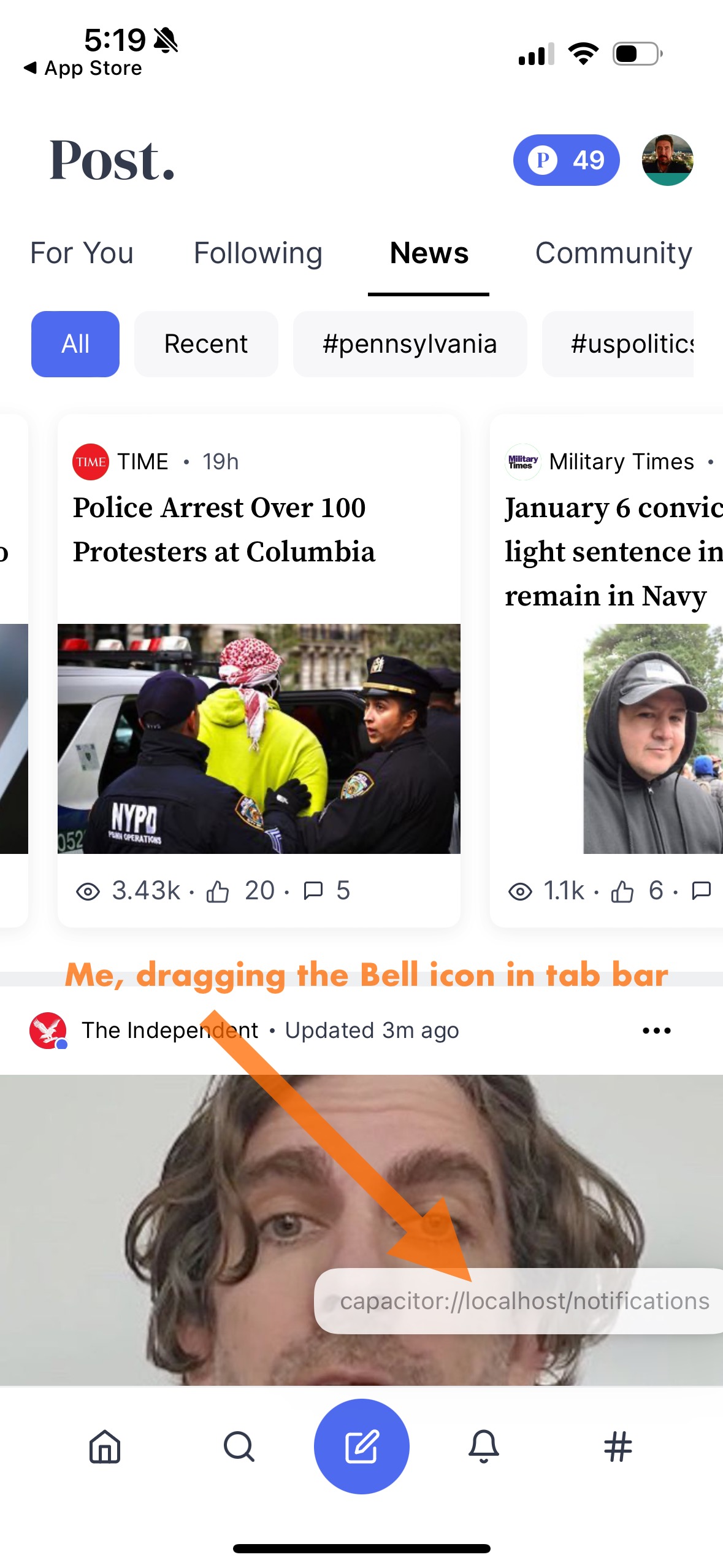
Post News was a longshot from the start, going up against (a) the entrenched leader in the space, Twitter/X; (b) the open alternative of Mastodon; (c) Meta-backed and Instagram-derived Threads; and (d) the Jack-Dorsey-funded Bluesky. I’m not sure there’s room for all four of those, let alone a fifth.
But I think Post shot itself in the foot right out of the gate going web-only. They eventually got around to putting an “app” in the App Store but it’s just a thin wrapper around their website — so thin that you can drag-and-drop the tab controller buttons and see exactly which PWA framework they used from the custom URLs shown in the drag proxy. People don’t want to use PWAs; they want real apps. Native iOS apps are so important to social networking that Threads launched app-only for its first two months before launching its web version.
- China Orders Apple to Remove WhatsApp, Threads, Signal, and Telegram From Chinese App Store ★
-
Aaron Tilley, Liza Lin, and Jeff Horwitz, reporting for The Wall Street Journal (News+):
Meta Platforms’ WhatsApp and Threads as well as messaging platforms Signal and Telegram were taken off the Chinese App Store Friday. Apple said it was told to remove certain apps because of national security concerns, without specifying which.
“We are obligated to follow the laws in the countries where we operate, even when we disagree,” an Apple spokesperson said.
These messaging apps, which allow users to exchange messages and share files individually and in large groups, combined have around three billion users globally. They can only be accessed in China through virtual private networks that take users outside China’s Great Firewall, but are still commonly used.
I’m surprised any of these apps had been available in China until now. Two questions:
Are these apps still on the iPhones of Chinese people who already had them installed? I don’t recall Apple ever using the kill switch that revokes the developer signing for already-installed copies of apps pulled from the App Store. E.g., iGBA, the rip-off Nintendo emulator that briefly rocketed to the top of the charts last weekend — pulled from the App Store early this week, but if you installed it while it was available, you can still use it.
Do Android phones in China offer sideloading?
Update: The answer re: sideloading is yes, and both Signal and WhatsApp offer direct downloads of their latest Android builds.
- The Best Simple USB-C Microphone: Audio-Technica’s ATR2100x-USB ★
-
Joe Fabisevich asked a common question on Threads:
What’s the go to simple USB-C podcast mic that sounds good, but doesn’t have to be top of the line or super expensive? Think more “I need to sound professional on a podcast or two”, not “I make my money by recording podcasts.”
My answer: Audio-Technica’s ATR2100×-USB. It costs just $50 at Amazon. (That’s an affiliate link that will make me rich if you buy through it.) Spend an extra $4 and get a foam windscreen cap. I mean just look at it — it literally looks like the microphone emoji: 🎤. You can just plug it into a USB-C port and it sounds great. No need for an XLR interface, but it does support XLR if you ever have the need.
My main podcasting microphone remains the $260 Shure BETA 87A Supercardioid Condenser, which I connect to a $180 SSL 2 audio interface. But that stays in my podcast cave in the basement. I keep the ATR2100× in my carry-on suitcase, so it’s with me whenever I’m away from home. My Dithering co-host Ben Thompson uses the same ATR2100× when he’s away from home, too. It’s a great simple mic and a fantastic value at just $50.
Thursday, 18 April 2024
- Google Reorg Puts Android, Chrome, Photos and More Under Leadership of Devices Team ★
-
David Pierce, writing for The Verge:
Google CEO Sundar Pichai announced substantial internal reorganizations on Thursday, including the creation of a new team called “Platforms and Devices” that will oversee all of Google’s Pixel products, all of Android, Chrome, ChromeOS, Photos, and more. The team will be run by Rick Osterloh, who was previously the SVP of devices and services, overseeing all of Google’s hardware efforts. Hiroshi Lockheimer, the longtime head of Android, Chrome, and ChromeOS, will be taking on other projects inside of Google and Alphabet.
This is a huge change for Google, and it likely won’t be the last one. There’s only one reason for all of it, Osterloh says: AI. “This is not a secret, right?” he says. Consolidating teams “helps us to be able to do full-stack innovation when that’s necessary,” Osterloh says.
I’m sure this is about AI, but I think it’s also about getting the company’s shit together and forming a cohesive strategy for integration with their consumer devices. Lost amid the schadenfreude surrounding the near-universal panning of Humane’s AI Pin is the question of, well, what are the device form factors we need for AI-driven features? I would argue, strenuously, that the phone is the natural AI device. It already has: always-on networking, cameras, a screen, microphones, and speakers. Everyone owns one and almost everyone takes theirs with them almost everywhere they go.
Putting all of Android under a new division led by the guy in charge of Pixel devices since 2016 says to me that Google sees AI not primarily as a way to make Android better, in general, but to make Pixel devices better, specifically. Best-of-class AI, only on Pixels, could be the sort of differentiation that actually results in Pixels gaining traction.
- Elizabeth Warren, Still Using Twitter/X: ‘It’s Time to Break Up Apple’s Smartphone Monopoly’ ★
-
Senator Elizabeth Warren seemingly thinks Apple ought to be forced to operate iMessage as a public utility, free of charge. Or something? She doesn’t actually say what she thinks should happen. Is she suggesting Apple be forced to spin off “iMessage” as a separate company? If not, what is she advocating “breaking up”?
- Google Fires 28 Employees Who Disrupted Workplaces to Protest Israel Cloud Contract ★
-
Chris Rackow, Google’s head of global security, in a company-wide memo published at The Verge, under the clear subject “Serious consequences for disruptive behavior”:
Behavior like this has no place in our workplace and we will not tolerate it. It clearly violates multiple policies that all employees must adhere to — including our Code of Conduct and Policy on Harassment, Discrimination, Retaliation, Standards of Conduct, and Workplace Concerns.
We are a place of business and every Googler is expected to read our policies and apply them to how they conduct themselves and communicate in our workplace. The overwhelming majority of our employees do the right thing. If you’re one of the few who are tempted to think we’re going to overlook conduct that violates our policies, think again. The company takes this extremely seriously, and we will continue to apply our longstanding policies to take action against disruptive behavior — up to and including termination.
It says a lot about how adrift Google was that “We are a place of business” needed to be stated, but better late than never. I can’t believe they let these goofs occupy Google Cloud CEO Thomas Kurian’s office for 8 hours before having them arrested. They look and act like college students doing a sit-in at the dean’s office, not professional employees protesting their CEO. In college you pay to be there — students are the customers, ostensibly. At work they pay you, at will.
- Meta Releases New AI Assistant Powered by Llama 3 Model ★
-
Alex Heath, reporting for The Verge:
ChatGPT kicked off the AI chatbot race. Meta is determined to win it.
To that end: the Meta AI assistant, introduced last September, is now being integrated into the search box of Instagram, Facebook, WhatsApp, and Messenger. It’s also going to start appearing directly in the main Facebook feed. You can still chat with it in the messaging inboxes of Meta’s apps. And for the first time, it’s now accessible via a standalone website at Meta.ai.
For Meta’s assistant to have any hope of being a real ChatGPT competitor, the underlying model has to be just as good, if not better. That’s why Meta is also announcing Llama 3, the next major version of its foundational open-source model. Meta says that Llama 3 outperforms competing models of its class on key benchmarks and that it’s better across the board at tasks like coding. Two smaller Llama 3 models are being released today, both in the Meta AI assistant and to outside developers, while a much larger, multimodal version is arriving in the coming months.
I keep circling back to the notion that OpenAI has no moat. ChatGPT is certainly the best-known LLM, and perhaps still the best, but I don’t think that’s any more of a long-term competitive advantage than some company in 1986 having “the best C compiler”. What’s needed are ways to bring LLMs to users. To give them purpose, in products. That’s what Meta is doing, by integrating their AI into all of their major products.
- Netflix Will Stop Reporting Subscriber Numbers Next Year ★
-
Todd Spangler, reporting for Variety:
Netflix will no longer report subscriber numbers — which has been a key metric for streaming services for years — beginning with the first quarter of 2025.
The company made the announcement in releasing its first-quarter 2024 earnings Thursday. Netflix handily topped expectations for subscribers net adds, gaining 9.33 million in the period, to reach nearly 270 million globally. It also beat Wall Street expectations on the top and bottom lines. [...]
Despite the Q1 earnings beat, Netflix shares dropped more than 4.5% in after-hours trading Thursday, possibly as investors reacted negatively to the news that the streamer will stop reporting quarterly sub totals.
In its Q1 letter to shareholders, Netflix said that engagement — time spent with the service — is its “best proxy for customer satisfaction.” As such, it will no longer report quarterly membership numbers or average revenue per member (which it dubs “ARM”), as of Q1 2025. Netflix said it will announce “major subscriber milestones as we cross them” but will cease disclosing quarterly subscriber numbers.
I don’t think investors should be alarmed. This is what companies do when their growth phase is over. Apple used to break down unit sales for its various devices and stopped long ago. Netflix is no longer an up-and-comer — they’re the established leader in streaming, and should be judged accordingly. Keeping existing subscribers happy and watching is more important at this point than signing up new ones.
- U.S. Court Rules That Police Can Force a Suspect to Unlock Phone With Thumbprint ★
-
Jon Brodkin, reporting for Ars Technica:
The US Constitution’s Fifth Amendment protection against self-incrimination does not prohibit police officers from forcing a suspect to unlock a phone with a thumbprint scan, a federal appeals court ruled yesterday. The ruling does not apply to all cases in which biometrics are used to unlock an electronic device but is a significant decision in an unsettled area of the law. [...]
Payne’s Fifth Amendment claim “rests entirely on whether the use of his thumb implicitly related certain facts to officers such that he can avail himself of the privilege against self-incrimination,” the ruling said. Judges rejected his claim, holding “that the compelled use of Payne’s thumb to unlock his phone (which he had already identified for the officers) required no cognitive exertion, placing it firmly in the same category as a blood draw or fingerprint taken at booking.”
“When Officer Coddington used Payne’s thumb to unlock his phone — which he could have accomplished even if Payne had been unconscious — he did not intrude on the contents of Payne’s mind,” the court also said.
Via Jamie Zawinski, who advises never using Touch ID or Face ID. I strongly disagree with that advice. Almost everyone is far more secure using Face ID rather than relying on a passcode/passphrase alone. People who don’t use Face/Touch ID are surely tempted to use a short easily-entered passcode for convenience, and anyone who disables Face/Touch ID while using a nontrivial passphrase is encountering a huge inconvenience every single time they unlock their phone. There’s no good reason to put yourself through that.
My advice is to internalize the shortcut to hard-lock an iPhone, which temporarily disables Face/Touch ID and requires the passcode to unlock: squeeze the side button and either of the volume buttons for a second or so. I wrote an entire article about this two years ago. Don’t just learn this shortcut, internalize it, so that you don’t have to think about it under duress. Just squeeze the side buttons until you feel the phone vibrate. Then it’s hard-locked. Do this whenever you go through security — be it at the airport, the ballpark, or anywhere. If you see a magnetometer, hard-lock your iPhone. If you get pulled over by a cop while driving, hard-lock your phone before you do anything else. (You can still launch the Camera app from the lock screen to record the encounter, if you wish, while the phone remains hard-locked.) Tell everyone you know how to hard-lock their iPhones.
(Also, this ruling is specific to the details of this particular case, and thus only addresses fingerprint authentication, not facial recognition. Those concerned with civil liberties should presume, though, that the same court would rule similarly regarding cops unlocking a device by waving it in front of the suspect’s face. But with “Require Attention for Face ID” — which is on by default — Face ID won’t work if you keep your eyes closed, and I don’t think a court would allow police to force your eyes open. The trick to worry about is the police handing you back your phone, under the pretense that you can use it to make a call or something, and then yanking it from your hands after you unlock it.)
- Nothing Integrates ChatGPT With Its Wireless Earbuds and Phones ★
-
James Pero, writing at Inverse:
Nothing’s audio products — including the newly announced Ear and Ear A — are bringing what the company calls an “industry-first” integration with ChatGPT that allows users who also own a Nothing Phone like the recently released Phone 2a to launch the chatbot with a pinch gesture on their Nothing earbuds.
“By integrating ChatGPT with Nothing earbuds, including the new Nothing Ear and Ear A, and with Nothing OS, we’ve taken our first steps towards change, and there’s more to come,” said Nothing CEO, Carl Pei, in a press release.
Looks like it’s time for the DOJ to file another lawsuit against Apple for offering tight integration between its phones and peripherals.
European Data Protection Board Goes There, Rules Against Meta’s ‘Pay or OK’ Model
Wednesday, 17 April 2024
The EDPB — the EU’s legislature of privacy authorities — adopted a draft opinion today determining that large online platforms can’t offer a “pay or okay” model as a strict binary and must also offer a third, free choice that doesn’t utilize personalized advertising.
Given which way the wind’s been blowing in the EU, this is unsurprising, but make no mistake, this is a radical stance. From the EDPB’s draft ruling (PDF):
The offering of (only) a paid alternative to the service which includes processing for behavioural advertising purposes should not be the default way forward for controllers. When developing the alternative to the version of the service with behavioural advertising, large online platforms should consider providing data subjects with an ‘equivalent alternative’ that does not entail the payment of a fee. If controllers choose to charge a fee for access to the ‘equivalent alternative’, controllers should consider also offering a further alternative, free of charge, without behavioural advertising, e.g. with a form of advertising involving the processing of less (or no) personal data. This is a particularly important factor in the assessment of certain criteria for valid consent under the GDPR. In most cases, whether a further alternative without behavioural advertising is offered by the controller, free of charge, will have a substantial impact on the assessment of the validity of consent, in particular with regard to the detriment aspect.
With respect to the requirements of the GDPR for valid consent, first of all, consent needs to be ‘freely given’. In order to avoid detriment that would exclude freely given consent, any fee imposed cannot be such as to effectively inhibit data subjects from making a free choice. Furthermore, detriment may arise where non-consenting data subjects do not pay a fee and thus face exclusion from the service, especially in cases where the service has a prominent role, or is decisive for participation in social life or access to professional networks, even more so in the presence of lock-in or network effects. As a result, detriment is likely to occur when large online platforms use a ‘consent or pay’ model to obtain consent for the processing.
In its opinion on Meta’s use of the Pay or Okay model, the EDPB effectively says that any sufficiently valuable product must offer a free version that doesn’t monetize via behavioral ads. That the quality of being indispensable means consumers must have unfettered access to it.
What makes this all the more outrageous is that many major publishers in the EU use this exact same “pay or OK” model to achieve GDPR compliance — and none offer a free alternative with non-targeted ads. Don’t hold your breath waiting for Der Spiegel to offer free access without ads. Christ, they don’t even let you look at their homepage without paying or consenting to targeted ads. And Spotify quite literally brags about its ad targeting. But Spotify is an EU company, so of course it wasn’t designated as a “gatekeeper” by the protection racketeers running the European Commission.

They’re not saying “pay or OK” is illegal. They’re saying it’s illegal only if you’re a big company from outside the EU with a very popular platform.
Meta’s only options for compliance with this ruling, as I see it:
Offer a new free tier with contextual, rather than targeted, ads. To achieve an ARPU equivalent to Meta’s paid and free-with-targeted-ads tiers, this new offering would likely have to inundate users with a veritable avalanche of annoying ads. This, I would wager, would be deemed “malicious compliance” and thus also illegal.
Offer a new free tier with contextual, rather than targeted, ads — but only show roughly the same frequency of ads as their lucrative free-with-targeted-ads tier. This is what the EDPB (and EC) are demanding, and seemingly think they can force Meta to do. Meta would almost certainly see ARPU plummet for all users who opt into this tier. Who knows if the revenue would even be sufficient to break even per such user?
Invent some novel way to generate as much revenue per non-targeted ad as targeted ones. This is the “nerd harder” fantasy solution, a la demanding that secure end-to-end encryption provide back doors available only to “the good guys”.
Cease offering Facebook and Instagram in the EU. (WhatsApp doesn’t monetize through targeted ads, so isn’t germane to this ruling.) This is the option the EDPB and EC believe “unthinkable” for Meta to take, because the EU is, in their minds, an indispensable market.
I don’t see how Meta can risk the second choice. Meta could afford to see ARPU plummet solely within the EU, and at first thought, you might think some revenue per EU user is surely better than no revenue at all from the EU. But if Meta caves and complies with this ruling by offering a free tier with significantly lower ARPU, that opens the door for regulators and legislative bodies around the globe to demand the same. Then, poof goes Meta as an industry colossus.
I suspect the EU regulatory bodies have some surprises coming regarding how this is going to play out. ★
Wednesday, 17 April 2024
- ‘Oh the Humanity’ ★
-
Ben Sandofsky:
An ex-Apple designer who went on to startup success once told me, “I wish I could give a workshop for Apple alumni jumping into startups, to help them un-learn The Apple Way.” As someone who strives to build products with the craft and quality of Apple, it pains me to admit that The Apple Way can destroy a lot of startups. Which brings us to Humane.
Great piece. And it brings to mind an observation I’m far from the first to make: There are far fewer startups founded by former Apple employees than one would expect, given Apple’s spectacular run over the past 25 years.
Nest is an obvious exception, but Tony Fadell had a very atypical career at Apple. He was brought in as a contractor in 2001 to help create the iPod, and stayed until 2008. He was more “the iPod guy” not “an Apple person”. And the original Nest thermostat couldn’t be more opposite from Humane’s AI Pin — the Nest did exactly what it promised, very well. Even the fact that it included a screen. Most importantly, Nest’s thermostat took aim at replacing existing dumb thermostats, which were terrible. Nest’s product really was something like 10× better than what it aimed to disrupt. The AI Pin took aim at the iPhone, which is insanely great.
- Ippei Mizuhara, Shohei Ohtani’s Interpreter and Friend, Stole $16 Million to Pay Only a Portion of His Gambling Losses ★
-
Speaking of sports gambling scandals, here’s Tim Arango and Michael S. Schmidt, reporting for The New York Times:
Ohtani has many other accounts, of course — he earns more money from endorsements and business deals than he does from his lucrative baseball salary. But it was this account, solely for Ohtani’s baseball earnings, that Mizuhara would scheme to take control of and then, as he fell deeper into a gambling addiction, pilfer for years, according to prosecutors.
Mizuhara changed the settings of the account so alerts and confirmations of transactions would go to him, not Ohtani. Drawing on phone recordings obtained from the bank, prosecutors said Mizuhara had also impersonated Ohtani to gain the bank’s approval for certain large transactions. And whenever one of Ohtani’s other advisers — his agent, tax preparer, bookkeeper or financial adviser, all of whom were interviewed for the federal investigation — inquired about the account, Mizuhara told them that Ohtani preferred the account to remain private.
Between November 2021 and January this year, Mizuhara stole $16 million from the account to feed his “voracious appetite for illegal sports betting,” according to E. Martin Estrada, the U.S. attorney in Los Angeles.
Sounds like the plot from a Coen brothers movie. At every step where anyone tried to check with Ohtani on this bank account, they went through Mizuhara as a translator.
This being a baseball story, the criminal complaint was stuffed with numbers:
- 19,000 bets.
- $142,256,769.74 total winning bets.
- $182,935,206.58 total losing bets.
That’s 20-some bets per day, for years, for nearly $20,000 per wager on average. Just the frequency alone, setting aside the high stakes, is staggering.
It’s good to know, though, that Ohtani was oblivious to all of it.
- NBA Bars Jontay Porter for Betting ★
-
Joe Vardon, reporting for The Athletic:
The league said that Porter, who spent part of his time in the NBA and part of it in its developmental G League, privately told a sports bettor he was hurt, removed himself from a game to control prop bets on his own play, and placed his own wagers on NBA games.
He is the first active player or coach to be expelled from the NBA for gambling since Jack Molinas in 1954.
According to the results of a league investigation, Porter, 24, gave a confidential tip about his health to a person he knew to be a sports bettor, prior to the Raptors’ game on March 20 against the Sacramento Kings. A third individual, connected to both Porter and the original recipient of Porter’s health information, placed an $80,000 parlay bet to win $1.1 million, betting that Porter would underperform against the Kings.
To make sure that the bet hit, the league found, Porter pulled himself out of that game against the Kings after just three minutes, claiming he was ill. The investigation also showed that from January through March, while either playing for Toronto or the Raptors’ G League affiliate, Porter placed at least 13 bets on NBA games using an associate’s online betting account. While none of those bets were on games in which Porter played, he did bet on the Raptors to lose as part of a parlay bet. The wagers ranged in size from $15 to $22,000, and totaled $54,000. He netted nearly $22,000 in winnings on the wagers, the league said.
Porter is a bench player, but in the NBA bench players do well. Porter’s salary this season was $411,000, and he’s earned close to $3 million since he made the NBA four years ago. But how much do you want to bet he’s not the last player in a major sport to get caught up in a point-shaving scam like this?
- Of Course Regulation Can Work ★
-
Dan Moren, writing last week at Six Colors:
Lately you can’t throw a digital camera without hitting a story on the various regulatory and legal challenges Apple’s been facing. While some have decried these actions as interference in the internal operations of a company, there’s one salient detail that I think those opinions often overlook.
Regulation works.
Here are just a handful of examples from the past few months of Apple changing its policies due to regulations — or, in some cases, the mere threat of regulation.
I’d change “regulation works” to “regulation can work” or “regulation sometimes works”. But there’s no question we’re seeing results. Moren cites three recent examples:
- New rules announced by Apple in January for game streaming services.
- New rules this month eliminating the ban on game emulators in the App Store.
- Changes last week in the Self Service Repair program regarding used components.1
These changes are all wins. But they’re also all low-hanging fruit. Apple has no major self-interested reasons to fight against any of them, and regulatory scrutiny forced the company to stop ignoring them. It’s similar to how the Japan Fair Trade Commission’s investigation led to Apple loosening its anti-steering rules for “reader” apps worldwide in 2021. That might not have happened at all without the regulatory scrutiny, and certainly wouldn’t have otherwise happened when it did. But it was the lowest of low-hanging fruit: Apple, to my eyes, lost nothing by loosening those anti-steering provisions.
The real regulatory rubber hits the road on the issues that are against Apple’s own interests, or detrimental to the experience of users (which issues are, effectively, against Apple’s interests — Apple is in the business of making its users happy).
-
The parts-pairing stuff is complex. Right-to-repair advocates often wrongly assume that Apple’s repair policies are geared toward making money — either turning a profit on the repairs and replacement parts directly, or by implicitly encouraging users to buy brand-new devices to replace broken ones rather than fix them. That’s just not the case. Repairs are not a profit center for Apple. The complexity Apple is trying to manage is guaranteeing that supposedly genuine replacement components are in fact genuine, and that stolen devices can’t be mined for black-market components. Last week’s changes seem to manage a good balance of all these factors. ↩︎
- Delta Game Emulator Now Available From the App Store ★
-
Everything is coming up Milhouse this week for Riley Testut. Juli Clover for MacRumors:
Game emulator apps have come and gone since Apple announced App Store support for them on April 5, but now popular game emulator Delta from developer Riley Testut is available for download. [...]
Delta is an all-in-one emulator that supports game systems including NES, SNES, N64, Nintendo DS, Game Boy, and Game Boy Advance. It works with popular game controllers, and supports cheats, save states, backups, syncing, and more. As this is Testut’s longtime project, it is more polished and feature rich than other emulators that have popped up. [...]
Delta can be downloaded from the App Store for free, and it does not collect information or include ads. The app is available in the United States and other countries, but it is not available in the European Union where it is instead being offered through an alternative app marketplace.
An incredibly polished, high-performance game emulator, available free of charge with no ads. That’s some old-school internet awesomeness. (App Store link.)
The alternative app marketplace for EU denizens to get Delta is Testut’s own AltStore PAL. (Delta is free there, too, but AltStore PAL requires a €1.50/year subscription to cover Apple’s Core Technology Fee.)
Now the questions is: Does Nintendo care? Nintendo recently shut down Yuzu, a popular open source Switch emulator. (David Pierce and Sean Hollister made a great episode of Decoder about this whole saga.) There’s a big difference between emulating the Switch — which is still current — and emulating classic consoles, but Nintendo still monetizes those classic consoles via emulation on the Switch.
Update: 24 hours later and Delta is the #1 app in the App Store. You love to see it. David Smith:
While the App Store is far from perfect, seeing Delta sustain its position at the top of the App Store is a lovely reminder of its best feature.
That an indie developer can dedicate years honing their craft and then create something so compelling that it beats out apps from trillion-dollar companies, enriching the lives of millions of people along the way.
That’s beautiful. That’s inspiring. And just plain awesome.
- AltStore PAL Launches in the EU ★
-
Riley Testut:
I’m thrilled to announce a brand new version of AltStore — AltStore PAL — is launching TODAY as an Apple-approved alternative app marketplace in the EU. AltStore PAL is an open-source app store made specifically for independent developers, designed to address the problems I and so many others have had with the App Store over the years. Basically, if you’ve ever experienced issues with App Review, this is for you!
We’re launching with 2 apps initially: my all-in-one Nintendo emulator Delta — a.k.a. the reason I built AltStore in the first place — and my clipboard manager Clip, a real clipboard manager that can actually run in the background. Delta will be FREE (with no ads!), whereas Clip will require a small donation of €1 or more. Once we’re sure everything is running smoothly we’ll then open the doors to third-party apps — so if you’d like to distribute your app with AltStore, please get in touch.
Exciting times for iOS users in the EU. Both of these things can be true:
- The DMA is a bad law that, I believe, will result in more harm than good for most users.
- For iOS power users and enthusiasts, alternative app marketplaces are going to be fun and useful. Right now there’s no better place to be an iPhone user than the EU.
(Also: How fun is the name AltStore PAL?)
- Donald Trump Writes and Narrates Documentary Short Film on the Battle of Gettysburg ★
-
Amazing he found time for this amidst his campaigning and legal travails. But like many former presidents, he has a serious interest in history.
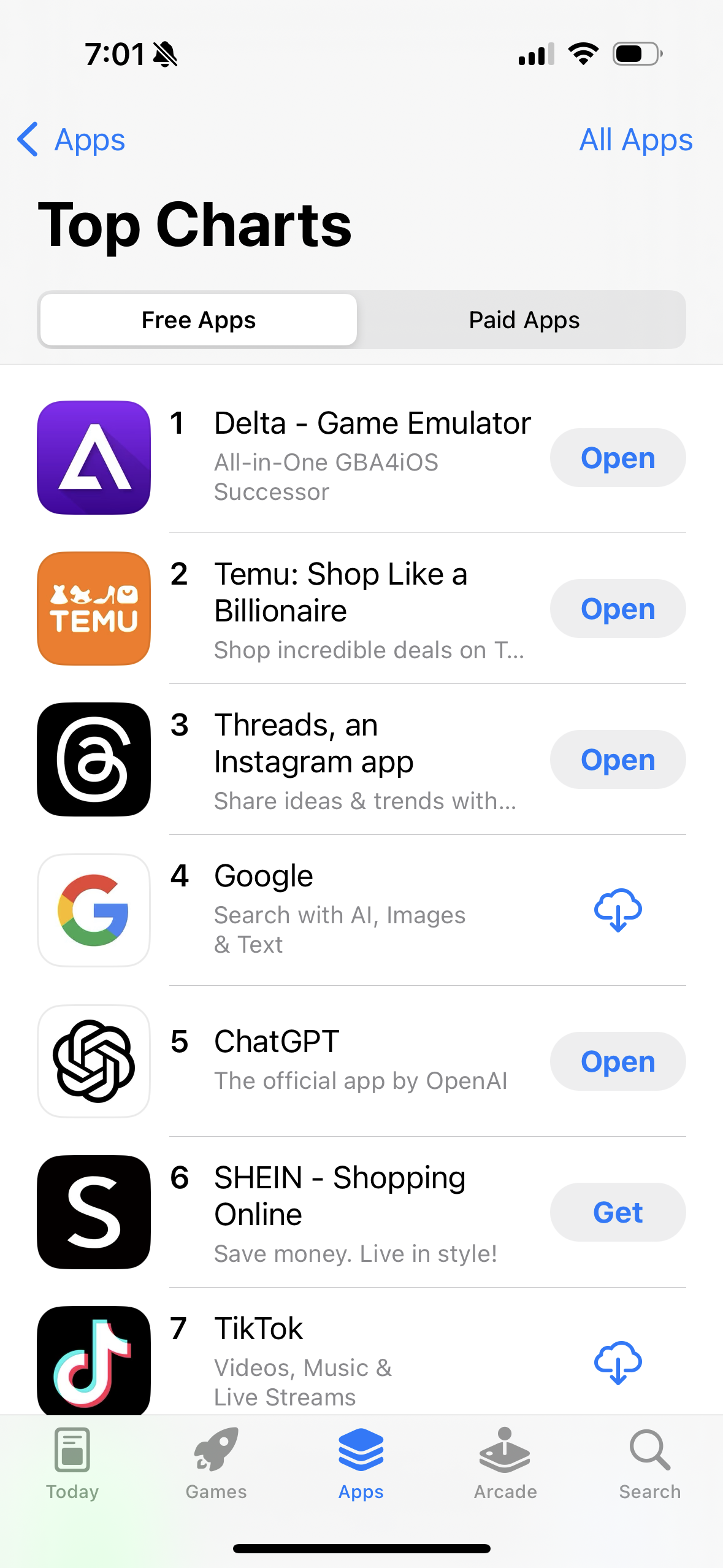
Tuesday, 16 April 2024
- ‘Papyrus 2’ ★
-
Jason Kottke:
Ryan Gosling was on Saturday Night Live this weekend and they did a sequel to one of my favorite SNL sketches (which is completely dorky in a design nerd sort of way) ever: Papyrus. Behold, Papyrus 2.
See also: Elle Cordova’s “Fonts Hanging Out” trilogy.
- ‘MKBHDs for Everything’ ★
-
Ben Thompson, marking the 10th anniversary of Stratechery as a full-time endeavor:
Who, though, is to blame, and who benefited? Surely the responsibility for the Humane AI Pin lies with Humane; the people who benefited from Brownlee’s honesty were his viewers, the only people to whom Brownlee owes anything. To think of this review — or even just the title — as “distasteful” or “unethical” is to view Humane — a recognizable entity, to be sure — as of more worth than the 3.5 million individuals who watched Brownlee’s review.
This is one of the challenges of scale: Brownlee has so many viewers that it is almost easier to pretend like they are some unimportant blob. Brownlee, though, is successful because he remembers his job is not to go easy on individual companies, but inform individual viewers who will make individual decisions about spending $700 on a product that doesn’t work. Thanks to the Internet he has absolutely no responsibility or incentive to do anything but.
The review is now up to 4.2 million views.
- Walt Mossberg, Still the King ★
-
Regarding the jacktastic argument that Marques Brownlee shouldn’t call the worst product he’s ever reviewed the worst product he’s ever reviewed, I’m reminded of the lede from Alan Deutschman’s 2004 profile of Walt Mossberg for Wired:
Walt Mossberg is walking through a convention hall at the Consumer Electronics Show in Las Vegas when a man starts screaming at him. The screamer, Hugh Panero, blames Mossberg for his company’s recent problems: falling stock price, a sudden plunge in consumer interest. Mossberg is annoyed but hardly intimidated. As the author of the weekly “Personal Technology” column in The Wall Street Journal, he’s used to dealing with disgruntled execs. He lets Panero shout. A crowd is gathering. Finally, Mossberg yells back, “I don’t give a fuck about your stock price!”
Keep reading. The story doesn’t end there.
What Mossberg always got right was that he relentlessly focused on his readers. Not what a product was supposed to be. Not what future versions might be. And not the fucking stock price of the company that made it. What he cared (and cares, in retirement) about was the actual experience of using the actual product, as it actually was, by actual users. He was rewarded with his readers’ trust.
That same mentality is what made Siskel and Ebert superstar film critics: they loved movies and they judged them for what they were, from the perspective of fellow moviegoers. They weren’t Hollywood insiders, and in the same way Mossberg didn’t give a fuck about XM Radio’s stock price, they didn’t give a fuck about how their reviews might affect opening weekend box office numbers. They cherished the trust of their TV viewers and newspaper readers, and rewarded them by providing nothing less than their fully honest expert appraisals of the movies they reviewed.
Art criticism has a long history, though. Consumer technology criticism does not. Mossberg blazed the trail.