
By John Gruber

OurCal: Shared calendar. Meet messenger.
Touch and Glow
Friday, 6 November 2026
I’m not cut out for Los Angeles.
It’s hard not to love the place, though. The weather is absurd. The people in LA, by and large, don’t believe in bad weather. It’s like a legend to them, like hearing about the Irish Potato Famine.
Angelenos are friendly and good looking. The food is good and varied. But you really do need to drive everywhere. Trips from any one part of the city to another invariably require time not just in a car but on a freeway. What is oft-described as LA’s sprawl, I would describe as a layout and geographic scale that is more like that of a small, densely populated nation than of a mere city. LA’s palpable vastness is incredible, in a wholly different sense than, say, Manhattan’s. I love to visit. I would never want to stay.
The greater San Francisco Bay Area, I don’t feel that way about. The weather there, too, is certainly nicer than back east, but it’s not implausibly nice. San Francisco is a walkable city and can punish you with its weather at certain times of the year. I’m not at all religious but I was raised in a Catholic family, and one way that’s stuck with me is that I innately believe we deserve some stretches of bad weather. That it’s good for us to suffer to some extent, like physical exercise and toiling at our jobs. That’s a stupid thing to believe, I know, but I believe it. We all believe some stupid things.
Los Angeles is an unusual place for Apple to hold a media event. They hold two big annual events on campus at Apple Park in Cupertino each year: WWDC in June, and the iPhone (and friends) event in September. Back in the old days, they held their major keynotes in San Francisco. I liked the old events in San Francisco better, if only because I enjoyed staying a few days in vibrant, gritty San Francisco better than the somnolent, sterile South Bay. But I think the events were more interesting too. Not better per se, but just more interesting. Less polished. More unique. Every inch of the Steve Jobs Theater was designed and crafted to host events like the annual iPhone introductions. It is an architectural marvel. But its perfection is off-putting. It somehow doesn’t quite feel realistic, even when you’re right there.
In its San Francisco events of yore, Apple experimented. The Macworld Expo and WWDC keynotes in Moscone North had an unavoidable sameness to them. But Apple held other events in other places in the 2010s, like the small Yerba Buena Theater across the street from Moscone, and the cavernous Bill Graham Civic Auditorium, which was built in 1915 and looks, feels, and smells like it. The room Apple used for its post-keynote hands-on area at Yerba Buena was always a little claustrophobic and very dark. This photo I took after the introduction of the original iPad in 2010 captures the feel of that room during those events.
A few years later, they held an event there in October 2013 and solved — or at least improved — the problem by knocking a hole in the wall to allow in some sunlight and fresh air. Here’s a picture from the hands-on area at that event, showing Tim Cook (Katie Cotton at his side, as ever) chatting with Ed Baig (then at USA Today, still on the beat today at AARP). You can see the open air over Cook’s shoulder.
After that event wound down, I grabbed lunch nearby, and then walked back through the plaza next to the theater. I don’t remember why. Best guess is that it was simply on the path back to my hotel. Apple already had a crew taking apart the entrance they’d added to the theater. Katie Cotton was outside, supervising. I stopped to chat. This was around 2:20pm, a little over four hours after the keynote and probably only 90 minutes after they’d politely escorted the last of us from the hands-on area inside. I didn’t write notes or record the chat, which would have been weird, but as best I recall, the conversation started with my saying something like “Man, you guys don’t waste any time, do you?” Cotton told me that while Apple loved the Yerba Buena venue, they were always bothered by the hands-on area being closed off and dark. I said that yes, it was previously a dank hellhole, and she laughed. She always seemed to genuinely enjoy my sarcasm. Apple, she explained, had inquired about options for opening that wall. Yerba Buena told them, sure, they could do whatever they wanted so long as they restored it after the event, but it would cost a small fortune. But to Apple the price was negligible, and they accepted the offer immediately and commenced with plans for how to do it.1 Cotton liked how it turned out, and I told her I agreed. It made for a noticeably nicer space.
My column about that October 2013 event began thus:
There is a certain sameness to almost every Apple event. A pattern, a formula, a structure, a rhythm and pacing. Does this make them boring? In some ways, certainly, insofar as the only thing we don’t know is what they’re going to say, as opposed to how they’re going to say it. (And even then, we often have a pretty good idea what they’re going to announce, too.)
And I went on to quote from — and then disagree with — then-NYT tech columnist Nick Bilton’s griping that Apple’s keynotes lacked “wow” and had grown stale. (Bilton is now leading failson David Ellison’s team of dipshit weasels who are sinking 60 Minutes, the crown jewel of CBS News.)
Somehow, here we are 13 years later (alas, not all of us), and there are still complaints about the repetitive sameness of Apple’s events. Yet Apple’s events these days don’t resemble that event from 2013 at all. Change comes slowly but it always comes.
I enjoyed last week’s “Pro and Tell” event more than any in recent memory. I enjoyed the venue — both the unique building and the city. I enjoyed the format. But most of all I loved the subject: the Mac.
The building is best known as CBS Columbia Square, opened in 1937 as the West Coast headquarters for CBS. The color of the event was blue — matching the default wallpaper for the new MacBook Pros with PROLED XDR displays. Blue carpet covered the sidewalk leading into the entrance. After walking up the carpet, checking in outside, and donning my press lanyard, the magnetometer dinged me, and I was pulled aside and politely but brusquely asked to put my briefcase on the (carpeted) ground, and wait for a busy police dog to take a smell at it. I presume the dog was sniffing for weapons, not drugs, but either way my bag passed muster. Inside, just past the lobby, Apple had created a rather spacious theater, with a large screen and stage. There were blue padded bench seats along the outside walls, but the primary center area of the space was for standing. From the floor to the room’s high ceiling, the walls were blue.
Behind the theater was a large area with coffee, water, and small breakfast treats. Invited guests — primarily tech journalists and social media creators — mingled and sipped. I checked my laptop bag, and carried only my notebook and phone for the morning. Apple PR reps were, as ever, present but never overpresent. Conversation touched upon the expected but as yet unknown touch-enabled MacBook Pros. Word spread that Steven Levy, the undisputed dean of the Apple press corps, had landed an exclusive first look for Wired. (Levy, ever the pro, and a delightful raconteur, confirmed only that, yes, he had the exclusive, but he offered not a word regarding its content before his agreed-upon embargo. His wry smile, though, betrayed that he was happy with what Apple was about to unveil.) Much of the pre-event chatter, however, was dominated by discussion about the iPhone Duo. A rather remarkable number of attendees had Duos in hand — many of them still in the midst of reviewing it, but others professed to having already gone all-in on it. To each their own; there’s no accounting for taste.
Shortly before 10am, word spread that it was time to pack into the theater. I squeezed in close to the stage. Why not? Steve Jobs, I noted, never took the stage quite on time. He was seldom more than two or three minutes late, but he was always at least two or three minutes late. Rock stars don’t take the stage on time. Tim Cook, on the other hand, was never late. A minute early, sometimes; a minute late, never. You could set your watch to 10:00 by listening for his “Good morning!”
John Ternus took the stage at 10:00.
He spoke briefly. Just a few minutes recapping Apple’s week of announcements. The new OLED iPad Mini, the new M6 MacBook Pro, the updates to Creator Studio. He spoke naturally and comfortably, and seemingly extemporaneously. He looks like he smells like Apple Park. He’s a cool guy. And he knows that Tim Cook handed him a killer lineup of new products to introduce over his first two months as CEO. Every one of Apple’s major platforms is in a good-to-great place. His on-stage remarks culminated with the introduction of the truly new MacBook Pros: “That’s why we’re here today — to mark another huge moment for MacBook Pro, and for the Mac itself.” When Ternus then announced, a moment later, “And yes, for the very first time, we are bringing touch to the Mac”, the audience erupted in gasps and cheers — a reminder that for as much as many of us know before Apple makes these announcements, a lot of the people in attendance do not even know who Mark Gurman is. A lot of the people in the room were genuinely shocked and surprised.
Apple paid a lot of money to put a fantastically bright screen behind Ternus, and they used that screen to show this two-minute “If you give a Mac an OLED” intro video. The first mention of touchscreen support, in that video, comes a full third of the way in.
Ternus teased the return of the glowing back-of-the-display Apple logo in a tweet that morning. On stage he made it official: “The logo is back.” I love the way he phrased that. Not “the glowing logo is back”. Just “the logo is back” — like it might as well not have been there in the unilluminated years since 2016. Fuck yeah.
The show in the theater was short and sweet. We shuttled off to the hands-on area by 10:15, if not sooner. The format of the event — or “experience”, as Apple calls these — mirrored that of the MacBook Neo experience in New York back in March. Brief welcoming remarks from Ternus, a crisp short video presented to a standing room of invited media guests, and then, boom, a scramble off to an expansive hands-on area. Apple didn’t stream Ternus’s live-on-stage remarks to the world back in March, and they chose not to again last week. They should. These aren’t live keynote events, but they are live events. I’m glad I’ve gotten to see them in person, but I wish everyone could see them online. They are good. Good things should be shown. Apple is run by people. Seeing the company’s CEO live on stage is a rare glimpse behind the aluminum and glass facade.
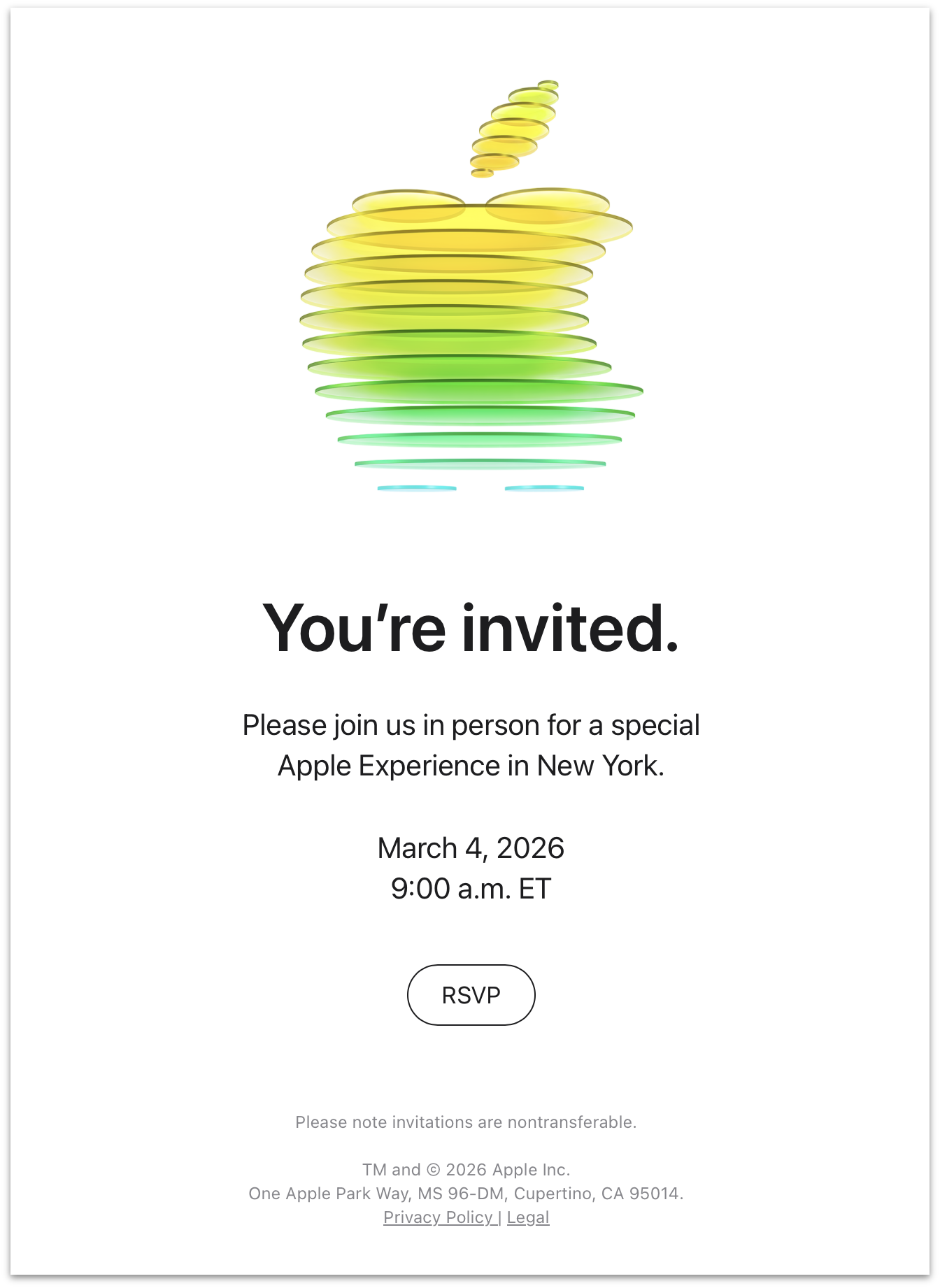
One is an anomaly. Two is a pattern. The Neo event (err, experience) back in March was like no other. This “Pro and Tell” MacBook Pro event was a lot like the Neo one. The Neo one didn’t get a punny title though — just a simple “You’re Invited” on the email invitation (although the decoration of the Apple logo hinted at the Neo’s signature citrus colorway). The Columbia Square building in Los Angeles is large, but it’s nowhere near as spacious as the empty warehouse in Chelsea where Apple held the Neo event. There seemingly were more invitees at last week’s event in LA too. In New York back in March, there was room to mingle. I snapped this fun photo of Jason Snell chatting with Phil Schiller, Greg Joswiak, and then-still-SVP-of-hardware John Ternus. Even setting aside Ternus’s subsequent promotion to CEO and levelling up in celebrity, that chat couldn’t have happened in the hands-on area of this event. There were too many people and too little space.
In the scramble after leaving the theater area, Apple reps were gladly informing attendees that there were two separate hands-on areas, and that “the one in the back” might be less crowded. It wasn’t. Both areas were tightly packed. They were tight tube-like hallways, with black walls, good lighting, and Apple Store-like tables upon which were arrayed the new MacBook Pros. Silver and space black; 14- and 16-inch; nano-texture and glossy. Some of the tables featured Apple’s speed-bumped M6 MacBook Pros, the enclosures for which are nearly indistinguishable from the machines everyone really wanted to see — the PROLED XDR M5 Pro and M5 Max models. I saw several attendees poking and sliding their fingers on the screens of those M6 models, to no avail, until someone gently told them “These are just the other new MacBook Pros.”
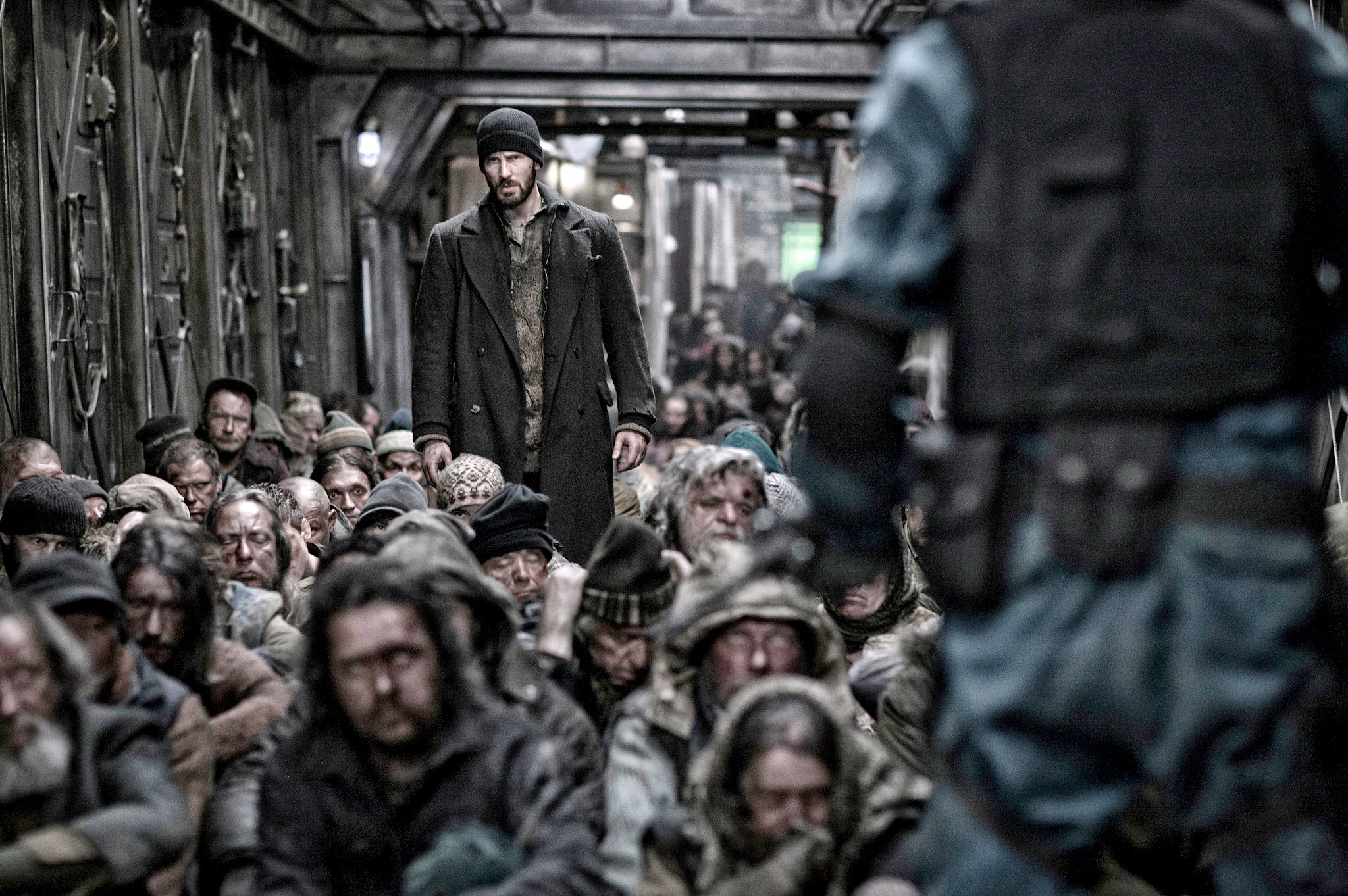
Packed shoulder-to-shoulder in a confined space with low ceilings, jostling for hands-on time with the PROLED XDR models, the temperatures — both atmospheric and emotional — got uncomfortably warm. It also became clear that some of the attendees chose not to shower that morning. The scene brought to mind the pungent imagery of the “coach” cars in Bong Joon-ho’s Snowpiercer.
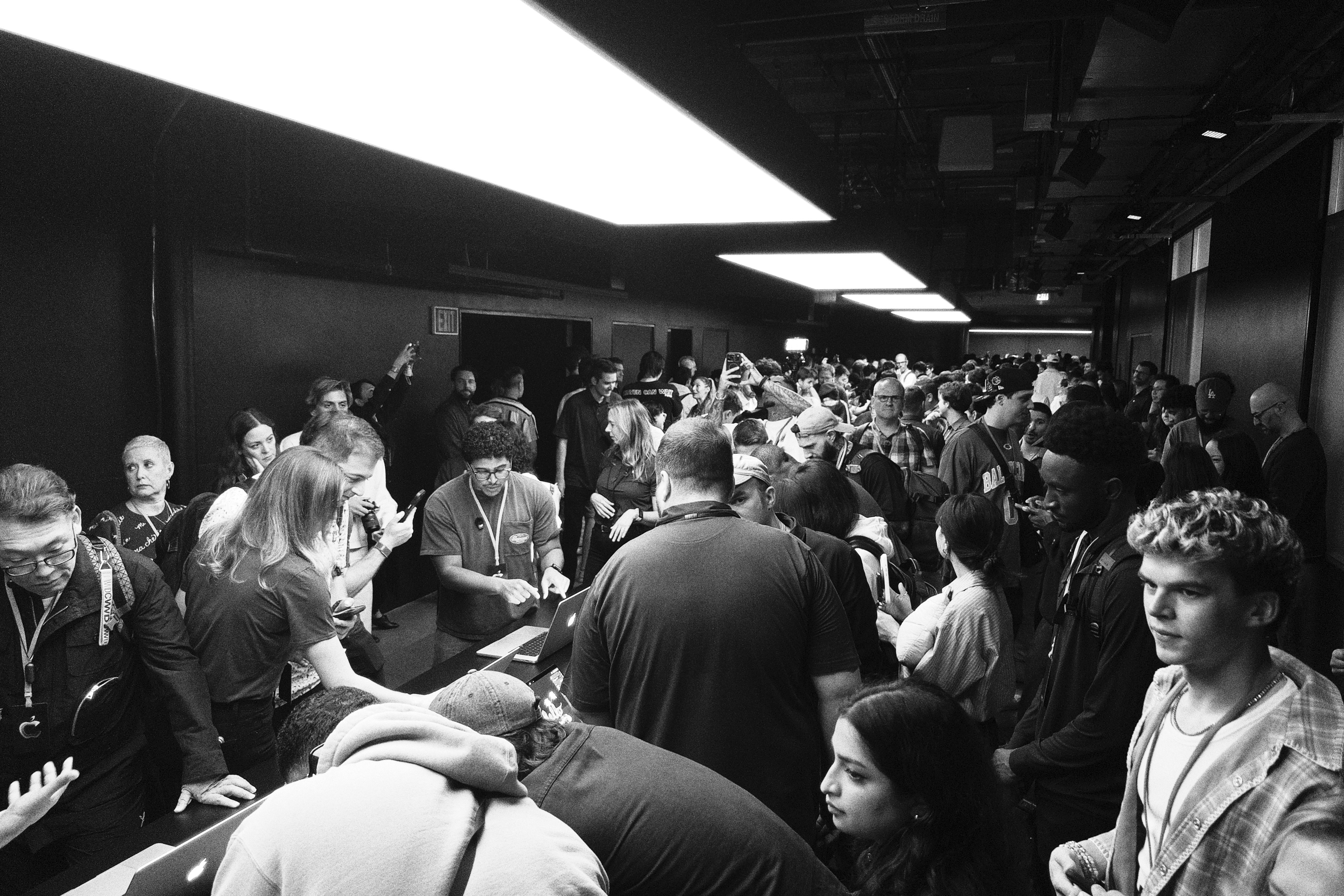
The Steve Jobs Theater, this was not.
But that’s not a complaint. This was different and different is good. It was a unique event in a unique venue. That’s good for Apple and good for those of us with the fortune to be invited to attend these things. Events at Steve Jobs Theater are held the SJT way. Apple adjusts and tweaks them, but the space defines them. An altogether new venue, whose ground floor Apple seemingly built out from scratch for this event, requires thinking about everything. And Apple’s thoughts are revealing. What I took away from the hands-on at this event is that Apple wanted us to get close to these MacBooks. To really look at them and appreciate them. No, they’re not radically different. They’re subtly different. But subtly different in very significant ways. That’s not exciting but it’s correct. The old MacBook Pros (including the new M6 model) were, by far, the best professional laptops ever made. The new ones are just better.
I like the hands-on scrums. There’s an energy to them you can use to gauge interest. When the products are genuinely exciting there’s a buzz that can’t be faked. People were fucking excited by these new MacBook Pros, and rightly so. These are the machines many of the people in attendance use themselves for their own work — our own work — all day, every day. The new tandem OLED displays are quite literally brilliant. You can see the difference even when they’re not side-by-side with the old mini-LEDs. When they are side-by-side, the old displays look washed. The new ones look wow.
And the “hands-on” aspect came into literal play two ways. First, yes, you can tap, swipe, and pinch the displays. Some people cared about that. A lot of others in the room, including yours truly, not so much. But even those of us who were ambivalent, at best, about touch coming to the Mac had reason to rejoice upon seeing Apple’s implementation: Apple added touchscreen support to MacOS the right way. Touch is decidedly secondary on MacOS. The density of the UI doesn’t change at all when you’re using a mouse pointer, and it only changes slightly to create larger tap targets when you touch the screen. This is the way. I would have bet that Apple would do it this way, but every bet is uncertain. And though the likelihood was low the stakes were high — a completely touch-first reimagining of the MacOS user interface would have been a devastating blow to an irreplaceable platform.
Second, the weight reduction Apple was able to achieve with these machines is astonishing. The 14-inch models weigh a full half pound less. The 16-inch models weigh 0.7 pounds less. Almost three-quarters of a pound! I saw numerous attendees picking up the hands-on demo machines to compare them to the personal MacBook Pros they were lugging around the event in their backpacks. Eureka after eureka. These are massive reductions in weight without — claims Apple — any decrease in sustained performance or battery life.
Next up, for some of us, were product briefings. I saw a disassembled PROLED XDR display panel. Five layers (I think?), each of them impossibly thin. A friend who was in another briefing group said the front panel cover glass shattered in the hands of one writer when it was passed around for examination. In my group — which might have been after that one — we didn’t get to touch anything.
Putting OLED into a laptop doesn’t magically make it good. Apple had a side-by-side comparison with a Lenovo Yoga 9 Whatever with an OLED display. The colors on that display were slightly greenish when viewed head-on, and garishly green when viewed off-angle. The colors on Apple’s PROLED XDR look remarkably good from any angle. Most surprising to me was Windows 11’s bizarrely clunky support for HDR images. When you open an HDR image, it displays as SDR, then you wait like 5–10 seconds for the display to “warm up” and only then does it show it in HDR — and when it does, the colors look bad. Getting a brief taste of “modern” Windows feels like visiting Cuba or something.
In the not-for-attribution Q&A after the briefing, I asked about the fact that the original glowing Apple logo in MacBooks — and PowerBooks — was a byproduct of the fact that the displays were backlit. There was a bright light sealed up inside the back of those display panels, and someone at Apple had the idea that if they just cut out the Apple logo on the back and fit it with translucent plastic, it would glow. Steve Jobs loved the idea and the rest is history. Every Mac laptop from 1999 through 2016 had a logo that glowed. Photos like this one from 2007 are iconic.
But OLED doesn’t use a backlight. Each pixel lights up on its own, which is how OLED’s blacks are so utterly black, and how light bleed is so drastically reduced. So if there’s no backlight, does that mean the new glowing logo has a light source of its own? Yes, was the answer. Apple engineered a custom light source just to enable the logo to glow once again, without adding any additional thickness to the lid. Someone else in my briefing group asked why Apple would bother doing that. “Because it’s awesome,” was the answer, which I’m quoting exactly and fully. That was the entire answer. Because it’s awesome.
If you work in a dark environment where the glowing logo might prove a distraction, or if you’ve had your sense of fun surgically removed, you can disable the light. The light-up logo was a particular source of joy for Apple executives and product managers, including the fact that they managed to keep it entirely secret. One difference between this new glowing logo and the old ones from 1999–2016 is that when the light is turned off on this one, it just looks like the highly polished Apple logos from MacBooks since 2016. It doesn’t look, at all, like a light that is turned off. Thus, Apple was able to keep it from leaking by not enabling the illumination in the builds of MacOS that were used by employees who were testing preproduction models inside the company.
Pure awesomeness. Fun for the sake of fun on the back. The best laptop display in the industry — by a longshot — on the front. How utterly Mac-like.
In the late afternoon came the “Pro Workflow Showcase”, on the third and fourth floors of the building. (The second floor held a cafe and an outdoor terrace with a separate coffee bar. There was an entire other cafe downstairs on the first floor. The coffee, as usual, was pretty good, and the small plates tasty and fresh.) This showcase featured half a dozen demonstrations from creative professionals using the Mac in innovative ways to pursue their various crafts. Impressive demos from obviously talented artists, one and all.
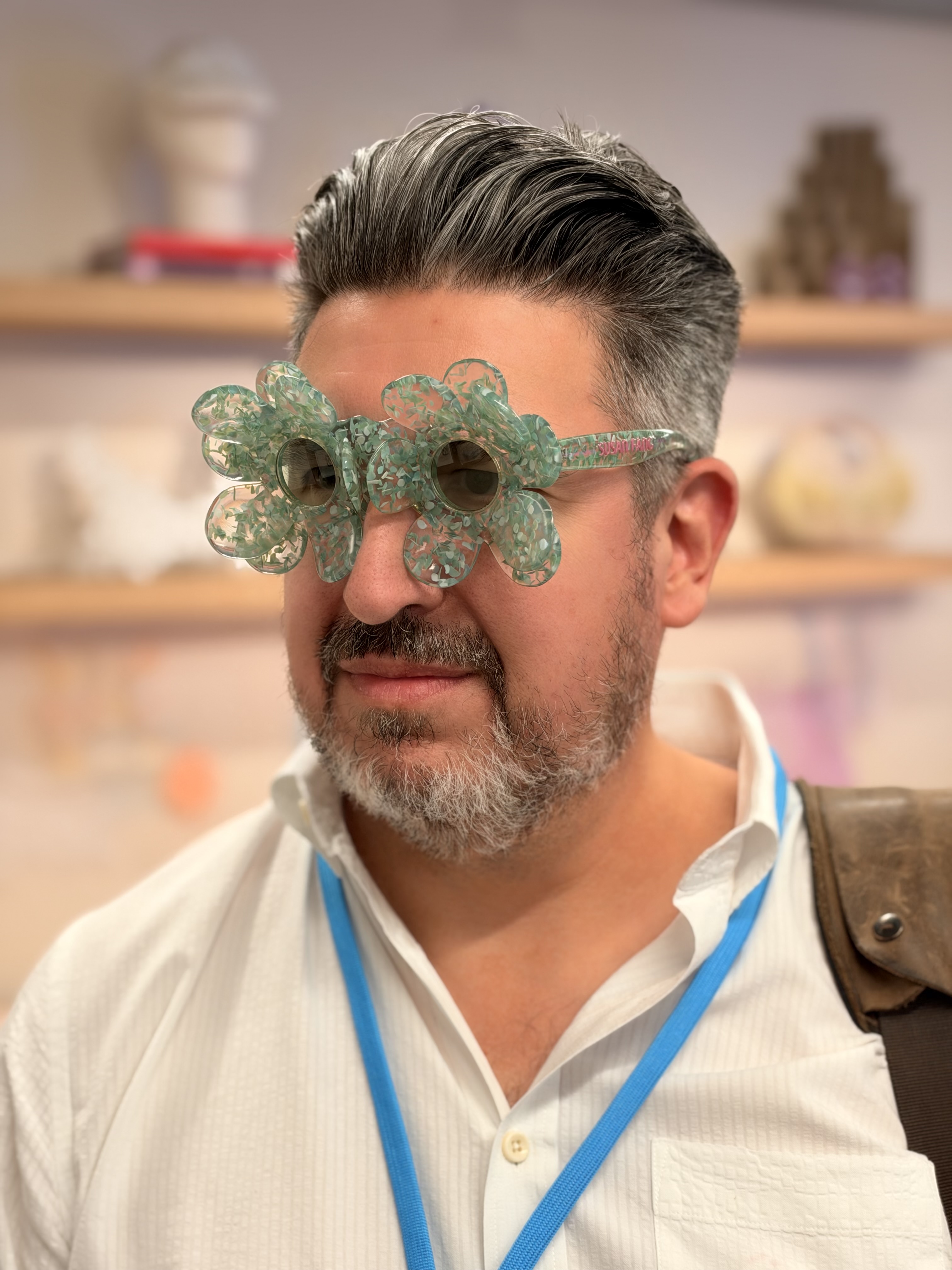
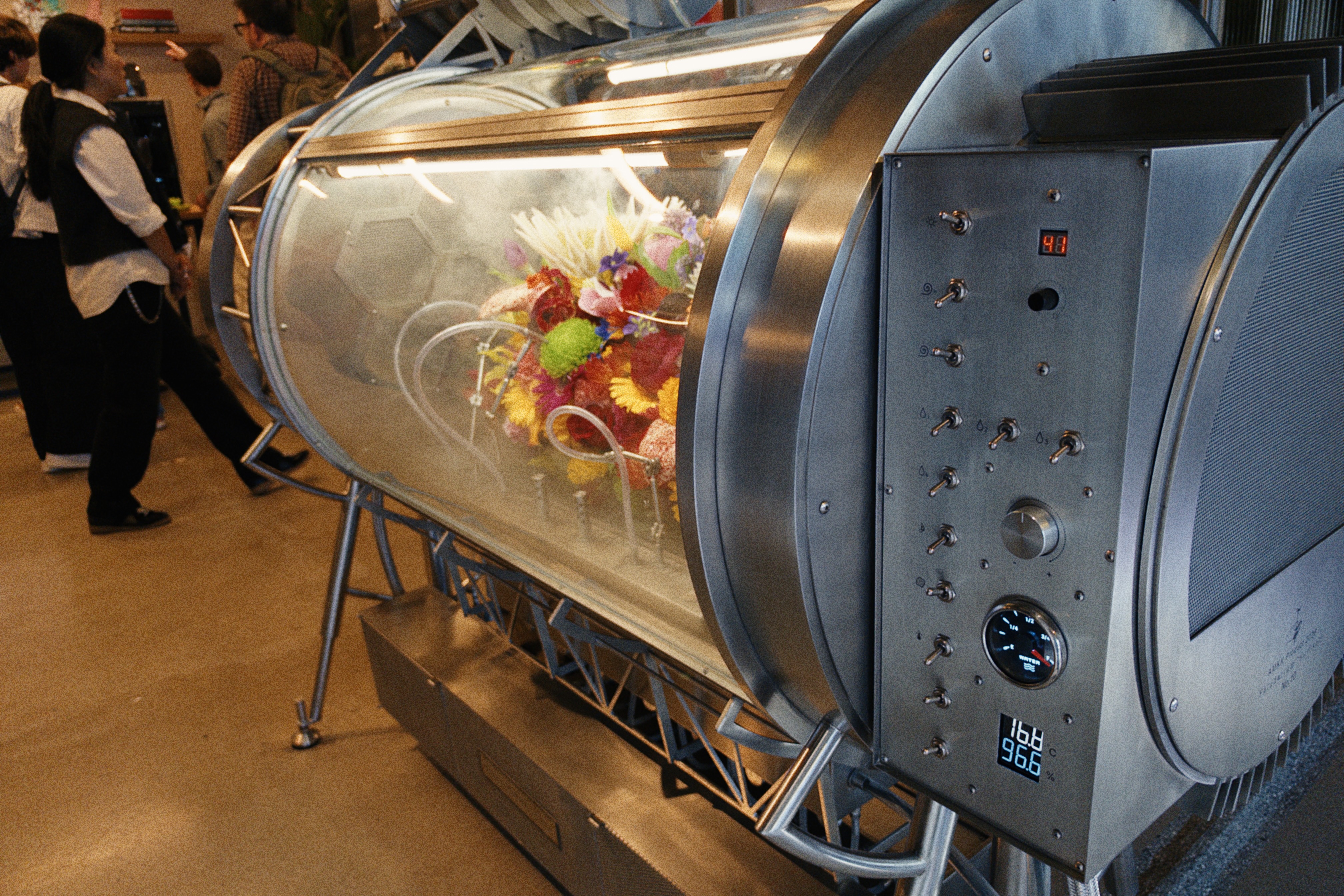
U.K. filmmaking brothers Will and Ed Reid (a.k.a. “The Reids”) showed off their “4D Gaussian splatting” workflow, which allows them to capture immersive 3D scenes using a synchronized array of nine iPhones used as cameras. Portrait photographer Jeremy Cowart, from Nashville, demonstrated his crazily customized studio workflow, which allows him to capture and process hundreds of still photos per minute, with the background behind the subject shifting with each frame. Record producer Fab Dupont, who has worked with musicians ranging from Bad Bunny to David Crosby, mixed music live in Logic Pro. (Dupont was particularly fond of the touchscreen on the new MacBook Pros, which he repeatedly stated he expected to ignore.) From the fashion world, the wife and husband duo of designers Susan Fang and Orelio de Jonghe showed off an array of intricate 3D-printed clothing, gowns, and accessories. I found a new pair of eyeglass frames that, I’m told, suit my face. (Photo credit: Austin Mann.) And then, most delightfully and surprisingly, there was a two-section demo area from Japanese experimental botanist and “haute couture” florist Azuma Makoto. Azuma was the subject of Flower Punk, a documentary short by Alison Klayman for The New Yorker back in 2020 — which, now that I’ve seen his work up close in person, is high atop my to-watch list. Azuma uses the Mac in multiple ways. First, to design elaborate, beautiful botanical sculptures. Second, to design and engineer intricate contraptions and machines — research equipment — that allow him and his team to optimize and control the blooming of picked flowers. Third, to control that equipment in operation. The machines are as beautiful as the flowers. I commented on the mechanical switches. They beg to be flipped just to feel them click. After hearing my brief question translated into Japanese, Azuma’s partner Shiinoki Shunsuke answered at length, with great enthusiasm. They’re often asked, he said, why they design their custom equipment with analog controls, rather than control them entirely through software. They feel that the physical nature of the plants inside the machines demands physical controls to manipulate their environment. It’s like touching the flowers without touching them. A beautiful description of hauntingly beautiful works at the intersection of technology, biology, and art. It’s like Doc Brown from Back to the Future meets Martha Stewart.
Oh, and there was one other demo station. It was from a small filmmaking outfit named Industrial Light and Magic, and the primary demo was helmed by John Knoll. Knoll co-created an image editor for the Mac in 1987 with his brother Thomas, and has pushed the cutting edge of VFX across five decades at ILM. Both the image editor and the movies he’s worked on have achieved a fair degree of renown and success. When I saw him, I was nearly dumbfounded. It was all I could do not to walk up to him and say what my mind was screaming: “You’re John Fucking Knoll.” John Fucking Knoll, doing demos on the third floor. Holy shit.
Knoll brought with him an elaborate rig from ILM. A spaceship model from Star Wars: Skeleton Crew. A real physical model. Behind the ship was a very large curved LED screen — a smaller version of the cavernous “Volume” 75-foot chamber that ILM first used for The Mandalorian in 2019. A miniature Volume for miniature models. In front of the ship was an iPhone camera with a large lens mounted on a track. In front of the track stood Knoll, controlling the whole apparatus from a MacBook Pro (with logo aglow, natch). Knoll built this motion-tracking camera control system in his garage and wrote the firmware himself. Of course. He’s John Fucking Knoll. And he showed us how they use this system to shoot a practical spaceship model flying through hyperspace that is being rendered, live, on the curved LED behind the model. It’s all just captured in camera. The secret is genlock, which syncs the video rendered on the LED in front of the camera with the video being captured on the camera — synchronized precisely not merely to the millisecond but to the microsecond.
There are two questions I can remember being obsessed with as a child, that started me on the path to what ultimately became my career. The first was, “How did they make Star Wars?”2 Now here I was, seeing, just a little at least, exactly how they make Star Wars today — in arm’s reach of an actual goddamn ILM spaceship miniature. And a big part of the answer of how they make it today is, “With the Mac.”
By my count Apple held four major events this year. Two of them were the inviolable tentpoles of the annual Apple calendar: WWDC in June, and the iPhone event in September — both held, as usual, at Apple Park. WWDC is the all-encompassing software event for all of Apple’s platforms. The iPhone event is the iPhone event, with Apple Watch as the opening act.
Apple’s other two major events in 2026 were the no-event-title Neo introduction in New York in March, and last week’s “Pro and Tell” introduction for the new MacBook Pros in Los Angeles — both of them big, expensive productions, both held in big, expensive cities far from Cupertino.
Now consider Jason Snell’s Six Colors chart of Apple’s quarterly revenue by product line for the last five years, up through last week’s results for Q4 2026:
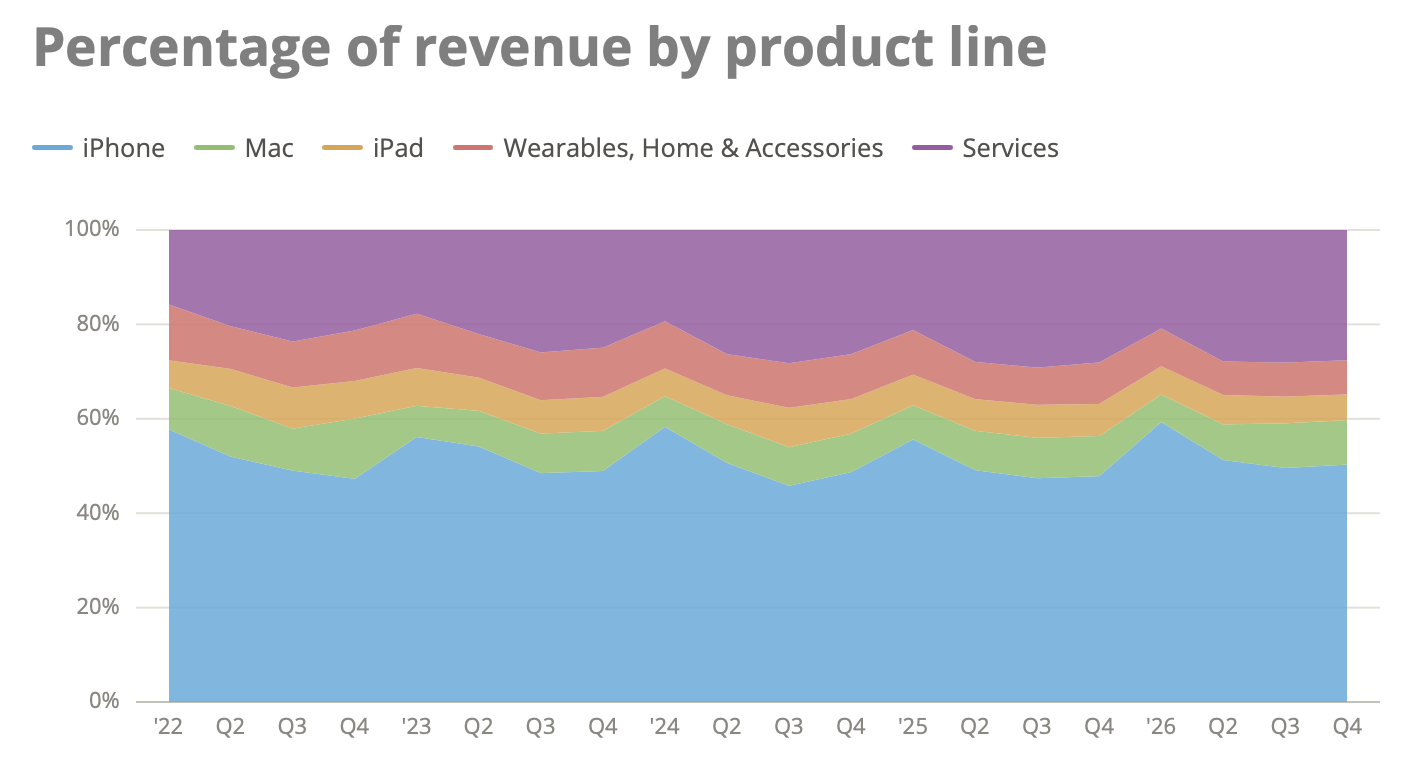
The green sliver represents the Mac’s share. Snell’s original chart is interactive — you can hover over it and get the specific breakdown for each quarter. The Mac’s share is consistently in the range of 7 to 9 percent for Q2, Q3, and Q4 each year. The iPhone is consistently around 50 percent in those quarters. In Q1 — the October/November/December holiday quarter — the iPhone jumps to around 60 percent, and the Mac drops to 5 or 6 percent. Year after year.
The Mac accounts for the high single digits of Apple’s revenue. High single digits, yes, but single digits. Yet two out of Apple’s four major events this year were focused entirely on the Mac. If you’re a pissant grump, you could argue that both of those events were wasteful, self-indulgent preening on Apple’s part. That the first one, for the MacBook Neo, was simply to announce a MacBook that cost $500 less than the previous entry point model, the MacBook Air. And the second one, last week in Los Angeles, was simply to announce MacBook Pros that cost $400 more than the previous ones, just to add touchscreen support that PC laptops have offered at lower prices for over a decade. All of this for a platform that doesn’t even account for 10 percent of the company’s revenue, with an operating system that ought to be put out to pasture.
What a miserably wrongheaded, ignorant, joyless take that would be.
These new MacBook Pros are worth showing off. What Mac users do and create on the platform is worth celebrating.
When I began closely following Apple, the Macintosh was Apple and Apple was the Macintosh. That hasn’t been true since the iPhone began its meteoric rise. Financially, Apple today is the iPhone, Services, and “everything else”.
But at the true center of Steve Jobs’s metaphorical intersection of Technology and the Liberal Arts, the Mac remains the heart and soul of everything Apple does, and responsible for so much of what users create with Apple’s products. We speak of people — both inside and outside the company — bleeding six colors. But the iPhone never had a six-color logo.
Apple has continuously adapted the Mac for changing times, changing technology, and a changing world, yet — for four decades — has kept it true to its original core. The Mac today is very recognizably the Mac to any user from any time in its illustrious history. Even touchscreen support, now, has been added the Macintosh way.
In 2010 I wrote “The Future of the Mac in an iOS World”. That piece has held up pretty well:
Here’s the short version of the “Mac is doomed” scenario: iOS is the future, Mac OS X is the past, and Apple, unlike most major tech companies, is strongly inclined to abandon the past in the name of the future.
You can’t really argue with that, can you? But the premise that the end is near for the Mac presupposes quite a bit about the near-term future of iOS. [...]
It’s the heaviness of the Mac that allows iOS to remain light.
When I say that iOS has no baggage, that’s not because there is no baggage. It’s because the Mac is there to carry it. Long term — say, ten years out — well, all good things must come to an end. But in the short term, Mac OS X has an essential role in an iOS world: serving as the platform for complex, resource-intensive tasks. The funny thing is, the best slogan to describe the Mac’s role is the same one it started with 25 years ago:
The computer for the rest of us.
I was only wrong then in fretting that the Mac might — perhaps — only have a decade or so yet ahead of it. Here we are now 16 years later and the Macintosh is more popular, more essential, more successful, and further ahead of its ostensible competition than ever in its 42-year history. Change comes slowly but it always comes.
The logo not only glows again. It might glow forever.
-
I am reminded of the delightful story of how Microsoft wound up with the rights to “Start Me Up” for the Windows 95 launch. The Rolling Stones had theretofore never licensed a song for use in a commercial. Mick Jagger had always handled such inquiries not by saying “no”, but instead by quoting astronomically high prices. Microsoft asked about “Start Me Up”, Jagger gave them a no-way-they’ll-say-yes price (supposedly $12 million) and Microsoft simply said, “Great, that’s a deal.” ↩︎