By John Gruber

WorkOS: How SSO works and the fastest way to add it.
Linked List: January 31, 2012
Tuesday, 31 January 2012
- Apple Hires Dixons CEO John Browett to Lead Retail ★
-
James Davey and Poornima Gupta, reporting for Reuters:
Apple chief Tim Cook, making his first high-profile hire since taking the helm of the world’s largest technology company, lured the well-regarded industry executive to fill a critical post once held by Ron Johnson, another outsider who left Target Corp to join Apple in 2000. […]
Browett, Dixons’ CEO since 2007, was previously chief executive of Tesco Plc’s successful online shopping site. He will oversee Apple’s retail strategy and the expansion of its stores around the world, from the current total of around 300.
You don’t see many executives trading up from CEO of one company to senior vice president of another. That Browett is from Europe is a pretty good signal that international expansion is a top priority for Apple retail.
- Tesla Motors Model S Options and Pricing ★
-
Looks great, and less expensive than I expected. I like my friend Nat Irons’s quip that the $50,000 40kWh model is “the white plastic MacBook of the product line”.
- Visualizing Apple’s Quarterly Results ★
-
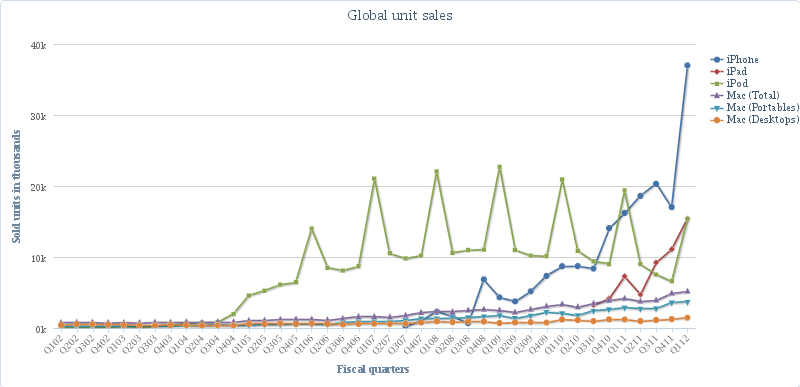
Fantastic tool by Francesco Schwarz for visualizing Apple unit sale and revenue growth over the past decade.
I stumbled across this earlier today when I asserted that the iPhone is now far more popular and profitable then the iPod ever was. Figured I should double check that, just to make sure. Not only is it true, but after last quarter it’s not even close. iPod unit sales followed a fairly regular pattern: about 10 million units sold per quarter for the first nine months of each calendar year, then a little over 20 million units sold each holiday quarter. Apple sold just under 23 million iPods in Q109 (the 2008 holiday quarter) — until this last quarter, that was the highest-ever quarterly unit sales number for an Apple product segment. Not only did the iPhone break the 30-million mark last quarter, but with a grand total of 37 million it came damn close to breaking the 40-million mark. Think about that: Apple had never sold 30 million of anything in a quarter and almost sold 40 million iPhones.
Now think about what happens if iPad sales continue to grow at their current trajectory.
- RIM Creates Four Cartoon Characters to Spread ‘Be Bold’ Message ★
-
Someone at RIM is even nuttier than those two guys who got drunk on that airplane and chewed their way out of their restraints.
- Sony, Too ★
-
Athima Chansanchai, reporting for Gadgetbox:
Sony’s Kate Dugan admitted that despite the natural disasters in Japan that affected production and shipment of its digital cameras, “true decline” has set in for digital cameras, in which sales are down 20 percent, the first time losses have hit in the double digits. The exodus is most pronounced amongst entry level users, who have turned to their phones as their all-in-one must-have gadget.
Dugan said that meant Sony has to focus on things phones can’t achieve, such as “high optical zoom, low light shooting, full HD video.” The way the company sees it, phones are fine to shoot food on the fly, but for “important moments should go to cameras.”
Compare and contrast Sony’s approach to dealing with the decline in point-and-shoot camera sales with Apple’s approach to the decline in iPod sales. Apple is skating to where the puck is heading; Sony is skating to where the puck is at the moment. Apple executives have long been on the record that the company is OK with iPod sales being cannibalized by smartphones — so long as they are Apple’s own smartphones. That’s worked out well for Apple, because the iPhone is now far more popular and profitable than the iPod ever was. They didn’t hesitate in 2007 to make the first iPhone, in Steve Jobs’s own words, “the best iPod ever” too.
Sony makes camera phones, too. But their phones are not as popular as their cameras were. (Could be worse. Consider, say, Canon and Nikon, whose point-and-shoot camera sales are in decline but neither of which even make smartphones.) Sony should no more abandon the point-and-shoot camera market than Apple should abandon the music-playing iPod market, but Sony has to recognize that it’s a business in decline and that the future is in putting better cameras into phones.