By John Gruber

We’re just out
here a-havin’ fun
In that warm
California sunnn…
Linked List: September 30, 2015
Wednesday, 30 September 2015
- Google’s New ‘Customer Match’ for Ads ★
-
Sridhar Ramaswamy, Google’s senior vice president for ads and commerce:
Customer Match is a new product designed to help you reach your highest-value customers on Google Search, YouTube, and Gmail — when it matters most. Customer Match allows you to upload a list of email addresses, which can be matched to signed-in users on Google in a secure and privacy-safe way. From there, you can build campaigns and ads specifically designed to reach your audience. Users can control the ads they see, including Customer Match ads, by opting out of personalized ads or by muting or blocking ads from individual advertisers through Google Ads Settings.
Here’s Peter Gothard’s take on what this means, writing for Computing:
Google is close to rolling out a tool named “Customer Match” which, it appears, will combine a logged-in Google account with any email address handed by a customer to a retailer to create lists of addresses to target specific users with marketing material.
The search giant can sit comfortably with this arrangement, as the lists of emails are anonymised through the service, meaning Google keeps hold of the specific details and the retailer doesn’t get them, but can use them to blind dump advertising into Google-based sessions in services such as YouTube, Gmail or basic search functions on the Google homepage.
The bottom line: ever-more-personally-targeted ads, and a growing divide between Google’s and Apple’s approach to privacy.
- Recode: Jack Dorsey to Be Named Permanent Twitter CEO ★
-
Kara Swisher and Kurt Wagner, reporting for Recode:
Jack is back — for good this time.
Twitter co-founder Jack Dorsey, who has been serving as interim CEO for the past three months, is expected be named the company’s new permanent CEO as early as tomorrow, although that timeframe may change, according to sources. Dorsey will apparently continue to run Square, the payments company he founded where he’s also CEO.
I feel good about this — Dorsey values product design, and he understands what makes Twitter what it is.
- How-To Geek: ‘Apple Maps vs. Google Maps’ ★
-
Chris Stobing, writing for How-To-Geek:
Going into this article, I thought we were going to have a clear winner with Google Maps sitting comfortably out front. However, it was a pleasant surprise to find that with Apple Maps updated and all the kinks finally worked out, the debate between Google or Apple Maps eventually just comes down to your own personal preference.
I know that Apple Maps still has terrible data for certain parts of the world. But I’ve been saying for a while now that for a lot of us, it’s gotten pretty good. I do still have Google Maps installed on my phone, but I haven’t used it in months.
- Apple Actually Wants You to Read and Understand Its Privacy Policies ★
-
Matthew Panzarino on Apple’s new Privacy Policy:
This is the template for all other tech companies when it comes to informing users about their privacy. Not a page of dense jargon, and not a page of cutesy simplified language that doesn’t actually communicate the nuance of the thing. Instead, it’s a true product. A product whose aims are to inform and educate, just as Apple says its other products do.
An example:
Here’s a tidbit with regards to Apple Maps. When you query Maps for a trip, Apple generates a generic device identifier and pulls the info using that, rather than an Apple ID. Halfway through your trip, it generates another random ID and associates the second half with that. Then, for good measure, it truncates the trip data so the information about exact origin and destination are not kept. That data is retained for 2 years to improve Maps and then deleted.
Pretty sure Google Maps doesn’t work that way.
- ‘Evidently’ ★
-
Kyle Wiens, iFixit:
You might have noticed that there’s no longer an iFixit app in the Apple’s App Store. We are sorry for anyone this has inconvenienced.
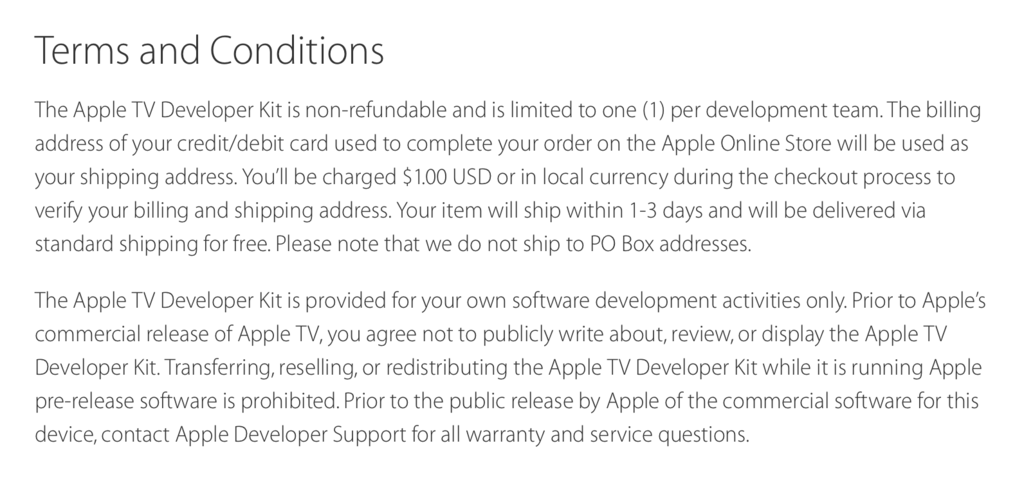
Not too long ago, we tore down the Apple TV and Siri Remote. The developer unit we disassembled was sent to us by Apple. Evidently, they didn’t intend for us to take it apart. But we’re a teardown and repair company; teardowns are in our DNA — and nothing makes us happier than figuring out what makes these gadgets tick. We weighed the risks, blithely tossed those risks over our shoulder, and tore down the Apple TV anyway.
A few days later, we got an email from Apple informing us that we violated their terms and conditions — and the offending developer account had been banned. Unfortunately, iFixit’s app was tied to that same account, so Apple pulled the app as well. Their justification was that we had taken “actions that may hinder the performance or intended use of the App Store, B2B Program, or the Program.”
“Evidently, they didn’t intend for us to take it apart” is the funniest thing I’ve read today. This isn’t some niggling technicality — they violated the spirit and plainly written letter of the developer kit agreement. Of course Apple was going to react. Whether a complete suspension of iFixit’s developer account is a just punishment is debatable, but it certainly shouldn’t be surprising.
There is, however, a certain purity to iFixit’s actions here, like the fable of the scorpion and the frog. It’s dishonest to blatantly violate an NDA, but it’s iFixit’s institutional nature to disassemble and publish every gadget they get their hands on.
- The Success of iOS Ad Blockers Is Not ‘Ironic’ ★
-
Jacob Davidson, writing for Time:
But Apple’s move to allow ad blockers has changed all that. In the days since iOS 9’s release, ad blockers quickly became the best selling software in the App Store. That means, ironically enough, that iPhone users want an ad-free mobile experience so badly they’re willing to pay directly for it.
That’s not irony. There is nothing ironic about people being willing to pay for something of value that removes something of negative value. What he’s trying to say here is that he had assumed that people are unwilling to pay for things and would put up with anything so long as it was free — and so he’s surprised to be proven wrong. But rather than face his wrong assumptions that led to his surprise, he’s chalking it up to iOS users doing something “ironic”.
What would be ironic would be if iOS users were buying ad blockers that were advertised via web banner ads that the blockers themselves block. Update: This isn’t quite irony, but it is chutzpah.
- Philadelphia City Paper to Cease Print Publication ★
-
Sam Wood, reporting for The Philadelphia Inquirer:
City Paper, Philadelphia’s feisty alternative newspaper, will cease its print publication as of Oct. 8. News of the prize-winning weekly’s demise came as a surprise this afternoon to the publication’s editors and staff writers. […]
City Paper’s website operations will be consolidated with philadelphiaweekly.com, which until today was City Paper’s primary competitor.
Unsurprising, given the current media climate, but City Paper and Philadelphia Weekly were arch-rivals. An ignominious end.
- MarketWatch: ‘Google Unveils Everything Apple Launched, Only Cheaper’ ★
-
I love this headline. Seriously, it’s perfect.
- Donald Trump Is Not Going Anywhere ★
-
Terrific behind-the-scenes profile of Trump on the campaign trail, by Mark Leibovich for the NYT Magazine:
“Don’t speak,” Trump instructed me as I sat down next to him in a Suburban. That was fine by me. None of the five staff members and security people in the vehicle said a word. We sat, per Trump’s dictate, in silence for the half-hour drive. It was almost comforting to me that he would take a break from being Donald, the Brand, and turn relatively “off” in my presence; that he could, as much as he ever does, retreat into himself. I wondered what he was thinking about.
There’s a you-are-there feel to Leibovich’s piece that I just love.
- AnandTech: iPhone 6s and iPhone 6s Plus Preliminary Results ★
-
It’s not just CPU performance: reading and writing to SSD storage have improved tremendously since last year — and are way ahead of the rest of the industry.