By John Gruber

We’re just out
here a-havin’ fun
In that warm
California sunnn…
Linked List: April 19, 2023
Wednesday, 19 April 2023
- Warren Buffett on Apple ★
-
Warren Buffett, asked on CNBC about Berkshire Hathaway’s largest holding, Apple (they own nearly 6 percent of Apple’s stock)
“If you’re an Apple user and somebody offers you $10,000, but the only proviso is they’ll take away your iPhone and you’ll never be able to buy another, you’re not going to take it. If they tell you if you buy another Ford car — they’ll give you $10,000 not to do that — you’ll take the $10,000 and you’ll buy a Chevy instead.”
Buffett, famously, isn’t technically minded. But I think that helps him understand Apple’s value. He’s right: Apple’s moat is customer loyalty, and that loyalty is earned through user experiences that other companies can’t match.
Using Ford and Chevy as his counterexamples is serendipitous, as Dare Obasanjo quipped:
Someone should print this tweet out, frame it and give it to the CEO of GM in commemoration of their decision to stop supporting CarPlay in their vehicles.
It’s true. The anger over GM’s decision to drop CarPlay and Android Auto support in its EVs is really only anger about dropping CarPlay.
- WhatsApp, Signal, and Other Secure Messaging Platforms Write Open Letter to the UK Government Defending End-to-End Encryption ★
-
From an open letter signed by the leaders of WhatsApp, Signal, Viber, and a few other secure services:
Proponents say that they appreciate the importance of encryption and privacy while also claiming that it’s possible to surveil everyone’s messages without undermining end-to-end encryption. The truth is that this is not possible.
We aren’t the only ones who share concerns about the UK Bill. The United Nations has warned that the UK Government’s efforts to impose backdoor requirements constitute “a paradigm shift that raises a host of serious problems with potentially dire consequences”. Even the UK Government itself has acknowledged the privacy risks that the text of the Bill poses, but has said its “intention” isn’t for the Bill to be interpreted this way.
Global providers of end-to-end encrypted products and services cannot weaken the security of their products and services to suit individual governments. There cannot be a “British internet,” or a version of end-to-end encryption that is specific to the UK.
The UK Government must urgently rethink the Bill, revising it to encourage companies to offer more privacy and security to its residents, not less. Weakening encryption, undermining privacy, and introducing the mass surveillance of people’s private communications is not the way forward.
I’m glad to see these companies defending end-to-end encryption, but this letter dances around the repercussions of this proposed legislation in the U.K. What they mean in the third paragraph quoted above is that if the legislation passes, people in the U.K. won’t be able to use WhatsApp or Signal or any other end-to-end encrypted service. Apple isn’t a signatory of the letter, but I think iMessage would be banned too.
Some reports are portraying this as though these services would begrudgingly comply if the law passes, but they can’t. End-to-end encryption is inherent to the protocols. If end-to-end encrypted messaging is banned in the U.K., it won’t mean that WhatsApp, Signal, et al will somehow switch to insecure protocols in order to comply — it will mean that people in the U.K. can’t use these apps.
It’s tough, messaging-wise, because coming right out and saying that sounds like these companies won’t comply, by choice. Laypeople seemingly can’t be made to understand that a “good-guys-only back door” is cryptographically impossible. But that’s the truth. WhatsApp is incredibly popular in the U.K. — the message should not be that U.K. lawmakers are trying to weaken WhatsApp’s encryption, but rather that U.K. lawmakers are going to make WhatsApp illegal.
- Washington Post Analysis of the Content That Trained Google’s ‘C4’ LLM Data Set ★
-
The Washington Post:
Tech companies have grown secretive about what they feed the AI. So The Washington Post set out to analyze one of these data sets to fully reveal the types of proprietary, personal, and often offensive websites that go into an AI’s training data.
To look inside this black box, we analyzed Google’s C4 data set, a massive snapshot of the contents of 15 million websites that have been used to instruct some high-profile English-language AIs, called large language models, including Google’s T5 and Facebook’s LLaMA. (OpenAI does not disclose what datasets it uses to train the models backing its popular chatbot, ChatGPT).
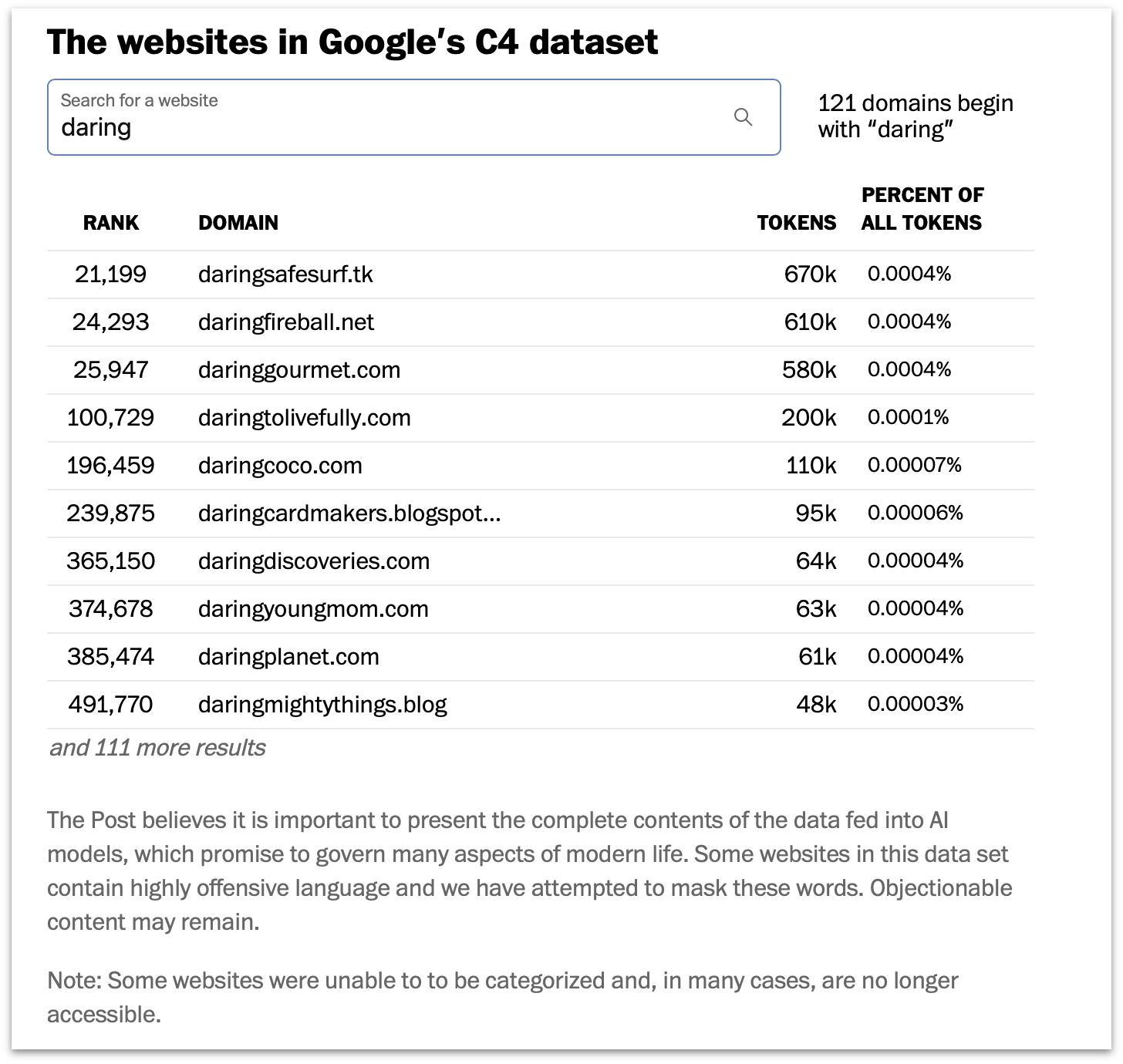
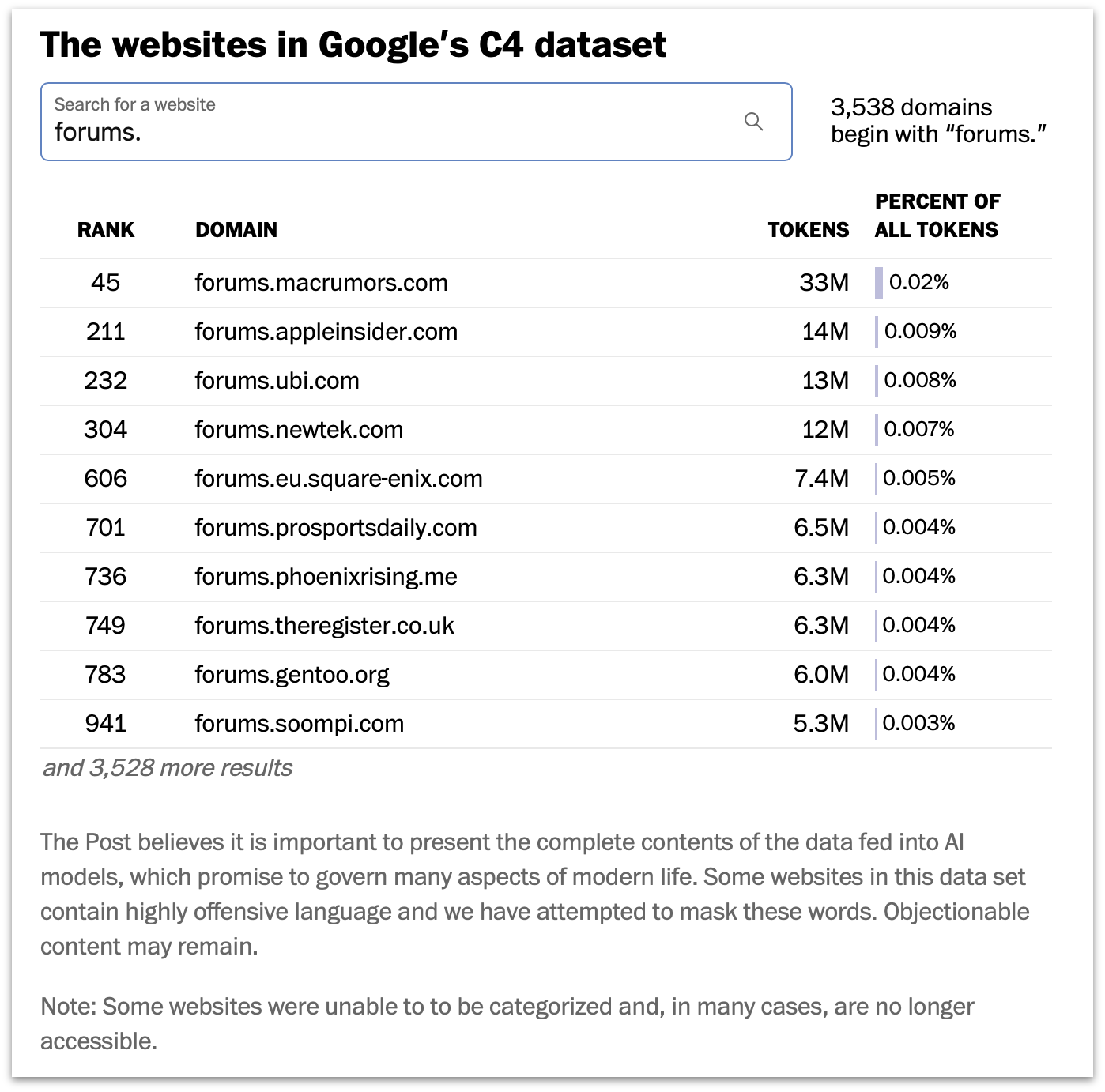
Scroll the bottom and they have a tool that lets you search for the ranking of a particular website. Daring Fireball is #24,293; Kottke.org is right behind at #25,310; Six Colors is #38,783; Stratechery is #57,283. MacRumors is way up at #761. MacRumors’s forums are at #45, and Apple Insider’s forums are at #211. The New York Times is #4, and The Washington Post itself #11.
- App of the Day: Glucomate ★
-
New app from developer Zach Simone — an iPhone and Apple Watch app for blood glucose recording, tracking, and monitoring. I don’t have diabetes, but I know many people who do or have loved ones who do, and it seems hard to overstate how important blood glucose monitoring is. Simone, on his blog:
For over 20 years, I’ve had to monitor my blood glucose every single day. The way in which I monitor it has changed a bit over the years, but the need to stay on top of the readings hasn’t. [...]
A [continuous glucose monitor] generates a lot of data, and the one I use even writes that data to HealthKit (though admittedly with a 3-hour delay). Real-time information is only available via the manufacturers app, unless you’re willing to jump through many hoops. No matter, there’s still a huge amount of data being collected. And it starts to build up. But surely all of this data is good for something. What can we do with it?
That’s where Glucomate comes in. It’s an app for people who record, track, and monitor their blood glucose and use HealthKit to do it. Glucomate is the app that finally does something with all that data. You can analyse recent readings, spot trends, or go back to any date and view its history. It does all this while trying to look as good as possible. A notable feature is the ability to customise each of the tabs by reordering the displayed data. You can even choose to hide the data that isn’t relevant to you.
The best apps, almost invariably, come from developers scratching their own itches. It looks to me like Simone has made a terrifically practical tool for anyone monitoring their blood glucose levels. If you have diabetes or know someone who does, Glucomate seems worth a look.
(There are rumors that future Apple Watch models might integrate sensors that read blood glucose levels continuously and non-invasively (read: without puncturing your skin), but that’s just a rumor, and even if it comes to pass, diabetics will still need ways to monitor their trends.)
- Four Takeaways From the Dominion v. Fox News Settlement ★
-
Great piece by Aaron Blake for The Washington Post that covers a lot of ground succinctly. This point stuck out to me:
Dominion says it’s not done, either, with lawyer Stephen Shackelford saying: “We’ve got some other people who have some accountability coming toward them. And we’ll move right on to the next one.”
Dominion is also suing MyPillow CEO Mike Lindell, who promoted the false election claims on Fox and elsewhere. (Lindell’s fate would also seem to matter greatly to Fox, given that documents in the Dominion case show Fox referring to him as the network’s top advertiser.)
Part of the way Fox News dug itself such a hole on this matter is that they were satisfying two demands at once: their audience wanted to hear these nonsensical lies about the election being rigged, and their top advertiser — Lindell — desperately wanted to come on the air to promulgate them.
See also: Elahe Izadi’s report for the Post on the one cable news channel that is reporting on this settlement very quietly. You’ll never guess which.