By John Gruber
WorkOS: How SSO works and the fastest way to add it.
Linked List: April 16, 2024
Tuesday, 16 April 2024
- ‘Papyrus 2’ ★
-
Jason Kottke:
Ryan Gosling was on Saturday Night Live this weekend and they did a sequel to one of my favorite SNL sketches (which is completely dorky in a design nerd sort of way) ever: Papyrus. Behold, Papyrus 2.
See also: Elle Cordova’s “Fonts Hanging Out” trilogy.
- ‘MKBHDs for Everything’ ★
-
Ben Thompson, marking the 10th anniversary of Stratechery as a full-time endeavor:
Who, though, is to blame, and who benefited? Surely the responsibility for the Humane AI Pin lies with Humane; the people who benefited from Brownlee’s honesty were his viewers, the only people to whom Brownlee owes anything. To think of this review — or even just the title — as “distasteful” or “unethical” is to view Humane — a recognizable entity, to be sure — as of more worth than the 3.5 million individuals who watched Brownlee’s review.
This is one of the challenges of scale: Brownlee has so many viewers that it is almost easier to pretend like they are some unimportant blob. Brownlee, though, is successful because he remembers his job is not to go easy on individual companies, but inform individual viewers who will make individual decisions about spending $700 on a product that doesn’t work. Thanks to the Internet he has absolutely no responsibility or incentive to do anything but.
The review is now up to 4.2 million views.
- Walt Mossberg, Still the King ★
-
Regarding the jacktastic argument that Marques Brownlee shouldn’t call the worst product he’s ever reviewed the worst product he’s ever reviewed, I’m reminded of the lede from Alan Deutschman’s 2004 profile of Walt Mossberg for Wired:
Walt Mossberg is walking through a convention hall at the Consumer Electronics Show in Las Vegas when a man starts screaming at him. The screamer, Hugh Panero, blames Mossberg for his company’s recent problems: falling stock price, a sudden plunge in consumer interest. Mossberg is annoyed but hardly intimidated. As the author of the weekly “Personal Technology” column in The Wall Street Journal, he’s used to dealing with disgruntled execs. He lets Panero shout. A crowd is gathering. Finally, Mossberg yells back, “I don’t give a fuck about your stock price!”
Keep reading. The story doesn’t end there.
What Mossberg always got right was that he relentlessly focused on his readers. Not what a product was supposed to be. Not what future versions might be. And not the fucking stock price of the company that made it. What he cared (and cares, in retirement) about was the actual experience of using the actual product, as it actually was, by actual users. He was rewarded with his readers’ trust.
That same mentality is what made Siskel and Ebert superstar film critics: they loved movies and they judged them for what they were, from the perspective of fellow moviegoers. They weren’t Hollywood insiders, and in the same way Mossberg didn’t give a fuck about XM Radio’s stock price, they didn’t give a fuck about how their reviews might affect opening weekend box office numbers. They cherished the trust of their TV viewers and newspaper readers, and rewarded them by providing nothing less than their fully honest expert appraisals of the movies they reviewed.
Art criticism has a long history, though. Consumer technology criticism does not. Mossberg blazed the trail.
- Jackass of the Week: Daniel Vassallo ★
-
Daniel Vassallo, who has over 172,000 followers on Twitter/X, regarding Marques Brownlee’s scathing but utterly fair (if not bend-over-backwards fair) “The Worst Product I’ve Ever Reviewed... For Now” review of the Humane AI Pin:
I find it distasteful, almost unethical, to say this when you have 18 million subscribers.
Hard to explain why, but with great reach comes great responsibility. Potentially killing someone else’s nascent project reeks of carelessness.
First, do no harm.
We disagree on what my job is.
There’s cool, and then there’s cool.
- No Notes ★
-
John Davidson, writing for the Australian Financial Review on Phil Schiller’s testimony in Australia, where Apple is once again facing off against Epic Games (archive link in case FR’s web server goes down):
The casual approach to its meetings, instituted by Apple co-founder Steve Jobs when he returned to the company in 1997 after having been fired in 1985, explained why Epic’s lawyers could find precious few contemporaneous records of Apple’s decision-making processes since the App Store was first launched in 2007, Mr Schiller suggested.
“When Mr Jobs came back in 1997, in one of the earliest meetings someone was taking notes, writing down what [Mr Jobs] was saying about what we’re doing. He stopped and said ‘Why are you writing this down? You should be smart enough to remember this. If you’re not smart enough to remember this you shouldn’t be in this meeting’. We all stopped taking notes and learnt to just listen and be part of the conversation and remember what we were supposed to do. And that became how we worked.” Mr Schiller testified.
“It was very action-oriented. It was built to be like a small start-up where we all are working together on the same things, and we all know what our plans are and what we’re doing.”
And:
Nor is there much talk in meetings of how profitable the Apple App Store is, despite the fact it would be the 63rd biggest company on the Fortune 500 if it were hived off as a separate entity.
“Are you telling His Honour that you have no idea whether ... the App Store has been profitable?” asked an incredulous Neil Young, KC, leading the cross-examination on behalf of Epic Games.
“I believe it is [profitable],” replied Mr Schiller, who has been in charge of the App Store since the beginning. “I’m simply saying ‘profit’ as a specific financial metric is not a report I get and spend time on. It’s not how we measure our performance as a team,” he said.
Sounds like Epic is getting its hat handed to it once again.
- Seeing What One Wants to See ★
-
Matt Stoller, linking to the aforelinked FT report on Apple “losing” the top spot in IDC’s phone market share figures:
The early signs that Apple is having a Boeing-like slow collapse.
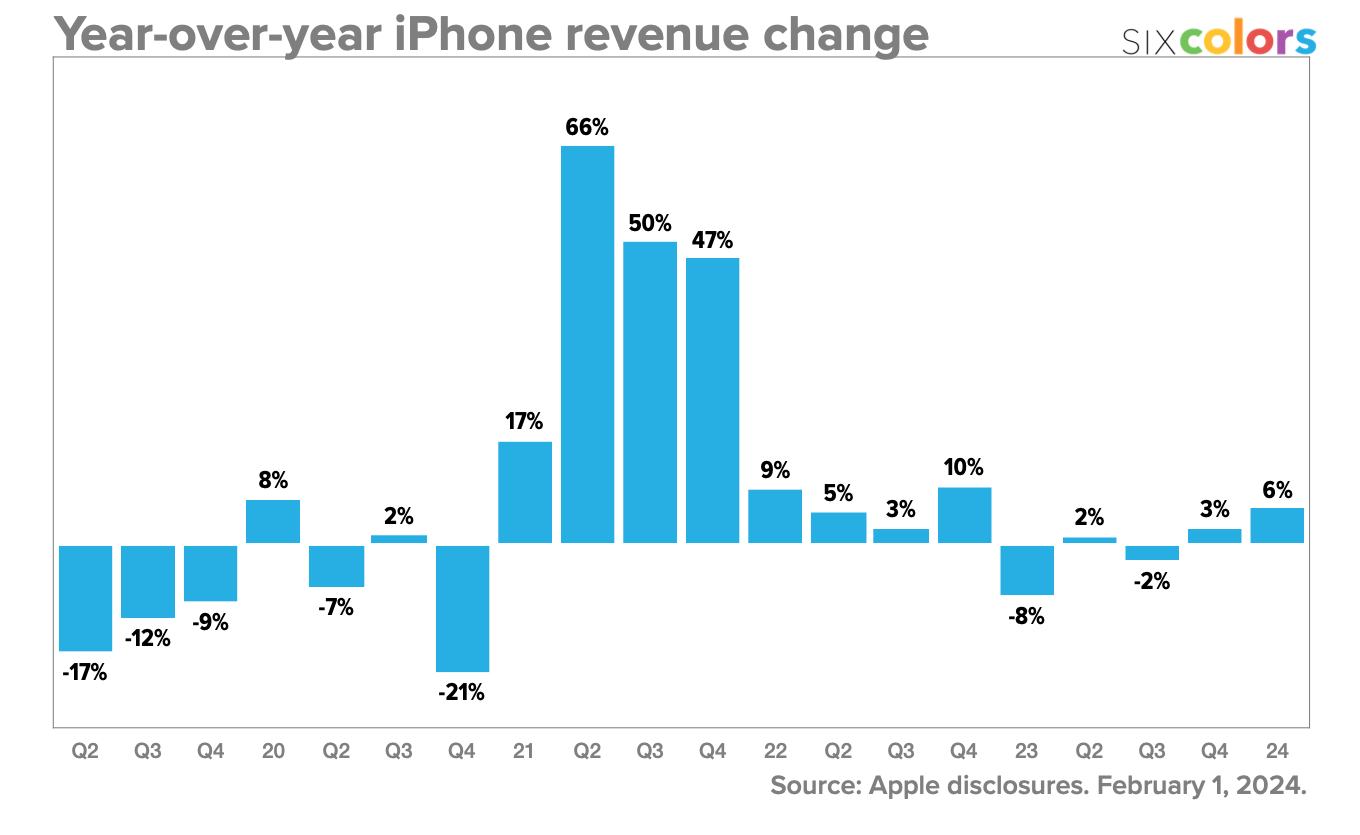
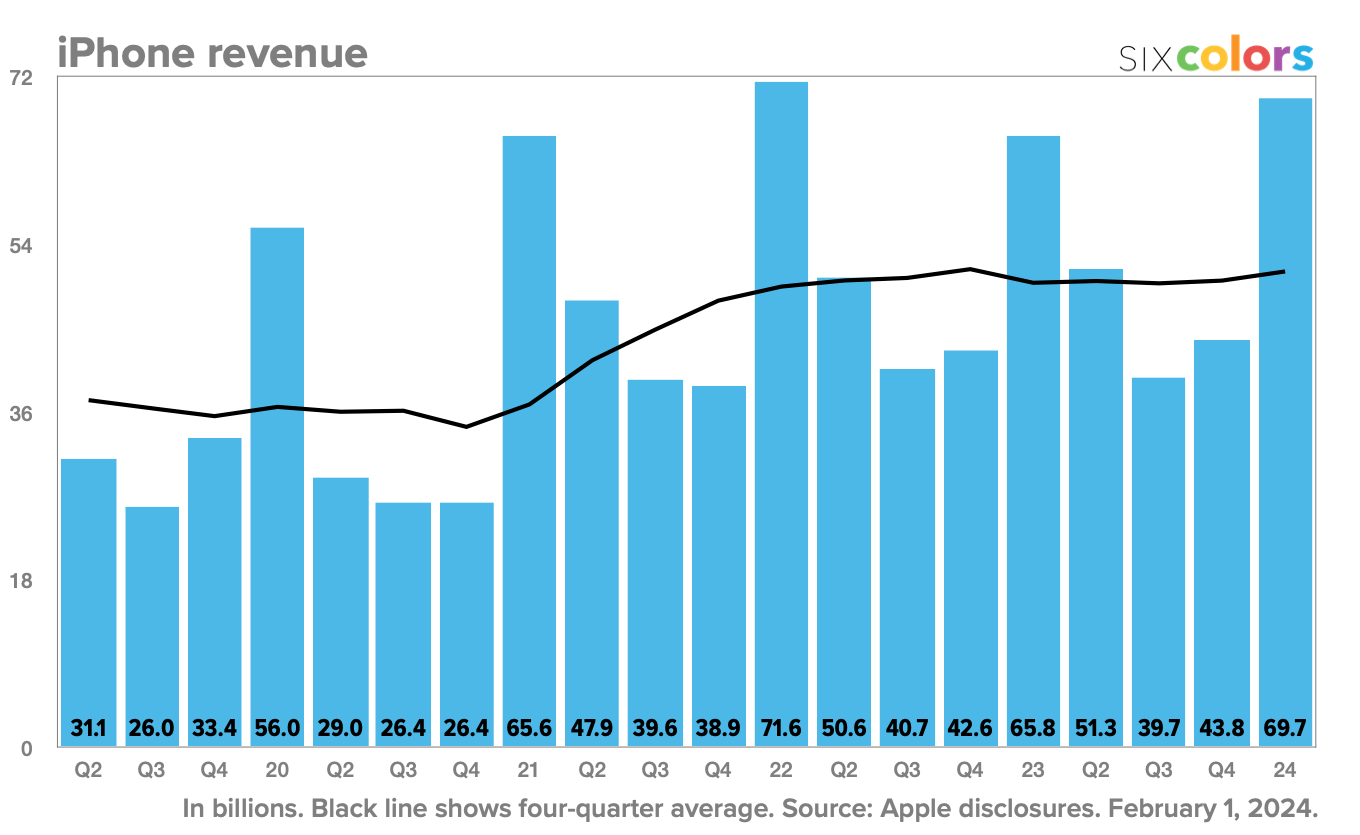
That’s quite the take. It is true that iPhone sales have been relatively flat for two years — here are the quarterly revenue and year-over-year revenue change charts from Six Colors for the October–December 2023 quarter. But they’re not in decline. Apple’s problem — or perhaps better said, Apple investors’ problem — is that iPhone sales have peaked because they’ve saturated the globe. Everyone who wants one and can afford one has one.
But whatever is going on with iPhone sales, a comparison to Boeing is just dumb. Boeing’s problem isn’t cheap Chinese competition. It’s that when Boeing was Boeing — a truly great American company — it was an engineering-driven company. It was — past tense — in broad strokes similar to Apple in that regard. Then Boeing “merged” with McDonnell Douglas, the McDonnell Douglas CEO became Boeing’s CEO, other executives with zero aviation experience came over from companies like General Electric, and “a passion for great planes was replaced with a passion for affordability.” The 737 Max isn’t just unpopular — it’s an engineering disaster. The iPhone 15 lineup is, by consensus, the best lineup of phones in the industry — the fastest chips, great reliability, and industry-leading customer satisfaction. Even if iPhone sales were in decline — which only IDC is claiming to be true — it’s not for reasons that bear any resemblance to Boeing at all.
Call me when Apple is led by executives who lack a passion for great computers.
-
Tim Bradshaw and Michael Acton, reporting for the Financial Times, under the eye-opening headline “Apple Loses Smartphone Crown to Samsung as Chinese Rivals Gain Ground” (archive link):
Apple lost its lead in the global smartphone market at the start of 2024, with iPhone sales falling 10 per cent as lower-cost Chinese rivals such as Xiaomi experienced rapid growth.
Sounds bad! Then comes the second paragraph of the report:
Samsung regained its position as the world’s largest smartphone maker by volume in the first quarter, according to market researcher International Data Corporation, just three months after Apple claimed the top spot for the first time.
So we’re talking about unit sales volume (a measure Apple has never pursued as a top priority), using numbers from IDC (sketchy at best), and a supposed lead that Apple held for ... three months? Which three months happen to be the holiday quarter, when — every single year — all of Apple’s sales go up, and when new iPhone models drop. Warm up your dictionaries, time to refresh your memory of how to spell beleaguered.
The iPhone’s success is so poorly reflected by market share numbers that the Department of Justice invented a fictional category of “performance smartphones” just to make it maybe sorta kinda — if you squint just right — look like they might possibly hold a monopoly under U.S. law.
IDC estimated that global iPhone shipments declined 10 per cent to 50.1mn in the first three months of 2024 compared with the same period in 2023, giving it a 21 per cent market share.
Let’s see if there’s a 10 percent drop in iPhone revenue year-over-year when Apple reports results for the January–March quarter on May 2. If so, that’ll be quite the feather in IDC’s cap. If not, I’m sure we’ll see a correction from IDC and the FT.
Update, 2 May 2024: IDC nailed it — iPhone sales were down exactly 10 percent.
- Not All Web APIs Are Good APIs ★
-
Eric Lee on Threads:
I was wondering why I haven’t seen websites utilizing Vibration API when I see more and more apps using it including Arc Search and AirChat. Safari doesn’t even support it so there it goes 🫠
This exemplifies the broken thinking among many web developers and PWA advocates regarding Safari and WebKit. Just because an API exists and some browsers support it does not mean all browsers should support it. I never ever want a website to be able to vibrate my device. Ever. Nor do I want websites to be able to prompt me with an alert asking for permission to vibrate my device. Not supporting the Vibration API is a feature, not an omission.
If you want web apps to have the same full range of capabilities as native apps, iOS is not the platform for you. PWA advocates treat it as axiomatic that web apps should be peers to native apps, but that’s not true for everyone. I think of native apps as software I carefully consider before installing, even from the App Store. I think of websites and web apps as software I will visit/run without consideration, because they’re so comparatively restricted.