By John Gruber

All your customer
data in that nice
California sunnn.
Early access now!
Linked List: June 6, 2024
Thursday, 6 June 2024
- Getting Closer: Tickets for The Talk Show Live From WWDC 2024 ★
-
Still available, but edging each day toward selling out:
Location: The California Theatre, San Jose
Showtime: Tuesday, 11 June 2024, 7pm PT (Doors open 6pm)
Special Guest(s): Yes
Price: $60At least one fun surprise is in store.
- NYT: ‘What Ukraine Has Lost During Russia’s Invasion’ ★
-
Marco Hernandez, Jeffrey Gettleman, Finbarr O’Reilly, and Tim Wallace, with reporting and imagery for The New York Times:
Few countries since World War II have experienced this level of devastation. But it’s been impossible for anybody to see more than glimpses of it. It’s too vast. Every battle, every bombing, every missile strike, every house burned down, has left its mark across multiple front lines, back and forth over more than two years.
This is the first comprehensive picture of where the Ukraine war has been fought and the totality of the destruction. Using detailed analysis of years of satellite data, we developed a record of each town, each street, each building that has been blown apart.
The scale is hard to comprehend. More buildings have been destroyed in Ukraine than if every building in Manhattan were to be leveled four times over. Parts of Ukraine hundreds of miles apart look like Dresden or London after World War II, or Gaza after half a year of bombardment.
To produce these estimates, The New York Times worked with two leading remote sensing scientists, Corey Scher of the City University of New York Graduate Center and Jamon Van Den Hoek of Oregon State University, to analyze data from radar satellites that can detect small changes in the built environment.
A staggering, sobering work of journalism and data visualization.
- Nvidia Hits the $3T Market Cap Club, Passing Apple, Trailing Only Microsoft ★
-
M.G. Siegler, writing at Spyglass yesterday:
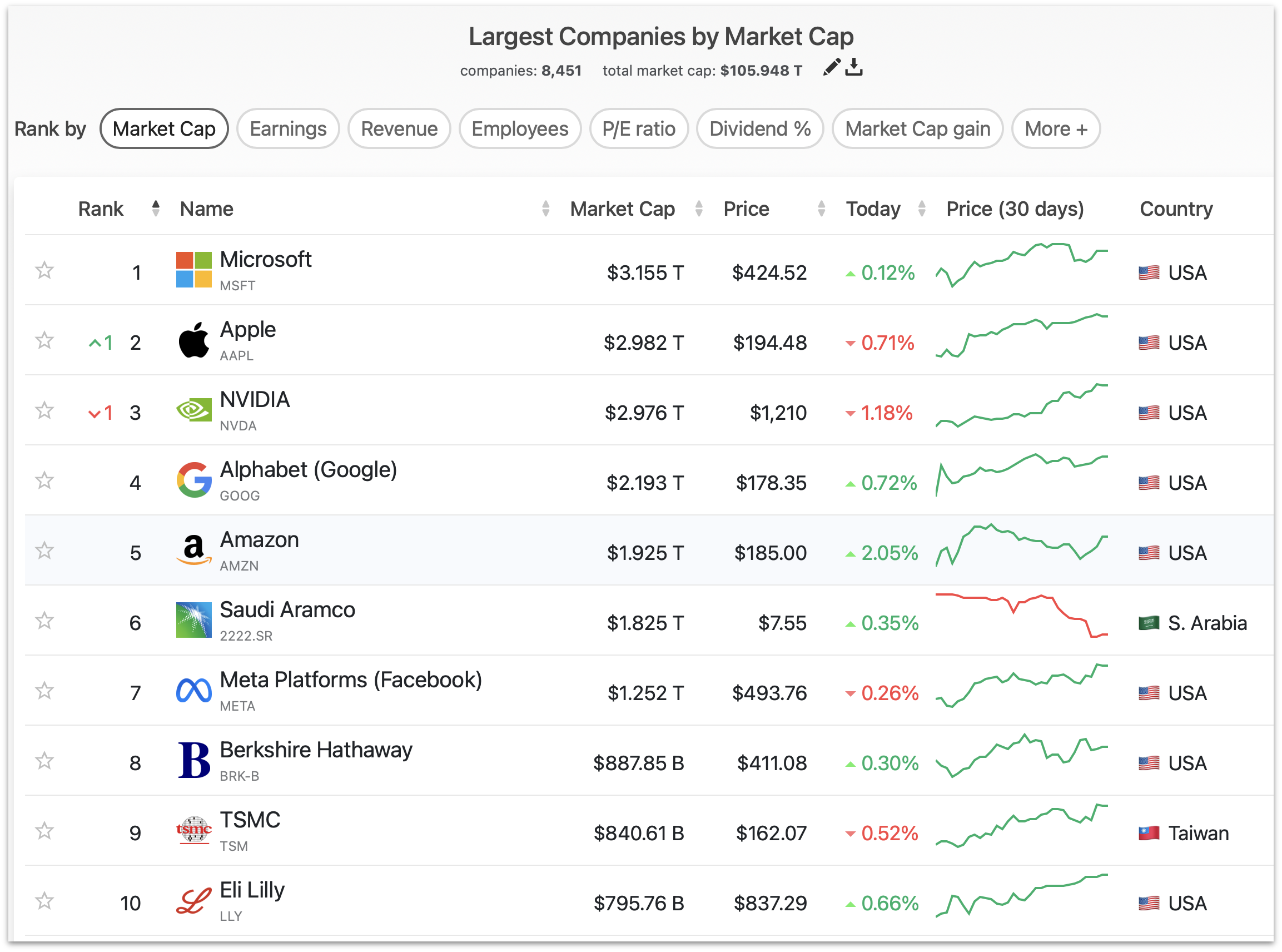
Today, NVIDIA hit the $3T market cap mark and passed Apple in that same metric. NVIDIA is now the second most valuable company in the world, only behind Microsoft. At this rate, they’ll catch them by Friday, just ahead of their 10-for-1 stock split.
The stock run-up has been totally and completely insane. The price is up over 200% in the past year. Over 150% in the past six months alone. Five years ago, NVIDIA’s stock was trading at $36/share. Today it closed at $1,224/share.
Is this sustainable? I mean, no. And it’s not because NVIDIA isn’t a great company. This run is just almost meme stock-like in its frenzy, with shades of Tesla, of course. It has just transformed into this sort of index bet on AI. And while AI is also real, it also can’t sustain the current investment hype surrounding it forever.
But for now, founder Jensen Huang should enjoy this moment.
He should, but one of these companies is not like the others:
’23 Revenue ’23 Profit ’22 Revenue ’22 Profit Microsoft $212 B $72 B $198 B $73 B Apple $383 B $97 B $394 B $100 B Nvidia $61 B $30 B $27 B $4 B Ming-Chi Kuo on X, claiming some Being Right Points™ for predicting this three months ago:
The prediction from three months ago has come true. This is not just a comparison of Nvidia and Apple’s stock prices but a contrast between the strong growth trend of AI and the innovation challenges faced by consumer electronics.
One man’s “strong growth trend” is another man’s “hype bubble”. And what exactly are the “challenges faced by consumer electronics”? Even with Nvidia’s exhilarating growth in the last two years, Apple generates over 6× Nvidia’s revenue. Apple’s numbers have not been growing, yes, and that’s a legitimate concern for investors. But Apple’s growth stopped not because interest in phones has slowed but because everyone in the world who can afford one has one. That’s a problem, but that’s a good problem.
(Apple and Nvidia both dipped back under $3T today, for what it’s worth.)
- How The Wall Street Journal Fell Behind in the ‘Apple Is Behind on AI’ Arms Race ★
-
Aaron Tilley, writing for The Wall Street Journal under the headline “How Apple Fell Behind in the AI Arms Race” (News+ link):
For those who saw them, the demonstrations inside Apple earlier this decade of a revamped Siri offered a showcase of the amazing capabilities a powerful AI voice assistant could have.
The famed assistant, one of the last projects Apple co-founder Steve Jobs worked on before his death, had been given a total overhaul. Capable of running on an iPhone and without an internet connection, the new Siri impressed people with its improved speed, conversational capabilities and the accuracy with which it understood user commands. Code-named Project Blackbird, the effort also imagined a Siri with capabilities built by third-party app developers, according to people familiar with the work.
Yet a competing project won out in an internal contest ahead of the 10-year anniversary of Siri’s launch. Known as Siri X, the more-modest upgrade involved moving more existing Siri software onto iPhones from remote servers to improve the voice assistant’s speed and privacy. The Siri X enhancement was unveiled in 2021.
Tilley is the WSJ’s Apple beat reporter, and one gets the feeling he was tasked with filing a report with the above headline already written. These opening three paragraphs are the only interesting ones in the entire story. But there’s nothing actually new in them.
Here’s Wayne Ma, reporting for The Information in April 2023 under the headline “Apple’s AI Chief Struggles With Turf Wars as New Era Begins” (archive):
In some cases, Giannandrea’s new hires have run into seemingly impenetrable bureaucratic obstacles. In one example, he in 2019 recruited another close friend, Arthur van Hoff, to explore a project to rewrite Siri from the ground up. Code-named Blackbird, the effort involved creating a lightweight version of Siri, which would delegate the creation of more functions to app developers, said five former Siri employees. The software would run on iPhones instead of in the cloud, which would improve Siri’s speed and performance while enhancing user privacy, they said. Demos of Blackbird prompted excitement among employees on the Siri team because of its responsiveness, they added.
But there was a problem. Blackbird competed with the work of two longtime senior Siri leaders: Alex Acero and Robby Walker, who were responsible for two important teams that helped Siri understand and respond to queries. Acero and Walker pushed for completion of their own project, code-named Siri X, for the 10th anniversary of the voice assistant, which aimed to move the Siri processing software onto the device for privacy reasons.
However, Siri X’s goal was simply to reproduce Siri’s existing capabilities without the more ambitious targets of Blackbird, the people said. Despite that, Acero and Walker won. They assigned hundreds of people to their effort, which subsumed and killed Blackbird. Most of their project was completed in 2021.
Same story, but Ma’s version from 13 months ago included the names of the engineers in charge of the dueling projects.
Back to Tilley’s report at the WSJ yesterday:
Apple has long prided itself on perfection in its product rollouts, a near impossibility with emerging AI models. While OpenAI systems have dazzled more than 180 million users with their generation of writing, images and video, they are prone to occasional errors, often called hallucinations. Apple has had limited tolerance for such issues.
“There’s no such thing as 100% accuracy with AI, that’s the fundamental reality,” said Pedro Domingos, a professor emeritus of computer science and engineering at the University of Washington. “Apple is not compatible with that. They won’t release something until it’s perfect.”
How does this square with the state of Siri as it works today? Does Tilley think today’s Siri, though limited in scope, is “100 percent accurate” and “perfect”?
Don’t know about you, but that’s not my experience.
- 1Password and Safari ★
-
Speaking of password management and WWDC, Mitch Cohen, product manager of 1Password, wrote a nice thread a few days ago on Mastodon:
Next week is WWDC, so it’s a good time for a thread about the 1Password browser extension for Safari, its history, challenges, and the future — both what we’re working on and what we’d like to see from Apple, Safari and the web platform at large.
I don’t envy them. They need to deal with bugs, missing APIs, and other complicating factors, and all the while need to be extra careful due to the extraordinary sensitivity of the data users put in 1Password. But while I sympathize, many of the complaints levied against 1Password 8, especially on the Mac, are self-inflicted choices.
- The New York Times: ‘How the Humane AI Pin Flopped’ ★
-
Tripp Mickle and Erin Griffith, with a “not what Humane needed the day after announcing their charging case is a potential fire hazard” report for The New York Times:
Days before gadget reviewers weighed in on the Humane Ai Pin, a futuristic wearable device powered by artificial intelligence, the founders of the company gathered their employees and encouraged them to brace themselves. The reviews might be disappointing, they warned.
I realize this is only a passing summary of the meeting, but I would hope that everyone at the company was aware of the AI Pin’s shortcomings. They’re the ones who were most familiar with it! However much trouble Humane is in, they were comically doomed if their own employees needed to be told the AI Pin was not a good product just days before reviews dropped. One would think the real topic of this all-hands was to explain why they shipped what they shipped and what the plan was to make it good.
About a week after the reviews came out, Humane started talking to HP, the computer and printer company, about selling itself for more than $1 billion, three people with knowledge of the conversations said. Other potential buyers have emerged, though talks have been casual and no formal sales process has begun.
I’m going to be insufferable if they sell to HP.
Its setbacks are part of a pattern of stumbles across the world of generative A.I., as companies release unpolished products. Over the past two years, Google has introduced and pared back A.I. search abilities that recommended people eat rocks, Microsoft has trumpeted a Bing chatbot that hallucinated and Samsung has added A.I. features to a smartphone that were called “excellent at times and baffling at others.”
The above paragraph exemplifies the sort of catch-22 corner the media is trying to portray Apple as having been painted into regarding AI. It’s just stated as fact that Apple “has fallen behind in the AI arms race” (that’s from yesterday in the WSJ) but the AI features from the companies Apple has supposedly fallen behind are, on their own, described with words like unpolished, embarrassing, hallucinating, untrustworthy, and even baffling. Like I wrote two weeks ago, isn’t “behind” where you want to be when those who are ahead are publishing nonsense? What is Apple behind on, embarrassing itself and confusing its users?
Many current and former employees said Mr. Chaudhri and Ms. Bongiorno preferred positivity over criticism, leading them to disregard warnings about the Ai Pin’s poor battery life and power consumption. A senior software engineer was dismissed after raising questions about the product, they said, while others left out of frustration.
Mr. Chaudhri said his company, which had 250 employees at its peak, encouraged workers to offer feedback. The departures were a natural consequence of transitioning from creating a new device to sustaining it after its release, which he said appealed to “a different type of person.” [...]
In January, Humane laid off about 10 employees. A month later, a senior software engineer was let go after she questioned whether the Ai Pin would be ready by April. In a company meeting after the dismissal, Mr. Chaudhri and Ms. Bongiorno said the employee had violated policy by talking negatively about Humane, two attendees said.
It is the kiss of death for any endeavor, creative or technical, to have a culture where brutally honest internal criticism is not welcome, especially when it goes up the chain. In fact it needs to be the expectation, if you’re pursuing excellence. This is probably one of the reasons why Chaudhri, in particular, is not remembered fondly in Cupertino. The key is to always remember to critique the work, not the person. It’s never personal; it’s always about the work.
From the beginning, current and former employees said, the Ai Pin had issues, which reviewers later picked apart. One was the device’s laser display, which consumed tremendous power and would cause the pin to overheat. Before showing the gadget to prospective partners and investors, Humane executives often chilled it on ice packs so it would last longer, three people familiar with the demonstrations said. Those employees said such measures could be common early in a product development cycle.
I’ll bet “Ice Ice Baby” is within Humane’s budget to license, even pre-acquisition.
- Gurman Reports Apple Is (Finally) Breaking Passwords Into a Standalone App for the Mac and iOS ★
-
Mark Gurman:
Apple Inc. will introduce a new homegrown app next week called Passwords, aiming to make it easier for customers to log in to websites and software, according to people with knowledge of the matter.
This isn’t an all-new app, but rather it’s breaking the Passwords panel out of the Settings app sidebar and into its own proper standalone app. I’ll bet Apple introduces new features, too, but Gurman doesn’t describe any. The Passwords panel in Settings, including the system-wide integrations with Safari and WebKit, already has the scope and breadth of an app. I’ve personally been all-in for many years on using iCloud for my own passwords, authentication codes, and now passkeys. For me it’s proven robust and trustworthy.
Making Passwords its own proper app is overdue, though. Apple tries to manage a good balance with how many standalone apps ship as part of the system on iOS. On the Mac, there’s an easier split: Apple puts a dozen or so of the system’s most-used apps in the Dock by default, and puts 46 apps in the Applications folder, and another 18 nerdier apps in the Utilities sub-folder within Applications. On iOS Apple puts some of its own apps within folders, but that still adds to the visual complexity of the default home screens. Password management is so important, and Apple’s own system is so good, that it deserves more prominence. Making Passwords its own app won’t just make it more discoverable, it will (correctly) set the perception that Apple Passwords is a serious personal security management tool that users should considering adopting.
- The M4-in-iPad-Pro Sleuth ★
-
Speaking of chip surprises in the new round of iPad hardware, here’s a post from “Jamie I” in the MacRumors forums, all the way back on April 14:
We have been expecting M3 iPad Pros for a while now but I was just browsing through some of the rumors and I noticed something interesting.
There was information from a private X account with a proven track record that shared chip identifiers for the new WiFi + cellular iPad Pros and it’s apparently using a T8132 chip. However, T8132 is not the identifier for the M3 chip which is T8122.
In fact, based on the pattern that the M series chips have been following, it seems like it’s the M4 chip.
This was exactly right. It was also two weeks before Mark Gurman’s “I’m hearing there is a strong possibility that the chip in the new iPad Pro will be the M4, not the M3” eye-opener in his Power On column.
- New M2 iPad Air Has 9-Core GPU, Not 10-Core as Originally Specified ★
-
Chance Miller, reporting for 9to5Mac:
Over the weekend, we reported that Apple had updated its website to say the new iPad Air’s M2 chip features a 9-core GPU, despite originally advertising it as a 10-core GPU. An Apple spokesperson has now confirmed this change to 9to5Mac, while also saying that all performance claims remain accurate and were based on a 9-core GPU.
Here’s the full statement from an Apple spokesperson:
We are updating Apple.com to correct the core count for the M2 iPad Air. All performance claims for the M2 iPad Air are accurate and based on a 9-core GPU.
The second part of that sentence is key. Apple is saying that all the performance claims it made about the M2 chip in the iPad Air are accurate, despite the 9-core versus 10-core GPU mix-up. For example, Apple’s claim that the M2 iPad Air is nearly 50% faster than the M1 model still stands.
This is not a big deal, at all, but still — what a surprising mistake from Apple. Really strange.