By John Gruber
All your customer
data in that nice
California sunnn.
Early access now!
Linked List: August 13, 2024
Tuesday, 13 August 2024
- New Distraction Control Safari Feature Is Now Available in the iOS 18 and MacOS 15 Betas ★
-
Juli Clover, writing last week for MacRumors:
Distraction Control can be used to hide static content on a page, but it is not an ad blocker and cannot be used to permanently hide ads. An ad can be temporarily hidden, but the feature was not designed for ads, and an ad will reappear when it refreshes. It was not created for elements on a webpage that regularly change.
To use Distraction Control, go to the Page Menu and select Hide Distracting Items. You can select an area on the page that you want to hide, and static content that you select will remain hidden. It is a good way to eliminate the pesky popovers that show up when browsing online stores, reading articles, and more. iPhone, iPad, and Mac users need to opt in to hiding elements on the page, and Apple says that nothing is hidden that is not proactively selected.
When hiding a cookie banner or GDPR popup with Distraction Control, the function is the same as closing a banner without submitting website preferences at all.
This is a really great feature, and the animations it employs are delightful.
Just last week, I found myself shaking my head at this screenshot posted by Nilay Patel of CBS News’s website. It’s ridiculous and sad that the state of web design has sunk so low, but the web browsers themselves — led by Safari — continue to allow users to fight back.
- Subtle Tweaks to the Harris/Walz Logo ★
-
Jonathan Hoefler, on Threads:
The Harris/Walz logo got a smart and subtle haircut this weekend, which, like the very best typography, is making everything better while drawing very little attention to itself.
I read a lot of comments about political logos… Having helped shape the logo of every Democratic president in the twenty-first century (hflr.io/biden, hflr.io/obama), let me say from experience that campaign typography is completely unlike graphic design: it’s a strange and fascinating agility sport, marked by limited information, a ticking clock, unimaginable pressures, and serious consequences. It’s Iron Chef, but in Adobe Illustrator.
The “Harris” was fine all along, and only ever-so-slightly tweaked in this updated logo. It was the “Walz” that needed help, and got it here. Making the letters in “Walz” just a tad taller makes the whole mark feel significantly more cohesive.
- Google’s Pixel 9 Launch Event ★
-
Emma Roth, writing for The Verge:
Google has finally taken the wraps off its Pixel 9 lineup, which includes three slab phones and a folding phone. The regular lineup consists of a base Pixel 9 with a 6.3-inch display, a Pixel 9 Pro XL with a 6.8-inch screen, and a new, smaller Pixel 9 Pro option measuring 6.3 inches. The trio of devices comes with a redesigned oval-shaped camera housing, Google’s updated G4 Tensor chip, better battery life, and a new satellite SOS feature.
While the Pixel 9’s $799 starting price is $100 more than last year’s model, the Pixel 9 Pro starts at $999, and the Pro XL will cost $1,099 and up. The Pixel 9 and 9 Pro XL start shipping on August 22nd, with availability for the smaller Pixel 9 Pro starting in September.
Almost certainly the best Android phones on the market, all things considered, yet it seems pretty predictable that, just like with all previous generations of Pixel phones, few people will buy them. IDC claims Pixels have 5 percent market share in the U.S. but it sure doesn’t seem to me like one out of every 20 phones I see is a Pixel.
In addition to three new standard Pixel devices, Google showed off the Pixel 9 Pro Fold. The refreshed Fold is taller and thinner than its predecessor, offering larger displays measuring 6.3 inches on the outside and eight inches on the inside.
The Pixel Pro Fold costs $1,800. I’ve seen a handful of folding phones in real-world use over the years, but only a handful. These things get a ton of attention in the tech media but seemingly nearly zero traction in the market. I continue to think this will remain true until and if Apple releases one, which I expect will look nothing like the existing ones, and then the Android handset makers will make ones that look like Apple’s, and the Android zealots will attempt to shoot down accusations of copycatting by arguing that the design is obvious.
Google’s Made By event was held live, including the AI demos, which didn’t go well. But I have no snark for that. I like live demos and miss them at Apple events. And part of what I like is the high-wire drama of potential demo failure. Watching a live demo gets your attention in a way that a pre-recorded demo cannot. It’s like watching a live stunt.
See also: Marques Brownlee’s first impressions of the new phones (and the new Pixel Watches and wireless earbuds).
- ‘He Sounded Like a Disoriented, Racist Daffy Duck’ ★
-
USA Today columnist Rex Huppke, on Donald Trump’s high-profile return to Twitter/X:
But the online interview went off (the rails) with a multitude of hitches. X users erupted with either frustration or laughter as the planned start time passed, and nothing could be accessed. It took more than 40 minutes before the interview could start and be heard by anyone. It was amateur hour, the last thing a campaign struggling to project competence needed.
Of course, things didn’t get better for Trump once the interview was able to proceed. He was rambling, babbling on about crowd sizes and immigration and President Joe Biden and whatever else seemed to pass through his mind. He was also badly slurring his words, raising questions about his health, and doing nothing to knock down rising concerns about his age and well-being.
He sounded like a disoriented, racist Daffy Duck.
Here’s Donald Trump, back in May 2023, when Ron DeSantis launched his primary campaign the same way, in a Twitter Space interview with Musk:
Wow! The DeSanctus TWITTER launch is a DISASTER! His whole campaign will be a disaster. WATCH!
- Patreon Should Consider Calling Apple on Its Threats ★
-
I neglected to call this paragraph out yesterday in my first link to this announcement from Patreon:
Patreon is home to an incredible range of creators, all with unique circumstances and billing needs. Apple’s in-app purchase system, on the other hand, only supports Patreon’s subscription billing model. Apple has also made clear that if creators on Patreon continue to use unsupported billing models or disable transactions in the iOS app, we will be at risk of having the entire app removed from their App Store.
Right now Patreon is offering its creators two options for dealing with the upcoming changes in its iOS app:
- Raise prices for users who subscribe through the app by 30 percent to accommodate Apple’s cut of the transactions. (This is the default.)
- Keep prices the same and pay Apple’s fees out of the creator’s share of the transaction.
What Patreon seems to be suggesting above is that if they offered a third option — not to allow subscriptions within the iOS app, controlled by each creator for their own subscriptions — that Apple has threatened to remove the Patreon app from the App Store.
I humbly suggest Patreon go ahead with that anyway. Let’s see how many of Patreon’s creators tell Apple to bugger off. And if Apple were to respond by removing Patreon from the App Store for offering this choice, how would that not backfire spectacularly in Apple’s face? I believe it would be a positive publicity bonanza for Patreon, and for high-visibility creators on their platform, as well. And this example would be a disaster for Apple publicity-wise and in the face of growing regulatory and antitrust scrutiny, especially right here in the U.S.
From the perspective of creators, this clearly ought to be an option. They don’t want to charge their fans 30 percent extra just to pad Apple’s bottom line. They don’t want to earn less money themselves. Thus, they might not want to participate in App Store in-app payments at all. How is that not a perfectly reasonable choice for Patreon to offer and for some of its creators to make? And then just put right there in the app that this creator’s subscriptions are only available on the web. Dare Apple to strike that down on the anti-steering grounds that are in the bullseye of regulators around the world.
Patreon, with an army of devoted creator fans on its side, should call Apple on this bluff. I don’t think they could lose.
- Creator Platforms Should Be a Special Category on the App Store ★
-
Substack cofounder Hamish McKenzie, on Patreon being required by Apple to offer in-app subscriptions through their iOS app:
But we also don’t think that Apple should be wholly blamed. This unfortunate situation, in which creators ultimately bear the biggest costs, is a structural issue rooted in how the commercial internet has evolved (or not) over the past couple of decades. [...]
But creators aren’t Apple’s traditional customers. They’re not app makers or game developers. They don’t actually have a piece of real estate in the App Store. They instead find their distribution through media platforms, including the likes of Patreon and Substack. It might feel weird for someone who publishes a podcast through Patreon, or a publication through Substack, to receive the same treatment from Apple as Netflix.
The emergence of the creator economy presents an interesting challenge and opportunity for Apple, and some delicate questions for Patreon and Substack. We want creators and subscribers to benefit from the power of Apple’s in-app purchases. In fact, at Substack we have been working with Apple to bring in-app purchases into our app, because we believe that anything that reduces the friction of a subscription is great for creators. We’re doing everything in our power to make the implementation of in-app purchases as creator-friendly as possible.
First, a correction: Yesterday I wrote that Substack didn’t offer in-app purchases in its iOS app. I was wrong. They do. How I got it wrong is that I checked, in the app, by looking at a publication to which I was already subscribed at the free tier, for an option to upgrade to a paid account. That showed me a panel that read “You cannot manage your subscription in the app.” But that’s because I started the subscription on Substack’s website. For Substack subscriptions made on the web, you must continue to manage them on the web. This probably isn’t merely about avoiding Apple’s payment fees, but a practical requirement. I don’t think there’s any way, technically, that an individual subscription you started paying for on the web could be migrated on-the-fly to Apple’s payments, or vice-versa. For a Substack publication you aren’t already subscribed to, even at the free tier, you can subscribe via IAP in the Substack iOS app.
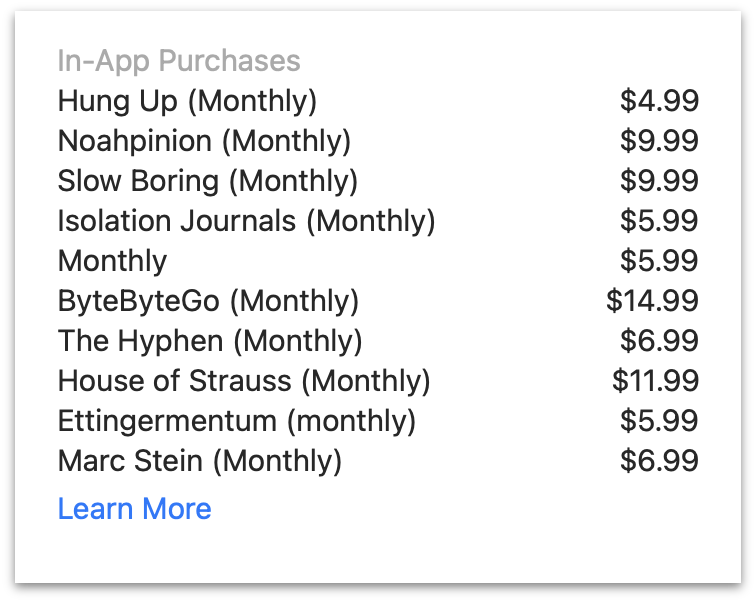
What I should have done is look at Substack’s listing on the App Store itself, which clearly shows that it offers in-app purchases. Each Substack publication offers a distinct SKU for each paid subscription it offers, so the Substack app’s listing shows the most popular ones.
Second: McKenzie’s observation that it’s weird for individual creators “to receive the same treatment from Apple as Netflix” is interesting, because Netflix doesn’t receive the same treatment as most apps. Netflix is a “reader app”, a special category Apple carved out in the App Store for “apps that provide one or more of the following digital content types — magazines, newspapers, books, audio, music, or video — as the primary functionality of the app”.
It seems obvious to me that creator-platform apps like Substack and Patreon ought to be in a new category of their own, the basic idea of which would be for Apple to take some sort of smaller cut of these transactions.