
By John Gruber
WorkOS: How SSO works and the fastest way to add it.
Linked List: April 4, 2025
Friday, 4 April 2025
- The Truth Is, These Are Not Very Bright Guys ★
-
Susan Glasser, writing for The New Yorker, “Donald Trump’s Ego Melts the Global Economy”:
In this new political moment of the unthinkable made manifest, the sheer power rush for Trump should also not be underestimated. Imagine his joy as he sat down to sign an executive order decreeing the new tariffs on the basis of sweeping powers he may or may not legally possess to declare a “national economic emergency” — here was Trump transforming the world with a single flourish of his Sharpie pen. “It’s such an honor to be finally able to do this,” he said. At what other moment in modern times has a single man wielded so much unaccountable power over such a large swath of the world economy? There are whole businesses devoted to risk analysis for corporations; this is a situation in which Trump himself is the risk and the crisis being analyzed is one that he created. Talk about an ego trip.
Glasser links to Garry Kasparov, on X, responding to Wall Street’s collective surprise that Trump did what he’s been saying he would do re: tariff policy:
As I’ve said for years about Putin, and which applies to other autocratic personalities like Trump: “Dictators always lie about what they’ve done, but are often quite plain about what they want to do.” “Trump would never...” is the new “Putin would never...”
Such people do and take whatever they can, unless they are stopped. That they don’t always succeed does not mean they were not sincere in their ambitions and won’t keep trying to fulfill them. Trump has only been emboldened by the sycophantic GOP this time around.
Even more apt, “Deep Throat” explaining the central truth of the Watergate scandal to Bob Woodward in the Alan-Pakula-directed / William-Goldman-written film adaptation of All the President’s Men:
“Forget the myths the media has created about the White House. The truth is, these are not very bright guys, and things got out of hand.”
- Trump Claims to Extend TikTok Deadline for Another 75 Days ★
-
CNBC:
President Donald Trump on Friday extended a deadline requiring China-based ByteDance to sell the U.S. operations of TikTok or face an effective ban in the country, marking the second time he has taken such action.
Trump, on Truth Social, which is by far the most popular social network in the world:
My Administration has been working very hard on a Deal to SAVE TIKTOK, and we have made tremendous progress. The Deal requires more work to ensure all necessary approvals are signed, which is why I am signing an Executive Order to keep TikTok up and running for an additional 75 days. We hope to continue working in Good Faith with China, who I understand are not very happy about our Reciprocal Tariffs (Necessary for Fair and Balanced Trade between China and the U.S.A.!). This proves that Tariffs are the most powerful Economic tool, and very important to our National Security! We do not want TikTok to “go dark.” We look forward to working with TikTok and China to close the Deal. Thank you for your attention to this matter!
Those are the remarks of the most powerful man in the world.
Keep in mind, too, that there is no mechanism in the law for the president to issue any such extension. What he’s saying is what he said the last time: he’s instructing Attorney General Pam Bondi not to enforce the law, and pinky-swearing that U.S. companies that are breaking the law to keep TikTok available (Akamai, Oracle, Google, Apple) won’t be held responsible for it. It’s just a complete abdication of the rule of law.
Not a peep from Republican Tom Cotton, who, on the cusp of Trump taking office again, was crowing about the PAFACA Act coming into effect to shut TikTok down in the US.
- ‘Floundering’ ★
-
From that same Reuters report by Akash Sriram that I just wrote about, speculating that iPhone prices might rise dramatically under Trump’s tariffs:
However, other analysts noted that iPhone sales have been floundering in the company’s major markets, as Apple Intelligence, a suite of features that helps summarize notifications, rewrite emails and give users access to ChatGPT, has failed to enthuse buyers.
Merriam-Webster defines flounder thus:
: to struggle to move or obtain footing : thrash about wildly
Here’s Jason Snell’s chart of iPhone sales through their most recent quarterly report — a record-breaking quarter for the company overall — covering the last three calendar months of 2024:
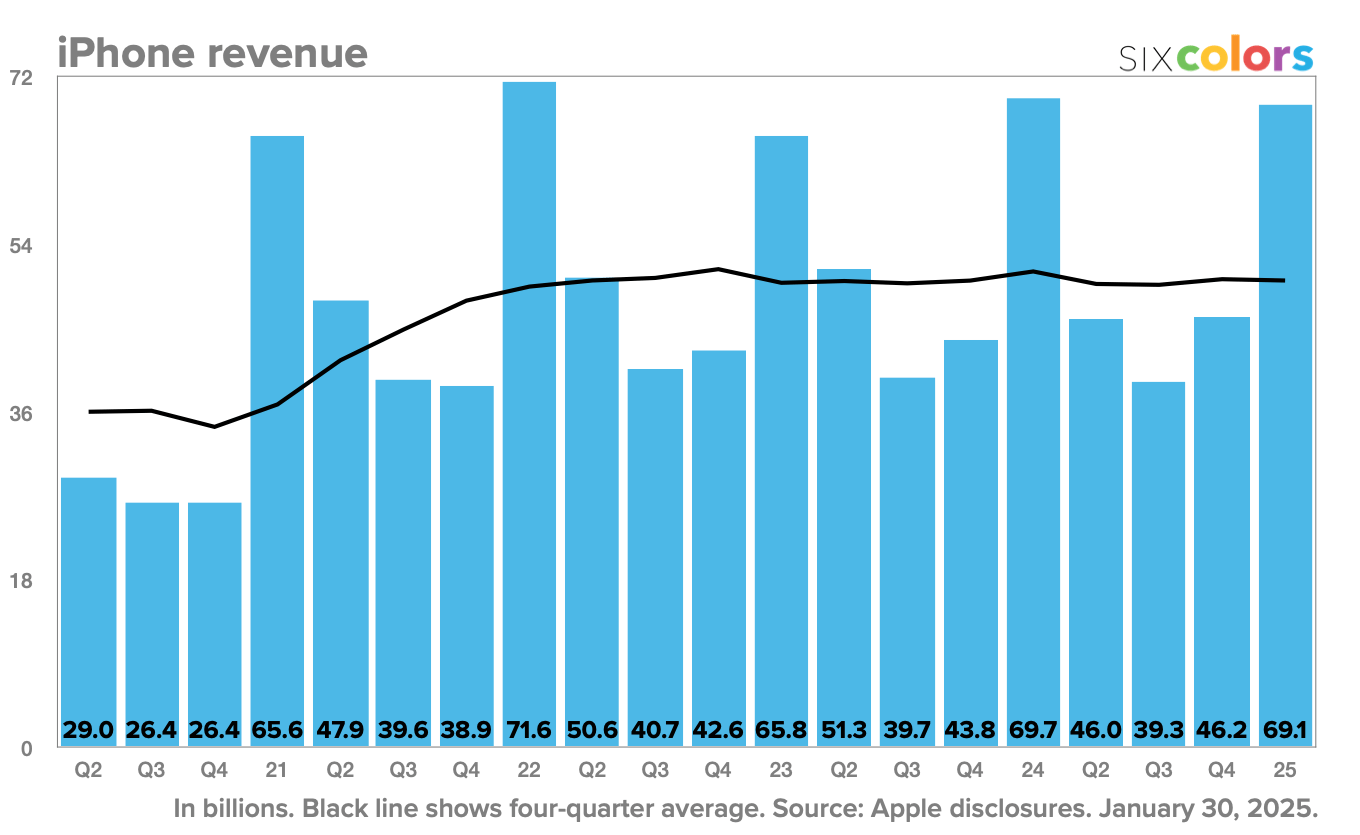
It’s certainly up for debate whether Apple Intelligence is an effective marketing driver for iPhone sales. I mean that with no snark. Maybe Apple Intelligence is driving iPhone sales. I don’t know why people have purchased new iPhones in the last six months. Neither do you, and neither do the “other analysts” (conveniently unnamed) cited by Reuters. But what we do know, because Apple reports the revenue numbers, is that iPhone sales have been remarkably flat, year-over-year, for the last 13 quarters.
- Why Trump’s Tariffs Are Rattling Even Meta ★
-
Mike Isaac, writing for The New York Times:
Apple, Dell, Oracle — which rely on hardware and global supply chains that are in the direct line of fire from tariffs — saw their shares go into free-fall. But there was another big tech company whose stock took a pummeling even though its core business has little to do with hardware: Meta. [...]
The effect of tariffs on Meta’s ad business is simple. Many of its small and medium-sized advertisers are from all across the world. President Trump’s tariffs will instantly make it more expensive for them to sell their products to customers in the United States. [...]
Last year, the company disclosed that 10 percent of its revenue in 2023 was from Chinese companies spending heavily on advertising across Facebook and Instagram, an ad blitz aimed at garnering a foothold in lucrative Western markets.
Much of that growth was fueled by the explosive expansion of the fast-fashion company Shein — which is based in Singapore but has a supply chain that is largely in China — and the e-commerce app Temu, a low-cost, Amazon-like company owned by the Chinese e-commerce conglomerate Pinduoduo. Temu was estimated to have spent $3 billion in marketing costs in 2023 alone, according to estimates from Bernstein Research.
When the stock market began crumbling after Trump’s announcement Wednesday, I didn’t get why Meta was being hit so hard. Meta makes devices, but unlike Apple, that’s just a side hustle. Meta isn’t a retailer like Amazon. But Meta is a huge advertising destination for retailers. It’s all interconnected.
- Nintendo Delays Switch 2 Preorders Over Tariff Concerns ★
-
Emma Roth, The Verge:
Nintendo is pushing back preorders for the Switch 2 due to concerns about Donald Trump’s newly announced tariffs. According to a statement sent to The Verge by Eddie Garcia on behalf of Nintendo, it says preorders will no longer begin on April 9th:
Pre-orders for Nintendo Switch 2 in the U.S. will not start April 9, 2025 in order to assess the potential impact of tariffs and evolving market conditions. Nintendo will update timing at a later date. The launch date of June 5, 2025 is unchanged.
Riots in the streets.
- Apple Cash Switched From Discover to Visa in 2022 ★
-
Allison McDaniel, writing for 9to5Mac back in 2022:
Apple Cash is a virtual debit card where you can send and receive money through iMessage. Stored in your Wallet, you can make secure and contactless payments with Apple Pay from your iPhone or Apple Watch. It’s also a way to receive daily cash back for those who use Apple Card. Previously a Discover card, your Apple Cash card is now Visa.
Spotted by user @Kanjo on Twitter, it’s easy to notice the card has a visible Visa logo in the bottom right corner. Before this change, there was no Discover logo on the card. While not everyone will like the addition of the logo, it’s going to be hard to forget it’s a Visa.
So Apple Card is a credit card, with Goldman Sachs as the bank and Mastercard as the network. Apple definitely needs a new banking partner, as Goldman is exiting the consumer banking business, and is rumored to be listening to offers from Visa and Amex to switch its network too.
Apple Cash is a debit card, which launched on the Discover network but switched to Visa three years ago — presumably with a nice kickback to Apple to get that Visa logo on the virtual cards in Wallet.
- Costco Only Accepts Visa Credit Cards ★
-
I observed yesterday that, in general, Visa and Mastercard credit cards are both accepted at the same locations. The most notable exception is Costco, which, as part of the deal to make its own credit card a Visa (after long partnering with Amex), only accepts Visa credit cards at its physical retail locations and gas stations. They accept “most PIN-based debit/ATM cards”, but for credit, only Visa.
Online, for reasons I don’t understand, Costco accepts Mastercard too (which they incorrectly style in camelcase — you’d think Costco, of all companies, would be sensitive to wrongly camelcased mid-name C’s). Also, in Canada’s Costcos, it’s reversed, with Mastercard being exclusive in-store but Visa being accepted online.
Another high-profile exception: The Olympics, which “proudly accepts only Visa for card and mobile payments, along with cash”.
- Bill Gates on the Creation of Microsoft, and the Source Code for Its First Product ★
-
Bill Gates, commemorating Microsoft’s 50th anniversary:
The story of how Microsoft came to be begins with, of all things, a magazine. The January 1975 issue of Popular Electronics featured an Altair 8800 on the cover. The Altair 8800, created by a small electronics company called MITS, was a groundbreaking personal computer kit that promised to bring computing power to hobbyists. When Paul and I saw that cover, we knew two things: the PC revolution was imminent, and we wanted to get in on the ground floor.
At the time, personal computers were practically non-existent. Paul and I knew that creating software that let people program the Altair could revolutionize the way people interacted with these machines. So, we reached out to Ed Roberts, the founder of MITS, and told him we had a version of the programming language BASIC for the chip that the Altair 8800 ran on.
There was just one problem: We didn’t.
It was time to get to work.At the bottom Gates links to a printout of the original source code for the BASIC interpreter, in extensively commented assembly language. Amongst all of his other accomplishments, Bill Gates was one hell of a programmer.
- The Making of the Lumon Industries WoeMeter ★
-
Wonderfully detailed write-up of a perfect prop from Make3:
Repurposed Nagra Knobs & Switches — To ground the device in a tangible, vintage aesthetic, we salvaged original knobs and switches from a 1990s Nagra IV-D recorder, seamlessly integrating them into our design. These components not only provided an authentic look and feel but also remained fully functional, with:
- A power switch for system activation.
- A reading on/off switch to engage or disable the Woe display.
- A manual override switch to cycle through needle positions if wireless control failed.
When I watched this episode, I remember noticing how cool the device seemed. It turns out to be even cooler than I thought. So much effort into such a little thing. And the coolest thing is that, in a sense, the WoeMeter actually works as a handheld wireless prop.
Reusing those Nagra dials to add verisimilitude reminds me of how much of Star Wars came from reused pieces of old gadgetry, like two of the lightsabers (Luke’s and Vader’s) being made from 1940s-era Graflex camera flash guns.
- Jason Snell’s M4 MacBook Air Review ★
-
Jason Snell, last month:
The new M4 MacBook Air is the Mac most people should buy. [...]
That’s why perhaps the most important change in the M4 MacBook Air is its base configuration, which starts at $999. When Apple introduced a winning new flat-with-rounded-corners Air design in 2022, it had to keep selling older models in order to get down under a thousand dollars. Three years later, Apple is finally able to sell a brand-new Air — with a generous 16GB of unified memory — at that important price.
So: No more quibbles about stepping back a generation or two to an older model with a lower price. Apple has done away with that strategy for the MacBook Air: The latest and greatest model is the one most people shopping for a Mac should buy, especially if they’re coming from an Intel model.
I’d put off linking to Snell’s review for a few weeks while thinking about writing my own, but I’ve got nothing to add. The M4 MacBook Air is utterly unsurprising, but only in the best possible way. It’s the MacBook Air everyone wanted Apple to make. The $999 base model is now exceedingly recommendable. It even brings back the most notable feature that was lost in the transition from Intel to Apple Silicon — the ability to drive two external displays and its own internal display. Just aces all around.