
By John Gruber
WorkOS: How SSO works and the fastest way to add it.
Linked List: June 5, 2026
Friday, 5 June 2026
- Nieman Journalism Lab: Twitter/X Punishes Accounts That Post Links ★
-
Laura Hazard Owen, writing for Nieman Journalism Lab back in April:
I used Claude to help me scrape the 200 most recent tweets from 18 large publishers’ X accounts and track the engagement (likes + comments + retweets) on each. Six of those publishers have paywalls: Bloomberg, CNN, Forbes, The New York Times, The Wall Street Journal, and The Washington Post. Nine don’t: Al Jazeera English, AP, BBC, Breitbart News, CBS News, Daily Wire, Fox News, NBC News, and Reuters. The last three accounts I looked at — Leading Report, unusual_whales, and Globe Eye News — are not news publishers, but aggregate breaking news in tweets without links. (Here, for example, is an example of a Leading Report tweet: “BREAKING: Iran has halted direct talks with the US, per WSJ.” They’re sometimes referred to as engagement-maxing accounts.
These charts make it pretty clear that links in tweets hurt engagement. The connection was so apparent in my analysis that a graph including all 18 publishers is almost unreadable: The traditional, link-loving publishers are clustered in the bottom left corner (lots of links, little engagement) in a nearly indistinguishable mass of bubbles, no matter how large their followings are.
Musk’s Twitter/X is not an aggregator for news. It’s a walled garden. But the type of garden where you need to keep your eyes open and your hand on your wallet. Sometimes it’s fun to visit a seedy neighborhood. But let’s not pretend it isn’t a seedy neighborhood just because, long ago, it used to be nice.
- Elon Musk’s X Is a Freak Show ★
-
Nate Silver, back in April, under the headline “Social Media Is Turning Into a Freak Show”, where by “social media” he mostly discusses Twitter/X:
But what does that remaining traffic consist of? I recently came across a bubble chart depicting the Twitter accounts that had received the most “engagement” in February 2026. It was depressing: most of the top accounts were extremely low-quality and highly partisan. I hadn’t even heard of many of them and only follow a handful of the top accounts. So I tracked down the original data myself and, with help from Claude, made my own improved version of the chart. Here, voilà, are the Twitter accounts with the most engagement so far in 2026:
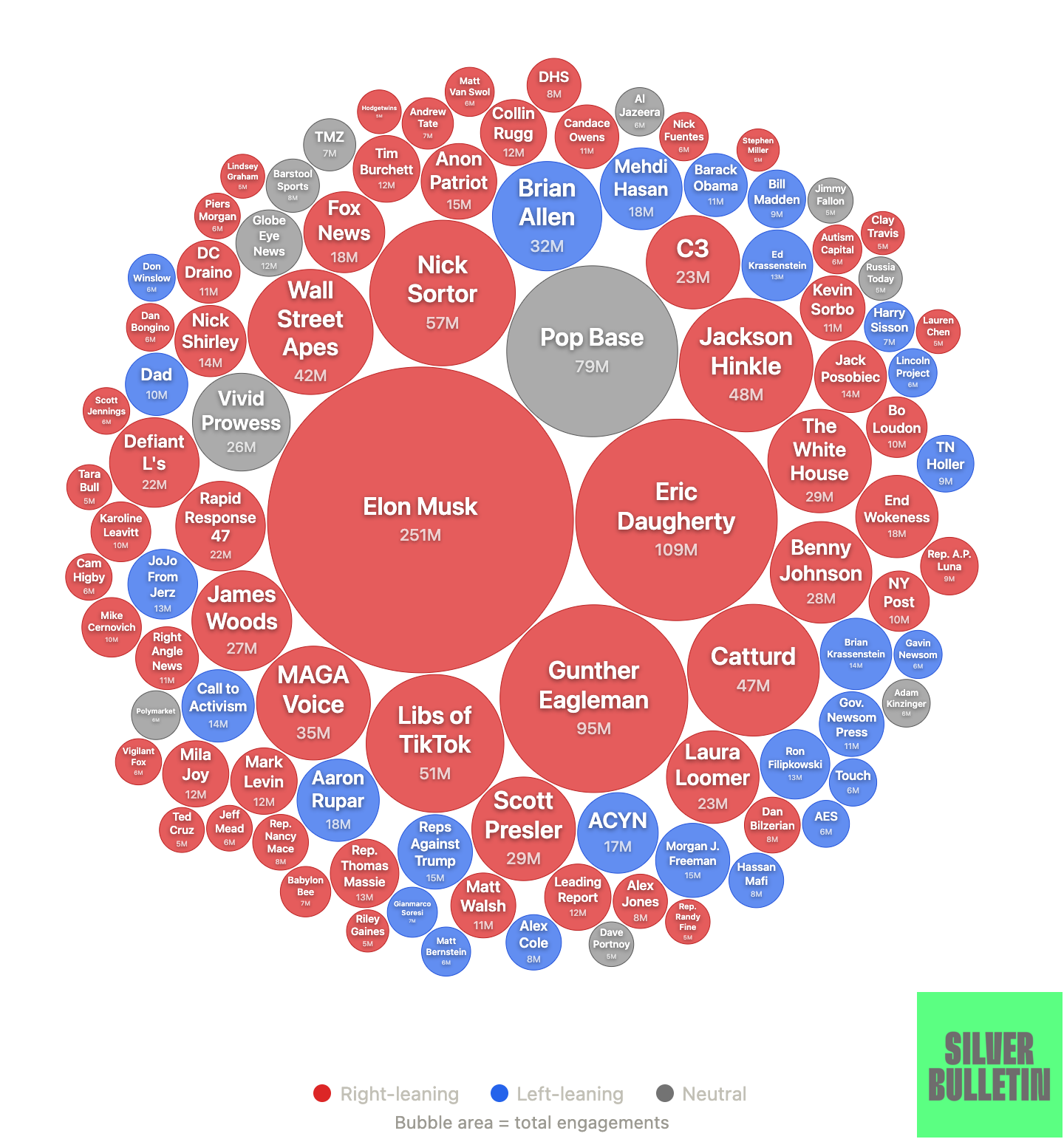
It’s not hard to notice that Twitter has become extremely right-leaning. But I’d argue there’s an equally important trend: the top accounts are of incredibly low quality. Elon, with the algorithmic boost he built in for himself, is at the eye of the storm, of course. But “Catturd” literally gets far more engagement than the New York Times, for instance.
There’s a common argument from proponents of the Musk-era X that the only problem is that left-leaning people have abandoned the platform. That the X algorithm is a contest and if only right-leaning accounts are playing, of course they’re winning. This is nonsense. The whole thing is rigged. Elon Musk’s outsized prominence as the most-engaged-with account is proof of that. Twitter existed for 16 years before Musk bought it. He wasn’t even close to the biggest account during that era. Then he bought it. Now his account is the biggest.
As Silver’s data analysis shows, Musk’s X is not just dominated by right-wing accounts, it’s dominated by “who the hell is that?” right-wing slop accounts.
The only way not to lose a rigged game is to refuse to play. X is still a thing. A lot of people, companies, and organizations still post there — treat it like their blogs — exclusively. I still wind up linking to posts on X because that’s where they are. That’s a whole separate discussion. But anyone who’s trying to “compete” there with subject matter that is even vaguely political has no chance of success unless what they’re posting is what Elon Musk wants to see promoted. It’s not like his thumb is on the scale, it’s like an anvil is on the scale. The conundrum is that there are still a lot interesting people posting interesting things there.
- Checking in on Perplexity ★
-
Yours truly, last August:
I can’t see why Apple would want to get involved with a company like this though. Gurman’s report makes it sound like his sources are inside Apple, but man, this “Apple + Perplexity” thing feels more like something Perplexity would be seeding than one that Apple executives would be leaking.
Perplexity is still occasionally in the news (often not in good ways), but it seems to me they’ve slipped into the “afterthought” tier of AI startups — which is exactly why they started leaning into clownish stunts last year. Everyone who previously suggested Apple should — or even might — buy them has gone silent.