
By John Gruber
WorkOS: How SSO works and the fastest way to add it.
Linked List: July 9, 2026
Thursday, 9 July 2026
- Shocking No One, Fidji Simo, Would-Be Usurper, Is Out at OpenAI ★
-
Berber Jin and Anissa Gardizy, reporting for The Wall Street Journal (gift link):
Fidji Simo, OpenAI’s No. 2 executive, plans to step down from her full-time role after an extended medical leave. She communicated her decision in a note to staff Thursday, saying that her medical condition had worsened and her road to recovery would be much longer than anticipated. She will become a part-time adviser to the company. [...]
The company abruptly pivoted its focus to building AI-powered coding tools for businesses after falling behind Anthropic in that lucrative market. Simo led early efforts to create a coding-focused “superapp,” which OpenAI launched today, and cut side projects such as the video-generator app Sora.
Quoting from the Ronan Farrow / Andrew Mantz blockbuster New Yorker profile of Sam Altman back in April:
Several executives connected to OpenAI have expressed ongoing reservations about Altman’s leadership and floated Fidji Simo, who was formerly the C.E.O. of Instacart and now serves as OpenAI’s C.E.O. for AGI Deployment, as a successor. Simo herself has privately said that she believes Altman may eventually step down, a person briefed on a recent discussion told us. (Simo disputes this. Instacart recently reached a settlement with the F.T.C., in which it admitted no wrongdoing but agreed to pay a sixty-million-dollar fine for alleged deceptive practices under Simo’s leadership.)
This whole dumb “superapp” idea that leaked last week sounds exactly like the sort of thing someone who ran the Facebook app would think is a good idea. The difference, I expect, is that Facebook is free to let product quality (and experience quality) fall by the wayside because their social platforms have such powerful network effects. People stay on Facebook and Instagram even as the experiences worsen because everyone they know is also still on those apps. There’s no network effect like that for ChatGPT. Claude is already rising to near-equal status in popularity, and Gemini isn’t far behind, and Simo hasn’t even started enshittifying ChatGPT yet. People will just switch.
- Today’s the Day OpenAI Fucked Up the ChatGPT Mac App ★
-
Zac Hall, writing at 9to5Mac about OpenAI’s sprawling product announcements today:
To summarize today’s desktop app changes:
The existing ChatGPT app is now ChatGPT Classic.
Codex is now the new ChatGPT desktop app. It still looks like Codex and includes the Codex icon as an option, but it’s now called ChatGPT.
ChatGPT for desktop includes ChatGPT Work and ChatGPT Codex, which share plug-ins. ChatGPT Codex mode shows more technical details that ChatGPT Work abstracts away from the user.
It’s possible to have ChatGPT Classic, ChatGPT, and Codex installed, but the way forward seems to be just running the new ChatGPT desktop app. Codex users can still use the Codex app icon, but the app will be called ChatGPT.
Looks like I picked the wrong week to quit sniffing glue.
The ChatGPT Classic app looks more native Mac-like, so that might be an issue for users.
The longstanding native ChatGPT Mac app — the one apparently now called ChatGPT Classic — is a 159 MB bundle. The new ChatGPT superapp — which in addition to combining the simple chatbot, ChatGPT Work, and Codex, also includes the remnants of the now-discontinued Atlas standalone web browser — is a svelte 1.5 GB Electron bundle, which doesn’t sound super to me at all.
- Apple’s Classic Mac Era Forays Into ‘Apps as Tiled Buttons’ Simplified Computing: At Ease and Launcher ★
-
Some historical follow-up regarding just-click-it launching and apps as tiled buttons with a uniform square shape. Back in the System 7 era in the 1990s, Apple sold (sold!) a product called At Ease (via Nathan Lineback’s venerable GUI Galley):
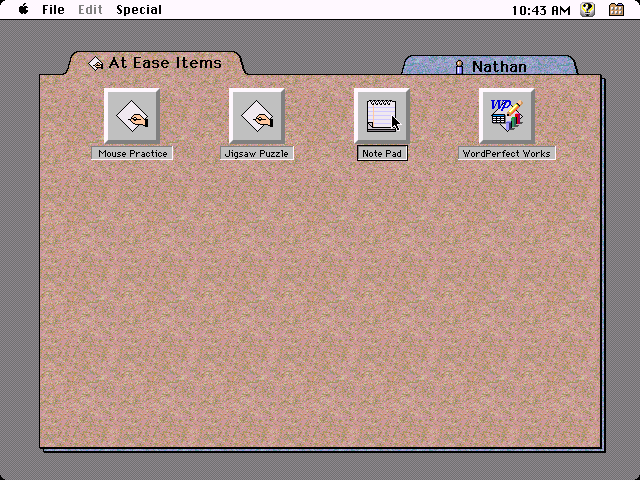
I don’t recall ever using At Ease, nor seeing anyone who did.
A few years later, Apple built a feature called Launcher into Mac OS 8 (via LinkedResources):
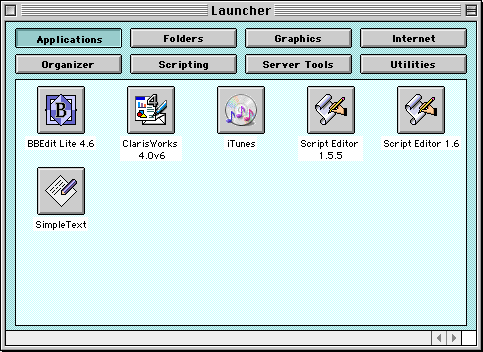
Launcher, I never used personally, but I do remember it being something of a thing. At Ease was an early effort to create a primitive “can’t mess it up” baby computer mode for the Mac. Launcher was more of a stilted attempt to sherlock great utilities like DragThing (R.I.P.). It wasn’t a baby computer mode, but an attempt to provide a bit of a power-user mode. I mean, when you first tried it, one of the default apps it included was Script Editor. Even the name “Launcher” evokes power-user utilities of today like Alfred, Raycast, and my favorite, LaunchBar.
Update 1: A whole slew of readers who are a decade or so younger than me have written to say that At Ease was a pervasive — and much despised — part of the Macs in their grade school computer labs. (Those computers were all Apple II models for me in the 1980s.) And, it turns out, DragThing creator James Thomson worked on At Ease while he was at Apple.
Update 2: The Mac OS 9 Finder had a “View as Buttons” mode I’d completely forgotten about.
- Meta Sets Default for Instagram Accounts to Permit Content Reuse by AI ★
-
Eli Tan, reporting for The New York Times (gift link):
The company’s new A.I. image generator has a surprising twist: It allows people to use images from public Instagram accounts.
When Meta unveiled an artificial intelligence image generator called Muse Image on Tuesday, it came with a feature that let users create A.I. images based on people’s Instagram photos. Any adult with a public Instagram account was automatically opted in. Using the Meta AI app, the company’s stand-alone chatbot, other users could pull from “part or all of your published photos” to create new A.I. images, the company wrote in a blog post.
This is an utterly unsurprising twist, given the entire history of the company. There are settings to turn this off (which Tan explains how to find), but to me it really does show that Meta views its users as something akin to vassals.