By John Gruber
WorkOS: How SSO works and the fastest way to add it.
Linked List: July 17, 2026
Friday, 17 July 2026
- Apple Books and Amazon Are Lousy With AI-Generated Books Ripping Off Legitimate Authors ★
-
Joanna Stern at New Things, last month:
Last month, just days after my book went on sale, AI knockoffs of the ebook version flooded Apple Books. There was Joanna Stern On I Am Not A Robot by Sophie Mercer. I AM NOT A ROBOT by Finn Tech. I AM NOT A ROBOT by Joana Stern — with one “n.” (Watch our latest video showing all these titles and more.)
In total, I found ten AI-generated ebooks clearly riding on mine, with AI-generated covers mimicking the style of my real one — the same blue, yellow and red color palette. Most were priced at $9.99, but some have gone as high as $20.99. [...]
After I contacted Apple about my own book’s clones back in May, the knockoffs quickly disappeared. [...] But now, a month after that first Apple cleanup, the problem is back. At the start of this week, there were at least three other I AM NOT A ROBOT counterfeits on Apple Books. (They seem to have since been removed.)
And I’m not alone. Lena Dunham’s Famesick has multiple lookalikes on the platform. Haley Sacks’s Future Rich Person has copycats that even use AI generated images of women on the cover that resemble the real author.
Kashmir Hill at The New York Times today (gift link):
Recently, I received a strange text from a new acquaintance. “You have your own biography???” it read. “How did you neglect to tell me this?”
This was news to me. I went to Amazon to investigate. There it was. A biography of Kashmir Hill — title: “The Biography of Kashmir Hill” — had been released nearly a year earlier, in August 2025. My life story had a mottled brown cover and a publisher I’d never heard of before. It had no reviews until I wrote one, asking, as the subject of this work, if I could please speak to the author. The hardcover cost $26.99, which seemed a bit steep, but my editor splurged on a copy and I was forced to read it.
My biography is 90 pages long and should be shorter. It combines facts about me that are widely available on the internet, such as where I grew up, with generic insights that could be true of anyone, like a horoscope spread over dozens of pages. “You cannot understand Kashmir Hill without understanding her contradictions,” my biographer wrote, along with an excruciatingly long description of my elaborate coffee-making ritual. (Fact check: My husband does it.)
It’s not just an e-book problem. Printing services are so cheap nowadays that some of these mooks (like one “author” Hill spoke to) are commissioning print editions for hundreds of these slopfests.
- Google Runs Out of Appeals, Must Pay Record $4.7 Billion EU Antitrust Fine ★
-
Arjun Kharpal, reporting for CNBC, back on July 2:
Europe’s top court on Thursday upheld Google’s fine of around 4.1 billion euros ($4.67 billion) over alleged anti-competitive practices.
In 2018, the European Commission slapped Google with the record-breaking penalty on the grounds that it abused Android’s mobile dominance to give unfair advantage to its own apps via pre-installation deals with smartphone makers.
Google has been appealing the ruling through the EU court system. But the European Court of Justice (ECJ), Europe’s top court, dismissed Google’s appeal. Google has no further right to appeal.
Google last year booked $132 billion in profit; this fine is about 3 percent of that. But in 2018, when the fine was initially assessed, Google booked “just” $31 billion in profit — this fine, if they’d paid it then, would have been about 15 percent of their annual profit. (And they booked only $13B, $19B, $16B, and $14B in profit going back from 2017 to 2014.)
There’s never a reason not to string the appeal process out, but it’s especially true when your profits are growing at an exceptional rate. By growing their profits around 5×, they’ve reduced the relative sting of this fine by 5×.
And that’s ignoring the effects of inflation — which over the last eight year have been significant.
- Roblox Set to Introduce AI Game-Building Feature, Including on iOS ★
-
Roblox executives Nick Tornow and Vlad Loktev, on the Roblox blog:
Twenty years ago, Roblox launched with a simple idea: “You make the game.” At the time, that was a radical proposition — most games were made by studios and professionals, and the idea that anyone could be a creator was far from obvious. But we believed it. And the millions of creators who built on Roblox proved it. As we look to a future where any one of Roblox’s 132 million daily active users could come up with the next hit game, we’re taking that original idea further than we ever have. Over the coming months, we’ll share a series of announcements that will give every creator a clear runway to go further and fulfill the promise of “You make the game” for more people than ever before.
Today, we’re announcing Build, a new mobile-first creation tab within the Roblox app, and a new suite of AI-powered tools within Studio for creators of every level. On July 28, we’ll begin testing these new agentic tools. With Build and Studio, creators can delegate the parts of development that don’t require their full attention.
This sounds really cool and fun. But you know what else was really cool and fun? AI coding apps that ran on iOS, like Bitrig, Replit, and Vibecode — all of which Apple put the kibosh on back in the winter. You of course are free to use any tool you want to build apps for iOS on a desktop computer, but Apple decided to disallowing building iOS apps on iOS.
But it’s OK for Roblox to allow AI-assisted game generation on iOS ... because Roblox is already so big and popular? How can Apple justify allowing Roblox to do this while disallowing anyone else?
- Apple Raises Prices for Apple Music and Apple One Subscriptions ★
-
Chance Miller, 9to5Mac:
Here are the new monthly prices for Apple Music and Apple One as of today:
Apple Music:
- Individual: $11.99 (up from $10.99)
- Family: $19.99 (up from $16.99)
- Student: $6.99 (up from $5.99)
Apple One:
- Individual: $19.95 (unchanged)
- Family: $27.95 (up from $25.95)
- Premier: $39.95 (up from $37.95)
- OpenAI’s Product Shake-Up Put the Complexifiers in Charge ★
-
Wired, back on May 15:
OpenAI says it’s folding ChatGPT, its AI coding agent Codex, and its developer-facing API into one core product team. The company says that Codex is increasingly powering its consumer and enterprise offerings, which are gaining the ability to perform digital tasks autonomously on behalf of users.
Other OpenAI leaders are also taking on larger roles at the company as part of the changes. OpenAI’s head of Codex, Thibault Sottiaux, has been tapped to lead the company’s core product and platform teams. Sottiaux was a key leader in building Codex into one of the company’s fastest-growing products of all time. He’s also one of the leaders overseeing development of OpenAI’s forthcoming “super app,” which aims to combine Codex, ChatGPT, and the company’s Atlas web browser into a unified desktop application.
I’ll give them credit for sticking with a plan for two whole months to get this out the door. But the problem is they went the wrong way. Instead of putting the eggheads from Codex in charge of ChatGPT, they should have put the product-minded people from ChatGPT in charge of Codex. Codex, I’m finally learning, is sprawling and confusing. It needs a strong dose of focus, clarity, and coherence — attributes that ChatGPT exhibited in spades. Instead, by putting the Codex dorks in charge, they’ve injected ChatGPT with confusion, incoherence, and sprawl.
Claude, the app OpenAI’s leadership is obsessed with copying now, is so goddamn confusing that it has Extensions, Plugins, Capabilities, Skills, and Connectors — and they’re all different things. You’ve let your own AI overuse turn your brain to mush if you think that makes sense, but even more so if you think that’s the model to copy.
I’ve been waiting for a while now for someone to explain all of this clearly and succinctly, worried that maybe it was my job to figure it out and do the clear succinct explaining. All of this dogshit from OpenAI and Anthropic presents itself as though it can be explained clearly and succinctly. But it’s just a veneer of coherence. It’s all just been thrown together in an AI blender and poured out as mush.
- MG Siegler: ‘OpenAI Makes ChatGPT ChatGPT Again’ ★
-
MG Siegler, writing at Spyglass:
In that light, we can see the dilemma. But there were also probably about a dozen better ways to do this roll-out — as highlighted by how fast they’re fixing these things — and they just missed the mark. While they undoubtedly knew there would be some backlash, they probably didn’t realize there would be this much. Again. All that points to perhaps a disturbing trend where OpenAI doesn’t really understand their user base. Which you almost can understand given how they clearly stumbled into ChatGPT in the first place. Still, here they are with those billion users. A problem that all of their competitors would love to have. But still a problem if you want to fundamentally change what you are as a product.
But those are bigger, existential issues. All I wanted was chat back in the ChatGPT app. Front and center. And I got it. It’s not perfect. It’s still bloated. But at least it’s usable again now and not a confusing mess of ideas out of the box.
MG is pretty scathing, but I still think he’s taking it too easy on OpenAI for what a colossal fuck-up this remains. There was nothing wrong with the way things were, with two apps — the simple ChatGPT and the complex Codex. (Well, the Codex Mac app being an Electron turd was wrong, but that complaint seems quaint at this point.)
Adding “ChatGPT” as a tab to Codex is fine. Renaming Codex to “ChatGPT” is stupid. They have not made ChatGPT “ChatGPT” again.
There is nothing — not one single tiny feature — in the new ChatGPT app that makes me want to use it instead of ChatGPT Classic. And there is so much in ChatGPT Classic that works better or just isn’t available in the new ChatGPT. You can’t even just delete a chat in the new app — you have to “archive” it first, then fish around to find the archive and delete it there.
I don’t think the problem is that OpenAI “doesn’t really understand their user base”. I think it’s that decisions are now being made by AI research eggheads who don’t understand their own products. They think this makes sense. So of course they don’t understand their user base — who uses the ChatGPT product — either. I mean what sense does it make that the ChatGPT app for iOS and Android is still the old ChatGPT, which on the Mac is now “ChatGPT Classic”, but there’s a totally different app that is an entire order of magnitude more complicated on the Mac now named “ChatGPT”?
The only good solution is to pretend this last week didn’t happen and go back to calling ChatGPT “ChatGPT” and Codex “Codex”. If they want to give one of them a new name, don’t call ChatGPT “ChatGPT Classic” — instead rename Codex “ChatGPT Codex”. There, done. All problems solved.
The Codex app is clearly capable of amazing things. But the reason that there are a billion users of ChatGPT but only a few million users of Codex — by OpenAI’s own accounting — is because ChatGPT is simple and focused and based on a single coherent concept: chat. The frustration of the eggheads now running product at OpenAI is obvious: how come these hundreds of millions of morons using ChatGPT aren’t running Codex instead? Somehow they thought they could fix this by giving Codex the ChatGPT name. This is like if Apple had gotten rid of the Messages app on the Mac and replaced it with Xcode, which they renamed to “Messages”. Now they’ve put an “iMessage” tab in the Xcode sidebar and re-released the Messages app everyone knew and loved as “Messages Classic”.
OpenAI separated itself from its competition — especially Anthropic — by being good at product. Now their product decisions are being made by people who don’t understand why Apple makes both iMovie and Final Cut Pro, or GarageBand and Logic Pro.
- OpenAI Starts Cleaning Up the Utter Mess It Made of ChatGPT ★
-
Thibault “Tibo” Sottiaux, the OpenAI engineering lead who’s taking the most public credit for this and thus probably deserves the most blame, on Twitter/X:
Evening! We’ve gotten lots of great feedback on the new ChatGPT desktop app (which we didn’t get totally quite right on the first try), and as a result, we’ve made some changes.
1/ ChatGPT conversation history and projects are now visible in the sidebar. Also, your Chat and Work history now sync across web, mobile, and desktop. Local tasks still stay on your computer.
How in the world did they ship this without sync?
2/ You can now easily switch between Chat and Work modes inside ChatGPT on desktop, which is now also consistent with how it shows on web and mobile.
Bringing back “chat” to ChatGPT is literally the least they needed to do. Hiding chat in an obscure corner of the interface from an app named “ChatGPT” would be like removing text editing from TextEdit.
The updates OpenAI shipped yesterday address some of the abject incoherence of the initial rollout of the “new” ChatGPT, but it’s still dogshit. The new app remains a 1.5 GB Electron monstrosity (and if it’s not technically Electron that’s because they’ve created another bloated layer of abstraction around Electron — Sottiaux oversees the only engineering group in the world that looked at Electron and thought it was too slim and close to the metal).
Here’s the software update dialog I saw today in the old version of ChatGPT, which is now named ChatGPT Classic:
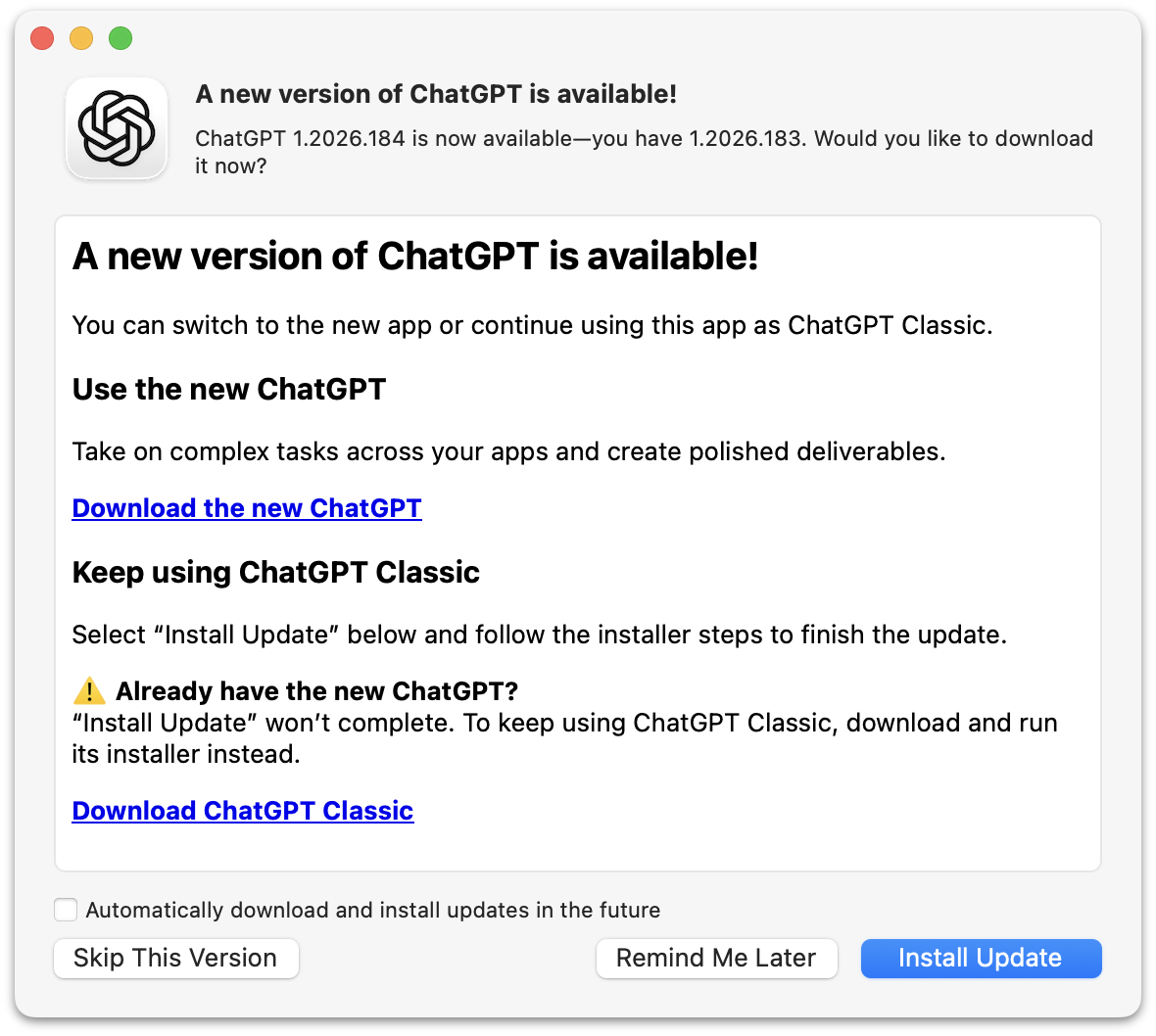
What they’re trying to say here is that if you’ve ever installed the new ChatGPT the “Install Update” button in this dialog will do nothing. It will take some time to do nothing, but ultimately do nothing. Except quit ChatGPT.
If you’ve never installed the new ChatGPT, this dialog box will update the old ChatGPT to the latest version, which is now renamed “ChatGPT Classic”. If you have tried the new ChatGPT, you need to install ChatGPT Classic manually, even though you’re seeing this update dialog box in a slightly older version of the app you want to keep using. But at least they now offer a supported way to install ChatGPT Classic.
This whole thing makes the “New Coke”/”Coke Classic” fiasco from the 1980s look like a well-thought-out change.
- Linus Torvalds: ‘AI Is a Tool, Just Like Other Tools We Use. And It’s Clearly a Useful One.’ ★
-
Linus Torvalds:
I realize that some people really dislike AI, but this is an area where I’m willing to absolutely put my foot down as the top-level maintainer.
Linux is not one of those anti-AI projects, and if somebody has issues with that, they can do the open-source thing and fork it.
Or just walk away.
AI is a tool, just like other tools we use. And it’s clearly a useful one.
It may not have been that “clearly” even just a year ago, but it’s no longer in question today.
There are other questions around AI (like what the economy of it will actually look like in the end), but “is it useful” is no longer one of those questions. Anybody who doubts that clearly hasn’t actually used it.
- BBEdit 16 ★
-
Speaking of BBEdit, version 16 dropped just before WWDC, and adds a slew of nifty improvements, headlined by vastly expanded support for Shortcuts. You can also search for text in images, use the W3C HTML syntax checker, and of all things, use vi keyboard emulation. There’s a lot more, of course — and as always the changes, improvements, and additions are copiously documented in the release notes.
New licenses are $60, upgrades from v15 cost $30, and upgrades from older versions are $40. In the Mac App Store it’s a $5/month or $50/year subscription.
See also: Jason Snell at Six Colors and Adam Engst at TidBITs.
- ArtfulType: Markdown Writing App for the 68K Macintosh ★
-
Sean Malseed — “Action Retro” on YouTube — created a Markdown editor for the original Macintosh. Source code on GitHub; intro video on YouTube. It’s written in C, not Pascal, and uses the modern Retro68 GCC-derived compiler.
I absolutely love that this exists. I don’t like the actual app at all. I guess “full screen” mode is the point of some “distraction free” editors, but I for one would never look twice at a Mac app that didn’t use windows. Full-screen mode just wasn’t a thing back then, except for games. ArtfulType is not a Mac-assed 1984 Mac app.
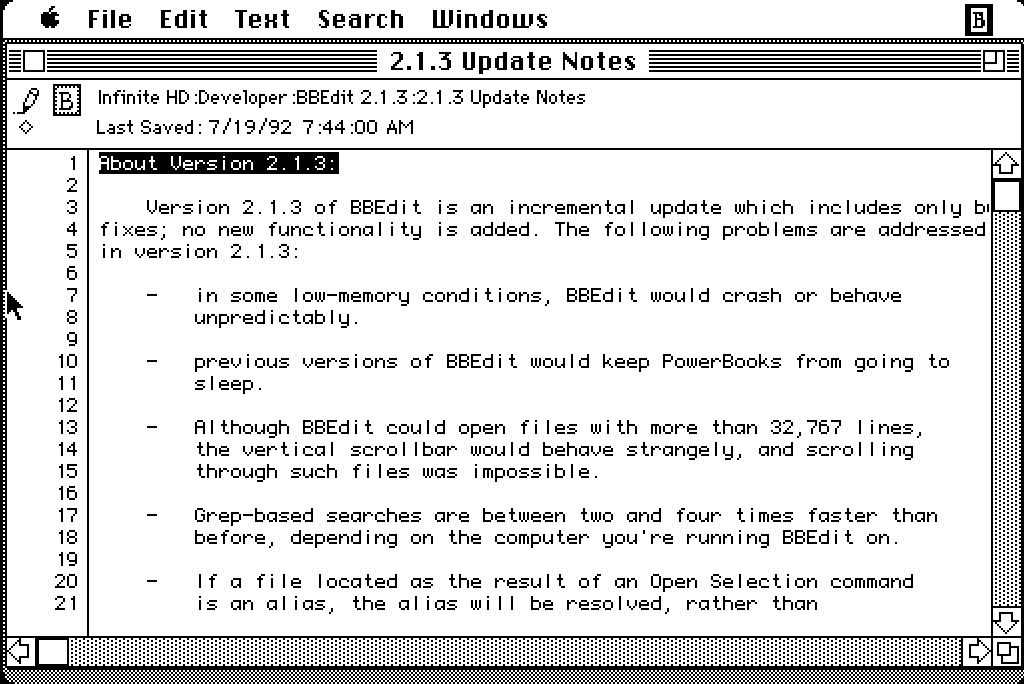
If I wanted to write in Markdown on a classic Mac, I’d use BBEdit, which was the app I originally created Markdown for use in. And one of two apps I primarily still use it in. But BBEdit won’t run on an original 128 KB Macintosh, because Rich Siegel didn’t create it until 1989, and the earliest public version was BBEdit 2 in 1992. BBEdit 2.1.3 does run in System 5 on Infinite Mac, but crashes if launched on System 3. I 100 percent see the appeal of using a 1980s retro Mac, but I don’t see the appeal of using one that can’t run System 6.
- Happy iCal Day ★
-
Joanna Stern explains why this emoji is correct today: 📅. (This one too: 📆)
- Google and Epic Give Up Fighting — Third-Party Android App Stores Are Coming Next Week ★
-
Sean Hollister, reporting for The Verge (gift link):
Here’s Google’s full statement on withdrawing its proposed modifications to Judge Donato’s permanent injunction, via Google spokesperson Dan Jackson:
We’ve agreed with Epic to withdraw our motion to modify the US Court’s injunction rather than prolonging this process which creates uncertainty for the ecosystem. This allows us to focus on executing our recently announced global business model evolution to deliver greater app store choice, lower prices, and more opportunities for developers and users. We remain committed to maintaining Android’s industry-leading security and fostering a competitive ecosystem where every app store and developer has the freedom to compete. In parallel, we continue to comply with the US Court’s injunction.
Google had previously announced that it would launch its sideloaded Registered App Store program in the rest of the world, beginning with the new version of Android later this year. That means there may be two different tracks for Android: stores-within-a-store in the United States and Registered App Stores everywhere else.
Google is already informing US app developers that their apps and game listings will automatically be provided to third-party app stores starting July 22nd, unless they opt out, and it’s launched a specific page for its Play Catalog Access Program for third-party app stores to enroll.
I presume that this new agreement between Google and Epic includes ripping up the “no criticism of Play Store” gag order that the highly principled Tim Sweeney had agreed to in exchange for $800 million back in March?
Anyway, it will be interesting to see what developers do. My guess is that all the big app developers will opt out of this. Games, though, maybe not?