
By John Gruber
We’re just out
here a-havin’ fun
In that warm
California sunnn…
Linked List: January 10, 2007
Wednesday, 10 January 2007
- Gotham Rounded ★
-
Lovely new font from Hoefler & Frere-Jones. Nice, friendly feel to it.
- Penny Arcade: The Microsoft Zune: 2006-2006 ★
-
The comic is funny, but the title is even funnier.
- 43 Folders Podcast: Snell and Gruber on iPhone Applications ★
-
Brief interview by the one and only Merlin Mann with Jason Snell and me, talking about whether or not the iPhone is going to be open to third-party software development. (The answer, alas, is “no”, or at least “not yet”.)
Update, 9 January 2017: The original audio file is lost to the sands of time, but here’s a copy.
- Mac Office 2008 ★
-
Includes a screenshot of a seriously revamped PowerPoint.
- Cisco Files Suit Against Apple Over Use of ‘iPhone’ Trademark ★
-
So much for there being an agreement “ready to sign”.
This is just weird. Seems a bit reckless for Apple to launch this without the trademark rights in hand. It’s worth noting, by the way, that the prototype hardware units on display here at Macworld Expo do not have “iPhone” printed on them anywhere.
- Cabel Sasser and John Gruber at the Irish Bank ★
-
Some of you would gladly cut off a finger to see what was on Cabel’s screen when Buzz took this picture. Maybe two fingers.
There are some pictures on Flickr from our little show at Macworld’s booth earlier in the day as well.
- Kottke’s Comparison of the Relative Size of the iPhone Compared to Other Popular Gadgets ★
-
Jason Kottke:
A lot of people are wondering just how big this thing is. Using the technical specs from apple.com, I grabbed some cardboard, scissors, and glue and made a scale model of the iPhone.
Similar effort from Engadget here.
- Macworld Photos, Day One ★
-
My photos from yesterday, including the keynote and the iPhone.
- Cisco Is Expecting ‘Signed Agreement’ on iPhone Trademark ★
-
Sounds like Apple and Cisco have reached an agreement.
- Time Magazine on the iPhone ★
-
Lev Grossman has a terrific report on the iPhone on Time.com:
Weaknesses? Absolutely. You can’t download songs directly onto it from the iTunes store, you have to export them from a computer. And even though it’s got WiFi and Bluetooth on it, you can’t sync iPhone with a computer wirelessly. And there should be games on it. And you’re required to use it as a phone — you can’t use it without signing up for cellular service. Boo.
And:
The iPhone is a phone, an iPod, and a mini-Internet computer all at once, and contrary to Newton — who knew a thing or two about apples — they all occupy the same space at the same time, but without taking a hit in performance. In a way iPhone is the wrong name for it. It’s a handheld computing platform that just happens to contain a phone.
“Newton” comes to mind in another way, as well.
- Regarding My Previous Commentary on the Use of the ‘iPhone’ Brand Name ★
-
Me, last month, in the wake of the Linksys “iPhone” announcement:
Did people really think that Apple, if — and it’s still an “if” — they produce a cell phone, was going to call it “iPhone”? The fact that iphone.com clearly belongs to someone else was a strong hint that they weren’t.
At least I wasn’t alone.
And, amazingly to me, iphone.com still points to a junky page from “The Internet Phone Company”. And I still haven’t heard any definitive answer regarding how Apple plans to use this name if Linksys claims the trademark and is using it for their own product.
- BBEdit 8.6 ★
-
My favorite new app from 1992, now with extensive Markdown support.
(New version of TextWrangler with Markdown support, too.)
- Yojimbo 1.4 ★
-
My favorite new app of 2006, now with extensive AppleScript support.
- Apple iPhone ★
-
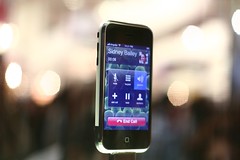
What you cannot appreciate looking at iPhone photographs on your computer display is how amazing its screen is. 160 DPI is an amazing resolution — tiny, tiny text is amazingly legible. And the device itself is very thin.
The battery policy, though, is exactly like that of other iPods: it’s sealed inside the case, and is not swappable.
- Apple: 802.11n ★
-
The only actual Mac news from Apple, and it didn’t even get mentioned in the keynote.
- Apple’s Stock Price Graphed Against Palm and RIM ★
-
Remember back in November when Palm CEO Ed Colligan was quoted saying, with regard to a then-hypothetical Apple phone, “We’ve learned and struggled for a few years here figuring out how to make a decent phone. PC guys are not going to just figure this out. They’re not going to just walk in.”
Guess what? They’re just walking in.