By John Gruber
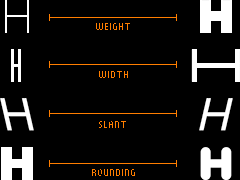
Zed — A font superfamily with extraordinary number of styles and extraordinary language support.
Linked List: July 5, 2011
Tuesday, 5 July 2011
- John Adams: ‘It Is More Important That Innocence Be Protected Than It Is That Guilt Be Punished’ ★
-
I almost linked to this page of quotes from founding father John Adams yesterday, but I’m glad I held off. This one seems more apt today:
It is more important that innocence be protected than it is that guilt be punished, for guilt and crimes are so frequent in this world that they cannot all be punished. But if innocence itself is brought to the bar and condemned, perhaps to die, then the citizen will say, “whether I do good or whether I do evil is immaterial, for innocence itself is no protection,” and if such an idea as that were to take hold in the mind of the citizen that would be the end of security whatsoever.
- Larry Mendte’s Five Funniest Philadelphians on Twitter ★
-
Number two sounds cute.
- ‘Designed for Use’ ★
-
Speaking of Lukas Mathis, he’s written a book for The Pragmatic Programmers on user interface design: Designed for Use: Create Usable Interfaces for Applications and the Web. See also: his FAQ for the book.
-
Jon Bell:
A button with no physical hardware, so it makes no distinction between “I pressed that button because I meant to” and “my finger brushed against the face of the phone, sending me to another screen against my will, sometimes even losing data in the process.”
- Verizon’s New Smartphone Data Plans ★
-
Phil Goldstein, FierceWireless:
Verizon spokeswoman Brenda Raney told FierceWireless that new smartphone customers will choose from one of three options: $30 for 2 GB, $50 for 5 GB or $80 for 10 GB. There will be an overage charge of $10 per GB of data. Verizon will also charge $10 for 75 MB per month for feature phone users. AT&T Mobility charges $15 per month for 200 MB and $25 per month for 2 GB.
“Unlimited” hasn’t worked for the carriers, and has never truly meant unlimited anyway. If you use more than 2 GB per month you’re going to pay more, but this strikes me as fair, because most people don’t use that much data.
What I don’t get is why not offer everyone the $10 for 75 MB plan? Lower the monthly minimum and get more people to switch from feature phones to app phones.
- Tim Bray: ‘Things About Google+’ ★
-
Good points from Tim Bray on Google+.
Something that occurred to me over the weekend is that Google+’s name suggests that this is a major initiative from Google. “Google” has always meant two things: the company, and its flagship product, the search engine at google.com. Google offers many products, but its main product has always been search. Adding a “+” — not the word plus but merely the punctuation character — strikes me as perhaps the most aggressive way that Google, the company, could attempt to redefine what “Google” means to the public at large. If it works out as they hope, the result is that we’ll wind up thinking of this social network at least as much as we do about web search when we think of “Google”.
- Bing for iPad 1.1 ★
-
Very clever new “lasso” feature: start a new search just by drawing a circle around words on the current web page.
- Word of the Day: Monopsony ★
-
Philip-Elmer DeWitt, culling analysis from Horace Dediu’s podcast and this thread on Quora:
In this way, according to Dediu, Apple has become not a monopoly (a single seller), but a monopsony — the one buyer that can control an entire market.
A compelling argument that Apple is using its cash hoard to great competitive advantage.
- Jon Rubinstein Sends Message to HP Staff; Addresses TouchPad Reviews ★
-
Jon Rubinstein, in a leaked company-wide memo:
In that spirit, Richard Kerris, head of worldwide developer relations for webOS, reminded me yesterday of the first reviews for a product introduced a little over ten years ago:
“…overall the software is sluggish” “…there are no quality apps to use, so it won’t last” “…it’s just not making sense….”
It’s hard to believe these statements described MacOS X — a platform that would go on to change the landscape of Silicon Valley in ways that no one could have imagined.
I think that analogy works.
- RIM Doubles Down on Flash ★
-
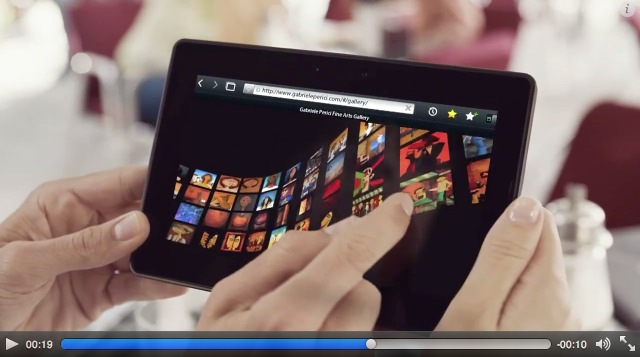
“What’s so special about web browsing on the new BlackBerry PlayBook? That’s right, it runs Flash.”
Update: DF reader Brian Smith spotted something fishy at the 19-second mark. Update 2: A bunch of readers say there’s nothing fishy about it — it’s a man and woman co-holding the PlayBook. Looks fake to me, though. Anyway, go Flash.
- A Brief Look at Apple’s Stock Seasonality ★
-
Andy Zaky:
Every year, Apple tends to see some sort of a correction which takes place during the first half of the year and usually ends between May and August. In six out of the last seven years, Apple has rallied at least 48% off of its lows.
- Lion Compatibility Update for My Simple Inbox Archiving Script for Apple Mail ★
-
Back in 2007 I published an AppleScript that I use daily with Apple Mail. I read email in batches, and just leave the read messages in my IMAP inboxes. When I’m done reading email, I run this script, and it moves all read unflagged messages in each inbox into an “Archive” mailbox for the corresponding account. I’ve been using this for over four years now.
The script, as originally published, doesn’t work in the Mac OS X 10.7.0 developer GM seed. I’ve updated the script with a workaround so that it now works both on 10.7 and 10.6. You can see the changes in the revision history for the script at Gist.
- WordPress for WebOS ★
-
Nice-looking blog-editing and management app for the TouchPad.