By John Gruber

All your customer
data in that nice
California sunnn.
Early access now!
Linked List: January 18, 2025
Saturday, 18 January 2025
- Microsoft Cleans Up Dirty Trick Where Bing Masqueraded as Google – Sort Of ★
-
Tom Warren, The Verge:
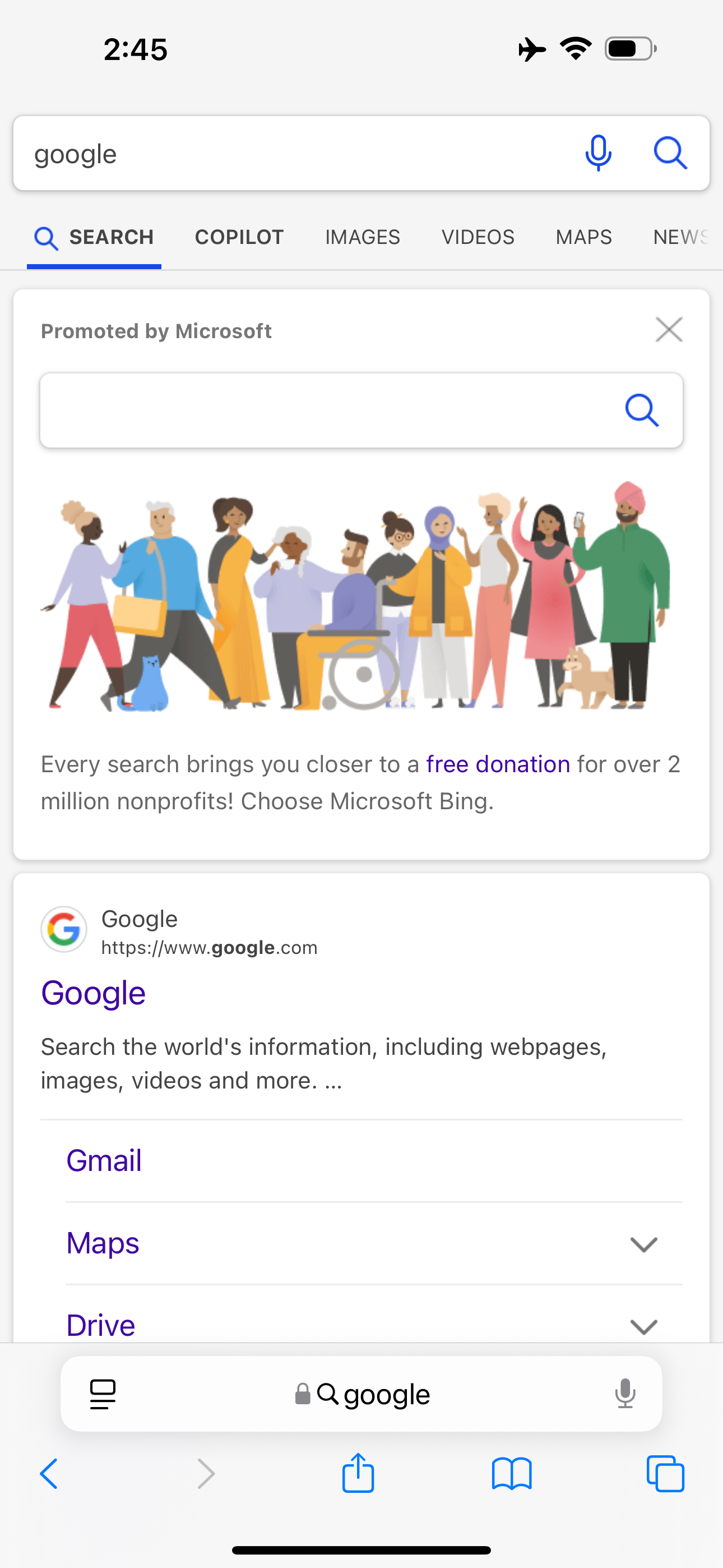
Earlier this month you could search for “Google” on Bing and get a page that looked a lot like Google, complete with a special search bar, an image resembling a Google Doodle, and even some small text under the search bar just like Google search.
The misleading UI no longer appears on the Google search result of Bing this week, just days after it was originally discovered by posters on Reddit.
So much for my praise for Microsoft still having it in them to rat-fuck without shame. They’ve gone soft.
Update: OK it’s not so much that Microsoft has stopped the trickery, but more like they’ve just turned the dial down a little bit. The Google-Doodle-style illustration is still there, but on desktop browsers, at least, they’ve stopped the autoscrolling that hides the Bing branding and site navigation at the top of the page. But if you have Mobile Safari set to use Bing as its default search and search for “Google” from the location field, you get the Google-lookalike layout with the Bing branding scrolled out of view. I’d say Microsoft’s dirty trick is still in place. Good for them.
- Another Never-Announced Product Might Fail to Meet Its Never-Announced Ship Date ★
-
Tim Hardwick, last week for MacRumors, “Apple Smart Home Hub Launch Possibly Delayed Until Later in Year”:
Apple’s long-rumoured smart home hub or “command center” may not arrive in the spring as previously expected, according to Bloomberg’s Mark Gurman. [...]
Apple originally planned to introduce the home hub in March 2025. However, writing in his latest Power On newsletter, Gurman says that the device “may take longer to reach consumers,” owing to the operating system’s heavy reliance on App Intents features that won’t be ready until iOS 18.4 and iOS 19. This in itself means “it’s plausible that the hardware itself will ship later,” adds Gurman.
Here’s Gurman in his own words:
Then there’s the brand-new smart home hub. This device has a roughly 7-inch screen and can help manage household tasks, run apps and conduct video calls. Consumers will be able to hang it on a wall or place it on a countertop — perhaps in a few spots around the home.
Apple has been planning to introduce the home hub in March, but it may take longer to reach consumers. The device’s new operating system — code-named Pebble — is heavily tied to App Intents features coming in iOS 18.4 and iOS 19, so it’s plausible that the hardware itself will ship a bit later.
How many Apple products that miss “expected” ship dates that were announced only by Gurman do we need before MacRumors writers, and the others on the Gurman
regurgitationre-blogging beat, start to wonder whether it’s really the case, as Gurman’s reporting would have us believe, that every single product from Apple winds up shipping months or even years later than intended?Maybe Gurman’s right, and Apple hasn’t shipped a single product on schedule since like maybe the original AirPods back in 2016 (an absolute banger of a scoop, from before Gurman left 9to5Mac for Bloomberg).
Or, and I’m just tossing this out there, maybe the way companies that are good at shipping new products actually ship new products is by setting aggressive, probably impossible, internal milestones to keep the entire team inside the company and manufacturing partners in the supply chain moving with urgency until the thing is actually ready to announce and ship. And that by reporting these milestones as actual expected ship dates, repeatedly, it makes Mark Gurman and Bloomberg News wrong, not the products late, when those dates are missed without the products ever having been announced. Something like that could happen when the incentive structure of a news publication is based on whether the reporting moves stock prices, not whether it turns out to be accurate.
I’m sure it’s just the case, though, that Apple has been unable to ship anything new on schedule for close to a decade.
- Joanna Stern’s Imaginary Husband ★
-
Joanna Stern, in her weekly Tech Things newsletter for the WSJ:
Despite what my iPhone’s frequent notification summaries report, my husband isn’t messy, he isn’t sad and he definitely didn’t take out the garbage — because, again, I don’t have one. Wife? Yes. Husband? No.
As part of Apple Intelligence, the company rolled out these AI-powered summaries. Instead of scrolling through a mountain of missed alerts, you get little condensed summaries, grouped by app. Great concept, not quite “intelligent” execution.
- Google Search, More Machine Now Than Man, Begins Requiring JavaScript ★
-
Kyle Wiggers, writing at TechCrunch:
Google says it has begun requiring users to turn on JavaScript, the widely used programming language to make web pages interactive, in order to use Google Search. In an email to TechCrunch, a company spokesperson claimed that the change is intended to “better protect” Google Search against malicious activity, such as bots and spam, and to improve the overall Google Search experience for users. The spokesperson noted that, without JavaScript, many Google Search features won’t work properly and that the quality of search results tends to be degraded.
The Google spokesperson told TechCrunch that, on average, “fewer than .1%” of searches on Google are done by people who disable JavaScript. That’s no small number at Google scale. Google processes around 8.5 billion searches per day, so one can assume that millions of people performing searches through Google aren’t using JavaScript.
One of Google’s motivations here may be inhibiting third-party tools that give insights into Google Search trends and traffic. According to a post on Search Engine Roundtable on Friday, a number of “rank-checking” tools — tools that indicate how websites are performing in search engines — began experiencing issues with Google Search around the time Google’s JavaScript requirement came into force.
I long ago stopped being a fan (or regular user) of Google Search, but the SEO industry is worse (to keep the Obi-Wan Kenobi quote references going from my headline, you’ll never find a more wretched hive of scum and villainy than “SEO experts”), so I’m amenable to an argument from Google that this is a justifiable step in their never-ending war with SEO scammers seeking to game search results in their favor.
But the bottom line is that with this change, Google Search is more of an app than it is a website. A website is a server where you can make requests over the HTTP protocol and get results in HTML format. A server that communicates with clients via executable JavaScript is not a website. Whether it’s a justifiable decision or not, I don’t buy for a second that it’s a necessary decision on Google’s part. Thus I find this decision sad, but given the course Google has been on for the last 15 years or so, I’m also unsurprised. Old original Google was a company of and for the open web. Post 2010-or-so Google is a company that sees the web as a de facto proprietary platform that it owns and controls. Those who experience the web through Google Chrome and Google Search are on that proprietary not-closed-per-se-but-not-really-open web.
Requiring JavaScript for Google Search is not about the fact that 99.9 percent of humans surfing the web have JavaScript enabled in their browsers. It’s about taking advantage of that fact to tightly control client access to Google Search results. But the nature of the true open web is that the server sticks to the specs for the HTTP protocol and the HTML content format, and clients are free to interpret that as they see fit. Original, novel, clever ways to do things with website output is what made the web so thrilling, fun, useful, and amazing. This JavaScript mandate is Google’s attempt at asserting that it will only serve search results to exactly the client software that it sees fit to serve. That’s Google’s right. But it’s sad.
Here’s a good thread on Hacker News discussing the change, with some interesting commentary on the state of the no-JavaScript web. Also worth pointing out that Kagi, the best search engine in the world, works fine without JavaScript.
I’ll end with my longstanding hot take, which, as the years go on, seems more and more obviously true and no longer a hot take at all: The web would be better off if browsers had never added support for scripting. The web would be much faster; much better for its original purpose of delivering content to consume, not software to interact with; and much more secure and private. More control would remain in the hands of client software — and thus in the hands of users — than server-side.