By John Gruber

All your customer
data in that nice
California sunnn.
Early access now!
Linked List: February 3, 2025
Monday, 3 February 2025
- LBJ on the Difference between Republicans and Democrats ★
-
The LBJ Presidential Library, regarding a largely ad-libbed address Lyndon Johnson gave to a group of 150 non-incumbent Democratic candidates for Congress in 1966:
He talked about the difference between Republicans and Democrats: “We’re for something, and they are against everything. Mr. Rayburn was asked one time, ‘What do you think — after 50 years — is the primary difference between the Republican and Democratic parties? Is it the tariff?’
“‘No.’
“‘Well, what is the difference?’
“Mr. Rayburn replied, ‘I’ll tell you the easiest and best explanation — one that I have observed, and I came here during Woodrow Wilson’s administration. They hate all of our Presidents.’
“He said, ‘I didn’t hate Harding. I felt sorry for him, but I didn’t hate him.’ He said, ‘I didn’t hate Coolidge. I thought he was totally inadequate to the responsibility, but I used to go down and eat scrambled eggs and just watch him. He never said anything. You couldn’t tell what he thought of anything.’
“He said, ‘I didn’t get angry with Hoover. Everything in the country folded up and we had bread lines all over the country and everybody in the Southwest was chasing rabbits in order to eat. But I didn’t hate him. We tried to help him. But look what they did to Roosevelt when he came in. They were after his wife. They were after his daughter. And they finally got down after his dog.’”
And LBJ pointed toward the South Lawn where his beagles were kept and said: “And I’ve got three of them out there to jump on if they want to.”
He talked about the difference between constructive action and obstructive action: “Any jackass can kick a barn down. But it takes a carpenter to build one.”
Much has changed in the last 60 years. Much has not.
- ‘Apple in China’ – New Book by Patrick McGee, Coming in May ★
-
Speaking of books, Simon & Schuster announced a new one:
Apple isn’t just a brand; it’s the world’s most valuable company and creator of the twenty-first century’s defining product. The iPhone has revolutionized the way we live, work and connect. But Apple is now a victim of its own success, caught in the middle of a new Cold War between two superpowers.
On the brink of bankruptcy in 1996, Apple launched a new strategy to outsource its manufacturing. After experimenting in eight countries, nearly all of its operations were lured to China by the promises of affordable, ubiquitous labour. As the iPod and iPhone transformed Apple’s fortunes, their sophisticated production played a seminal role financing, training, supervising, and supplying Chinese manufacturers — skills Beijing is now weaponizing against the West.
Apple in China is the sometimes disturbing and always revelatory story of how an outspoken, proud company that once praised “rebels” and “troublemakers” — the company that encouraged us all to “Think Different” — devolved into a silent, passive partner to a belligerent regime that increasingly controls its fate.
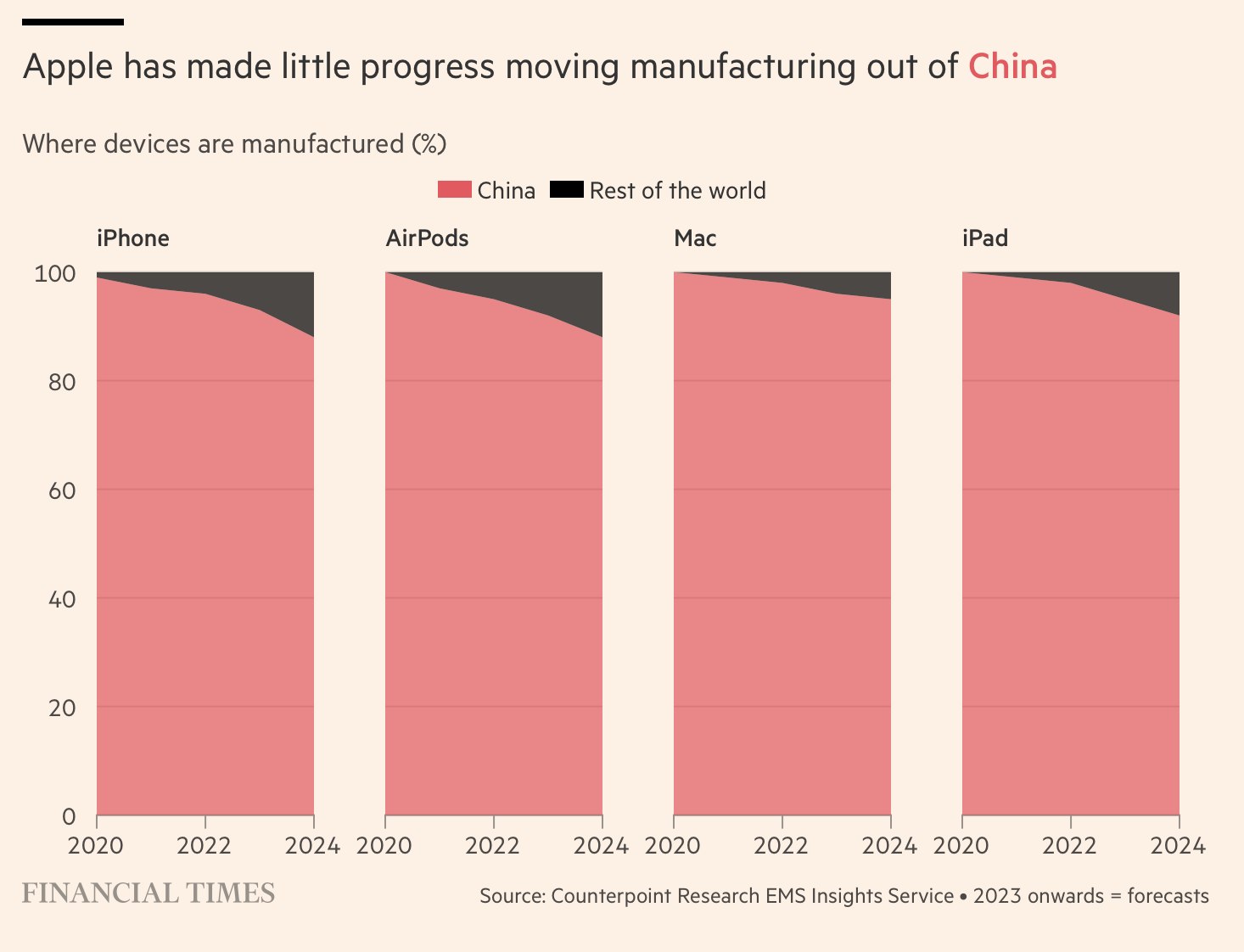
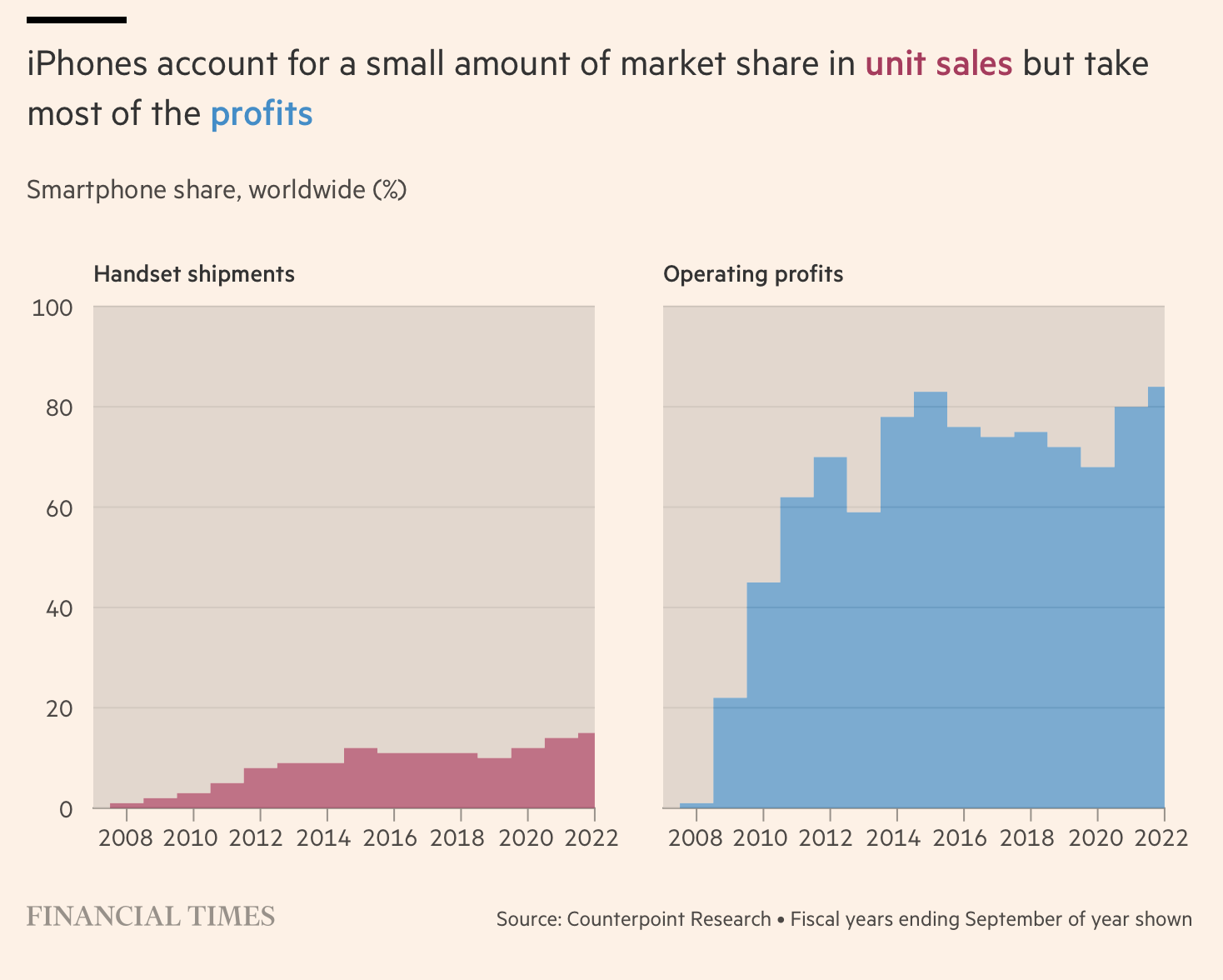
I’ve long been a fan of McGee’s work as the Financial Times’s Silicon Valley correspondent. Two years ago, the Financial Times ran a good two-part series by McGee that seemingly started him down the path to this book: “How Apple Tied Its Fortunes to China”, and “What It Would Take for Apple to Disentangle Itself From China”. Both are worth reading. This chart from the first report shows just how reliant Apple remains on Chinese manufacturing, and this one from the second shows just how remarkably profitable the iPhone is.
- Rick Reilly’s ‘Commander in Cheat’ ★
-
Speaking of cheating, my favorite book from Trump’s first term was Rick Reilly’s Commander in Cheat, which I linked to, with an excerpt still available at The Guardian, when it came out in 2019. I’ve been a fan of Reilly’s writing since I was a teenager and he was the back-page columnist for Sports Illustrated; this is the book Reilly was born to write. I just picked my copy off my shelf and started to re-read it, and got sucked right back in. Posting this link is my way of forcing myself to put it down until tonight.
(Main link here is an Amazon affiliate one, which will make me rich if you purchase through it. If you prefer not to buy books from Amazon, here’s a link to Bookshop.org.)
- Elon Musk Cheats at Video Games ★
-
Drew Harwell, at The Washington Post (gift link, via Harwell himself on Bluesky — which seemingly uses a ludicrously long 397-character token in the URL):
But after poring over his live-streamed gameplay, online sleuths recently made a shocking accusation: Musk had cheated. They suspected that he had pursued a widely mocked tactic known as “boosting,” paying strangers to play his character and rake in loot so that, when he logged in, he could face challenges with the most powerful gear.
Musk fought the allegations before ultimately confessing in messages this month. “It’s impossible to beat players in Asia if you don’t,” he wrote. A few days later, his character could be seen chasing treasure through the game’s sulfuric caverns while Musk was in the Capitol Rotunda, attending President Donald Trump’s inauguration.
Every cheater’s story is the same: “I’m not cheating, and I’m offended you’d accuse me.” Then, presented with incontrovertible proof, “I had to cheat because everyone else is cheating so it’s the only way to win, and anyone who isn’t doing it is a simp.” But the simple truth is that cheaters are rotten people, and most people naturally despise cheating.
But watching Musk’s streams, Jake began to suspect foul play. The billionaire did amateurish things, such as failing to drink mana flasks when he needed them and trying to pick up items when his inventory was full. And he made comments that struck devoted players as clueless, saying, for instance, that his character’s “Hand of Wisdom and Action” gloves, which rank among the game’s most valuable items, “could be better.” A normal gamer could write these off as simple flubs in the heat of battle, Jake said. But Musk was supposedly a global grand master, and gamers at that level don’t make these kinds of mistakes.
“It’s like if you said you’re the number two truck driver in the world … and when you try to get the truck to turn on, the windshield wipers start going,” Jake said. “It just felt like there was no way this guy did this.”
When Jake posted a thread on Reddit documenting Musk’s “suspicious” gameplay, the accusations kicked up a firestorm, with “Path of Exile 2” fans scraping through the streams Musk had posted to X for clues of what some were calling his “stolen valor.” [...]
By paying someone else to earn him his high-level gear, they said, he had removed most of the challenge — only to boast how quickly he had beaten others who played fair and square. One poster on a Diablo subreddit called it “unbelievably pathetic” that the world’s richest man would feel “the need to cheat” in a video game to “claim he is good at something” most people “couldn’t care less about.”
It’s the boasting that’s most revealing.
It’s a trope as old as fiction itself that villains cheat at everything. Auric Goldfinger cheated at golf, famously. And in Ian Fleming’s Moonraker (but not the movie), the whole plot was driven by M’s suspicion that mysterious millionaire (the billionaire of the 1950s) industrialist Hugo Drax was cheating at cards at their gentlemen’s club. He assigned Bond to figure out how he was cheating, and Bond stumbled into Drax’s plot to annihilate London. Drax, you see, is in fact a Nazi. And his industry: rocketry.
- ‘Don’t Believe Him’ ★
-
Ezra Klein in an audio essay/transcribed column at The New York Times:
That is the tension at the heart of Trump’s whole strategy: Trump is acting like a king because he is too weak to govern like a president. He is trying to substitute perception for reality. He is hoping that perception then becomes reality. That can only happen if we believe him. [...]
What Trump wants you to see in all this activity is command. What is really in all this activity is chaos. They do not have some secret reservoir of focus and attention the rest of us do not. They have convinced themselves that speed and force is a strategy unto itself — that it is, in a sense, a replacement for a real strategy. Don’t believe them.
It is easy and quick, often instantaneous, to destroy things. It is hard and slow work to build new things, and often even harder and slower work to improve existing ones.
I had a conversation a couple months ago with someone who knows how the federal government works about as well as anyone alive. I asked him what would worry him most if he saw Trump doing it. What he told me is that he would worry most if Trump went slowly. If he began his term by doing things that made him more popular and made his opposition weaker and more confused. If he tried to build strength for the midterms while slowly expanding his powers and chipping away at the deep state where it was weakest.
That’s the optimistic take — Trump and his new administration are trying to manically (or is it maniacally?) punch their way to a first-round knockout. They’re utterly unprepared for a 15-round grueling slog. The pessimistic take is that the first-round knockout might happen.
The ultimate power in America isn’t our political or legal systems. It’s our culture. Our collective attitudes. We, collectively, are quite obviously very bad at history, because we, collectively, clearly forgot how chaotic a Trump presidency is after just four years, and we forgot how much we dislike chaotic leadership. But we know what we don’t like and we’re vocal about it. He’s not doing anything to increase his slim margin of popularity, and is already doing a lot of things to lose it. He was never once popular during his first term — not at the start, not in the middle, and definitely not at the end. Right now is the most popular he’s ever been, with a net approval of around zero. That’s the high water mark for Trump — just ever so barely popular enough to win an election.