
By John Gruber
WorkOS: How SSO works and the fastest way to add it.
Linked List: May 18, 2026
Monday, 18 May 2026
- Jury Rejects Elon Musk’s Claim Against Sam Altman in Unanimous Verdict ★
-
Cade Metz and Mike Isaac, reporting for The New York Times (gift link):
A nine-person jury found that Elon Musk did not bring his lawsuit against OpenAI and Sam Altman until after the expiration of the three-year statute of limitations.
Mr. Musk filed his suit against the $730 billion artificial intelligence start-up in the summer of 2024, but the jury found that he was aware of the behavior discussed in his complaint against OpenAI as far back as 2021.
This update quoting Judge Yvonne Gonzalez Rogers’s “poetic” jury instructions is just lovely:
“A jury reflects the attitudes and mores of the community from which it is drawn,” she said, paraphrasing another judge. “It lives only for the day and does justice according to its limits. The group of jurors who are drawn to hear a case make a decision and then melt away. It is not present the next day to be criticized. It is the one governmental agency that has no ambition. It is as human as the people who make it up.”
- ‘John Appleseed’ ★
-
Here’s a great take from last month re: the Cook/Ternus transition, from Om Malik:
When he took over from Steve Jobs in August 2011, Apple’s market capitalization was around $350 billion. As of this morning, it sits near $4 trillion. That is more than a 1,000 percent increase. Revenue went from $108 billion in fiscal 2011 to over $416 billion in fiscal 2025, almost four times bigger. Apple under Cook became the most valuable company in human history, multiple times over. It built Services into a $100-billion-a-year business.
Sure, Cook inherited the greatest product portfolio and the greatest brand in modern business. How many times have we seen people screw it up? He ran it with operational ruthlessness. He is no product visionary, and neither is Ternus. They are not Steve. Tim has run Apple for fifteen years, through a pandemic, two trade wars, a supply chain reordering, and the slow grinding shift from hardware-only to hardware-plus-services-plus-silicon. Most importantly, he didn’t mess it up.
Services, as a whole, is now as big a business for Apple as the entirety of the company was when Cook took the helm. And “not screwing it up” is an enormous accomplishment. Success is always precarious. Keeping a good thing going is inordinately difficult. It only looks easy compared to getting the good thing off the ground in the first place.
- Define ‘Boom’ Please ★
-
While I’m linking to pieces on Apple’s CEO transition, here’s an annoying tidbit from Tripp Mickle and Karl Russell’s piece for The New York Times, under the headline “Tim Cook Was Very, Very Good at Making Money” (gift link):
Even though it has largely missed out on the artificial intelligence boom now lifting the sales of its technology peers, the company’s profits and stock value continue to grow.
Which peers have had their “sales lifted” by AI? There’s Nvidia (now the most valuable company in the world). But Apple doesn’t compete directly with Nvidia. What makes Apple different from its peer companies isn’t that the others are profiting from AI while Apple is not, but rather that Apple, seemingly alone, is not funnelling its free cash flow to Nvidia to build out massive AI datacenters.
Apple might wind up missing out on something huge as a result of its decision to stay out of this race. But it’s nonsense to say they’ve already missed out on a boom. To date it’s a money pit.
- Ted Turner’s Small Apartment Above the Former CNN Center ★
-
Simultaneously audacious and humble, a combination that epitomizes Ted Turner’s entire life. (Shades, too, of Walt Disney’s apartment above the fire department at Disneyland.)
- Existing Stakeholders Have a Say in the Future ★
-
A follow-up point on my “AI Is Technology, Not a Product” column over the weekend. Here’s a repeat of Steven Levy’s argument that John Ternus must direct Apple towards building “a killer AI product”:
By the end of this decade, it’s unlikely that people will swipe on their phones to tap on Uber or Lyft. They will just tell their always-on AI agent to get them home. Or that agent will have already figured out where they need to go, and the car will be waiting without the friction of a request. “There’s an app for that,” may be replaced by “Let the agent do that.”
Putting aside whether this is technically feasible or psychologically comfortable, what Levy is arguing here is yadda-yadda-yadda-ing over Uber and Lyft’s say in the matter. Those two companies are now deeply entrenched. They might get disrupted. (Google’s Waymo isn’t operating here in Philly yet, but I see their vehicles around the city all the time now. You can’t miss them.) But I think it’s a good bet that most ride shares at the end of this decade (which is Levy’s own timeline) will largely be Ubers and Lyfts.
Uber and Lyft get to decide the terms of which platforms they’re hail-able from. Here’s a note a friend sent me that prompted this follow-up:
It’s a newbie take to think all deeds will soon be on the blockchain, all newspapers will migrate to RSS, all broadcast companies will put shows out on one service.
Some companies will forge a path into the next medium, some will be replaced, and others will succeed at slowing its adoption.
When people get taken by a wave of technology hype, there’s a strong tendency to assume that not only will other people get taken by the same hype wave, but that entrenched stakeholders will too. That often doesn’t happen. Walmart still doesn’t take Apple Pay, for chrissakes. The idea that Uber and Lyft are going to put their own futures in the hands of OpenAI and Anthropic (or Google, who, through Waymo, is already their direct competitor) seems like folly.
- ‘AI, “Humanity”, and Dr. Manhattan Syndrome’ ★
-
Jim Prosser, back in February:
Let me be clear about causation, because the AI parallel only works if we’re honest about it. The communications failures didn’t kill nuclear power. The disasters did. But two decades of talking over the public meant the industry had built precisely zero reservoir of human-scale trust to draw on when the real crises hit. Nuclear pioneer Alvin Weinberg admitted in 1976 (three years before Three Mile Island) that “the public perception and acceptance of nuclear energy appears to be the question that we missed rather badly.” After TMI and Chernobyl confirmed the public’s worst suspicions, over a hundred planned U.S. reactors were cancelled.
The entire essay is very good, quite thought provoking. But it really shines in drawing the parallels to nuclear power a generation ago, and the need to communicate the benefits to ordinary people in ways that they actually care about. Regarding OpenAI co-founder Greg Brockman:
But think about what the people behind those numbers are actually worried about. They’re not anxious about AI in the abstract, per se, but its implications. They’re anxious about their job, their kid’s homework, their creative work getting scraped without permission, their privacy. Human-scale concerns that are specific, personal, and grounded in the daily texture of individual lives.
And Brockman’s response to this very specific, very human anxiety is to ... float further up into the philosophical stratosphere while writing a mega-checks to a partisan PAC and explaining it in the language of civilizational mission. It’s like a doctor hearing a patient who says, “My knee hurts,” who then delivers a lecture on the elegance of the musculoskeletal system. The patient doesn’t need you to appreciate the beauty of human biology. They need you to look at their damn knee.
- The Alaska Permanent Fund as Loose Precedent for AI Data Center ‘UBI’ Payments ★
-
Wikipedia:
The Alaska Permanent Fund (APF) is a constitutionally established permanent fund and sovereign wealth fund managed by a state-owned corporation, the Alaska Permanent Fund Corporation (APFC). It was established in Alaska in 1976 by Article 9, Section 15 of the Alaska State Constitution under Governor Jay Hammond and Attorney General Avrum Gross. [...] As of 2019, the fund was worth approximately $64 billion that has been funded by oil and mining revenues and has paid out an average of approximately $1,600 annually per resident (adjusted to 2019 dollars). The main use for the fund’s revenue has been to pay out the Permanent Fund Dividend (PFD), which many authors portray as the only example of a basic income in practice. [...]
The PFD is a Basic Income in the form of a resource dividend. Some researchers argue, “It has helped Alaska attain the highest economic equality of any state in the United States... And, seemingly unnoticed, it has provided unconditional cash assistance to needy Alaskans at a time when most states have scaled back aid and increased conditionality.”
Alaska is not exactly a left-wing state. Again, money talks.
- AI Data Centers Are Deeply Unpopular, Across the Political Spectrum ★
-
Jeffrey M. Jones, Gallup:
Seven in 10 Americans oppose constructing data centers for artificial intelligence in their local area, including nearly half, 48%, who are strongly opposed. Barely a quarter favor these projects, with 7% strongly in favor. [...]
The data center question parallels the wording Gallup uses to ask about local nuclear power plant construction. In the same March survey, 53% of Americans say they oppose building a nuclear energy plant in their area, far less than the 71% opposed to data center construction. Since Gallup first asked the nuclear power plant question in 2001, the high point in opposition has been 63%.
It’s hard to overstate how unpopular this polling paints AI data centers. It’s just an absolute messaging and marketing disaster for the entire tech industry. Tellingly, the anti-AI-data-center sentiment is bipartisan:
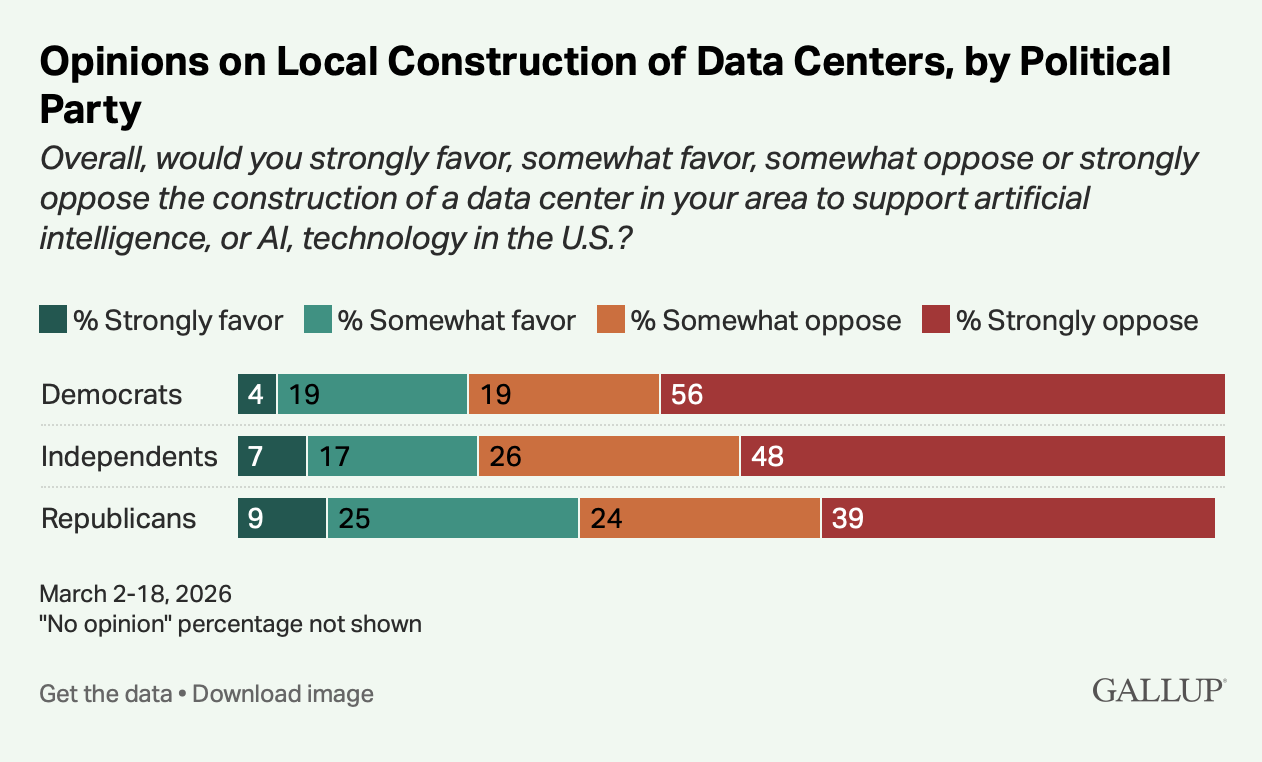
There are partisan differences, but only in slight degree. A savvy politician or party could grab this issue and carve out a broadly bipartisan anti-data-center, anti-AI message. US politics is so polarized in today’s era that the salience of this issue will not go unnoticed. The only thing the hyperscalers have on their side is money, but that fact is a significant factor in the general resentment toward the entire industry.
To that point, Ben Thompson suggests (in today’s subscriber-only Stratechery column) that the industry simply pay residents:
Instead, the most obvious solution is the most crass: simply start giving people money. If data centers are a resource for our AI future, then start paying people for that resource. If that data center up the road weren’t sold to my neighbors based on amorphous tax benefits that my local government may or may not spend appropriately, but rather were to result in a check in the mailbox every year, I suspect you could get a lot more people on board!
Just to put some numbers on this, the data center up the road was expected to be 1.6 GW, which could generate around $3 billion in annual operator revenue. DeForest, the village it was to be built in, has around 11,500 people. You could pay every person in DeForest $10,000 a year for 3.8% of annual revenue grossed by the data center — I bet that proposal would have been approved, and I bet that the operator could very easily pass those costs on to the actual data center users (it also highlights how relatively pathetic QTS’s $50 million commitment was).
I do get how ridiculous this sounds, but ridiculous is how we do things in America.
After mulling the idea for a bit this morning, I’d say it’s unusual, but not ridiculous. Money talks.