By John Gruber

WorkOS: How SSO works and the fastest way to add it.
Linked List: October 20, 2011
Thursday, 20 October 2011
- Siri Searches Bing and Yahoo, Too ★
-
Nice find by Greg Sterling.
- iCloud Calendars Are Type-Specific ★
-
From BusyCal’s “Upgrading to iCloud” support page:
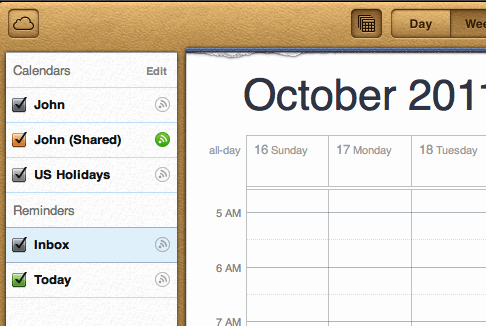
iCloud calendars are type-specific. Each iCloud calendar may contain either Events or To Dos, but not both. When you move your calendars to iCloud, each calendar will be split into two calendars — one for Events and one for To Dos.
This was a source of confusion for me, because iCal doesn’t list reminder-only calendars as separate calendars, but BusyCal and certain other CalDAV clients do.
E.g., with MobileMe, I had one calendar named “John”. When I upgraded from MobileMe to iCloud, that calendar was split in two — one for events, one for reminders — but both were named “John”. BusyCal shows two calendars, but iCal still shows just one. The app that handles this best is — perhaps unsurprisingly — the web-based iCloud Calendar app. There, calendars and reminder lists are presented in the source list as discrete items.
- Apple’s Relentless Push Forward ★
-
David Barnard, on Apple’s aggressive move forward to iOS 5:
At a time when most current Android devices — even the ones that will be sold over the holiday shopping season — won’t ever have the option to install Android 4.0, Apple is specifically pushing the iOS install base forward. Apple wants all iOS users on iOS 5, not just the ones who buy a brand new device.
- How to Disable Internal MacBook Display When External Display Is Attached ★
-
Mac OS X Hints:
Before Lion it was possible to run an external display off a laptop and have the internal display disabled, even if you opened the lid. This can be useful for a myriad of reasons including energy saving and better Wi-Fi reception. With Lion the internal display will always turn on when the lid is opened, even if there is already an external display connected.
I just ran into this after upgrading my main machine to Lion. A little
nvramcommand-line jiggery-pokery does the trick. - Decades-Old ‘Calvin and Hobbes’ Strip Succinctly Explains Occupy Wall Street Movement ★
-
Remarkably apt.
- Thirteen Observations Made by Lemony Snicket While Watching Occupy Wall Street From a Discreet Distance ★
-
Best thing I’ve read about Occupy Wall Street. Love this one:
11. Historically, a story about people inside impressive buildings ignoring or even taunting people standing outside shouting at them turns out to be a story with an unhappy ending.
- How to Bring Good Design to a Platform ★
-
Stupid arrogant iOS and Mac developers. Think they know it all. Google will show them.
- Let’s Take This One With a Grain of Salt ★
-
Ina Fried, covering some conference in Asia on some website:
Andy Rubin thinks there is a lot of potential for phones to be more useful companions, but says he is not interested in turning Android devices into personal assistants.
“I don’t believe that your phone should be an assistant,” the Android chief said in an interview on Wednesday just after appearing on stage at AsiaD. “Your phone is a tool for communicating. You shouldn’t be communicating with the phone; you should be communicating with somebody on the other side of the phone.”
What do you expect him to say about Siri, though? “Well, Apple really pulled ahead of us there”? Not going to happen. The truth is, Google has been working on voice-driven stuff for mobile devices for years. The primary interface to their Google for iPhone app is voice. The ante has been raised, and the correct play is for Google to downplay Siri’s relevance until they feel they’re competitive. This is like Steve Jobs dismissing video-playing iPods, claiming that no one wants to watch movies or TV shows on a handheld display, one year before Apple shipped video-playing iPods.
- FlatpanelsHD on the Galaxy Nexus 4.65-inch OLED Display ★
-
Rasmus Larsen:
And if you calculate the real pixel density you will find that the Galaxy Nexus is actually closer to a “real” ppi value of 200, which is slightly lower than on the Galaxy S II (that uses a Super AMOLED Plus with RGB pixel structure). Some claim that a PenTile panel needs around 420 ppi to qualify as a Retina display and that is probably also the reason why Retina is nowhere to be found on the specs sheets of neither Galaxy Note nor Galaxy Nexus. If you are keen on a Samsung smartphone you might even find that the screen in the Galaxy S II is better. But the iPhone 4 and iPhone 4S still lead the pixel race. Some people say they never notice the PenTile pixel structure but it is just like a stain on a carpet; once you see it, it is hard to disregard.
My problem with OLED displays is color saturation. I have yet to see an OLED display where colors aren’t severely over-saturated. Blacks are blacker, yes, but colors are way off. This seems to be another area where iOS and Android devices are diverging.
- Newest U.S. iPhone 4S Carrier: C Spire ★
-
CNN Money:
C Spire, a wireless carrier you’ve probably never heard of, announced Wednesday that it will become the fourth U.S. wireless provider to sell the iPhone 4S.
The regional carrier formerly known as Cellular South serves just under 900,000 customers, mostly in Mississippi. By contrast, Sprint, previously the smallest carrier to sell the iPhone, serves 52 million customers.
Why a tiny regional like C Spire and yet still not T-Mobile? My guess is that it’s because T-Mobile uses a different band for 3G than AT&T (and most other GSM carriers around the globe). C Spire is a regular CDMA carrier, so the iPhone 4S just works. Getting 3G to work on T-Mobile would require different GSM antenna hardware, I think. (Via Joe Stump.)
- Lies, Damned Lies, and App Store Statistics ★
-
Interesting analysis of iOS App Store popularity by category, by Casey Fleser. (Via Jamin Guy.)
- What Is a Computer? ★
-
Sesame Street, 1984. These kids got it.