By John Gruber

Mux: Turn your video
into context
Linked List: July 25, 2014
Friday, 25 July 2014
- Continuity and Gratification ★
-
Mark Sigal on Apple’s Q3 results:
While others may see a company that can’t possibly keep selling more devices, quarter after quarter after quarter, I see a company that has continually avoided the gratification of going for market share and sales at all costs (i.e., at the price of margins, profits and cash flow).
This is no small task when one considers that investors, the media and virtually every pundit in the blogosphere is not so adept at delaying gratification.
- Number Games ★
-
Jon Bell:
Which brings me to Chromecast. All Google will say is they’ve sold “millions” of the $35, (presumably) break-even device. But recently they announced 400 million “sessions”. Sounds impressive! A recent headline states “Chromecast turns one: why this small streaming stick became such a big deal” and the subheads are “So cheap, and so different”, “400 million cast sessions”, “Competitors are getting the streaming stick fever”, and “Why Chromecast continues to be disruptive”.
So kudos to Google for an enormous number, and for getting great press from it. But, wait. We’re actually going to record “uses” of products now? Well, sure. Because it makes the number look bigger.
- Bezos Alarms Amazon Investors With Spending Pace as Loss Widens ★
-
Bloomberg:
Jeff Bezos is testing the patience of investors after Amazon.com Inc. missed analysts’ estimates for a second straight quarter, sending the shares tumbling 11 percent.
The world’s largest online retailer yesterday reported a second-quarter loss of $126 million, more than double what was predicted, even as sales climbed 23 percent to $19.3 billion. Expenses jumped 24 percent to $19.4 billion. […]
The loss in the latest period was the biggest since the third quarter of 2012, when Amazon posted a $274 million loss. Looking ahead, Amazon projected sales of $19.7 billion to $21.5 billion for the current quarter. Operating losses are projected to be $810 million to $410 million, Amazon said.
You can’t dig forever.
- Another Xiaomi Shocker ★
-
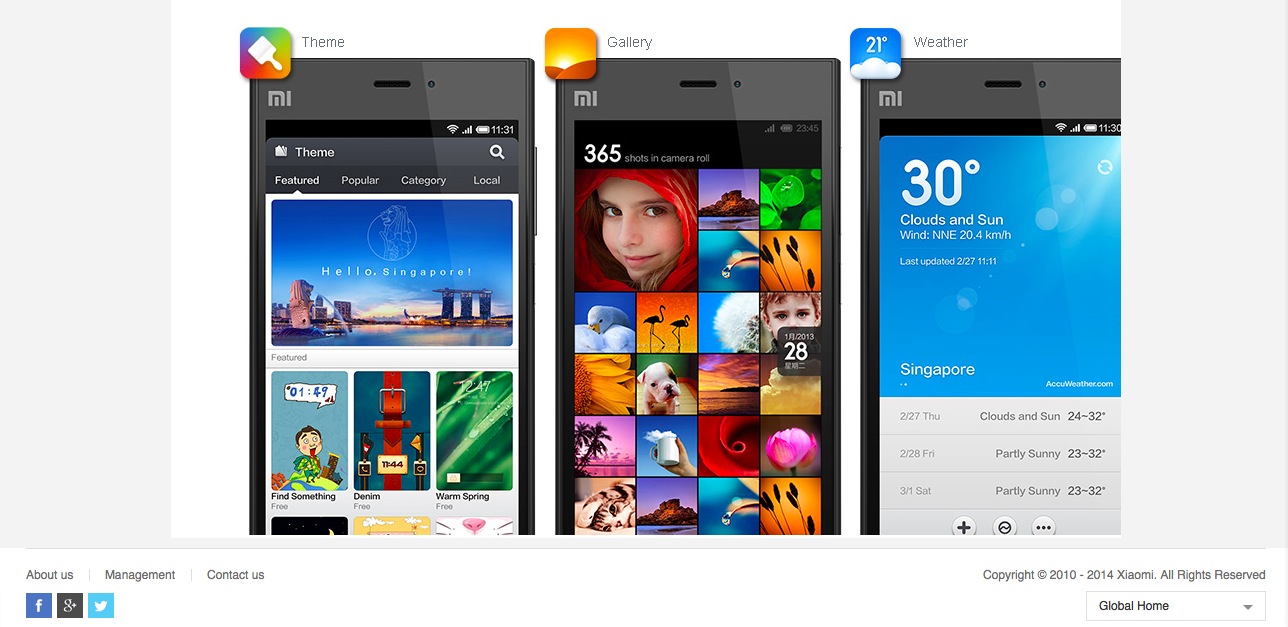
Here’s a beautiful photograph of a young girl by Javi Inchusta Gonzalez, posted to Flickr. Note that it was taken with a Nikon D700 SLR, and that its licensing is set to “Copyright, All Rights Reserved”.
Now go back to our old friend, the Xiaomi Mi 3 “Features” page. Scroll down to where they show the Android photo gallery app, and look at the first image, labeled as a shot from the device’s camera roll. (Screenshot.)
So Xiaomi:
Ripped off a copyright photo. (I’ll eat my hat if they obtained permission to use this photo from Gonzalez.)
Is passing off photos taken with professional SLRs as shots from their phone’s camera.
I wouldn’t be surprised if most or even all the example photos in their gallery are similar ripoffs. (Hat tip.)
Update: Another. And three more. They even stole one from National Geographic. Like I said, they’re probably all rip-offs, and all misrepresentations of the Mi 3’s actual camera.
- Putting IBM MobileFirst in (Apple’s Enterprise) Context ★
-
Andrew Laurence, writing for TidBITS:
Since the iPhone, Apple has developed a subtle enterprise strategy, so subtle that many pundits miss it. Instead of pursuing business sales directly, Apple has quietly worked to remove barriers that might impede usage of its products, including in enterprises. This approach enables Apple to pursue design and user experience while also making its devices more useful to business and fitting enterprise concerns better.
- The Secret of Minecraft ★
-
Robin Sloan:
There are dangerous creatures lurking in this world, including but not limited to giant spiders and skeleton archers. But they only venture out at night, and they can be deterred by walls. The sun (a bright cube) sets fast, so your first task is always the same: Build a shelter.
The genius of Minecraft is that the game does not specify how this is done.
It’s almost impossible to overstate just how big a deal Minecraft is for my son and his friends.