By John Gruber
WorkOS: How SSO works and the fastest way to add it.
Linked List: March 1, 2024
Friday, 1 March 2024
- Richard Lewis on Letterman ★
-
So many fond remembrances of Richard Lewis are coming out — he really was “the menschiest of mensches” — but this highlight reel from his appearances on Letterman’s show, especially the early ones from the 1980s, hits home for me. He was a great comedian and an absolutely perfect talk show guest. He was seemingly always on Late Night back then, and every time he was, as a viewer, it was like, “Richard Lewis again? Can’t wait!”
Also:
- Lewis’s first appearance on Late Night in 1982. Hard to overstate how forward-thinking this entire segment was.
- Lewis killing on Johnny Carson’s The Tonight Show in 1990.
- Keith Olbermann’s remembrance.
- Lewis making Bob Costas laugh so hard NBC almost shelved the episode. Here’s the whole first appearance on Costas’s (vastly underrated) late late night show in 1989.
- Weather Up 3.0 ★
-
One more link from the latest episode of The Talk Show: Weather Up 3.0. If you’re a longtime reader you know I’m a nut for iPhone weather apps. There are so many great ones for iOS, starting with Apple’s own. I just love how much creativity and originality there is in presentation, emphasis, and information design.
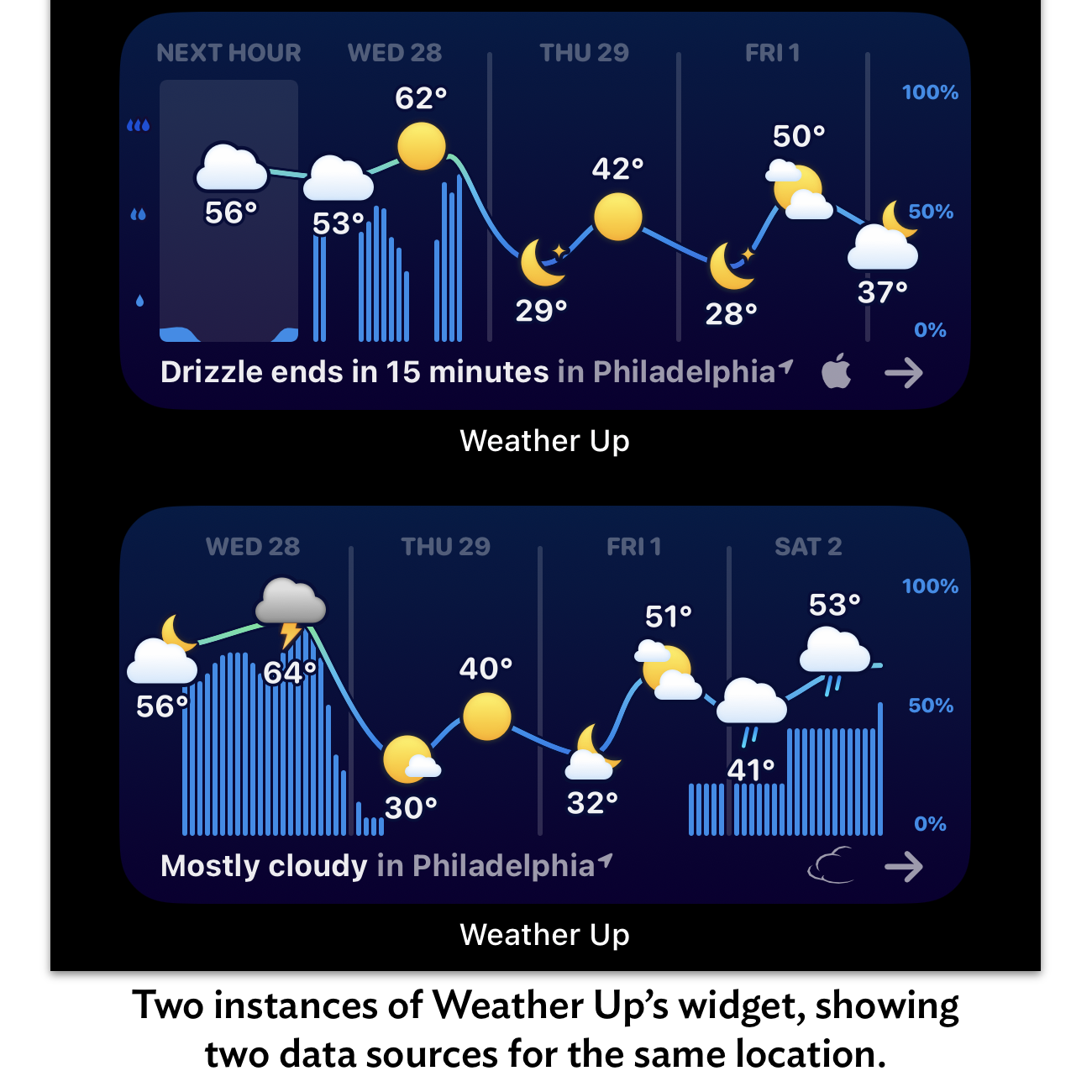
Weather Up 3 stakes out two unique positions. The app itself presents a map-first design. No other weather app (that I’m aware of) goes map-first presentation-wise (which, as David Barnard explained on my podcast, is expensive).
But even more interesting is that Weather Up 3 is really widget-first — the app interface is secondary to the widget interface, which, for weather, I think is the right priority — and the widget design is:
- Information-dense
- Attractive
- Original
Just a phenomenally good weather app, that you should definitely try.
- ‘Great Developers Steal Ideas, Not Products’ ★
-
David Barnard, in a post from 2011 on the oft-cited (and oft-misattributed) adage about good artists copying and great artists stealing:
In dancing around the moral and semantic differences between borrowing and stealing, I’ve been missing the greater point. Elliot used the word steal, not for its immoral connotation, but to suggest ownership. To steal something is to take possession of it.
When you steal an idea and have the time and good taste to make it your own, it grows into something different, hopefully something greater. But as you borrow more and more from other products, there’s less and less of you in the result. Less to be proud of, less to own.
Barnard quotes the actual origin of the adage, from T.S. Eliot, and that alone is worth a bookmark. In Eliot’s formulation, it’s not copying vs. stealing, but imitating vs. stealing. That subtle distinction is clarifying. People who are creative and ethical generally see the clear distinction between remixing and ripping off. I add generally there because some people are truly offended when the ideas behind their own creations are remixed — stolen — by others.
To name one notable example, I’d argue that Android, as a whole, is a remix of the iPhone. But there are specific Android handsets — starting with some early Samsung Galaxy models — that are rip-offs of iPhone hardware designs. Steve Jobs, however, felt otherwise.
(And which is not to say Google hasn’t often been a shameless imitator/copycat.)
- The Talk Show: ‘The Essence of Stealing’ ★
-
Special guest David Barnard joins the show. Topics include the App Store — past, present, and post-DMA future — and the excellent new update to his app Weather Up.
Sponsored by:
- Nuts.com: The world’s best snacks, delivered fast and fresh.
- Squarespace: Make your next move. Use code talkshow for 10% off your first order.
Links (which I usually don’t post here in Linked List posts for episodes, but which are exceptionally good this episode):
- Weather Up.
- On the App Store.
- Screenshot of two Weather Up widgets showing somewhat different forecasts via two different weather sources.
- RevenueCat.
- Sub Club Podcast.
- “How to Game the App Store” — an unfortunately still-relevant piece David wrote back in 2018.
- Trip Cubby — first link on Daring Fireball to one of David’s apps, in September 2008 (just two months after the App Store opened).
- March 2008 Apple event announcing the iPhone SDK and App Store.
- WWDC 2010 keynote: iPhone 4 and iAds announced.
- Aaron Hillegass’s acclaimed books on Objective-C and Cocoa programming.
- Ben Bajarin, Creative Strategies.
- Fakespot — Mozilla’s tool for identifying scams and fake reviews.
- City on Fire — Ringo Lam’s 1987 Hong Kong action movie, starring the great Chow Yun-fat, that inspired Tarantino’s Reservoir Dogs.
- Apple’s nearly ruinous “Look and feel” lawsuit against Microsoft in 1994.
- “Good artists copy, great artists steal.”
- David, in a blog post from 2011: “Great Developers Steal Ideas, Not Products”.
- David, on Twitter/X, with a more accurate ballpark estimate of Meta’s average revenue per user (ARPU) in the EU: roughly $4 per user per app per quarter. They could pay Apple’s €0.50 per app installation per year Core Technology Fee without breaking a sweat.