By John Gruber
WorkOS: How SSO works and the fastest way to add it.
Linked List: January 14, 2011
Friday, 14 January 2011
- AccountEdge ★
-
My thanks to AccountEdge for sponsoring this week’s DF RSS feed. AccountEdge — formerly known as MYOB — has been providing small businesses with reliable cross-platform accounting software for over 20 years. Even better, they’ve always had strong support for the Mac. Not just this past decade, but during the ’90s too. That says something about the company, in my book.
Accounting software isn’t something you can get people very excited about, but this is pretty cool: AccountEdge now has a free iPad app (with an iPhone app on the way) that allows AccountEdge users to take their work on the road.
- Adobe’s John Dowdell on Chrome Dropping H.264 ★
-
He’s downright giddy:
The VIDEO tag was simply not well-considered at the outset. Its original rationale was: “You don’t require a plug-in to view images… video is the next natural evolution of that.” But from the very start the practical questions about use were swept under the rug… at least until the rug started piling up too high. It wasn’t sustainable.
So, (a) he thinks Chrome just killed the HTML5
<video>element.Video publishers need the VIDEO tag for one purpose only: to support Apple’s non-standard HTML browser and its denial of third-party extensibility via APPLET, OBJECT, and EMBED.
And (b) Dowdell thinks
<video>is needed only for iOS devices, and (c) that MobileSafari is non-standards-compliant because it doesn’t support plugins like Flash. I.e. Flash is standard,<video>is not, and we’ve always been at war with Eurasia.(a) Might be true, (b) obviously is not, and (c) is pretty much the craziest thing I’ve read in a while.
But: we have an answer to my question about who’s happy about Chrome dropping H.264 support.
- Google Says WebM Plugins Coming Soon for Safari and IE9 ★
-
MG Siegler:
But buried in their post is another interesting nugget worth highlighting by itself: WebM plugins are coming shortly for Safari and IE9.
Yes, plugins.
This is both humorous and terrifying on a few levels. First and foremost, the point of all of this H.264/WebM stuff is so that the web can shift to an HTML5 video standard going forward. Of course, since neither IE nor Safari will support Google’s, Mozilla’s, and Opera’s preferred codec for that standard, we’re right back to plugin land! Why don’t we just call WebM, Flash 2.0?
- Ed Burnette: ‘Chrome Users Are the Latest Casualty in Google’s Crusade Against Apple’ ★
-
Ed Burnette:
On paper, Google is taking a principled stand in favor of open technologies. But they’re not really. First, WebM is not truly an open technology because it almost certainly uses patents owned by MPEG-LA or its members. Right now, the patent holders are ignoring it because it’s too small to bother with. We’ve seen this tactic many times before (for example, NTP vs. RIM): bide your time until a lot of people are using the infringing software and then hit it with a massive lawsuit for maximum profit. WebM is its own patent trap, and Google refuses to indemnify users against possible claims further down the road. If they were certain it was IP-clean then why hesitate to provide that protection? Clearly they don’t want that unknown, possibly large liability on their balance sheet.
- Google: ‘More About the Chrome HTML Video Codec Change’ ★
-
Mike Jazayeri, Google:
As it stands, the organizations involved in defining the HTML video standard are at an impasse. There is no agreement on which video codec should be the baseline standard. Firefox and Opera support the open WebM and Ogg Theora codecs and will not support H.264 due to its licensing requirements; Safari and IE9 support H.264. With this status quo, all publishers and developers using the
<video>tag will be forced to support multiple formats.Or they’ll take the path of least resistance, and continue supporting only H.264, requiring Flash Player for browsers that don’t support H.264 natively.
Unsaid is that Apple and Microsoft are surely as unwilling to support WebM as Mozilla and Opera are to support H.264. The impasse is unchanged. However, with Firefox and Opera, users can still be served H.264 through Flash Player. With iOS and Windows Phone 7, users cannot be served WebM, because there are no plugins. (There could be plugins for Mac OS X and Windows 7, but aren’t yet.)
Q: Does this mean I will no longer be able to play H.264 videos in Chrome?
H.264 plays an important role in video and the vast majority of the H.264 videos on the web today are viewed in plug-ins such as Flash and Silverlight. These plug-ins are and will continue to be supported in Chrome.
Thus, Chrome users will continue to be served most video, with the possible exception of YouTube, through Flash.
Our announcement was only related to the
<video>tag, which is part of the emerging HTML platform. While the HTML video platform offers great promise, few sites use it today and therefore few users will be immediately impacted by this change.And fewer sites will use HTML5
<video>than if Chrome had continued to support both H.264 and WebM. This move is about encouraging web video publishers to stick with Flash. - Girl Falls in Mall Fountain While Texting ★
-
Cue the Nelson Muntz “Ha-ha!”
- Ten Changes Macworld Would Like to See at the Mac App Store ★
-
Pretty good list.
- 11 iPhone GPS Apps Compared ★
-
Terrific work from Glenn Fleishman for Macworld. These sort of comparisons are an essential resource.
- Mike Arrington, Working for The Man ★
-
Jay Yarow reports on the intra-AOL spat between Mike Arrington and Engadget (which spat, shockingly, strikes me mostly as Arrington being a jackass).
- Embrace, Extend, Extinguish ★
-
Matt Drance on Chrome and WebM:
Why dump H.264 entirely? Why not hedge your bets, especially if H.264 is working right now? Google says “our goal is to enable open innovation;” what it in fact means is “we prefer patents we own.”
- Sarah Perez: ‘iPhone to Android: One Month With the Nexus S’ ★
-
Great review of life with a Nexus S from a former iPhone user. Matches my experiences with the Nexus S almost exactly. On battery life:
To prolong the battery life, I’ve learned to do this little dance with my phone. Arrive somewhere, turn on GPS, check-in on Foursquare, turn off GPS. Turn off Wi-Fi, if none present. Turn on Wi-Fi when I get back home. Turn off Sync when I’m worried about the battery draining too quickly and I’m far from home. Turn everything off if the phone is going to sit around for a while, unused. Turn Auto-Brightness on, turn it off. Turn 3G on, turn it off. Over and over, I’m tapping the little Settings widget. […]
I asked my (non-tech savvy) husband who totes the Galaxy S if he had the same problem. His response, and one I’ve seen echoed among Android’s many fans, is that it’s “no big deal” to switch something off if you’re not using it. “It’s like turning off the lights when you leave the room,” my husband said. (I’m not good at that, either).
And the lack of iTunes for TV and movie content:
I have to say it frustrates me to no end when I hear Android users say that you can duplicate the iTunes experience via apps. For example, the Android Market, plus DoubleTwist and Spotify (or Rdio, MOG, etc.) No you cannot. You cannot!
People who say this act as if the only things iTunes provides is music and apps. They completely dismiss the large, and very complete, collection of iTunes video content, for example. Where do you find both current and older TV shows on Android? No seriously, please explain where you’re getting this content. BitTorrent? How do you watch movies? mSpot? Illegal torrents? My guess is, Android users either torrent videos and copy them to their phone or they don’t watch movies and TV shows at all, so the thought doesn’t even cross their mind that Android lacks this feature.
She’s got many positive things to say about it, too: superior Maps app, voice recognition, and she found replacements for many of her favorite iOS apps. But the battery life issue is something that doesn’t get enough attention. I couldn’t get through a whole day on a single charge with the Nexus S. That’s not a problem with the iPhone 4.
- The Strange Disappearance of Dancho Danchev ★
-
Ryan Naraine:
Zero Day blogger and malware researcher Dancho Danchev has gone missing since August last year and we have some troubling information that suggests he may have been harmed in his native Bulgaria. […]
Last month, we finally got a mysterious message from a local source in Bulgaria that “Dancho’s alive but he’s in a lot of trouble.” We were told that he’s in the kind of trouble to keep him away from a computer and telephone, so it would be impossible to make contact with him.
- Dan Frommer: ‘Android Hasn’t Been Hurting the iPhone, It’s Been Hurting RIM’ ★
-
Interesting chart.
- App Store 10 Billion App Countdown ★
-
True story. Tomorrow is my son’s birthday, and his first-grade class has a “birthday circle” at lunch on Fridays for birthday celebrants. Parents are invited, so my wife and I had lunch today with some first graders. The main topic of discussion: games for the iPod Touch — and it wasn’t me who brought it up. First graders, obsessed with apps.
- Charlie Wolf: Verizon iPhone Will ‘Suck the Wind Out of Android’s Growth’ ★
-
John Paczkowski:
“The installed base of smartphone subscribers is a small percentage of the installed based of mobile phone subscribers in the U.S.,” Needham and Co. analyst Charlie Wolf told me. “Just 23 percent of Verizon’s 83 million post-paid subs (Q3 release)…. Where the iPhone will have a dramatic impact is on the brand choices of feature phone users migrating to smartphones going forward. The iPhone will suck the wind out of Android’s growth on Verizon.”
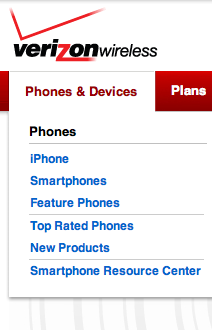
One thing I’ve been thinking about in this regard is that no matter how cheap Android handsets get, the monthly plans are still the biggest cost. And check out this screenshot from Verizon Wireless’s home page — they list three categories of phones: iPhone, Smartphones, Feature Phones. That says it all.
- The Talk Show, Episode 24 ★
-
It feels like I’ve had a fairly prolific week here on DF, but even so, I haven’t written much, at least yet, about the Verizon iPhone announcement. One reason is that Dan Benjamin and I talked about it at length on this week’s The Talk Show. Other topics: Google’s decision to drop H.264 support from Chrome, and the first James Bond movie, 1962’s Dr. No.
Brought to you by two fine sponsors: Sourcebits and Campaign Monitor.
- Branding Should Have a Backbone ★
-
Graphicology:
The point here is that more companies should do what Comedy Central did when they launched their new look. They gave people the reason(s) behind the move in a way that resonated with who they were and basically told people to deal with it.