
By John Gruber
WorkOS: Let agents use your tools without giving them free rein.
Linked List: November 2026
Thursday, 12 November 2026
- Jensen Huang Agrees to Testify Before Congress, But Not Publicly (Yet) ★
-
Aisha Malik, TechCrunch:
Ex-Nvidia CEO Jensen Huang has agreed to testify before Congress, House Foreign Affairs Committee Chairman Brian Mast said on Thursday, according to reports from Bloomberg and NBC News. Huang, who stepped down as CEO following reports of an alleged affair with a woman suspected of spying for China, agreed to testify Wednesday after several senior lawmakers threatened to subpoena him.
Huang has agreed to testify before Congress by Thanksgiving, which falls later this month. [...]
The testimony will take place behind closed doors, though Mast said he expects the briefing to be recorded on video and transcribed.
Closed-door is pantomime. Public reckonings will come next year. This whole thing could crater Nvidia’s stock price, sinking the market, and it’s Nvidia’s investments that are propping up the entire AI industry. So if the whole economy takes a severe beating in the coming months, imagine just how much more contentious Congressional inquiries under Democratic control could be.
I’m of the belief that the whole AI boom is ultimately a complex Ponzi scheme, and Ponzi schemes, by their nature, eventually crash out. But now Huang has set himself up as the villain. If I’m right and there’s an inevitable crash, it’s probably coming soon, and those who are left holding the bag aren’t going to come to their senses, realize it was an unsustainable circular financing scam all along, and blame themselves for falling for it. They’re going to blame Jensen Huang for not keeping his dick in his pants.
- Scott Colom Flips Mississippi ★
-
Emine Yücel, reporting for TPM:
Mississippi prosecutor Scott Colom officially defeated incumbent Sen. Cindy Hyde-Smith (R-MS) Wednesday night. Colom will be the first Democrat to represent Mississippi in the Senate since 1982 and he will also become the state’s first Black senator in nearly 150 years.
150 years is, needless to say, a long time. The crazy part about that is that Mississippi has the highest proportion of black citizens in the entire country (38 percent).
Colom, by all accounts, ran a fantastic campaign, with little to no support from the national Democratic Party because almost no one imagined Mississippi — the deepest of the deep South — might turn blue. This commercial Colom ran is one of the best I’ve ever seen. Not just best political commercials. I mean it’s one of the best 30-second spots ever made. It’s perfect. I just keep watching it over and over.
Update: I stand corrected on the national support. The WSJ ran a story back in September — six weeks before the election — on Senate Minority Leader Chuck Schumer raising funds for Colom amongst big Democratic donors. Schumer smelled a winner.
- The Dream of Quibi Lives On ★
-
Actual headline from an actual press release: “Peacock Extends Its Vertical Video Leadership With a Reimagined Mobile Experience”. Please tell me that someone printed up some t-shirts and hats with “Vertical Video Leadership” on them.
- And Every New Boy That You Meet / He Doesn’t Know the Real Surprise ★
-
Lingling Wei, reporting for The Wall Street Journal:
Before the affair that threatened his job as Nvidia’s chief executive, Jensen Huang was introduced to his future romantic interest, Alice Huang, by a Chinese businessman he’d known for a decade, Kang Wei.
Kang also happened to be Alice Huang’s husband, said people who know the couple.
For two years, Kang appeared to accept his wife’s romantic relationship with the Nvidia CEO and spoke openly of their closeness, these people said. Sometimes, Kang told associates, half-jokingly, that she was a personal assistant to Jensen Huang, they said.
The Cars’ “My Best Friend’s Girl” is not a bad song to have stuck in your head. Not a bad song at all.
Over the past decade, Kang and Alice Huang hopscotched from one lucrative opportunity to the next — videogame companies, pharmaceutical takeovers and cloud computing — each time weaving a web of related entities, transferring stakes among themselves and capitalizing on whatever connections were at hand, said people familiar with the couple’s business dealings. Nvidia’s AI chips were the latest play for a couple with a track record of riding hot trades and, on occasion, running afoul of regulators.
Now the couple are the subject of a raft of investigations, and the blast radius of their relations with Jensen Huang is expanding.
U.S. officials believe that China’s intelligence services recruited Alice Huang as an asset because of her access to the chip-designer chief.
That sentence at the end clarifies what I think is, at the moment, a widely held misconception. The allegation that Alice Huang was a “spy” for Chinese intelligence isn’t that she was a trained secret agent whose mission was to seduce Jensen Huang and infiltrate Nvidia. It’s that once the Chinese spooks learned of the affair — which, in hindsight, wasn’t well hidden — they gave Alice Huang an offer she couldn’t refuse. To do what, we don’t know, but it sure sounds like a part of it was to procure and smuggle Nvidia hardware in contravention of U.S. national security regulations.
- Reuters Raises the Jensen Huang Affair Tally to Three ★
-
Reuters:
Ousted Nvidia CEO Jensen Huang had an intimate relationship with a second employee, according to two people familiar with the matter, Reuters has learned.
The revelation follows two other extramarital affairs that led to his resignation Thursday. The two women are Alice Huang, who US intelligence suspects of being a Chinese spy, and Kimberly Powell, Nvidia’s vice president of health care.
Reuters is not naming the second employee. Attempts to reach the woman were not successful.
What’s the over-under at? If it’s 4.5, I’ll take the over.
- Trump Weighs in on Huang’s Successor ★
-
The president of the United States, on his blog:
NOW THAT Nvidia CEO JENSEN HUANG, who has done a fantastic job, has resigned, there is only one man to take his place — TIM COOK of Apple. A Legend replaces a Legend! President DONALD J. TRUMP
Nope.
- Jensen Huang’s Advice to His Successor: ‘They’ll Just Have to Reshape the Company’ ★
-
Jenson Huang, in an on-stage interview with Garry Tan at Y Combinator’s “Startup School”, three months ago, on how Nvidia is organized (starting at 17m:00s):
Huang: You’re going to build an F1 racer, but you’re going to build it in a way that you can drive. You should adapt the car to you. Somebody asked me, Jensen, if you don’t use conventional management techniques and organizational techniques, what’s going to happen when you leave the company?
Well, when I die on the job — someday — I told them they’ll just have to reshape the company for the next CEO. And the reason that’s wisdom is because we’re the F1 drivers. We’re the racers. And the world is really competitive, and we’ve got to win. We’ve got to achieve our mission. And so whatever it takes to fit the car to you, whatever it takes to fit the organization to you, that’s what you got to do. And the next CEO, whatever their personality is, they can figure it out.
Tan: Amazing.
It now seems like there are better words than “amazing” to describe this structure and strategy, for what was — at the time of the interview — the biggest company by market cap in the world. As of this morning, they’ve dropped to #2, and I think they’re going to drop to #3 or #4 soon.
By Huang’s own description, Nvidia needs to completely rebuild the car for his successor. And Huang left at least two huge turds in the cockpit of the existing car. (My money says there are more turds yet to be revealed.)
- Jensen Huang Resigns From Nvidia ★
-
Nvidia Newsroom:
Nvidia Board of Directors announced today that Jensen Huang has resigned as President, Chief Executive Officer, and a member of the Board, effective immediately.
Colette Kress, current Executive Vice President and Chief Financial Officer of NVIDIA, has agreed to serve as Interim Chief Executive Officer. Kress will continue to serve as Executive Vice President and Chief Financial Officer while serving as Interim Chief Executive Officer until a permanent successor has been named. The Board is initiating a search for a permanent Chief Executive Officer and will consider internal and external candidates. [...]
“Colette has helped lead NVIDIA through a period of extraordinary growth and has a deep understanding of our business, customers, operations and financial position,” said Harvey Jones, Chair of the NVIDIA Board of Directors. “She is supported by an experienced leadership team that has been instrumental in executing NVIDIA’s strategy and advancing its technology roadmap. The Board has full confidence in Colette and the leadership team, and we expect the company’s operations, customer commitments and product roadmap to continue without interruption.”
This might be wishful thinking. Remember all the predictions that Apple would implode without Steve Jobs? That he was the company? I argued, on the day of his resignation, that Apple was likely to continue to thrive post-Jobs, writing, “Jobs’s greatest creation isn’t any Apple product. It is Apple itself.” He built a great company with a deep bench and a highly distinctive, incredibly strong culture.
I’m not seeing anyone say those things about Nvidia. In fact I’ve only seen the opposite — that Nvidia has a weak board and an executive structure with Huang at the top and 60 direct reports under him. Nvidia sounds like it is the fantasy version of Apple that people imagined when Jobs’s health finally failed.
The press release contains no quote from Huang, and his X account is silent.
Nvidia will report its third-quarter fiscal 2027 financial results on Tuesday, November 17, at approximately 1:20 p.m. PT, as previously scheduled, followed by its earnings call at 2 p.m. PT.
They should sell tickets to this one.
Wednesday, 11 November 2026
- Semafor: ‘Nvidia Board Preparing to Oust CEO Jensen Huang, Name Interim CEO’ ★
-
Rohan Goswami, Reed Albergotti, and Ashley Gold, reporting for Semafor at 10:27pm ET:
Some members of Nvidia’s board favor appointing Chief Financial Officer Colette Kress as interim CEO at the beleaguered chipmaker if CEO and founder Jensen Huang is ousted, according to people familiar with the matter.
Here’s Kress’s LinkedIn profile.
Semafor earlier confirmed that Nvidia’s board is preparing to oust Huang as soon as Wednesday, after media reports detailed that he had a second extramarital affair. The Nvidia board briefed the White House on its planned meeting, according to a senior administration official.
Nvidia has tapped an outside search firm to find the company’s next CEO, Bloomberg reported. One person being considered for the top job is Apple hardware chief Johny Srouji, who was among the executives considered for Intel CEO in 2019, according to another person familiar with the matter.
Kara Swisher spitballed Tim Cook as an idea, but that’s nonsense. If Cook wanted to be the CEO of a Fortune 2 company, he’d still be CEO at Apple. Apple despises Nvidia and Nvidia despises Apple. Cook may well be enjoying this fiasco, but only as entertainment drizzled with fresh farm-to-table schadenfreude — not as a personal opportunity.
Srouji, though, is an interesting name. Semafor doesn’t say whether this is just wishful thinking on the part of Nvidia’s board or if Srouji has indicated receptiveness. Srouji has been at Apple since 2008 but he’s a bit of a cipher. My spidey-sense can’t tell if he bleeds six colors or not.
Mark Gurman — and no one else — claimed last year that Srouji went to Tim Cook and threatened to leave for another company. Srouji called bullshit on this with a memo that stated flatly, “I love my job at Apple, and I don’t plan on leaving anytime soon.” Then, in April, when John Ternus was named Cook’s successor, Srouji was simultaneously promoted to the new position of Chief Hardware Officer.
So one scenario is that Srouji feels no allegiance to Apple, and Tim Cook and John Ternus are the sort of leaders who, when faced with a threat from a subordinate, give in because they’re cowards, and give a big promotion to someone who might leave Apple for a rival just weeks after Apple’s CEO transition.
Another scenario is that Srouji meant what he said, loves his job at Apple, and truly is John Ternus’s trusted and trustworthy hardware lieutenant. In this case, Nvidia’s board leaking that they’re considering Srouji to replace Huang is like someone in hell saying they’re considering ordering some ice water. My money is on this scenario.
- Nvidia Working With Outside Firm to Identify CEO Candidates ★
-
Nina Trentmann and Ian King, reporting tonight for Bloomberg:
Nvidia Corp.’s board has been working with an outside firm to identify potential replacements for Chief Executive Officer Jensen Huang following reports of multiple extramarital affairs, including one with a woman who is reportedly suspected of spying for China, a person familiar with the situation said.
The board is weighing the idea of naming a temporary chief while searching for a permanent one, the person said, asking not to be identified because the information isn’t public. Directors were meeting on Wednesday to discuss Huang’s fate, according to people familiar with the situation. The Wall Street Journal said earlier that the board was preparing to oust Huang, citing unidentified people familiar with the matter. Nvidia didn’t immediately respond to a request for comment.
There’s no obvious internal candidate because Huang rejected any sort of succession planning within the company’s ranks. I don’t know who they could hire from outside with gravitas, expertise, and integrity who would want the job. It looks more and more like 20 percent of their sales have been illegally smuggled into China and Nvidia covered it up. There’s more to clean up here than marital infidelities.
If the board goes ahead and sacks Huang, I think they should find the best internal candidate and promote them. At least as the temporary CEO. Then conduct a measured search for a replacement. Panicking would only make this worse — but Nvidia’s board is a bunch of no-names who might be shitting their pants at the moment.
- WSJ: ‘Nvidia Is Preparing to Oust CEO Jensen Huang’ ★
-
Robbie Whelan, Josh Dawsey, Amrith Ramkumar, reporting for The Wall Street Journal in the aftermath of the NYT’s scoop that Huang was having an affair with an Nvidia vice president too:
Nvidia’s board is preparing to oust CEO Jensen Huang after he had two extramarital affairs, including one with a suspected Chinese spy and another with an employee.
The board is planning to meet as soon as Wednesday to determine his future, people familiar with the matter said. His departure would bring down the curtain on an era during which he stoked the global artificial-intelligence boom and became a geopolitical star. It would leave one of the world’s most valuable companies in need of a new leader.
The WSJ report was filed at 7p ET Wednesday, so presumably “as soon as Wednesday” means tonight. I give it better than even odds that we wake up tomorrow and Huang is out.
- Jensen Huang Was Banging an Nvidia Vice President Too ★
-
Ryan Mac, Tripp Mickle, and Georgia Gee, reporting for The New York Times:
Jensen Huang, the leader of Nvidia who is under investigation for an affair with a woman who U.S. intelligence determined is a Chinese spy, also had an extramarital relationship with an executive who reports to him, according to five people who worked at the company.
The relationship, which has not been previously reported, was with Kimberly Powell, Nvidia’s vice president of health care, said the people, who spoke under the condition of anonymity to describe sensitive information. Under Nvidia’s code of conduct, employees are told to “avoid situations where our actions create conflict” including “personal relationships,” and the company states that it “promptly investigates reports of misconduct.” Many corporations have policies against managers having relationships with subordinates.
Mr. Huang, 63, and Ms. Powell, 48, were captured on video being affectionate at a San Jose, Calif., hotel during a Nvidia conference in March, according to two of the people who worked at the company. The New York Times has not seen the video.
Both Mr. Huang and Ms. Powell are married to other people.
If there are other affairs, it seems pretty likely that intelligence agencies know about those too. He wasn’t very secretive about either of the affairs that have come out so far. If there are more, those who know about them in the China-hawk U.S. national security community are going to keep leaking new ones every few days until Huang resigns or the Nvidia board fires him. And at this point I would bet there are more affairs.
When reached by phone Wednesday and asked about his relationship with Ms. Powell, Mr. Huang said, “I don’t think you should be talking to me directly.” He then hung up. [...]
In March, Ms. Powell appeared at GTC, Nvidia’s annual developer conference in San Jose, where she spoke about using A.I. to aid in breakthroughs in health care and biology. Her presentation used cartoon depictions of Mr. Huang.
During the conference, Nvidia executives were at a nearby hotel for meetings. Mr. Huang and Ms. Powell were seen being affectionate at the hotel. One bystander captured the interaction on their phone, three people briefed on the incident said. Mr. Huang’s security workers witnessed the bystander with the phone and sequestered the person, the people said. The workers then asked the person to sign a nondisclosure agreement.
The Times doesn’t say whether the “bystander” signed the agreement, whether they were offered anything in exchange for signing it, or whether they were an Nvidia employee (in which case the offer could have been that they get to keep their job in exchange for signing it). The Times also doesn’t say whether Huang’s security team carries a pad of NDAs with them, like meter maids do with parking tickets.
- Apple Shutters Their Longstanding ‘Apple Support Community’ ★
-
Jason Snell:
These message boards were an embarrassment for Apple. Not only were they very much out of step with what the web has come to be over the last couple of decades, but their presence under an apple.com domain meant that they ranked highly in search and were perceived by the general public as being official in some way.
I’m with Snell. Good riddance.
- Austin Mann’s iPhone Duo Review ★
-
Austin Mann:
Honestly, the idea of a folding iPhone didn’t immediately appeal to me. I usually like smaller devices, but when I first started playing with the Duo in September, I realized it’s really something special and I couldn’t wait to get my hands on a review unit from Apple. The iPhone 18 Pro remains the most powerful camera in the lineup, and though the Duo also has an excellent camera, where it really shines is everything around the photograph: planning, editing and sharing.
There are many reasons to prefer any of the regular (“uno”) iPhones to the Duo, but for almost everyone, the camera is not one of them. The iPhone Duo’s ultrawide 0.5× lens is either identical or nearly identical to the iPhone 18 Pro’s. It’s nice to have the Pro’s 4×/8× telephoto third lens when you really need it. And, yes, the Pro’s 1×/2× main camera is definitely the best one that Apple makes.
But just like with the iPhone Air — whose one-lens camera I love — the Duo’s 1×/2× main camera is really good. Just look at the photos Mann captured with it. Gorgeous. The camera system is not a reason not to buy a Duo.
(That said, when Mann captured this stylish photo of me at Apple’s “Pro and Tell” event in Los Angeles last month, he was carrying his iPhone 18 Pro.)
- Quinn Nelson: ‘The iPhone Duo Doesn’t Feel Like an iPhone’ ★
-
This is a really good and fair Duo review.
- ‘Dangerous or Unusual’ ★
-
Mike McIntire and Eli Murray, reporting for The New York Times (gift link)
For nearly two decades, judges across the country have invoked this language to strike down gun-control laws. It is a pivotal legal test.
It is also based on a misquote.
Justice Antonin Scalia, writing for the majority in the 2008 case, District of Columbia v. Heller, attributed the “dangerous and unusual” language to Sir William Blackstone, an 18th-century English jurist whose writings became the basis for much of American law.
But in his seminal 1769 treatise, “Commentaries on the Laws of England,” Blackstone referred to weapons that were “dangerous or unusual,” suggesting that a gun did not need to be both in order to be restricted.
I’ve written before that Heller overturned two centuries of Supreme Court interpretation of the 2nd Amendment. The current interpretation — literally the NRA’s interpretation — was characterized by former Chief Justice Warren Burger as “one of the greatest pieces of fraud, I repeat the word fraud, on the American public by special interest groups that I have ever seen in my lifetime.”
So it’s not like anything needs to rest on this and-vs.-or misquoting of something William Blackstone wrote before the United States was even founded. But, still, it’s interesting nonetheless how often the gun-fetish jurists like to cite the misquoting. The government should, and can, regulate dangerous weapons.

Tuesday, 10 November 2026
- Gary Marcus: ‘Just Say No to Anthropic’s IPO’ ★
-
Gary Marcus:
When a business needs exponentially increasing amounts of capital to make modest increases in quality in an intensely competitive market and still owes far more money than it has ever made, there is a serious problem.
I continue to believe that there is no moat in AI models. None. But the entire premise of Anthropic’s IPO is that they have an enormous gulf of a moat.
I would not be shocked to see Anthropic go out of business. Nor would I be shocked if the IPO fails. WeWork tried to IPO, 3 times, and didn’t make it.
I would be surprised if Anthropic does not go out of business. Most cults implode, and Anthropic doesn’t even hide that they’re a cult. And I just don’t see how the math works. Scientology is a long-running cult, but Scientology hasn’t committed $900 billion in spending over the next few years.
(Marcus’s post is on his Substack blog, which, annoyingly, requires you to be logged into a Substack account and to “subscribe”, even though it’s ostensibly a free post. What a rotten oppressive turd of a blogging platform Substack is. Just in case your Substack account isn’t working, here’s a PDF archive.)
- Altar II Keyboard on Kickstarter ★
-
Electronic Materials Office is the brainchild of Andrew Emerson. Back in 2023 he launched the Altar I, a rather distinctive mechanical keyboard. Much thinner than most, very opinionated in its industrial design and keycap typography. I got one and I don’t regret it, but there was too much I didn’t like about it, so it’s mostly sat in a drawer.
Today on Kickstarter Emerson/EMO has launched a campaign for the Altar II. Same cool aesthetic, but with improvements that address everything I didn’t like about the Altar I. The Altar II has all new switches. It’s so thin it resembles the profile of Apple’s Magic Keyboard from the side. The dial — now called the M-Dial — now attaches magnetically, which means it’s easy to detach for putting the keyboard into a bag. And it has new features that never even occurred to me, like NiteLite — backlighting from “a long-wavelength amber-red light that won’t affect your body’s circadian rhythm, meaning you can sleep better at night.” The sleep benefits might be voodoo but red lights are undeniably easier on your eyes at night, and it looks cool as shit. (My favorite feature of Apple Watch Ultra is “Night Mode” — a handful of watch faces that switch to all-red in the dark.)
I love that mechanical keyboards have come back into vogue, and that the market for them is thriving. But most of them annoy me. Often because they aren’t really keyboards — they’re design-your-own-keyboard kits. Kits are fun, but I want someone else to do the hard work of making all the design decisions. Don’t make me choose between half a dozen (or more!) types of switches. You’re the goddamn keyboard designer, you pick the switches. That’s my thinking. Altar II is that type of keyboard — one that has been properly and thoroughly designed for you. You just choose the key layout — US or UK. That’s it.
Another thing I don’t like about most mechanical keyboards — that also makes them feel like a hobby, not a finished product — is that they’re designed for cross-platform use. If they’re customizable via software, the software tends to be confusing and poorly made. Altar II is designed for the Mac and is going to come with a native Mac app for configuration. Fuckin’-A right.
I haven’t tried the Altar II yet because it’s only at the preproduction stage. That’s why it’s on Kickstarter. You can wait and see what I think of it next year. But if you jump on the Kickstarter now, there’s a first-48-hours early bird price that will save you $70. Retail price is going to be $350; for the remaining 40 hours or so, you can book one for just $280. After tomorrow, Kickstarter pricing goes up to $300.
- Bloomberg: ‘Nvidia Intervened in U.S. Probe of Megaspeed Chip Smuggling’ ★
-
Mackenzie Hawkins, reporting yesterday for Bloomberg:
Despite that stance, in the months after Teter’s initial call with Kessler, Nvidia gave BIS an incomplete account of its business with Megaspeed. After several visits to Megaspeed’s data centers — 12 facilities owned by eight companies across three countries in Southeast Asia — Nvidia had sent inventory checks to the agency and declared to Bloomberg News in mid-November 2025 that everything was where it should be.
The company also said at the time that it had asked the US government whether it needed to cut off business with Megaspeed, and was told no.
But Nvidia’s tabulations, as relayed to the US government, undercounted the number of chips it had sold to Megaspeed via hardware partners by 50,000 units, according to trade records analyzed by Bloomberg. That’s worth billions of dollars. After being pressed about the gap, Nvidia told Bloomberg in December 2025 that it had checked additional Megaspeed warehouses that contained the missing hardware, while declining to state exactly how many chips it found in those facilities or provide any further details.
- Regarding Graveyards and Indispensable Men ★
-
Steve Jobs to 60 Minutes in 2003: “Great things in business are never done by one person. They’re done by a team of people.”
(I linked to this just a few months ago, but thought it worth a re-link today.)
- Steven Levy on John Ternus ★
-
Steven Levy at Wired, in a terrific post-event follow-up to his exclusive early look at the new MacBook Pros (News+ link):
I first met Ternus in 2015, when I spent a day with him at Apple’s Input Design Lab, a testing facility in Cupertino. He’d risen to VP for Mac, iPad, Ecosystem, and Audio Engineering, and he struck me as affable and knowledgeable. (He spent four years right out of college at a virtual reality company, but he’s been at Apple ever since.) The peg to my story at the time was how this unknown manager conducted a Javert-like investigation to fix the weird sound a redesigned mouse made when sliding on a table.
That attention to detail was a legacy of Jobs’ perfectionism, which Tim Cook sustained as the next CEO. In the decade when Ternus overlapped with Jobs, he says he had only “a handful of interactions” with the founder. “But I’ve always felt like sort of a student of Steve’s teachings,” Ternus said. “And then being able to work very closely with Tim, I’ve been very lucky.” [...]
The extent to which Ternus is a deep Apple insider became clear when I probed him on his views on being a corporate leader. I asked him which non-Apple CEOs he admires, and he was stumped. “I haven’t really thought about that,” he said. I asked whether any business books had an impact on him. “Not really,” he said. “Of course I’ve read books, but there’s so much to be learned from the people I get to work with.” Indeed, every time I tried to pin down Ternus on what mark he wants to make at Apple, he deflected the question and told me how he will continue Apple’s commitment to internal collaboration.
- OurCal ★
-
My thanks to OurCal for sponsoring last week at DF. You ever have a discussion that starts with “I didn’t see you put that on the calendar”? Could be with your colleagues, could be with your family. But the problem is familiar: Shared calendars solved scheduling, not communication.
OurCal connects any calendar, new or existing, to a group chat. Changes post there automatically, so nobody misses them. Because it’s a messenger, they made everything end-to-end encrypted, certified by France’s cybersecurity agency.
OurCal is native SwiftUI across Apple’s platforms, and the App Store just featured it in “Great apps on iPhone Duo”. They’ve got an Android app too, but they’re an Apple-first company. It’s really well done. Even the app icon is chef’s kiss.
OurCal is free to try, then a low monthly group subscription. No ads, no tracking.
- Safari 27.3 Adds Support for Global Privacy Control ★
-
Nick Heer, Pixel Envy:
There are a whole bunch of features and fixes coming to Safari with Apple’s OS 27.3 update. One that is not in the beta release notes but appears nevertheless is support for Global Privacy Control. This new standard is effectively a replacement for Do Not Track with legal muscle that should permit you to indicate your tracking preference one time and then, theoretically, never again see a cookie consent banner.
- ‘A Scandal at the Center of the Economy’ ★
-
Charlie Warzel, writing for The Atlantic (gift link):
It is curious, then, that, as news came out that the Nvidia CEO, Jensen Huang, had had a romantic relationship with a Chinese businesswoman who was also an asset of Beijing’s Ministry of State Security, notable factions of Silicon Valley and Washington, D.C., seemed nonplussed. “Even incredible humans make mistakes,” Bill Ackman, the billionaire hedge-fund manager, posted on X yesterday. “We should all support him and his family. Onward.” The venture capitalist Shaun Maguire offered a five-point analysis of Huang’s situation, noting that the CEO did something “incredibly dumb” and “bad for America,” but that “my guess is there was no bad intention.” He then argued, “I believe Jensen is irreplaceable for America’s AI leadership.” Elon Musk agreed. From there, the posts, written before we know all the facts of the scandal, got only more absurd, including defending Huang’s affair on the grounds that his kids are adults now. [...]
Huang’s thinking on issues such as AI doomerism (he’s anti-doom) and chip allocation in China (he’s for it — a position that warrants examining, given this weekend’s revelations) influences U.S. policy. This centrality is why one tech analyst on CNBC this morning implied that replacing Huang was a comical suggestion. Huang is a singular figure: the linchpin of the company that is arguably the linchpin of the American economy. Framed another way, Nvidia has much of the financial system in a hostage situation. Huang is too big to fail. Which may be why so many people seem motivated to downplay or protect him right now.
Elbert Hubbard: “The graveyards are full of people the world could not do without.”
- U.S. Commerce Dept. Inquiry Into Megaspeed Was Halted After Nvidia Name-Dropped Trump Appointee ★
-
Ana Swanson and Devlin Barrett, reporting yesterday for The New York Times (gift link):
Investigators at the Commerce Department were deep into a monthslong investigation of a Singaporean company that they suspected of smuggling Nvidia’s artificial intelligence chips into China when their work came to a sudden halt late last year. The investigation centered on Megaspeed, a data center company led by an executive who U.S. officials now believe to be a Chinese spy who had a relationship with Nvidia’s chief executive, Jensen Huang.
But the case was abruptly transferred to the Justice Department last year. The shift came after Commerce Department investigators working on the case received an email from Nvidia’s general counsel seeking information about the inquiry into Megaspeed.
It is not necessarily unusual for Commerce Department agents working on a case to speak with a company’s representatives about issues involving their firm. But what was unusual was the content of the message. Tim Teter, Nvidia’s general counsel, said that Jeff Kessler, a top official at the department, had given Nvidia permission to reach out about the case.
The agents were alarmed that Nvidia had invoked the name of Mr. Kessler, their superior, who was nominated to his role by President Trump. Some viewed Mr. Kessler’s interaction with Nvidia as violating government procedure and potentially tainting the case, according to current and former government officials and others familiar with the incident.
“Nice job you have there. Be a shame if something happened to it.”
If this is as abjectly corrupt as it sounds, it seems indefensible — and Congressional oversight investigations are now inevitable with both the House and Senate in Democratic hands. This isn’t just pocket-stuffing corruption — it’s a national security issue.
Monday, 9 November 2026
- Bloomberg Was Onto Megaspeed’s Game a Year Ago ★
-
Mackenzie Hawkins, Andy Lin, and Kari Soo Lindberg, reporting for Bloomberg last year on December 22 (Archive.today link):
In an industry run by titans, a Singapore AI firm called Megaspeed International Pte. is drawing an unusual amount of attention. In less than three years, the once-obscure spinoff of a Chinese gaming enterprise has evolved into the single largest Southeast Asian buyer of Nvidia Corp. chips — a rapid ascent that’s lifted hopes for a regional champion in the lucrative business of AI cloud computing.
Now Megaspeed finds itself a focal point of Washington’s long-held fears about semiconductor smuggling into China, an issue of escalating concern among national security hawks despite Nvidia’s repeated assurances that chip diversion doesn’t exist. [...]
Nvidia, which conducts regular spot-checks of data centers around the world, told Bloomberg that it went to Megaspeed’s facilities multiple times to verify that there’s nothing untoward. “Our visits confirmed that the GPUs shipped to Megaspeed by our partners are where they are supposed to be,” an Nvidia spokesperson said in mid-November.
It turns out these inspections were rather intimately thorough, conducted firsthand by Nvidia’s CEO Jensen Huang. Nothing untoward indeed.
One of several questions I have: When did Jensen Huang break off the relationship with Alice Huang? I get the impression that the affair was still ongoing at least as recently as May, when the whole weird thing happened with Huang being invited to join Trump’s envoy to Beijing mid-flight. It’s possible the affair was still ongoing until this weekend.
But how can Jensen Huang defend continuing the affair even after Bloomberg was reporting the above last December?
- Short-Seller Culper Research Published Information on Jensen Huang’s Affair Back in May ★
-
Culper Research is a short-seller that published a report (PDF and in a thread on X) in May alleging that Nvidia “had a China problem”. From the start of its report:
Nvidia claims that its business in China went to “zero” after April 2025 U.S. trade restrictions. We believe that in reality, over 20% of Nvidia’s FY 2026 compute revenues remained driven by China — supported both by illegal GPU diversion and Southeast Asian intermediaries.
Nvidia has repeatedly vouched for Megaspeed — its single largest Southeast Asian chip buyer currently under investigation by both U.S. Commerce and Singapore authorities — as “wholly owned and operated by a company based and headquartered outside China, with no China shareholders.” Nvidia has also claimed that it has “repeatedly tested and sampled data centers around the world and found no diversion.” Documents we uncovered, however, suggest that Megaspeed has been secretly financed by Alibaba via a series of apparent shell companies. Tellingly, Nvidia’s lawyered phrasing — that Megaspeed holds no Chinese equity — doesn’t seem to preclude Chinese financing.
From Culper’s report on X (replete with another photo of Huang and Huang alongside each other at a festive occasion):
$NVDA CEO Huang has walked alongside Megaspeed at every step, and seems to have a close relationship with Megaspeed’s Alice Huang. They partied together in June 2024 — same month as the Apex/Alibaba pledge, then dined together in May 2025 — just after U.S. trade restrictions.
Per a current Megaspeed employee, “every single time” $NVDA’s CEO visits their facility, Alibaba reps come too. One former $NVDA employee told us that internally, Nvidia employees speculated as to the seemingly special nature of the relationship with Jensen.
The jig was clearly up back in May. Short-sellers were hinting at the affair, and the CIA obviously knew about it. That was the time for Jensen Huang to get on top of the story. At that point it was certain that the details were going to come out. The only question was if the details would come out on Huang’s terms or someone else’s.
Remember back in 2019 when the National Enquirer tried to blackmail Jeff Bezos, who at the time was having an affair with Lauren Sanchez (now his second wife), unbeknownst to MacKenzie Scott (now his ex-wife)? Huang should have done something more like what Bezos did: which was just come clean, publicly. Instead, Huang allowed Nvidia spokespeople and legal counsel to make fools of themselves lying on his behalf.
- Tesla Brain Drain ★
-
Fred Lambert, writing for Electrek:
Tesla painted a very different picture just two years ago. At its 2024 shareholder meeting, it showed this slide of its lineup: the Model 3, Model Y, Model S, Model X, Cybertruck, and Semi, plus three vehicles under covers that Musk said were “going to be pretty special.” Of the five consumer vehicles on that slide, three are now dead or on their way out. [...]
At Tesla’s Investor Day at Giga Texas on March 1, 2023, Musk mostly stayed out of the spotlight. Instead, Tesla paraded more than a dozen executives on stage to present its plans, a rare move for a company long criticized for being a one-man show. “We’ve obviously got significant bench strength here,” Musk said at the time.
Of the 14 executives named as presenters that day, seven are gone.
It’s kind of weird for a carmaker that’s currently the 11th-largest market cap company in the world to only have two vehicles in production.
- Rubio Warned Officials About Jensen Huang’s Affair With a Chinese Spy ★
-
Maggie Haberman, Jonathan Swan, Julian E. Barnes, and Tripp Mickle, reporting for The New York Times (gift link):
Mr. Rubio’s memo was circulated to administration officials with high-level security clearances ahead of a trip Mr. Trump took to China in May, the people briefed on the matter said. They spoke on the condition of anonymity to discuss sensitive material.
Despite his status as an A.I. pioneer and head of one of the world’s most valuable companies, Mr. Huang was initially left off the list of major business and tech executives invited to join Mr. Trump in China. It is unclear whether the exclusion was connected to the memo. By that point, a number of people inside the administration were concerned about Mr. Huang’s influence on the president’s policy of only lightly regulating A.I., people briefed on the matter said.
After Mr. Trump saw media coverage about Mr. Huang being absent from the delegation, the president asked him to join the trip by meeting Air Force One during a layover in Alaska. The president drafted a social media post saying that it was an honor to have “the Great Jensen Huang,” and other business leaders “journeying to the Great Country of China where I will be asking President Xi, a Leader of extraordinary distinction, to ‘open up’ China so that these brilliant people can work their magic.”
This Huang-Huang affair explains a few things that until now didn’t make sense, and Jensen Huang not being invited on that May trip to China — until Trump invited him on the fly at the Alaska layover — is one of them. Also worth noting that on multi-byline stories, The Times puts them in order of who contributed the most to the story. In this case it’s Haberman, who is closest to Trump and the White House:
Asked about Mr. Huang’s admission to his company about his affair with Ms. Huang, Mr. Trump told reporters on Sunday evening that he did not regret his own lack of action.
“No, I don’t think so,” the president said. He added that he believed Mr. Huang should stay on as Nvidia’s chief executive.
“I think he’s an honorable guy. I think he probably has an excuse for it. You have to hear it,” Mr. Trump said.
Trump, you will recall, was convicted on 34 felony counts of falsifying business records related to his hush-money payments to porno star Stormy Daniels, who banged him and (spanked him with a magazine with himself on the cover) at a celebrity golf tournament in Lake Tahoe in 2006. That was four months after Melania Trump, his third wife, gave birth to their son Barron. So take “he probably has an excuse for it” with a $130,000 grain of salt.
There’s a Journalism 101 adage that news stories should be written in an “upside down triangle”, with the most important information at the top and the least important at the bottom. Another little inside-baseball tidbit about The Times, however, is that The Times, rather uniquely, often buries the most interesting (but not most important) paragraph at the very end. This story ends thus:
In recent years, Megaspeed, despite having essentially a storefront office and little local footprint, purchased $2 billion worth of Nvidia’s products. Megaspeed builds data centers in Southeast Asia that rent out their computing power to Alibaba, the giant Chinese internet company. U.S. officials suspect Megaspeed has been helping smuggle restricted advanced Nvidia chips into China.
If true, this is politically damaging to both Nvidia and Huang personally, but the context is that Nvidia booked over $300 billion in revenue over the last year.

Sunday, 8 November 2026
- Jensen Huang Betrayed Nvidia, Not Just His Family ★
-
Julian E. Barnes, Tripp Mickle, Paul Mozur, and Maggie Haberman, reporting for The New York Times on Friday:
John Rizzo, an Nvidia spokesman, said that the company does not share classified information with its customers, and that customers do not ask Nvidia to press the U.S. government to change its policies on chip sales to China.
He added that the Chinese government had “consistently promoted its own domestic alternatives in China, including Huawei, and strictly limited imports of our data center products.”
Mr. Rizzo has maintained that Mr. Huang’s interactions with Ms. Huang were “not unusual” and consistent with the kinds of meetings he has with any of Nvidia’s many customers.
Turns out this was not true, unless Jensen Huang is consistently banging many of Nvidia’s customers. And it now looks especially bad that an Nvidia spokesman was effectively vouching for the Chinese government’s integrity when it comes to their interest in circumventing the ban against selling them high-end Nvidia hardware.
Liu Chang, a spokesman for the Chinese embassy, said The Times reporting was “unsubstantiated” and “nothing but smears against China.”
Turns out this was completely substantiated and everything it implies about the Chinese government is true.
Ms. Huang has not responded to multiple attempts to reach her for comment in recent days.
The Times has a photo of Ms. Huang with Mr. Huang at a Taipei party in 2024. She’s straight out of Central Casting for a Chinese honeypot.
The New York Times, back on October 29:
Nvidia said the company that employed Ms. Huang, Megaspeed, was like any other regional customer and that it had previously investigated and debunked claims the Singaporean company was smuggling chips to China. John Rizzo, a spokesman for Nvidia, said: “Jensen’s interactions with Ms. Huang are not unusual or unexpected. Meetings with customers are part of a C.E.O.’s job; Jensen talks with thousands of customer executives every year.”
Jensen Huang’s personal life is his personal life. But he’s made it Nvidia business — an Nvidia spokesman has been repeatedly on the record saying the Huang/Huang relationship was “not unusual”. If you want to cheat on your spouse that’s your business, but it’s irresponsible to allow employees at your company to tell what you know to be lies on your behalf.
Worse would be if it turns out that Megaspeed, the company Alice Huang works (worked?) at, was funneling Nvidia hardware to China in contravention of US national security law. That could make Jensen Huang’s position at Nvidia untenable.
- Nvidia CEO Jensen Huang Was Banging a Chinese Spy, Who Was Feeding Information Back to Beijing ★
-
Tripp Mickle, reporting for The New York Times:
Nvidia said on Sunday that it was opening an investigation into Jensen Huang, its chief executive and co-founder, after he acknowledged to the company’s board that he had been intimate with a business executive who U.S. intelligence determined to be a Chinese spy.
Mr. Huang’s relationship with the woman, who is named Alice Huang, became a U.S. government concern after surveillance revealed that she was feeding information directly to Beijing. The revelation raised troubling possibilities because Mr. Huang is one of the most powerful figures in the A.I. revolution as well as an influential ally of President Trump.
In a message to the company, Mr. Huang apologized. “I was unfaithful to my wife,” he said. “My actions hurt her and our children. There is no excuse for what I did. I am deeply sorry.”
Nvidia’s board said that it had “no reason to believe that either national security or Nvidia secrets were compromised,” but that “the board’s inquiry will examine all available information.” It said Mr. Huang “fully supports the review and has committed to cooperating with it.”
When the NYT first broke this story a little over a week ago, they simply described Jensen Huang’s relationship with the Chinese spy, an executive at a Singapore data center company named Alice Huang (no relation), as “a close relationship”. Reading between the lines, though — including the fact that Donald Trump, once briefed on the situation, decided to keep it quiet — it seemed pretty clear what the story was.
Saturday, 7 November 2026
- Yours Truly on Full Stack Creator, Talking About the New MacBook Pros With PROLED XDR Displays ★
-
Tyler Stalman and David Altizer were kind enough to have me on their show this week. These new MacBook Pros are very fun computers that are very fun to talk about.
(We even sneak in some love for Ricoh’s legendary GR line of compact cameras. I used my original GR-D from 20 years ago to shoot this 2010 photo of Steve Jobs and Walt Mossberg that I linked to in my feature-length “Touch and Glow” piece yesterday.)
Friday, 6 November 2026
- Apple Support: ‘About the Illuminated Apple Logo on MacBook Pro With PROLED XDR Display’ ★
-
Apple Support:
To make the Apple logo dark in all lighting conditions, you can turn off its illumination using Terminal, which is in the Utilities folder of your Applications folder. You can also use Spotlight to find and open it.
Type or paste this command in Terminal, then press Return:
sudo defaults write com.apple.CoreBrightness LEBacklightMode -int 0[...]
To turn logo illumination on again, enter this command in Terminal:
sudo defaults delete com.apple.CoreBrightness LEBacklightModeApple might make this a GUI setting, but if I were them, I’d keep it this way. Make the people without fun in their souls use the Terminal command.
(Keeping it as a
defaultssetting also helps emphasize that you save no meaningful battery life by turning it off. If this gets exposed as a GUI preference, I could see it spreading as a dumb-ass “pro tip” to turn it off to save battery life, like the unshakeable utterly wrongheaded belief millions hold that they should religiously force-quit apps on iOS, when in fact doing so chews up more energy when the apps get relaunched from a cold start.) - The President is Coping Well ★
-
The WSJ, “Trump Signs Proclamation He Says Will Protect Oval Office From Major Changes”:
President Trump signed a proclamation Thursday that he said would designate the White House’s Oval Office and Cabinet Room as landmarks to prevent future presidents from making major changes to them.
“They won’t be able to be taken down, destroyed, touched or anything else,” Trump told reporters. “It’s called, actually, a national monument. It’s a federal landmark, and when completed and when we get the documentation fully done, legally binding, it’ll make it impossible for anybody ever to destroy this incredible space.”
Oh, buddy, every last bit of that pyrite cack will be pried off the walls and in a dumpster by mid-morning on 20 January 2029.
You know that scene in Pulp Fiction where John Travolta’s Vincent Vega tells his drug dealer (Eric Stoltz) about his vintage Chevy Malibu getting keyed? “Boy I wish I could’ve caught him doing it. I’d have given anything to catch that asshole doing it. It would have been worth him doing it, just so I could’ve caught him. What’s more chickenshit than fucking with a man’s automobile?”
I sort of feel that way about Trump and the next two years.
Thursday, 5 November 2026
- Salon Ceases Publication ★
-
Salon, in an unsigned goodbye post:
Thirty-one years is a remarkable run, but what matters most is what happened during those years: the journalism, the ideas, the voices, the conversations and the community that grew around them. Salon helped demonstrate what digital journalism could be and could become. We hope that legacy will continue to matter long after today.
I hope the archives stay online, but considering the care taken for this announcement, I doubt it.
Salon felt old and established when I started Daring Fireball in 2002. They were pioneers of treating the web as a first-class medium. A quick search indicates that I’ve linked to Salon in 27 posts here, starting with this one in 2003 (which was primarily a retort to a Paul Boutin column for Slate), and most recently with this April 2025 post that linked to a 2013 Salon article.
- Meta Releases Mac Version of Edits ★
-
From Instagram’s Edits blog:
I’m Brett Westervelt, and I lead the Edits app.
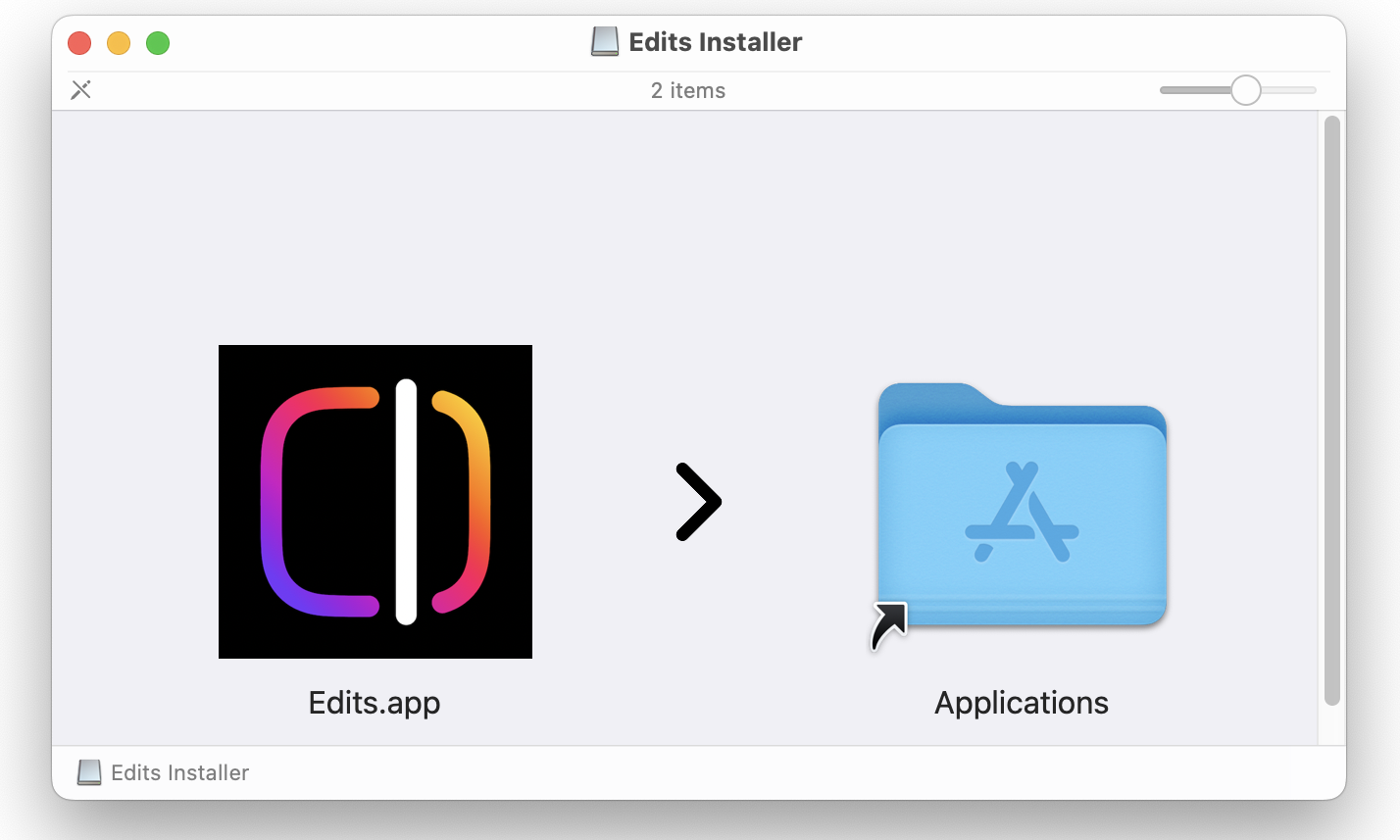
In just over a year, 50 million people have made Edits part of how they bring ideas to life, and we’re excited to expand what Edits can do for creators. Today we’re bringing Edits to the big screen. The first version of our desktop editor is now available for macOS. We’ve designed it to support more involved projects, where a larger screen and the precision of a mouse and keyboard really matter. Just like Edits on mobile, we’ll be updating our desktop app every week, so let us know what you think and what you’d like to see next.
Edits isn’t an app I need but I’m glad to see the resurgence in native Mac app development continue. I mean Instagram waited 15 years before they supported the iPad with their main app. Now they’ve got a native Mac video editor. That’s cool, and the app seems good. Looks like it’s SwiftUI? Someone on the team needs to go through the entire menu bar and properly title-case all the menu item commands, but overall it passes the sniff test. (It supports MacOS 15 Sequoia, but the icon looks lame — a sharp-cornered square.)
But I can’t help but think this just shows how Apple has ceded this market. Final Cut Pro is overkill for quick video editing, but iMovie ought to be optimized for this use case. It’s not. Who is iMovie for today?
And a decade ago Apple launched Clips, the entire point of which was to create social media-style videos. Clips was a really good app that never found an audience because it never had a clear use case. When it was new in 2017, I described it as “the single best example of a productivity app designed for iOS”. Apple officially end-of-life’d Clips in October last year, but before that, in January 2025, I wrote:
A mobile-first video editor isn’t a “money pit”. It’s an app. Apple makes a lot of apps, and they could easily afford to assign a team to make Clips truly great. It’s no different than 20–25 years ago, when Apple dedicated itself to making iMovie and Final Cut both great apps. It’s no different than the motivation to create GarageBand. The monetization wouldn’t be direct; it would be downstream of the general idea that if you’re editing videos for social media on your phone, the best app to do it with is from Apple and it’s exclusively available on iPhone. The idea is that Apple doesn’t just make the best computing devices for artists, writers, and creators, but they also make some of the best apps for those fields too. [...]
I don’t know if Edits is a rip-off of CapCut or not, but it’s definitely not a rip-off of Clips. It’s a good rule of thumb that when Apple succeeds at something, it gets ripped off. The better the Apple product, the more shamelessly it gets copied. Apple should make Clips into an iOS video editing app that everyone rips off shamelessly.
The other problem with Clips that comes to mind is that Apple never made a Mac version. I don’t know if the Mac version of Edits is actually a good Mac app, but it’s certainly a better Mac app than the no-app-at-all support for the Mac that Clips had. Maybe that was a byproduct of Clips being developed in 2016 and debuting in 2017, which coincided with the nadir of Mac hardware and the height of the-iPad-is-the-future within Apple. But a decade later, the Mac is back — and I’d say is in the strongest position as a platform that it has ever been. It seems rather embarrassing in hindsight that Apple itself never made a Mac version of Clips.
Now that Clips is dead (and largely forgotten), iMovie is the brand that Apple should reinvigorate. Apple ought to make a rethought-from-the-ground-up iMovie that is a great app on iPhone, iPad, and the Mac. The point of it should be to show CapCut and Edits how it’s done.
Wednesday, 4 November 2026
- This Election Will Not Look Surprising in History ★
-
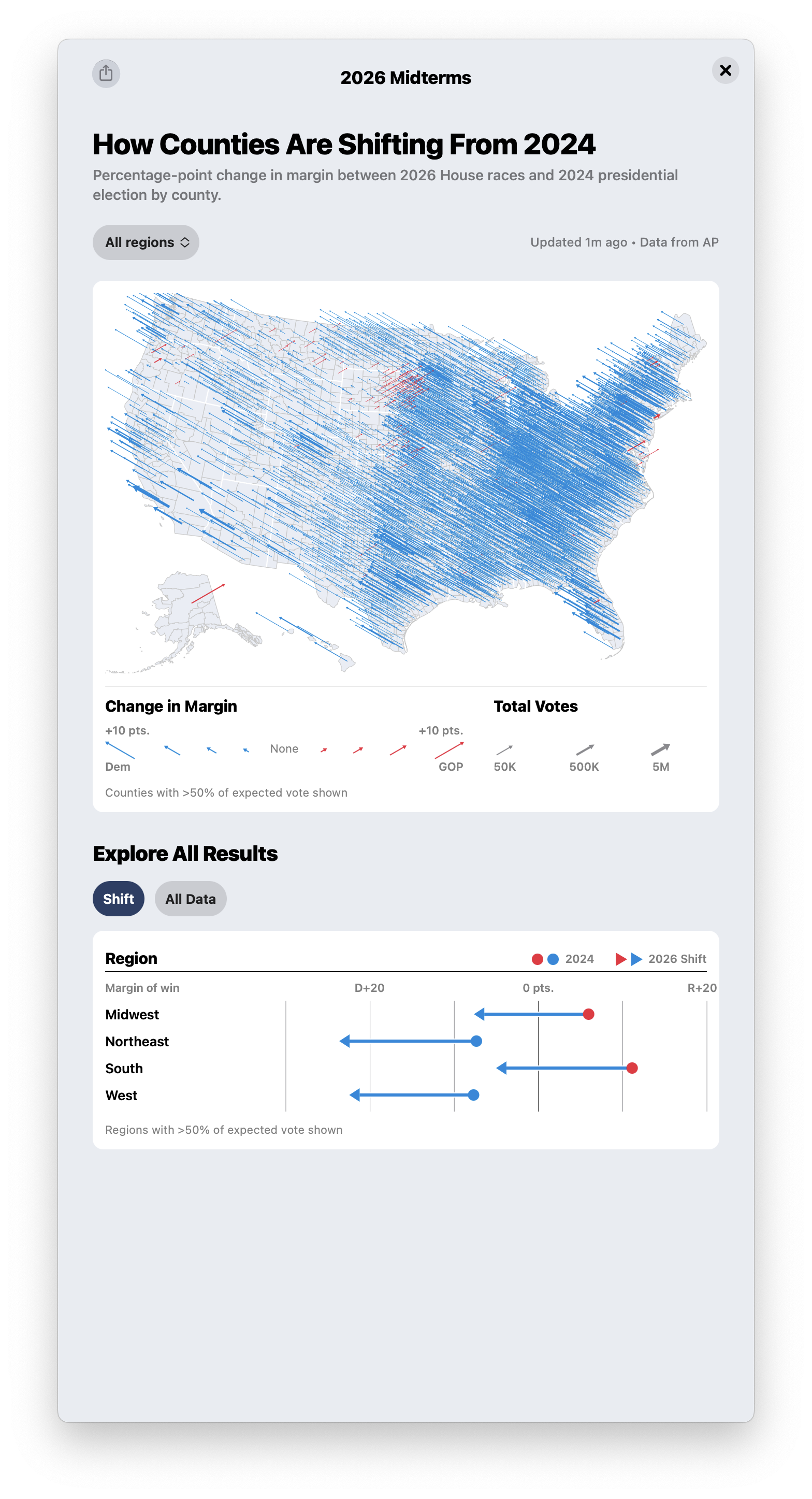
This striking map from Apple News tells the story of the magnitude of the shift since 2024.
The late Lindsey Graham, on Twitter back in May 2016 (punctuation sic):
If we nominate Trump, we will get destroyed.......and we will deserve it.
The wheels of history grind slowly, but they do grind. By the time of his death, Graham was amongst the lickspittlest of Trump’s GOP toadies. Graham’s idiot sister ran for his vacant Senate seat in South Carolina and lost.
Former representative Liz Cheney, at the January 6 hearings in 2021:
I say this to my Republican colleagues who are defending the indefensible. There will come a day when Donald Trump is gone, but your dishonor will remain.
Winston Churchill, perhaps apocryphally:
Americans can always be trusted to do the right thing, once all other possibilities have been exhausted.
You can fool some of the people all of the time, and all of the people some of the time, but you can not fool all of the people all of the time.
- ‘Political Reckoning Shatters Trump’s Grip on Washington’ ★
-
Aaron Zitner, reporting for the Rupert Murdoch-owned Wall Street Journal:
Rarely in American politics has a president traded away so much political support so quickly.
The losses that Republicans suffered on Tuesday marked one of the most decisive repudiations of a president in modern history. President Trump had re-entered the White House with advantages he lacked in his first term: a victory in the popular vote, a cadre of aides eager to expand his authority and cultural currency that had NFL players doing the “Trump dance” in the end zone.
Only two years later, his political standing has collapsed, all because of a dramatic miscalculation of his power to shape events. A war of choice with Iran and tariffs imposed on U.S. trading partners betrayed his promise to avoid foreign entanglements and tame inflation. His extraordinary interventions in his party’s primaries left Republicans with a set of unusually weak candidates.
The Democrats went from out of power in Washington to a massive majority in the House and an apparent 55-45 or even 56-44 majority in the Senate. Keisha Lance Bottoms was elected the first black woman governor in history — in Georgia. By a 9-point margin. Texas elected Democrats to the Senate and governor’s mansion. Kansas elected a Democratic senator for the first time in 94 years.
The fever, finally, well and truly broke.
Tuesday, 3 November 2026
- Apple Begins Opening Siri AI to Developers ★
-
Apple Developer:
Starting today with the iOS 27.3, iPadOS 27.3, macOS 27.3, and visionOS 27.3 betas, a new Developer Preview enables any developer to integrate their app with Siri AI, giving businesses and developers new ways to reach and serve their customers. [...]
This developer beta offers a sneak peek at Siri AI app intents for developers. With this early Developer Preview, your app can work directly with Siri AI, giving you a first look at new ways to reach and serve your customers. This preview provides early access before first shipping to customers in a few months; and with submission to the App Store opening up in the spring, developers have time to explore, build, and help shape their experiences before launch. Try it out and share your feedback.
As you explore early, we will follow up with more details about the terms and usage policies for experiences enabled through Siri AI. More to share soon.
Greg Pierce (developer of Drafts and other fine apps):
This sounds amazing, and I didn’t think we’d see App Intents integration into Siri AI until next WWDC.
Siri AI is getting to the point of underpromising and overdelivering, which is where you want products to be. In 2025 things were so bad, Apple had overpromised and not just underdelivered, but delivered nothing.
- iPad Mini (A20 Pro) Review Roundup ★
-
David Pierce at The Verge, on the Acoustic Display:
It means the sound fires out of the front panel rather than from speaker holes. (Some TVs currently work the same way.) It doesn’t sound any better than before, maybe a tiny bit bassier, but it also doesn’t sound worse, and if anything it’s slightly better to have the sound actually pointed at you instead of out the sides of the tablet. Mostly it’s a wash in service of the ruggedization, which is good enough for me.
Stephen Robles, on YouTube, thinks it sounds muffled at high volumes and doesn’t seem to like how you can feel the whole tablet vibrate at high volumes.
Tony Polanco at Tom’s Guide liked the Acoustic Display sound quality and praised the battery life (but only had time to run the battery test once):
In the Tom’s Guide battery test, which involves continuous web-surfing over Wi-Fi with the display set to 150 nits of brightness, the iPad mini 8 lasted for an astonishing 14 hours and 24 minutes! That’s nearly four hours longer than the previous model and Apple’s claims.
John Voorhees at MacStories was impressed by the Mini’s local AI performance:
The mini’s local AI capabilities extend beyond software optimized for the Neural Engine. To explore those, I ran Qwen 3.5 4B (4-bit) locally using a benchmark built into Russet, a local AI and developer tool. The 512GB iPad mini averaged a pace of 40 tokens per second across four sessions on both tests that output 128 or 256 tokens with a time to first token of 0.32 seconds for the 128 output token tests and 0.36 for the 256 output token tests.
I couldn’t compare the new mini’s local AI performance to my 6th generation iPad mini because it only has 4GB of memory, which is too little for the models Russet offers for download. Instead, I downloaded the same model on my 11-inch M4 iPad Pro and ran the same Russet benchmark. The A20 Pro came out on top in my tests. The Russet tests I ran use MLX, which runs on the CPU and GPU, so they don’t measure the benefit of the Dual 16-core Neural Engine. However, they do demonstrate the A20 Pro’s serious local AI capabilities.
- MKBHD on the New A20 Pro iPad Mini ★
-
Marques Brownlee describes the two color choices as “annoyingly, slightly not black and slightly not white,” which is apt. He digs the acoustic display enough that he can imagine Apple bringing it to a future high-end iPhone (like if they do a big redesign next year for the 20th anniversary), but he says you can feel the whole iPad shake if you turn the volume up high enough.
And, of course, he dings it for not having a 120 Hz display, and wonders where Apple even sourced a high quality OLED that doesn’t support 120 Hz. I think that’s the wrong question to ask. It’s not about the display panel. It’s the display controller, and ProMotion requires a display driver that’s enough more expensive that adding it to the iPad Mini would either raise the price even further or cut into Apple’s profit margins. It’s the display controller, though, not the panel, in my understanding.
- Safari 27.3 Beta Adds Vertical Tabs and Adaptive Dark Mode ★
-
Juli Clover, MacRumors:
With iOS 27.3, iPadOS 27.3, and macOS Golden Gate 27.3, Apple is making major updates to Safari. The browser is getting a Vertical Tabs layout, which can be used instead of the standard horizontal tab bar. It’s a change that pairs well with the iPhone Duo’s larger display, but it is available across iPhone, iPad, and Mac.
Vertical Tabs are located on the left side of the display and use icons by default to save space, but there is an option to make the tab bar wider to show website titles as well. Vertical Tabs work with both Topics and Tab Groups to keep things organized. Topics are created when automatic Apple Intelligence tab sorting is turned on in iOS 27. Pinning tabs by dragging, quickly swapping between Tab Groups, and other features also continue to work.
I got an advance demo of this last week and I’m really looking forward to trying it. I’ve gotten very used to horizontal tabs over the years, but a long time ago I was a devoted user of the Omni Group’s OmniWeb browser, of which one of my favorite features was its vertical tabs. That was so long ago, the tabs went in a drawer.
Apple is adding Adaptive Dark Mode for websites that don’t have a dark mode design option by default. If you use Dark Mode and then browse to a website with a bright background color, Safari will offer an option to “Try” Adaptive Dark Mode.
There are some popular Safari extensions that offer this (e.g. Noir), but Safari 27.3 has the feature built-in, and the demo I saw looked great. It kicks in for light-background websites that don’t offer a dark mode alternative presentation, and it allows for web developers to explicitly opt out.
- The New York Times (et al.) Sues Brave for Copyright Infringement, Selling Scraped Content to AI Companies for Model Training ★
-
Jay Peters, The Verge:
The New York Times and a group of other publications have filed lawsuits against the company that makes the Brave web browser over alleged unlawful scraping to train AI and also letting users bypass their paywalls, as reported by Reuters.
According to a complaint filed by the New York Daily News, the Chicago Tribune, and the Orlando Sentinel, Brave Software has monetized its index of scraped websites by, in part, providing AI companies with paid access to “real-time online content from the Brave Index.” The AI companies then use that index to train their models, access content to “respond to specific user queries,” or both. Brave has allegedly provided “stolen copyrighted content” to “many” AI companies including Anthropic, Perplexity, Mistral, xAI, and Cohere.
Brave also promotes “hundreds of top publishers” as being accessible through its “Paywall blocker” feature in its browser.
- Steve Jobs on His Final Quarterly Analyst Call: ‘We Think the Open Versus Closed Argument Is Just a Smokescreen’ ★
-
After linking to it earlier today, I re-read Steve Jobs’s remarks from his last appearance on a quarterly analyst call. It’s a banger of a good read:
You know, even if Google were right, and the real issue is “closed” versus “open,” it is worthwhile to remember that open systems don’t always win. Take Microsoft’s “Plays For Sure” music strategy, which used the PC model — which Android uses as well — of separating the software components from the hardware components. Even Microsoft finally abandoned this “open” strategy in favor of copying Apple’s integrated approach with their Zune player, unfortunately leaving their OEMs empty-handed in the process. Google flirted with this integrated approach with their Nexus One phone.
In reality, we think the open versus closed argument is just a smokescreen to try and hide the real issue, which is, “What’s best for the customer — fragmented versus integrated?” We think Android is very, very fragmented, and becoming more fragmented by the day. And as you know, Apple strives for the integrated model so that the user isn’t forced to be the systems integrator. We see tremendous value at having Apple, rather than our users, be the systems integrator. We think this a huge strength of our approach compared to Google’s: when selling the users who want their devices to just work, we believe that integrated will trump fragmented every time.
Prescient.
- Chance Miller Reviews the New A20 Pro iPad Mini ★
-
Chance Miller, writing at 9to5Mac:
Unfortunately, the new iPad mini’s screen has one limitation: it doesn’t support ProMotion, or a 120Hz refresh rate of any kind. Instead, it’s still locked to 60Hz. This is an incredibly frustrating decision that I can’t quite wrap my head around.
Apple touts the iPad mini’s OLED screen as offering significantly faster pixel response time than the previous generation’s LCD panel, leading to improvements like smoother scrolling and reduced motion blur.
I’ve noticed that things like swiping between Home Screen pages, scrolling social media, and system animations are noticeably smoother. They aren’t, however, as smooth as an Apple device with a ProMotion display, and they’re not a substitute for a higher refresh-rate display.
Apple is very stingy with ProMotion. Until last year it was exclusively available in iPhones, iPads, and MacBooks that had “Pro” in their name. Last year they added ProMotion to two products without “Pro” in their names: the iPhone 17 and iPhone Air. This year’s $2,000 iPhone Duo of course offers it now too. Apple refreshed the $1,600 Studio Display last year but it still only supports 60 Hz; only the $3,300 Studio Display XDR supports 120 Hz. (Apple does not call this “ProMotion”.)
What makes this frustrating with the iPad Mini is that Apple doesn’t sell an iPad Pro smaller than 11 inches. With MacBooks and larger iPads, if you really care about ProMotion, you can spend money to get it. With a small iPad, however, you can’t.
My big question re: the new iPad Mini is the new “acoustic display”. Miller gives it a thumbs-up:
Essentially, Apple has designed special woofers that vibrate the display to produce low and midrange frequencies. For higher frequencies, custom tweeters are hidden between the glass and aluminum enclosure. Apple says this new system delivers louder audio, “punchier” bass, and clearer highs, despite the iPad mini’s significantly thinner design.
In practice, I think the new iPad mini sounds great. I’d choose headphones or an external speaker for serious music or video consumption, but day-to-day the iPad mini’s built-in speakers are perfectly adequate. (I’d bet that this Acoustic Display technology shows up in future iPhones too, and the iPad mini is serving as a test bed of sorts.)
- Apple’s Analyst Calls Have Been Scripted for Decades ★
-
Bloomberg opinion columnist Dave Lee:
Apple investors and fans hoping to get an insight into the philosophy of new Chief Executive Officer John Ternus on Monday were left sorely disappointed. The 51-year-old’s first earnings call was a timid affair, with Ternus taking cover behind a carefully written script as analysts peppered him with questions.
This is stupid. I mean, it would have been fun if Ternus’s style on the analyst conference call had been loose and freewheeling. Just like it would have been fun if the questions from analysts hadn’t been mostly insipid and pointless. But nothing has changed here other than who the CEO is. Tim Cook’s quarter calls were snoozefests. Save those recordings and use them to help you sleep. And that’s exactly how Cook wanted them.
What Ternus should do is follow Steve Jobs’s lead, and skip these calls except when there’s something exceptional to address. Let CFO Kevan Parekh and COO Sabih Khan handle them, the way Jobs used to let Tim Cook and Apple’s then CFOs handle them. At one point in 2008, Jobs had only appeared on three of the calls in 11 years. He then appeared on the call in October 2008 to address the global financial crisis, and again in October 2010 (one year before he died) to celebrate Apple’s first $20 billion quarter and to throw shade at Android, BlackBerry, and competing tablets. In the 14 years of Jobs’s 2.0 stint as CEO, he only appeared on five quarterly calls. That’s the way to do it. Show up only when you have something worth saying. Otherwise the message remains clear: steady as she goes.
- Apple’s New iPhone Release Schedule Seems to Pay Off ★
-
Horace Dediu, tweeting yesterday on Apple’s results:
iPhone grew at 17% sales which is amazing considering they did not launch the 18 or the Duo or the new Air in the quarter.
The Duo didn’t launch until October, which is Q1 (in Apple’s financial calendar). And the Air, last year, was not a big seller (putting it lightly). The big bet Apple made this year was postponing the regular iPhone 18 until the end of winter early next year. The pro models — Pro and Pro Max — combined sell more than the regular non-pro no-adjective iPhone each year, but the regular non-pro iPhone is Apple’s single best-selling iPhone model. The bet that Apple made is that those mainstream buyers don’t care if the regular iPhone 18 ships five or six months after the 18 Pros — and won’t care next year, or the year after that, or the year after that about this same schedule being followed by the iPhones 19, 20, 21, etc.
The other factor at play is that the just-reported quarter started in July, just after Apple raised prices on just about every major product it sells other than the iPhone. So it’s theoretically possible that this quarter’s sales were boosted by people buying year-old iPhone 17-generation models in anticipation of Apple raising prices with the new models in September (which is exactly what happened). But I don’t see how that can explain 17 percent growth in sales year-over-year. Some savvy enthusiasts definitely did this. I have heard from a few people who bought iPhone 17 Pros in August, concluding that they’d be better off saving money than spending more for an only incrementally better 18 Pro (which would no longer come in the all-time-great cosmic orange colorway). But general consumers don’t follow Apple that closely. There are around 1.6 billion iPhone users worldwide, and I bet at least an entire billion of them have no idea that Apple always holds an iPhone introduction event in early September.
We can’t call this new launch schedule a win until we see what happens in late February or early March when Apple launches the iPhone 18, 18e, and Air 2, but so far it sure looks like a win.
Monday, 2 November 2026
- Apple Announces Record $114.5B Fourth-Quarter Results ★
-
Jason Snell, Six Colors:
On Monday, Apple announced record fourth-quarter earnings, with total revenue of $114.5B, up 12 percent from the year-ago quarter. iPhone revenue was up 17.5%, Mac revenue was up 23.7%, and Services revenue was up 9.8%. Wearables revenue was down 7.9% and iPad revenue was down 10.4%. [...]
And now, to help you visualize what Apple just announced, here is our traditional barrage of charts and graphs.
As usual, Snell also has a transcript of the analyst call — Ternus’s first as CEO. My favorite tidbit was his line at the end of this answer:
Richard Kramer, Arete Research: Your latest MacBook Pros included more iOS features like Touch and Dynamic Island as well as, obviously, Siri AI. Should we anticipate further close linking of macOS and iOS features, maybe even pointing at some point to a single unified OS, either for simplicity or to reduce costs?
John Ternus: Look, we are very proud of both the Mac and the iPad, and I think what you’ve seen over the years is we’ve really enjoyed the ability to bring features and capabilities across the ecosystem and create really compelling features that span things between handoff between iPhone and Mac and iPad, and so when we design the product, we’re looking at how can we make the best version of each and every product, and if you look at what we just did last week with the MacBook Pro, we took a huge leap forward. These MacBook Pros are better in every way than the ones that came before them, and we’re really proud of that, and so we don’t have any fundamentally different changes that we’re planning right now, nor would we talk about it anyway.
Sunday, 1 November 2026
- WorkOS: Let Agents Sign Up for Your App Without a Browser ★
-
My thanks to WorkOS for sponsoring last week at DF. An agent can’t click through a signup page built for humans, so give it something it can read instead. Publish an auth.md file and agents register themselves without ever touching a browser login, and the user never gets pulled out of what they were doing.
With WorkOS auth.md, enroll in the dashboard and AuthKit publishes the file. Agents read it, register, and get scoped, short-lived credentials you control.