
By John Gruber

WorkOS: How SSO works and the fastest way to add it.
Linked List: August 2026
Sunday, 30 August 2026
- Finalist 4 ★
-
My thanks to Finalist for sponsoring last week at Daring Fireball. Finalist is a remarkable, ambitious, and novel app for iPhone, iPad, and the Mac from indie developer Slaven Radic. It’s a planner inspired by paper day planners. I wrote quite a bit about Finalist when it first sponsored DF back in December — you should read that post. I’ve been using Finalist ever since. It’s a really good app. I’ll just reiterate from the first post that what really resonates for me is the idea of adding tasks to days, not assigning dates to tasks. If you add some tasks and then never actually do them, they’re still there, but they’re in the past, not harassing you in an ever-growing list of undone stuff today.
Finalist 4, which just came out a few weeks ago, is the biggest update yet. The headline new feature is notes, in the app or as a folder of Markdown files that round-trips with Obsidian. Tasks in those files land on the right day, next to your reminders and events, even inside the Mac menu bar app. Finalist’s rebuilt Timeline lets you pencil tasks into your day, and Apple Pencil gets special powers to sketch the plan in seconds.
There’s tons more, brewed over four months with 1,000 beta testers. Try it free on the App Store — for iPhone, iPad, Mac, and now Apple Watch.
Friday, 28 August 2026
- Apple Announces Price Increase for Apple TV and Apple One Subscriptions ★
-
Chance Miller, 9to5Mac:
Here are the full details on the price increases:
- Apple TV (monthly): $14.99 (up from $12.99)
- Apple TV (annual): $119 (up from $99)
- Apple One Individual: $21.95 (up from $19.95)
Prices for other Apple One plans are unchanged. When Apple increased the price of Apple Music last month, it also raised the Apple One Family and Apple One Premier plans, but not the Individual plan.
The higher prices go into effect today for new subscribers. Apple says existing subscribers will be notified of the price increase about a month before they are charged the new price.
Seems poetic that Tim Cook’s last action as CEO is a goose to services revenue.
- ‘I’m the Guy Who Destroys Antique Books After We Scan Them Into Our Company’s Insatiable AI Platform’ ★
-
Jack Loftus, writing at McSweeney’s:
People assume scanning is the exciting part. And, sure, it is impressive. They shear off the spine, separate the pages, and run everything through these enormous machines so the computer can absorb every sentence ever written and use it to create some fairly compelling LinkedIn posts. But then, boy oh boy, the wheeled cart carrying those decimated remains comes to me. That is where the human touch enters the process, assuming you count industrial shredders and a giant burn pit out back as an extension of the hand, which I certainly do.
- ‘How Americans See E.U. Tech’ ★
-
I think at least half a dozen people have sent me a link to this video and now that I’ve watched it, I understand why. Perfect.
- We Certainly Have Made a Hames Out of This ★
-
I mentioned earlier that for anyone going along with the ruse that Lake Ontario is now named Lake America, the HOMES mnemonic no longer holds, the only two valid words in English with the new five letters are hames and shame, and that hames is rather too obscure.
But it’s not so obscure in Ireland, where they use it in an idiom: to make a hames of something is to make a mess of it. With that in mind, it’s hard to say which is more apt for this embarrassment, hames or shame.
(The other longstanding Great Lakes mnemonic is the phrase “Super Man Helps Every One”, which I don’t love because neither Superman nor everyone ought to be treated as two words, but it does have the advantage of sorting the lakes geographically from west to east.)
- ‘Not Sure How You Own Canada by Deleting Your Own History’ ★
-
Matt Walsh, described by Wikipedia as “an American far-right political commentator and podcast host” (a description that sounds harsh, but I’d say is describing him euphemistically), on Twitter/X (retweeting the official White House account’s announcement of the name change):
This will be an unpopular opinion on the Right but I think this is kind of dumb, even as a troll. Lake Ontario was given that name on maps by European explorers long before the Canadian province of Ontario was named. There are several cities in America called Ontario — at least one of them predating the Canadian province by like 100 years — because the word originates with native tribes in North America. It’s not a Canadian invention. Canadians never uniquely owned the lake or the name. So in effect all you’re doing here is actually giving them credit for a thing that wasn’t theirs to begin with. Yeah it’s funny when Canadians are upset I guess or whatever, but Lake Ontario, the name itself, is American history dating back many centuries. Not sure how you own Canada by deleting your own history.
Politically this is also stupid because the number one challenge Republicans will face in the midterms is the charge that they haven’t used their time in power to advance the interests of everyday Americans. This kind of thing will be used as evidence to make that case. That might not be fair. Sure technically you can advance the interests of everyday Americans and also do dumb shit like this. But the fact is that far from “making liberal heads explore [sic],” you’re actually handing them a political gift. It helps their case much more than it helps ours. And, like I said, the historical logic here is totally confused. Lake Ontario was not named after the Canadian province of Ontario. It’s the other way around.
Good sign that the whole mad-king thing is running on fumes when even Daily Wire commentators agree that this is stupid and isn’t even an effective troll. Every deluded fool runs into reality eventually. (Via Oliver Darcy’s Status.)
Also: Applying a new name to the Gulf of Mexico is equally ahistorical — Mexico only achieved independence from Spain in 1821; the Gulf’s name is twice as old as Mexico as a nation and 150 years older than the United States.
- From the DF Archive: ‘Golfo Del Gringo Loco’ ★
-
Yours truly back in February 2025:
The motivation behind the name change is simple as well. Trump didn’t change the US’s officially recognized name of, say, the Atlantic Ocean or the continent of Africa. He just as easily could, but he won’t.
I’m starting to worry how well that’s going to hold up.
And it’s not like “Gulf of Mexico” was on a list of “debatable or controversial names” until he created this controversy out of thin air. It’s just the one name on the globe that a president of the United States can change to stick it to Mexico, a country Donald Trump has objectively racist feelings toward. Trump never campaigned on building a wall at our northern border with Canada, nor has he (yet?) attempted to rename Lake Ontario.
That “(yet?)” held up very well, alas. The rest of my essay holds up very well too, I think, especially pertaining to how Google and Apple present the change in their respective maps apps:
So whether Google and Apple should show the new name at all shouldn’t be the question we’re asking. The right question is necessarily more nuanced: Who should see which names, where? And Google and Apple’s answers to that question are, alas, disappointing and worrisome. I’ll repeat the seemingly identical policy both companies are actually presenting today, by region:
- United States: “Gulf of America”.
- Mexico: “Gulf of Mexico”.
- Everywhere else in the world: “Gulf of Mexico (Gulf of America)”.
The best politically realistic option they could have chosen would be (I’ll use italics to emphasize that these are my own suggestions):
- United States: “Gulf of America (Gulf of Mexico)”.
- Everywhere else in the world: “Gulf of Mexico”.
There’s no good reason to even show “Gulf of America” in parentheses outside the US. We’re the ones with the stupid name change on the books, so we’re the ones who should get stuck seeing the stupid name. No one else should suffer the consequences of our political lunacy. But it is correct to show us, in America, the new dumb “Gulf of America” name. Again, if it were up to me, American users would see “Gulf of America (Gulf of Mexico)”, and everyone else would just see “Gulf of Mexico”. But that’s surely the best we in the reality-based community could hope for.
Earlier in the essay, I wrote:
To ignore political reality is to court political controversy. It is not in the interests of large multinational corporations to court controversy. But it’s not possible to avoid controversy. What is reasonable is to minimize controversy.
Trump has delivered fresh “Lake America” shit sandwiches for Google and Apple to eat. I suggest that the path I recommended 18 months ago remains the path of eating the least shit, maintaining the most integrity, and courting the least collective controversy. Label it “Lake America (Lake Ontario)” to those of us here in the U.S., and keep it as “Lake Ontario” with no mention of Trump’s petulant fiat name anywhere else in the world.
- Trump Declares That Lake Ontario Is Now ‘Lake America’ ★
-
Jackie Llanos and Jenna Monnin, reporting for NOTUS:
President Donald Trump on Thursday signed an executive order meant to rename Lake Ontario “Lake America,” taking his apparent jab at Canada one step further as a trade war between the two countries escalates.
The president said the name change was “effective immediately” during a signing ceremony in the Oval Office. The executive order directs Interior Secretary Doug Burgum to update the Geographic Names Information Service to reflect the name change. When asked by reporters about the move, Trump said he was sending “no message” to Canada with the name change.
“Lake of America was something I’ve been thinking about for a long time,” the president said. “Actually, as you know, we took something called the Gulf of Mexico, we changed it, and now it’s very routinely the Gulf of America.”
Aaron Rupar has video clips of Trump declaring the change in an Oval Office press event, here and here. In the second clip Trump ruminates, “So if you think about it, we have a gulf, and we have a lake, now all we need is an ocean, so maybe we’ll have to change the name of the Atlantic and/or the Pacific. Maybe we’ll change them both.” Those who deny that he’s a mad king slipping ever deeper into dementia might say, well, he’s obviously joking. But if I had told those same people just two years ago, in the run up to his reelection, that Trump was going to declare new names for the Gulf of Mexico and Lake Ontario, they’d have said I was crazy because that would be nutty.
It is nutty. Renaming these large bodies of water is nuts. He’s nuts. This is not complicated. Crazy people do crazy things and this is obviously crazy. I often use the phrase jokingly but Donald Trump is not hooked up right, and the proof is right before our eyes on camera every day.
Factoid: HOMES is the longstanding mnemonic for recalling the five Great Lake names: Huron, Ontario, Michigan, Erie, Superior. “Hames”, technically, is a playable Scrabble/Wordle word (“a part of a horse collar”), but it’s far too obscure to serve as a mnemonic. That leaves one word in the English language consisting of the five necessary letters: SHAME.
Thursday, 27 August 2026
- U.S. Judge Blocks Trump Defense Department’s Anthropic Blacklisting ★
-
Jack Queen, Reuters:
A U.S. judge on Thursday blocked the Pentagon’s blacklisting of Anthropic, the latest turn in the Claude maker’s high-stakes fight with the military over AI safety on the battlefield.
Anthropic’s lawsuit in California federal court alleges that Defense Secretary Pete Hegseth overstepped his authority when he designated Anthropic a national security supply-chain risk, a label the government can apply to companies that expose military systems to potential infiltration or sabotage by adversaries. [...]
U.S. District Judge Rita Lin, an appointee of former Democratic President Joe Biden, made the ruling in a 59-page order where she found that the Pentagon’s decision was “illegal and baseless.”
“The empty invocation of national security is not a blank check to punish and retaliate against government critics,” she wrote.
The imperial aspects of Trump 2.0 are increasingly coming apart at the seams.
- Afterglow — Classic After Dark Screen Savers on Today’s MacOS ★
-
Jeff Halter has done it again: after bringing back the single greatest After Dark module (Ben Haller’s Lunatic Fringe game, via a modern runtime named Lunacy), he’s now released Afterglow:
Running After Dark modules in the present day has involved fussy configuration of Mac OS emulators or vintage hardware. Even then, no single emulator or vintage computer can faithfully run every module: some animate too fast, some too slow.
Afterglow is an emulator built specifically for running After Dark modules — the original 68k module code, not a remake or port — with no dependencies on ROMs or classic Mac OS. Created in the spirit of software preservation, it makes After Dark easy to enjoy today and for years to come.
All this in the same summer during which Halter released Stacks, his beautiful native modern HyperCard player. And don’t even look at his reproduction of volume 68 of MacWarehouse from 1997.
- The Load-Bearing Vocabulary of Claude ★
-
Fun (but depressing?) data analysis project from Louis Abraham, showing how repetitive Claude is in the words it chooses when submitting GitHub pull requests. Abraham, in the project’s readme:
GitHub pull request descriptions, grouped by the words they are written with rather than by anything they were told to look for: eight ways of writing, and every description belongs to one of them. One of the eight was 1.0% of the corpus at the start of 2025 and is 45% of it by the middle of 2026.
If you want to get a little more depressed, I’ve been doing deeper reading into AI watermarking research, and one of the admissions in Google’s white paper on SynthID-Text — the watermarking scheme Anthropic says Claude is going to start using — is that the technique incurs “some reduction to inter-response diversity”. That means different answers to the same prompt become more similar to each other — there’s less variety to watermarked text responses. That’s a load-bearing problem given that Claude clearly already struggles in this regard before watermarking its output.
- Elizabeth Warren’s Incoherent Outrage Regarding Apple’s Tariff Refund ★
-
Speaking of tariff refunds, here’s an official statement from Senator Elizabeth Warren from a few weeks ago:
U.S. Senator Elizabeth Warren (D-Mass.) wrote to Target, Apple, Amazon, Nike, Motorola, Walmart, and Energizer pushing these companies — each of which have or are expected to receive massive rebates from the Trump Administration for tariffs paid last year — to provide refunds to customers.
“I urge you to pass along any refund you may receive to the consumers who paid higher prices for your products while the tariffs were in place,” wrote Senator Warren.
NEW: Apple reportedly got $2.2 BILLION back in tariff refunds. Amazon got $600 MILLION.
What’s their plan to give YOU your money back?
Warren published the letters she sent to the CEOs, including Tim Cook:
Reports indicate that Apple has applied for a refund of the roughly $3.3 billion in tariffs you paid in 2025, and as of July 30th, that you have received nearly $2.2 billion in refunds. This amounts to a multi-billion dollar windfall, which could still grow if more of your refund petitions are granted. You have claimed that you “plan to reinvest any amount we receive back into U.S. innovation and advanced manufacturing,” but this vague statement offers no clarity as to where this money will go: indeed, it implies that you will not be returning it to the millions of consumers who purchased Apple products last year and paid higher prices. [...]
You have received an astronomical cash infusion in the form of a tariff refund, and Apple customers who paid increased prices for your products, ostensibly due to tariffs, deserve to know how that money will be spent. Your vague statements about “reinvesting” the refund leave hardworking Americans who paid hundreds of dollars more to buy Apple products in the dark about why they paid those increased prices and where their money will go. To better understand the disposition of any tariff refund you might receive, I request that you respond to the following questions by August 21, 2026.
Amongst the 11 questions she asks, the only one that seems pertinent is #5:
(5) How much did Apple increase prices on products in 2025?
(a) For what products did Apple increase prices, and how many of these products were directly impacted by tariffs?Unless I’m missing something, the answers are “$0” and “none”. Apple increased none of its prices on any of its products in response to tariffs in 2025. The iPhone 17 lineup, in fact, surprised many observers and made news by holding prices steady.
In May 2025, Warren co-signed a letter to the FTC encouraging them to discourage large profitable companies from raising prices due to tariffs. Apple — a large profitable company — didn’t raise prices at all, which seemingly was what Warren thought they should do. But now she’s expressing outrage that Apple got a refund for the tariffs whose costs the company covered, and her followers are left to believe that Apple did raise prices and is keeping the money.
- Panic Is Refunding Tariff Fees to Playdate Buyers ★
-
Nicole Carpenter and Diego Argüello, reporting for Game Developer:
“There was a specific window of time this year where we charged tariffs to customers,” Panic co-founder Cabel Sasser explained in an e-mail to Game Developer confirming the news. “We tried absorbing the cost for a while, but that was financially difficult for a small company like ours. We made the tariff a very obvious and clearly labeled line item on checkout for any customer affected.”
Panic also set up a website to explain the 19% tariff surcharge. [...] The refund amount a customer will get back depends on how much they purchased.
“It’s just not our money to keep, and it felt really good to give it back,” Sasser said. “That’s an easy way to know you made the right decision.”
He continued: “Still, it took a lot of work for us to file all the paperwork to get the refund from the government, and it took work to build a little system to process the refund, and sometimes it felt like, wait, why are we seemingly doing more work than even gigantic companies are on this issue? That felt weird. But I guess it makes sense in a way, because our small size means we’re far more directly affected by something like a tariff.”
Sasser said he hopes Panic never has to talk about tariffs again.
Cool story from a cool company, and amen to the day we never hear about tariffs again.
- Ads in Apple Maps Have Now Launched ★
-
Ryan Christoffel, 9to5Mac:
Apple confirmed to 9to5Mac that the ads rollout in Maps began in the last few days. And it will continue ramping in the weeks ahead to all users.
There are two places you’ll find ads in the Maps app:
- Before searching: Suggested Places in the search screen will feature an ad.
- After searching: Ads will appear in search results when relevant.
Before searching, I saw an ad for an HVAC contractor 12 miles away in “Suggested Places”. Knock on wood but I currently have no HVAC problems, and even if I did, I’d just call someone and have them come here. Then I waited a few minutes and looked again. This time I saw an ad for Tommy’s Express Car Wash (“Get your first month free”), 23 miles away in the middle of a suburban shopping mall. Apple Maps estimates it would take me 1 hour 8 minutes to drive there right now. I’ll get right on that.
The first organic (non-ad) suggested place is a coffee shop 300 feet away.
- ‘How Europe Is Killing Makers and Micro-Entrepreneurs’ ★
-
Alain Pannetrat, founder of Lectronz:
Lectronz is a marketplace for open-source hardware makers and DIY electronics. Most of our sellers are not factories or well-funded start-ups. They are engineers, independent designers, and hardware enthusiasts working from spare rooms, garages, and tiny workshops.
Some earn a living from their products. Some sell only a handful of boards each year. Others build ten units simply because they created something useful and want to share it with the community. Occasionally, one of those experiments grows into a real business. Every Arduino begins somewhere.
But the European Union’s new packaging rules now threaten to kill the world of makers and micro-entrepreneurs, putting jobs, livelihoods and an entire ecosystem of innovation at risk.
Pannetrat says these new regulations will require even one-person hobbyists to spend hundreds of euros per year (and file paperwork) for each country they ship to. The costs will far outstrip the money they make from selling a few dozen gadgets or circuit boards, and the hassles are probably worse than the costs. But these regulations are no big deal at all to big companies like Amazon — they only hurt smaller companies, and they’re effectively crushing to hobbyists.
A couple of years ago Philadelphia banned retailers from using plastic bags. It’s worked out great. More people bring reusable shopping bags with them, and if you need a bag from the store, you get paper bags that they charge you a nickel each for. A small price to encourage bag reuse, and the end result is no more plastic bags. Regulations can be very effective without adding any complexity or annoyance to daily life.

Wednesday, 26 August 2026
- POSIWID: The Purpose of a System Is What It Does ★
-
Wikipedia:
The purpose of a system is what it does (POSIWID) is a heuristic in systems thinking coined by the British management consultant Stafford Beer, who stated that there is “no point in claiming that the purpose of a system is to do what it constantly fails to do”. It is used in systems theory, and is generally invoked to counter the notion that the purpose of a system can or should be read from the intentions of those who design, operate, or promote it. When a system’s side effects or unintended consequences reveal that its behaviour is poorly understood, then the POSIWID perspective can balance political understandings of system behaviour with a more straightforwardly descriptive view.
I don’t recall seeing POSIWID before, but I love the concept. A friend sent this to me, with the quip that I forgot to include a link to it in my “What Is the Point of the DMA?” piece this week. Indeed, it encapsulates my arguments about the DMA specifically and the European Commission generally. The purpose of the DMA is what it does, not what you imagine it is intended to do.
In the same vein, I have been thinking too about the famous anecdote reported by Adam Lashinsky for Fortune back in 2011:
Steve Jobs doesn’t tolerate duds. Shortly after the launch event, he summoned the MobileMe team, gathering them in the Town Hall auditorium in Building 4 of Apple’s campus, the venue the company uses for intimate product unveilings for journalists. According to a participant in the meeting, Jobs walked in, clad in his trademark black mock turtleneck and blue jeans, clasped his hands together, and asked a simple question:
“Can anyone tell me what MobileMe is supposed to do?” Having received a satisfactory answer, he continued, “So why the fuck doesn’t it do that?”
You can argue all you want that the DMA is intended to give developers and users choice and freedom. My retort is “So why the fuck doesn’t it do that?” The DMA is what it does — and it isn’t that.
(Also, if you follow the link quoted above to Stafford Beer’s Wikipedia entry — man, put a hat on that guy and damned if he doesn’t look like Jim Dalrymple. It would be even more uncanny if his name had been Stafford Heineken.)
- Apple’s Polishing Cloth Is Now Just $9 ★
-
Chance Miller:
Not to be overshadowed by the new Mac mini and Mac Studio, Apple today has also released an updated version of its Polishing Cloth. In an age of everything getting more expensive, the new Polishing Cloth is cheaper than before at $9 (down from $19). [...]
Apple released the Polishing Cloth in October 2021 and sold out almost instantly. While it has become a meme, it is genuinely a good polishing cloth for your Apple gear.
Moore’s Law comes for everything eventually.
- ‘Surprise and Shine’ Apple Event: Wednesday 9 September ★
-
Zac Hall, 9to5Mac:
Apple has officially announced its next product event, where it will unveil the iPhone 18 Pro lineup and its first foldable iPhone. The event will take place on September 9 at 10 am, PT. The tagline reads “Surprise and shine,” and the invitation features a glowing Apple logo with a sun shining through.
Apple generally prefers Tuesdays, but on years when Labor Day falls in the second week of September, they move it to Wednesday.
Tuesday, 25 August 2026
- XCancel, the Twitter/X Mirror, Shuts Down After Cease and Desist From the Fine Folks at X Corp ★
-
XCancel:
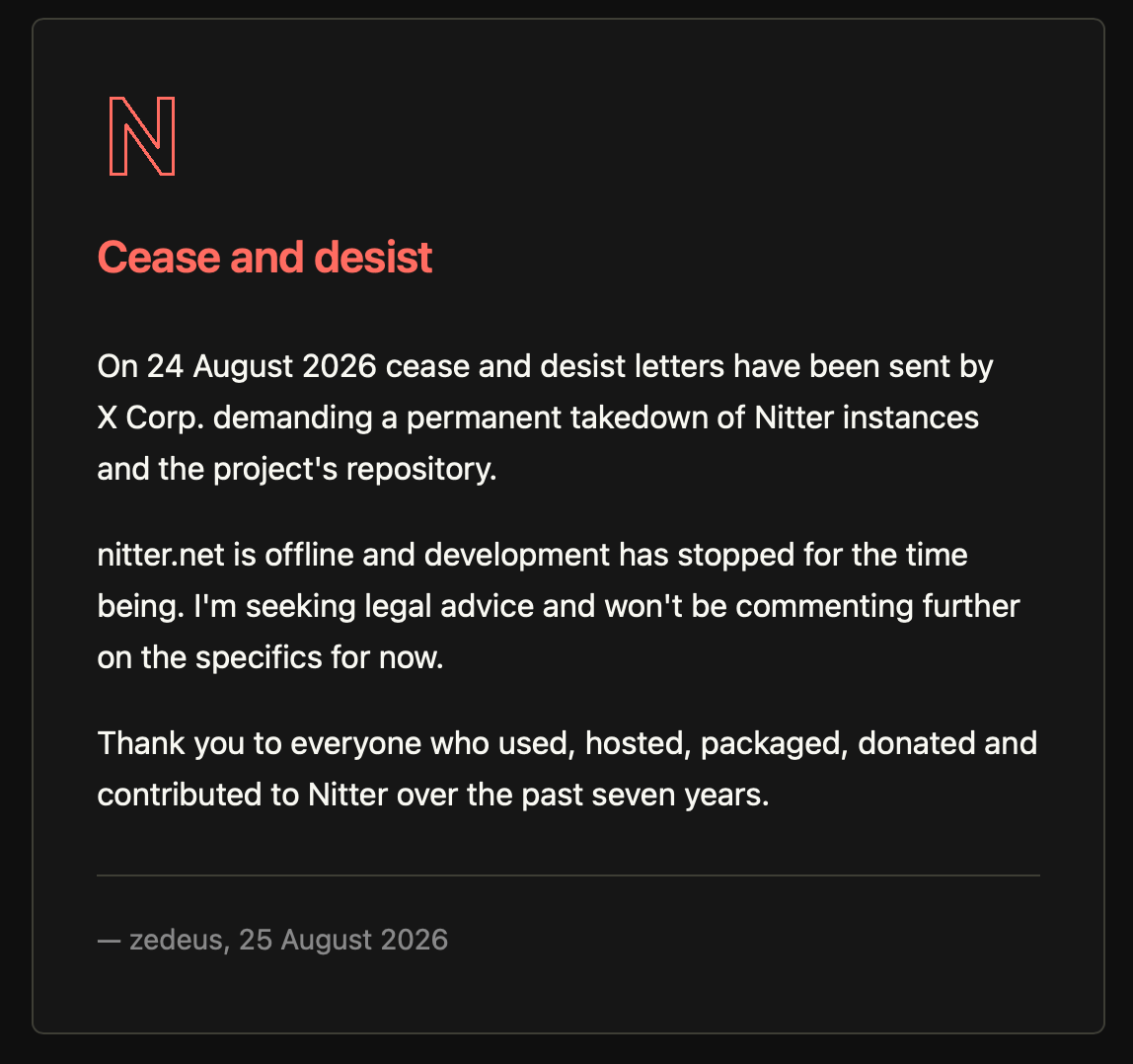
On Monday 24th August at 8PM EST, we received at letter from X Corp. asking to cease and desist the service XCancel.
The service XCancel is stopped until further notice.
We are seeking legal advice and won’t share more details for now.
Thank you for the trust you have put in these two years of XCancel.
I didn’t want to jinx them, but this obvious threat hanging over their head was the main reason I never linked only to XCancel rather than directly to tweets on x.com. This sucks not just because some people don’t want to visit x.com, but because XCancel was a faster-loading website with no bullshit.
Update: Nitter, the open source project that XCancel was an instance of, got the same cease and desist and also shut down.
- Dolly Parton Dies at 80 ★
-
Bill Friskics-Warren for The New York Times:
Her death was announced in a video posted on social media by her nephew Bryan Seaver. No cause was provided. Concerns about Ms. Parton’s health were raised last year as she postponed and later canceled a Las Vegas residency, and intensified to the point that she took to social media in October to announce, “I ain’t dead yet.” This May, she said that she had responded well to treatment after her immune and digestive systems had, as she put it, “got all out of whack” in recent years.
From her hardscrabble beginnings to glittering stardom, Ms. Parton’s life was the stuff of make-believe. With her voluptuous figure, sparkly stage costumes and blond bouffant wigs, she was likened by the writer Chet Flippo to the Big Rock Candy Mountain, the Depression-era symbol of abundance. Her songs spoke to millions, confronting privation and loss even as they radiated possibility and hope.
She was, quintessentially, a uniter of people. In 2019, The New York Times ran a story with the headline “Is There Anything We Can All Agree On? Yes: Dolly Parton.”
Dolly Parton did all the good she could, for all the people she could, for as long as ever she could.
From her legendary songwriting to the Imagination Library — which sent 1 million books a month to children across the country — she was the best of America.
Dolly, we’ll miss your great heart.
Parton accomplished so many great things, but man, the Imagination Library is just hard to believe. They’ve distributed over 330 million books to children — and counting. In lieu of flowers or anything else, her family is requesting that any money you might want to contribute to show your appreciation be donated to the library. Count me in.
- Update Regarding the Base Prices of the M5 Max Mac Studio ★
-
I made a mistake in my table earlier today regarding the base price of the M5 Max Mac Studio, but my mistake was because of a rather sneaky design in Apple’s purchasing flow. Apple’s web interface looks like this:

Both of the available M5 Max SoCs have 18-core CPUs, but the entry model (that starts at $2,500) has a 32-core GPU, and the upgraded chip has a 40-core GPU. That upgrade is labeled “+ $300”, which makes it look as though the starting price for the 18/40-core model is $2,800. That’s the price I put in the original version of my chart.
But if you select that option, you’ll notice that the actual starting price jumps from $2,500 to $3,100 — a $600 difference, not $300. The reason is that the $2500 18/32-core version only comes with one option for RAM: 36 GB. The 18/40-core chip has three tiers for RAM: 48, 64, and 128 GB. So when you switch from the 18/32-core chip to the 18/40-core chip, you don’t just get 8 extra GPU cores (which Apple is saying costs $300), but the base RAM jumps from 36 to 48 GB, and that costs you an additional $300.
Apple does show a blue notification stripe when you change chips here, which states “Based on your new selection, other parts of your configuration have been updated. Please review the changes.” But because the RAM options are mutually exclusive between the two M5 Max variants, it’s easy to make the mistake I did, and think the base price for the 18/40-core M5 Max Studio is $2,500 + $300 = $2,800, when in fact it’s $2,500 + $300 + $300 = $3,100.
I regret the error, and we all regret how expensive all of this has gotten.
-
If you already read my “What Is the Point of the DMA?” piece yesterday, this morning I added a lengthy footnote regarding the DMA’s predecessor, the GDPR. Click through to read the entire note, but here’s the kicker:
The GDPR went into effect 10 years ago. By their inaction, they obviously think it’s working just fine. I think they look at the situation and realize, with satisfaction, that every time any website presents a cookie-permission dickover, that dickover effectively has a “Brought to you by the European Commission” badge on it. They were here, they did something, and everyone around the world sees the fruits of the GDPR cookie regulations every time they open their web browser. Job well done.
- Apple Introduces M6 and M5 Ultra Chips, in New Mac Mini and Mac Studio ★
-
Apple Newsroom:
Apple today debuted M6 in the new Mac mini and M5 Ultra in the new Mac Studio, providing an extraordinary leap in performance and AI capabilities. M6, Apple’s first state-of-the-art 2-nanometer chip, advances every compute block, delivering gains across every dimension of performance. The chip features a larger 12-core CPU complex with the world’s fastest CPU core, a larger 12-core GPU with Neural Accelerators, a Dual 16-core Neural Engine, and up to 170GB/s of unified memory bandwidth. M5 Ultra, the ultimate powerhouse for pro and AI workloads, uses next-generation UltraFusion technology to form a quad-die architecture for the first time in an M-series system on a chip (SoC). The chip includes an up-to-36-core CPU and up-to-80-core GPU with a massive 1.2TB/s of unified memory bandwidth, 50 percent more than M3 Ultra.
The new Mac Mini (M6 and M5 Pro) and Mac Studio (M5 Max and M5 Ultra) are available for preorder today, but none of them ship until September 22.
All are slated to ship with MacOS 27 Golden Gate. On a background briefing for these new desktops yesterday, I asked if that implied that MacOS 27 would be released to the public on or before September 22, and the folks from Apple just sort of smiled and said they had no comment on anything other than the new hardware.
Monday, 24 August 2026
- Apple Rethinks Plan to Merge ‘Hide My Email’ Domain Name With ‘Sign In With Apple’ ★
-
Apple Developer News:
Starting later this year, new Sign in with Apple addresses, previously issued on
privaterelay.appleid.com, will be issued onprivate.icloud.com. Existing addresses onprivaterelay.appleid.comwill continue to work and forward mail to users without interruption.After further consideration and reviewing community feedback, iCloud+ Hide My Email addresses will remain on
icloud.com.Back in June, Apple announced plans to merge both systems onto the new
private.icloud.comdomain. The objection to this plan was rather obvious: it’s fine for Sign In With Apple to use an easily distinguishable domain name, because the only sites that see such email addresses are those that support Sign In With Apple (SIWA). The problem with moving Hide My Email (HME) addresses to a distinguishable domain name is that we often want to use such hidden email addresses on sites that would prefer to block those addresses and try to force us to use our “real” addresses. A little birdie suggested to me after I wrote about it in June that there were strong objections to the merger internally all along, from the HME side. Seems like those objections have won out. - BitCam: The 1-Bit Camera App Turns 2.0 ★
-
10 years ago I wrote about BitCam 1.0:
Gorgeous, unbelievably faithful one-bit camera app for iPhone done in the style of the original Mac. A lovely tribute to Bill Atkinson’s remarkable dithering algorithm. “Catnip for old-school Mac users,” says John Siracusa. Check out the fun recent-hire-at-Apple Chris Espinosa is having with it.
Originally a creation of The Iconfactory, BitCam is now in the good hands of Héliographe (coiners of the best icon-design zinger ever). Version 2.0 has everything great about BitCam 1, and so much more. Just a wonderful ode to the original Mac, with so much extraordinary attention to detail. Great fun on the iPhone (especially as a camera), and great fun on the Mac (especially to explore the details of its OG-style UI). Free to download on the App Store, and a one-time purchase of just $10 to unlock the full feature set.
If BitCam doesn’t speak to you, you’re not hooked up right.
- More on TestFlight’s Screwy Sort Order ★
-
I complained last week that starting with an update last month, the list of apps I’m testing in Apple’s TestFlight app has been sorted alphabetically, rather than by recency. Whatever is going on with this sort order, it isn’t affecting everyone. John Siracusa, amongst many others, has the same problem I do — his list is now alphabetical, and it’s driving him nuts too. Ryan Booker, amongst many others, still has his list sorted by recency.
The weird thing is, back on August 13, the iPhone version of TestFlight started showing my lists in recency-of-last-update order once again. There was no update to the TestFlight app itself. I just started seeing the list in the correct order once again. It was only on my iPhone though — on my Macs and iPad, TestFlight continued to sort apps alphabetically. Then, two days later, my iPhone went back to alphabetical order, and it’s been stuck there ever since.
When the list is sorted by recency, there’s also a “Currently Testing” header at the top of the list, and there are other (disclosable) categories like “Incompatible” and “Previously Tested” at the bottom of the list. When the list is sorted alphabetically, none of these category headers are visible.
Update: The bug was seemingly fixed in v4.3.1 on September 3.
Sunday, 23 August 2026
- Cooper Sharp Proves That American Cheese Can Be Great Cheese ★
-
John Moltz, in his weekly members-only column for Six Colors (no gift links, but Moltz’s column is worth the subscription in and of itself):
This week Anthropic announced that in order to identify AI from human-generated content it would be watermarking all text it generates by subtly altering the randomness at which its models picked the next word. While this might seem a perfectly cromulent means of accomplishing a worthy goal, it really rubbed John Gruber the wrong way, as if someone suggested putting autocomplete Swiss on his Philly cheesesteak AI.
Cooper Sharp cheese is the way to go. The best new cheesesteak joint in town — Uncle Gus’s — only offers Cooper Sharp, in fact.
Surely a fair number of the hundreds and hundreds of bees that have nested in Gruber’s extremely fancy bonnet are a result of the fact that this is all ostensibly in response to a mandate from the EU. But, as James Thomson has suggested, Anthropic might actually want to watermark so that it doesn’t scoop up its own output to train its models, thereby degrading the results. In fact, the company would probably love to be able to figure out other companies’ watermarks and have them not be able to figure out its watermark.
For the record, my opposition to Claude’s plan to begin watermark-adulterating all generated text, worldwide, has nothing to do with it ostensibly being to comply with a regulation from the EU. I do think the EU regulation is deeply ill-considered (and, having been drafted in 2024, already technically out of date), but I’d have written everything I wrote (and will continue to write) about the matter even if the EU had no AI-related regulations in place. In fact, while writing my initial piece, I really wished this had nothing to do with the EU, because pointing out the folly of the regulation (and the ridiculousness of a company supposedly worth $2 trillion being technically unable to comply with an EU regulation without applying the changes globally) seemed a distraction from my point, regarding the ramifications of watermarking text by way of detectable word choices. Moltz’s aside here confirms that.
Also, more and more, I do think this has little to do with the EU regulation and everything to do with Anthropic and Google wanting to watermark the text that Claude and Gemini generate for their own purposes, to identify text to avoid training future models on to avoid model collapse/AI inbreeding. I suspect blaming the decision on the EU “Code of Practice” regulation is just scapegoating on Anthropic’s part.
(As a bonus, Moltz has a deliciously sharp (no cheese pun intended) take on the schadenfreude-rich saga of MacStories returning to Twitter/X.)
Saturday, 22 August 2026
- Mark Carney on the U.S. Under Trump: ‘Sometimes, Its Signature Is Written in Pencil’ ★
-
Ian Austen, reporting for The New York Times (gift link):
The morning after he pulled negotiators from trade talks in Washington and set off a new round of American tariffs, Prime Minister Mark Carney on Saturday explained to Canadians why he walked away, calling the U.S. proposal “a bad deal.”
“We’ve recognized from the start that America has changed,” Mr. Carney said. “We recognize that sometimes, its signature is written in pencil.”
“We cannot accept what they offered and we will not give what they asked,” he added. “We were not prepared to compromise Canada’s sovereignty or undermine our key industries.”
If only Sharpie made pencils.
Carney is rising to the moment and showing the rest of the world how to deal with the Trump administration. Trump is erratic, emotionally unstable, ignorant, and dishonest. Carney is consistent, steadfast, knowledgeable, and honest. The only correct way to deal with a con man is to cut him off and call him out for what he is.
- WorkOS: Agents Can Now Sign Up for Your App ★
-
My thanks to WorkOS for sponsoring the Daring Fireball weekly newsletter this week to promote their Agent Registration. Agents are hitting your signup flow and they’re bouncing off a browser login that was designed for humans. Every one that gives up is a signup you never see.
WorkOS Agent Registration turns that traffic into signups. Enroll via the dashboard and AuthKit publishes an auth.md file that agents read to register for scoped, short-lived credentials you control.
- Dutch Regulator Fines Uber $1 Billion for Suspending Dishonest Drivers ★
-
Toby Sterling, reporting for Reuters:
The Dutch Data Protection Authority has fined Uber €825 million ($966 million) for deactivating driver accounts through automated systems without adequately informing them, according to an August 17 decision reviewed by Reuters.
The penalty would be the second-largest issued yet under Europe’s General Data Protection Regulation. It is behind only a €1.2 billion fine imposed on Meta by Ireland in 2023 for unlawfully transferring European Facebook users’ data to the United States. Meta is appealing.
Uber said it would also appeal. [...]
The Dutch authority confirmed the decision later on Friday. “Uber has committed serious infringements,” in deactivating driver accounts without warning or human involvement, the organisation’s deputy chair Monique Verdier said in a statement. “From one moment to the next they no longer had any income ... A computer should not make decisions on its own that have (such) major consequences.”
Saying that “a computer” made these decisions is like saying that when a company suspends or fires a habitually late employee, that “the time clock” made the decision. Managers at the company set the policies, and the devices measure employee compliance. Verdier’s statement is talking about this like it’s HAL 9000 deciding to kill the astronauts on the Discovery.
GDPR rules ban decisions made solely by computer algorithms when they have a significant impact on people’s lives, saying such decisions require meaningful human review and a way to challenge a decision.
Uber temporarily suspended accounts of some drivers who were suspected of fraud, including when its systems concluded drivers had taken unnecessary detours to inflate fares or accepted trips without intending to complete them. Uber said such suspensions were usually brief, and it did not permanently deactivate such accounts without human review. Drivers with low customer ratings were sometimes permanently deactivated by computer, the Dutch agency said. Uber disputed that, saying it had never automated permanent deactivation decisions.
The company said one reason it considers the fine disproportionate is that only a small number of drivers were affected, with 126 having been deactivated in Europe as a result of low customer ratings in 2021.
It’s possible that Reuters’s reporting is incomplete, but there’s no allegation here that the grounds for these suspensions were incorrect. Uber suspended drivers who were pulling long-haul scams against customers to run up fare prices, and doing the annoying thing where they accept a ride and then never show up, hoping the customer will eventually get frustrated and cancel the trip themselves. (My understanding is that drivers do this when they’re driving for, say, both Uber and Lyft. They’ll accept a ride from Uber and then if a more appealing offer comes from Lyft, they’ll accept that one too and just never pick up the customer they accepted from Uber.)
Per this fine, it’s unlawful in the EU for Uber to monitor its drivers for pulling scams against customers, or just never picking riders up, leaving them stranded. I mean, I’m not a member of the “Uber Labor Practices” fan club, but one of the best things about Uber compared to taxis is that they monitor for and take action against scam drivers.
This isn’t a two-sided conflict between employees (drivers) and a big corporation (Uber). It’s three-sided. Where does customer experience factor into this? The drivers were scamming customers, and Uber took action to stop it. This sounds to me like a system that works. The EU regulation doesn’t seem to factor in customers at all.
Friday, 21 August 2026
- The Fourth Horseman of the File-Format-Hegemony Apocalypse ★
-
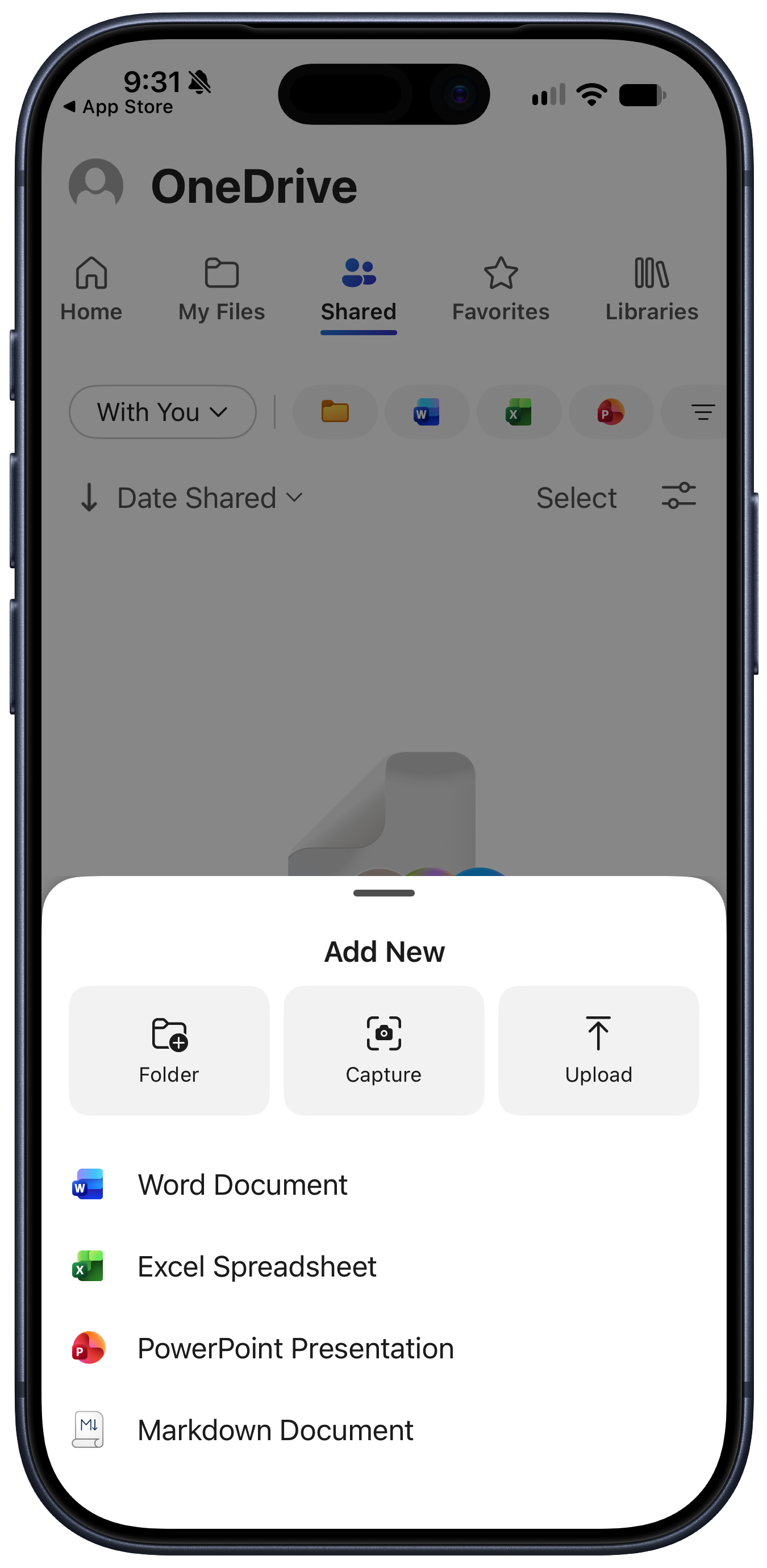
Microsoft’s iPhone app for OneDrive has long supported creating three new document types via a big “+” button right in its file viewer: Excel, Word, PowerPoint. It recently came to my attention that they’ve added a fourth document type, and they even gave it real Microsoft-style “they just have no taste” file icon. Just look at it. The whole world’s coming to an end, Mallory.
- Walmart Finally Caves, Will Soon Support Apple Pay ★
-
Walmart:
When we think about convenience, we think about a lot of things, but making shopping feel simpler and more seamless from start to finish is a big part. And one of the moments where that matters most is at checkout.
We want customers and members to have choice in how they pay, so they can check out in the way that works best for them. Now, beginning Aug. 24, we will be adding Tap to Pay to our payment options at select Walmart stores and Sam’s Club locations, with plans to roll it out to all U.S. stores and clubs by the end of 2026 and to fuel stations by mid-2027.
When I think about convenience, I think about CurrentC, scanning stupid-ass QR codes, and waiting 12 years to adopt Apple Pay.
- Bluesky’s Active User Base Is Shrinking, and Remains Tiny Compared to Threads and Twitter/X ★
-
Sarah Perez, writing at TechCrunch last week:
Decentralized social network Bluesky was one of the bigger beneficiaries of the exodus from Elon Musk’s X in November 2024, following the U.S. elections. But now, nearly two years later, the social network and would-be X competitor is struggling to hold on to its momentum.
According to data from digital intelligence provider Similarweb, Bluesky’s mobile app had 10.4 million monthly active users worldwide in June 2026, down 27.2% year-over-year. In addition, mobile daily active users continued to decline, falling 25.6% year-over-year in July to around 3 million.
As always, take all third-party analytics and usage data about app usage with an enormous grain of salt. Third-party data companies can only estimate this data, they can’t know it. It’s like comparing polling data to election results.
But I think it’s obviously true that Threads and Twitter/X both have hundreds of millions of active users, and Bluesky has like maybe 10 million. Even if Bluesky has three times more actual users than Similarweb’s data suggests, that would still suggest that Bluesky’s user base is an entire order of magnitude smaller than Threads or Twitter/X. And Mastodon is so small that no one even mentions it anymore in these comparisons. Mastodon and the whole ActivityPub world make Bluesky look large and culturally relevant.
Small is not necessarily bad. My favorite of these networks, personally, is Mastodon. I like my community there because it’s small and generally free of both drama and nonsense. But small precludes mainstream cultural relevance.
- Bluesky Is Full of Anti-AI Zealots ★
-
Mike Masnick, in a thread on Bluesky:
Multiple people I know have told me that they love the idea of Bluesky, and want it to succeed, but have abandoned it for X because they use agentic tools in their work and find them incredibly useful, and feel that any mention of their usage here leads to hate and ridicule.
I wouldn’t bring this up if it was just one person, but it was multiple people since the beginning of August who mentioned in passing something to the effect of either “I’d spend more time on Bluesky if people weren’t so anti-AI” or “As much as I hate to be there all the useful AI talk is on X.” [...]
I’m not telling anyone what to do or what tech to use or what to like or not like. I’m just relaying that the reputation this place now has is one that a large segment of the population who are NOT fascists, saying they don’t feel comfortable here because a main area of their interest is considered worthy of being mocked and attacked. And even as I’ve explained that I’ve been able to have positive conversations about productive AI usage here with many of you, the reputation of the community here as insisting their own lived experience can’t possibly be real has driven them away.
It’s not just “the reputation”. That really is the culture of Bluesky. I’ve obviously written more about AI this month than usual — in particular, my two long pieces regarding watermarking LLM-generated text through word-choice diddling. I don’t really write much about AI generally.
Broadly, I’m making two arguments against text watermarking. First, that the embedding of a detectable signal (even if subtle) must necessarily degrade the quality of the generated prose (even if only slightly), and that this is an unacceptable trade-off for a feature that has no benefit to the user and in fact can only be used against the user. Second, that even if I’m wrong about the first part, and a clever enough watermarking scheme can embed a detectable signature without any degradation of prose quality, this is a bad idea and should be rejected.
Reaction to my takes on text watermarking have largely been about these two arguments. Some people agree with me that what watermarking proponents are claiming is not possible — the text quality must degrade. Others agree that while it must have an effect on text quality, it in fact is so subtle that it truly does not matter and even a careful reader will not notice an overall degradation. Others disagree, tell me I don’t understand the cleverness of the systems, and are convinced that somehow this watermarking truly embeds a detectable signal in prose without any degradation of text quality whatsoever. There’s a range of disagreement, but it’s all reasonable. Likewise on the broader question of whether it’s a good idea or not to even try to do this.
The reaction on Bluesky to my recent work is like nothing else. It’s largely in the vein that watermarking can’t possibly make AI-generated text worse because it’s already random gibberish, and that the only explanation for my being opposed to this is that I must be using AI to produce my own writing and I’m upset that my scheme will soon be detectable. Read the replies to this one; they speak for themselves.
I continue to think my friend Daniel Jalkut has espoused the one true take: “My take on AI is, essentially, everybody who’s against it is too against it and everybody who’s for it is too for it.” It is way less inflammatory to espouse an AI-skeptical stance on Twitter/X than it is to simply state that AI can be truly useful on Bluesky.
Anyway, Masnick, at the end of the day yesterday:
The people bitching about me turning off replies on my thread earlier today are doing an excellent job reinforcing why I was right to turn off replies.
Thursday, 20 August 2026
- How Bluesky and Threads Sneak Their Logos Into iOS Screenshots ★
-
Bluesky and Threads both pull the same trick: When you take a screenshot on iOS of an individual tweet, they replace the “Follow” button in their user interface with their logo. Tim Marinin noticed this in the Bluesky app, got curious, and because they publish the app’s source code, he dug in to figure out how they do this:
The answer was in the file literally called GrowthHack.tsx, introduced in January 2026 by mozzius. But it merely used a dependency, so to understand I looked into package expo-privacy-sensitive, also by them.
The package creates
UITextFieldwithisSecureTextEntryproperty set to true and renders the actual content (the button) into that field’s.layer. When I take the screenshot, iOS hides this UITextField by blanking the layer, allowing the Bluesky logo to flutter its wings through (it was here the whooole time). For other platforms it simply renders content as-is, without masking.Marinin says, “I think it’s cute.”
I think it’s bullshit. If I take a screenshot I want to see exactly what is on my screen. If I take a photograph with a Sony camera, they don’t put a fucking Sony logo in the image. Screenshots should be purely WYSIWYG, and it’s obvious that the
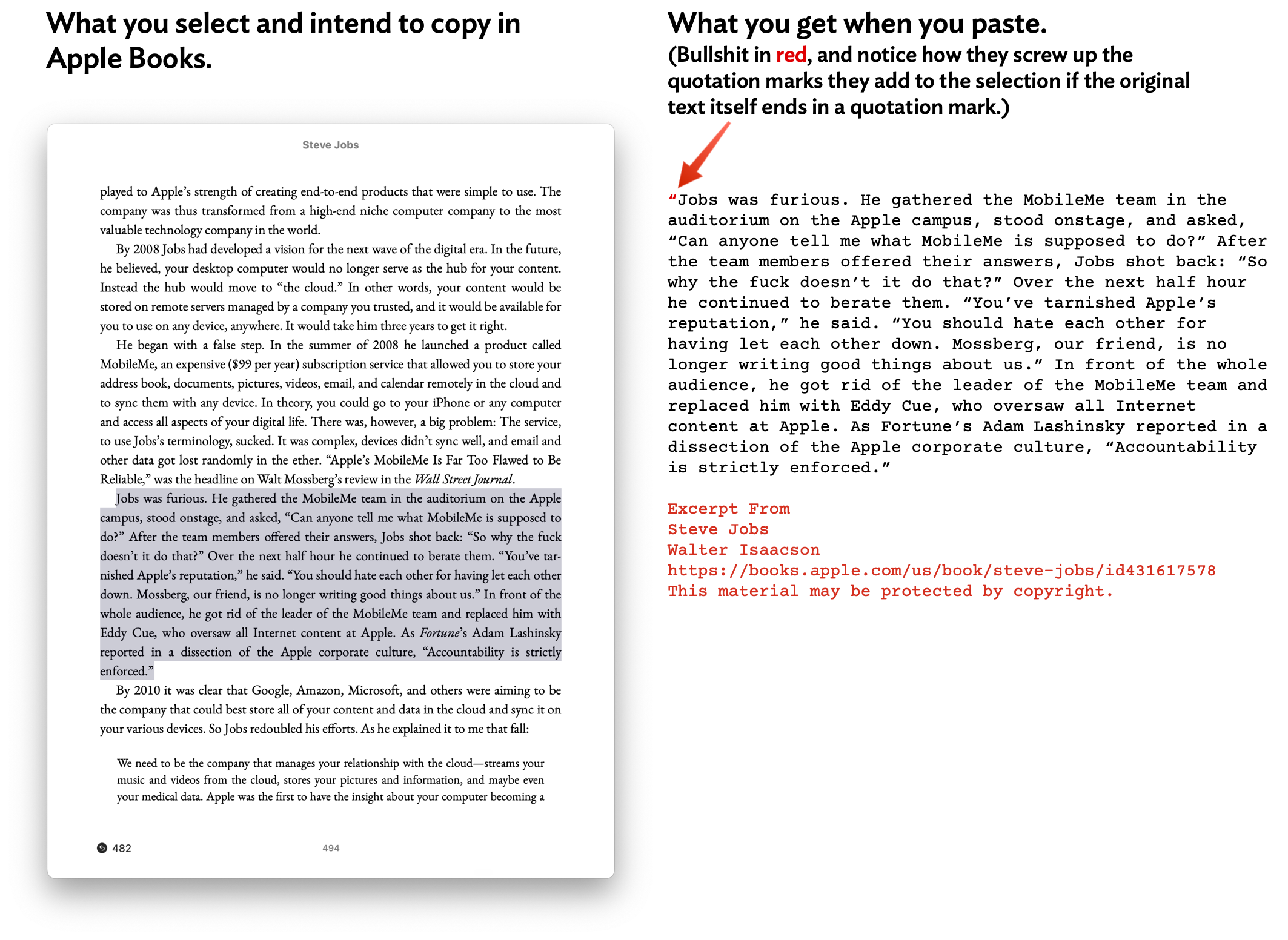
isSecureTextEntryproperty is meant to obscure the contents of secure text entry fields. It’s clever, but it’s bullshit.It’s a bit like the bullshit some apps pull where they append extra text on the clipboard when you copy and paste — like Apple Books, which adds quotation marks around the text you copied (a little annoying) and appends five lines of attribution cruft (a lot annoying). But at least with Books’s attribution cruft, you can just delete the extra lines (and the additional quotation marks). With this stunt Bluesky and Threads are pulling, there’s no way to capture a screenshot of what you actually see in the app.
I’m not surprised Threads does something sneaky like this; I am surprised that Bluesky does.
Wednesday, 19 August 2026
- Gurman Says No Camera-Equipped AirPods Until 2027 ★
-
Mark Gurman, Bloomberg:
Earlier this week, a developer version of a Mac computer software update accidentally included references to several upcoming Apple products, including a video of the AirPods with cameras in action. [...]
But the product challenges are still being resolved, and the camera AirPods remain off the company’s 2026 release schedule. Apple continues to believe the earbuds will launch in 2027, said the people, who asked not to be identified when discussing unannounced products.
If true, it makes that video even stranger. If not, we can file this along the flat-sided Series 7 Apple Watch.
- NBC News Strikes Ad Sales Deal With Taboola for Programmatic Display Ads ★
-
Sara Fischer, Axios:
Ad tech giant Taboola has struck a deal with NBC News to exclusively power all of its programmatic, or automated, display advertising sales, CEO Adam Singolda tells Axios.
Worked out great for Apple with Apple News. They struck a deal with Taboola two years ago and the ads in Apple News today are super premium and something the company can be really proud of.
Tuesday, 18 August 2026
- Disney’s ABC Sues Trump’s FCC Over Challenge to Its Broadcast License ★
-
Joe Flint, reporting for The Wall Street Journal (gift link):
Walt Disney’s ABC has sued the Federal Communications Commission alleging the agency’s efforts to challenge its broadcast licenses and regulate its talk show “The View” are illegal and an effort to quash speech the Trump administration finds objectionable.
In a suit filed in federal court in Washington, D.C., on Tuesday, ABC said, “Again and again, the Administration has attacked ABC’s speech — the stories its journalists report and the viewpoints its network programs air. Over time, those attacks have escalated into express demands that ABC be stripped of its broadcast licenses because of its speech.”
This is how you handle a bully: “Fuck you, make me.”
Our local 6ABC affiliate here in Philadelphia is the highest-profile station that the FCC has targeted for a bogus “license review”. It’s impossible for someone who doesn’t live here to understand just how dominant a media presence 6ABC Action News is. The Action News theme song is, effectively, the city of Philadelphia’s theme song. Watch this and you’ll get it, trust me.
- Apple Gives Legal Middle Finger to DOJ Challenge on Apple’s July Discovery Win ★
-
Marcus Mendes at 9to5Mac has a fun update on U.S. v. Apple, the ill-considered antitrust case started by the Biden administration. A bunch of what the DOJ argues are anticompetitive features in Apple’s platforms, Apple argues are in fact privacy and security related.
Back in July Apple won a big discovery ruling — Apple asked for documents from 14 federal agencies — including the CIA, FBI, Department of Defense, NSA, and State Department — to see the reasons why those agencies purchase iPhones, iPads, and Macintosh computers. And in July, Apple won. They get to see what these federal agencies say about those features.
The DOJ filed a longshot “Hey, no fair” complaint trying to overrule that discovery ruling. Now Apple has filed a retort saying the July order should stand, and the DOJ should get ready to argue in court that it’s unlawful for Apple to implement the sort of features that are the very reason why security-minded federal agencies purchase Apple devices.
- Organized Thieves Are Targeting AI Server Chips With Violent Highway Hijackings ★
-
Paresh Dave and Aarian Marshall, reporting for Wired (News+ link in case Wired hits you with their paywall):
The incidents involved two different shipments of high-value technology traveling from Silicon Valley to Southern California, according to Pachuca, who says he learned about the thefts from law enforcement authorities. Each truck was tailed by private security professionals driving unmarked escort vehicles, which were supposed to ensure the goods made it to their destinations safely. But hours into one journey, another driver rear-ended the escort in a hit-and-run, forcing it to stop. In the other case, the escort stopped after another car nudged it into a tailspin, a ploy commonly known as a PIT maneuver, and then fled.
Everyone familiar with the “accidents” believes the escorts were deliberately immobilized, according to Pachuca. Once the semitrucks lost their escorts, the drivers proceeded without halting — but not to their planned destinations. They were never heard from again, Pachua says, and millions of dollars in data center gear remains unaccounted for.
I called it back in March: RAM is the new bearer bond.
- ‘Dickover’ Makes It Into The Guardian ★
-
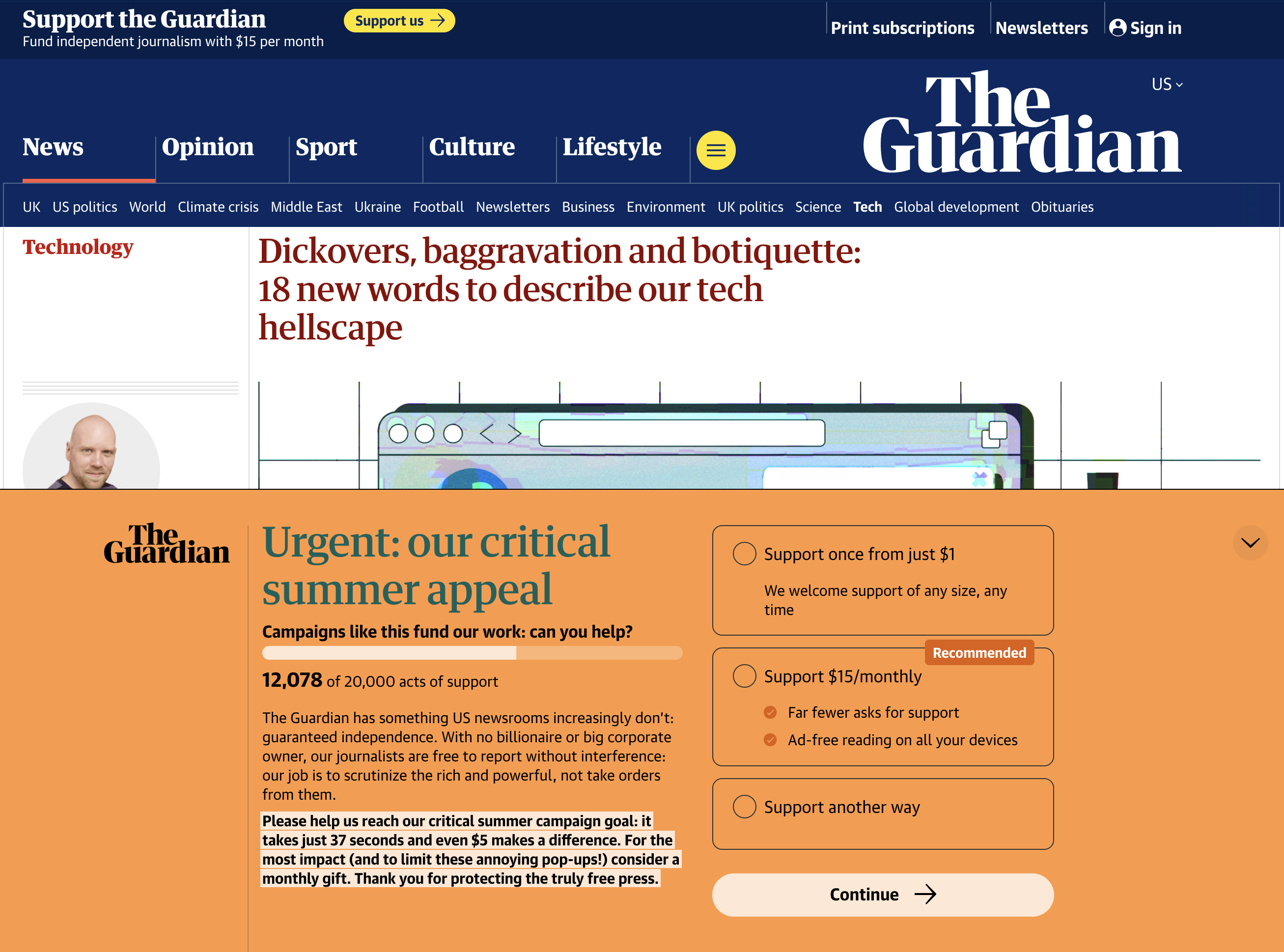
Stuart Heritage, writing for The Guardian, under the splendid headline “Dickovers, Baggravation and Botiquette: 18 New Words to Describe Our Tech Hellscape”:
The “dickover” is the scourge of the modern age. Coined in May by John Gruber, a tech writer, it is defined as “a modal panel, popover, or curtain presented by a website or app, deliberately obscuring its own content to frustrate the user”. Essentially, it is the thing (or more often, things) you have to click away in order to read the thing you wanted to read. It is the “accept cookies” box, the “allow notifications?” box, the “sign in with Google” box, the pop-up video box, etc.
We shouldn’t fool ourselves into thinking that dickovers are the only terrible thing about technology in 2026. Until now, though, we have lacked the vocabulary to describe them, so here are some suggestions.
This was a delight to see, but it would have been nicer if it had included a link. I remain quite fond of my self-exemplifying definition.
Amongst Heritage’s suggested coinages, I like baggravation (maddening self-checkout retail kiosks) and Schrödinger’s Wi-Fi (public Wi-Fi, especially on trains and planes, that simultaneously does and does not exist).
Next stop for dickover: the OED.
Update: Filed under “Shit You Can’t Make Up”, many of you, upon following the above link to The Guardian, are seeing something like this — and, unsurprisingly, it’s worse on a mobile device.
- OpenAI Pot Complains That Google Kettle Is Black ★
-
Thibault Sottiaux, the OpenAI genius in charge of Codex and the new ChatGPT Homer Simpson car, on Twitter/X:
I don’t come often to GMail [sic] (OpenAI is a Slack company), but I swear, every time I do open it, there is a new button somewhere around the top right corner.
I mean, he’s right about Google’s zero-taste just-keep-cramming-shit-in approach to Gmail, but it’s almost hard to believe he could post this without any self-awareness that it’s the exact same approach his Codex team has applied to ChatGPT.
Gmail debuted in 2004 homely but wonderfully simple (which I’d argue was Google’s original, but now long-lost UI brand). It was just your email. Now it’s too complex to explain. ChatGPT’s original incarnation was attractive-in-today’s-minimalist-fad-way and wonderfully simple. It was just AI chat. Now it’s too complex to explain.
(ChatGPT’s original incarnation still exists, in the form of the hard-to-find-if-you-don’t-already-have-it-installed
CokeChatGPT Classic, just like how Gmail, after Google started needlessly complicating it, used to have a “classic” view that many users preferred but Google soon took away.) - Nature Is Healing: MacOS 27 Golden Gate Beta 6 Adds Redesigned Traffic Light Window Controls ★
-
Zac Hall, 9to5Mac:
macOS 27 Golden Gate beta 6 introduces redesigned traffic light window controls. The new look resembles older Mac OS X systems with more detail in each button.
Nice. But these changes can’t improve fast enough for me — I am impatient. The MacOS user interface had been in a slow, steady, sad, no-fun decline for years, and then, a year ago, the bottom fell out with the disaster of 26 Tahoe.
But all the changes in 27 Golden Gate are in the right direction. Golden Gate is not a mixed bag. Designers with taste and talent are clearly back at the helm. And I love that they’re still pushing UI and icon changes in mid-August, entering the home stretch of the .0 beta cycle.
Monday, 17 August 2026
- MacOS 26.7 Tahoe Release Candidate Contains a Video Demonstrating Camera-Equipped AirPods in Action ★
-
Oops.
- Apple TV Still Has No Start Date for ‘The Savant’ ★
-
The Savant is a political thriller series starring Jessica Chastain that was supposed to debut a year ago. Apple “postponed” it, apparently out of fear of upsetting extremist right-wing nut jobs because the show is about an undercover investigator (Chastain) hunting down extremist right-wing nut jobs. Chastain was not happy about the show being delayed.
Last we heard about the show was back in April, when Marc Malkin reported this for Variety:
“Before it was like, ‘I don’t know if we’re going to see it,’ but now I can say, ‘We’re going to see it,’” Chastain told me exclusively on Saturday at the Breakthrough Prize ceremony in Santa Monica.
As for when, sources tell me that Apple is planning for a July release.
Given that it’s now the middle of August, I think that a July release is looking less and less likely by the day.
- No Update Since Early July Regarding Siri AI Coming to the EU, Ever ★
-
The Financial Times, back on July 1, with the transcontinental byline “Michael Acton in San Francisco and Barbara Moens in Brussels” (non-paywalled summaries from 9to5Mac and MacRumors):
Apple chief executive Tim Cook and EU tech chief Henna Virkkunen held “constructive” talks on Tuesday as the two sides aim to lower the temperature in a bitter dispute over the iPhone maker’s new “Siri AI.”
An EU spokesperson said the virtual meeting had involved a “constructive exchange on topics of common interest, on which the work continues”. The meeting included a discussion of how Apple can launch its reinvented Siri in Europe while avoiding millions of dollars in fines for violating the bloc’s flagship competition rules, according to two people familiar with the talks.
[9 paragraphs of explanatory backstory on the Siri AI/DMA standoff elided ...]
The dispute triggered a fierce public backlash against the commission, with European officials reporting hundreds of emails from consumers accusing Brussels of depriving Europeans of a new technology. One EU official said that a commission spokesperson had received a stream of abusive messages, including several death threats.
If there are actual kooks who made credible death threats, of course they should be investigated, identified, and arrested. But mentioning this in the context of the “fierce public backlash” feels like fishing for sympathy over a deeply unpopular policy of zero benefit to Europeans. That there are hundreds or thousands of complaints is no surprise. This policy sucks and is indefensible on practical grounds.
In November, Apple first proposed a technical fix to the EU it later dubbed a “Trusted System Agent” — a layer of software between a user’s device data and a third-party AI model. It would allow rival AI assistants to draw on personal information from the device without giving them full access to the data. However, Apple has yet to build the agent, and said it was looking for assurances from the EU before it starts.
A commission official said its contact with Apple on the idea was limited, and that it lacked a concrete proposal or details on how such an agent would work beyond the general concept. They said Apple “focused on obtaining a green light to delay the compliance”.
That’s the nut of it. Last winter Apple sent an entire team, including engineers, to Brussels to present a proposal for the TSA (maybe that’s another acronym that needs rethinking on the basis of prior art) to ask, basically, “If we build this, would you deem it DMA-compliant?” and the Commission’s response was basically, “Build it first and then we’ll tell you, after we get feedback from your competitors on what they think of it.” And Apple doesn’t want to spend up to two years building a complex system, exclusively for the EU, only to find out then whether it was all for naught.
As for how detailed Apple’s Trusted System Agent proposal was, we have a he-said/she-said dispute. Apple said at a press briefing at WWDC that it was quite detailed. An anonymous “commission official” here told the Financial Times “that it lacked a concrete proposal or details on how such an agent would work beyond the general concept”. Apple has more credibility here, if only because their statements claiming the proposal was detailed weren’t from anonymous sources. They were on the record.
In the meantime, we’ve seen what the European Commission is demanding of Google with Android regarding third-party LLMs. I can’t see Apple ever agreeing to such a system for iOS. We don’t know the details of Apple’s TSA proposal, but I’d be rather flabbergasted if it enabled the things the EC is demanding for third-party AI providers on Android, like unrestricted background execution.
Sunday, 16 August 2026
- The Information Profiles Cami Clark — Dario Amodei’s Wife, Ivanka Trump’s Friend, One-Time Would-Be Pornographer, and Anthropic’s ‘First Lady’ ★
-
Cory Weinberg, Jemima McEvoy, Jessica E. Lessin, and Stephanie Palazzolo, writing for the paywalled-without-gift-links The Information:
As Amodei has hopscotched the globe to preach about the potential and risks of AI — from New Delhi to Davos to Sun Valley — Clark has almost always been near his side. Several people who know the couple describe Clark as Amodei’s emotional ballast, someone he has sought counsel from during the turbulence of Anthropic’s growth and clashes with Washington over the future of AI.
Clark may well be the most consequential person within Anthropic’s orbit who doesn’t have a formal role at the startup. You might even call her the first lady of Anthropic. [...]
And before Female Algorithm Technologies, Clark tried her hand at building a pornographic film company, Eddice, that planned to make movies with high-production values and female protagonists. She also hoped it would have online shopping capabilities. In 2011, she tried to raise money for Eddice from Jeffrey Epstein, who’d pleaded guilty to charges of soliciting a minor for prostitution three years earlier, according to emails made public as part of the Epstein files released by the Department of Justice earlier this year. She emailed Epstein the script for the first of a series of films they hoped to make (title: “American Girl in Paris”).
“We thought you and the ladies might enjoy,” Clark wrote. She then appended a winking warning: “A little nsfw,” an acronym for “not safe for work.” Epstein didn’t invest.
While enormous attention has fallen on AI and the people behind the companies developing it, Clark has largely flown under the radar.
- ‘Anthropic’s Weak Watermarks Appease a Weak Law’ ★
-
James Padolsey, on the Claude-text-watermarking-to-comply-with-an-EU-regulation imbroglio:
The same thought that led to this law could have applied to calculators at the time of their inception, had their outputs revealed themselves through artefacts. Thankfully, a sum borne of the brain is treated no differently from one produced by a calculator. Likewise with spellcheckers. To make assistance suspect only once the tool becomes capable enough to compose a whole sentence is not a principled boundary. It is a moral premium placed on difficulty itself.
Anthropic has nevertheless chosen a blanket, model-level implementation that appears broader than the law’s minimum requirement. That may be convenient compliance engineering, but it discards distinctions the law expressly attempted to preserve. The result is a signal broad enough to implicate harmless and assistive use, yet fragile enough to be removed by a motivated person through substantial recomposition. It risks concentrating suspicion on ordinary and assistive users while remaining weakest against deliberate deception.
Padolsey is the creator of Declaude, a delightfully simple web app that allows you to “Paste in AI-flavored text and get the same content back as plain prose”. Declaude’s original purpose is cleaning the cutesy Claude personality stink from text (whether it was created by Claude or any other LLM), but, if Anthropic persists in its stated plan to begin adulterating all text Claude generates, Declaude will also serve as a copy-paste single-extra-step way to eliminates those marks. Declaude is interesting and useful already, but goes to show how ill-considered this EU regulation is.
Padolsey also wrote and programmed a splendid interactive essay that explains and illustrated how the “watermarking” scheme Anthropic is adopting (and Google Gemini has already adopted) works.
- Trump Administration ‘Not in Favor’ of Apple Using Chinese RAM ★
-
The Wall Street Journal (gift link):
To help alleviate the supply crunch, Apple is looking to Chinese manufacturers.
“The Trump administration is not in favor of that,” Lutnick said in an interview after touring an Apple manufacturing facility in Houston. There have to be “other solutions to the memory issue, but it’s not great American companies using Chinese memory.”
Asked if he has relayed that message to Apple, Lutnick said “plainly.”
But:
U.S. government rules require American companies to secure a license before sharing product information with CXMT and YMTC. The Chinese chip makers would need such information if they were to make customized chips for Apple. But Apple is free to buy off-the-shelf parts from the companies, and to negotiate prices with them.
Apple’s chief operating officer, Sabih Khan, declined to confirm that Apple was testing Chinese memory chips in an interview Thursday. But he said that given the magnitude of the supply shortage, “we have to look at all options,” including working with existing suppliers to increase U.S. production.
- XCancel – An Unofficial Twitter/X Mirror ★
-
XCancel:
XCancel is an instance of Nitter.
Nitter is a free and open source alternative Twitter front-end focused on privacy and performance. The source is available on GitHub at https://github.com/zedeus/nitter [...]
Using an instance of Nitter (hosted on a VPS for example), you can browse Twitter without JavaScript while retaining your privacy. In addition to respecting your privacy, Nitter is on average around 15 times lighter than Twitter, and in most cases serves pages faster (eg. timelines load 2-4× faster).
I personally don’t care for Elon Musk’s X-rebranded Twitter. I also realize that some of you outright despise it, and, worse, that under Musk, they make it difficult to view content if you’re not signed into an account or if you have JavaScript disabled. So, sometimes, when I link to posts or threads on Twitter/X, I include a link to the same content at XCancel.
XCancel isn’t perfect, alas. Just this week I linked to a tweet from Google Design that contained an animation of an Android app that they were inexplicably proud to show off. The XCancel cache of that tweet only showed it as animated to some people. Others just saw a static image. I don’t know why. That’s XCancel’s problem, not mine.
Also, it’s tiresome and repetitive to include an extra link to XCancel every time I link to a tweet on Twitter/X. If you would prefer to view
x.comlinks onxcancel.com, you should automate the redirection. If you use Safari, XCancel Redirect is a free extension that claims to do just what you think it does. (I haven’t tried it.) Or you can use a general-purpose redirect extension. RedirectWeb is a good one that I can recommend. Also, Jeff Johnson’s excellent StopTheMadness — an extension I rely on for multiple purposes and frequently recommend. With StopTheMadness, you can redirect all x.com URLs to xcancel.com with the following rules (you need the leading and trailing slashes in the pattern to tell STM that it’s a regex pattern, not a plain text string):Pattern:
/https?://(www[.])?x[.]com/
Replacement:https://xcancel.com
Enabled on platforms:AllI understand not wanting to visit Twitter/X. But if you feel that way, I do sympathize, but that’s your decision, and you should use tools to redirect Twitter/X links automatically. And if you’re wondering why I don’t just refuse to link to anything on Twitter/X, that just isn’t practical. I wish it weren’t so, but many people, including senior Apple executives, and many organizations post interesting content exclusively to Twitter/X. If something posted to Twitter/X is also available elsewhere, I link to the elsewhere version. But if it’s exclusively available on Twitter/X and interesting, I link to the original.
My linking to original content on Twitter/X does not perpetuate Twitter/X’s relative popularity. Original content appearing exclusively on Twitter/X does.
Saturday, 15 August 2026
- Drata ★
-
My thanks to Drata for sponsoring last week at DF. Their message is short and sweet: Leverage autonomous AI agents to automate compliance, manage internal and third-party risk, and continuously prove your security posture.
Friday, 14 August 2026
- Google’s ‘Material 3’ Design Write-Up Is 93.3 Percent Embarrassing ★
-
This page from Google Design on their “Material 3” UI language came to my attention after my snarky post about the ungainly new to-do app they bizarrely bragged about on Twitter/X this week. I don’t think this “Material 3” page is new — I think it’s a few years old — but I’d never seen it before.
First, it’s crazy that (in desktop browsers with a mouse cursor) they change the I-beam cursor for text selection to ... a circle. I guess it looks kind of fun but the whole point of the I-beam cursor is to enable precise character selection. They changed that to something that makes precise selection as difficult as possible. It’d be better to just use an arrow pointer than to replace the I-beam with a goddamn circle. This, from the UI design team.
Second, this paragraph made me honestly wonder if I was reading a spoof, a years-old unfunny April Fool’s “prank”. But as far as I can tell this is totally straight, not a prank:
These factors can be quantified in users’ responses to new M3 Expressive designs. We found a 32% increase in subculture perception, which indicates that expressive design makes a brand feel more relevant and “in-the-know.” We also saw a 34% boost in modernity, making a brand feel fresh and forward-thinking. On top of that, there was a 30% jump in rebelliousness, suggesting that expressive design positions a brand as bold, innovative, and willing to break from convention.
Nothing says rebellious and “in-the-know” like assigning precise percentages to “rebelliousness”, “modernity”, and “subculture perception”.
Update: Believe it or not there is video of the Google Design team putting this research together. Worth a watch.
Thursday, 13 August 2026
- Ceramic Shield 2 Is the Real Deal ★
-
Philip Michaels, writing last September for Tom’s Guide:
iPhone 17 torture test videos done by JerryRigEverything indicate that Ceramic Shield 2 certainly resists scratching, with scratch testing leaving only light scratches at level 7 on the Mohs scale of hardness. Scratches typically show up on glass at levels 5 or 6 on that scale.
“Ceramic Shield 2 is indeed the best we’ve ever seen,” JerryRigEverything remarks in the iPhone 17 Pro testing video.
That backs up Apple’s own Ceramic Shield 2 video, in which a mineral tip can be seen rubbing against a Ceramic Shield 2-coated display. There’s residue left on the screen, but it’s material from that tip, as it wipes away fairly easily.
I mentioned yesterday that I try never to place my iPhones face down, to avoid scratches, and that my nearly year-old iPhone 17 Pro seemingly has not one visible scratch on the front glass. Not even a single micro abrasion I can see, even when tilting it with the display off to hunt for them. Surely Apple’s Ceramic Shield 2, which is intended to provide best-ever scratch resistance, is a factor too — and likely the biggest factor. Apple at its best.
Wednesday, 12 August 2026
- Google Design Pisses Its Pants on Twitter/X ★
-
A few years ago I’d have looked at this post and maybe leaned toward the idea that a precocious 8th grader somewhere hacked into the @GoogleDesign Twitter account and tried to pass off their little to-do app as having come from Google’s design team. But this is apparently real. I almost hope it’s AI slop and that there aren’t any human designers there who think anything in this app has appropriate proportions or is aesthetically pleasing.
(Here’s an XCancel link for the x.com averse. You can just change any x.com/* URL to xcancel.com/*. But, alas, the XCancel mirror of the original tweet loses the animation showing the UI in motion — for some, but not all, users.)
- Joanna Stern on the Pixel 11 ‘HiLight’ Notification Light ★
-
Joanna Stern, writing at The New Things (gift link):
I used to love the blinking notification light on my BlackBerry, and later my Droid 2. It was a simple way to know I had a message without actually looking at my messages. Then BlackBerry let you customize the color, and it was a rainbow dream.
Google’s HiLight takes it a step further by letting you assign different colors to VIP contacts. So when your phone is face down, you can tell who’s trying to reach you without picking it up. It looks cool. The big bummer? At launch, it only works for phone calls.
Google told me it’s “continuing to invest in this technology” and that messaging notifications are coming. Still, it’s odd they aren’t there at launch, especially since Google found plenty of colors for Gemini. The ring changes hue depending on whether the AI is listening, thinking or responding.
I have no interest in this because a few years ago I stopped ever putting my iPhone on any surface face down. I don’t use a case, so setting the phone face down is a good way to pick up scratches. I stopped doing that, ever, and now I’ve got a nearly year-old iPhone 17 Pro that seemingly doesn’t have even a micro abrasion on the display glass.
And it seems downright goofy that it’s launching with support only for phone calls. Google can’t even launch a blinking light right on these Pixel phones.
- Google Introduces ‘Camera Looks’ With Pixel 11 Phones ★
-
David Imel, The Verge:
But in our current moment, the photos people are drawn to are not flawless — and that’s created a real problem for the people making smartphone cameras. “The gap between what two random people want from their camera is growing dramatically,” says Isaac Reynolds, who leads the Pixel camera team at Google. Some people want a perfectly optimized photo, Reynolds says. “But there’s a growing number of people who want something that they feel is more authentic or traditional, by their definition.”
That’s what Reynolds and the Pixel team are setting out to solve with Camera Looks, a total rethink of how the camera captures and styles an image on the Pixel 11 series. The phones include a new suite of processing tools aimed at giving people much more control over the camera’s output. At first glance, they look a lot like filters, with names like Black Tie, Classic, and most strikingly, Digi, in reference to the growing trend of buying cheap digital cameras from the early aughts. But unlike a filter, which generally applies editing tweaks after the processing happens, Camera Looks is changing how image data is processed at the sensor level.
This sounds a lot like Apple’s “Photographic Styles” in the iPhone 13 and later, but with the addition of some control over grain and sharpness. I love grain, and the thing I like least about Apple’s built-in photo processing is the way it attempts to eliminate all noise. I like digital cameras that embrace noise and try to make it pleasing, rather than over-processing to try to pretend these tiny sensors aren’t inherently noisy. So I say kudos to Google for loosening up on “everyone gets the over-sharpened, over-smoothed look”.
But, that said, what’s made me happy over the last year is shooting almost all my photos with third-party apps — in particular, Halide, Not Boring Camera, and Analogue — that give me low-level control over processing through LUTs (or in Halide’s parlance, “looks”). These apps give me the looks I want just through point-and-shoot photography. No need to process images after shooting. But because they (optionally) shoot RAW, I can reprocess in post without losing any original sensor data. I can shoot in black-and-white and subsequently change my mind and reprocess with a color look later. These apps enable honest film-look photography without looking at all gimmicky, and without baking any sort of filtering into the image data in my camera roll. It’s the best of both worlds. It’s also way, way fussier than the built-in Camera app should be.
Anyway, all this Pixel announcement news today has me thinking that these days, I never hear much about Pixel cameras or image processing. In the early years of the Pixel lineup, there was a common view that Pixel phones were the best camera phones in the world. I never believed that, but I did think they were an interesting alternative, taking different but equally valid philosophical choices than Apple. Apple has always insisted on instant processing. You snap the shutter and the iPhone saves your image instantly. Pixel cameras often undertook seconds-long processing. That enabled features the iPhone couldn’t offer.
I think it’s pretty easy to pinpoint when things changed for Pixel — when Marc Levoy left Google for Adobe in 2020 (where he now leads the team making the very intriguing Indigo camera app, that is exclusively available for iPhone and which offers a slew of innovative computational photography features).
When Levoy was leading Google’s camera photography team, there was a credible argument that Pixel phones were the best still camera phones in the world. (They were never even close on video.) Ever since, I never hear about them except in the middle of August each year, when Google announces new Pixel hardware. See you in 12 months.
- TechCrunch on Google’s Pixel 11 Lineup ★
-
Ivan Mehta, TechCrunch:
With this year’s Pixel 11 series launch, Google is thinking more agentic AI to complete your tasks. With Gemini, U.S.-based users will be able to order groceries, book rides, or get coffee, for instance. Plus, Gemini can call businesses on users’ behalf for table reservations or appointments. Google said that users can take over or stop tasks at any point in time and also review transcripts for AI-operated calls.
Over the next few weeks, a new slate of connected apps will be able to work with Gemini to get things done, including Granola, Otter.ai, Wix, Fever, Get Your Guide, Localiza, OpenTable (U.K.), Ticketmaster, iHeartRadio, Pandora, Angi, Thumbtack, and Zocdoc.
I’ve never heard of most of those apps, or, if I have heard of them, I thought they went defunct years ago. The one app amongst those I do use, OpenTable, apparently only supports this Gemini integration in the U.K.?
Another knockout year for the Pixel phones and Android.
- Hands-On With Google Pixel 11 Pro Fold ★
-
Sam Rutherford, writing for Engadget:
Granted, the P11 Pro Fold still includes IP68 dust and water resistance, which is better than what you get on the Z Fold 8 line (IP48). But after making an absolute tank of a foldable phone with last year’s model, I said Google really needed to cut weight and thickness this generation, and it just hasn’t. Instead, it seems like Google has leaned even more into the Pro Fold’s sturdiness with a new glass fibre material for its rear panel that the company says is nearly impossible to crack. This is great in theory, but obviously I wasn’t in a position to smash one of Google’s demo units in order to test that claim.
I have never seen anyone, anywhere, with a folding Pixel phone. Pretty sure I won’t this year either.
I played with a Pixel 10 Fold or whatever its name was last year at the Google Store on Newbury street in Boston, which store felt like a small library or museum. The Pixel Fold display was so plasticky that I had a moment where I wondered if the display units were fake props, like at Ikea. But no, it was the real thing. And it cost $1,800 to start.
- Google’s Pixel Watch 5 ★
-
Victoria Song, The Verge:
The $399 Google Pixel Watch 5 isn’t about the hardware. Sure, there’s a new satin pyrite case finish, a few new strap colors, and a Steph Curry Special Edition. Under the hood, there’s a slightly faster Qualcomm processor and an itty-bitty battery bump. There’s a $50 price hike from last year, too, because the Pixel Watch 5 isn’t immune to RAMageddon — none of us are. Otherwise, no one would blame you for looking at this watch and thinking absolutely nothing’s changed. That’s because the big updates this year are all software-based.
I have never seen anyone in real life wearing a Pixel Watch. (I’ve only seen a handful of people using Pixel phones, and every single one of them was at a tech event of some sort.)
You can also use AI to generate watchfaces. I created a watchface featuring “fat cats and an elegant font.” It didn’t quite do that. The fat cats weren’t characters, so much as pleasantly plump, cat-shaped clock numbers. It’s a gimmicky way to shoehorn the Nano Banana model onto the watch… but if that’s your thing, it works.
Well I’m sure now I’ll see plenty of people wearing Pixel Watches.
- Amazon Is Spiting Customers With Unhelpful Order Confirmation Emails ★
-
Mia Sato, The Verge:
Earlier this summer, Amazon customers began noticing that emails related to their online orders looked sparse: Order confirmation emails didn’t name specific items anymore, and instead listed only item categories.
“Your Beauty item is confirmed!” an email about my retainer cleaning tablets read. Shoppers have posted other iterations of the redacted emails as well: “Ordered: 1 Hardware item,” “Your Drugstore, Shoes, and other items are here!” and “1 Nutrition & Wellness, 1 Wireless Accessories,” for example. The emails have clip art-style illustrations of general product categories, and a shopper has to exit their email and go to Amazon to see what item it’s actually referring to.
Complaints about the vague emails appear to have started in July; orders placed as recently as June contain thumbnails and names of the exact item purchased. [...]
“As customers shop with us more frequently, including on their phones, and use the ‘Your Orders’ page in the Amazon app to get real-time, consolidated order details and delivery status, we’ve simplified several order-related emails to direct customers to our app and website for the latest information on their orders,” spokesperson Maxine Tagay said in an email. “This also reduces customer information shared outside the Amazon app and website to further improve customer privacy.”
That statement from Amazon is almost honest, if you squint at it and ignore the bit about it having anything to do with “simplification”. If you order a Torx screwdriver, what’s simple is getting a confirmation email with the exact name, brand, and photo of the item you ordered, not “a hardware item”. The honest part is “reduces customer information shared outside the Amazon app”.
The fact is, a lot of people use apps like Gmail for email. In fact, a lot of people use Gmail in particular. There’s a good chance you do. When you use Gmail, Google learns everything in your email. Amazon sees this as a competitive problem for them, not a privacy problem for users. Everyone who uses Gmail basically knows that Google “knows” what’s in their email, and they’re voluntarily agreeing to that. Amazon just doesn’t like that any of its competitors — perhaps especially Google — can glean so much information about what people are buying from Amazon. So Amazon, in an act of competitive spite that corrupts its relationship with its own customers, is limiting all useful purchase information to channels that it controls — its website and its own apps.
If customers relied solely on the “Your Orders” page at Amazon, they wouldn’t need to send any emails at all. The obvious fact is, people go to Amazon when they want to buy something. They don’t come back until they want to buy something else. They enjoy getting confirmation and shipping notifications in email because they check their email regularly.
- App Store Scam of the Week: ‘TabControl Extension’ for Safari ★
-
Jeff Johnson:
These purported reviews, all but one of which is 5 stars, are all in English. Yet none of them is in the US App Store. I also looked at other English-speaking countries such as Australia and Canada but found no reviews. Also suspicious is that the name of every reviewer was a first name followed by an initial for the last name. If you’ve ever looked through App Store user reviews, it’s unusual to find this naming format. In most cases, the name on App Store user reviews is a uniquely chosen username, with no space character, often suffixed by a number.
The final and most conclusive evidence that these reviews are fake, totally invented out of thin air by the developer (or more likely, by an LLM), is that the dates on the reviews, such as “Mar 12,” predate the release of TabControl Extension in the App Store!
God only knows what this obvious AI slop scam is doing with the data from users’ Safari tabs. It’s currently the 12th or 13th most popular Safari extension in the App Store.
- Reed Jobs Tells a Neuroscience Story ★
-
Watch this. No words needed, everyone can feel it. Genes are a hell of a thing.
- Nature Is Healing ★
-
Basic Apple Guy:
Apple just dropped the hardest icon glow-up for the new Chess icon in macOS 27 Beta 5.

This is not just a tweak or small improvement. This is the difference between total shit and a really nice icon.
Tuesday, 11 August 2026
- The Economist: ‘How to Spot AI Writing’ ★
-
The Economist (‘twas a gift link, but alas, I guess gift views have been used up — here’s an archive link in case the gift link is vexing you):
You can discover AI’s hallmarks by comparing the writing of man and machine. To do this you need a baseline that is distinctive and familiar. The Economist turned to prose that we’re sure is human and that readers will recognise: our own. We designed a study to ask top LLMs — OpenAI’s ChatGPT, Anthropic’s Claude, Google’s Gemini and xAI’s Grok — to write versions of our articles without consulting the web. (As a prompt, we gave them the AI-generated summaries that we have experimentally added to some of our articles.)
This gave us a corpus of human and AI creations and we compared them across 55,940 sentences and 1.2m words. To make sure we were detecting AI quirks rather than our own, we also checked the AI texts against journalism from CNN, the New York Times and the Washington Post. Excerpts from hit novels published between 1950 and 2022 offered another test.
Our findings are surprising. AI prose is distinguishable by word and punctuation choice as well as sentence and paragraph structure. But its hallmarks are not what you might expect, partly because its writing style has changed with software updates. That does not mean that LLMs are great writers: their prose lacks lucidity and elegance and is often formulaic. So those aspiring to be impressive (human) storytellers should avoid the following peculiarities in their own prose.
On point for today.
Some specific findings:
Much of this language could be described as what George Orwell called “pretentious diction”. He railed against writers who “dress up simple statements” with complicated words and jargon to sound clever. Such pontificating penmen, Orwell observed, also believe that “Latin or Greek words are grander than Saxon ones”. (Bots agree: more Latinate suffixes crop up in their writing than in human texts.)
Then look at punctuation. Many believe LLMs stuff their prose with em-dashes, but that is not true after the most recent updates. Today only Claude uses more em-dashes than human writers, with ChatGPT using markedly fewer than any other writer in our study. Humans rejoice — and start using dashes again.
A better way to spot AI-generated writing would be to look for texts without much punctuation at all. LLMs are very Joycean about it: they use fewer commas and semicolons than humans (and hardly any parentheses). They use less punctuation in part because they write longer sentences — “and” is their most overused word — and in part because they do not quote experts.
- Alex Micek on BMW’s iDrive ‘Special Surprises’ ★
-
Alex Micek:
In the future, I will feel angry if my car strands me on the side of the road.
I will feel angry if the motor brushes fail expectedly.
I will feel angry if it leaks water.By contrast, I don’t feel anger when the car tricks me into seeing an advertisement. Instead, I feel a deep, smothering, let-down at the promise of futurism. Bottomless despair is probably inappropriate; a symptom of the misanthropy I should grow out of. But. In the meantime, I feel helpless, discouraged, deeply sad.
Such a good take. I should not let 19 years pass again between linking to his writing.
- BMW Probably Paid Sony for the Spider-Man Dashboard Ads, Not the Other Way Around ★
-
This didn’t occur to me but should have — BMW paid Sony to place BMWs throughout the new Spider-Man: Brand New Day movie. They’re not just in the movie but part of the story. So it’s probably the case not that Sony paid BMW to put Spider-Man animations in the dashboards of every late model BMW on the road, but that BMW offered to do it as part of the promotional deal they paid Sony. So BMW probably paid Sony for something that ultimately infuriated a bunch of BMW’s own customers. Geniuses.
- Mark Zuckerberg Posts 6,500-Word AI Essay ★
-
Two weeks ago Zuckerberg published a 1,000-word essay, “The AI Future Is for Everyone”. This week he published an expanded 6,500-word version of the essay on Meta’s website. Somehow it almost says nothing more than the original. This tidbit, however, struck me as notable:
For example, in Richland Parish, Louisiana, where Meta is building a large data center, teachers received a $50,000 bonus this year because of the increased tax revenue from our investment. The superintendent told us that teachers are now moving there from across the country and he believes it will become one of the nation’s best school districts.
Unlike the concern about knowledge work displacement, there is a shortage of skilled tradespeople like carpenters, electricians, and construction workers to support the demand for infrastructure buildout. Meta has created America’s Workforce Academy to provide free training for skilled tradespeople and guaranteed high-paying jobs in the areas we’re building data centers.
Those $50K bonuses to public-school teachers are real, and they’re more than most of those teachers’ annual salaries. That’s the sort of thing that could turn public sentiment on data center construction around. But it hasn’t turned around yet.
- The Talk Show: ‘Getting the Snack Right’ ★
-
Chance Miller returns to the show. Topics include iOS 27’s progress over summer, live baseball in Vision Pro, the RAM crisis, Apple’s trade secret lawsuit against OpenAI and io, and the EU/DMA situation.
Sponsored by:
- Squarespace: Save 10% off your first purchase of a website or domain using code TALKSHOW.
- Factor: Healthy eating, made easy. Get 50% off and one free breakfast item per box for one year, with code talkshow50off.
- Notion: The collaborative AI workspace where teams and agents work side by side, with a Developer Platform teams can build on.
- Netflix Has Peaked ★
-
Andrew Sharp, writing at Sharp Text last month after Netflix’s earnings, asking “Is Netflix Washed Now?”:
I offer this observation as a swirl of heightened anxiety surrounds the company, so let me clarify one thing up front: I’m not predicting imminent doom. Netflix content reaches a staggering 85% of American viewers and has 325 million subscribers globally. Growth is slowing, but that’s the law of large numbers. If practically everyone in America and much of the world is already subscribed to some version of Netflix, and churn rates are still low, then any concern is relative. Going forward: cable is still dying, and even if the biggest premium distribution platform in the world can’t make great content of its own, it can still license movies, TV and sports rights. Netflix can then spread those costs across hundreds of millions of subscribers and a steadily growing ads business, seeing more engagement in a week than Apple TV sees in a year.
So no, the company’s not doomed today or destined for collapse tomorrow. Instead, I think what’s interesting to consider is that Netflix has almost certainly peaked. As a cultural force, as a business success story, and as an entertainment death star destined to swallow Hollywood whole, the arrows are all pointing the wrong direction.
Sometimes the problem with a company isn’t that it isn’t a good business, but merely that it isn’t as good a business as it holds itself up to be. A billion-dollar business ought to be a good thing, but it’s a disaster if the company is valued by investors as a trillion-dollar business. That’s Netflix.
To me it’s backwards that Netflix is valued at $300 billion, roughly the 50th most valued company in the world, and Disney is valued at $180 billion, roughly 120th. Netflix has a streaming video service and owns some IP, like Stranger Things and Squid Game. Disney owns two streaming video services (Disney+ and Hulu), and owns some IP. Little stuff like Mickey Mouse, Star Wars, Marvel, the Disney princesses, and everything from Pixar. Netflix has started dabbling in sports; Disney owns ESPN. Disney owns the world’s biggest and best theme parks and an entire cruise ship line.
It’s true that Netflix’s streaming service is by far the biggest in the world, and likely will remain so for the foreseeable future. But Disney+ combined with Hulu is clearly in second place globally.
For the most recent 12 months:
Disney Netflix Revenue $97 B $48 B Net Profit $11 B $14 B Net Margin 11.5% 28% Netflix is generating slightly more profit on half the revenue. With its theme parks, resorts, and cruise ships, big parts of Disney are effectively hardware, not software — so it’s almost inevitable its margins will be lower than a pure software play like Netflix. But those “hardware” businesses diversify Disney. How confident are you that Netflix will remain the undisputed leader in streaming 10 years from now, or 25? I’d bet good money that Walt Disney World will be the world’s biggest, best, and most profitable theme park 50 years from now. And it’s a joke to compare the value and longevity of the two companies’ IP.
I don’t know that Disney is undervalued by the market, but I sure think Netflix is overvalued. And as for quality, I’ve watched a bit more Netflix original content this summer than I had of late. David Attenborough’s A Gorilla Story was a splendid documentary, but nature documentaries don’t pay the bills. A few other things I watched (or at least watched part of) were absolute dreck. Not high-quality fun trash like Tiger King but amateur-hour I’m-worried-I-lost-a-few-IQ-points-by-watching-it trash. We pay $27/month for Netflix premium and I can say unequivocally that it’s not worth it. I continue paying for it because I’m willing to overpay for it the same way I am for beverages at a hotel — it’s money I’m willing to squander, knowing full well I’m squandering it.
It feels to me like Mr. Market is getting increasingly skeptical whether Netflix justifies its valuation, and Netflix is getting a little squirrelly and desperate trying to come up with an answer. Simple question: what’s their moat? It sure isn’t content quality.
- Anthropic Posts ‘How Claude Marks AI-Generated Content’ Without Explaining How Claude Marks AI-Generated Content ★
-
Anthropic support page:
Anthropic has signed the EU AI Act’s Article 50(2) Code of Practice on Transparency of AI-Generated Content, as a provider of both generative AI models and generative AI systems. This article describes how we’re planning to put those commitments into practice, how marking works, and what its limitations are. We’ll update this article and publish more detailed technical guidance as it becomes available.
Regarding generated plain text output:
When a supported Claude model generates text, it weaves an imperceptible watermark directly into the text itself. You won’t see it, and it doesn’t change the meaning, quality, or readability of Claude’s response.
Because the watermark is part of the text, it will travel with the text when it’s copied and pasted elsewhere, and may persist through some editing. Watermarking will be applied at the model level, which means it will be present no matter which Claude product or surface the text comes from. [...]
We’re also working to enable users and other third parties to detect Claude’s embedded watermarks and provenance metadata. Detection checks whether a piece of text or a file carries a supported Claude mark. If a supported mark is found, it indicates that the content may have been processed by Claude.
We’ll share details on detection mechanisms in forthcoming technical documentation.
Anthropic is claiming this is for compliance with an EU law but that “Marking will apply to output from supported models wherever Claude is offered, worldwide.”
This is infuriatingly opaque. I won’t speak to the “signed provenance metadata” they say they’ll be embedding in generated files like PDFs, SVGs, PNGs, and JPEGs. That’s important but it’s complex. Plain text is simple. A string of text is just one character followed by another. At first I presumed that Claude is going to start “embedding” invisible characters/byte sequences between visible characters — which would unavoidably cause immediate problems.
Let’s say I have Claude generate the phrase “Hello world”. (Two words is surely too short to bother with “AI generated” detection — I’m using a two-word phrase here for simplicity in the example.) Claude creates the string of characters “Hello«invisible characters that comprise a “watermark” here» world”. I paste this on the web. Humans who look at it will see “Hello world” but the invisible characters are there. Character-count-limited social media platforms will show that the string contains more than the 11 visible characters in “Hello world”.
If the “watermark” is not comprised of invisible characters but rather visible ones, how in the world does this jibe with their claim that it’s “imperceptible”? This Reddit thread claims that’s how it will work — “It’s a form of steganography where the model subtly biases its word choice to create a statistical pattern that can be detected later.” How in the world can that be squared with “it doesn’t change the meaning, quality, or readability”? And any sort of semantic detection like this is going to cause false-positive problems.
If I ask a tool to generate text or suggest text for me, I expect that tool to generate the best possible word choices it can. Not corrupt its output for the sake of watermarking. If they go through with this, this ought to be poison to the Claude brand.
What happens if you copy my text and quote it in something you write, by hand? Now you’ve got a watermark in your prose, invisible characters or something, that implicates that your prose is AI-generated? Even though you didn’t use AI and just copy and pasted text from me? Madness.
They obviously need to explain exactly what they’re embedding in text if anyone is actually going to detect it, but if they explain it, anyone can simply remove it. And what happens, for example, if someone just OCRs Claude-generated text rather than selects and copies it? This is all so stupid. I have never been happier that I’ve never actually used Claude for anything.
Monday, 10 August 2026
- What’s New in iOS 27 Beta 5 ★
-
Zac Hall at 9to5Mac has a good rundown of new features and changes in beta 5. Some app icons got tweaks (the Siri app in particular looks much cooler now), and a bunch of the existing American and British Siri speaking voices now have the Pace and Expressivity adjustment sliders.
Also interesting: the OS 27 releases were stuck at beta 4 for 22 days. That’s a week longer than usual. Will Hains (my Kotoba friend) maintains a wonderful single-page website tracking iOS version release date history. For these summer “next big version” comparisons, it’s best to filter by “*.0” releases. Do that at Hains’s website and you can see a fairly clear pattern: betas 1 through 4 typically last about two weeks each; then starting with beta 5, Apple switches to a roughly weekly schedule until the end of the beta cycle. I wouldn’t read anything into that other than to expect beta 6 next week and beta 7 the week after that.
- ‘Friday Night Baseball’ Will Start Broadcasting Games Live, in Apple Immersive, on Vision Pro ★
-
Apple Newsroom:
For the first time, baseball fans can take in all the action of “Friday Night Baseball” live in Apple Immersive on Apple Vision Pro, leveraging 3D video recorded in 8K with a 180-degree field of view. On August 28, viewers with Vision Pro will experience the iconic Red Sox vs. Yankees rivalry from unique camera angles that place viewers right in the game, immersed in the drama of each at-bat, the celebrations in the dugout after a big hit, close plays at the outfield wall, and more.
The experience features bespoke commentary from Paul Severino (play-by-play), Xavier Scruggs (analyst), and Michelle Margaux (sideline reporter); dedicated replays; and an immersive graphics package that includes team lineups and stats floating in the viewer’s space. During breaks in the action, the broadcast remains live, immersing viewers in the stadium experience from all angles as ambisonic microphones capture sounds in Spatial Audio.
Hot damn, they even picked the best rivalry in sports to kick it off.
- Michael Tsai on My Retraction of the Astrology/Astronomy App Store Rejection Story ★
-
Michael Tsai:
I’m really unhappy about this, both for my role in spreading a false story and because I think it will hurt the cause of reforming App Review. I know there are many crazy rejections and have experienced some first-hand. This story was believable because of that well-known history and because Godier didn’t seem like a nobody trying to get attention — he was the developer of another highly regarded app. But now people are going to point to true developer stories and accuse them of being fakes, too.
Same.
- ‘The Problem With Vibe-Coded Flattery’ ★
-
Ernie Smith at Tedium:
I’m seeing email after email suggesting these users built a thing they’re truly passionate about. But if we can’t trust that this passion is real, legit, and from the heart, we’re in trouble.
Take a step back. Is this thing you built a reflection of you?
I think it’s fun and exciting that I’m getting a lot more emails about a lot more new apps. But a fair chunk of those emails are themselves clearly written by an AI chatbot. It’s so obvious. Those go straight in the trash.
- The NYT and WSJ on Apple, China, and the RAM Crisis ★
-
Kalley Huang, reporting from San Francisco, and Ana Swanson, from Washington, for The New York Times (gift link):
Apple, which has cited the memory chip shortage for recent price increases, is working with other consumer electronics companies to push for permission to buy memory chips from China, which faces certain restrictions, seven people said.
Apple was in talks in 2022 to buy memory chips from Yangtze Memory Technologies Corporation, or YMTC, but those efforts fizzled under pressure from U.S. lawmakers.
Many officials appear unsympathetic to Apple’s desire to buy Chinese chips, because the company has promised for years to move more of its supply chain to the United States but has made only small steps toward that goal, four people said. Other critics of the plan said that China was also experiencing a similar chip crunch, and had proved itself to be a risky supplier when it restricted its mineral exports last year.
Raffaele Huang and Rolfe Winkler, reporting for The Wall Street Journal (also a gift link):
Apple has been testing memory chips from China’s CXMT across product lines including iPhones and MacBooks, according to people familiar with the matter, as the U.S. company addresses a memory crunch during the artificial-intelligence boom.
Apple has held early talks with CXMT about supplying components with the goal of using them in some devices sold in China, the people said. Apple hopes to win the White House’s blessing to do business with the Chinese company. [...]
Apple often tailors components to its devices to maximize performance. Using standard CXMT memory chips could force Apple to redesign certain parts of its products. Industry analysts also say CXMT’s technology still trails its foreign competitors, in part because the company’s access to the most sophisticated chip-making equipment is restricted.
At present, CXMT wouldn’t be a panacea for Apple. The Chinese company has maxed out its production capacity this year, leaving little room for new international clients, the people familiar with the matter said.
The gist of both reports is that just like in 2022, Apple might not get permission from the U.S. government to use Chinese RAM, even for devices sold in China. And, even if they do secure permission, it might not actually help much with the supply crunch.
Sunday, 9 August 2026
- WorkOS: Connect Your Agents to Your API ★
-
My thanks to WorkOS for, once again, sponsoring DF last week. What’s the best way to connect AI agents to your API? REST is great for human developers; MCP serves the agents. Many teams treat REST and MCP as competing standards, and through choice or necessity, pick one. But they ought not be considered rivals. They’re separate layers. Most MCP servers just call REST internally to do the real work. The best ones don’t convert every endpoint into a tool, they focus on what the agents are actually trying to accomplish.
That layered approach also means shipping OAuth 2.1 with scoped tokens. WorkOS AuthKit already speaks that spec, so you skip building an auth provider on top. Check out WorkOS’s breakdown on MCP vs. REST.
Saturday, 8 August 2026
- Corrupt Minds Think Alike ★
-
Tariq Panja, reporting for The New York Times:
The five men should have been in a celebratory mood. FIFA had just pulled off a World Cup that broke records on a number of fronts. Its spectacular culmination, the final, was a day away from kickoff.
But their mood was anything but jubilant. The men, a group of top directors known as the FIFA bureau of the management board, had been summoned to a hastily organized meeting at the Waldorf Astoria hotel in Manhattan, according to three people familiar with the discussions speaking on condition of anonymity because the talks were private. The directors had until midnight to sign off on a plan that threatened to change soccer forever and would almost certainly lead to a major schism among the sport’s leaders.
The project purported to sell a 20 percent stake in FIFA to a group of investors led by Joshua Kushner, the brother of President Trump’s son-in-law Jared Kushner. Such a move would put into private hands a portion of the World Cup, an event that has been run and controlled by FIFA, a nonprofit in Zurich, for 96 years.
I don’t know what’s dumber — this stupid corrupt scheme to privatize the World Cup, or me, for not assuming from the start that the Trump family was involved in it somehow.
- Maybe ‘Steal Underpants by Blowing a Fortune on AI Tokens’ Is, in Fact, Not a Good Business Plan ★
-
Joseph Cox, writing for 404 Media (paywalled, sans gift links, alas):
Consulting giant Accenture is trying to figure out how to stop non-technical workers from blowing through companies’ AI token budget on trivial tasks like converting PDFs to presentation slides, according to leaked audio obtained by 404 Media. Across the industry Accenture is seeing “soaring token spend,” according to the audio. [...] It also undercuts the narrative that superpowered engineers generating mountains of code are behind the AI boom. In many cases it is non-technical staff burning through tokens for non-specialized tasks. [...]
At one point in the meeting, Kwak and Eduardo Salamanca de Diego, senior manager of product management at the company’s Center for Advanced AI, start presenting about what is described as “token ops.”
Kwak says he knows people aren’t using slides these days, but he has some. As he appears to be preparing to present, Stuart Henderson, Accenture’s client group lead, interrupts. He jokes he hopes Kwak didn’t just convert a PDF into images and then into Markdown files. “I’m learning that’s one of the big token chewers,” Henderson says. “Turning PDFs into Markdown: is that right?”
That’s when Kwak says that’s what Accenture’s own data shows.
My impression of consulting giants like Accenture (McKinsey, Bain, Deloitte, KPMG...) has always been that they are very good at looking smart but in fact very bad at actually being smart. The idea that they’re spending serious money on AI tokens to turn PDFs and PowerPoint decks into Markdown only makes me think I’ve overestimated the median intelligence of the people who work there. I really thought Markdown couldn’t get more successful but this takes the cake. I love it that my little baby is helping burn these companies’ cash. This is so stupid it hurts to think about.
Markdown is something you start with because it’s easy to write and universally readable. You write Markdown and use that to make slides — like, say, with iA Presenter — not the other way around.
Friday, 7 August 2026
- Simon Willison on Blogging ★
-
Simon Willison, with Cynthia Dunlop for her tech blogger interview series (from back in January, but he just got around to linking to it so I just got around to seeing it):
Any lessons learned that you want to share with the community?
My number one tip for blogging is to lower your standards! Aim to hit publish while you are still actively unhappy with what you have written, because the only alternative is a huge folder full of drafts and never publishing anything at all.
Nobody will ever know how perfect the thing you intended to write would have been. The flaws you see in your writing are invisible to everyone else.
This is excellent advice. Me, I try to get into the mindset of playing live music, not recording a studio album. Except when I’m writing a piece where I really want it to be an album. Those aren’t rare, per se, but they’re occasional. If I tried to make every post a hall-of-famer I’d never get anything out.
I’m aiming for professionalism. I’m performing live in front of an audience — not just jamming in my garage or bedroom, fucking around. So I’m careful and concentrate. I want to hit every note, in time. But at my best I’m moving from song to song.
But that leads to Dunlop’s next question for Willison:
Your advice for people just getting started with blogging?
Just start. It’s so easy to get caught in the trap of obsessing over the design of your blog, and planning for content that you never actually get around to writing. As long as each entry has a date on it and a permanent URL, it counts as a blog. I think adding an Atom or RSS feed is important too, but you can get started without one — don’t treat that as a blocker.
Don’t worry if nobody reads it. People are unlikely to stumble on your blog organically, but what matters is not the quantity but the quality of your readers. If the only person who reads your blog is a hiring manager that you send a link to, and that gets you an interview, your blog has already paid itself off many times over.
That’s the hard part about getting started, or at least it was for me. When you already have an audience it’s easier to take it seriously, to concentrate, to focus, to strive for perfection even though you will fall short. If you’re playing music in an empty room it’s harder to do that, to play the same way you would with an audience of dozens, hundreds, or thousands of people in front of you.
But just imagine they’re there. They will be if you keep it up. That’s one of my bits of advice to new bloggers: I firmly believe all blogs eventually get the audience they deserve, if they keep going. Write for the audience you want, not the audience you have.
- Google Earth Retracts AI Tool for Making Fake Satellite Images After It Was Immediately Abused Upon Release ★
-
Jeremy Hsu, Ars Technica:
Google briefly allowed anyone to create AI-modified versions of satellite imagery available in Google Earth — before quickly reversing its decision as people shared examples of AI-generated pictures that illustrated the potential for misinformation and disinformation.
- Some New Data Centers Are Necessary ★
-
A bunch of mine are stored here.
- An AI Model From Meta Also Hacked Another Company During Testing ★
-
Simon Willison:
So that’s Anthropic, OpenAI, and Meta. Google Gemini really needs to catch up on accidentally cyberattacking other companies.
I’m surprised Willison hasn’t heard about how much momentum Gemini has.
- Meta: Introducing Muse Code and Muse Spark 1.2 ★
-
Meta AI:
We’re excited to release Muse Code (beta), a terminal coding agent powered by Muse Spark 1.2, our newest model. This marks our next step toward the frontier, with larger and much more capable models on the way. [...]
Muse Code takes on complex software engineering tasks across large repositories: planning changes, writing code, and validating the results. It can coordinate multiple persistent subagents for each task, solving difficult problems faster, more accurately, and with less intervention.
Terminal-only (so far), so it avoids the whole native-app-versus-Electron-shit-sandwich debate. They’ve embedded some fun interactive examples of Spark’s output right in the web page.
An interesting twist on pricing is that the model is offered as two different model IDs.
muse-spark-1.2is priced at $1.25/million input and $4.25/million output — close to Gemini 3.6 Flash ($1.50/$7.50) — but if you agree to let Meta use your data “to improve our products” you can usemuse-spark-1.2-contributorwhich is $0.10/$0.20 — a huge discount, closer to GPT-5.6 Luna ($0.20/$1.20) and Gemini 3.1 Flash-Lite ($0.25/$1.50).That’s over a 10× discount in exchange for giving your data to Meta. I can see the appeal if you don’t care about the privacy of your data and code, like, say, if you’re using Muse Spark to generate code for a throwaway project, or for something that’s open source anyway. But I wonder if Meta has considered that this offer might spook would-be users who absolutely do not want to grant Meta the rights to their data. One would hope that the two systems have a strong firewall between them. But given Meta’s well-established contempt for the sanctity of user data, it’s not at all unreasonable to suspect that the difference here is like reserving a no-smoking seat in an airplane with a smoking section.
- App Store Review Times Are Failing to Meet the AI-Driven Influx of Submissions ★
-
Joe Fabisevich, on Mastodon:
I submitted Plinky 6.0.4 for review last week. The macOS app was approved in 4 hours, the iOS app is still waiting for review. Sure do love to distribute software this way.
He’s not an outlier; I see comments like this from App Store developers everywhere I look.
(Plinky, by the way, is an intriguing link-bookmarking app that syncs across iOS and MacOS. It’s not for me, but the nature of my work is such that I have very unusual bookmarking needs. Plinky offers a bunch of convenient ways to stash new bookmarks with low friction. It’s a labor of love — it’s totally obvious that Fabisevich himself is the number one user of Plinky, and that’s almost always true of the very best apps.)
- Leadership Shake-Up at Google DeepMind ★
-
Demis Hassabis, CEO of Google DeepMind, the company’s artificial intelligence research lab:
We have arrived at a pivotal moment in human history. I’ve been working towards AGI my whole life and now, like many of you, I feel it is close at hand. It’s critical that we collectively get the next steps right to ensure this all goes well for humanity and we usher in an incredible new age of discovery and wonder.
With this backdrop, I’ve decided that now is the right time for me to hand over my day-to-day operational responsibilities at GDM, so that I have the time and space to focus on the big picture and help influence what is to come to the best of my ability. I will be taking on a new strategic role as Chair of GDM and Chief Scientist of Alphabet, and I’m excited to announce that Koray will be stepping up to lead GDM as SVP of Google DeepMind, in addition to his role as Chief AI Architect of Google.
Google published Hassabis’s letter alongside a letter from Sundar Pichai, and all of this is happening alongside four longtime Google leaders leaving to form a new AI-focused company. The headline of Google’s dual-memo announcement was “The Next Chapter of Our AI Momentum”, and Pichai uses the same word in 10 percent of his 30 sentences (emphasis added):
And you saw the incredible momentum at earnings across all our businesses, including Search, YouTube, and Cloud. […]
Google DeepMind: We are building strong momentum: Flash is in high demand, our Cyber model is live, and Gemma models have surpassed 900M+ downloads. […]
With today’s changes we’re going to keep driving our momentum. Onwards!
Methinks he doth protest too much. If Google really had the momentum in AI that Pichai is declaring, I suspect Gemini might have suggested he’s overusing the word.
- ‘Google’s Top AI Brains Are Leaving to Launch Discovery Loop’ ★
-
Steven Levy, writing for Wired:
Today it’s official: After almost 27 years, Dean is leaving Google, along with Ghemawat and two other top-tier AI scientists, to found a company called Discovery Loop.
Even though Google will take a stake in the new company, it’s a devastating blow to the search giant as it attempts to keep pace in the frantic AI model competition. It’s bad enough that Dean and Ghemawat, who were among the company’s first hires, are leaving — that’s like Mick Jagger and Keith Richards ditching the Rolling Stones to start a new band. Worse, the other cofounders are also supernovas in the AI firmament: Oriol Vinyals, VP of research at DeepMind and a technical lead for Gemini, and Quoc Le, a cofounder of Google Brain and the key scientist behind Google’s AutoML-Zero, a project that uses machine learning algorithms to autonomously build AI products.
In an interview I did with the cofounders just before launch, Dean tells me the idea came up only a few weeks ago. He was quickly joined by the other three, who are not only long-time colleagues but friends who vacation together. “We were working on different things, but we were all starting to see the possibility of AI being able to automate scientific and engineering loops,” he says.
I think the Jagger/Richards analogy is strained, to say the least, but the tectonic plates have shifted this week over in Googleland. This might be to Google what io is to Apple — something that ought to have happened within rather than requiring departures of legendary talent.
- Meta Ordered to Pay $942 Million in New Mexico Child-Safety Lawsuit ★
-
Meghan Bobrowsky and Erin Mulvaney, reporting for The Wall Street Journal (gift link):
A New Mexico judge ordered Meta Platforms to pay more than $900 million and limit the time young people in the state can spend on its apps, significantly increasing the cost of the landmark child safety verdict against the Facebook and Instagram parent.
The judge said Thursday that Meta must create a new $567 million abatement fund in addition to paying $375 million in civil penalties that a jury previously ordered. The company must also enact certain safety features such as limiting the amount of time underage users in the state spend on Facebook and Instagram, hiding by default the number of “likes” on photos for such people and disclosing to users there the risks of its platforms.
The creation of the fund, aimed at rectifying harms caused by the Facebook parent’s social-media apps, was “necessary, due to the wide-ranging impacts of the harm and the complex nature of the remedy,” state Judge Bryan Biedscheid said. The dollar-amount of the abatement fund was slightly smaller than the $779.5 million attorneys for the state sought.
Meta said it disagreed with the ruling and planned to appeal.
You don’t say.
The next trial, brought by four state attorneys general, begins jury selection in Oakland, Calif., next week. Meta said in a court filing that the states in that case are asking for more than $1 trillion in damages.
The case they just lost, with a judgment of about $1 billion, was for New Mexico alone. If this isn’t overturned, and then sets nationwide precedent, we’re talking real money. The tobacco companies survived, but this seems like that. Investors seem unconcerned — Meta’s stock is up 1.5% so far this morning.
Thursday, 6 August 2026
- Gurman on OpenAI’s Device: ‘A Doughnut-Shaped Speaker That Costs Over $300’ ★
-
Mark Gurman, reporting for Bloomberg (gift link):
OpenAI expects users to rely on the smart speaker throughout the day. It will work similarly to the company’s ChatGPT voice mode on smartphone apps, but with more advanced models for humanlike interactivity. The device is designed to learn more about a user over time, letting it tailor conversations and act more like a real person.
The circle-shaped device will include parts that move on their own, according to the people. That will help show when it’s responding and interacting with the user. The goal is to make the object feel more alive than today’s stationary speaker products. The product will have speaker grills and microphones for fielding commands and conversing with users. The battery-powered item will be designed to work in different positions — in a user’s hand, say, or placed on a nightstand or kitchen counter.
OpenAI is also planning to include lights on the device to demonstrate when it’s listening and make interactions feel more personal. A camera system and other sensors, meanwhile, will perceive the surrounding environment and feed visual information into the AI.
This doesn’t sound like a “smart speaker” with lights, moving parts, cameras, and other sensors. It sounds like a robot companion, and a robot companion obviously needs a speaker, amongst its other essential features. It’s like calling R2-D2 “a smart speaker” — it wouldn’t be wrong but it’s missing the point. (You could technically call the iPhone “a smart speaker”.) What the io device seems to be missing is autonomous movement. So you need to carry it around like a mogwai, rather than it following you around or going places on its own. I couldn’t give two shits about an OpenAI “smart speaker” if the point is just to play music and podcasts, but a handheld cross between R2-D2 and C-3PO, that could be fucking cool.
It’s a pet, it sounds like. A revolutionary pet, if they pull it off. And people love their pets.
- OpenAI Files 28-Page Motion to Dismiss Apple’s Lawsuit (PDF Link) ★
-
This is more like it. No mealymouthing or wishy-washiness here. This is a strident defense. I’ll quote just one line for now:
Apple offers nothing because it has nothing because there is nothing. Its Complaint cannot and does not state a misappropriation claim against Defendant Tan.
I’ll post more thoughts later, but if you’re following this lawsuit, you should read OpenAI’s motion yourself. It’s cogently written, not mired in legalese. Legalese is generally a sign of shitty lawyers. The law is meant to be practiced by lawyers, but understood by everyone. The law is not a priesthood; motions in a lawsuit are not holy texts reserved for the sainted few. What boggles my mind is that almost none of the outlets reporting on this today linked to OpenAI’s actual motion. (Kudos to Jess Weatherbed of The Verge, who did.) Summaries are necessary and commentary is good, but for chrissake link to the source document.
- Brendan Leonard: ‘Do It 14,000 Times Slower With This One Trick’ ★
-
This comic from Brendan Leonard is a fine companion to yesterday’s items (here and here) on pausing to consider if our use of AI is helping us focus our time on what we love to do, or, instead, robbing us of the things that make us human. The bit about making a sandwich hit close enough to home for me to make me laugh aloud.
- Add a Shortcut to Control Center to Open the Current App’s Preferences in the Settings App ★
-
Regarding my earlier complaint about it being a slog to open Safari’s preferences in the Settings app on iOS, a few readers pointed me to this tweet last year from Quinn Nelson, showing how to build (or download from iCloud) a simple Shortcuts shortcut that you can add to Control Center to open the current app’s preferences in Settings. Works great.
Update: Stephen Robles:
I made a few riffs off that one as well:
- BMW Executive in 2023: No Plans to Sell in-Vehicle Ads ★
-
Tanya Gazdik, reporting for MediaPost back in December 2023:
Despite the ever-expanding screens in its vehicles, including an available 31-inch backseat theatre screen, BMW has no plans to sell advertising on any of them. Radio commercials are intrusive enough, says Stephan Durach, the brand’s senior vice president, connected company development.
“At the end of the day, I think your car is your last private space,” Durach told a small group of media members last week during a roundtable discussion. “It’s where you can do whatever you want by yourself — you have the right temperature, the music you want. To say I’m selling the screen to play a commercial — I don’t see it. It’s a private space.”
BMW has not been afraid to push the envelope to find new ways to make money. The automaker was the first to charge a fee for heated seats in its vehicles in some overseas markets. But earlier this fall, the automaker dropped the heated seats subscription option after customers expressed discontent for having to pay to unlock existing functions in their cars.
“Discontent” is doing a lot of work there.
I got this MediaPost link from this article in Der Spiegel, regarding the outrage over the Spider-Man ad BMW injected into the dashboards of its vehicles around the world last week. The Der Spiegel article is in German, but according to Safari’s translation to English, a BMW spokesperson had the temerity to claim that the Spider-Man promotion is not an advertisement, but instead “a special surprise for its customers”, and that it is “not intended to advertise the film or serve as a conventional film trailer. In this respect, it is also not classic advertising — and no advertising will continue to be displayed in the vehicle.”
If BMW was paid by Sony for this, it’s by definition an advertisement. If I owned a BMW and this fucking thing showed up on my dashboard I’d feel compelled to take it back to the dealership and drive it right through the window into the showroom, to reciprocate with “a special surprise” for them.
- StopTheScript Is a Dickover Killer ★
-
Back in March I sung the praises of Jeff Johnson’s StopTheScript and StopTheMadness Safari extensions. I want to re-link to StopTheScript in particular. I wrote last week about ad-blocking content blockers, and I’ve gotten a slew of wonderful feedback from readers about that. (My thanks to everyone who whitelisted DF with their ad-blocker of choice, too.)
One of the recurring issues that readers raised are sites that present “It looks like you’re running an ad-blocker...” dickovers. It’s classic whack-a-mole: (1) website shows annoying obtrusive ads; (2) you install a browser extension to hide those ads; (3) website tries to detect that you’re hiding their ads and prevent you from accessing their content until you turn it off. Fuck them. It’s your web browser.
The detectors require JavaScript to do their thing. The entire purpose of StopTheScript is to disable JavaScript on a per-website basis. By itself, Safari only offers a global on/off switch for JavaScript (in the Security tab in its Settings window on Mac, or in Settings → Apps → Safari → Advanced on iOS). For me, and probably for you, it’s unfeasible to browse the entire web with JavaScript disabled. StopTheScript is the solution. When you run into a website where JavaScript is being used against you, just tap the StopTheScript button in Safari’s toolbar and then tap “Always Allow on This Website” — or, what I often do, tap “Allow for One Day” just to see if it helps.
For these ad-blocker-detecting-dickovers, StopTheScript generally works like a charm. I just used it earlier today when I linked to the BMW/Spider-Man ad story at The Hollywood Reporter. Turned off JavaScript on THR’s website, reloaded the web page, and boom, their fucking dickover was gone. Turning off JavaScript on THR does have other side effects — it prevents the loading of thumbnail images in the sidebar list of “Most Popular” articles — screenshot. I see this as a positive side effect, not a negative. StopTheScript also works like a charm to disable the ad-blocker-detecting-dickover at Snopes, which I linked to for my Ulysses S. Grant post this week. And you will definitely want to enable it for Reuters.
If turning off JavaScript breaks a website, you can re-allow it. It’s easier on the Mac: Control-click on the StopTheScript toolbar button and choose “Manage Extension...” — this will jump you to the right place in Safari’s Settings. On iOS, you’ve (alas) got to trek into the Settings app (Settings → Apps → Safari → Extensions → StopTheScript) to revoke it for a particular website.
StopTheScript is a $6 one-time purchase, including Mac, iPhone, and iPad. A veritable bargain.
- BMW Has Put a Spider-Man Ad on the Dashboard Display of Owners’ Cars ★
-
James Hibberd, The Hollywood Reporter:
BMW owners are taking to social media to express outrage that the automaker suddenly started pushing ads for Spider-Man: Brand New Day onto their dashboards.
The ads began appearing last week on newer-model vehicles and some drivers who forked up to $160,000 for a luxury car or SUV aren’t very happy about being spammed when they start their cars. The promotion is scheduled to run through Aug. 10, according to the automaker’s press release, and represents a partnership between the automaker and Sony-Marvel.
Some of the scathing comments on Reddit’s r/BMW forum and other subreddits include: “That’s some absolute bullshit”; “Insanely dystopian”; “This needs to be made illegal before everyone starts doing it”; “$130K to get a Spider-Man commercial”; “sounds like a Black Mirror episode” and simply: “Fuck everything about this.”
A banner touting the film first appears when the car is started, though owners have to click on the ad to see the full video. Still, one owner claimed BMW has been pushing increasingly intrusive videos onto its dashboard space.
This is absolutely insane, especially for cars that people own. If you own a car and an ad is shown in your car, you should get paid for the ad. And you should need to agree to it first. BMW is supposed to be a luxury brand, and one meant for driving enthusiasts. This is so absurd it’s hard to believe it’s real. I asked a family member who just got a new BMW to confirm it. Unbelievable.

Wednesday, 5 August 2026
- Shawn Smucker: ‘Please Use AI’ ★
-
I find most poetry obtuse, dancing around a point rather than making one sharply. Not this one.
- Matthew Green on Anthropic’s New Cryptanalysis Results ★
-
Matthew Green:
If you’re under the impression that these models are “glorified autocomplete” or that progress is slowing down, I need to urge you: stop thinking that. The models are very intelligent and capable, they are getting better at a fast clip. I can cite measurable and impressive progress over just the past five months on specific types of problem I’ve asked them to look at. If there’s a ceiling out there, I don’t yet see evidence of it. The people who think models are dumb are mostly using Google’s free AI search results, and not interacting with the high-end stuff (which only costs $20, so it’s not out of reach.) And they’re mostly not working in new areas.
On the other hand: if you think that models are super-intelligent or that AGI is already here, you should also stop thinking that. Working with these tools is like swimming in a pond where the ground drops off sharply. One minute you’re wading comfortably and there’s support under your feet. Then suddenly you cross a specific line, and you’re back to swimming on your own. This analogy is my best way to explain what it feels like when the model goes from helpful to clueless.
Green is second-to-none in his ability to explain advanced cryptography in easily understood ways, without dumbing it down.
- Uh, I’m Pretty Sure People Would Know ★
-
New York Times Magazine story editor Willy Staley tried Sean O’Mara’s “Living Diet” (nothing but steak and fermented foods like sauerkraut) for a week:
To O’Mara, the diet is not just a temporary means of losing weight but a way to eat for good. He has been doing it for 10 years, and credits it with turning his life around. At one point in our conversation he pulled up the Bristol Stool Chart, which ranges from Type 1 (“separate, hard pellets”) to Type 7 (“watery, no solid pieces”). O’Mara is consistently delivering Type 4 (“smooth, soft, like a snake”), with pointed ends, indicative of healthy rectal function, he told me. “When you start eating healthy, you don’t need toilet paper,” he claimed. “Animals in the wild have no residual stool on their anus.” He described a proper bowel movement to me this way: odorless, wipe-free, over in three to seven seconds and “nearly orgasmic.”
“I could have a bowel movement behind a sheet at a dinner party in the corner of the room,” he said, “and nobody would know.”
My first thought upon reading this was, What a load of shit. Then I realized, well, yes, literally.
Then I thought about it some more and realized this is the Platonic ideal of a bullshit claim. If I told you that, say, I can eat an entire meal while doing a headstand, you could say, “I don’t believe you, show me.” But who in their right mind would challenge this quack O’Mara on this one? Certainly not the hosts of the dinner party, that’s for sure.
- Sam Altman, Definitely Not a Weirdo ★
-
cool use case of chatgpt work i heard last night:
connect your family calendars and explain your kids’ interests.
every morning for the drive to school, have it make a podcast that talks about one kid’s soccer game that afternoon, one kid’s upcoming birthday, some news, etc.
Katie Notopoulos, at Business Insider:
Talking to your kids about their upcoming soccer game or birthday is one of the enjoyable, pleasurable experiences of parenting. Those nice moments of positive connection, chatting in the car, are something I suspect most parents aren’t looking to give up or outsource.
This is one of the overall challenges with where we are with AI right now: AI might be capable of doing some of the tasks we find pleasurable and enjoyable (like creative writing or drawing), but what many people want is for it to take on the ones we don’t want to do.
I’m starting to think maybe Sam Altman isn’t hooked up right.
- David Pogue: ‘Alexa+ Is a Buggy Embarrassment’ ★
-
David Pogue, at Pogue’s Posts:
Amazon’s “50+ things to try” list mentions that Alexa can “find a home maintenance professional.” So I tried it.
ME: I need a septic-system repair.
ALEXA: That service isn’t currently supported. I can help with plumbing services instead.
ME: Okay, fine. Plumbing services.
ALEXA: What’s your plumbing issue?
ME: I have untreated sewage pouring out of my kitchen faucet.
ALEXA: Is this urgent?
Uh … what do YOU think, dumbass? But OK:
ME: Yes.
ALEXA: When do you need it by?
Displays four responses: ASAP, Within a week, Further out, and I haven’t decided yet.
ME: ASAP.
ALEXA: I’m Alexa, not Shaq.
This could only have been funnier if Alexa had responded “The Aristocrats!”
(Which great film, is, in fact, available to stream on Amazon Prime.)
- Apple News Ad of the Week ★
-
I look forward to this level of class and brand prestige coming to Apple Maps.
- Paul Thurrott Reviews the HP OmniBook Ultra 14, With Qualcomm’s Snapdragon X2 ★
-
Paul Thurrott:
We didn’t need more evidence that Qualcomm’s Snapdragon X2 compute platform is superior to anything in the x86 world. But here it is, regardless: The HP OmniBook Ultra 14 is yet another nearly-perfect laptop running Windows 11 on Arm, an ideal combination of hardware and software that delivers a superior overall experience.
Thurrott has high praise for the performance, battery life, and silence (it has a fan, but Thurrott says he never heard it engage). Intel and the x86 platform seem well and fully cooked. They completely lost Apple 6 years ago and the Windows world is finally catching up. Maybe they can hold onto the gaming market for a while but for a work laptop it sounds like you’re crazy if you don’t go with Qualcomm’s ARM chips.
Thurrott likes the design too:
In Snapdragon X2 guise, the laptop comes in a unique blue-gray Stone Blue color that’s nicely complemented by the darker gray of the keyboard keycaps. But if you get an Intel model, oh the horror, you can choose between Eclipse Gray and Silk Sand colors instead. Either way, the branding is minimal and classy and premium all the way.
He helpfully includes this photo of the “Snapdragon X2 Elite / Copilot+PC” sticker on the palm rest to prove how minimal and classy and premium all the way” it is.
Coming from the Mac world, I think the irregular shape of the OmniBook case is ungainly and bizarre. And the default display is criminally crude — low-res and only 300 nits. But if you spend to upgrade the display it seems like a nice machine, and 2.8 pounds is lighter than a MacBook Air (3.0 pounds).
- Hacker News Thread on OpenAI’s ‘Apple Is Getting This Wrong’ Post ★
-
There’s an old adage that you should never bring a knife to a gunfight. My take on OpenAI’s response yesterday was expressing incredulity that OpenAI was bringing, like, a box of chocolates to the gunfight. Apple is trying to kill io, and OpenAI’s public response is basically “We love you guys, can’t we just be friends?”
This thread on Hacker News though points out that their response doesn’t even explain what they’re responding to. There’s no context. They just assume the reader is up to date on the lawsuit Apple filed. If you didn’t know anything about the suit and started with this post, it would make no sense at all. I’ve heard from friends there that the OpenAI culture is “too online”, and this might be the best proof of it.
Tuesday, 4 August 2026
- Yours Truly on TBPN Yesterday ★
-
TBPN seems like a show I wouldn’t enjoy guesting on, but I actually enjoy it quite a bit.
- Apple Seeks Preliminary Injunction Against OpenAI in Trade Secrets Case ★
-
Reuters:
Apple on Monday asked a U.S. judge for a preliminary injunction barring two former employees and OpenAI from accessing, acquiring, using or disclosing alleged confidential information as it moves ahead with its trade secrets case. [...]
The iPhone maker also filed a concurrent motion on Monday seeking expedited discovery, including production of documents relating to the defendants’ alleged access of Apple’s proprietary and trade secret information. It asked the judge to order the two former Apple employees named in the lawsuit, Chang Liu and Tang Yew Tan, to sit for depositions, along with OpenAI employee Yu-Ting Peng and an unnamed OpenAI employee who previously worked at Apple.
The request for expedited discovery and the depositions, I understand. Apple wants to move fast, and they want to get depositions (especially, I’m sure, with Tan) now. The preliminary injunction request, though, I think Reuters is underplaying here.
I suggest reading Apple’s actual motion, not the news coverage. From Apple’s motion:
OpenAI, its people, and partners should not be permitted to develop, release, and benefit from products using and developed with the benefit of Apple’s trade secrets.
- Bending Spoons to Buy Airtable for $1.3 Billion ★
-
Ivan Mehta, reporting for TechCrunch:
In its first acquisition since going public last month, Bending Spoons on Tuesday said that it has agreed to buy spreadsheet and database startup Airtable for $1.28 billion in cash.
Founded in 2013, Airtable has so far raised over $1.4 billion over multiple funding rounds. At its peak, during the boom days of 2021, it was valued at over $11 billion, but earlier this year, its shares were said to be trading on the secondary markets at a valuation of $4 billion.
With its current net cash-and-cash-equivalents balance, Airtable is now valued at about $2.25 billion, Bending Spoons said.
The problem isn’t that Airtable isn’t a good product with a good business. According to the announcement, Airtable’s revenue is up to $480 million/year and grew 20 percent year-over-year. That’s good. That’s just not $11-billion-valuation good. In the abstract building a company worth $1 billion is a success; it’s a problem, though, if its financials are such that it needs to justify a valuation an order of magnitude greater than what it’s actually worth.
Monday, 3 August 2026
- TerminalWidget 1.0 ★
-
New app from Brett Terpstra:
TerminalWidget lets you send output from commands, scripts, APIs, and Shortcuts directly to widgets across macOS, iOS, and iPadOS with rich formatting, progress bars, sparklines, and image support. It is available as a universal app on the App Store for $19.99.
I don’t know what I’m going to use this for, but I know I want to use it.
- John Ternus Has Rehired Former Hardware VP Laura Legros ★
-
Juli Clover, MacRumors:
Incoming Apple CEO John Ternus is rehiring Laura Legros, a former vice president of hardware engineering who retired from Apple in 2022, reports Bloomberg. Legros previously managed product delivery, development schedules, and coordination across engineering teams. Under Ternus, she will work across different parts of the company, and report directly to him.
According to Bloomberg, Legros was one of Ternus’ most trusted deputies before she retired. She has presented at past Apple events, introducing the 2018 MacBook Air and the 2020 iPad Air.
The 2018 introduction of the first retina MacBook Air was an interesting event. I noted at the time that it was conspicuous how seldom Apple mentioned “Intel”, despite the fact that all the products introduced ran on Intel chips. Then you look at the specs of that MacBook Air compared to the then-current iPad Pros (see link above) and you can see why Apple, privately, was seething.
- The Information on Apple’s Unusual Use of iCloud for Confidential Work ★
-
Aaron “Homeboy” Tilley, reporting for The Information (paywalled without gift links, alas, but MacRumors has a summary):
When new employees join Apple, the company often issues them an iPhone and Mac and pays for an iCloud account with a large amount of online storage capacity. Crucially, during the onboarding process, Apple encourages new hires to use their preexisting personal Apple IDs with this iCloud account, through which their co-workers can share internal Apple documents and other files with them.
There’s a practical reason for Apple’s policy. Users of iPhones can only log into a single primary Apple ID that unlocks all iCloud capabilities at a time. Apple employees who want to maintain separate work and personal Apple IDs need to carry two iPhones with them. As a result, most Apple employees opt to use their personal Apple IDs to access their iCloud accounts, former employees said.
When employees leave Apple, the company revokes access to a dedicated iCloud directory for Apple work files, as well as an authentication system for logging into other internal services, such as Slack. But former employees say the company doesn’t do a thorough job during the offboarding process of looking for confidential files that have slipped through the cracks. Because those former employees typically continue to use their personal Apple IDs with their iCloud accounts, any Apple documents stored outside workplace directories remain available to them.
If you use your personal Apple ID, you get a magic “Apple Work” folder in iCloud Drive. When you leave Apple, that “Apple Work” folder disappears. But any other files or folders that were shared with you that were outside that magic folder are still in your iCloud Drive, because it’s still your personal iCloud account.
Another factor that plays into this, I think, but which Tilley doesn’t address, is that your Apple ID is not an email address. Your Apple ID is an account that has one or more email addresses associated with it. Let’s say your personal iCloud account has two email addresses associated with it: [email protected] and [email protected]. Then you take a job at Apple and get the address [email protected]. When you leave Apple, you lose access to the @apple.com address. But anything shared with your Apple ID through iCloud is still shared with you. You still have the same Apple ID account, even though you no longer have an employee @apple.com email account. Overall, this is a humane way of dealing with digital identity. Your Apple ID account is you, the person, not “[email protected]”, one specific unique email address. And you, the person, may well have multiple email addresses — all of which can be associated with your one Apple ID account. That makes Apple IDs more nuanced and complicated than a simple mapping of one email address = one account. And it obviously makes access restrictions more complicated.
Let’s say you delete your Gmail account. Now you can’t access your old [email protected] email address. But your iCloud access to items shared with your Apple ID still works, even for items that were sent to your now-deleted @gmail.com address. That’s just not how “work stuff” is accessed at most companies.
Tilley’s report at The Information is presented as being potentially relevant to Apple’s trade secret lawsuit against OpenAI, but Apple, in a statement to The Information, says it is not:
In a statement, Apple said: “This case is about OpenAI employees wrongfully taking Apple’s secret and confidential information regarding our unreleased technologies, processes, and products. Nothing in the filing relates to documents shared by, or stored in, iCloud.” The company said it doesn’t pursue legal claims against former employees who accidentally hold on to Apple documents in their personal iCloud accounts.
- Om Malik’s Final Essay: ‘The Myth, the Mythos and the Man’ ★
-
Om published this on Monday June 7 — the day of the WWDC keynote. He sent me a note about it, that is too personal to share in full. He described it as his “last shot” — “In case I don’t make it”. He didn’t make it.
I didn’t read it right away because I was busy with WWDC. Then, after he died, I didn’t read it because I couldn’t bring myself to. I did, finally, today. It’s so good. Truly insightful. A taste:
Augustus had the Senate and the priests. Dario had the Oval Office and the Vatican. The structure is the same. Two thousand years apart.
Plato would recognize this immediately. He spent his career distinguishing the philosopher who seeks truth from the sophist who manufactures persuasion. The sophist is not lying exactly. The sophist is selecting, sequencing, and presenting in ways that produce belief without requiring the audience to do the work. Mythos, for Plato, was the domain of poets and myth-makers. Useful for educating the young, dangerous when deployed as a substitute for rigorous argument among adults. He would look at Anthropic’s naming strategy and see sophistry wearing philosophical clothes.
If you haven’t already, set aside some time and give it a read.
- Ulysses S. Grant on the Future Dividing Line ★
-
Ulysses S. Grant, in 1875:
Where the citizen is sovereign and the official the servant, where no power is exercised except by the will of the people, it is important that the sovereign — the people — should possess intelligence.
The free school is the promoter of that intelligence which is to preserve us as a free nation. If we are to have another contest in the near future of our national existence, I predict that the dividing line will not be Mason and Dixon’s, but between patriotism and intelligence on the one side, and superstition, ambition, and ignorance on the other.
Not sure if the 2020s count as “the near future”, but holy hell is that a spot-on synopsis of our current moment.
-
Bobby Allyn, reporting for NPR:
Trump Media & Technology Group is now shopping to traders and investors a premium version of Truth Social delivering early access to the feeds of high-profile users, including the president. Starting Saturday, for a fee of up to $100,000 a month, trading firms can access “Truth API” to get a glimpse of the president’s often market-moving announcements about economic policy and global affairs before the rest of the world.
Trump’s media company says customers have already started signing up. Such an offering would give institutional investors a leg up in areas of finance like high-frequency trading, where an advantage of a few milliseconds can mean the difference of millions of dollars. But will the service be widely adopted across Wall Street?
“It’s insane,” said one Wall Street executive, who requested anonymity for fear of retaliation from the Trump administration. “I can say for myself and 200 of my friends in finance, we’re not getting anywhere near this. In another administration, this would be considered criminal.”
It is criminal. It’s prima facie insider-trading-as-a-service, or at least it’s intended to be. And in the next administration, there’s no reason to think it won’t be prosecuted as such. It really is astonishing how far the Trump 2.0 administration is willing to take the notion that it’s not corruption if it’s done in the open. There’s an old adage that it’s not the crime but the cover-up that does you in. They’ve taken this to heart and just eschewed the cover-ups.
Sunday, 2 August 2026
- Agent Fone ★
-
My thanks to Agent Fone for sponsoring last week at DF. Agent Fone is a crazily ambitious new smartphone that doesn’t merely ship with a built-in AI assistant. Instead, the entire concept is that it enables you to create custom software, right on the phone itself. Ideas for new apps that you’ve had in your notes for years. Weird little app ideas that only you would want. Describe your idea, answer a few questions, and Agent Fone builds an app, or widget, and it’s on your home screen. They’re looking for 50 people and small teams to sell the first 50 hardware units to. If you’re interested, check out their website for all the information you need, and broader description of the platform.
- Boris Cherny on Trying to Get Claude Code to Rewrite the Claude App ★
-
Boris Cherny, head of Claude Code at Anthropic, was interviewed by Diana Hu on stage at Y Combinator’s Startup School 2026 last week. Starting around 20:30 in the video, he briefly discussed directing Claude to perform difficult tasks:
Cherny: I think the skill nowadays is less about prompt engineering and more about figuring out how do you give Claude a hard task that seems a little bit too hard. Then how do you make it possible for Claude to verify its work along the way? The verification is probably the single most important thing that people do not get right, largely.
One example of this is people were — we have this desktop app for Claude and it’s built using Electron. We’ve made it quite fast. Now it’s a pretty awesome experience. Six months ago it was sluggish and it wasn’t very reliable. Now it’s pretty awesome. It’s the thing that most of the team uses. As an experiment, I wanted to see what it would feel like if it was native. So what I did is I started a Claude Tag session. Claude Tag is a new product we have. It’s just Claude running in Slack. My first question was, “Hey Tag, do you have access to a Mac OS runner on GitHub?” It said no. Then I hooked up a runner. So it was able to start a Mac virtual machine using GitHub. My second question was, I created this empty code base that was a Claude desktop app rewritten in Swift.
I asked, “Can you access this code base?” It said no. Then I gave it access and it was like, “Okay, great. Now I have access.” Then I said, “Okay, now what I want you to do is I want you to rewrite the Electron app in Swift. I want you to run the Electron app in the Mac virtual machine, screenshot it, and then look pixel by pixel. Compare it to the Swift version. Don’t stop until you’re done.”
Hu: And that was your prompt basically?
Cherny: That was my prompt.
Hu: And how long did this take to run?
Cherny: It’s still running.
Hu: When did you start it?
Cherny: It’s been a little over two weeks. So it’s like 14 days, 15 days.
I suppose this is interesting, but I don’t think it’s interesting in the way some people sending me links to this interview think it is. I don’t think this is a serious effort to create a truly native Mac client for Claude. And if it is, Cherny is going about it all wrong.
It’s not like the problem with the current Claude Mac client is merely the technical detail that it’s written with a bloated non-native framework. The actual problem is that it’s a poorly designed app written with a bloated non-native framework. The design itself is non-native. And aside from ignoring most Mac UI idioms, it’s just a bad design in the abstract. It’s bad on the web, bad on Windows, and thus of course it’s also bad on the Mac. So pointing Claude Code at the current Electron app and directing it to recreate it in Swift — pixel-by-pixel — could at best solve only the technical problems with the current app, not the design problems. I’d be more likely to use Claude if it were well designed but still written using Electron, than if it were ported to AppKit and/or SwiftUI but with exactly the current design. The current Claude app is like a shitty recipe made with shitty ingredients; what Cherny asked Claude Code to do is to follow the shitty recipe using better ingredients. It’s still going to taste like shit.
And it’s probably no wonder the task failed. AppKit and SwiftUI are made to create Mac-style apps. Trying to use them to recreate the utterly un-Mac-like Claude UI is like trying to brush your hair the wrong way. It’s not the way things are meant to go.
I also can’t let pass Cherny’s aside, re: the current Claude Mac app, that “Six months ago it was sluggish and it wasn’t very reliable. Now it’s pretty awesome.” I just launched the Claude app on my Mac, and it took 30 seconds before it was ready to use. The last 15 seconds of which, it showed the spinning beach ball cursor. When it finally finished it showed me a dickover. Maybe it was worse six months ago but this is not “pretty awesome”.
Saturday, 1 August 2026
- The Apple Upgrade Situation ★
-
Michael Lopp, at Rands in Repose:
I have felt since it was announced that the Apple iPhone Upgrade Program has not just been a deal, but a steal. The specifics:
- You apply for a loan for a full-price iPhone at 0%.
- If approved, your payments are split over 24 months.
- Pay for 24 months, and the phone is yours.
That was just the deal; the steal was that it was low effort every single year to get a new phone. I’d re-up for a new phone, and Apple would forgive the remaining payments of the loan because I’d signed up for another 24 months. Oh, and bonus, AppleCare was included, which was a total steal because I hate iPhone cases (iPhones are designed to be felt) and, uh, also I have been known to drop my phone. [...]
At first glance, the new plan looks cheaper. The original plan: one year of iPhone 17 Pro (256GB, $1,099 sticker) was ~$57/month. 12 payments, trade-in, restart: ~$684 for the year. The new one, same phone: $45.99/month on the 12-month lease: $552 for the year.
But wait! The first and most important change to the new plan is that AppleCare is no longer included. Adding it back to this phone at $13.99/month: $720 for the year.
That’s probably the single best argument for “the catch” in the new plan. The old iPhone Upgrade Program included AppleCare coverage, and the new Apple Upgrade leases do not.
Personally, I haven’t purchased AppleCare for any device, for me or my family, since I got it for my college Macintosh LC in 1991. Apple products come with good warranties. I’ve saved thousands of dollars in the intervening decades by never paying for AppleCare and instead paying for very occasional repairs out of pocket. (I’ve twice cracked my iPhone screen and paid to have it replaced.) But I know that some people wouldn’t even consider buying an iPhone (in particular, as a potentially dropped device) without AppleCare. Update: Lopp’s AppleCare math is for monthly AppleCare; if you pay annually ($139, for a $1,099 iPhone) then the annual cost for the monthly Apple Upgrade payments plus AppleCare is $691 — which is very close to the $684 annual cost for the old iPhone Upgrade Program.
- Apple Q3 2026 Results ★
-
Jason Snell:
On Thursday, Apple announced record third-quarter earnings, with total revenue of $109.4B, up 16 percent from the year-ago quarter. iPhone revenue was up 22%, Mac revenue was up 10.4%, Services revenue was up 12%, and Wearables revenue was up 6%. iPad revenue was down 6%.
Six Colors also has their usual transcript of the analyst call, Tim Cook’s 90th and final one.
Over at MacRumors, Juli Clover wrote a retrospective on Tim Cook’s 15-year run as CEO:
When Cook took over as CEO, Apple’s revenue for all of 2011 was $108 billion. Apple reported $109.4 billion for Q3 2026, earning its 2011 revenue in a single quarter. We don’t have the numbers for fiscal 2026 yet, but in fiscal 2025, revenue was $416 billion. [...]
A day after Cook took over in August 2011, Apple’s stock price was $13.35 (split-adjusted). Today, it opened at $304.81, a roughly 23× increase.
Apple did alright under Cook.