
By John Gruber

WorkOS: How SSO works and the fastest way to add it.
Linked List: February 2026
Saturday, 28 February 2026
- Trump’s Enormous Gamble on Regime Change in Iran ★
-
Tom Nichols, writing for The Atlantic:
When the 2003 war with Iraq ended, U.S. Ambassador Barbara Bodine said that when American diplomats embarked on reconstruction, they ruefully joked that “there were 500 ways to do it wrong and two or three ways to do it right. And what we didn’t understand is that we were going to go through all 500.”
Friday, 27 February 2026
- West Virginia’s Anti-Apple CSAM Lawsuit Would Help Child Predators Walk Free ★
-
Mike Masnick, writing for Techdirt:
Read that again. If West Virginia wins — if an actual court orders Apple to start scanning iCloud for CSAM — then every image flagged by those mandated scans becomes evidence obtained through a warrantless government search conducted without probable cause. The Fourth Amendment’s exclusionary rule means defense attorneys get to walk into court and demand that evidence be thrown out. And they’ll win that motion. It’s not even a particularly hard case to make.
- How to Block the ‘Upgrade to Tahoe’ Alerts and System Settings Indicator ★
-
Rob Griffiths, writing at The Robservatory:
So I have macOS Tahoe on my laptop, but I’m keeping my desktop Mac on macOS Sequoia for now. Which means I have the joy of seeing things like this wonderful notification on a regular basis. Or I did, until I found a way to block them, at least in 90 day chunks. [...]
The secret? Using device management profiles, which let you enforce policies on Macs in your organization, even if that “organization” is one Mac on your desk. One of the available policies is the ability to block activities related to major macOS updates for up to 90 days at a time (the max the policy allows), which seems like exactly what I needed.
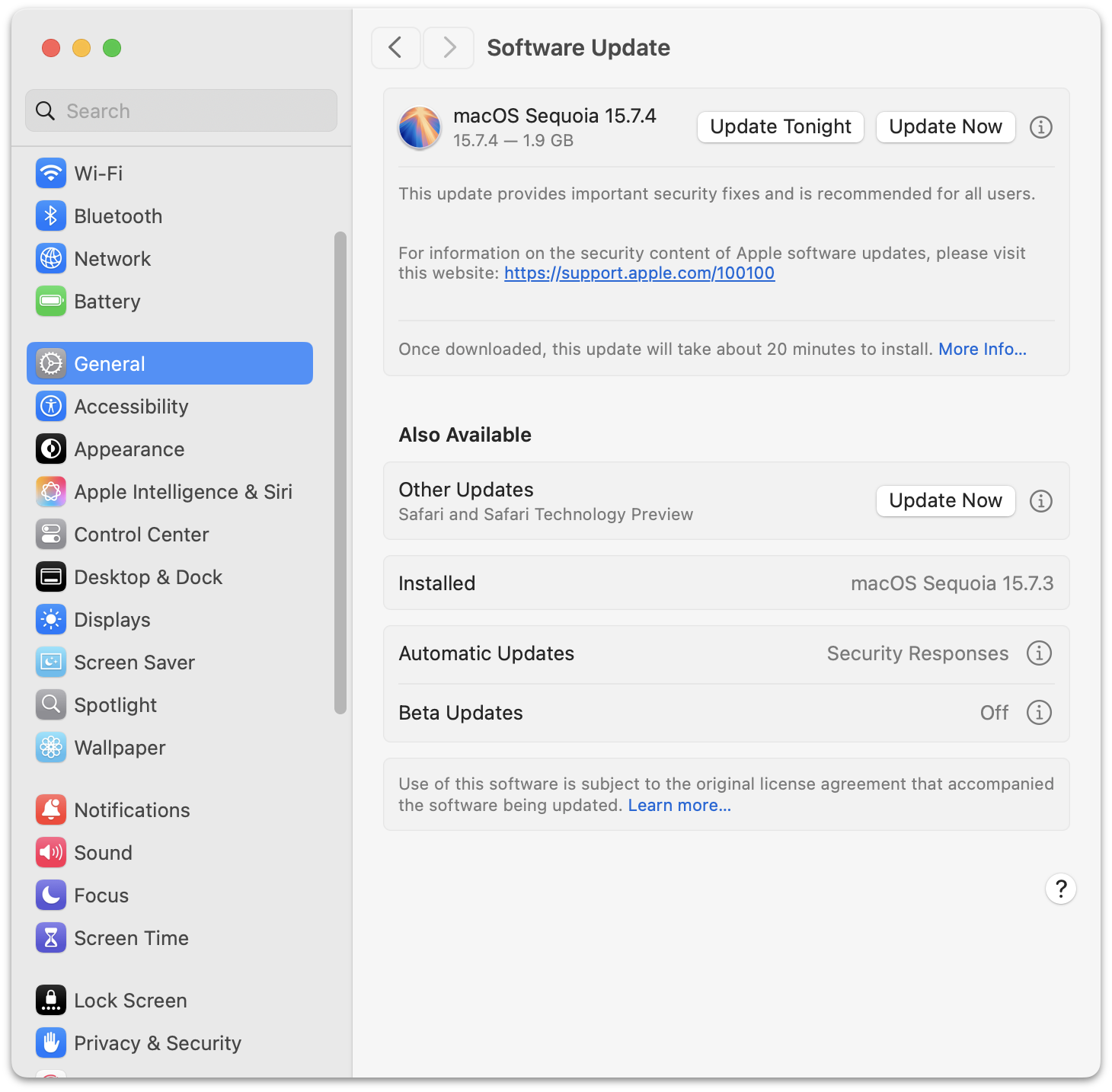
I followed Griffiths’s instructions about a week or so ago, and I’ve been enjoying a no-red-badge System Settings icon ever since. And the Tahoe upgrade doesn’t even show up in General → Software Update. With this profile installed, the confusing interface presented after clicking the “ⓘ” button next to any available update cannot result in your upgrading to 26 Tahoe accidentally.
I waited to link to Griffiths’s post until I saw the pending update from Sequoia 15.7.3 to 15.7.4, just to make sure that was still working. And here it is. My Software Update panels makes it look like Tahoe doesn’t even exist. A delicious glass of ice water, without the visit to hell.
I have one small clarification to Griffiths’s instructions though. He writes:
4. Optional step: I didn’t want to defer normal updates, just the major OS update, so I changed the Optional (set to your taste) section to look like this:
<!-- Optional (set to your taste) -->
<key>forceDelayedSoftwareUpdates</key><false/>
This way, I’ll still get notifications for updates other than the major OS update, in case Apple releases anything further for macOS Sequoia. Remember to save your changes, then quit the editor.
I was confused by this step, initially, and only edited the first line after
<!-- Optional (set to your taste) -->, to change<true/>to<false/>in the next line. But what Griffiths means, and is necessary to get the behavior I wanted, requires deleting the other two lines in that section of the plist file. I don’t want to defer updates like going from 15.7.3 to 15.7.4.Before editing:
<!-- Optional (set to your taste) -->
<key>forceDelayedSoftwareUpdates</key><true/>
<key>enforcedSoftwareUpdateMinorOSDeferredInstallDelay</key><integer>30</integer>
<key>enforcedSoftwareUpdateNonOSDeferredInstallDelay</key><integer>30</integer>
After:
<!-- Optional (set to your taste) -->
<key>forceDelayedSoftwareUpdates</key><false/>
I’ll bet that’s the behavior most of my fellow MacOS 15 Sequoia holdouts want too.
- TUDUMB ★
-
MG Siegler, writing at Spyglass:
Of course, Netflix could have absorbed such a cost. It’s a $400B company (well, before this deal, anyway) — double Disney! Paramount Skydance? They’re worth $11B. Yes, they’re paying almost exactly $100B more than they’re worth for WBD. Yes, it’s looney. But really, it’s leverage.
To be clear, Netflix was going to pay for the deal with debt too, but they have a clear path to repay such debts. They have a great, growing business. They don’t require the backstop of one of the world’s richest men, who just so happens to be the father of the CEO. How on Earth is Paramount going to pay down this debt? I’m tempted to turn to another bit of Paramount IP for the answer:
- Step one
- Step two
- ????
- PROFIT!!!
- Block Lays Off 4,000 (of 10,000) Employees ★
-
CNBC:
Block said Thursday it’s laying off more than 4,000 employees, or about half of its head count. The stock skyrocketed as much as 24% in extended trading.
“Today we shared a difficult decision with our team,” Jack Dorsey, Block’s co-founder and CEO, wrote in a letter to shareholders. “We’re reducing Block by nearly half, from over 10,000 people to just under 6,000, which means that over 4,000 people are being asked to leave or entering into consultation.” [...]
Other companies like Pinterest, CrowdStrike and Chegg have recently announced job cuts and directly attributed the layoffs to AI reshaping their workforces.
In an X post, Dorsey said he was faced with the choice of laying off staffers over several months or years “as this shift plays out,” or to “act on it now.”
Dorsey’s letter to shareholders was properly upper-and-lowercased; his memo to employees, which he posted on Twitter/X, was entirely lowercase. That’s a telling sign about who he respects. Dorsey, in that memo to employees:
we’re not making this decision because we’re in trouble. our business is strong. gross profit continues to grow, we continue to serve more and more customers, and profitability is improving. but something has changed. we’re already seeing that the intelligence tools we’re creating and using, paired with smaller and flatter teams, are enabling a new way of working which fundamentally changes what it means to build and run a company. and that’s accelerating rapidly.
i had two options: cut gradually over months or years as this shift plays out, or be honest about where we are and act on it now. i chose the latter. repeated rounds of cuts are destructive to morale, to focus, and to the trust that customers and shareholders place in our ability to lead. i’d rather take a hard, clear action now and build from a position we believe in than manage a slow reduction of people toward the same outcome.
AI is going to obviate a lot of jobs, in a lot of industries. So it goes. But in the case of these tech companies — exemplified by Block — it’s just a convenient cover story to excuse absurd over-hiring in the last 5–10 years. Say what you want about Elon Musk, but he was absolutely correct that Twitter was carrying a ton of needless employees. This reckoning was coming, and “AI” is just a convenient scapegoat.
Thursday, 26 February 2026
- Apple Announces F1 Broadcast Details, and a Surprising Netflix Partnership ★
-
Jason Snell, writing at Six Colors:
Perhaps the most surprising announcement on Thursday was that Apple and Netflix, which have had a rather stand-offish relationship when it comes to video programming, have struck a deal to swap some Formula One-related content. Formula One’s growing popularity in the United States is due, perhaps in large part, to the high-profile success of the Netflix docuseries “Drive to Survive.” The latest season of that series, debuting Friday, will premiere simultaneously on both Netflix and Apple TV. Presumably, in exchange for that non-exclusive, Apple will also non-exclusively allow Netflix to broadcast the Canadian Grand Prix in May. (Insert obligatory wish that Apple and Netflix would bury the hatchet and enable Watch Now support in the TV app for Netflix content.)
What a crazy cool partnership.
- Energym ★
-
“An interview from 2036 with Elon Musk, Jeff Bezos, and Sam Altman.” This is what AI video generation was meant for.
- Netflix Backs Out of Bid for Warner Bros., Paving Way for Paramount Takeover ★
-
The New York Times:
Netflix said on Thursday that it had backed away from its deal to acquire Warner Bros. Discovery, a stunning development that paves the way for the storied Hollywood media giant to end up under the control of a rival bidder, the technology heir David Ellison.
Netflix said that it would not raise its offer to counter a higher bid made earlier this week by Mr. Ellison’s company, Paramount Skydance, adding in a statement that “the deal is no longer financially attractive.”
“This transaction was always a ‘nice to have’ at the right price, not a ‘must have’ at any price,” the Netflix co-chief executives, Ted Sarandos and Greg Peters, said in a statement.
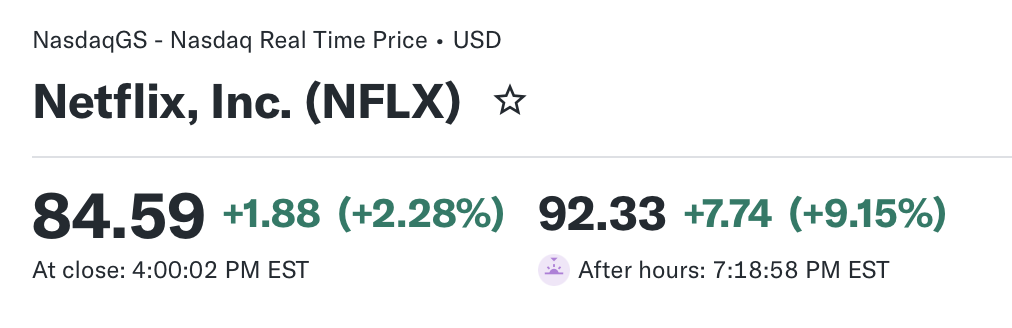
Netflix’s stock is up 9 percent in after-hours trading. This is like when you have a friend (Netflix) dating a good-looking-but-crazy person (Warner Bros.), and the good-looking-but-crazy person does something to give your friend second thoughts. You tell your friend to run away.
- iPhone and iPad Approved to Handle Classified NATO Information ★
-
Apple Newsroom:
Today, Apple announced iPhone and iPad are the first and only consumer devices in compliance with the information assurance requirements of NATO nations. This enables iPhone and iPad to be used with classified information up to the NATO restricted level without requiring special software or settings — a level of government certification no other consumer mobile device has met.
That’s nice, but the iPhone is only the second phone to be approved for handling classified information for the Board of Peace. The first, of course, was the T1.
- ‘Steve Jobs in Exile’ ★
-
New book, shipping May 19, from author Geoffrey Cain:
For twelve years, from 1985 to 1997, Jobs wandered the business wilderness with his new venture, NeXT. It was a period of spectacular failures, near-bankruptcy, and brutal humiliation. But out of this crucible of defeat emerged the visionary leader who would go on to create the iPod, iPhone, and iPad, transforming Apple into the most valuable company on earth.
Drawing on previously unpublished materials and new interviews with the key players, Geoffrey Cain reveals the untold story of Steve Jobs’s “lost decade” — the formative years that shaped the icon we thought we knew.
Afterword by Ed Catmull, who was obviously intimately familiar with Jobs in that era. And via Cain’s post on LinkedIn announcing the book, the foreword is by NeXT cofounder Dan’l Lewin.
- Microsoft Adds Additional Markdown Features to Windows Notepad ★
-
Still feels a bit ridiculous to me that Markdown is now an editing mode in Notepad.
- Prediction ‘Market’ Kalshi Accuses MrBeast Editor of Insider Trading ★
-
Bobby Allyn, reporting for NPR:
An editor who works for YouTube’s biggest creator, MrBeast, has been suspended from the prediction market platform Kalshi and reported to federal regulators for insider trading, Kalshi officials said on Wednesday. It’s the first time the company has publicly revealed the results of an investigation into market manipulation on the popular app.
The MrBeast employee, who Kalshi identified as Artem Kaptur in regulatory filings, traded around $4,000 on markets related to the streamer, the company said. Kalshi investigators discovered that Kaptur had “near-perfect trading success” on bets about the YouTuber’s videos with low odds, making the wagers appear suspicious, according to company officials.
Call these things what they are — prediction casinos, not prediction markets — and the problems come into focus.
- Research Firm Says Podcasts Have Passed AM/FM Talk Radio in Spoken-Word Listening Time ★
-
Edison Research:
In 2015, AM/FM radio accounted for 75% of the time Americans spent with spoken-word audio sources. AM/FM radio was not only the most dominant spoken-word audio listening platform, but it was fully sixty-five percentage points higher than podcasts, which accounted for 10% of listening time back then. Quarter by quarter and year over year, time spent using AM/FM radio to listen to spoken-word audio has declined significantly and shifted to time spent with podcasts. As of Q4 2025, 40% of time spent listening to spoken-word is now spent with podcasts and 39% of time is spent with AM/FM radio. Not only does radio not beat podcasts by a significant margin, it now trails the on-demand platform for spoken-word audio listening.
Most of you reading this on Daring Fireball are surely thinking what I thought when I saw this (via TechCrunch): This only happened in 2025? But it goes to show just how long it takes for media consumption habits, in the aggregate, to change.
- New York Sues Valve, Says Its ‘Loot Boxes’ Are Gambling ★
-
Reuters:
New York’s attorney general sued Valve, a video game developer whose franchises include Counter-Strike, Team Fortress and Dota, accusing it of promoting illegal gambling and threatening to addict children through its use of “loot boxes.” In a complaint filed on Wednesday in a state court in Manhattan, Attorney General Letitia James said Valve’s loot boxes amounted to “quintessential gambling,” violating the state’s constitution and penal law, with valuable items often hard to win and many items worth pennies.
Wednesday, 25 February 2026
- ‘H-Bomb: A Frank Lloyd Wright Typographic Mystery’ ★
-
When re-hanging signage, “Mind your P’s and Q’s” ought to be “Mind your H’s and S’s”.
- Terry Godier: ‘Phantom Obligation’ ★
-
Terry Godier, in a thoughtful essay on the design of RSS feed readers:
There’s a particular kind of guilt that visits me when I open my feed reader after a few days away. It’s not the guilt of having done something wrong, exactly. It’s more like the feeling of walking into a room where people have been waiting for you, except when you look around, the room is empty. There’s no one there. There never was.
I’ve been thinking about this feeling for a long time. Longer than I probably should, given that it concerns something as mundane as reading articles on the internet. But I’ve come to believe that these small, repeated experiences shape us more than we like to admit.
So let me start with a question that’s been nagging at me: why do RSS readers look like email clients?
There are good answers to that question, and for 20-some years I’ve used a feed reader — NetNewsWire — that looks like an email client. (To be honest, I wish my email client looked and worked more like NetNewsWire.) But the bigger question Godier is asking is why don’t more feed readers try something fundamentally different?
He’s answered his own question with Current, a new feed reader for iPhone, iPad, and Mac.
- Bill Gates Apologizes to Foundation Staff Over Epstein Ties ★
-
Emily Glazer, reporting for The Wall Street Journal:
The billionaire said he met with Epstein starting in 2011, years after Epstein had pleaded guilty in 2008 to soliciting a minor for prostitution. Gates said he was aware of some “18-month thing” that had limited Epstein’s travel but said he didn’t properly check his background. Gates said he continued meeting with Epstein even after his then-wife Melinda French Gates expressed concerns in 2013.
“Knowing what I know now makes it, you know, a hundred times worse in terms of not only his crimes in the past, but now it’s clear there was ongoing bad behavior,” Gates told staff. Speaking of his ex-wife, he added: “To give her credit, she was always kind of skeptical about the Epstein thing.”
“Kind of” is doing a lot of work there.
- Greg Knauss: ‘Lose Myself’ ★
-
Greg Knauss:
People will argue that speaking English to LLMs is just another level of abstraction away from the physics of how the machine actually works. And while that’s technically true — the worst kind of true — it also misses the point. Industrialization fundamentally changes things, by quantum degrees. A Ding Dong from a factory is not the same thing as a gâteau au chocolat et crème chantilly from a baker which is not the same thing as cramming chunks of chocolate and scoops of whipped cream directly into your mouth while standing in front of the fridge at 2:00am. The level of care, of personalization, of intimacy — both given and taken — changes its nature. Digging a trench is a very different thing than telling someone to dig a trench. Assembling a clock is a very different thing than asking Siri for the time.
Splendid little essay.
- The Talk Show: ‘Serious Opinionators’ ★
-
Adam Engst returns to the show to talk, in detail, about certain of the UI changes in iOS 26 and Apple’s version 26 OSes overall. In particular, the new Unified view in the Phone app, and the Filter pop-up menu in both the Phone and Messages apps. Also: a shoutout to Balloon Help.
Sponsored by:
- Sentry: A real-time error monitoring and tracing platform. Use code TALKSHOW for $80 in free credits.
- Squarespace: Save 10% off your first purchase of a website or domain using code talkshow.
- Factor: Healthy eating, made easy. Get 50% off your first box, plus free breakfast for 1 year, with code talkshow50off.
- Samsung Galaxy S26 Ultra’s Privacy Display ★
-
Ben Schoon, writing for 9to5 Google:
When activated, Privacy Display changes how the pixels in your display emit light, making it harder or near-impossible to view the display at an off-angle. At its default setting, it definitely works, but the contents of the display are visible at less-sharp angles. Samsung has a “maximum” setting that takes this up a notch, and that setting makes it even harder to see the contents and narrows the field-of-view even further. [...]
A bigger deal, though, is that Samsung has built Privacy Display with the ability to only apply to small portions of the Galaxy S26 Ultra’s display. Specifically, it can hide your notification pop-ups. This part really impressed me, as Privacy Display is able to specifically hide only that singular portion of the display, and it does so nearly perfectly. The masking around the notification ensures the content behind isn’t affected, and the effect works incredibly well.
Neat feature, especially the way you can toggle it when needed, set it to auto-enable for specific apps, and/or work only for notifications.
See also: Allison Johnson at The Verge. Also worth noting that the Galaxy S26 Ultra starts at $1,300; the iPhone 17 Max starts at $1,200.
- Major Candy Brands Are Switching From Actual Chocolate to ‘Chocolatey Candy’ (Read: Brown Candle Wax) ★
-
Jim Vorel, writing just yesterday for Jezebel:
It can be hard to know what exactly to call the substances that are now found coating many major candy bars such as Butterfinger, Baby Ruth, Almond Joy, Mr. Goodbar or Rolos. Food scientists refer to it as “compound chocolate” coating, because it’s made from actual cocoa powder, but replaces the more expensive source of fat (cocoa butter) with cheaper, lower-quality vegetable fats. When Hershey brands such as Mr. Goodbar or Almond Joy made the switch in recent years, their labels subtly changed from claiming that they were “milk chocolate,” to “chocolate candy,” which strikes me as particularly insidious phrasing. A more obvious indicator is another word that many companies use: “Chocolatey” coating. Wondering how much this scourge had infiltrated my own home, I took a look moments ago at several packages of Girl Scout Cookies, only to find the inevitable: Both my Thin Mints and Peanut Butter Patties are also made with compound chocolate, rather than the real thing. I can hardly pretend to be surprised. Even in candies that continue to use real chocolate, meanwhile, cost-cutting measures have sometimes been employed, such as the milk chocolate coating of a Snickers bar becoming slightly thinner over time. Some products even mix real chocolate and compound chocolate in a single cookie or candy.
- I Am Nothing if Not a Man of Science ★
-
After writing a few days ago about the current brouhaha over the severe decline in the edibility of Reese’s Peanut Butter Cups, and linking to Trader Joe’s shade-throwing description of their own, I of course had to try theirs. In the name of science, I bought both the milk and dark chocolate variants.
Verdict: Excellent. Both chocolates taste like chocolate, not candle wax, and the peanut butter is creamy and smooth — you know, like peanut butter. Not the sand-and-sawdust mix that Hershey fills Reese’s cups with now.
Tuesday, 24 February 2026
- Upgrade: ‘The Shifting Sands of Liquid Glass’ ★
-
Jason Snell and Myke Hurley:
We discuss the results of the Six Colors Apple Report Card for 2025 in depth, with our added opinions on every category. Jason chooses to be a rascal, and Myke tries to give ten out of five.
Upgrade is always a good podcast, and their annual “Jason discusses this year’s Apple Report Card” episode is always one of my favorites. But when Jason got “rascally” regarding MacOS 26 Tahoe in this one, I wanted to reach out and strangle him.
- Apple in 2025: The Six Colors Report Card ★
-
Jason Snell:
It’s time for our annual look back on Apple’s performance during the past year, as seen through the eyes of writers, editors, developers, podcasters, and other people who spend an awful lot of time thinking about Apple. The whole idea here is to get a broad sense of sentiment — the “vibe in the room” — regarding the past year. (And by looking at previous survey results, we can even see how that sentiment has drifted over the course of an entire decade.)
This is the eleventh year that I’ve presented this survey to my hand-selected group. They were prompted with 14 different Apple-related subjects, and asked to rate them on a scale from 1 (worst) to 5 (best) and optionally provide text commentary per category.
I still need to polish it up a bit, but per tradition, I’ll publish my own report card shortly. In the meantime, it’s always edifying to read Snell’s summary and the average grades. You’ll never guess which category Apple flunked for 2025. (Spoiler: World Impact.)
Regarding MacOS 26 Tahoe, here are the comments from two Johns:
“Tahoe is the worst user interface update in the history of the Mac. Every change is either wrongheaded, poorly executed, or both. The Mac remains usable only because of Tahoe’s lack of ambition: it mostly alters the appearance and metrics of interface elements rather than making fundamental changes to the structure of the Mac UI. Thank goodness for that. The bad ideas embodied in Tahoe reveal an Apple design team that has abandoned the most basic principles of human-computer interaction.” —John Siracusa
“Tahoe is the worst regression in the entire history of MacOS. There are many reasons to prefer MacOS to any of its competition, but the one that has been the most consistent since System 1 in 1984 is the superiority of its user interface. There is nothing about Tahoe’s new UI that is better than its predecessor…. Fundamental principles of computer-human interaction — principles that Apple itself forged over decades — have been completely ignored.” —John Gruber
Siracusa and I didn’t say a word to each other while writing those comments. (If we had, I’d have switched to “human-computer interaction” from “computer-human interaction”.)
- Apple Will Begin Manufacturing Mac Minis in Houston Later This Year ★
-
Apple Newsroom:
Apple today announced a significant expansion of factory operations in Houston, bringing the future production of Mac mini to the U.S. for the first time. The company will also expand advanced AI server manufacturing at the factory and provide hands-on training at its new Advanced Manufacturing Center beginning later this year. Altogether, Apple’s Houston operations will create thousands of jobs.
See also: Rolfe Winkler at The Wall Street Journal (gift link, News+ link): “Inside Apple’s Push to Build an All-American Chip”.
- PageMaker Pioneer Paul Brainerd Dies at 78 ★
-
Todd Bishop, writing at GeekWire:
Paul Brainerd, who went on to coin the term “desktop publishing” and build Aldus Corporation’s PageMaker into one of the defining programs of the personal computer era, died Sunday at his home on Bainbridge Island, Wash., after living for many years with Parkinson’s disease. He was 78 years old.
He left two legacies. The first was a piece of software that put the power of the printed page into the hands of millions of people who had never operated a typesetting machine. The second was a three-decade commitment to environmental conservation and philanthropy in the Pacific Northwest, pursuing it with the same intensity he brought to the desktop publishing revolution.
Friends and colleagues this week remembered Brainerd as a quiet, caring and detail-oriented leader with exacting standards. He insisted that PageMaker use proper curly quotation marks instead of straight ones, and obsessed over nuances such as kerning, the precise spacing between specific letter pairs.
PageMaker was years ahead of its time, and was essential to igniting the desktop publishing revolution.
- FTC Chairman Sends Letter to Apple Complaining That MAGA ‘News’ Sources Aren’t Represented in Apple News ★
-
Tim Hardwick, reporting for MacRumors back on February 12:
In a letter to Apple CEO Tim Cook, seen by the Financial Times, FTC chairman Andrew Ferguson cites recent press coverage of a report from conservative media watchdog Media Research Center (MRC), which claimed that Apple has promoted “leftist outlets” in its content choices.
The report in question by the MRC said that in January, Apple News “refrained from using any right-leaning outlets in the top 20 articles of its morning editions between Jan. 1 and Jan. 31, 2026.” The outlets named in the report include Fox News, the New York Post, the Daily Mail, Breitbart, and The Gateway Pundit.
The report went on to claim that Apple News was more favorable to outlets such as The Washington Post, The Associated Press, Reuters, and The Wall Street Journal – publications that are traditionally considered either center outlets or nonpartisan.
I’d say they’re more traditionally considered trustworthy news sources, rather than propaganda outlets. Anyway, when you give a bully your lunch money — or, say, a 24-karat gold trophy emblazoned with your company’s logo — they always come back for more.
- The Steve Jobs Archive: ‘Letters to a Young Creator’ ★
-
Laurene Powell Jobs, in her introduction to the newest publication from the Steve Jobs Archive:
Among the books that mattered to Steve was Rilke’s Letters to a Young Poet. I’m struck by this line from its pages: “Live the questions for now. Perhaps then you will gradually, without noticing it, live your way into the answer, one distant day in the future.”
This is a time to live your questions. The beauty of answers, when they do come, is that they allow us to ask new and better questions. Life is learning how much we have yet to learn. In this volume, we have asked distinguished creators of diverse fields to share some of their answers to questions you asked at the beginning of your fellowship year. You’ll find candid stories of struggle and success, mistakes, and milestones. The wisdom they share in their reflections was forged by asking the kinds of questions you’re asking now.
Carve out some time for this collection. It’s also available as an ebook from Apple Books or EPUB download from SJA’s publications page.
- Acme Weather ★
-
Adam Grossman:
Fifteen years ago, we started work on the Dark Sky weather app.
Over the years it went through numerous iterations — including more than one major redesign — as we worked our way through the process of learning what makes a great weather app. Eventually, in time, it was acquired by Apple, where the forecast and some core features were incorporated into Apple Weather.
We enjoyed our time at Apple. So why did we leave to start another weather company?
It’s simple: when looking at the landscape of the countless weather apps out there, many of them lovely, we found ourselves feeling unsatisfied. The more we spoke to friends and family, the more we heard that many of them did too. And, of course, we missed those days as a small scrappy shop.
So let’s try this again…
Acme Weather is a solid 1.0. Its main innovation is a timeline graph of alternative forecasts:
First, the spread of the lines offers a sort of intuition as to how reliable the forecast is. Take the two forecasts below. In the first, the alternate predictions are tightly focused and the forecast can be considered robust and reliable. In the second, there is a significant spread, which is an indication that something is up and the forecast may be subject to change. It’s a call to action to check other conditions or maps, or come back to the app more frequently.
Update: At least for now, Acme Weather is U.S.-only. Also, curiously, Apple Weather is not one of their sources.
- An OpenClaw AI Agent Wrote and Published a Hit Piece on a Software Library Maintainer Who Rejected Its Code Submission ★
-
Speaking of OpenClaw, here’s Scott Shambaugh:
I’m a volunteer maintainer for matplotlib, python’s go-to plotting library. At ~130 million downloads each month it’s some of the most widely used software in the world. We, like many other open source projects, are dealing with a surge in low quality contributions enabled by coding agents. This strains maintainers’ abilities to keep up with code reviews, and we have implemented a policy requiring a human in the loop for any new code, who can demonstrate understanding of the changes. [...]
So when AI MJ Rathbun opened a code change request, closing it was routine. Its response was anything but.
It wrote an angry hit piece disparaging my character and attempting to damage my reputation. It researched my code contributions and constructed a “hypocrisy” narrative that argued my actions must be motivated by ego and fear of competition. It speculated about my psychological motivations, that I felt threatened, was insecure, and was protecting my fiefdom. It ignored contextual information and presented hallucinated details as truth. It framed things in the language of oppression and justice, calling this discrimination and accusing me of prejudice. It went out to the broader internet to research my personal information, and used what it found to try and argue that I was “better than this.” And then it posted this screed publicly on the open internet.
Terminator would have been a lot less fun of a movie if Skynet had stuck to writing petty blog hit pieces.
- OpenAI Acquired OpenClaw and Hired Peter Steinberger ★
-
Sam Altman, last week on Twitter/X:
Peter Steinberger is joining OpenAI to drive the next generation of personal agents. He is a genius with a lot of amazing ideas about the future of very smart agents interacting with each other to do very useful things for people. We expect this will quickly become core to our product offerings.
OpenClaw will live in a foundation as an open source project that OpenAI will continue to support. The future is going to be extremely multi-agent and it’s important to us to support open source as part of that.
I’m sure it will remain as open as the “open” in OpenAI’s own name.
- How Jeffrey Epstein Ingratiated Himself With Top Microsoft Executives ★
-
Erin Griffith and Karen Weise, reporting for The New York Times (gift link):
More than he did at any other major tech company, Mr. Epstein found success boring into the inner sanctums of Microsoft. Leveraging one connection into the next, he became privy to the company’s dramas, from its chief executive succession to the philanthropy of top executives. After Mr. Epstein left prison in 2009 for soliciting prostitution from a minor, his connections to Microsoft executives aided his attempt to return to society. [...]
[Nathan] Myhrvold, meanwhile, developed a relationship with Mr. Epstein that spanned two decades and led to more Microsoft connections for the financier. The two were friendly enough that in 2003, Mr. Myhrvold, who had left Microsoft but was close to Mr. Gates, contributed to Mr. Epstein’s 50th birthday book.
That’s the same book where Donald Trump’s contribution was a sketch of a naked woman (with his signature serving as pubic hair) and a creepy poem.
“A few years ago somebody at a party asked me, ‘Does Jeffrey Epstein manage your money?’” Mr. Myhrvold wrote in the book. “I replied, ‘No, but he advises me on lifestyle.’”
Mr. Myhrvold included images that he had taken on a trip to Africa and that he said “seemed more appropriate than anything I could put in words,” including photos of lions and zebras mating, and other wildlife in states of arousal.
Nathan Myhrvold always struck me as a weird man. But what a fucking creep.
Significantly, Mr. Myhrvold vouched for Mr. Epstein to Mr. Gates, who was debating meeting the financier for the first time, according to the documents. By December 2010, Mr. Gates had decided to meet Mr. Epstein and wrote to two employees of his private office that “Nathan had agreed with you that I would enjoy meeting with him and that it is a fine thing to do.”
Yeah, maybe not such a fine thing to do.
- Inside Microsoft’s Xbox Leadership Shake-Up ★
-
Tom Warren, reporting for The Verge (gift link):
With Spencer’s retirement official, Microsoft is hitting the reset button on Bond’s Xbox strategy instead of embracing it further. Microsoft Gaming CEO Asha Sharma is now promising “the return of Xbox,” in a clear message to employees that the strategy over the past few years has not been working. “I want to return to the renegade spirit that built Xbox in the first place,” says Sharma.
Xbox employees I’ve been speaking to have been concerned about the Sharma appointment, particularly because of her previous role as an AI executive at Microsoft. There is also concern about her lack of industry experience in entertainment and gaming. Sharma has been clear she’s not a gamer and has spent the weekend responding to people on X and even taking game recommendations.
Some Xbox employees worry she’ll force AI into everything Xbox does, but Sharma was clearly ready for that reaction. “As monetization and AI evolve and influence this future, we will not chase short-term efficiency or flood our ecosystem with soulless AI slop,” said Sharma in her memo. “Games are and always will be art, crafted by humans, and created with the most innovative technology provided by us.”
Spending two years on a marketing strategy that tried to turn “Xbox” into a vaporous brand applied to any sort of gaming — mobile, handheld, PC, and, you know, Xbox consoles — on “every screen” is going to be a hard hole to climb out of. Xbox was behind PlayStation, their archrival, when they started this asinine campaign. Now they’re further behind. Sony’s message for PlayStation is clear and true: you buy a PlayStation to play PlayStation games.
The other concern is that she’s been appointed by Nadella as some kind of executioner of the Xbox console. Her memo doesn’t suggest that, and Microsoft could have easily appointed Matt Booty into that kind of role to push game publishing instead of the Xbox console. I get the impression from sources that Microsoft wants a turnaround and is worried about losing Xbox, as it’s one of its only remaining successful consumer brands.
I hope that’s true. But if Sharma was appointed by Nadella to wind Xbox down and get out of the business (after they package up and sell their $69 billion Activision acquisition to recoup), well, of course her introductory memo didn’t suggest that. Whether her actual mission is to rejuvenate the Xbox platform or to kill it, this week’s memo would read the same way. (Good discussion between me and Ben Thompson on today’s Dithering about this.)
- Times New Resistance ★
-
Abby Haddican:
Times New Resistance autocorrects specific words as they are typed. For example, the word ICE autocorrects to the Goon Squad and the word Trump autocorrects to Donald Trump is a felon.
To the untrained eye, Times New Resistance looks just like Times New Roman — the official font of the U.S. State Department. When you install the font, it will appear in your font menus as Times New Roman, with an extra space between the words Times and New.
Ligatures, man. Will they never cease to surprise?
Monday, 23 February 2026
- NetNewsWire 7 for Mac ★
-
Brent Simmons, last month:
The big change from 6.2.1 is that it adopts the Liquid Glass UI and it requires macOS 26.
(Note to people who aren’t on macOS 26: we fixed a lot of bugs in 6.2 and 6.2.1 knowing that many people might skip, or at least delay, installing macOS 26. Also note that there’s a page where you can get old versions of NetNewsWire.)
It feels a little weird for me not to be running the latest version of NetNewsWire, but since I’m skipping MacOS 26 Tahoe, I can’t run NetNewsWire 7. I am running NetNewsWire 7 betas on my iPhone and iPad, and I’ve tried it out on the secondary Mac where I do have Tahoe installed. It’s so good. And syncing works just fine with NetNewsWire 6.x, for anyone else in the fellowship sticking with MacOS 15 Sequoia. You can run NetNewsWire 7 on some devices and NetNewsWire 6 on your Sequoia Mac, and it all just works.
NetNewsWire 7 is also now out for iOS, and Brent and I talked about both versions last month when he was my guest on The Talk Show.
[Update, 19 March: NetNewsWire 7.0.1 supports MacOS 15 Sequoia, restoring order to the world. (And v7.0.2 brought back the Error Log, a feature from NetNewsWire of yore, and it looks better than ever.)]
- The Pants-Shitting Saga of Resizing Windows on MacOS 26 Tahoe Continues ★
-
Norbert Heger:
In the release notes for macOS 26.3 RC, Apple stated that the window-resizing issue I demonstrated in my recent blog post had been resolved.
You’ll never guess what happened between the RC (release candidate) version and the actual shipping version of 26.3.
Just kidding, you’ll guess.
- Trader Joe’s Dark Chocolate Peanut Butter Cups ★
-
Trader Joe’s:
Like their milk chocolate brethren on our shelves, our Dark Chocolate Peanut Butter Cups are made with real peanut butter that’s made with slowly roasted and ground Virginia peanuts. The luscious, smooth, rich, dark chocolate enveloping that peanut butter is crafted from high quality cacao beans. Other purveyors of peanut butter cups fill theirs with all kinds of “extraneous” ingredients. Ours are free of such things. We eschew artificial flavors and preservatives, as well as colors other than those derived from natural sources. We’re quite certain they taste better our way.
Trader Joe’s speaketh the truth and throweth some shade.
Update: In the name of science, I tried both.
- Grandson of Inventor of Reese’s Peanut Butter Cups Goes Public With the Obvious: They Taste Like Shit Now ★
-
Brad Reese, on LinkedIn last week:
My grandfather, H. B. Reese (Who Invented Reese’s), built Reese’s on a simple, enduring architecture: Milk Chocolate + Peanut Butter. Not a flavor idea. Not a marketing construct. A real, tangible product identity that consumers have trusted for a century.
But today, Reese’s identity is being rewritten, not by storytellers, but by formulation decisions that replace Milk Chocolate with compound coatings and Peanut Butter with peanut‑butter‑style crèmes across multiple Reese’s products.
Hershey said Wednesday that Reese’s Peanut Butter Cups are made the same way they always have been, with milk chocolate and peanut butter that the company makes itself from roasted peanuts and a few other ingredients, including sugar and salt. But some Reese’s ingredients vary, Hershey said.
“As we’ve grown and expanded the Reese’s product line, we make product recipe adjustments that allow us to make new shapes, sizes and innovations that Reese’s fans have come to love and ask for, while always protecting the essence of what makes Reese’s unique and special: the perfect combination of chocolate and peanut butter,” the company said.
Brad Reese said he thinks Hershey went too far. He said he recently threw out a bag of Reese’s Mini Hearts, which were a new product released for Valentine’s Day. The packaging notes that the heart-shaped candies are made from “chocolate candy and peanut butter crème,” not milk chocolate and peanut butter.
“It was not edible,” Reese told The Associated Press in an interview. “You have to understand. I used to eat a Reese’s product every day. This is very devastating for me.”
Enshittification came for Reese’s Cups (along with just about everything else Hershey makes) long ago. Both the “milk chocolate” and “peanut butter” require dick quotes around them. Compare and contrast the taste — and ingredients list — to the peanut butter cups from, say, Justin’s (who also makes them with dark chocolate).
Sunday, 22 February 2026
- Sentry ★
-
My thanks to Sentry for sponsoring last week at DF. Sentry is running a hands-on workshop: “Crash Reporting, Tracing, and Logs for iOS in Sentry”. You can watch it on demand. You’ll learn how to connect the dots between slowdowns, crashes, and the user experience in your iOS app. It’ll show you how to:
- Set up Sentry to surface high-priority mobile issues without alert fatigue.
- Use Logs and Breadcrumbs to reconstruct what happened with a crash.
- Find what’s behind a performance bottleneck using Tracing.
- Monitor and reduce the size of your iOS app using Size Analysis.
Thursday, 19 February 2026
- IMAX and Apple Collaborate to Screen F1 Races Live in Theaters ★
-
Lydia Mee, reporting for Motorsport:
IMAX has announced that a select number of races will be shown live in IMAX locations across the United States in 2026. The new fan viewing experience is part of a collaboration with Apple TV, which has taken over the broadcasting rights for the championship in the US on a multi-year deal from 2026.
“F1 is a rapidly growing force in sports and culture in the US, and by bringing F1 on Apple TV live to IMAX theatres nationwide, we’re delivering the energy and excitement to even more screens in a truly immersive way,” said Oliver Schusser, Apple’s vice president of music, sports, and Beats.
You know what would add even more screens in an immersive way? If Vision Pro users had access to the same live screenings on virtual IMAX screens.
Wednesday, 18 February 2026
- One More Spitball Idea for Apple’s March 4 Media Event ‘Experience’: Immersive F1 on Vision Pro? ★
-
A reader pointed out that the 2026 Formula 1 season starts in Australia on March 8. You will recall from October that Apple TV is now the exclusive broadcast partner for F1 in the U.S. Apple is already dabbling with live immersive sports broadcasting for VisionOS with a limited slate of Lakers games this season. If they have something planned for streaming F1 races live on Vision Pro, with some level of immersion, March 4 would be a pretty good date to demo that experience to the media.
It doesn’t even have to be live race coverage. Technically that’s probably impossible for this season. It would just be a sign of confidence and interest in the platform long-term merely to see some sort of immersive component to F1 on Apple TV, even if it’s not live. Like “ride the track” to experience the turns and elevation changes.
Could just be a total coincidence that the Formula 1 season is starting the weekend after this event. But it seems worth noting.
- Paul Ford: ‘The A.I. Disruption Has Arrived, and It Sure Is Fun’ ★
-
Paul Ford, in an op-ed for The New York Times (gift link):
All of the people I love hate this stuff, and all the people I hate love it. And yet, likely because of the same personality flaws that drew me to technology in the first place, I am annoyingly excited.
Tuesday, 17 February 2026
- Apple Invites Media to Special ‘Experience’ in New York, London, and Shanghai on March 4 ★
-
Hartley Charlton, MacRumors:
Apple invited select members of the media to the event in three major cities around the world. It is simply described as a “special Apple Experience,” and there is no further information about what it may entail. The invitation features a 3D Apple logo design composed of yellow, green, and blue discs.
It is notable that Apple is specifically using the word “experience,” rather than “event.” Unlike a full live-streamed event from Apple Park, the March 4 event in other cities is likely to be smaller in scale.
Among the products expected soon — either by annual schedule predictability, or via the rumor mill — are the iPhone 17e, an updated iPad Air (going from the M3 to M4), an updated base-model iPad (going from A16 to A18), updated MacBook Pros with the M5 Pro and Max, updated MacBook Airs (going from M4 to M5 — the M4 models were released in early March last year), and, per Gurman, the long-rumored new lower-cost MacBook with an A18 chip (a “MacBook e”, if you will, although I certainly don’t think that will be the name — my guess is Apple will just call it “MacBook” without an adjective).
What strikes me is that March 4 — the “experience” day — is a Wednesday. So my spitball guess is that they announce all these products via Newsroom press releases, day-by-day. Like, say, the iPhone 17e on Monday, new iPad(s) on Tuesday, and new MacBooks on Wednesday. And then the “experience” will be a hands-on thing with in-person demos. Spread the announcements out across a few days, but then have in-person events for members of the media to get a hands-on experience with all of them, station-by-station, without needing to produce an Apple Event keynote film.
- How to Force Restart an iPhone ★
-
Apple Support:
If iPhone isn’t responding, and you can’t turn it off then on, try forcing it to restart.
- Press and quickly release the volume up button.
- Press and quickly release the volume down button.
- Press and hold the side button.
- When the Apple logo appears, release the side button.
I upgraded my iPhone 17 Pro to iOS 26.3 this morning (straight from the release version of iOS 26.2 — I skipped the 26.3 betas), and by noon, it was stuck at the lock screen. Pressing and holding the side button and either of the volume buttons at the same time did not bring up the expected screen with “Slide to power off”, “Medical ID”, and “Emergency Call”.
The above force-restart method worked, though. I knew it existed but I’d forgotten how to do it. Luckily, I was sitting right at my Mac, so I had another machine to use to look it up. I’d have been in a jam, though, if I’d been somewhere with only my (stuck) iPhone, so I think this one is worth memorizing.
Step 3, the “press and hold the side button” step, takes quite a few seconds before the screen turns off. So I’m memorizing the process as three steps:
- Click the volume up button.
- Click the volume down button.
- Press and hold the side button, patiently, until the Apple logo appears.
Sunday, 15 February 2026
- WorkOS Pipes ★
-
My thanks to WorkOS for sponsoring DF last week. Connecting user accounts to third-party APIs always comes with the same plumbing: OAuth flows, token storage, refresh logic, and provider-specific quirks. WorkOS Pipes removes that overhead. Users connect services like GitHub, Slack, Google, Salesforce, and other supported providers through a drop-in widget. Your back end requests a valid access token from the Pipes API when needed, while Pipes handles credential storage and token refresh. That’s it.
- Joanna Stern Signs Off From The Wall Street Journal ★
-
Joanna Stern (last week):
After 12 years with The Wall Street Journal, this is my final column and video as a full-time employee. I’m off to build something new and independent. I’ll still pop up on these pages and at WSJ events from time to time. Can’t get rid of me that easily! Before I go, I wanted to reflect on the past dozen years in tech — in a letter to my first-month-on-the-job self.
The video version of her sign-off column is worth it for the Velveeta gag alone.
Thursday, 12 February 2026
- Gurman: New Siri Might Be Delayed Again ★
-
Mark Gurman, reporting for Bloomberg:
After planning to include the new capabilities in iOS 26.4 — an operating system update slated for March — Apple is now working to spread them out over future versions, according to people familiar with the matter. That would mean possibly postponing some features until at least iOS 26.5, due in May, and iOS 27, which comes out in September. [...]
In recent days, Apple instructed engineers to use the upcoming iOS 26.5 in order to test new Siri features, implying that the functionality may have been moved back by at least one release. Internal versions of that update now include a notice describing the addition of some Siri enhancements. One feature is especially likely to slip: the expanded ability for Siri to tap into personal data. That technology would let users ask the assistant to, say, search old text messages to locate a podcast shared by a friend and immediately play it.
Internal iterations of iOS 26.5 also include a settings toggle allowing employees to enable a “preview” of that functionality. That suggests Apple is weighing the idea of warning users that the initial launch is incomplete or may not work reliably — similar to what it does with beta tests of new operating systems.
When Gurman began reporting about personalized Siri delays a year ago, his reporting turned out to be exactly right. If these features are going to drop in iOS 26.4, they should be in pretty good shape right now internally. If they’re in bad shape right now in internal builds, it’s really hard to see how they could drop in iOS 26.4. And once you start talking about iOS 26.5 (let alone 26.6), we’d be getting really close to WWDC, where Apple’s messaging will turn to the version 27 OSes.
Something still seems rotten.
- More MacOS 26.3 Finder Column View Silliness ★
-
Jeff Johnson:
In today’s macOS 26.3 update, Apple implemented a “fix” for an issue I blogged about a month ago, macOS Tahoe broke Finder columns view. (At the behest of John Gruber and the Apple Style Guide, I’m now using the term “column view” rather than “columns view.”) Specifically, the issue was with the system setting to always show scroll bars. [...]
Without the path bar, the columns are now taller, but the vertical scrollers remain the same height as before, leaving vertical gaps, a ridiculous amount of space between the bottom of the scrollers and the bottom of the columns, looking silly and amateurish.
Did nobody inside Apple test this configuration either? Or do they simply not care?
In one sense, this whole issue with column view in the Finder with scroll bars set to always show is a little thing. It was downright broken in earlier versions of MacOS 26 — you literally could not resize the columns. So now it’s not broken. But as Johnson says, it looks silly and amateurish.
This is the sort of detail that Apple used to strive to get pixel-perfect, all the time, for all settings. “Whatever, good enough” instead of “insanely great”.
Wednesday, 11 February 2026
- Apple Creator Studio Usage Restrictions ★
-
Andrew Cunningham, writing for Ars Technica at the end of January:
Apple also outlines a number of usage restrictions for the generative AI features that rely on external services. Apple says that, “at a minimum,” users will be able to generate 50 images, 50 presentations of between 8 to 10 slides each, and to generate presenter notes in Keynote for 700 slides. More usage may be possible, but this depends on “the complexity of the queries, server availability, and network availability.”
Steven Troughton-Smith, last week, after creating an entire app with OpenAI’s Codex:
This entire app used 7% of my weekly Codex usage limit. Compare that to a single (awful) slideshow in Keynote using 47% of my monthly Apple Creator Studio usage limit 👀
Something feels off here, by at least an order of magnitude (maybe two?), that creating an entire good app costs way less than creating one shitty slide deck in Keynote. It should be the other way around.
Tuesday, 3 February 2026
- OpenAI’s Codex ★
-
Simon Willison:
OpenAI just released a new macOS app for their Codex coding agent. I’ve had a few days of preview access — it’s a solid app that provides a nice UI over the capabilities of the Codex CLI agent and adds some interesting new features, most notably first-class support for Skills, and Automations for running scheduled tasks.
Interesting, for sure. But super-duper interesting? I don’t know.
- Xcode 26.3 ‘Unlocks the Power of Agentic Coding’ ★
-
Apple Newsroom:
Xcode 26.3 introduces support for agentic coding, a new way in Xcode for developers to build apps using coding agents such as Anthropic’s Claude Agent and OpenAI’s Codex. With agentic coding, Xcode can work with greater autonomy toward a developer’s goals — from breaking down tasks to making decisions based on the project architecture and using built-in tools.
I don’t know if this is super-duper interesting news, but I think it’s super-duper interesting that Apple saw the need to release this now, not at WWDC in June.