
By John Gruber
WorkOS: Let agents use your tools without giving them free rein.
Linked List: October 2026
Friday, 30 October 2026
- Sponsorship Openings for Daring Fireball (Including The Talk Show) ★
-
Sponsorships have continued selling briskly, of late. Knock on wood. As of yesterday, the next opening on the schedule wasn’t until the last week of December, and the Q1 2027 schedule is already filling up.
However, due to some schedule rejiggering, next week is now open.Update: OK, next week has been sold, but Christmas week remains open. That’s a good week at DF. I keep posting and readers are often more bored than usual. Also a good week to promote games.If you’ve got a product or service you think would be of interest to DF’s audience of people obsessed with high quality and good design, just email me — especially if you can act quick for next week’s opening. I’m also booking sponsorships for Q1 and Q2 2027, and over half of those weeks are already sold. The rate for the two remaining weeks in 2026 is $11,000, and the rate for open weeks in 2027 is $12,500.
The sponsorship schedule for The Talk Show also has openings, including for the next few episodes in November and December. The general rule of thumb is that sponsorship spots on The Talk Show cost one-third the rate for the weekly spots on DF. I’m happy to work out deals a little lower than that for first-time sponsors. If you’ve got a product or service you’d like to hear pitched on America’s favorite three-star podcast, get in touch.
- The Only Good Easter Eggs Are Whole-Assed Easter Eggs ★
-
Marcin Wichary on the original iPod easter egg on Apple Music’s website 404 page:
I am usually not a fan of easter eggs — most of them are poorly made — but this might be the best iPod recreation I’ve seen, and it’s an interesting thing to study:
- I think it generally covers all the modes etc.
- (with small exceptions) the typography looks accurate,
- it has the little “haptic” beeps,
- it has proper acceleration and the scrollbar,
- it has a little music library with various playlists,
- I have only noticed a few small bugs.
It looks real, sounds real, feels real. Don’t bother with your easter egg idea if you’re going to half-ass it.
Update: The original iPod itself had a great easter egg: a hidden version of the classic game Breakout. Apple’s new easter egg web-page iPod includes the hardware iPod easter egg. Just go to Settings → About and hold down the center button for 5 seconds. An easter egg in the easter egg. That’s how you do it.
- GM to Pay $220 Million After Betraying Their Own Drivers’ Privacy ★
-
Jonathan Stempel, reporting for Reuters:
General Motors will pay $220 million to settle allegations that it illegally sold drivers’ private behavior and location data to brokers, who then sold the information to insurers that used it to set and sometimes increase rates.
The settlement, announced on Thursday, resolves claims by the attorneys general of 35 US states and the District of Columbia over the automaker’s Smart Driver program, which enrolled millions of drivers between 2016 and its discontinuation in 2024. Other regulators have also reviewed GM’s handling of driver data.
GM was accused of pitching Smart Driver to help people improve their personal driving safety, only to violate drivers’ privacy by reneging on its promise not to sell their data without permission. Many people who signed up were also enrolled in GM’s OnStar safety, navigation and diagnostic service.
Reuters’s milquetoast headline was “GM to Pay $220 Million to Settle Allegations It Violated Drivers’ Privacy”. They’re not mere allegations. They did it. They just betrayed their customers’ privacy to make a few quick bucks.
I’ve driven a few GM rentals in recent years, and I’d almost certainly never buy one of their cars just because they’re poorly-designed pieces of crap. But even if they made a decent car I wouldn’t buy it. They’re still seemingly digging in on the CarPlay thing, and they ratted out their own customers to insurance companies.
- Patrick Stewart Dies at 86 ★
-
Aaron Couch, The Hollywood Reporter:
Patrick Stewart, the sophisticated actor who brought a Shakespearean touch to Star Trek and X-Men as he made an otherworldly transformation from British stage veteran to sci-fi icon, has died. He was 86.
Stewart died Wednesday at his home in Los Angeles following “a brief and poignant journey with Alzheimer’s disease and Lewy body dementia,” longtime spokesperson Kelly Bush Novak announced.
There’s an old adage that everyone’s favorite SNL cast is the one from their teenage years. It’s probably true for Star Trek too. My favorite is The Next Generation and it’s not even close. Stewart’s Jean-Luc Picard was just so fucking cool. Smart, wise, firm, curious, empathetic, and just fucking cool. Those same adjectives seemingly all apply to Stewart himself.
See Kottke for a bunch more links.
Thursday, 29 October 2026
- Apple Drops App Store Commission by a Whopping 4 Percentage Points in Taiwan ★
-
Apple Developer News:
Apple is making changes to the Taiwan storefront of the App Store, following discussions with the Taiwan Fair Trade Commission.
As of October 31, 2026, the commission rate for standard Apple In-App Purchase and paid app transactions will be 26% on the Taiwan storefront of the App Store on iOS and iPadOS. Currently, that rate is 30%.
Well there we go. The App Store in Taiwan — just like in Japan — is fixed.
- A Health Update From Craig Hockenberry ★
-
Craig Hockenberry:
If you noticed that the Iconfactory sites were kinda broken last week, now you know why. It’s because I was kinda broken last week.
Now I’m finishing this post from a comfy chair on our deck. Typing into the latest version of WordPress and PHP. And I couldn’t be happier.
No, you teared up a little reading this.
Very good news from a very good friend.
- Rolfe Winkler at The WSJ: ‘The Beleaguered Chip Sellers Getting Their Revenge on Apple’ ★
-
Rolfe Winkler, in a crackerjack story for The Wall Street Journal (gift link):
Blevins, who left Apple in 2022, sometimes set up back-to-back meetings with suppliers so that rival sales teams might run into each other, stoking competitive tension. Sales representatives learned to pack nutrition bars to sustain them through negotiating sessions that Apple executives sometimes pushed past midnight without a dinner break. Blevins’s bad-cop reputation gave his staff leverage: They threatened to call him in if contract terms weren’t to their liking.
One significant contract term allowed Apple to audit its suppliers’ books. Flash makers typically had to designate Apple as a “most favored customer,” which guaranteed that no other buyer got a lower price, according to people familiar with the agreements. Apple’s audits allowed it to verify that no one paid less.
Apple caught Micron selling flash at cheaper prices to another customer and won an arbitration settlement worth tens of millions of dollars more than a decade ago, said people familiar with the dispute. Apple audited its suppliers so often that Blevins negotiated a volume discount with the auditor, Deloitte.
The whole story is a fascinating and entertaining read. But I don’t get the “revenge” angle in the headline. The biggest buyers can negotiate the best deals. Apple used to be the biggest buyer, by far, for flash memory chips. They negotiated, with hardball but above-the-board tactics, the best deals. Now, Apple isn’t the biggest buyer — the AI datacenter hyperscalers are. Apple no longer gets the best deals. But they’re still getting fair deals. Apple is still negotiating the best deals it can for itself. So where is the “revenge”? The pinch mostly isn’t being felt by Apple — it’s being felt by Apple’s customers, who now face significantly higher product prices.
I included “mostly” in the preceding sentence because Winkler, in collaboration with the research firm TechInsights, makes the case in the piece that the rising costs of flash memory have eaten into the remarkably juicy profit margins Apple has historically earned from higher-storage upgrades.
What I also don’t get, at all, is the participation in the story by Scott Nelson, the chief marketing officer at Kioxia (which I learned in this story is the new name for the company formerly known as Toshiba Memory Corporation), a major flash supplier. Nelson told Winkler he so loathes Apple that he shot his old iPod with a rifle and keeps the pieces on his desk. The article ends thus:
The industry’s low point came in 2023. The Covid-era, work-from-home device boom cooled, and flash prices bottomed out at 5 cents a gigabyte. Bernstein Research estimated the flash industry generated operating losses of $19 billion that year, while Apple earned $14 billion in gross profit selling extra flash storage.
Those were tough times that “I hope we don’t ever see again,” said Nelson, the Kioxia sales executive.
Yes, I’m sure the current AI datacenter mania will last forever, the bubble will never burst, and that even if it does, no one at Apple will remember Nelson’s participation in this story.
- The Space Shuttle Discovery’s Starboard Side ‘s’ Is Upside Down ★
-
How Jason Snell beat me to linking to this, I don’t know. But like I said back in February, when it comes to signage, “Mind your P’s and Q’s” ought to be “Mind your H’s and S’s”.
- Steven Levy on the New MacBook Pro, With, Yes, a Touchscreen ★
-
Steven Levy, writing at Wired with the scoop on the new MacBook Pros (News+ link):
This turnaround is a big deal to Apple fans. Ternus shrugs off the drama. “The Mac is first and foremost an indirect input device, built around the trackpad and keyboard. But I think there’s times when it’s comfortable and handy to have touch.”
Ternus and Apple want to make sure that the Mac faithful don’t panic that the 42-year-old franchise is losing its identity to Apple’s gangbusters mobile products. “We needed to get to a point where adding touch didn’t make the product lesser in any way. It didn’t make it heavier. It didn’t make it thicker. That came together with the OLED screen, the best display we’ve ever put into a Mac,” Ternus told me. “All of these things, and, oh yeah, it has touch as well.”
After a long fun day of hands-on exploration, briefings, and a slew of demos, not just most, but all of my concerns about touchscreen support adversely affecting the Mac UI have been allayed. I love it. These seem like exquisite machines even if you never want to touch the screen. I think what Ternus told Levy captures the truth of touch’s role: “All of these things, and, oh yeah, it has touch as well.”
Wednesday, 28 October 2026
- Guessing the Name: MacBook Studio? ★
-
Joe Rossignol, MacRumors:
A teaser video shared by Apple CEO John Ternus today hints at a potential name for the rumored MacBook models with touch-enabled OLED displays: MacBook Studio. [...]
Apple is expected to show off the new MacBooks to selected tech reporters and content creators at an experience in Los Angeles at 10 a.m. Pacific Time today, and that is the home of Hollywood movie studios after all.
I went to bed last night thinking “MacBook Studio” was the best guess. I woke up this morning feeling like it was a name worth betting on. It just fits. There’s a Mac Studio desktop, Studio Display monitor, and Apple’s suite of pro software tools is named Creator Studio — and they just announced big updates to that yesterday. As I suggested yesterday, these should be a new MacBook line, not the new MacBook Pros.
If this is the name, Rossignol gets the Being Right Point for calling it.
(A bunch of readers chimed in to suggest “MacBook Touch”. That wouldn’t work for the same reasons that Apple didn’t even consider calling the Duo the “iPhone Fold”. Yes, they used “Touch” for the iPod Touch of yore, but (a) that was a different era, and (b) that was such a mediocre product name that most consumers referred to it by the wrong name, “iTouch”. Apple likes names that evoke a feeling, not that describe a specific feature of the product.)
Update: Welp, never mind.
Tuesday, 27 October 2026
- Siri AI Expands to More Languages in OS 27.2 ★
-
Apple Newsroom yesterday:
With the 27.2 software updates released today, Siri AI — an entirely new version of Siri that is profoundly more capable, conversational, and personal — is expanding to more people around the world, with availability now in the French, Japanese, Korean, Portuguese, and Spanish languages. [...]
Siri AI is currently unavailable in the EU in iOS, iPadOS, and watchOS. Apple is working constructively with the EU in an attempt to find a path forward.
Don’t hold your breath. (Or if you prefer, N’y comptez pas trop.)
- Apple Creator Studio Updated With a Slew of AI Features, Along With a New Open JSON File Format for Keynote ★
-
Apple Newsroom, with software news for Apple’s “Pro and Tell” week:
Apple today introduced transformative updates to Apple Creator Studio, the powerful collection of creative apps designed to put studio-grade tools into the hands of modern creators across Mac, iPad, and iPhone. Final Cut Pro for Mac now includes built-in MotionVFX — an expansive collection of visual effects, plug-ins, transitions, templates, and motion graphics tools — as well as seamless editing in Pixelmator Pro. Apple’s curated Content Hub now includes video assets and is available in Final Cut Pro. Music creators using Logic Pro for Mac gain a new intelligent assistant in beta, an enhanced Stem Splitter that now separates drums, and a redesigned Browser that incorporates all sounds, with music understanding and even a Splice library. Pixelmator Pro introduces Generate Fill, which lets creators transform selected areas of an image using natural language. Keynote, Pages, and Numbers introduce new AI features in beta, including assistants that understand document context and new Model Context Protocol (MCP) support for workflow automation. They also add stock video in the Content Hub and new premium themes and templates.
Apple Creator Studio updates will be available on the App Store this November as a free update for existing subscribers.
That’s a lot. But this part at the end caught my eye:
Across Keynote, Pages, and Numbers, the Content Hub expands to include Apple-curated stock video footage, giving creators dynamic visuals to enhance presentations, reports, and spreadsheets. Subscribers also gain access to a fresh collection of professionally designed templates and themes. Keynote introduces support for Keynote Interchange Format (.keyx), an open JSON-based bundle file format designed to be readable and accessible to external tools, developer workflows, and AI agents.
Jesse Bunch, engineering manager for productivity apps at Apple, on X and LinkedIn:
Our new in-app assistants can help you get things done in record time. MCP allows you to bring your own agent if you want. And an open source format for Keynote (and Python library!) so you can create Keynote documents programmatically on any platform. Huge day for Creator Studio today.
I don’t think the Python library for the new Keynote Interchange Format is out yet, but neither are the updates to the Creator Studio apps. Very cool news, along the same lines as the new JSON-based format for Xcode projects that Apple announced last month.
- What’s Left for ‘Pro and Tell’ Week: Touch-Enabled OLED MacBooks ★
-
Joe Rossignol, MacRumors:
Apple on Wednesday will announce 14-inch and 16-inch MacBook Pro models featuring touch-enabled OLED displays with thinner bezels, a Dynamic Island instead of a notch, M5 Pro and M5 Max chips, and a lighter and slightly thinner design, Bloomberg’s Mark Gurman reports. Apple is hosting a private “Pro and tell” experience in Los Angeles starting at 10 a.m. Pacific Time tomorrow.
I’m here in LA for the press shindig tomorrow. One thing I’ve been thinking about regarding these reported touch-enabled OLED MacBooks is that Gurman has reported for months that these new MacBooks will sport M5 Pro and M5 Max chips. Here’s Gurman back on June 26:
The MacBook models, positioned at the top of Apple’s lineup, will arrive between late this year and early next year, according to people with knowledge of the matter. They’re planned to be powered by the existing M5 Pro and M5 Max chips, said the people, who asked not to be identified because the plans are private. [...]
The first touch-screen 14-inch and 16-inch models, code-named K114 and K116, will represent the biggest overhaul of Apple’s high-end laptops since the company began moving away from Intel Corp. chips in 2020. An Apple spokesperson declined to comment on the company’s plans.
Apple’s decision to use the M5 line before jumping to a future M7 is part of a broader shift in its chip strategy. The company is skipping M6-generation Pro and Max chips altogether, breaking from its usual approach. Bloomberg News reported on this strategy earlier this week.
If that’s all true, it’s certainly unusual for Apple to skip the Pro and Max variants for the M6 chip generation. But there have been oddities with the higher-end Apple Silicon chips before. (There was no M4 Ultra chip, for example, and the M3 Ultra didn’t appear until the March 2025 Mac Studio update, 18 months after the M3 generation debuted.) But what I would find downright weird is the possibility of shipping a second generation of MacBook Pro models based on the exact same M5 Pro and M5 Max chips that the current generation offers. They only came out in March. So what’s the idea here? That Apple replaces the current higher-end MacBook Pros with versions whose only upgrades are to the chassis and display, but the performance remains the same? That’s certainly possible, I guess, but it would be weird.
So I’m just wondering if tomorrow’s new touchscreen OLED MacBooks aren’t replacements for the current MacBook Pros, but instead are the start of a new MacBook family with another name. I don’t think they’d call them MacBook “Duos”, because they’re not two-in-one devices. MacBook “Ultras”, maybe — with the same specs as the MacBook Pros but more expensive displays? But “Ultra” seems like a wrong name for a MacBook because Apple’s M-series Ultra chips are (to date at least) desktop only. It’d be weird if the M5 Ultra is exclusive to the Mac Studio while the MacBook “Ultra” maxes out with the M5 Max. So maybe they just are the new MacBook Pros and this first OLED/touch generation uses the same chips as the ones from March?
That’s what I’m most curious about heading into tomorrow.
- Apple Also Announces iMac With M6 ★
-
Just a speed bump, but speed bumps are good.
Pricing and configurations:
M6 with 2 Thunderbolt ports:
    Base price:    $1500

    RAM:   16 GB      +0
           24 GB    +200

    SSD:  256 GB      +0
          512 GB    +200
            1 TB    +500


M6 with 4 Thunderbolt ports:
    Base price:    $1700

    RAM:   16 GB      +0
           24 GB    +200

    SSD:  256 GB      +0
          512 GB    +200
            1 TB    +500
            2 TB   +1000


    Base price:    $2300

    RAM:   32 GB      +0

    SSD:  512 GB      +0
            1 TB    +300
            2 TB    +800
I list a separate base price for the 4-port, 32 GB RAM configuration in the table above because with 32 GB of RAM, the base storage goes from 256 to 512 GB. It’s effectively a $400 RAM upgrade and $200 SSD upgrade that are tied together, and that changes the upgrade prices to move up to 1 or 2 TB of SSD storage.
Nano-texture is a $200 upgrade, and the 2-Thunderbolt-port models have a $30 option for 2.5 gigabit Ethernet (by default it’s Wi-Fi only). The Ethernet port is on the power adapter. The 4-port models come with the Ethernet equipped power adapter.
- Apple Introduces New Base MacBook Pro With M6, 14-Inch-Only ★
-
Apple Newsroom’s “Pro and Tell” announcement week continues:
Apple today announced the new 14-inch MacBook Pro with M6, delivering even more performance, powerful on-device AI capabilities, and faster connectivity for college students, business users, creators, and more. M6 features an advanced 12-core CPU with the world’s fastest CPU core, so everything from productivity tasks to more demanding pro workflows feels incredibly fast and responsive. The 12-core GPU delivers up to 30 percent faster graphics and up to 25 percent faster AI workloads when compared to M5, making the 14-inch MacBook Pro with M6 a compelling value for users who need serious power. For those upgrading from M1, the performance gains are even more significant, with up to 11× faster graphics and up to 13× faster AI performance. With additional Neural Accelerators in the GPU and a Dual 16-core Neural Engine, M6 turns MacBook Pro into an even more powerful platform for AI — from taking advantage of Siri AI and Apple Intelligence features across apps and macOS to running LLMs locally, all while preserving user privacy. In addition, the 14-inch MacBook Pro features Wi-Fi 7 and Bluetooth 6, while superfast storage makes working with large files, exporting projects, and running demanding AI workflows fly.
I questioned Apple’s decision to close up “superfast” there, but I stand corrected — it is, in fact, a perfectly cromulent adjective. I learn something every day.
Anyway, this is just the base MacBook Pro, the one that’s more like a MacBook Air Plus than a true professional laptop with an M-series Pro or Max chip. This tier of MacBook Pro has only ever been offered in the smaller 14-inch size. Prices seem unchanged from the post-June-price-hike M5 models:
Base price:     $2000

  RAM:  16 GB      +0
        24 GB    +200
        32 GB    +400

  SSD:   1 TB      +0
         2 TB    +500
         4 TB   +1500
Space black and silver colors, and nano-texture is available for $150 extra.
Monday, 26 October 2026
- The NYT Seemingly Does Marissa Mayer Dirty ★
-
Alexandra Alter, in the lede for her profile of Marissa Mayer’s new AI startup Dazzle for The New York Times (gift link):
Late last year, Marissa Mayer was struggling with what felt like an impossible task.
Her daughter Marielle was turning 10, and Marielle’s teacher wanted three bullet points summarizing what made her special. Mayer — the former chief executive of Yahoo and a pioneer at Google, where she was the first female engineer — likes cracking a hard problem. But she felt overwhelmed by the range and complexity of potential answers.
So Mayer asked her personal A.I. assistant, Dazzle. Within a few seconds, Dazzle delivered an answer.
“It came back and was like, your daughter is empathetic, creative and an animal lover,” Mayer said. She thought it was perfect.
That anecdote is brutal. It makes it seem like Mayer has lost her mind. She’s getting roasted for it on social media. I suspected (and hoped) there was more to the story. There was. Here’s Mayer herself on X:
To be clear, I didn’t use Dazzle because I was overwhelmed by making a slide. I used it because summing up your child in a few bullets feels laughably limiting. And, since our team had just gotten an early prototype running, I wanted to see what deeper threads it might find.
She might just be hyping her startup. But she definitely didn’t tell The Times that she needed help from AI to remember that her own daughter is “empathetic, creative, and an animal lover”. She seemingly got done dirty by Alter and the Times on that use-case anecdote.
- Apple Issues Statement on iPhone Duo’s Crack Problem ★
-
Chance Miller, 9to5Mac:
Here is Apple’s full statement:
The response to iPhone Duo from early users has been incredibly positive, and we are seeing exciting things from developers who are rapidly updating their apps to take advantage of its unique form factor. We are aware of an issue impacting the inner display on a small number of iPhone Duo units. If users experience issues with their iPhone Duo display, they should contact AppleCare for a replacement.
The company says the problem affects a very small number of iPhone Duo units and appears to surface relatively quickly. Most iPhone Duo units are not affected. You do not need AppleCare+ to have your iPhone Duo replaced for this problem. If you bought from a carrier, you should contact AppleCare directly, not your carrier, to get your device replaced.
Did it cross Ternus’s mind to just say “You’re folding it wrong?”
(History doesn’t repeat, and in this case, it actually doesn’t even rhyme. Steve Jobs never told anyone they were “holding it wrong” with the iPhone 4 — he emailed a customer, “Just avoid holding it in that way.” But CNN went with the headline “Apple on iPhone Complaints: You’re Holding It Wrong” and that’s the line everyone wrongly remembers.)
- Glenn Fleishman on Apple Notes and Markdown ★
-
Glenn Fleishman, writing at Six Colors, “Why Notes Will Never Let Us Edit Markdown”:
The Notes app added Markdown import and export in the version 26 operating system releases, and the macOS 27 Golden Gate update lets us copy and paste as Markdown. Why can’t we just write natively in that hoary, simple format?
I use Markdown all day, every day. In fact, I’m writing these words in Markdown without you even knowing it. All content-management systems (CMSes) I’m aware of support native Markdown entries when posting, and many writing and note-taking apps integrate Markdown conventions without needing to trumpet them.
Fleishman not only ably describes why Apple Notes doesn’t support editing in Markdown syntax, but also why it shouldn’t. It is correct for Notes only to natively support WYSIWYG editing. Normal users should never ever be exposed to formatting codes. Also, Markdown, as a language, can be malformed. It should be impossible for users to create a malformed note in Notes. If you could edit in Markdown in Notes, you could create malformed notes. That’s just gross. I can say that. Markdown isn’t for everyone. And even for me — Markdown’s creator — I don’t want it in Notes, which is the notes app I use.
I think Apple has done a really good job in the last few years adding import/export and copy/paste support for Markdown to Notes. That’s the right way for Notes to support Markdown. My biggest complaint with Notes’s recent Markdown support — as noted by Fleishman — is that most of these features are only on the Mac, not iOS.
- A Simple Two-Step Shortcuts Shortcut Lets You Lock the iPhone Duo When You Close It ★
-
Federico Viticci:
Don’t like that the iPhone Duo doesn’t auto-lock when you close it?
You can fix it with this simple Shortcuts automation.
Two steps:
- A conditional for when the iPhone is
Closed. - Lock the screen.
I mentioned in my review that I kept closing the Duo expecting it to lock, like when closing a book (or a laptop, for that matter). And it didn’t occur to me that I could simply add this feature via Shortcuts. That’s cool. But I also mentioned in my review that I wouldn’t want that to happen every time I closed it. Sometimes you do want to just switch from the wonderful inner display to the miserable little outer display, and the last thing you want when you do that is to need to re-authenticate for the hundredth time of the day with Touch ID. It was just a wrong instinct I had, and I broke myself of that instinct after about a week or so of full-time Duo use. I stopped expecting it to lock on close. So while I think this shortcut is worth pointing out — and I especially think it’s a good reminder to think about Shortcuts when you find yourself wishing for features that aren’t in Settings — I recommend trying to break yourself of this habit if you have a Duo and find yourself with the same wrong close-to-lock instinct I initially had.
Update: Stephen Robles posted a clever version that only locks the Duo on close if it’s on the home screen; if any app is open, it stays unlocked. That’s much more tempting to try. (He includes that one in a whole video full of Duo tips on YouTube.)
- A conditional for when the iPhone is
- Tiny Computers for iPhone Duo ★
-
If you’ve got or get a Duo and don’t try this out, you’re not hooked up right.
Update: But as Cabel Sasser notes, though incredibly fun, this was clearly made by a young Claude-aided developer who never used any of these actual old computers. Let’s just say there are a lot of ahistorical details.
Sunday, 25 October 2026
- Sunnny ★
-
My thanks to Sunnny for sponsoring last week at DF. Sunnny’s pitch to B2B companies is simple: you store valuable customer information across a myriad of systems, making it hard to get a simple overview. Sunnny consolidates your customer data, cleans it, resolves identities, identifies relationships, and presents it neatly for you, your team, and your AI model.
Early access is open now.
- Duo Users Are Registering the Base of Their Index Finger as a Touch ID Coping Strategy ★
-
Some guy on Reddit (with an illustration video):
Saw this online, tried it, and it works beautifully. Basically, I registered the lowest part of my right index finger. That part of the finger sits naturally when you go to swipe up at the phone.
This resolves a major issue I had where I couldn’t easily just look at my phone to glance through notifications on the lock screen. Now, it’s never been easier (shown at the end of the video).
This is arguably better than Face ID. The speed is up there, and the phone doesn’t need to be facing directly at you to unlock, this motion can be done as soon as you pick up the phone.
Tim Hardwick at MacRumors quotes the “arguably better than Face ID” line.
This idea is clever, and it does seem to work if you grip the Duo just right, but the idea that this is better than Face ID is a joke. Copium is a strong drug but it wears off quickly.
- The Talk Show: ‘Lubricate the Inside of the Hinge’ ★
-
Special guest: Joanna Stern.
Special topic: The iPhone Duo.Sponsored by:
- iPhone Portrait Mode, 10 Years In ★
-
Speaking of Johnnie Manzari, he wrote a post yesterday marking the 10 year anniversary of Portrait Mode:
Initially, Portrait mode was seen as a giant math problem. You’d do disparity calculations on the two sensors and output a depth map. The problem was this approach feels and looks digital; it feels fake. In areas without texture, it’s impossible to do this calculation. In areas with ultra fine detail, a lower resolution depth map leads to terrible transitions and a full resolution depth map takes forever to compute. One solution would be to reduce the amount of bokeh so the issues are not as obvious. But then you lose the whole point of the feature, which was to make it look like you had a large, wide-open lens.
The solution to this conundrum — the tradeoff between artifacts and the amount of blur — was quite elegant, but it took a while to stumble across. There’s a saying in painting that if you get the eyes right, nothing else matters. Inspired by this principle from oil painting, the idea was to make sure we never got the eyes wrong.
I remember getting the call to test out portrait mode before its release. The marriage of history, art and computational science that came together to make this possible is still incredible to me to this day.
Saturday, 24 October 2026
- Nicole Nguyen’s Duo Review for the WSJ ★
-
Nicole Nguyen (also with a 5-minute video), writing for The Wall Street Journal (gift link):
Every time I used the Duo in phone mode, one-handed, I felt its heft. It’s wider and thicker than a Pro iPhone — and heavier, even compared with competing foldables. My hand actually hurts after using the Duo nonstop, straining to grip the device securely while trying to reach the far edge of the screen.
An Apple spokesman pointed to the Duo’s titanium frame for durability. Other folding models use a lighter aluminum. The company also moved the dock and common controls to the right to be more reachable (sorry, southpaws). Still, there were plenty of instances where my thumb found its limits: turning off the flash in the camera app, or typing the letter “A.”
There are people who can easily use two hands and won’t see this as a problem, including train commuters, frequent fliers or parents who wait around for kids to finish their activities. For me, I look forward to the day the Duo is lighter and thinner — maybe folding to the size of a deck of cards, like in the movie “Her.”
Interesting that she’d prefer a smaller Duo, not a bigger one, if Apple makes a second size. I agree that one-hand-ability is a problem with the Duo, but I also think the front screen is already too squat in terms of how much content it shows. I just think it’s the nature of foldables that they’re two-handed devices, even closed.
Her’s deck of cards foldable isn’t what I think we need to wait for. It’s Westworld’s super-thin trifolds — or even a bifold that’s more along those lines of thinness.
- Reuters and the WSJ on the Duo Launch ★
-
Aditya Soni, Christine Chen, and Will Russell, reporting Friday for Reuters:
CEO Ternus played greeter at a store in Austin, Texas, throwing open the doors and high-fiving customers as they streamed in, a video posted on X by CBS Austin showed. A known car enthusiast, Ternus’s Austin visit coincides with this weekend’s Formula 1 US Grand Prix in the city, with Apple holding exclusive US broadcast and streaming rights to the racing series.
I was wondering why Ternus and retail chief Deirdre O’Brien were in Austin for the launch. Joz held down the fort and held court at the Fifth Avenue store.
Regarding reviews:
They also said the folded Duo is less handy for the quick tasks most users do daily and several prominent reviewers recommended against it for many Apple customers.
“It’s been a lot of fun trying the Duo out for a week, but it feels like I’ve gotten to use an extraordinarily polished prototype — not a finished product that I’d want to buy and carry,” wrote longtime Apple commentator John Gruber.
Tech commentator Marques Brownlee said in a YouTube review that for a regular person who mostly texts and browses, “it is probably a no. But if the $2,000 doesn’t mean much to you, and you like the idea, after the learning curve and getting used to not having facial identification, it is a really fun phone.”
In Berlin, YouTube content creator Patrick Wolter was impressed that the Duo works as a phone and an iPad in one.
Not sure Wolter set a high bar there.
Reporting for the WSJ (gift link), Rolfe Winkler quoted yours truly as well, with (IMO, and I feel I get to have an opinion here) a better line from my review:
“The outer device is, by far, the worst iPhone Apple has ever made. It’s a miserable fat little thing. The inner device is a splendid, joyful, beautiful tablet,” wrote John Gruber, a well-known Apple blogger, in his review. “The decision of whether you might want to buy a Duo is not easy, because only one of its two selves is good.”
- Marion Barry Meets the iPhone Duo ★
-
Jay Peters, The Verge:
The iPhone Duo officially goes on sale today, but a few units already have broken screens. According to posts on Reddit about the affected units, the issue appears to be happening at a similar spot on all of them: Some kind of problem shows up on the inner screen along the hinge and a strange bright line (or lines) across the right side of the display.
This crack problem doesn’t seem to be widespread, but it’s seemingly more than a handful.
- MKBHD’s Duo Review ★
-
Marques Brownlee thinks the lack of Face ID will be the biggest gripe. I agree. And I love his central framing for the review: that the Duo is extremely polished around the edges (figuratively, but also true literally) but rough in the middle.
But he spends more time griping about third-party apps that haven’t been optimized for the Duo than most other reviews, because he oddly seems to personally rely on a lot of apps from shitty iOS developers, like Discord and Google Calendar. I get it, Google Calendar is very popular. So too is Discord — it’s #6 in the App Store today for the “social networking” category. And I get it, Brownlee splits his time across iOS and Android. But Google is a notoriously terrible iOS developer. Every time there’s a major hardware display transition on iPhones that requires developer support, most of Google’s apps are late. And whatever the reasons for Discord’s popularity, it’s sure as shit not the quality of its app.
The best apps for the Duo are the best apps for iOS generally: ones that are exclusively for iOS. (And Brownlee sings the praises of several of them, too, like Carrot Weather.)
- Tim Pan’s iPhone Duo Review ★
-
I hadn’t heard of Tim Pan or Mediastorm until running across his 24-minute video review of the Duo. It’s a good and fair review, but what struck me are the rather astonishing production values. Amongst other things, they stress-tested the hinge with an industrial robot by opening/closing it 10,000 times. (That’s less than one-third the folds tested by Joanna Stern’s Hingey, but still.) It’s an incredible piece of work, especially given the one-week time constraint. English is Pan’s second language, and there’s an entire alternate version of the whole review, under the Mediastorm channel, in Chinese. It’s not just a different soundtrack — it’s an entirely separate cut of the video, where all his on-camera shots are spoken in Chinese.
At about 7:30 in the (English) review, Pan mentions that they (he?) offer every employee in the company a new iPhone each year. This year’s choices, by employee count:
- iPhone 18 Pro: 17
- iPhone 18 Pro Max: 41
- iPhone Duo: 140
The point of this in the review was to show how strong demand is for the Duo amongst Pan’s company’s Chinese employees. But what struck me is that the company has 198 employees. (Last year, he says, 150 chose the 17 Pro or Pro Max; only 1 chose the Air.) Pan’s YouTube channel includes interviews with Christopher Nolan and Hans Zimmer. I never heard of him before but he obviously didn’t come out of nowhere. (Perhaps this is only a function of how little YouTube content I watch.)
Pan only launched his X account this week. He posted the entire review video there, too, and it’s got 187,000 likes and 6,700 comments. As a promotion to launch his X account, he’s giving away 100 iPhone 18 Pros. Even if they’re base models purchased somewhere without sales tax, that’s $120,000.
Remarkable.
- Apple Built a Photo-Realistic Functional Original iPod for Apple Music’s 404 Page ★
-
It seems like this amazing Easter egg only launched yesterday, to celebrate the original iPod’s 25th anniversary. Exquisitely well done. More like this, please.
- Chan Karunamuni on the Duo’s Open/Close Translucent Transition ★
-
Chan Karunamuni, human interface designer at Apple, on X:
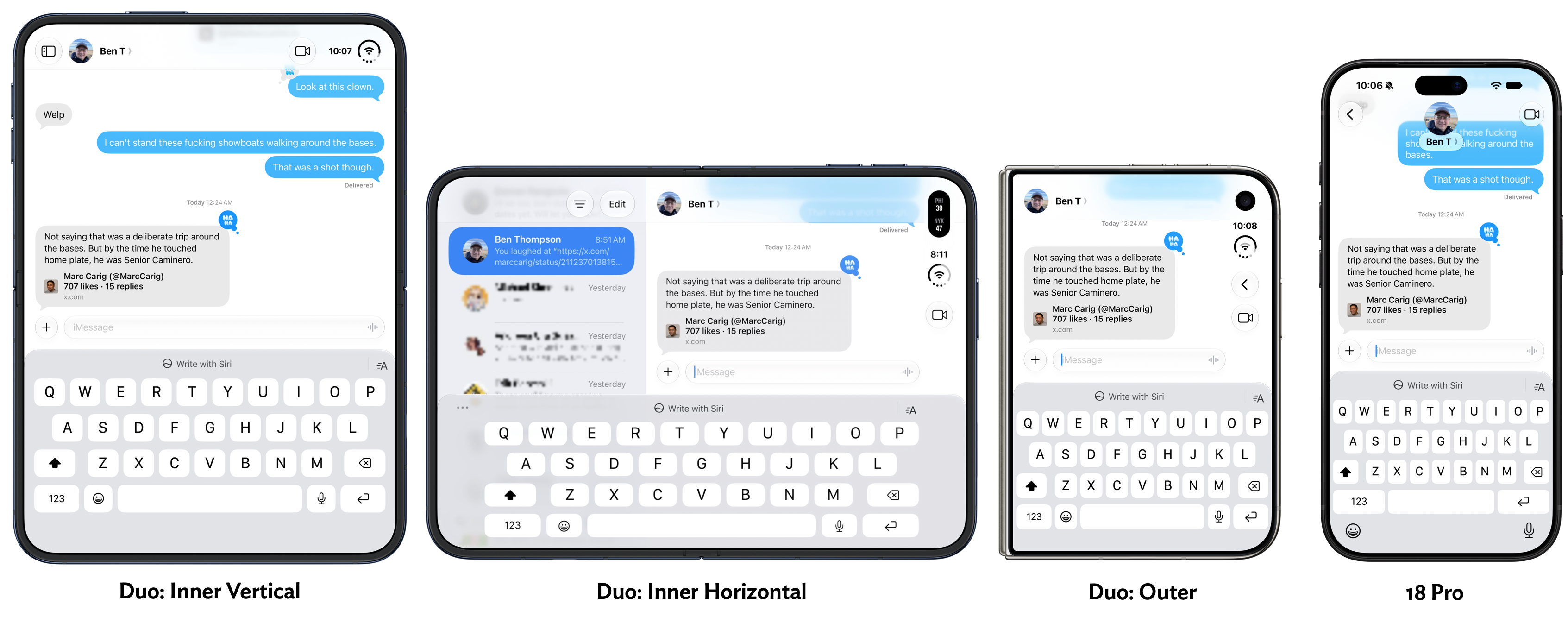
iPhone Duo is here! Excited to have worked on the design of our open/close transition. It’s designed to make the two displays feel like one seamless experience by perceptually bending the focal plane, not the content, so that it feels like opening a window onto a singular view.
Karunamuni thanks a few engineers by name, which is always good (and for Apple employees, far too rare) to see.
Johnnie Manzari, HI designer formerly of Apple, now at Google DeepMind, retweeting Karunamuni:
The second I saw that transition I thought “here’s the next ‘change the whole industry’ design from Chan”.
Previous such raise-the-bar designs that Karunamuni led or played a major hand in include the Dynamic Island in 2022, the “shockwave moment” when you put two iPhones together to initiate AirDrop or NameDrop in 2023, and iOS 18’s cool-ass Flashlight beam UI in 2024. He also gave Steve Lemay this full-throated public endorsement upon his promotion to lead all of Apple HI design upon Alan Dye’s departure for Meta last December.
Friday, 23 October 2026
- The Verge’s Duo Review: ‘Apple’s Folding Phone Is a Messy, Expensive Good Time’ ★
-
Nilay Patel and Allison Johnson (also: 26-minute video review on YouTube):
This means almost every time you open the phone you instinctively rotate it, and while it will work no matter how it’s rotated, it’s better to rotate it counterclockwise so the cameras are on top and the volume buttons are on the top left. Over our week of testing, this started feeling more natural, but it’s exactly the opposite of what you’d initially expect. It’s especially odd in Apple’s bumper case, which has a large notch to expose the Touch ID sensor and camera control, and it looks for all the world like it belongs at the bottom.
You might think this is a little thing, but it’s strange to find yourself slightly unsure of how to hold a smartphone. A nontrivial part of the Duo experience is just reorienting yourself to where the volume buttons are as you flip the thing around. When closed, they’re on top of the phone, but if you rotate the Duo clockwise, they end up on the bottom right, and it’s the top button that turns the volume down because they don’t change orientation with the display. There’s a buried setting in iOS that makes the volume buttons reorient themselves as you turn the Duo around; Apple needs to set it so it works right by default.
Completely agree with them on this — it seems inexplicable that with default settings, while holding the open Duo vertically, if the volume buttons are on the right, you press the up button to lower the volume and down button to raise it.
One other thing to get used to is simply unlocking the phone. Touch ID is integrated into the wake button on the side of the phone. There’s no Face ID at all, and it might take a minute to remember that when you stare at your phone for a beat and wonder why your notifications aren’t unfurling. Ask us how we know. But a week is long enough to get used to Touch ID life again, and it’s mostly painless once you remember you’re supposed to be using it.
Completely disagree with them on this — unless you wear an Apple Watch all day every day.
Re: the cameras, they make this interesting aside:
(It would be cool if you could switch the image preview to the other panel to use it halfway open like a waist-level viewfinder, but you can’t.)
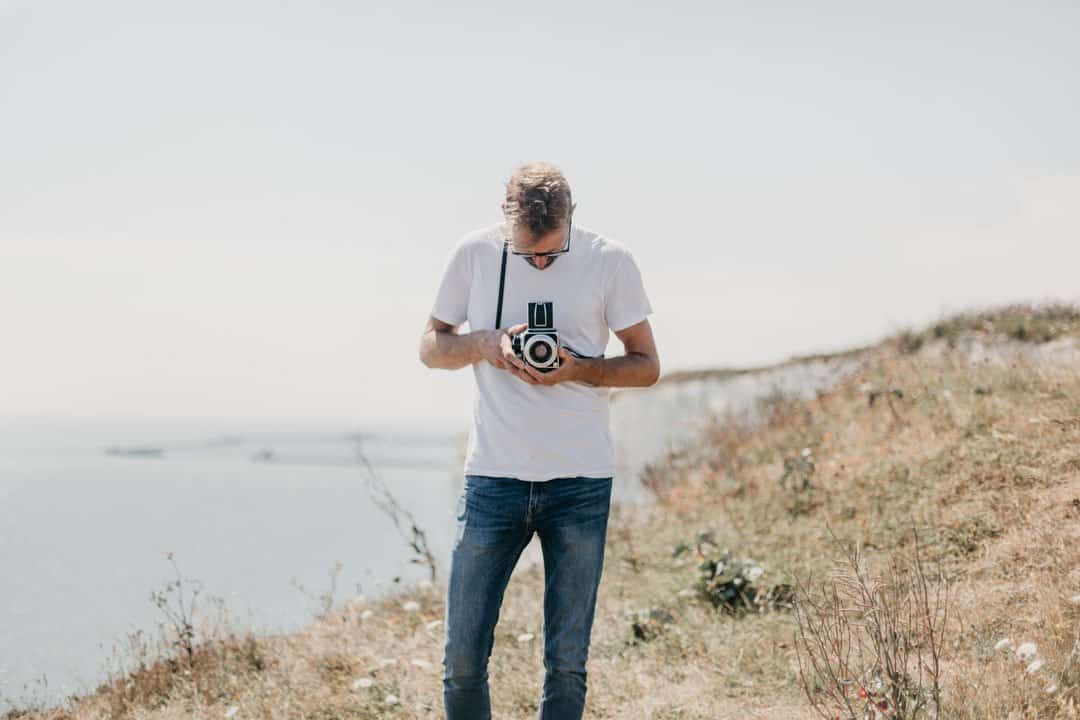
This is a great opportunity for third-party camera apps. Imagine using the Duo in the L-shaped laptop pose, holding it at waist level, looking down — like a Hasselblad 500.
Overall Patel and Johnson are fair and astute, but far more positive about the iPhone Duo than me or Joanna Stern. Don’t get me started on The Verge’s 10-point ratings scale, but they scored the Duo a 7/10, and only gave last month’s iPhone 18 Pro an 8/10. Based on this description of their scale, I’d give the 18 Pro a 10/10 (“best of the best”) and the Duo a 4/10 (“mediocre — has multiple outstanding issues”).
- Joanna Stern Reviews the Duo: ‘The Good, the Bad, and the Buggy’ ★
-
Joanna Stern’s video review packs a ton into 16 minutes. She commissioned a custom robot to fold/unfold the thing over 32,000 times in a week, to see if it loosened the hinge. (I won’t spoil the answer.) She took it on a yacht on the Hudson. She took it to a dark bar to test the cameras. And she really, really missed Face ID. I don’t know how she makes these videos in just a week, along with all the actual testing. So good.
We rank our complaints (and praise) in different order, but overall her take jibes with mine on every single point. You can read a version of her review, too, if you’re a subscriber to The New Things, which you should be.
Thursday, 22 October 2026
- Apple Highlights 50+ iPhone Apps That Have Already Been Optimized for the Duo ★
-
Apple Newsroom:
New editorial collections for iPhone Duo apps and games will go live on the App Store this Friday, with additional app updates rolling out throughout the year. Apps optimized for iPhone Duo are easy to identify with a Made for iPhone Duo badge on product pages across the storefront.
This story highlights dozens of apps that have been optimized. This sort of transition happens every time Apple introduces a major screen change. It happened with the iPhone X in 2017, it happened when the iPhone 6 added a Plus size, it happened when the iPhone 5 changed the aspect ratio from 3:2 to 16:9, and, most memorably of all, it happened when the iPhone 4 went retina. Every time this happens it sucks to some varying degree of suckiness to use apps that haven’t been optimized. And soon enough, all apps still under active development get updated.
Developers know that iPhone users care how apps look and work. iPhone users will switch to competing apps for something like this. I stopped checking Mastodon on my phone for the last week and half because Ivory isn’t optimized. I stopped reading my messages on Signal — I just wait until I’m back at my desk. If I bought a Duo, I’d literally stop using Signal if they don’t update their app soon. Life’s too short to use shitty apps. iPhone developers get that.
Out of all those transitions I listed above, my gut feeling is that there are more third-party apps ready to go on day one for the Duo than for any of those previous transitions. No, it’s not all apps. Some of the apps that aren’t yet updated are quite popular, and others are ones that users can’t easily just switch away from (like, say, your bank’s app). But developer support is not a problem for the Duo. If anything the launch of the Duo has exemplified better than any event in iPhone history just how different the iPhone and Android developer communities are. “Flagship” Android foldables have been out for over 7 years and developer support for them today remains nothing close to developer support for the Duo — and the Duo doesn’t even launch until tomorrow.
- Updates to My iPhone Duo Review ★
-
Nothing major, but since publishing at 7:00pm last night, I’ve made a few additions and changes to my iPhone Duo review. I’m calling them out here, so that if you’ve already read it, you can see the changes. If I make more, I’ll add them to the top.
Regarding the camera, added and/or clarified the following (in bold):
As for the camera itself, it’s terrific. It’s clearly not of the same caliber as the iPhone 18 Pro, but it’s good. The technical specs of the Duo’s main 1×/2× camera are nearly identical to those of the year-ago iPhone Air, and I love the iPhone Air’s camera. If anything, the Duo’s camera should be better, because it gets the year-better A20 Pro imaging pipeline. Which, notably, brings support for the same new Photographic Styles, including textures like film grain, that were introduced with the iPhone 18 Pro. However, the Duo is not “Pro” — it does not get camera features like “Pro controls” (variable lens aperture, shutter speed, white balance, histogram), Apple Reference Image, spatial video, ProRes (video or RAW), or Apple Log. Apple’s “shot with iPhone” keynotes will continue to use iPhones Pro.
Also, notably different from the Air, the Duo has an ultrawide 0.5× second camera lens. This brings both the ultrawide perspective and macro photography. Like the Air, the Duo’s main 1× camera has a minimum focus distance of 15cm. That’s closer than the 17 and 18 Pro cameras (20cm), but there are a lot of times you want to snap photos of receipts or documents closer than 15cm. With the Air, you can’t focus closer than 15cm, because it only has that one camera. With the Duo, you can focus on subjects down to just 2cm away, using the 0.5× lens or the 1× lens in “macro” mode (which switches to the ultrawide lens but sensor-crops to the 1× field of view).
Regarding the security of “Unlock with Apple Watch”, I added this note:
(It’s worth noting that the wrist tap on your watch for this gives you a button to tap to lock your iPhone immediately — it’s not just a notification that it happened, it presents you with an action to undo it.)
Added this note (in bold) about it occasionally rotating (uncomfortably) in pocket, because it happened to me again twice today:
It does not go into or out of my jeans pocket smoothly. Sometimes, in my pocket, it rotates 90 degrees, which is uncomfortable. Folded up it never stops feeling heavy. It is heavy, compared to other iPhones.
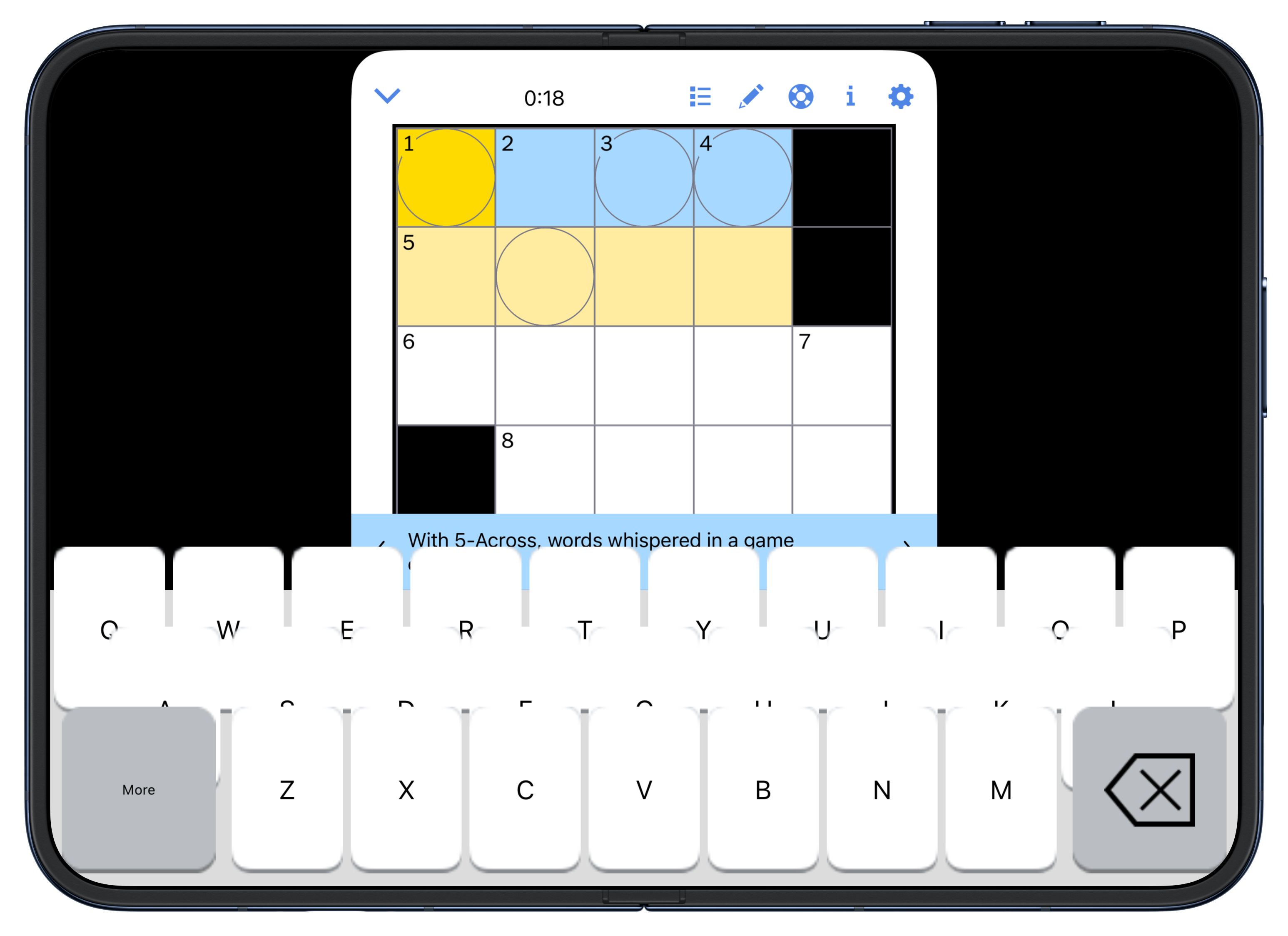
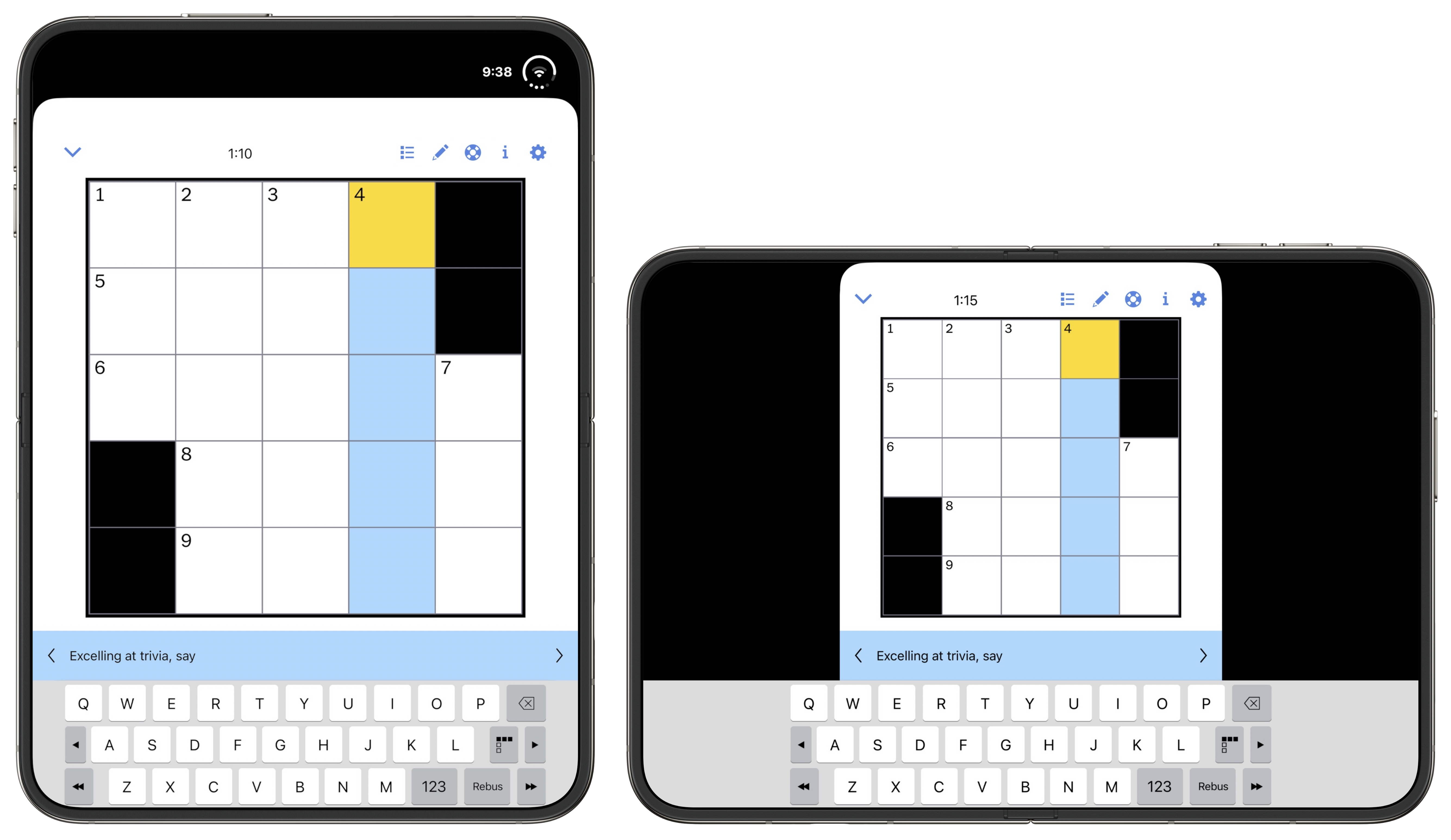
Added this updated regarding the janky crossword keyboard in the NYT Games app on the Duo’s inner screen:
[Update, Thursday: One day later and there’s an updated version of the NYT Games app, and they’ve fixed the orthodontic mess of their crossword keyboard, in both orientations. Screenshot. This goes to show just how fast the Duo-optimized updates are streaming in from developers. My review was up-to-date when I published at 7:00pm ET Wednesday, and outdated by the time I woke up Thursday morning.]
Monday, 19 October 2026
- Barack Obama on the Trump Administration’s Intimidation Campaign Against Congresswoman Ilhan Omar ★
-
Barack Obama, in a 430-word essay:
It is a basic principle of American democracy that the government can’t selectively target individuals simply because of their political beliefs or what they say. But that’s exactly what the Trump Administration is doing to Congresswoman Ilhan Omar of Minnesota. [...]
The fact that any president, or any administration, is willing to engage in such transparent efforts to intimidate someone should outrage all Americans, regardless of how they feel about Congresswoman Omar’s political views. Because if this becomes the new normal, there’s no reason to believe it will stop with her — or that future presidents, in either party, won’t do the same.
Thoughtful, sharp, and eloquent as ever.
But Obama posted this essay on X, which, I have been told in the past week, shows that he in fact is a Nazi sympathizer, a fascist, a pedophile, and unconcerned about racism. As surprised as I was to learn those things about myself, I’m equally surprised to learn them about President Obama, whom I heretofore considered a thoughtful statesman and moral compass.
Either that, or, Threads, Bluesky, and Mastodon have relegated themselves into irrelevance by allowing their discourse to be dominated by a fringe of unhinged kooks who want to be angry and want everyone else to be angry.
- From the DF Archive: Should a CEO Be a Nerd About Their Company’s Products? ★
-
Back in 2022, I quoted from an interesting post by Ben Schlappig at One Mile at a Time, where he wrote:
I’ve had the opportunity to interact with quite a few senior airline executives over the years, and I find that their knowledge about competitors is typically one extreme or the other:
- Some airline executives literally couldn’t tell you the first thing about their competitors, and have no knowledge of their passenger experience, fleet, etc.
- Some airline executives know literally everything about their competitors, down to being able to tell you how many seats competitors have on specific planes
I find there are very few executives who are just kind of in the middle, as it’s pretty polarizing. Either they know virtually everything about competitors, or nearly nothing. Without naming any names, I’ll say that generally speaking there’s a high correlation between airlines that have a great passenger experience, and airlines that have executives that keep very close tabs on the competition.
And I wrote:
If the CEO’s primary perspective on the company is via spreadsheets — if it’s all just P&L to them — that company is not going to excel at quality. Or if they do excel at quality, they won’t for long.
I think Tim Cook was truly an exception in this regard. He’s not a product guy, and never pretended to be. He is a spreadsheet guy. But he clearly realized that about himself, and he understood that Apple’s entire point is delivering great products and experiences. But I think Ternus is a breath of fresh air in this regard. Apple didn’t immediately switch to decision-making by quantifiable numbers under Cook, but incrementally, year-by-year, decision-making by quantifiable numbers took over.
You simply cannot assign numeric values to everything, and some of those things that cannot be quantified are the most important things. Apple needs a CEO who makes some major product decisions by gut alone.
- Apple Event, in Los Angeles, Next Week: ‘Pro and Tell’ ★
-
Greg Joswiak, on X:
Can’t wait to pro and tell next week.
Rumors suggest Apple is planning to debut the new MacBook Pro with an OLED touchscreen display, an M6 entry-level MacBook Pro, an M6 iMac, an iPad mini with an OLED display.
- Netflix Shitcanned Film Chief Dan Lin Too ★
-
Anthony D’Alessandro, reporting for Deadline:
Dan Lin is out as film boss at Netflix in a move that has been largely speculated for weeks. Insiders at the streamer have denied that Lin and even Bela Bajaria were on the chopping block, but here we are.
Lin is meeting with his feature staff Monday morning for a post-mortem after the news. Per sources close to the situation, a successor to Lin won’t be named until the arrival of Peter Rice, who is taking over Netflix’s Chief Content Officer role from Bajaria.
Netflix’s movies are worse than their series, which also mostly stink. (As opposed to Apple TV, which somehow makes terrible movies while making the best series in the business.)
it has long been understood that, qualitatively, a “netflix movie” exists in the liminal space between theatrical release and Lifetime production
with some notable exceptions, even the biggest budget productions feel cheap, strange and worst of all, unmemorable
- Ex-Apple Employee Fred Potter on HomeView ★
-
Fred Potter, on LinkedIn:
So if you ever meet someone who tells you, “At Apple, I’m the one who did this,” take it with a grain of salt. They were probably part of the team that made it happen, and that’s already something to be proud of.
Sometimes, when the final product finally comes out, you can recognize a few of the personal touches you contributed along the way. And that, in itself, is immensely rewarding.
Wishing HomeView every success!
Potter’s LinkedIn bio lists his time at Apple as July 2021 through June 2024, and describes it only as “Worked on HomeView”. (Via Christophe Laporte at iGeneration.)
- Netflix Lays Off 6 Percent of Staff ★
-
Joe Flint and Jessica Toonkel, reporting for The Wall Street Journal last week:
Netflix is cutting 6% of its staff, or roughly 1,000 positions globally, its biggest round of layoffs since 2022, as it struggles with slowing growth and customer engagement. Co-Chief Executives Greg Peters and Ted Sarandos said in an email to employees Wednesday morning that the bulk of the cuts would be in the streaming giant’s product, tech, legal and human-resources teams.
The layoffs may have hit those teams (including some of the talent that created the excellent Duo support for Netflix’s iOS app), but Peters and Sarandos seem to know where the fundamental problem lies: Netflix has peaked and their content blows.
Flint, in a follow-up report the next day, “Netflix Replaces Content Chief as It Struggles to Engage Viewers”:
Netflix’s Chief Content Officer Bela Bajaria is leaving the company, as it struggles with slowing growth and falling customer engagement.
Yours truly, back in August: “Netflix Has Peaked”.
- Time Magazine Profiles John Ternus ★
-
Andrew Chow, writing for Time:
Just below the broad smile he’s been wearing all morning, John Ternus’ hands are shaking.
On this September day in Silicon Valley, Apple’s new CEO is surrounded by celebrities, tech enthusiasts, and reporters who have flocked to Apple Park from around the world to catch a glimpse of the company’s new and long-awaited foldable phone, the Duo. After Ternus takes a few photos with the device, an Apple PR rep pulls the influencer known as IShowSpeed out of the crowd to meet him. Winning over the 21-year-old isn’t exactly the toughest assignment Ternus has faced in his 25-year Apple career: Speed barks when he sees the phone and then gleefully springs into a backflip.
But IShowSpeed also happens to be livestreaming the encounter to his 61 million subscribers on YouTube. And as Ternus thumbs through the $1,999-and-up phone, attempting to drag a photo into a text-message box, eagle-eyed viewers notice his hands quivering. Ternus later explains that he didn’t sleep much the night before. “I was on such a moment of adrenaline and caffeine and excitement for the day,” he tells Time.
There’s only a glimpse of Ternus’s personality revealed here. To date he’s more of a cipher than even Cook. He’s Apple’s San Francisco sans serif typeface brought to life. Handsome, distinctive, decidedly “Apple” — but plain. That, surely, is not the real John Ternus.
So it’s fitting that his ascension coincided with the announcement of the Duo, Apple’s most radical design change to the iPhone since its 2007 release. Apple has been exploring the concept for years. In 2011, when many people still carried around flip phones, Ternus and five other engineers filed a patent application for foldable electronic devices, exploring what kind of batteries and circuit boards might be needed for such an idea. “It felt clear that we were going to eventually get to a place where OLED displays were going to be flexible,” Ternus says.
The Ternus profile is the cover story for Time’s “Best Inventions of 2026”, which is led by the iPhone Duo. Let us not forget that this esteemed accolade was awarded to Humane’s AI Pin in 2023.
At the end of September, Apple was conspicuously absent when President Donald Trump hosted a luncheon for AI power players like SpaceX’s Elon Musk, Meta’s Mark Zuckerberg, and Google’s Sundar Pichai, who lobbied him on their visions for America’s tech future.
But Ternus and other Apple executives say they aren’t concerned. In the midst of a populist AI backlash, they contend that they are building a modest but personalized and privacy-preserving form of AI that will actually help ordinary people as opposed to merely dazzling Silicon Valley’s “lunatic fringe,” as Greg Joswiak, senior vice president of worldwide marketing, puts it. And besides, Ternus argues, even if other companies succeed in their mission of building super-intelligence, users will still want to talk to it on Apple devices.
This is, I’m convinced, the correct strategy for Apple. They’re smart not even to be ankle-deep in the wild capex spending pool that has all of their peer companies way out in the deep end, where their feet no longer touch the bottom. But this is a bet, and bets carry risk.
Also, I’d bet my bottom dollar that Joswiak is, in fact, a decades-long fan of Lunatic Fringe.
Sunday, 18 October 2026
- Tom the Dancing Bug’s Inner Hive, and Harvey Richards, the Greatest Lawyer in the History of Fiction ★
-
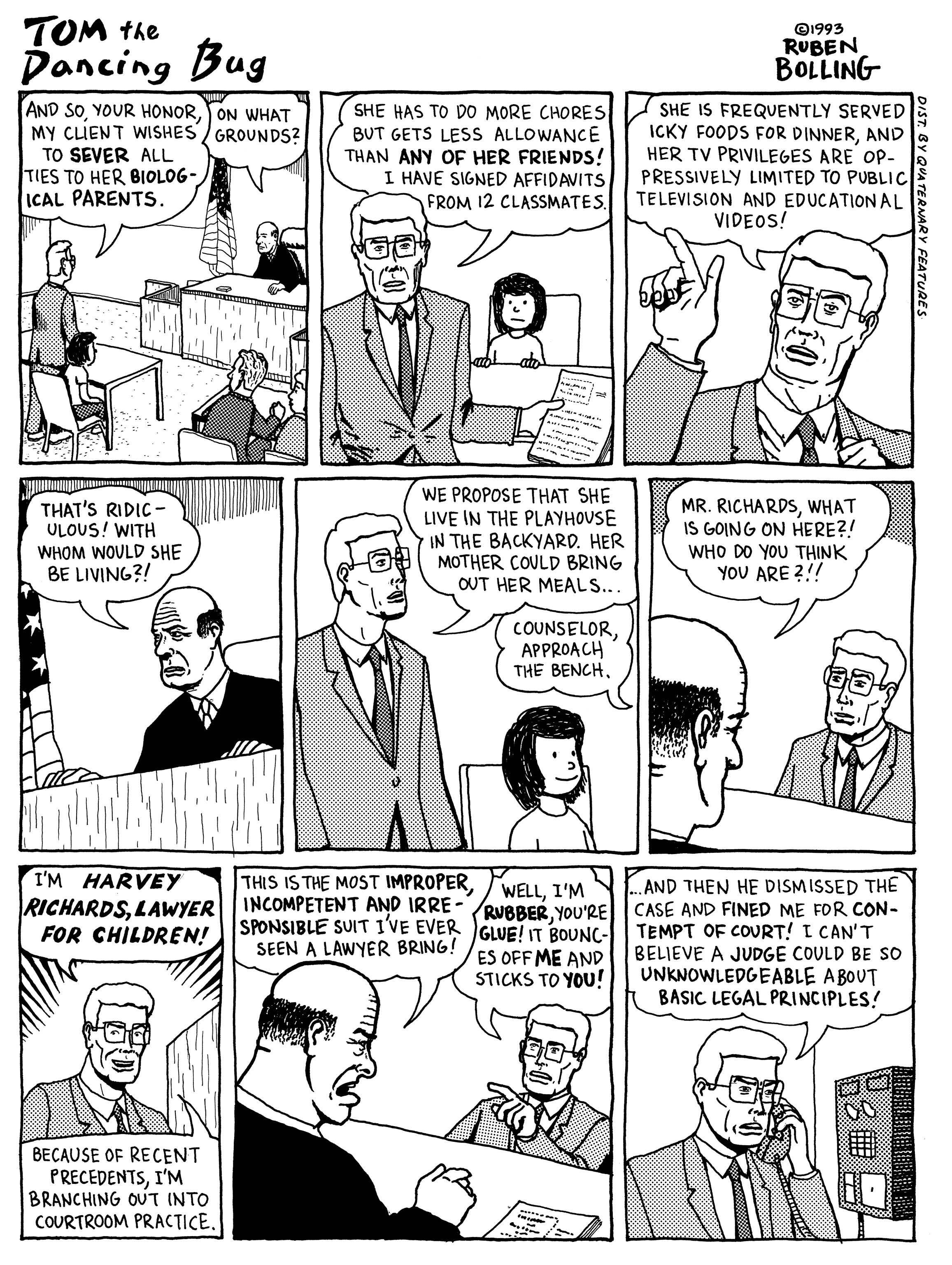
Ruben Bolling’s long-running Tom the Dancing Bug is one of my favorite comic strips. I’ve been a huge fan since the early 1990s, when I started reading it in alternative newspapers. (Newspapers were sort of like websites, excepted they were printed daily or weekly. I swear.) Back in 2012 Bolling — noting that the comic was more widely read than ever yet generating less money than ever — started a subscription membership called The Inner Hive. I love it. Not just because I’m supporting work that I adore and value, but because the extras that members get are so fun. If you’re even half as big a fan of Tom the Dancing Bug as I am, you should join too. There are several options — Patreon, MailChimp, Substack — but in my opinion Patreon is the simplest and the best, and it gets you everything.
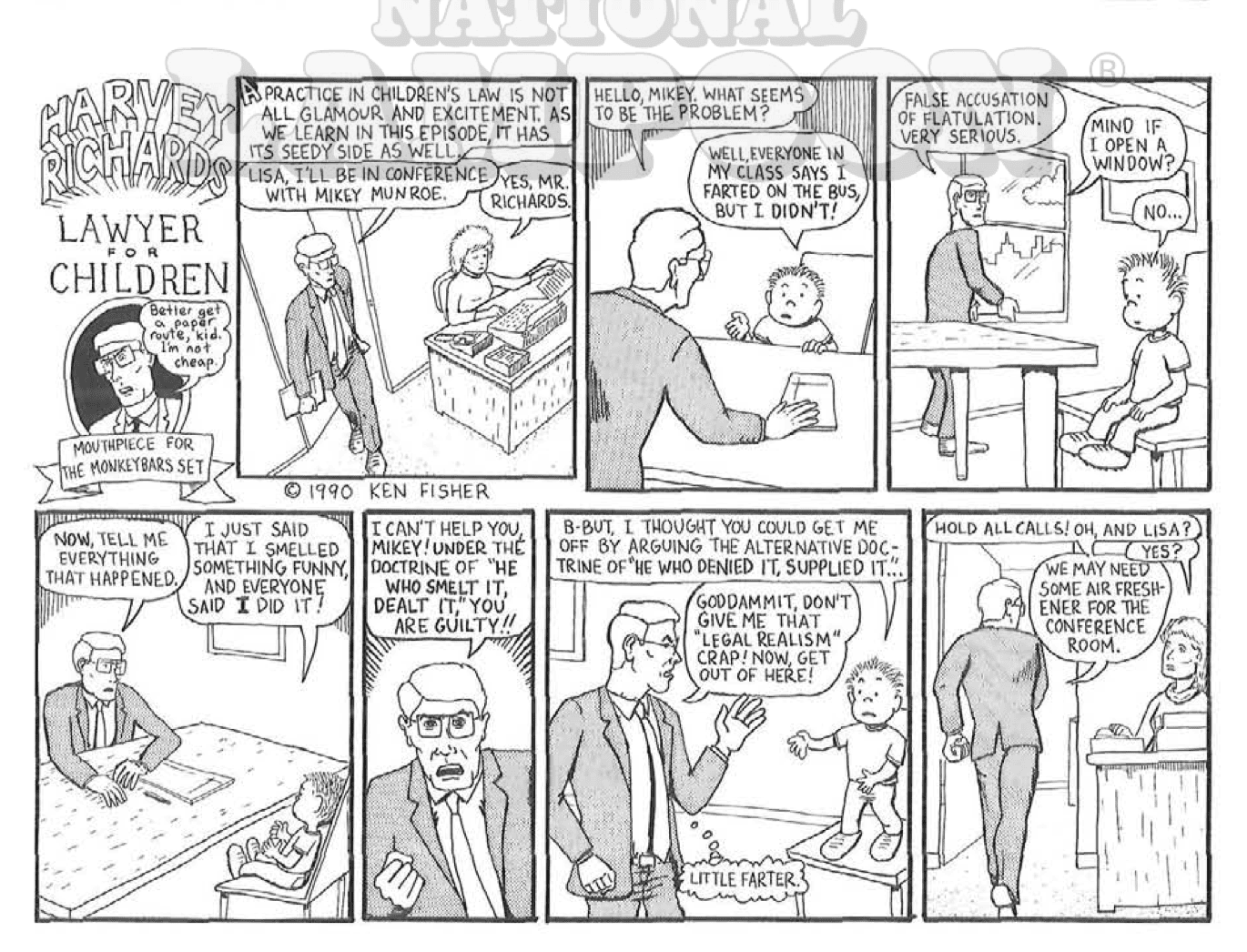
I was reminded to re-endorse The Inner Hive after I wrote a post last night referencing Harvey Richards, lawyer for children — one of the comic’s longest running recurring characters. Tom the Dancing Bug’s entire schtick is premised on a wide array of recurring characters and premises, but Richards is probably my favorite. Here’s an early one regarding the doctrine of “He Who Smelt It, Dealt It” that ran in National Lampoon in 1990. Here’s one from 2012 at Boing Boing (where Bolling is a contributor), and here’s one from 2018 where Richards joins the Trump 1.0 White House, and specifically invokes the “I’m Rubber, You’re Glue, Everything You Say Bounces Off Me and Sticks to You” doctrine that I mentioned as a Richards specialty in my post yesterday.
But the thing is, my earliest memory of Harvey Richards was regarding the “I’m Rubber, You’re Glue” doctrine. It’s the foundation of all of children’s law, obviously. In my memory, it’s the first thing I remember about Harvey Richards in the strip. But I searched the web, and couldn’t find any old strips with it. I asked the LLM robots to search, and they came up with nothing. So I wrote to Bolling, with whom I’ve exchanged occasional correspondence for many years. Bolling not only confirmed that my memory isn’t entirely shot, but he graciously granted me permission to reproduce it here. It’s from 1993, when I know I was already a weekly reader of the strip.
- WorkOS AuthKit ★
-
My thanks to WorkOS for sponsoring DF last week. Login looks simple until you’re building password resets, email verification, MFA, social providers, session management, and the enterprise SSO your first big customer asked for last week.
WorkOS AuthKit lets you:
- Offer SSO, MFA, passkeys, passwords, email codes, and social sign-in.
- Add and remove users automatically with SCIM provisioning.
- Track who did what with audit logs.
- Verizon Is Going to Charge $10/Month for iPhone Handoff ★
-
Verizon, in a post headlined “Switch to Verizon and Get the New iPhone Duo Now. No Trade-In Needed.”:
Verizon will support iPhone Handoff, giving customers the flexibility to use a single Verizon phone number seamlessly across two compatible iPhone models. Whether using the pocketable iPhone Duo on the go or iPhone 18 Pro for work, customers can switch active status between devices at any time while keeping full access to Verizon’s 5G network. iPhone Handoff will be available from Verizon for $10/month on compatible iPhones models running iOS 27.
First, the word “now” is doing a lot of work in that headline, given the current January 25 estimate for new Duo orders.
Second, we all know Verizon is the most expensive competent carrier in the U.S. (Maybe AT&T is just as expensive, but I said “competent”.) It feels like a rip that T-Mobile is charging $5/month. Verizon charging double is on-brand but irritating.
- Gurman on HomeView: ‘Finished Units Have Been Sitting Boxed Up in Warehouses for the Better Part of a Year’ ★
-
Mark Gurman, today, in his weekly Power On column for Bloomberg (gift link):
Without a serviceable version of the new assistant, Apple couldn’t deliver the experience it had envisioned. That left the hardware ready to go, but the software nowhere near finished.
So Apple postponed the HomeView repeatedly — first until spring 2025, then summer, then fall, and then again throughout 2026 before finally unveiling it this past week. And the hardware betrays its age. With thick bezels, an A18 processor and 8 gigabytes of memory, this is clearly a product conceived years ago. Finished units have been sitting boxed up in warehouses for the better part of a year, waiting for the software to catch up.
The A18 chip and 8 GB of RAM aren’t a sure sign of delay; this year’s MacBook Neo has the 18 Pro chip and only 8 GB RAM, and wasn’t delayed. And if a kick-ass MacBook can get by with an A18-class chip and 8 GB RAM, surely a HomeView can too. HomeView only does a fraction of what a Mac can do, and the MacBook Neo is perhaps Apple’s best new product in years, full stop.
But I have no reason to doubt Gurman that this hardware was finished and production started long ago. His reporting on this product has proven out going back two years. Parts of Apple clearly — and disastrously — believed that a credible version of Siri AI would ship in early 2025. You might recall my writing about that. HomeView clearly depends on having a credible version of Siri AI behind it. But Siri AI didn’t ship until last month.
One revealing sign of how long this thing has been in development: I spotted several posts on social media from former Apple employees proudly touting their work on the HomeView. These weren’t people who had just left the company, either. Some hadn’t worked at Apple in quite a while, yet were still able to point to the newly announced device as something they helped create. That tells you plenty about how long ago much of the work was completed.
That’s juicy, but it might have been good to include some links here?
- Claim Chowder: The Information on HomeView Having a ‘Robotic Swiveling Base’ ★
-
Wayne Ma and Qianer Liu, reporting, wrongly, for The Information in January this year (paywalled; here’s MacRumors’s summary)
Apple’s pin joins a growing portfolio of AI-powered products the tech giant has under development, including AirPods equipped with enhanced sensors, a security camera, smart glasses and augmented reality glasses, according to multiple people familiar with the projects. Apple is also working on a home product featuring a small display, speakers and a robotic swiveling base, designed with a heavy emphasis on AI features. That device could be released as soon as this spring, according to two of the people.
Wrong. So I’d say that the stupid-sounding “AI pin” that these same “people familiar with the matter” told Ma and Liu about is probably equally wrong. (That supposed “AI pin” was the main thrust of the article.)
I love to point out when Mark Gurman is wrong, which is not infrequently, but in the case of HomeView he’s seemingly been right about everything going back to 2025. He reported back in April 2025, with codenames, that the initial HomeView (J490) had no robotics but that a subsequent version (J595) would — or at least might. Two dinguses heard a rumor about J595 and told The Information it might ship six months ago, when in fact it’s something that won’t ship until 2027 or 2028 at the earliest. But The Information ran with it.
The phrase “familiar with the matter” often just means “who heard something about it from someone who goes to the same gym as a guy whose wife works at Apple”. Substitute that longer phrase whenever you see “people familiar with the matter”.
- Apple Issues Statement on Duo Demand Far Outstripping Supply ★
-
The Financial Times:
Apple had originally promised delivery of the Duo by October 23, but within hours of orders opening, delivery times through Apple’s website had slipped into late January. US mobile carriers also saw delivery times for new orders pushed back.
“The pre-order demand for iPhone Duo, our first foldable iPhone, has been nothing short of extraordinary,” Apple said in a statement. “We are working hard to get this revolutionary new product into customers’ hands as quickly as possible,” it added.
Of course Apple is going to play it this way. I would too. But no one other than Apple’s operations teams knows how low the initial supply is. Just judging from my friends and my social media feeds, I think demand is quite strong for a device that starts at $2000. But I think initial supply is incredibly low.
To that point, Hartley Charlton has a nice scoop for MacRumors:
Apple Store employees told MacRumors that they have been advised that there will likely be no iPhone Duo stock available for walk-in purchases on launch day. Staff have been instructed to discourage customers without pre-orders from coming in expecting to buy the device, warning that they will be disappointed. [...]
Warnings about a constrained launch began well before Apple announced the iPhone Duo. In early September, Nikkei Asia reported that production had reached only a few hundred devices per day in late August. Further production problems emerged in late September.
I suspect this means Apple is going to discourage, if not disperse, anyone attempting to camp out overnight on Thursday outside Apple stores.
That said, a few hours after pre-orders opened Friday morning, ship dates went to January 25. They’re still at January 25, as I write this Sunday afternoon. So it seems Apple expects to greatly increase production in the next two months. I bet a lot of those “January 25” pre-orders wind up delivering weeks before that. Apple has a strong history of under-promising and over-delivering when new products are backordered.
- Manton Reece’s Spitball Theory on Why the Wall-Mounted HomeView Costs the Same as the Version With the Subwoofer Base ★
-
Manton Reece:
All I can come up with is that Apple doesn’t want you to buy the wall-mounted version unless you’re really sure that’s what you need. If the wall-mounted version was cheaper, some people might buy it based on price, then be unhappy because it’s too much trouble to install.
Oh, that clicks for me.
- Michigan Democratic Senate Candidate Abdul El-Sayed on His Allegiances ★
-
I do see some political content in my feed on X. For example, this extraordinary video posted by Abdul El-Sayed, who seems poised to become the next junior senator from Michigan. You should watch it. It’s so good you might suspect the questioner was a plant, but in fact, he was not. This actually happened. El-Sayed actually handled this heckler this well, on the fly. And he posted it on X, where it’s garnered 9 million views. He posted it on Bluesky too, if you’d prefer that. El-Sayed hands this guy his (red) hat so soundly it’s like something out of an Aaron Sorkin script: “So I think it’s you who needs to understand the Constitution, not me.”
Update: This guy “Tommy” was in fact a plant — a plant from the Republicans. The best way to understand the political re-sorting that Trumpism has created isn’t left/right or conservative/liberal. It’s smart/stupid. There are and always have been stupid people everywhere — on the left, on the right, at the top, at the bottom. But Donald Trump turned the Republican Party into one that celebrates stupidity and ignorance. That this dope Thomas Teepell was a Republican operative whose stunt blew up in his face, Wile E. Coyote style, exemplifies that.
Saturday, 17 October 2026
- Whatever You Say Bounces Off Me and Sticks to You ★
-
Stephen Nellis and Deepa Seetharaman, reporting Wednesday for Reuters:
An OpenAI employee who left the ChatGPT maker for Apple sent more than 100 files about an unreleased product to a personal account and later made a presentation about the unreleased product to senior Apple leadership, a new filing in the lawsuit between OpenAI and Apple alleges.
In the filing in US federal court in San Jose, California, OpenAI alleged that the presentation happened months ago and that Apple is now making AI products of its own, citing the release of Apple’s HomeView product this week.
“OpenAI is very concerned that its trade secret and confidential information is now circulating inside Apple, where Apple engineers can shape Apple’s upcoming products based on OpenAI’s confidential and innovative work,” OpenAI said in its filing.
I see OpenAI has added Harvey Richards, the world renowned lawyer for children, to their legal team, to present the “I’m rubber, you’re glue” defense.
- Apple TV Price History, Charted ★
-
Glenn Fleishman:
I wondered what the entry-level, initial price of each Apple TV box at introduction was, from the March 2007 original to the Apple TV 4K (4th generation) announced October 13, 2026, adjusted for inflation. So I charted it.
I suppose this doesn’t mean Apple has given up on making Apple TV content accessible, but the price-accessible path is just using the Apple TV app on the crapware OS your “smart” TV runs.
Friday, 16 October 2026
- The Late Charlie Munger on Elon Musk and Tesla ★
-
Re: my post today on the still-vaporware Tesla Roadster and Benedict Evans’s maxim that “Elon Musk is a bullshitter who delivers”, a reader sent me this YouTube short of Charlie Munger’s answer to a question at Daily Journal’s 2020 shareholder meeting regarding Tesla’s volatility and Musk’s self-promotion. Munger said:
My thoughts are two. I would never buy it, and I would never sell it short.
[Audience laughs.]
I have a third comment. There was a man out in Los Angeles for years named Howard Ahmanson. He once said something that I’ve taken to my heart: “Never underestimate the man who overestimates himself.” I think Elon Musk is peculiar and he may overestimate himself, but he may not be wrong all the time.
- Apple: ‘Strengthening App Review Guidelines Against Nonconsensual Intimate Imagery and Bait-And-Switch Apps’ ★
-
Apple Developer News:
As outlined in our App Review Guidelines, pornographic material has long been prohibited on the App Store — this includes apps that generate nudity or sexually explicit imagery, such as “nudification” apps that create sexually explicit images of real individuals without their consent. Apps that host user-generated content are required to filter objectionable material, give users a way to report offensive content, and let users block abusive accounts. Apps containing hidden or undocumented features are also prohibited on the App Store, including apps that misrepresent their purpose during review and only reveal harmful capabilities — such as “nudification” — after approval, a tactic commonly known as bait-and-switch.
Their post includes the specific changes to the guidelines. Let’s hope the guideline changes are accompanied by better enforcement.
Of course, it’s worth noting that the best known perpetrator of AI-generated non-consensual nudification is X, which (checks notes) is where Apple executives do all their social media posting, and which, yes, I argue once again marks the spot in the zeitgeist. The zeitgeist is not clean.
- Apple TV Started at $69 in 2015 ★
-
Joe Rossignol, reporting for MacRumors back on 9 March 2015:
Apple CEO Tim Cook on Monday at the “Spring Forward” media event in San Francisco announced that Apple TV will now cost $69, discounted from its regular price of $99. The new price for the set-top box arrives on the heels of the announcement of HBO Now for Apple TV. The new price appears to apply to the third-generation Apple TV, as the company did not announce a new set-top box on stage at the Yerba Buena Center this afternoon.
Basic Apple Guy posted a short clip of Tim Cook, on stage, announcing the price reduction. Cook said:
And it’s got a very attractive entry level price of $99. But today, we would like to make it even more accessible for more people so they can take advantage of this great new content. So we are lowering the price today to $69.
The audience greeted this with whoops and cheers. (This, despite it being a smaller media event — Apple always packs the front of the house with employee ringers. Whoops and cheers are one of the things Apple is missing out on with their post-COVID pre-filmed keynotes.)
Apple continued selling the 3rd-gen Apple TV (not to be confused with “Apple TV 4K”, which restarted the generation counting in 2017 alongside the introduction of the iPhone X) for $69 until October 2016.
Inflation adjusted, a $69 Apple TV box today would cost a little under $99. Even if we only consider the $99 price in 2015 dollars, that’s about $137 in today’s dollars. Round that up to $150 and it would still be half the price of the only Apple TV hardware Apple now sells: this week’s new 4th-gen Apple TV 4K.
The new Siri Remote, with precision Find My support (and a speaker), is compatible with all prior generations of Apple TV 4K. So if you just want the new remote you can just buy the new remote. But it costs $59, which is almost as much as an entire Apple TV (with remote, of course) did in 2015.
- Strange Times Make for Strange Bedfellows ★
-
Mark Zuckerberg, on X:
Muse Spark Open — weights releasing today — runs great on new Mac Studios thanks to work with @johnternus and Apple.
Congrats to the team! Amazing to run a model of Muse Spark Open’s caliber and scale this efficiently, right from your desk. Mac Studio keeps pushing the boundaries of on-device AI!
You will recall that the M5 Ultra Mac Studio with 512 GB RAM is set to ship by “the end of October”, and we’re midway through the month. You will also recall, from that same announcement, that multiple Macs can be clustered together via Thunderbolt — four Mac Studios can be connected to each other.
For Ternus, I could do without the second exclamation mark. For Zuckerberg, it’s fascinating that he had to post this on X, despite owning Threads, because no one at Apple uses Threads.
Zuckerberg has been posting somewhat regularly to X for months now, particularly regarding AI. Alex Heath asked him about it on his Sources podcast a month ago. From that one-minute clip:
Threads is doing great. I think it’s actually ... either bigger than X at this point, or it’s like very soon about to be. But, I mean, look, there are different communities in the different places. There’s a lot of AI folks on X, and I think part of what you try to do with social media is just communicate where people are, right?
Lastly, there’s this “1984” spoof posted by Alexandr Wang, Meta’s chief of AI and mulletry, which I find both amusing and painful.
- How They Got Duo Support in NetNewsWire ★
-
From the NetNewsWire blog:
The latest version of NetNewsWire for iOS supports iPhone Duo, which is very much a novel iPhone with toolbars running up the side and all kinds of behavior.
How we did it: we didn’t do any work at all. We built the app using Xcode 27.1 and the default iOS SDK that comes with it, and that’s it.
Here’s the thing, though: we were already using standard controls — toolbars, navigation controllers, split views, etc. — and we were paying attention to size classes and such (as opposed to just looking at device type).
Develop your app the right way and, depending on the app, it might literally be no work at all to produce a great version for the Duo. Develop your app the wrong way and it might take months. NetNewsWire is one of my most-used apps. I keep it in my home screen dock, alongside Messages, Notes, and Safari. It would drive me nuts to use a Duo without a version of NetNewsWire that adapts to the Duo’s novel display sizes.
- Shyam Sankar, CTO of Palantir, Says AI Researchers Have Started Smoking Because They’re Convinced AI (Claude, Probably) Is Going to Cure Cancer ★
-
From the transcript of Sunday’s Face the Nation on CBS:
Shyam Sankar: You know, I take — I think there’s a profound truth to Pascal’s saying that every human has a god-shaped hole in their heart, and it’s important to understand that many of these folks in Silicon Valley who are building this technology have filled that hole with the machine God of AGI. And I mean, there’s so many interesting stories around this. Like, for example, so many AI researchers have started smoking as a way of signaling to other researchers how much they believe in AI. I believe so much — (CROSSTALK)
Margaret Brennan: What? That makes no sense. What do you think —
Shyam Sankar: I believe so much in AI that it’s going to cure cancer. So I will — I’m showing you my chips are all in. So there is kind of this mass psychosis, social delusion around it, and I think it’s getting in the way of actually what is happening with AI.
Sankar doesn’t name anyone, alas, but if there’s any truth to this (and good god do I hope there is) it’s got to be Anthropic researchers specifically. They’re the religious kooks who believe they’re creating an AI god and hold the psychotic belief that Claude is already conscious. Smoke ‘em if you got ‘em, you crazy fucks.
Via Ben Collins, CEO of The Onion, who notes that the nation’s finest news source was on this story 13 years ago.
- iPhone Duo Pre-Orders Launched, and Three Hours Later It’s Sold Out Through the End of January ★
-
Joe Rossignol, MacRumors:
If you were hoping to surprise someone with an iPhone Duo for Christmas, you might be out of luck, as Apple’s online store in the U.S. is already showing an estimated shipping date of January 25 for all configurations following the start of pre-orders today.
It is possible that some Apple Stores will have the iPhone Duo available for walk-in customers on Friday, October 23 launch day, but it seems likely that inventory will be very tight.
I suspect it’s a combination of high demand and low supply but I doubt we’ll get any insight on that from Apple itself. It’s in their interest to let people think demand is simply very high, and not draw attention to their production limits.
I feel for the folks on the West Coast who woke up for a 5:00am start and still got stuck with December or even January ship dates. This is one of those times where it’s frustrating that, per Apple’s consistent schedule, pre-orders always start before reviews appear. People are left to guess whether they’re going to like it without any word from people who’ve used it.
Thursday, 15 October 2026
- Secret Documents Reveal Donors Behind $330 Million for Trump’s Ballroom – Apple and Nvidia Top the List at $25 Million Each ★
-
Jonathan O’Connell, Sarah Blaskey, and Aaron Schaffer, reporting for The Washington Post (News+ link; Archive.today link):
A list obtained by The Washington Post reveals all the major donors to President Donald Trump’s White House ballroom project, including previously undisclosed contributors who have benefited from regulatory decisions, government contracts and, in one case, a pardon for a family member.
Tech giants Nvidia and Apple each committed $25 million, the top contribution amount, the list shows. The Adelson family, one of the GOP’s largest donor dynasties, committed that sum as well, as did billionaire Charles Ergen, co-founder and chairman of telecommunications company Dish Network.
Absent from the list is Trump himself, who has said that he is helping to pay for the project. “It’s being paid for a hundred percent by me and some friends of mine,” he said last year, days after demolition began on the old East Wing.
The White House publicly identified 37 people, companies and foundations as donors last October, without revealing the amount of their individual gifts.
The list obtained by The Post, an internal spreadsheet used to track contributions for the fundraising effort, contains the source, date and amount of all 67 donations above $10,000 recorded as of late last month. It shows a total of $333 million from private donors, aligning with the administration’s public statements. Additional records, also internal to the fundraising effort, provide more detail about the donations and indicate that at least $77 million came from donors who requested anonymity.
In addition to being a shameful display of abject corruption, it’s also a shameful act of support for horrendous architecture. This entire edifice ought to be destroyed — I won’t vote for any Democratic candidate in the 2028 primary who doesn’t pledge to knock all this Trump cack to the ground in January 2029. That’s table stakes.
Wednesday, 14 October 2026
- The FBI Arrested a Saudi National OpenAI Employee for Planting a Recording Device in the Company’s Executive Conference Room ★
-
The Department of Justice, yesterday:
An employee of OpenAI has been arrested for and charged with using or endeavoring to use an electronic, mechanical, or other device to intercept oral communications. Abdulrahman Alfozan, 35, a national of the Kingdom of Saudi Arabia, was arrested on Oct. 9, and made his initial appearance in federal court today.
“This serious situation underscores why winning the global super intelligence race is a national security prerogative — and why President Trump’s leadership in creating the Super Intelligence Force is so important,” said Director of National Intelligence Jay Clayton. “I thank Director Patel and our FBI partners for their diligence and swift action. The intelligence community remains committed to safeguarding America’s cutting-edge intellectual property from foreign threats.”
“According to the complaint unsealed today, Abdulrahman Alfozan allegedly concealed a covert recording device inside his employer’s executive conference room to secretly capture sensitive communications about the company’s super intelligence technology,” said FBI Director Kash Patel. “Protecting American SI innovation is essential to safeguarding our nation’s economic strength and national security, and the FBI views that mission as one of our highest counterintelligence priorities.
Four references to “super intelligence” in two paragraphs. Not weird at all.
Alfozan, unsurprisingly, was fired.
Tuesday, 13 October 2026
- Apple HomeView ★
-
Apple Newsroom:
Apple today introduced Apple HomeView, designed to be central to the home and personal to everyone in it. With a stunning 7-inch Liquid Retina display, HomeView brings entertainment, connection, and smart home management together in one place, from playing music and making FaceTime calls to home monitoring and hands-free automations with voice control — all designed with privacy and security at the core. HomeView recognizes users by their faces, adapting so they can access their personal content in Messages, FaceTime, Calendar, Reminders, and Find My. HomeView features Siri AI, an entirely new version of Siri that’s profoundly more capable and conversational, with broad world knowledge that powers richer music discovery and onscreen awareness. When paired with an Apple Intelligence-enabled device, it can also draw on a user’s personal context, such as their Calendar, Messages, and relevant information across their apps, to provide more helpful, personalized responses.
Your first question might be how this facial recognition to identify users works, using a Center Stage camera alone, when other products (like, notably, the iPhone Duo) don’t let you unlock using the camera alone. HomeView does not have Face ID. I asked about this and Apple reps said that first, your home is (reasonably!) presumed to be a safe space. But in order for users to be recognized — by voice or face — they must have a “registered personal device” that supports Apple Intelligence and Siri AI, that device must be present on the home’s Wi-Fi network, and it must have been recently unlocked. Per footnote 2 on the Newsroom post:
Personal context requests require a paired Apple Intelligence-enabled iPhone or iPad running the latest software version with Siri AI turned on and set to a supported language.
So, alas, an Apple Watch does not count as a personal device. Effectively, your iPhone or iPad serves as a second factor to securely identify you. FaceID serves as a single factor for authentication, so something like iPhone Duo cannot do what HomeView is doing here.
Monday, 12 October 2026
- Mark Stephens, a.k.a. Robert X. Cringely, Died at 73 ★
-
Mary Alyce Stephens (née Neader), posting on Cringely’s Facebook account:
Hello, this is Mary Alyce, Bob’s wife. I am coming to you with immense sadness to let you know that Bob passed away. His obituary follows. His family is not requesting anything, however, if you would like to make a donation in his honor, please consider The American Heart Association or The American SIDS Institute. [...]
Writing as Robert X. Cringely, Mark became a distinctive voice in technology journalism. He had an unusual ability to understand not only technology but also the human beings behind it — the dreamers, inventors, entrepreneurs, eccentrics, and risk-takers who were changing the world. He could take a complicated subject and make it understandable, entertaining, funny, and deeply human. He was skeptical when skepticism was warranted, irreverent when others were overly serious, and never particularly interested in following conventional wisdom. That independence was not simply part of his writing. It was Mark.
He followed the beat of his own drummer throughout his life. He was brilliant, funny, opinionated, curious, generous, exasperating, and unforgettable — sometimes all within the same conversation. He loved a good story and knew how to tell one. He could make you laugh, make you think, make you argue with him, and occasionally drive you crazy. Life with Mark was rarely dull.
Mark’s life also included heartbreaking loss. He was preceded in death by his beloved sons, Chase and Cole Stephens, as well as his parents, Ray and Lois Stephens and father-in-law Jim Neader. I could also add brother-in-law Jimmy Neader and niece Ericka Neader, but they were a thorn in our side.
That last dig, at her own dead brother and niece, offers a hint at why Cringely loved her. He wasn’t one to pull punches either.
Her full obituary for Cringely/Stephens is visible without being logged into Facebook (I’ve still never created one), but Steven Sinofsky kindly posted it to his account on X. Pick your poison. Update: Here’s a version hosted by the funeral home.
Sunday, 11 October 2026
- Apple Only Started Suggesting iOS 26 Users Upgrade to 27 Three Days Ago ★
-
Joe Rossignol, on Thursday:
Starting today, iPhone users still running iOS 26 will see iOS 27.0.1 as the prominent software update in the Settings app under General → Software Update, with iOS 26.7.1 now relegated to a smaller “Also Available” section at the bottom.
Just the other day I posted about how most users only get OS updates when Apple pushes them through automatic updates. But even for users who update manually, until Thursday, the default suggested update for users on iOS 26.x was to remain on the latest version of iOS 26. To get iOS 27 you had to scroll down “below the fold” and most users don’t do that.
iOS 27 adoption amongst normals is very slow, but that’s only because Apple wants it slow. That’s not because iOS 27 is buggy — it speaks to its Snow-Leopard-like focus on bug fixes and performance updates that it’s actually remarkably stable. The obvious explanation is that Apple is slow-rolling 27 updates to gate access to Siri AI.
Saturday, 10 October 2026
- Sunnny ★
-
My thanks to Sunnny for sponsoring this week at DF. How can B2B software be so friggin’ delicious? Find out when early access launches on Monday, October 19.
- ‘Proof-of-Human’ ★
-
Benjamin Mayo (on X, of course), commenting on Apple promoting behind-the-scenes footage showing that the embroidered “Welcome Home” logo for next week’s keynote/experience was stitched by hand:
There needs to be a name for this phenomenon where every published piece of art by a company is now accompanied by a proof-of-human video.
I agree, and I think Mayo coined the term right there. It’s always been fun to see footage of talented artists and craftspeople making things by hand. But in the age of AI it’s a differentiator — not just that you aren’t lazily generating your art via prompts, but that you understand that heart comes from the human hand.
Thursday, 8 October 2026
- Let’s Check In on Trump’s Blog ★
-
An actual post from the sitting president of the United States:
The White House considers anyone that uses the term, “Artificial Intelligence,” as opposed to the highly accepted new and more accurate term, “Super Intelligence,” THE ENEMY! President DONALD J. TRUMP
This, from the self-professed “party of free speech”. Trump’s screws are so loose you can hear them rattling around.
- Apple Is Slow-Rolling iOS 27 Adoption, So Far ★
-
David Smith, last week:
Been really interesting to watch the iOS 27 adoption curve over the first two weeks. Clearly on a different path than previous years. Still steadily growing, at a similar rate to the ‘steady growth’ phase of most years, but without the big surge at the start.
Given that this rate is largely controlled by Apple’s automatic update logic, I suspect it’s a deliberate choice. Likely because it lets them manage the Siri AI waiting list and avoid a big queue on day one.
Smith’s numbers are from analytics from users of Widgetsmith and Pedometer++. If you look at his chart for Widgetsmith, there’s really no explanation other than Apple pushing automatic updates to users more slowly than in any previous year, and I think it makes sense that this is to gate admissions to Siri AI. You can also see from his chart that Apple has been slowing down updates to initial .0 versions in recent years — the adoption rates were much faster for iOS 15 and 16 back in 2021 and 2022. Note too that every year Apple makes it more and more likely that users will opt into automatic software updates. The overwhelming majority of iOS users get OS updates when their devices update themselves.
And remember the whole thing with slower-than-previous-years adoption of iOS 26 last year — that was all attributable to the auto-update pace set by Apple.
(It’s purely personal anecdata, but I feel like Siri AI has gotten worse since iOS 27.0 was officially released. It feels a bit slower and I seem to get worse answers, sometimes. I asked it for a word today, using it as an interactive thesaurus, and it simply told me it couldn’t. It never did that over the summer. I started using iOS 27 full-time on my iPhone the day after the WWDC keynote and I got into the Siri AI beta the next week. While it might be some sort of placebo effect, I feel like Siri AI was better — slightly faster and more useful — in July and August than it is now. I could be wrong, or maybe just unlucky of late. But I’m also quite certain that scaling up the Private Cloud Compute side of Siri AI is a massive challenge for a platform with over a billion Siri AI-eligible users.)
- Joz Announces ‘Welcome Home’ Keynote Coming Tuesday, 13 October ★
-
It’s almost like you can predict the timing of such things, if you pay attention to Apple’s consistent patterns.
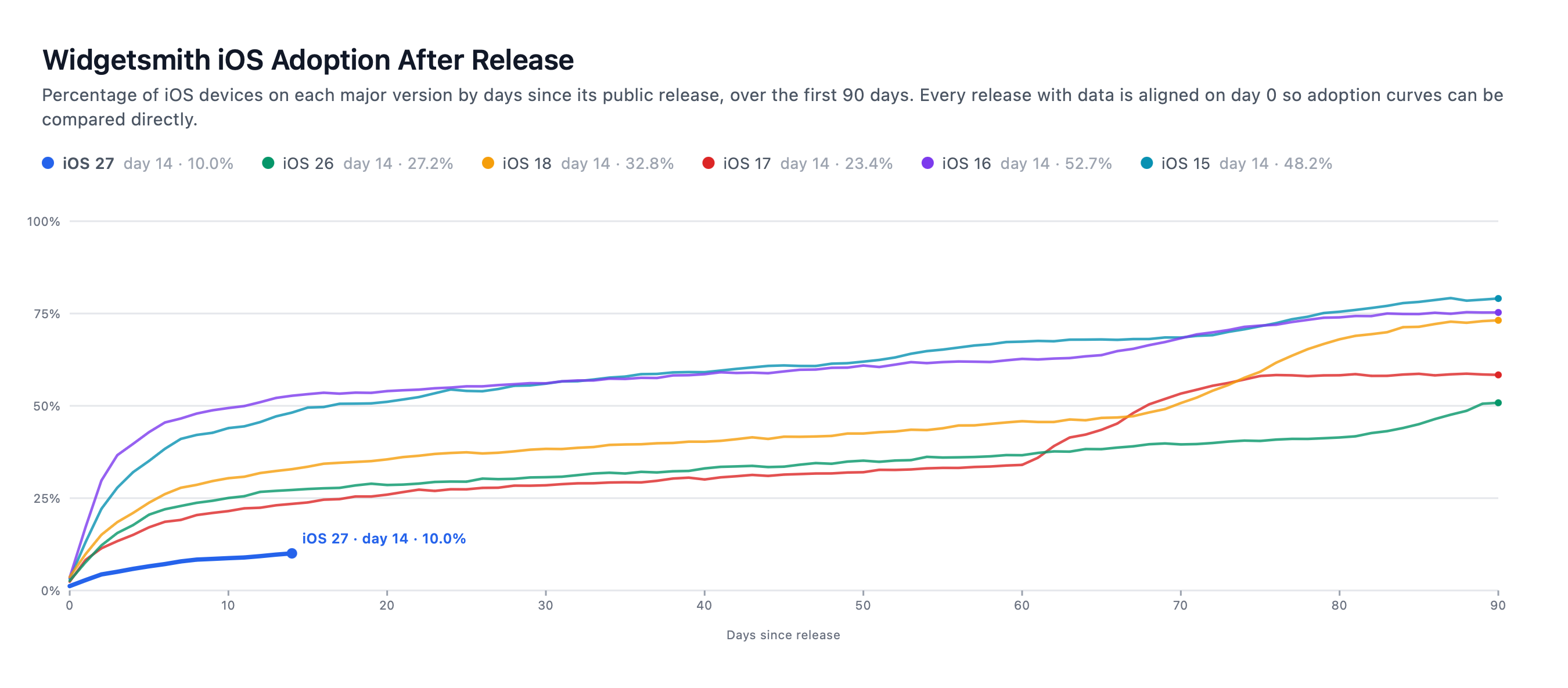
Wednesday, 7 October 2026
- Jaguar Type 01 ★
-
This is a cool car. It doesn’t look like anything else and it looks like it’s been pulled a few years from the future. I don’t know about this whole trend where cars don’t have rear windows though. I get it that you just use the camera but my old habits says I want to see out the back sometimes.
But the only reason I wouldn’t buy this thing is that turd of a new logo Jaguar went with. I could not abide driving around in something with this typographic calamity.
- Gurman Strikes Again: ‘Apple’s Smart Home Push Includes Doorbell, Lock, Thermostat Codeveloped With LG’ ★
-
The incomparable Mark Gurman, reporting for Bloomberg:
Apple Inc.’s upcoming push into smart home devices will include a doorbell, thermostat and other accessories developed through an unusual partnership with LG Electronics Inc.
The products will be part of an ecosystem of devices that work with Apple’s new smart home hub, as well as an upgraded HomePod mini and fresh TV set-top box, according to people with knowledge of the matter. The new Apple devices are set to be introduced on Oct. 13.
The products developed with South Korea’s LG will also include a smart deadbolt lock, indoor security camera, outdoor security camera and floodlight camera, said the people, who asked not to be identified because the undertaking is private.
Though the two companies worked together to develop the accessories, the products will carry the LG brand. The South Korean firm is handling manufacturing and product support.
Gurman has more than “people familiar with the matter” (or Matter, for that matter) — he cites FCC filings from LG that have product names and illustrations of some of the devices’ rear panels (with the connectors).
As Gurman himself notes, this is somewhat unusual for Apple, but it’s not altogether new territory either. In Venn diagram terms, the circle for “peripherals Apple very much wants on the market” is a superset of “peripherals Apple wants to make itself and put the Apple brand on”. For some of these products that Apple doesn’t want to make under its own brand, Apple makes them through Beats. But for others they partner with other companies. They’ve long partnered with Logitech for keyboards, keyboard iPad cases, and even the Logitech Crayon, the only third-party alternative to Apple’s own official iPad Pencils. Unlike Apple’s Pencils, the Crayon works without pairing to a specific iPad — surely a godsend in classrooms. There’s also the Logitech Muse — an air-pencil/magic-wand peripheral for Vision Pro. (Vision Pro is a $4000 mixed reality headset that weighs 2 pounds, which Apple released in early 2024.) Apple does this with Belkin too — that’s another trusted partner for Apple.
And, in addition to serving as a longtime display component supplier for Apple, back when Apple had temporarily and foolishly exited the market for Apple-branded external displays, they worked with LG to make the LG 5K Ultrafine display, which for a while was simultaneously the best external Mac display on the market yet also an unreliable flaky product. Even at its best it had an unstable sub-par stand.
The thing that makes this partnership awkward for Apple is that these products — doorbells, cameras, deadbolt locks — are products that require the utmost of trust. What products could possibly require more trust than a camera with footage of what’s going on in or at your home, or a lock that controls who can get in? I think that’s why Apple wants to get into this market with products that they can put their stamp of approval on. But LG, of all companies, was just exposed in a scandal for shipping “smart” TVs that literally listen to the ambient audio in the room — even in standby! — and invade your privacy by tracking what content appears on screen. (I own a 2019 LG TV but I haven’t allowed it Wi-Fi access since, literally, 2019.)
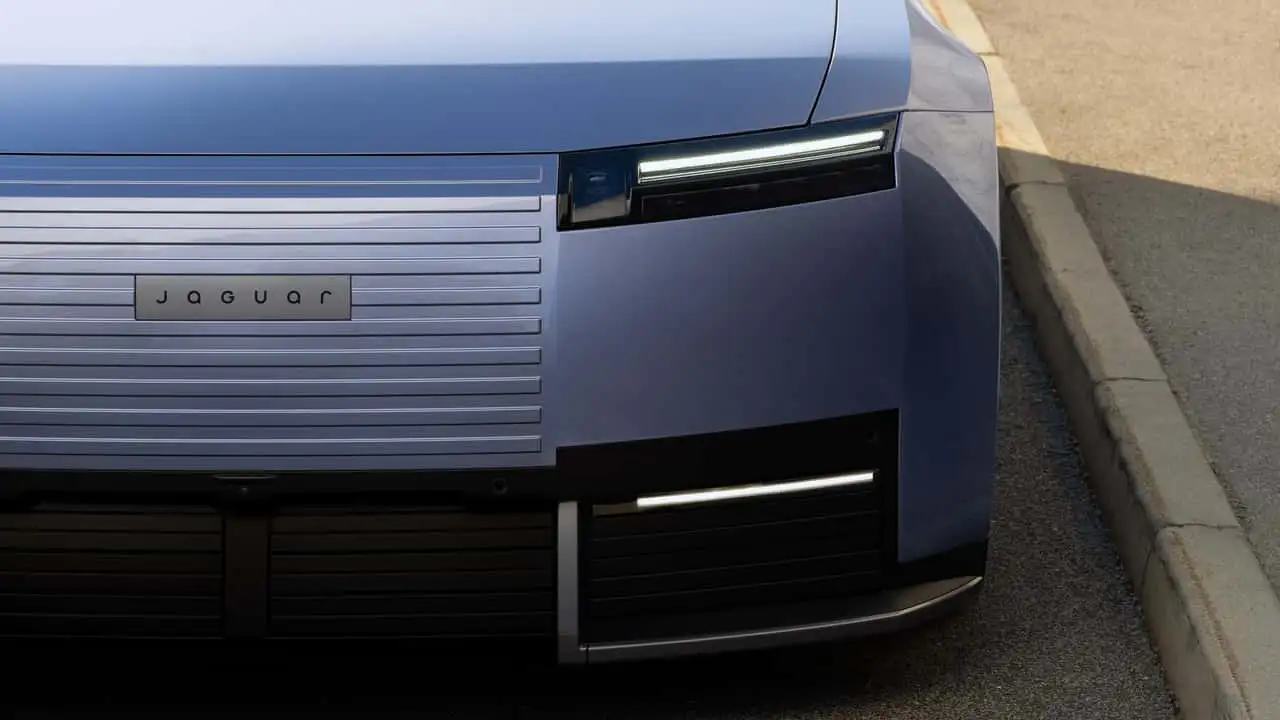
Tuesday, 6 October 2026
- Unofficial Command-Line Tool Removes Apple Intelligence From MacOS 27 ★
-
Scharon Harding, Ars Technica:
Unlike with previous versions of macOS, macOS 27 Golden Gate doesn’t have a toggle for turning off Apple Intelligence. That makes disabling AI features that you may not want more difficult. It also means that the AI models necessary for running Apple Intelligence will take up space on your disk, even if you don’t use them or if you go through your settings to individually find and disable AI capabilities.
In response, a developer known as Om Lahore on GitHub last week created RemoveMacAI, a command-line tool that allows macOS 27 users to “turn off Apple Intelligence on macOS 27” in a way that is “fully reversible,” per the GitHub page. They said that Apple’s Intelligence models take up “about 12GB,” but the models can actually take up over 30GB, The Verge noted.
RemoveMacAI “turns off Siri, Writing Tools, Genmoji, Image Playground, the ChatGPT extension, and all the summaries, then it deletes the models and stops macOS from downloading them again. Dictation still works because it’s a separate setting,” the developer said in a Reddit post first spotted by MacRumors.
Sounds crazy but it’s not
rming files in the /System/ folder — it uses techniques that work with System Integrity Protection remaining enabled. I mean, I wouldn’t do it on a production machine, but, I don’t want to disable Apple Intelligence.I can see the reasons why some people are frustrated that MacOS 27 Golden Gate doesn’t have built-in support for disabling this and removing the local models, though. If your Mac only has 256 or even 512 GB of storage, a dozen GB (or more) is meaningful. And there are institutional groups that have rules against AI — these places aren’t allowing Golden Gate at all until and unless Apple Intelligence can be removed. And that means not buying new Mac hardware that only runs Golden Gate.
Monday, 5 October 2026
- Steve Jobs, Walking Through a Mockup for Apple Park in 2010 ★
-
What an apt photo, today of all days. What a gift Make Something Wonderful is.

- OpenAI Announces Their Text Watermarking Plans ★
-
OpenAI, today:
The EU AI Act requires generative AI providers to make generated text identifiable in a machine-readable way. Text watermarking and detection remain early technologies with significant limitations, and views about their benefits and responsible uses are still developing. Our phased approach reflects both the EU AI Act requirements as well as the technology’s limitations, with an emphasis on transparency about what a text watermark can and cannot tell people:
- Starting today, API customers globally will be able to opt in to text watermarking for select models. Text watermarking will remain off by default in the API.
- Over the coming weeks, we will add an invisible watermark to eligible ChatGPT and Codex text output in the European Union.
- We’re opening applications to access our text watermark detector. Access will initially be limited to approved researchers and expert organizations that can help us evaluate and improve the technology.
First, unlike Anthropic, OpenAI is only forcing this upon users in the EU, where it’s mandated by their ill-considered 2024 regulation. Second, also unlike Anthropic, OpenAI has made this available via an API so developers should be able to actually see if this adulterates text output with real-world usage.
Third, none of these companies have yet made their watermark detectors publicly accessible. I remain highly skeptical that they will work as advertised in the real world. I think this is all somewhat of a sham to claim compliance with the EU AI Act without actually providing anything that anyone can actually use in a practical way.
Our text watermarking technology, textGrain, adds an invisible statistical signal to the model’s word choices. Our detector looks for that signal to assess whether a passage contains an OpenAI watermark. More details about how textGrain works can be found in our technical report, which will be updated with additional details in the coming weeks. We also plan to make the technology available in open source so that others can build on it.
In our evaluations, textGrain matched or exceeded the performance of other approaches we tested, including SynthID for text. Even so, strong performance under ideal conditions does not guarantee reliable detection in everyday use.
SynthID-Text is the Google algorithm that Anthropic says they’re using too.
Maybe I’m all wet, but I think what they mean in that last sentence quoted above is that it only performs usefully in ideal conditions, with simplistic prompts, and will prove to be unusable in practical everyday use, especially if the user’s prompt contains instructions designed to circumvent it.
- Ternus and Cook Tweet Brief Remembrances on the 15th Anniversary of Steve Jobs’s Death ★
-
John Ternus, posting on X:
The way Steve taught us to care about every detail, every experience, every person, still guides our work today. Forever grateful.
Tim Cook, also on X (with a photo I don’t recall seeing before):
There are people who leave a mark on the world, and then there are people who change it entirely. Steve changed the world and so many lives in the process. He certainly changed my life forever. His spirit lives on in everything he created and everyone he inspired.
Saturday, 3 October 2026
- WorkOS ★
-
My thanks to WorkOS for sponsoring this last week, once again, at DF.
SSO is table stakes for enterprise deals, but building it into your app yourself means writing SAML controllers, parsing XML assertions, and handling IdP-specific quirks for each provider. Learn how SAML flows work, the tradeoffs between building or buying, and best practices for security, routing, and UX.
Or, skip the hassle and add SSO with WorkOS. Read their developer’s guide to learn more — everything from how SSO works to why WorkOS is the fastest way to add it.
- Apple Confirms iPhone 18 Pro Max AT&T Cellular Issues, Affected Devices Require Hardware Replacement ★
-
Chance Miller, 9to5Mac:
In a statement to 9to5Mac, Apple said:
We have identified an issue affecting a small number of iPhone 18 Pro Max users on the AT&T network that may cause a device to lose service and be unable to make calls. We released iOS 27.0.1 earlier this week and strongly encourage all iPhone 18 Pro Max users to update now, and are also issuing a carrier settings update today. These updates together are meant to help prevent this issue from occurring.
The carrier settings update for the iPhone 18 Pro Max will download automatically over the next 14 days. However, users can manually trigger the download by going to Settings, choosing General, then About.
Apple explains that the software updates will help prevent future issues for iPhone 18 Pro Max users on AT&T. The software updates will not restore service on devices that have already lost it.
Apple says that iPhone 18 Pro Max users who have already lost service will need a hardware replacement. Those users should contact Apple Support or AT&T, or visit an Apple Store or AT&T location.
As we reported this morning, iPhone 18 Pro Max users affected by this problem can’t connect to AT&T’s network for calls, texts, and data. Instead, those users see “SOS” in their iPhone’s status bar. The connectivity issues aren’t impacting every iPhone 18 Pro Max user on AT&T.
I’ve heard from a handful of DF readers about this, and the readers experiencing the problem have all found each other in various forums over the last two weeks. The following all seem to be true:
It’s only a problem for AT&T customers. No such problems on Verizon or T-Mobile.
It’s only the 18 Pro Max, not the regular 18 Pro. The salient fact here is that the only iPhone 18 Pro models that use Qualcomm cellular modems, rather than Apple’s own C2 modem, are 18 Pro Max devices in the U.S.. So the problem seems to be something related to the Qualcomm modem and AT&T’s network.
It is not a problem for all 18 Pro Max devices on AT&T’s network. “A small number” is all Apple will say, but anecdotally it seems clear that it’s not most 18 Pro Max devices on AT&T. But it still seems like many. It’s not exceedingly rare.
Pretty unusual that once a device is affected and loses service, the device must be replaced. Yet, the 27.0.1 iOS update contains a fix (or fixes) that should help devices that haven’t yet lost service from losing service. I’d love to understand how a software update can prevent existing devices from being affected, but a software update cannot restore service to existing devices that have already been affected.
Something else I’m curious about is whether it’s related to AT&T customers, or AT&T’s network — are iPhone 18 Pro Maxes that are connected to MVNO carriers whose backend is provided by AT&T similarly affected? E.g. US Mobile customers on US Mobile’s “Dark Star” service? I’d love to hear from anyone who knows.
Thursday, 1 October 2026
- Yankees Sweep Boston in Two Games, by Combined Score of 18-2 ★
-
In the 6th inning last night the Yankees were only ahead 2-0, and Red Sox first baseman and all-around jackass Willson Contreras hit a home run, closing it to 2-1. Contreras decided to walk around the bases. The baseball gods do not look kindly upon that sort of ostentatiously belligerent showboatery. (Especially when your team is still losing.) Contreras circled the bags after his dinger like a rooster letting you know he just banged a few hens — but at a slower pace.
In the next inning, Contreras wasn’t paying attention and his laziness allowed a Yankee to reach base after striking out on a wild pitch. That started the rally that resulted in the blowout final score.