
By John Gruber
WorkOS: How SSO works and the fastest way to add it.
Linked List: September 2026
Wednesday, 30 September 2026
- Gurman Reports Apple Is Launching New ‘Smart Home’ Products on October 13 ★
-
Mark Gurman, reporting for Bloomberg (gift link):
Apple Inc. plans to make its long-delayed push into the smart-home market on Oct. 13, marking a critical product expansion for the company under new Chief Executive Officer John Ternus. At the center of the strategy is a smart-home hub code-named J490, according to people familiar with the matter. Apple also plans to announce the first update to the HomePod mini since that device’s 2020 debut and its first new TV set-top box since 2022. [...]
The home hub will take the form of a roughly 6-inch square display, with versions that can be mounted on a wall or placed on a countertop, according to the people, who asked not to be identified because the products haven’t been announced. [...]
Because the device is intended to remain stationary, it has a single FaceTime camera on the front and no rear camera. The product has microphones and speakers in its connected base. The hub is about as thick as an iPhone, and its display is surrounded by a quarter-inch, black bezel reminiscent of older iPads. It has rounded corners and no sharp edges. The device lacks a battery, so it has to be plugged in at all times, and there are no volume or power buttons.
The product comes in Apple’s standard gray aluminum finish and includes a USB-C port for power. The screen sits above a metal, round base with multiple rings of perforated speaker holes and connects to it through a polished metal arm. Users can manually tilt the display forward or backward. And the base has a rubberized bottom to help it stay on a table.
If you think that sounds like the beloved but short-lived “sunflower” iMac G4 from 2002, that’s exactly what Gurman says it resembles. As is so often the case, Gurman seems to know many details about the device, but yet doesn’t know its name or price. Presumably the speakers are good enough to serve by themselves, but how good are they? Can they be paired with HomePods to create stereo pairs?
The hub’s defining feature will be its ability to serve multiple members of a household. It is designed to recognize who is speaking to it or approaching it, and then display personalized content and provide answers based on that person’s data and accounts. When a user walks up, for example, the device will show that person’s contacts, messages, calendar appointments, notes and preferred app layout. The interface can then change automatically when another recognized household member approaches. It will also have a mode for visitors that hides personal information.
The device identifies users by their voices or through a facial-recognition system, though the latter is less reliable than Face ID on the iPhone. Users can require secondary authentication through an iPhone if they don’t want to rely solely on voice or facial recognition. The iPhone also serves as a fallback when the hub cannot identify someone correctly.
Given that Apple Watch is used as an identifier to unlock your Mac (and, says Apple, iPhone Duo), it would make sense if that worked with this device too.
- Anthropic’s IPO Prospectus Is a Fucking Doozy ★
-
Echo Wang, reporting for Reuters yesterday:
Anthropic is making a massive bet that AI will transform the global economy more profoundly than industrialization, electricity and the internet, according to its IPO prospectus seen by Reuters.
This is a strong clear lede, but even so it falls short of expressing the true magnitude of what Anthropic represents. To wit, not that “AI” as a field will prove more profoundly transformational than industrialization, electricity, and the Internet, but that Anthropic alone will. This is not an IPO that makes sense if you consider Anthropic one among peers, even a short list placing them alongside just (say) OpenAI, Google, and Meta. It only makes sense if you believe Anthropic is on the cusp of winning a race to create a godlike super intelligence, and that first godlike super intelligence will take over the world.
You know, something exactly akin to the “rapture” events that religious cultists believe are coming.
But the cost to get there will be staggering. Anthropic reported a net loss of $42 billion in 2025, and plans to spend $518 billion on cloud, computing and infrastructure obligations in coming years, according to the prospectus.
If you believe that they’re profitable now you’re as crazy as they are. They’ll seed stories to the press that they’re now profitable, using accounting methods they won’t define (and wouldn’t pass muster for a public company) but won’t make such claims in writing.
The prospectus details how the company has grown sharply in the last year — while also posting wider losses. Revenue grew 12-fold in 2025 to nearly $4.6 billion, even as the company lost more than $8 billion on an operating basis, excluding writedowns of various liabilities mostly tied to previous fundraising, according to the documents, reported here for the first time. [...]
Anthropic said nearly a quarter of its revenue came from two customers last year, and as part of its risk factors, warned that many of its largest clients were not locked into long-term contracts and could cut or stop spending.
I don’t think this is complicated. Their revenue is accelerating rapidly because they’re selling compute at a loss. They spent $13 billion to make $5 billion last year. Their revenue is growing rapidly, yes, but their costs are growing even faster. They’re already on the hook for half a trillion dollars on cloud computing expansion but their revenue is precariously reliant on a few big-spending whales who aren’t under contract, and commodity open source models are rapidly closing the gap. If Anthropic is losing a fortune now with $13 billion in costs how are they going to break even spending $100+ billion per year? Don’t worry, their godlike AI will figure that out?
Anthropic’s proposed valuation is easily calculated, as -50 times 2025 losses.
The more they lose, the more they win!
Tuesday, 29 September 2026
- Follow-Up on my Spitballed Predictions for Apple’s October ★
-
Regarding my post yesterday speculating on how Apple’s October — seemingly set to be a big one — might play out, a friend asked if any or all of the new stuff might be released through Apple Newsroom announcements only. Good question. Let’s run through the rumored new hardware products:
- Apple TV hardware: I’d love to say no, but the answer is yes. I could see this coming out as a simple announcement with new specs. I really want to see Apple double-down in this space, reinvigorate it. I think watching TV on Apple TV hardware is by far the best experience out there. Yet its market share is very low. Apple TV is to the living room today what the Mac was to desktop computing in the late ’90s and early ’00s. Everyone sees it as too expensive and they have no idea why they’d actually be happier if they had one. So I hope Apple makes it a big part of a keynote/event, but I wouldn’t bet on it.
- iPad Mini: Yes, could be just a press release.
- HomePod Mini: Yes, could be just a press release.
- HomePod-type thing with a screen (maybe they will just call it “HomePad”?): No way — if this is coming, it has to be unveiled with a keynote video and some sort of media event with hands-on demos. And if they’re going to have some sort of event/show for this, they might as well unveil the above things there too.
- MacBooks with OLED touchscreens: No way could this be released only with a press release.
- M6 iMacs: Could be just a press release, but if they’re going to have some sort of event/show for the touchscreen MacBooks, why not include these at the start of that?
- Destroy Any Website ★
-
Desktop only, and you definitely want sound on. (Update: Now works great on mobile devices, too!)
With things like this I always start with Kottke.org. No idea why, because it’s quite possibly the last site on the entire web I’d want to see actually destroyed. (Well, second-to-last.)
Monday, 28 September 2026
- Bastardica ★
-
“A foundry for bastard web fonts.” The default is a version of Times New Roman but every 7th glyph is replaced with one from Arial, but you can dial up whatever bastardization you want.
This is why I’m not at all worried about AI destroying the world. Look at the horrible things human beings have made.
- ‘When Did Google Get So F-Ing Weird?’ ★
-
Sancho Panza:
I recently had an experience while doing a simple Google search that was so profoundly weird that it stopped me in my tracks.
Kagi, the search engine I’ve been using for a few years now, gave me the exact sort of results to Panza’s query that he was looking for.
- Joanna Stern Pokes the Pickle ★
-
If anyone could devise a funny way to measure battery life, it’s her.
- ‘Donald Decodes’ Interview Craig Federighi Regarding the iPhone Duo ★
-
Apple executives seemingly did very few interviews after the iPhone event three weeks ago. The best, perhaps by far, is this 11-minute video with Craig Federighi by “Donald Decodes”, a Chinese language creator. His YouTube account only has 1,100 followers (and only had 500 at the time of the video) and only one other video — presumably he’s got a big following in China. Very insightful questions about the Duo user interface — and Federighi gives very thoughtful answers. The question (and answer) about “back” swiping really gets to the heart of what makes iOS so much more cohesively designed than Android, spatially.
- Why Stolen Device Protection Makes Passwords Safer ★
-
Glenn Fleishman:
Leaving Stolen Device Protection enabled does mean that you may have to wait an hour in some scenarios to manage aspects of your Apple Account, make changes to Face ID or Touch ID, change your device passcode, and a few other actions. But this minor inconvenience might assuage the kinds of concerns that Scott wrote in about, and make you more comfortable that your big basket of secret eggs won’t scramble.
I put off enabling Stolen Device Protection for a while after it came out, because I’m stubborn and trust myself to a degree that’s probably irrational. But when it became the default I enabled it, and haven’t once regretted it.
- Jeremy Stern’s Profile of Mark Zuckerberg for Colossus ★
-
Jeremy Stern, in a massive and massively good profile of Mark Zuckerberg for Colossus:
Unsure of my own ability to evaluate such things, I leave Meta HQ and spend another few days in Palo Alto and San Francisco ahead of my interview with Zuckerberg, seeking out a number of MSL’s competitors and investors who agree to speak to me on background. Many of them take pleasure in what they describe as the organizational “mess” of MSL, in the people there allegedly being motivated more by money than by true belief, and in Zuckerberg as a maker of boredom-relief apps and targeted advertising, not of godlike intelligence or the singularity.
I’m inclined toward sympathy with much of what they say, though I am also irritated and want to shove them in a locker. While I am not the first to chafe at their combination of messianism, contempt for ordinary consumers, and denial that they, too, are rapacious capitalists, I am apparently the first to ask them to steelman the outcome in which Zuckerberg, in light of his long history, survives and expands. Which turns out to be simple:
AI is not, in fact, God. Instead, it does math and solves a limited set of problems humans face, and is otherwise simply useful and cool. Anthropic, and to a lesser extent OpenAI, have trouble ever accepting this fact. Zuckerberg does not. He has not spent a decade comparing his company to the Manhattan Project, and thus he is not above pushing the frontier of AI to help people book airline tickets, make dinner reservations, and edit photos. He will use it to drive down the cost of serving his users to zero, and to drive up his revenue by improving ads. He will use cash from the ad business — and his ownership of data centers, chips, and other infrastructure that Anthropic and OpenAI have to pay to rent — to undercut them on price. The potential install base for his AI is 3.6 billion people, who don’t care whether a given model is six months behind the frontier.
If AI commoditizes, then Anthropic and OpenAI go to zero, and value accrues instead at the complements Meta already dominates, like distribution, attention, personalization, and commerce. If it doesn’t commoditize, then at least he is not his competitors’ prisoner the way he’s been with Apple, and all he has to do is remain within six months of the frontier, which he’s already close to. Heads, he wins; tails, he wins.
Until last week I’d somehow never heard of Stern and never heard of Colossus (of which Stern is editor-in-chief). But on Thursday Ben Thompson published an interview with Stern at Stratechery — in the wake of this astonishingly well-written, insightful, and dare I say fair 15,000-word profile of Zuckerberg. It’s incomprehensible to me that heretofore I was unaware of Stern’s work or Colossus’s existence.
There is so much of the piece that I do not want to spoil, but I very much want to talk about. (Tummy drums!) I quoted the bit above simply because that third paragraph summarizes my own take on AI so well — along with my take on what is profoundly wrong with Anthropic in particular, and OpenAI to some degree.
Whatever your expectations are for a “long profile of Mark Zuckerberg”, Stern’s piece will surprise and delight you.
- Muse, Instagram, and VLC Lookalike Rip-Offs in the Mac App Store ★
-
Jeff Johnson:
In other words, Muse AI is a blatant copy of Muse from Meta, the latter of which is currently the #1 iOS App Store download in the United States. I don’t know where Muse AI ranks in the iOS App Store, but I do know that it’s currently the #20 Mac App Store download in the US.
It wasn’t languishing in obscurity — it had risen to #20 in the Mac App Store. A lot of Mac users are very confused when they’re told that Mac apps are available but they’re not in the Mac App Store, so it’s a rife opportunity for scammers. In the same post Johnson also documents an app named “App for Instagram º” and another named “Video Player for VLC”, both of which use rip-off icons in addition to their rip-off names. “Muse AI” is now gone, but “App for Instagram °” and “Video Player for VLC” are both still there.
I do wonder what the guy who made Muse AI was thinking. How long did he think he was going to get away with this?
- Duo-Man ★
-
Vidit Bhargava (developer of LookUp and Movie Buzz):
Duo-Man offers the complete walkman experience on the iPhone Duo. Open the Duo to pick and “insert” the cassette, Close the Duo to start listening.
Yes, I actually recorded the button clicks and static noise from a real Walkman!
More like this, please.
Sunday, 27 September 2026
- Mux: Turn Your Video Into Context ★
-
My thanks to Mux for sponsoring last week at DF. Video isn’t just something to stream; it’s structured data you build with.
Mux Robots — hosted AI workflows — turns video into context. Generate chapters, find key moments, translate audio, and more, through one API call, with no model hosting to maintain. Each workflow is evaluated against real video, not generic benchmarks. Configure the workflows once, and every new upload runs automatically.
Mux is video infrastructure trusted by Patreon, Substack, and Perplexity. Start building for free. Use code FIREBALL for an extra $50 credit.
- Katie Notopoulos on Alexandr Wang’s ‘Faux-Hallmark Pap’ ★
-
Katie Notopoulos, in a short tweet thread regarding Alexandr Wang’s “Why We’re Building Muse” essay:
This makes me feel insane! This is faux-hallmark pap and if you believe for 1 sec that he cares about helping people “spending more time with family” or “opening a bakery” you don’t need to wait for AI to kill us; you’re stupid enough to drown from looking up at the rain.
My take is much closer to Notopoulos’s than to Manton Reece’s. I think it’s fascinating that Wang’s essay doesn’t sound at all like the sterile neutered voice of a Meta executive. I think it’s his voice, and he really wrote it. I just think the sentiment he’s expressing is creepy.
Wang wrote that Muse “Clears the way and solves all the problems it can until the human part, the wanting and the dreaming, is all that’s left.” That’s dystopic, not utopic. It’s the actual creation and doing of things that makes life worthwhile — not just wanting and dreaming about it.
Wang’s premise only reaffirms my longstanding hunch that Zuckerberg sees Buy n Large as the good guys in Wall-E.
Saturday, 26 September 2026
- Reelizer Returns ★
-
Back in 2011 I linked to Reelizer, a splendid archive of movie posters curated by Roger Erik Tinch. Reelizer went away for a few years, but Tinch has brought it back, seemingly better than ever. Huzzah.
- Alexandr Wang: ‘Why I’m Building Muse’ ★
-
Alexandr Wang, blogging on X:
Now imagine every person on earth with a second mind beyond their own. A general manager whose whole job is to find out what you want and make sure it happens. Someone that hears the half-sentence, “I feel like there’s something more I could be doing,” and helps fill in the blanks. This might not be a genie in a bottle, but it can be someone that says, “This is the thing you’ve been dreaming of your whole life. Let’s go get it. Here’s how.” And then builds a plan. Sends the email. Makes the phone call. Finds the funding. Keeps you on schedule. Clears the way and solves all the problems it can until the human part, the wanting and the dreaming, is all that’s left.
Via Manton Reece, who writes:
This is a mission statement. It’s ambitious and clear. Compared to Meta’s usual “connecting people” pitch — which we just translate to “scale to everyone and serve ads” — this new statement from Alexandr feels almost shockingly personal and new.
- Apple’s Other Recent ‘Duo’ ★
-
I keep mentioning Apple’s 1992 groundbreaking PowerBook Duo series as a precedent for the iPhone Duo’s name. But of course in 2020, Apple released the MagSafe Duo Charger, a wonderful Lightning peripheral for charging an iPhone and Apple Watch at the same time. It even folded.
A brief note on the PowerBook Duo, while I’m at it. I got an email this month from Dave Rothschild, a now-retired former Apple employee who helped spearhead that project, and he emphasized that the internal motto was always “Best of Both Worlds”, abbreviated internally to just “BOBW”. At the time, laptops were just profoundly less powerful than desktop computers, but desktop computers of course were the opposite of “portable”. The Macintosh Duo was a terrific success, because it really did achieve that “best of both worlds” experience. Here’s a 2015 retrospective on the PowerBook Duo by Christopher Phin that captures and illustrates just how groundbreaking it was.
BOBW is exactly what the iPhone Duo needs to be. It needs to be a great iPhone on the outside, and a great mini tablet on the inside.
Bonus link: Rothschild’s daughter Gabby made a nice “This is not Apple’s first Duo” video, including footage of her dad doing the initial on-stage demo back in 1992.
- International Standard Paper Sizes ★
-
Markus Kuhn:
In the ISO paper size system, the height-to-width ratio of all pages is the square root of two (1.4142 : 1). In other words, the width and the height of a page relate to each other like the side and the diagonal of a square. This aspect ratio is especially convenient for a paper size. If you put two such pages next to each other, or equivalently cut one parallel to its shorter side into two equal pieces, then the resulting page will have again the same width/height ratio.
Same principle as using the square root of 2 to achieve a very similar aspect ratio on both the iPhone Duo’s inner and outer displays. With the international paper system, you can do things like scale up 2× or scale down 0.5× without changing the relative margins. E.g. print or photocopy at 50 percent to get two virtual pages per printed page of output. It’s an elegant system.
- Microsoft Took the ‘Copilot+ PC’ Brand Out Behind the Shed ★
-
Zac Bowden, Windows Central:
In 2024, Microsoft and Qualcomm kicked off a new category of Windows hardware it called “Copilot+ PCs” that set the baseline for a new wave of AI-first computers, and launched with exclusive features that would not be made available on PCs that didn’t meet a new set of system requirements.
The launch didn’t go smoothly. [...]
I’ve noticed that none of the Surface PCs launched in 2026 include the Copilot+ PC moniker in their product names, unlike the Surface PCs that launched in 2025 and before. Now, you have to go digging to find any mention of Copilot+ compatibility in specification sheets.
Microsoft’s had to dig a lot of holes in the ground behind that shed over the years. The lesson here is that good devices are just good devices. A good PC is going to be a good PC for AI too. Wasting time with special branding is a distraction from the core task of just making the devices good.
- The Talk Show: ‘I’m Thinking X, Not X’ ★
-
Andru Edwards returns to the show to discuss Apple’s big September event and their new products: the iPhones 18 Pro and Duo, AirPods 5, and Apple Watch Series 12/Ultra 4.
Sponsored by:
Friday, 25 September 2026
- Mr. Choyka Is Apparently Doing Well ★
-
A reader asked if this Gary Choyka who hit two holes-in-one in the same round of golf back in 2020 is the same Gary Choyka who was my history teacher 30+ years ago. Indeed it is. He looks good. (He was a hell of a basketball player too.)
- Stock UI in MacOS 27 Eschews Clarity ★
-
“Thibault”, in post on Mastodon responding to Brent Simmons’s “stock Mac UI” post that I just linked to:
It reminded me of my own explorations with the macOS design language, especially the modern title/toolbar which I believe is one of the most foundational design regression on the platform.
I played with the idea of redesigning the Finder with the original hierarchy but keeping the current Liquid Glass styling. Though it’s still far from what I’d like to see on my Mac, I thought I’d share.
Here’s his subtle mockup:
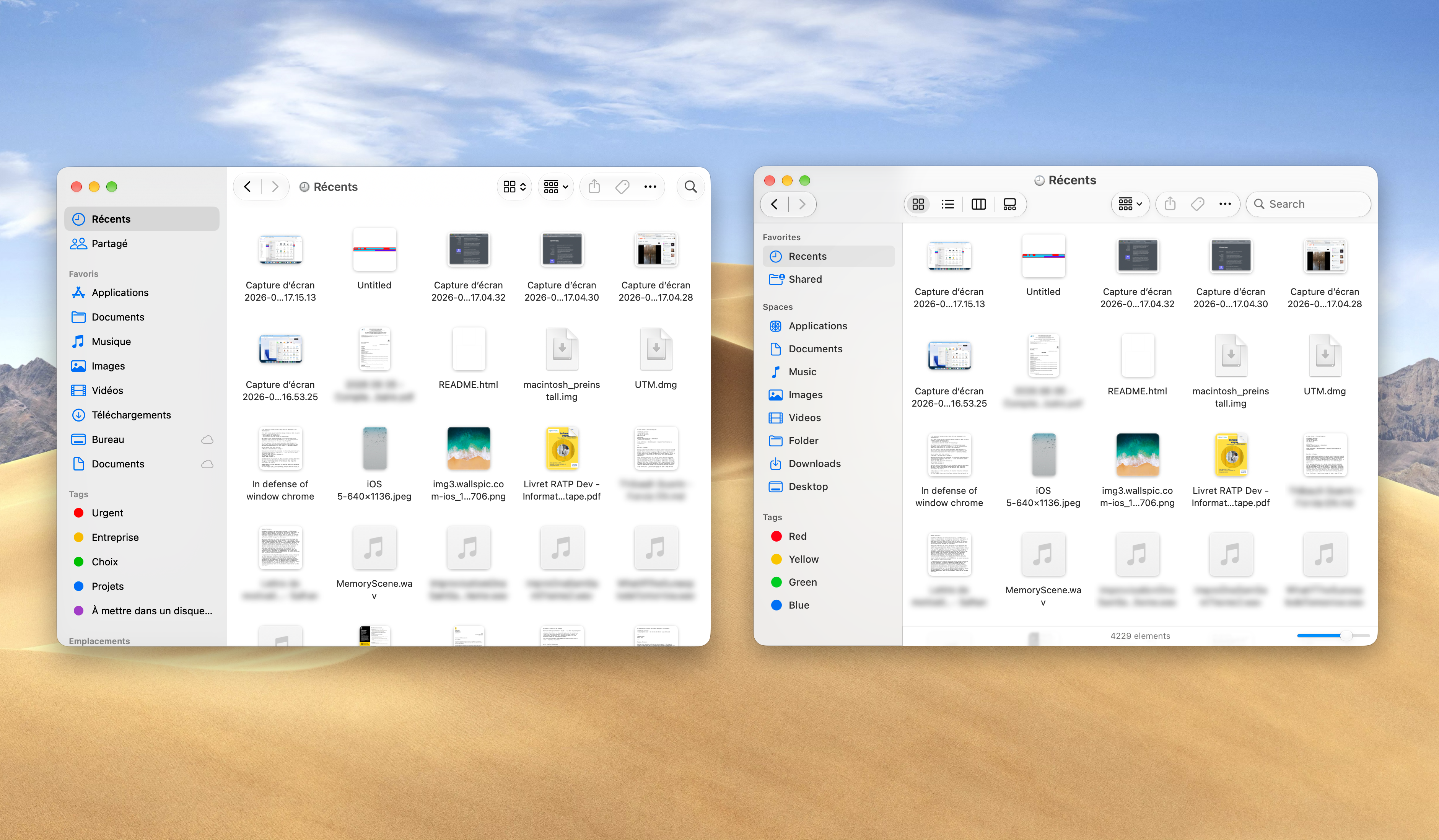
The changes in Thibault’s redesign, if you describe them verbally, sound minor. But looking at the differences feels like a huge — and much needed — breath of fresh air. It relaxes my nervous system to see obvious differentiation for window chrome at the top. The hierarchy is clear: this area is the window, this area is the content of the window.
Apple’s MacOS 27 Golden Gate stock UI deliberately does away with that differentiation, for no good reason. I crave clarity, and Apple’s current MacOS design language rejects clarity. Like: where exactly can you click to drag a window around? That ought to be obvious; instead it’s literally a guessing game. And Thibault’s simple example also shows that the problem has nothing to do with “Liquid Glass” controls.
- Brent Simmons on ‘Stock’ Mac UI ★
-
Brent Simmons:
To recap: the reasons for using stock Mac UI are 1) user familiarity, which we’ve known for a while just isn’t a thing, and 2) hoping to be able to expend less developer effort, which we’ve seen can work against you.
But there’s another reason: the stock Mac UI is designed by Apple, the best designers in the world, and do you really think you can do better? Really?
The app world is full of people who think they’re better and they’re really, really, really not.
Well, I still think Apple has the best collection of UI designers in the world, but, for whatever reasons, the guidance from above on how the Mac UI should look is missing the mark. I’m not blaming the people doing the work — they’re doing great work with the direction they’re given.
So this — bad direction — is where the secret third reason falls down. And we’re left with no real reason to stick with stock Mac UI (except for wanting approval from longtime Mac people like me, and you really shouldn’t care about that at all).
I was hesitant to quote anything from Simmons’s post, because you really ought to read the whole thing. (I’ve always loved the way Brent writes.) But I really like his emphasis throughout the piece on the term “stock Mac UI”. Debating the nuances of what it means for software to be “Mac-like” is one of the through lines of Daring Fireball since the very beginning. It doesn’t mean just one thing, and it doesn’t encompass just a few things. It’s a lot of things. But that makes it susceptible to picking and choosing — what one considers “Mac-like” might just be what one personally prefers.
But using the stock Mac UI — or building your custom UI atop (or in OOP terms, subclassing) stock Mac UI controls — is so thoroughly agreed-upon as a fundamental aspect of Mac-like-ness that it’s seldom even discussed. This relatively short post from Simmons bursts that bubble — or if you’ll permit a grosser but perhaps more apt metaphor, lances that boil. The emperor has no clothes, and MacOS’s stock UI is bad. It’s that simple.
At the end of the post Simmons includes two screenshots of NetNewsWire after a day of noodling where he removed the stock window chrome and toolbar (the venerable NSToolbar, perhaps the stockiest of stock UI elements) and replaced them with custom controls. If you told me 10 or 20 years ago that Brent Simmons spent a day replacing NSToolbar in NetNewsWire just to see what it looked like, I’d have called him on the phone to see if he was OK.
But today, after the last few years of Apple losing the plot with the Mac user interface, I look at these two screenshots and my first thought isn’t that they look old-school. It’s simply that they look refreshingly Mac-like. Understated, humble, and obvious. Not nostalgic. Just ... good. And more Mac-like than the actual current version of NetNewsWire, which thoroughly embraces the stock Mac UI from Apple.
- Regarding the Provenance of Charm Within Meta ★
-
Mark Gurman, reporting for Bloomberg Wednesday, after Meta’s 2026 Connect keynote (gift link):
Meta Platforms Inc. unveiled a palm-sized, dedicated gadget for using Muse, the company’s popular new artificial intelligence assistant, pushing deeper into the AI devices market with a surprise announcement.
The product, unveiled on stage by Meta Chief Executive Officer Mark Zuckerberg, was born out of the company’s new design lab led by former Apple Inc. interface design chief Alan Dye and its Superintelligence AI group. [...]
Dye, the former Apple design executive, and Billy Sorrentino, one of his top deputies at the iPhone maker, were two of the driving forces behind the project and the creation of the Muse character-based interface, Bosworth said.
Meta recruited the executives at the end of 2025, forcing Apple to shake up its own design team to fill the void left by their absence. Dye and Sorrentino hired a slew of other designers from Apple as well, and they contributed to Muse Charm as well as the interface of its Muse smartphone apps, Bosworth said.
On today’s episode of Dithering (which you should subscribe to), Ben Thompson dropped a juicy tidbit about this (starting around 5m:15s):
Thompson: By the way, do you want to hear some gossip about this?
Gruber: Yeah, of course!
Thompson: Well, Mark Gurman has a piece crediting Alan Dye. Utter and complete theft of credit is what I’m hearing. Alan Dye doing Alan Dye things.
- Muse Looks Cute, but Looks Are Deceiving ★
-
Jason Aten, in a good follow-up to his previous column at Inc. (the one where he described how Muse, running on his Mac, read his Messages database):
The entire reason Muse is interesting is that it isn’t just a chatbot, but can actually do things for you. But that promise also comes with a pretty high bar of responsibility. If your goal is to put a powerful AI agent on millions of devices, you have to be incredibly clear about what’s happening, and what people are agreeing to.
If your primary audience does not understand what Full Disk Access means, you should not surprise them with “I’m reading your text messages.” It’s unreasonable to expect them to learn about things like virtual machines, permission architectures, macOS TCC, Sentinel agents, or database synchronization in order to understand what the thing is doing or what is happening with their personal information.
Having an agent installed on people’s computers that appears overeager to access their information or take action on their behalf isn’t helpful. It’s terrifying.
Aten makes some good points about the inherent tension between Muse — especially in the context of running on your Mac desktop — being powerful cutting-edge technology yet being presented by Meta in an extremely consumer-friendly package. Muse is getting a lot of attention — including mine — because it’s both groundbreaking technically (each user gets their own entire persistent Linux VM running in Meta’s cloud) and because it’s packaged in an easy-to-install easy-to-use way. It’s literally presented as a cute mascot. It’s the first consumer-accessible agentic AI system, and Meta has truly done an amazing job with that. But it’s a genuinely open question whether consumers have any understanding what this means. If you buy a power saw that can cut your fingers off, you are almost certainly aware that you are buying a power saw that can sever your fingers. You may or may not choose to use it with appropriate carefulness. But you know just by looking at it that a power saw (or a nail gun, or a chef’s knife, or a hammer, or any other powerful tool) is dangerous. I don’t think people realize how powerful — and thus dangerous — Muse is, especially if it’s running on your Mac.
- I Was Not Blown Away by Eli Tan’s ‘I Was Blown Away’ Review of Meta Muse ★
-
Eli Tan, writing for The New York Times, “I Gave My Life Over to Meta’s A.I. Agent and Was Blown Away” (gift link):
For one final task, I asked Wren for a good way to spend that $44.99 it had saved me. At this point, it knew my life pretty well. I thought it might suggest something altruistic, like donating the money to charity or buying flowers for my girlfriend, who was recovering from surgery.
Instead, it suggested something even better — buying bowls from Heath Ceramics, a local ceramics maker with a dedicated following, on Facebook Marketplace, one of my favorite pastimes.
Reading Tan’s “blown away” review (which words only appear in the headline, but it’s his byline under it) made me feel like I was on a hidden camera show. Like I’ve been told I’m about to be served some blow-you-away good coffee and what I’m tasting sure tastes like Folger’s fucking crystals. I’m not saying Muse isn’t capable of blow-you-away things, but I sure didn’t read any of them in Tan’s review. And then, at the end, it steers him toward buying something from ... Meta’s own Facebook Marketplace? And the reaction isn’t a hard eye roll?
I get the feeling that Tan believes he’s supposed to be impressed by Muse so he wrote a piece saying he was impressed even though he didn’t use it to do a single impressive thing. If Tan asked the new Siri AI for a recommendation on what to do and it suggested he go to an Apple Store and buy new AirPods, would he not think that a bit cynical? Or if Alexa suggested that he should buy more Kindle books?
Here’s Rusty Foster, over at Today in Tabs:
Tan and Johnson both seem like they have totally ordinary middle class white collar 2026 American lives, so I don’t mean anything personal against them when I say these reviews both make their authors sound like the biggest imaginable losers. You can’t call a guy to pick up a branch? Within two weeks? You can’t actually pick up a branch yourself with your own meat hands and throw it in the woods or something? What do you mean you had your robot shop for collectible ceramics? Is there any other part of collecting ceramics as a hobby besides shopping for them? Is your hobby now “having bowls?” Hi, I’m Eli Tan, writer for the New York Times. In my leisure time I enjoy owning dishes.
Thursday, 24 September 2026
- Victoria Song on Meta Muse’s Cuteness ★
-
Victoria Song, in her Optimizer column/newsletter for The Verge:
I’ve been aggressively avoiding Muse since it launched a few weeks ago. Sure, some of that is because I was busy testing other devices. But the number-one reason why is that I am horribly vulnerable when faced with extreme cuteness.
Alas, at Meta Connect, I couldn’t escape this pink-cheeked fella with his plush ivory fur, and so I finally downloaded the app once I returned to my hotel room. He was plastered on every screen during the keynote. My eye twitched with maximum cute aggression when Meta CTO Andrew Bosworth showed us his Muse agent Cooper. The duderino was dressed in a lil pilot outfit because he’s Boz’s test pilot. My face scrunched with rage when Cooper picked up his pudgy round arms to wave. It’s the cutest thing I’ve ever seen at a tech keynote. The tiny demon in my head thought to itself, “I WANT TO SQUISH ITS LITTLE FACE.” [...]
Most people I know would say that Meta stuffing an AI agent into everything and anything feels sinister. Now look at Jolly’s little smile. Tell me it doesn’t make the corners of your mouth twitch slightly upward. If you honestly say no, you’re stronger than I am.
What attracted Song to Muse is what has, to be honest, turned me off. I don’t think it’s because I’m stronger than Song. I just think it’s weird that Muse wants me to give it a name and design a cartoon mascot for it. My impression of Muse isn’t that it’s even vaguely cute. I’m not trying to be obtuse here. I see that it’s supposed to be cute. I can see why some people see it as cute in the way it’s clearly intended to be cute. But I just see it as phony. And I despise phoniness as much as Holden Caulfield did.
My wife and son both love cilantro. I can’t stand it. I’m one of those people who thinks it tastes not just like soap, but soap that I’d regret washing my hands with because if I did I’d hate how my hands smell and I’d want to find another sink with different soap to scrub that off. I don’t have better taste than my wife or son. (My wife says quite the opposite.) It just registers differently for me.
Muse’s cutesy appearance and tone hits my mind like cilantro hits my tongue. I want my humans and animals warm, and my computers cold. Fun? Sure! But not cute. That’s a fine line between fun and cute, but I know it when I see it, just as surely as I know when something has cilantro in it.
- Joanna Stern Interviews Mark Zuckerberg ★
-
Great interview from Stern, as usual, seemingly conducted on the old set of Three’s Company. She opened by asking if AI is going to wipe out humanity, and I think Zuck whiffed by not simply laughing and saying no. She also directly asked his thoughts on people calling Meta Glasses “pervert glasses”.
Regarding the shift from “the metaverse” to AI, Zuckerberg likened it to Apple having started work on touchscreen tablets and then pivoting to turn the technology into the iPhone first. His point being that it’s not that iPads weren’t a big successful idea, but they’re not as big as phones.
There are four big players in consumer AI: Google, Meta, OpenAI, and Anthropic. I don’t think Zuckerberg mentioned any of the others by name — neither in his Meta Connect keynote, nor in this interview with Stern. But much of what he unveiled and explained, in both, makes the case for Meta as the leader in this space. Compared to Google, Meta is highly focused and Google is seemingly utterly unfocused. Focus matters when you’re trying to ship something new while exploring uncharted territory. Compared to OpenAI and Anthropic, Meta has consumer-product chops. If there’s no moat around the AI model technology — and I’m ever more convinced there is not — it’ll be the products AI is wrapped into that matter.
- Meta Connect Keynote 2026 ★
-
Meta’s annual keynote yesterday was a tight 55-minute live event held on their campus in Menlo Park. I watched the whole thing this morning, before recording tomorrow’s episode of Dithering. (Which you should subscribe to.)
It was a good keynote. Consumer products announced:
Third-generation Meta Glasses with cameras.
A new glasses product: Ray-Ban Meta Audio. These are audio-only smart glasses, with microphones and speakers, but no camera. Zuckerberg pitched them as being less expensive, having longer battery life, and looking much more like regular glasses. All of those things are true, but he deftly avoided the privacy backlash against glasses with cameras. They’re not that much less expensive than the camera models, starting at $350.
Meta VR Glasses. Slogan: “The weight is over.” Some similarities to Vision Pro: use cases include immersive movies and sports, virtual displays for computing, and gaming; the computer is a thick phone-sized puck connected to the glasses via a cable. Some significant differences from Vision Pro: Meta VR Glasses only weigh 100g; Vision Pro weighs 750–800g. It’s almost an order of magnitude difference by weight. Also: these are only going to cost $1,300. Not out yet, coming in “spring”. I used to think I’d at least use my Vision Pro when I fly, but I haven’t taken it with me on a flight in two years. It’s too big and too heavy — a small piece of carry-on luggage unto itself. By dint of their weight alone, Meta VR Glasses seem far more comfortable, and also far more portable. They look a lot more like regular sunglasses than Vision Pro (or Meta’s own Quest goggles) — but they definitely don’t look like regular sunglasses.
Meta Charm. A pendant/stopwatch-sized thing with a screen and fingerprint reader, that serves as a dedicated device for interacting with Muse. Will supposedly have 5G cellular connectivity in addition to Wi-Fi, but it’s not a phone. Vaporware at the moment but supposedly shipping by December. No price given. My daily “World in Brief” newsletter from The Economist described Charm thus: “Imagine a tiny smartphone that can’t do 95% of the things that the one in your pocket can.”
The star of the show wasn’t any of the hardware products but Meta Muse. Muse is the through line for Meta this year. If there’s one thing I think Zuckerberg did wrong in the keynote, it’s that he didn’t explain where Muse stands compared to Meta AI. I’m pretty sure that the answer is that Muse, as an AI agent, is a superset of Meta AI, a mere chatbot. If you use Muse, you should have no reason to use Meta AI; if you use Meta AI, Zuckerberg should have encouraged you to upgrade to Muse. I think that’s the gist. But it would have been good for Zuckerberg to explain it.
- ‘Apple Opens Apple Music Hall, a State-of-the-Art Live Music Venue in London’ ★
-
Apple Newsroom:
Apple today announced the opening of Apple Music Hall, a brand-new state-of-the-art live music venue in London’s storied Battersea Power Station, designed to connect artists and fans through bespoke, intimate performances unlike anywhere else.
Apple might be the most interesting architecture company in the world this century. They have a core look and feel they apply to their own facilities built from the ground up (e.g., Apple Park, certain flagship retail stores), but they also have tremendous respect for historic buildings they take over.
The balconies in Apple Music Hall are bronze, but the lighting (at least in Apple’s photos) is so warm that the balconies look a little like giant Mac Minis.
- Ed Zitron’s AI Prediction Track Record ★
-
Dan Luu serves up some copiously documented claim chowder:
After this point, most further predictions that I saw were either non-falsifiable or resolve in the future. Note that I didn’t attempt to catalogue statements that are nonsensical or were simply factually incorrect statements at the time, such as his December 2024 claim that “Generative AI’s products have effectively been trapped in amber for over a year.” January 2026 claim that “[models are] basically the same as they were a year ago. They have the same efficacy”. Zitron has not only made forward-looking statements that AI capabilities will not improve, he’s also consistently made backwards-looking statements that capabilities have not improved which, while obviously false at the time, seem to play well to his base (along with his other false statements). If you connect all his statements together, it’s implied that AI had the same capabilities in January 2026 as they did in December 2023 (and if you connect later statements, it’s actually implied that capabilities in August 2026 are the same as in December 2023, though to be fair to Zitron he frequently contradicts himself and has also admitted to limited improvement in mid 2026).
- Copland D11E4, Emulated in Your Browser ★
-
Michael Steil:
Apple’s ill-fated Copland operating system is notoriously hard to run on real hardware, and has not previously been available in emulation. Here is the last build, D11E4 from June 1996, in an improved DingusPPC.
Playing around with the GXSlidemaster app, I found a bug. The keyboard shortcut for File → Print One is ⌥⌘P, but the menu manager displays it as ⌘π (because Option-P is how you type a lowercase pi; add Shift to get an uppercase pi (∏)). I should file a Radar.
Anyway, I don’t think I’ve ever used Copland before. It wasn’t just hard to run on real hardware, but hard to get. It’s fun but kind of gross to see it boot up spewing console detritus rendered in good old bitmapped Monaco 9 (inside windows — even as an early developer build Apple was still Apple). There’s really not much there there, though. The only work they’d accomplished was under the hood, and there’s seemingly nothing of actual interest in the user interface.


Wednesday, 23 September 2026
- Changes to App Tracking Transparency in the E.U. ★
-
Apple Developer:
As part of agreements with select European competition authorities, Apple is introducing changes to its App Tracking Transparency framework in the European Union. Beginning with iOS 27.2 and iPadOS 27.2, developers will have the option to use an alternative version of the App Tracking Transparency system prompt in the EU. The requirements for when you must seek permission to track users will remain the same. Due to legal requirements, only the alternative version of the system prompt is available for apps distributed in Germany, France, Italy, Poland, and Romania.
In addition, for users in the European Union, you can reprompt [sic] a user via the App Tracking Transparency system prompt one year after the user’s previous choice in your app’s App Tracking Transparency system prompt, regardless of whether that choice was to accept or reject. A user cannot be re-prompted if they have disabled “Allow Apps to Request to Track” (renamed to “Allow Apps to Request to Link Your Activity Across Companies” in the EU) in their device’s Settings.
As Benjamin Mayo notes, “Allow Apps to Request to Link Your Activity Across Companies” is catchy.
The gist of this is that there are three constituent groups: Apple, users, and third-party developers. I’ve long argued that Apple prioritizes those groups in that order. What DMA/EU proponents have fooled themselves into believing is that the European Commission works to move users into, or at least closer to, the top spot. The truth is that they (and national regulatory authorities in Europe) work to move third-party developers and publishers into a more privileged position, at the expense of users’ privacy and experience. Users don’t want to be tracked without permission. Apple doesn’t want users to be tracked without their permission. But an awful lot of third-party developers and publishers want to track users without their permission or knowledge.
Just getting the term changed from “tracking” (one word, easily understood) to “linking your activity across companies” (five words, obfuscated) tells you all you need to know.
See also: Nick Heer has a different take at Pixel Envy.
- ‘Prepare to Ship’ Is a Clever Software Solution That Allows iPhone 18 Pro Max to Ship With a Battery That Would Otherwise Exceed International Shipping Regulations ★
-
Apple Support:
iPhone 18 Pro Max offers a huge increase in battery life, in part due to increasing the battery capacity to over 20 watt-hours (Wh). Devices with a single-cell battery over 20 Wh have additional shipping requirements in most countries and regions. To address these requirements, iPhone 18 Pro Max uses an innovative battery-firmware solution that limits battery capacity to below 20 Wh from the time it’s manufactured through its transport from the factory. When you activate your iPhone, the limit is removed and the battery’s full charging capacity is available.
After activation, if you need to ship your iPhone 18 Pro Max for a repair, trade-in, return, or as a gift for example, use the Prepare to Ship feature in Settings. This feature discharges your battery to below 20 Wh and sets a charge limit so your iPhone stays below this limit while shipping. This can be reversed and you can reset your charge limit after shipping.
The battery in iPhone 18 Pro Max is safe, including for shipping and air travel. This process is needed only to meet shipping requirements and isn’t required while traveling or for any other iPhone model.
- App Store Scam of the Week: ‘Update My Phone & Apps: Guide’ by Tair Olzhasev ★
-
“Update My Phone & Apps: Guide” is an iOS app from developer Tair Olzhasev. By default, the only thing it does for free is give you a “Check for Updates” button that launches the system Settings app. It doesn’t even take you to the General → Software Update screen. It just takes you to the root level of Settings.
Everything else it purports to do requires a $15/week subscription. That’s $780 per year. (It does offer a three-day free trial before weekly billing starts.) These other features, gated behind the “pro” subscription:
- Clear device status: iOS version and storage usage at a glance
- One-tap shortcut to system update settings
- Tip of the Day with practical hacks and best practices
- Lightweight, private, and fast — no accounts or tracking
- Optional Premium for extra guidance and tools
In other words, the app does nothing that iOS doesn’t automatically do for all users. Absolutely nothing. I came across it from a user on Mastodon who discovered their father was paying $8/week ($416 per year) for it. It seems like the esteemed Mr. Olzhasev, savvy businessman that he is, changes the subscription price frequently.
Olzhasev’s other two apps are Thermal Camera Filter Effects (a neat trick, given that iPhones do not have thermal cameras or heat sensors) and Settings App: Simulator, a $15 app that admittedly gives you just what it says on the tin. It’s an inaccurate mirror of the Settings app “so you can practice without changing the real system.”
Update, next day: These apps are no longer in the App Store.
- Super Intelligence, Indeed ★
-
President Donald Trump, in a prepared speech before the United Nations General Assembly yesterday (one-minute video clip from Aaron Rupar, posted on Bluesky):
The United States also totally rejects any attempt to construct a globalist scheme to control for the artificial intelligence — being spoken of so much, now — here and after officially called “super intelligence”, changing the name. The use of the word “artificial” makes intelligence fake, it makes it sound fake, and it is not fake. It’s actually amazing. But we have to be careful. In fact it is exactly the opposite of what it purports. From this point forward, all of United States’ documents and hopefully the world’s will be changed to use the much more accurate term “super” as opposed to “artificial”. So it’s “super intelligence”. In other words, welcome to the world of super intelligence dash SI. SI. Let’s see if that goes. It sounds much better. It is much better. And it’s much more accurate. Let’s see if I have any power. Maybe I do, and maybe I don’t, we’re going to find out pretty soon. Super intelligence.
Pretty sure he wasn’t supposed to say the “dash” aloud, but other than that, no signs of dementia or madness. Sharp as a tack, directly addressing the nation’s top concerns regarding AI.
In the 1971 comedy film Bananas a third-world nation’s strongman announces his new policies:
From this day on, the official language of San Marcos will be Swedish. Silence! In addition to that, all citizens will be required to change their underwear every half-hour. Underwear will be worn on the outside so we can check.
Tuesday, 22 September 2026
- Meta’s Muse Logomark, Designed by Jessica Hische ★
-
Bill McCool, writing at Dieline:
This past Wednesday, lettering artist, designer, and author Jessica Hische took to Threads to announce that she had worked alongside Meta’s team to create the icon and logotype for their agentic AI, Muse. Acknowledging that people would be “mad because it’s AI and Meta,” Hische sought to explain at least why she had taken the gig in the first place. Obviously, she took some flak for working with Meta. While plenty of comments voiced support, just as many chastised her for even considering the project, which I can mostly sum up as a general narrative thread of “How could you?”
FWIW, it’s pretty rich to criticize someone for working with Meta while you’re very much using a Meta product to issue said criticism. But I digress.
I like the Muse mark/icon. It’s both an obvious “M” and yet at the same time, not an “M”. It’s friendly but not un-serious.
And, as Meta chief AI officer Alexandr Wang noted today on X (not Threads), it doesn’t look like a butthole. (Yet Meta AI’s logo/icon is a little butthole-y.)
- Meta’s New Muse AI Agent Read Jason Aten’s Messages Database ★
-
Jason Aten, writing for Inc:
Then, yesterday, I was having a conversation with my Primary Technology podcast co-host, Stephen Robles, about the new iPhones. Moments later, I got a push notification from Muse suggesting that the conversation we were having would make for a good column and offered to put together research for me to write about. It even flagged a message from my editor about having a column ready for Monday.
Not only had I not asked it to do that sort of thing, I never gave it permission to read my messages. In fact, I remember explicitly choosing not to let it have access to my messages, calendar, and other personal information.
Stranger still was what happened when I asked Muse how it knew.
Like I told Aten on Threads, Muse was right about one thing: it did give him a good idea for a column. Later on, Aten writes:
I also want to be clear about something else: If your response to this is that, of course, Meta would do this — it’s Meta — you are just letting them off the hook. You’re normalizing behavior that should not be normal, and you should not let them off the hook.
My response to this is a little more complex than that. At the top level, this is why I don’t run any AI agents, from any source, on my production/work Macs where all my personal information and communication apps are. And if I eventually do, I’ll pay surgical attention to the permissions I grant them.
But at a second level, I do think “Of course Meta would do this”. If I were going to run an AI agent on my personal Mac today, Meta’s would be among the last I’d choose. They’re the proverbial scorpion and we’re the frogs. I’m genuinely curious about Muse, and might soon try it — but I’ll try it on a machine without most of my data on it. This isn’t “letting them off the hook” — this is keeping Meta on the hook, where they belong.
- Why Didn’t Google Build Muse? ★
-
MG Siegler, writing at Spyglass:
The number one response I’ve gotten to my thoughts on Meta’s Muse personal assistant agent is some variation of “I will never trust Meta with my data.” But the number two response is arguably more interesting (and related): “Why didn’t Google build this?”
The short answer to this is undoubtedly: they’re working on it. But the longer answer is probably more interesting here too.
Siegler’s take is basically that Google lacks focus. They’ve got multiple AI agent products, none of which are hitting — which as he points out has been their decades-long problem with messaging apps. Say what you want about Meta as a company and Mark Zuckerberg as a leader, but they (and he) have focus. I make fun of them (and him) for going all-in on “the metaverse” only to lose all interest in it just a few years later, but to play devil’s advocate, that’s how focus works.
- Amazon Blocks Meta’s Muse AI Assistant ★
-
Todd Bishop, reporting at GeekWire:
Amazon says it has cut off Meta’s new Muse personal AI agent from shopping on Amazon.com on behalf of customers, after attempting unsuccessfully to get the Facebook parent company to voluntarily exclude the e-commerce site from the experience.
The problem, Amazon says, is that it never agreed to any of it. Meta didn’t tell Amazon that Muse would access its store, the agent doesn’t identify itself when it browses, and it appears to capture and store customer credentials, which the company says could create privacy and security risks.
As of Sunday night, people trying to use Muse to shop on Amazon were seeing the popup, “Continued access by an unauthorized AI agent violates Amazon’s Conditions of Use, to which our customers have agreed.”
On the one hand, Muse is software, and Amazon cutting off an unauthorized software client from accessing its store seems like a normal thing for Amazon to do. I suspect Meta has protections in place to prevent other agents from acting as clients for Instagram or Facebook.
But on the other hand, an agent is an agent. If I hired a human personal assistant and told them to buy some stuff at Amazon for me, they’d just do it, and Amazon wouldn’t — and seemingly couldn’t — stop it. How is Muse different than that other than the fact it’s an AI assistant, not a human one? I’m sure Amazon’s answer is that they don’t care about the philosophical debate; they’re not going to sit back and let Meta software spider their store and aggregate purchasing data.
- Meta’s New Muse AI Agent App Overtakes ChatGPT as Top iPhone App ★
-
Zac Hall, writing for 9to5 Mac on Friday:
Meta’s new Muse AI agent app has taken the top spot on the free iPhone charts for the U.S. App Store, displacing OpenAI’s ChatGPT from the first place.
Muse by Meta only launched this month, although the app has been around for a couple of weeks. This means new installs are picking up and boosting the app on the App Store’s top charts beyond the day-one launch.
Just yesterday, Meta expanded Muse app availability to include the Mac. The desktop version of the app doesn’t contribute to the App Store ranking, however, as it’s downloadable from the web.
Four days later and Muse still holds the #1 spot in the U.S. iOS App Store. Here’s the top 15 today (with the full, sometimes insipid, name of each app, and my own commentary in brackets):
- Muse from Meta
- ChatGPT
- Vinted: Pre-loved marketplace [if this crap was loved why did they sell it?]
- StoryReel: Drama Shorts & TV
- Google Gemini
- Polymarket: Trade Live Sports [trading, not gambling!]
- PineDrama — Short Dramas
- TikTok Pro — Events
- Depop — Buy & Sell Clothes
- CapCut: Photo & Video Editor
- Kalshi: Trade Football & more [but the “more” is definitely not gambling!]
- Claude by Anthropic
- The White House
- Threads
Hit apps come and go. Temu had been at or near the top for a long while, but now sits at #20. But ChatGPT has been at or very near the top for years now. Anthropic is on the cusp of a record-breaking IPO based on the strength of its enterprise success. #12 is nothing to sneeze at — clearly, Claude is a consumer hit. But it’s behind Gemini, and all of these apps are typically behind ChatGPT.
The odds are that Muse won’t stay at the top for long. And eventually, ChatGPT will decline in popularity. But Muse is off to a big start. And ChatGPT’s persistence atop the App Store is quite remarkable.
- Xcode 27.2 Now Supports a New JSON Project File Format ★
-
Apple Developer:
Xcode now supports a JSON-based project format (.xcproj) that’s more readable, merge-friendly, and easier for coding agents to edit. Enable it in the file inspector. Projects using .xcproj also open in earlier versions of Xcode 27.
Apple released, on GitHub, a Swift library (and CLI tool) for reading, writing, and manipulating this new project format. Michael Tsai has a list of developer reactions, which are universally positive. A sampling:
Developers have been screaming for a friendlier Xcode project format for years. I’m one of them.
I’ve been waiting for something like this for most of my career! 🎉
It does feel like another case of “we’ve quickly done a thing to help AI that we’ve been unwilling to do for years to help humans.” I’m seeing that happen across the industry.
It is very welcome and appreciated, and lots of thanks to the teams involved. It’s also frustrating that it took “it can help AI” to make it happen.
The old .pbxproj project format was not XML; it was an old NeXT-style “ASCII” property list — a file format that is surprisingly JSON-like considering that it predates not only JSON, but JavaScript (JSON = JavaScript Object Notation). The problem developers have long had with the old .pbxproj project file isn’t about the old plist format, but instead the way the object graph was represented in it. Everything was represented by opaque ID values; one small change in Xcode often resulted in multiple changes on different lines in the .pbxproj file. While technically that format is a human-readable (and thus LLM-readable) text file, it effectively needed to be treated as a binary file.
- Siri AI Class-Action Lawsuit Settlement Website Is Now Live ★
-
Joe Rossignol, MacRumors:
In May, Apple agreed to pay $250 million to settle a U.S. class action lawsuit over Siri AI’s delayed launch, and the settlement website is now live.
Apple will pay an estimated $25 per eligible iPhone to eligible customers, who can submit a claim via the settlement website between September 21 and December 21 of this year. The exact payment may be higher or lower than $25 depending on the total number of valid claims submitted and other factors, with the maximum amount set at $95.
Apple denies all of the allegations made in the lawsuit. Apple agreed to the settlement to avoid the costs and risks of a trial.
I went ahead and filled it out for the iPhone 16 Pro I purchased in September 2024. I’d call it borderline whether it was worth my time for $25. It was a pain in the ass every step of the way.
For the eventual payment, your choices to receive the dough are PayPal, Venmo, ACH (bank transfer), or check. I tried to get it via PayPal and it just wouldn’t complete the connection to my PayPal account. After wasting time on a few tries, I tried ACH next, and the web form had pasting disabled on the fields for the routing and account numbers. Ridiculous. I was able to get around that to paste the numbers in, because I use StopTheMadness. But most people don’t. The only reason I can think of that they try to block pasting on those fields is to make it difficult.
Monday, 21 September 2026
- Lex Friedman Brings Back Strategery ★
-
I first recommended Strategery back in May 2009, including a link to Friedman’s review at Macworld. I described it thus:
Strategery is a beautiful $2 Risk-like strategy game for the iPhone. Lots of fun and the gameplay has a great feel.
Still lots of fun and still has a great feel. It now costs $5, but, if you’re an existing user — even if you only paid $2 back when I told you to 17 years ago — it’s a free update. And it’s a great story: the original Strategery game finally gave up the compatibility ghost with iOS 27. Friedman made his own version of the game, including multiplayer support, but before releasing it on his own under a new name, he reached out to the original developers and it turns out everyone was happy to make a deal. Sometimes all you need to do is ask.
(First thing you should do after installing the new version is go into settings and turn on “Classic Hex Edges”. The default style — Lex edges? — doesn’t look right.)
- GM Confirms They’re Still Smoking Crack ★
-
Joanna Stern, on X:
GM has confirmed it is NOT rolling phone projection to GM EVs. Instead this announcement is specific to JUST their new gas powered light-duty pickups, which have always supported Apple CarPlay and Android Auto.
- America’s Decline Can Be Measured by the Names of Ballparks and Arenas ★
-
MLB:
Comerica Park has had several alternate identities since it became the Tigers’ home in 2000. Some have called it Comerica National Park for its spacious dimensions. Some fans simply came to call it Comerica, or abbreviated it to CoPa, as they grew comfortable with it over the years.
Starting next year, the Tigers’ ballpark will have a new formal name: Fifth Third Park.
Filth Turd Park. Rolls right off the tongue.
- Ichiro, at 52, Throws 127-Pitch Shutout Against All-Star Girls Team in Japan ★
-
Sofia Schwarzwalder, reporting for The Seattle Times:
Since turning 50, the Mariners legend has been inducted into the Hall of Fame, launched eight homers at the Mariners Alumni Home Run Derby this summer and, most recently, tossed a 127-pitch shutout with 17 strikeouts during an annual All-Star Game against the best high-school girls in Japan. [...]
The All-Star Game took place Sunday at the Tokyo Dome in front of a reported 25,000 fans. The game also featured former New York Yankees All-Star outfielder Hideki Matsui. In addition to his dazzling performance on the mound, Ichiro led off the game and had a pair of hits.
Speaking to reporters in Japanese, Ichiro said, “I wanted to see what my current limits were, and this gave me confidence in myself.”
Trung Phan, on X, posted a short video of clips. Ichiro was tossing some nasty stuff.
- Glenn Fleishman on the Increasing Impracticality of Shipping From the U.S. to the E.U. ★
-
Glenn Fleishman:
Recent protectionist changes by the European Union further effectively exclude U.S. small businesses like mine from selling to EU customers. It’s a little complicated, but it has to do with how tax and customs fees are collected and extracted from low-value packages. This is not a tariff issue, unbelievably, but one about reducing competition.
The summary:
Delivering items under €150 per shipment into the EU now costs at least €3 per package, and may require hiring a specialty firm to manage time-of-purchase tax collection and payment because of the many differences in filing by EU nation. Shipping prices have swelled. No shipper currently offers rates close to affordable for modestly priced items, like books, while properly collecting the €3+ customs fee.
If these new rules were prompted by Chinese companies like Temu taking advantage of de minimis shipping exceptions (basically by shipping zillions of cheap items one at a time, rather than in bulk), the new rules ought to apply only for items arriving from China.
- David Pogue: ‘125 Tests of the New AI Siri’ ★
-
David Pogue:
The hardest part will be getting out of the habit of opening apps, and remembering that you have Siri. Give it a few tries. Learn to trust it. You’ll save incredible amounts of time and fumbling.
I used the beta-test version all summer, growing more and more excited. Now that the final version is out, I wanted to see how often it gets things right. It is AI, after all. So I ran it through 125 tests.
Some of these tasks are things Apple said are possible. Some ideas, I picked up from people on Reddit trying stuff. Some, I just wondered if Siri could do. It failed a handful of times. But a few other times, it absolutely blew me away. It did amazing things I bet you never suspected Siri could do.
I’ve been using iOS 27 with the new Siri AI since the week after WWDC, and the single biggest problem I have echoes Pogue’s: remembering that Siri is now useful. I keep doing things manually, then thinking “Hey, I should have tried that with Siri...”, trying it again with Siri after the fact, and realizing only then that Siri accomplished the thing.
- Matthew Butterick: ‘Big AI to Humanity: Drop Dead’ ★
-
Matthew Butterick:
So let’s not take the bait. Nor overcomplicate. We needn’t spin our collective wheels spitballing answers to big-picture, long-term Al-policy questions. We don’t know enough yet. The best next steps are the concrete ones: Big Al needs to follow all current laws — just like everyone else. So far — they haven’t. When Big Al breaks those laws, they must face prosecution and penalties — just like everyone else. So far — they haven’t. The state and federal agencies tasked with enforcing those laws need to apply them to Big Al — just like everyone else. So far — they haven’t. In short, we have to attend to the basic features of the rule of law. So far — we haven’t. If we can’t or won’t insist on that now, then we shouldn’t expect to be able to later.
- ‘Measuring Nothing (With Great Accuracy)’ ★
-
Seth Godin back in 2014:
You can’t tell if a book is any good by the number of words it contains, even though it’s quite easy and direct to measure this.
(Vis-à-vis my sidenote over the weekend about Apple refusing to publish mAh battery specs for iPhones.)
Sunday, 20 September 2026
- Apple TV to Finally Air ‘The Savant’ in Early 2027, Supposedly ★
-
Nellie Andreeva, reporting for Deadline:
The release of The Savant is back on. A year after Apple TV put the thriller starring Jessica Chastain on hold three days before it was slated to premiere on Sept. 26, 2025, the streamer has rescheduled it for spring, 2027. The exact timing, which is still being finalized, will make the series eligible for the 2027 Emmys, I hear.
As Deadline reported at the time of the postponement, The Savant’s last-minute benching was due to its storyline about preventing extremist attacks and some imagery, including sniper attacks, that were considered potentially triggering two weeks after the assassination of right-wing political activist Charlie Kirk.
The only people who were potentially “triggered” by this would be whoever answers the phone in Cupertino when the White House calls. Variety and Dark Horizons both echo Deadline’s reporting that Apple TV is finally going to air The Savant early next year, but Apple TV’s own press page still lists it as “Premiere Date: Coming Soon”.
- Yours Truly on CNBC’s ‘Squawk on the Street’ Friday ★
-
I genuinely enjoyed that Sara Eisen laughed a little when introducing me as having written a 5,000-word review of the iPhone 18 Pro.
- WorkOS: How SSO Works and the Fastest Way to Add It ★
-
My thanks to WorkOS for sponsoring this last week — a big week — at DF.
SSO is table stakes for enterprise deals, but building it into your app yourself means writing SAML controllers, parsing XML assertions, and handling IdP-specific quirks for each provider. Learn how SAML flows work, the tradeoffs between building or buying, and best practices for security, routing, and UX.
Or, skip the hassle and add SSO with WorkOS. Read their developer’s guide to learn more.
- GM Revives CarPlay for 2027 Trucks ★
-
Natalie Neff, Autoweek:
General Motors is reversing course after having begun to remove Apple CarPlay from its vehicles, showing off instead a redesigned infotainment interface for the 2027 Chevrolet Silverado and GMC Sierra pickups that melds the smartphone apps with the truck’s native vehicle controls on the same screen.
The new system, which will roll out later this year, marks a significant walk-back after the automaker faced widespread criticism for removing Apple CarPlay and Android Auto from its Ultium-based electric vehicles beginning with the 2024 Chevrolet Blazer EV.
One of the dumbest own goals in recent memory. Tesla gets away with not supporting CarPlay because they created their own system that’s so good that many Tesla owners prefer it, or, at least find it good enough as an alternative. GM tried to replace CarPlay with a system that no one liked.
- Marques Brownlee’s iPhone 18 Pro Review ★
-
He takes the same “this is pretty much exactly what Apple used to label an ‘S’ year” angle I did, so, unsurprisingly, I think his review is spot-on. Brownlee emphasizes one point that I should have, but didn’t: according to Apple’s published specs, the regular iPhone 18 Pro gets longer battery life than the iPhone 17 Pro Max. That’s just a year-over-year spec that anyone can understand, for an attribute that everyone cares about.
Sidenote, per that point: Brownlee wonders why Apple still refuses to publish the capacities of iPhone batteries in mAh. We eventually find out when people take new iPhones apart, so why not publish the numbers? Brownlee only mentions batteries but I’ll point out that Apple still does the same thing with RAM. There is no spec on the tech specs page for any iPhone telling you how much RAM it has. In some ways this is a little silly, but the way Apple thinks about it is that they only publish specs that they think are useful for comparison. Storage is useful for comparison, so Apple dutifully publishes storage capacities. In fact that is the spec by which they price higher tiers. Battery life is useful for comparison, so Apple publishes that as a spec, based on multiple use cases. But mAh capacity of the battery, to Apple’s mind, isn’t useful for comparison. Not for comparison to Android phones, especially, and not even for comparison to other iPhone models. If they published a spec that says iPhone A has a 4,000 mAh battery and some Samsung phone has a 5,000 mAh battery, one could conclude that the Samsung phone “wins”. Obviously a bigger battery leads to longer battery life, but battery capacity alone doesn’t tell the battery life story for any device. The main reason that the year-over-year iPhone Pro battery life has improved so much that the regular iPhone 18 Pro gets longer battery life than the 17 Pro Max isn’t related to battery size — it’s the increased efficiency of the A20 Pro SoC (and perhaps secondarily the improved thermal system). Same thing for RAM. To Apple’s mind, iPhones perform much better with less physical RAM than Android phones do, so they don’t think RAM-vs.-RAM is a useful comparison. In fact, they think looking at RAM would be misleading. So they don’t publish it. They know that those of us who care are going to learn how much RAM is in these phones (12 GB, just like last year’s 17 Pro models), and how big the batteries are in mAh. But they’re only going to list the specs that they think are useful for comparison purposes.
Saturday, 19 September 2026
- Tyler Stalman’s iPhone 18 Pro Camera Review ★
-
Splendid video. Love that Stalman shot photos side-by-side with a film SLR using Kodak Portra 400, for comparison to Apple’s new film-look Photographic Styles.
- Austin Mann’s iPhone 18 Pro Camera Review, From Dunton, Colorado ★
-
Austin Mann:
I’m here at the beautiful Dunton River Camp in southwest Colorado, where I’ve spent the last week testing the new camera and features on the iPhone 18 Pro.
Beyond the variable aperture and Pro Controls, Apple also built in a bunch of other new features like Photographic Styles 3 with film texture and grain control, 4K Time-lapse and Focus Tracking. As always, when I start a field test I’m asking one question:
How will this new tech make our pictures and videos better?
Outstanding example photos, a terrific video that illustrates how some of the new “pro controls” in the Camera app work, and some terrific examples of Photographic Styles 3.
(I love how Mann takes these new phones to exotic locales around the globe each year, and I take them to the hardware store.)
Friday, 18 September 2026
- Just Me or Does This Argument Not Add Up? ★
-
Miriam Pawel, in an op-ed in The New York Times arguing that the University of California should not bring back the SAT requirement for admission:
What has made the University of California exceptional is its commitment to increase access without sacrificing excellence. [...] Students on University of California campuses may struggle with basic math, but they are graduating at record rates.
A success story would be increasing the number of people with solid math skills. Printing degrees for students who struggle with basic math is not a success story, and sounds like the antithesis of “academic excellence”.
- Will Oremus Is a Duo Doubter ★
-
Will Oremus, writing for The Atlantic last week, “Okay, Sure, a Folding iPhone” (gift link):
Apple’s next big invention, the company revealed at a launch event in Cupertino, is a $2,000 iPhone that sports — get ready — a “remarkable hinge.”
Is it not possible for a hinge to be remarkable?
This is the iPhone Duo, a foldable gadget that opens like a book to reveal a capacious 7.6-inch screen. Billed as the most versatile iPhone, it can be used in folded or unfolded form, and in split-screen or full-screen modes. The screen appears seamless when open, which is a clever engineering feat. Yet an iPhone that blossoms into an iPad Mini seems unlikely to change many lives — especially at the price of a MacBook Pro.
Why is it strange for an iPhone to have a similar price to a MacBook Pro? For many people the phone is their primary computer, the most important and personal device in their life. Not me. Not Oremus. Probably not you. But I bet there are a lot more people out there who would rather have a $2500 iPhone and a $700 MacBook Neo than who would want a $2500 MacBook Pro and a $700 iPhone.
The oddity isn’t that the Duo is priced from $2000–$3200, it’s that it’s taken Apple 20 years to get to an iPhone with prices like this.
And foldable smartphones have been on the market since Samsung popularized the category, in 2019. In the pantheon of “one more things,” the Duo feels like a dud.
This is half correct. Samsung has had foldables on the market since 2019. They have, as yet, not been popularized. “The Duo feels like a dud” has a bit of “No wireless. Less space than a nomad. Lame.” energy to it. If an all-new iPhone form factor doesn’t qualify for “one more thing” not much will.
- Apple Releases Xcode 27.1, First SDK With Support for iPhone Duo ★
-
In addition to the Duo-specific 27.1 SDK, which allows third-party developers to get started adapting apps to the Duo’s new screen sizes and layouts, Apple’s developer site also has Figma and Sketch design kits.
- Warren Buffett, at 96, Steps Down as Chairman at Berkshire Hathaway ★
-
Warren Buffett, in a letter to Berkshire shareholders:
Recently, I celebrated my 96th birthday with family and friends, including one of my great-grandchildren, who had just turned one. He’s moving a bit faster than I am these days. [...]
So the timing is right to complete the transition. I will become Chairman Emeritus and remain a Director. My son, Howard, will succeed me as Chairman.
Howard has been a Berkshire Director for 33 years. That is a longer apprenticeship than I served before taking the reins at the age of 34. Greg runs the company; Howard will guard its culture and values — both worth more than anything on our balance sheet. Think of Howard as a policy the shareholders own and hope never to claim against.
Not many 71-year-olds rise to the position of chairman at leading corporations.
- Trump Says He’s Banning MS NOW, CNN, and Politico From White House ★
-
Let’s check in on the president of the United States, having a normal one on his blog:
I am proud to announce that, effective immediately, I am banning Fake News CNN, MSNOW (who recently changed their name from MSNBC due to lack of viewership and credibility!), and Politico (The recipients of an illegal and ridiculous $8 Million Dollar subscription, an All Time Record, directly from the United States Government, under Crooked Joe Biden, in order to keep them “alive.” Seems like corruption to me!), from the White House as a result of their constant “reporting” FAKE NEWS! Media Outlets shouldn’t be able to constantly write or report FICTION and LIES when they’re covering the President of the United States, the Trump Administration, or the United States of America. Other Fake News Media Outlets to follow. Thank you for your attention to this matter! President DONALD J. TRUMP
Republicans are the party of free speech.
- Hollywood Wants the Duo ★
-
Page Six Hollywood:
Ternus attended an intimate Apple party the night before the Emmys, filled with stars and powerbrokers, where some talent brazenly hit him up for the phone.
“The new phone is big news,” said one top Hollywood exec, who added that they heard of at least one star, “asking [Ternus] to get him on the list” for a phone. Joked the source about who gets the phones: “It’s like CEOs. That’s like the ‘Eddy Cue list of illuminati.’” (Cue is Apple’s senior vice president of services and health.)
- Gauging Interest in the iPhone Duo ★
-
Max Roberts, after looking at the list of MKBHD’s all-time most popular videos, and noting that his Duo first-look is #3, and a Duo follow-up is already at #36:
Apple enters the category and in a week it blows past every other folding video.
Now, this doesn’t translate to sales and folding phones taking over the entire smartphone market, but it does highlight a few things to me about tech and the viewers of Marques’ channel.
- Apple is the most popular brand Marques talks about.
- New products and form factors from Apple are the most popular Apple videos.
- When the iPhone comes in a new form, watch out.
There’s no need to overthink it. Humans are decidedly visual animals. Our brains evolved to notice and take interest in novelties. “New” will forever be the most powerful word in marketing. If something looks new, it feels new. If something doesn’t look new (like, say, the iPhone 18 Pro), it doesn’t feel new.
The Duo looks totally new.
It doesn’t matter that Samsung and Google and a bunch of Chinese companies have made foldable Android phones for a decade. Almost nobody cares. The Duo is a fucking iPhone. That makes people care.
- One More Thing About the iPhones 18 Pro: the Bigger/Smaller Dynamic Island ★
-
Cleaning up my notes this morning, I realized I forgot to write about the new under-display Face ID sensor in the iPhones 18 Pro, and the corresponding change to the Dynamic Island. I just added it to my review. For those of you who’ve already read the review, here’s the new section in its entirety:
A Smaller — or Is It Bigger? — Dynamic Island
Apple moved the Face ID infrared camera under the display. It’s up in the top left, underneath the area where iOS displays the time in the status bar. This means that the dedicated black cutout for the Dynamic Island is now noticeably smaller. But it also means that when iOS is rendering the dynamic features of the Dynamic Island, it’s effectively bigger, because now iOS can draw to the left of it, where the Face ID sensor had previously occupied dedicated space. On all previous iPhones with the Dynamic Island, you can see up to two Live Activities at once in the Dynamic Island. With the iPhone 18 Pro, you can now see up to three. I don’t often have three Live Activities going at once, but sometimes I do — simultaneous sporting events, upcoming flights plus an Uber to the airport, etc. So the permanent cutout for the Dynamic Island is smaller, but the usable space for content in the Dynamic Island is now larger.
There’s a minor tradeoff with this design. Even my middle-aged eyes can see that the pixels on top of the Face ID sensor aren’t quite as sharp as those on the rest of the screen. The time of day in the status bar looks like it’s just a tad fuzzy, like the text isn’t anti-aliased correctly. No big deal, and you need to look for it to notice it.
Over the past decade, Apple has taken this design from a big notch, to a smaller notch, to the Dynamic Island, and now to a smaller cutout for the Dynamic Island. I don’t know if they’re ever going to get there, but the goal, obviously, is to eventually put all sensors under the display, creating a genuine all-display front. Putting Face ID under the display on the iPhone 18 Pro is a significant step toward that.
- YouTube Changed How It Counts ‘Views’ Last Month, Inflating New Numbers ★
-
YouTube Help:
Last year, we updated how we count public views for Shorts to better capture how viewers watch on YouTube. Now, we’re aligning all other video formats to this same standard for consistency across the platform. Beginning on 8/24/2026, a view will be counted the moment a video begins to play — from the very first frame. This standard will now apply globally across all formats.
Historically, we’ve used multiple view counting systems across different formats. However, we’ve heard that creators want to eliminate this metric confusion and accurately understand their true exposure, which is why we’re making this update!
In my long take on Apple’s week ago keynote, I made mention of the higher-than-ever view numbers for Apple’s iPhone keynote and announcement. I still think interest in Apple’s September iPhone events is higher than ever, and interest in the iPhone Duo is perhaps unprecedented, but there’s no point trying to measure this objectively via YouTube view counts with this change.
Thursday, 17 September 2026
- Why Do U.S. Models of the iPhone 18 Pro Max, and Only U.S. Models of the 18 Pro Max, Use Qualcomm Cellular Modems Instead of Apple’s Own Superior C2 Modem? ★
-
Joe Rossignol at MacRumors over the weekend:
Apple now says the iPhone 18 Pro has a C2 modem worldwide, while the iPhone 18 Pro Max uses the chip in every country except for the U.S. [...]
Apple has yet to provide an explanation for this modem difference, so we can only speculate for now. In 2023, Qualcomm announced that it would supply Apple with smartphone modems through 2026, so perhaps Apple is equipping the U.S. version of the iPhone 18 Pro Max with a Qualcomm modem in order to honor this agreement in a minimum way.
Apple’s C2 modem supports ultra-fast mmWave 5G in the U.S., unlike its previous-generation C1 and C1X modems. Qualcomm modems in the iPhone 12 and newer already supported mmWave 5G in the U.S., so Apple is playing catch up here. Apple said the C2 delivers “meaningfully faster uploads” compared to the C1X while consuming 15% less energy.
I’d say Apple played catch-up here, past tense. They caught up in terms of support for mmWave. And ever since the C1 first shipped with the iPhone 16e in early 2025, Apple has been noticeably ahead of Qualcomm on energy efficiency.
Apple isn’t explaining why the U.S. iPhone 18 Pro Max models are the only 18 Pro models worldwide using Qualcomm modems, but I think Rossignol’s explanation must basically be it: they needed to use it in some models in order to minimally comply with their 2023 contract with Qualcomm.
Wednesday, 16 September 2026
- Xcode 27.2 Is Out, but 27.1 Is Not, Which Means Developers Still Can’t Get Started on Duo-Adapted Apps ★
-
A note flagged “Important” atop the Xcode 27.2 release notes:
The iOS SDK and simulator support for iPhone Duo will be available later this month in an upcoming release of Xcode 27.1.
Adapting apps for the Duo is not just a simple “recompile with the new SDK”. It’s different. For just about all apps it’s going to be a significant amount of work, and for some apps it’s going to be a lot of work. But without Xcode 27.1, developers cannot get started. Developers wanted this SDK a week ago. And when day one preorder buyers start using their Duos on October 23, they’re going to wish Apple had shipped this SDK last week too.
- Is That a Duo in Ternus’s Pocket or Was He Just Happy That Apple TV Shows Won 28 Emmys? ★
-
Note the reaction from the Deadline reporter.
- Woz Launches Merch Store ★
-
Steve Wozniak:
I’ve decided it’s time to have a little more fun on X this year! 😄⚡
I get to speak at some amazing events, meet fascinating people, hear great stories, and occasionally find myself in places I never expected to be. So I figured… why not share some of those moments here?
He announced this on X, you will note, not “social media”.
- Apple OS 27.2 Betas Are Out; Version 27.1 Is the Duo-Exclusive iOS Fork ★
-
Joe Rossignol, MacRumors:
Apple just seeded the first beta of iOS 27.2 to developers for testing. Yes, you read that correctly: iOS 27.2, not iOS 27.1.
Why no iOS 27.1 beta? The answer likely relates to the iPhone Duo.
This unusual version numbering is entirely about the Duo. The Duo is on its own branch of iOS — heretofore to keep details about its software secret / internal to Apple. When it launches October 23, Apple has already announced it will ship with iOS 27.1. Apple is thus using 27.2 as the version number for the first post-27.0 updates to all of its OSes for devices other than the Duo, to keep those version numbers aligned. The 27.2 releases, I am to understand, are scheduled to ship in October too. I bet they’ll ship after the iPhone Duo launches on October 23. So, putting beta releases aside, we’ll see the versions hit the public in numeric order:
- All OS 27.0 releases: two days ago.
- iOS 27.1: October 23, exclusively on the iPhone Duo.
- All OS 27.2.0 releases: probably in late October, after the 23rd, but with the Duo remaining on its own 27.1 branch.
Then, with a subsequent 27.2.x update, the Duo will join the other devices and version numbers across all devices on all platforms will converge, in November or early December. I believe that’s the plan. Maybe Duo convergence will wait for 27.3, but I think it’ll be a 27.2.x update.
Something similar happened back in 2010 with the original iPad, which launched in April 2010 running what was then still called iPhone OS, version 3.2. iPhone OS 3.2 was exclusive to the iPad — no iPhone or iPod Touch ever ran it. (Those devices remained on v3.1 after the iPad launched.) Apple renamed the OS to iOS at WWDC in June that year, but iOS 4.0 and 4.1 remained exclusive to iPhones and iPod Touches. Convergence with the iPad didn’t happen until iOS 4.2 in late November.
This time it should only take a month or so to converge for the Duo, not seven or eight months like it did for the iPad in 2010. But iOS 27.1 is exclusively for the Duo in a very similar way that 3.2 was exclusive to the iPad.
- AirPods 5 With Wireless Charging Case Works With MagSafe, But Not Magnetically ★
-
In my long take yesterday on Apple’s event last week, I wrote that when you pay $20 extra to get the $150 AirPods 5 With Wireless Charging Case, that the case is compatible for inductive charging with “MagSafe, Qi, or Apple Watch pucks”. But the compatibility section of Apple’s tech specs page for AirPods 5 doesn’t list MagSafe:
Works with USB‑C connector, Apple Watch charger, or Qi‑certified chargers
That’s because for Apple, true MagSafe compatibility means magnetic attachment. The AirPods 5 case doesn’t have MagSafe magnets (the case is seemingly too small), only magnets for the Apple Watch puck. AirPods Pro cases have magnets to attach to both pucks. So when you charge AirPods Pro with MagSafe, they snap to the puck. I can snap my AirPods Pro 3 case onto a nearly vertical MagSafe charger, like the Nomad Stand One I keep next to my keyboard. (Great product — you should get one. I have two; the other is on my nightstand.) I can’t charge the AirPods 5 case on that stand because it just falls off.
But if I lay the AirPods 5 case on a horizontal MagSafe puck, it charges just fine. That’s because MagSafe pucks are themselves Qi-compatible. I see why Apple is a stickler for this — the “Mag” in MagSafe carries an obvious meaning — but by not mentioning MagSafe, it’s reasonable to draw the conclusion that the AirPods 5 Wireless Charging Case doesn’t work with MagSafe at all.
Tuesday, 15 September 2026
- ‘Apple Reference Image: A New Approach for Verified Photography’ ★
-
Apple Security Research has released a concise, cogent paper describing how Apple Reference Image works, and why they made it. A terrific read. Here’s just one fascinating bit regarding privacy:
Other industry solutions require a photographer or institution to vouch for an image using their own credentials. We are concerned this puts some photographers, such as those operating in conflict zones, in a difficult position; it should not be necessary to forgo anonymity in order to prove image authenticity. We built Apple Reference Image to avoid using an explicit, public credential for photographers, and to avoid even implicit public association between different photos taken by the same sensor. The final reference image is instead signed by Apple’s signing service, after validation by PCC. That signature is backed by Apple’s strongest technical guarantees.
Our implementation also protects the confidentiality of the image itself, including from Apple. Merely capturing a reference image should never expose the actual pixels to Apple or anyone else. We achieve this through the exceptional privacy properties of PCC — the nodes themselves are architected so that not even Apple can access image data, just as Apple cannot see the information processed for Apple Intelligence in PCC. While the revocation service must maintain a private record of photo GUIDs and associated sensors to allow for revocation, it never has access to the image data, and does not allow for public access to this record. And as final revocation checks occur using on-device lists, a device never reveals to anyone which photo it’s looking at in order to find out whether it’s still valid.
- FT: ‘Steve Bannon and Bernie Sanders Unite in AI Safety Call’ ★
-
Joe Miller, reporting for the Financial Times (via Political Wire):
Veteran socialist Bernie Sanders and rightwing activist Steve Bannon are joining forces to call for greater guardrails on AI, even as Donald Trump insists concerns about the technology are a hoax that will help China overtake the US.
In a sign of how the outcry over AI safety is reshaping the US political landscape, speakers from the far right and left of the political spectrum will join an event billed as the “Pro-Human Assembly” in Washington on Tuesday to urge lawmakers to do more to tackle the effects of AI.
One take would be that Sanders is a voice of sound reason and compassion, and Bannon is aligned with him on this issue in the way that a stopped clock shows the correct time twice a day. Another take is the horseshoe theory, which holds that leftwing and rightwing zealots are more alike than different, because they’re all crackpot ideologues.
Monday, 14 September 2026
- Apple’s 27.0 OS Updates ★
-
Armin Briegel at Scripting OS X has compiled links for all the release notes for all of today’s OS updates (features, developer, security). In addition to the 27.0 updates, Apple also released 26.7 updates and MacOS 15.8 Sequoia. Big day.
- Dumpster Fire – Litterbox-Inspired Extension for Firefox ★
-
Miles Abbott:
Open x.com links in a popup so you can read the one post and leave. Port of the Litterbox Safari extension.
Litterbox is a cleverer name, but Dumpster Fire is funnier.
- XCancel Shuts Down Again ★
-
XCancel:
Unfortunately, due to a new development in the ongoing legal proceedings, we are required to suspend this service again until further notice. We can’t share more details.
Not surprised, and not sure what to make of the “can’t share more details” part. Again, if you want to avoid visiting X but want to see the content posted there linked from other sites (and, let’s admit it at this point: there’s not just a lot posted on X, it is outright resurgent in popularity), install a browser extension like Litterbox (Safari) or Post Peek (Chrome).
Sunday, 13 September 2026
- Glyphs 4 ★
-
My thanks to Glyphs for sponsoring this last week at DF. Glyphs 4 is a truly native Mac app for creating fonts, lettering, icons, and pictograms. Glyphs lets you draw with flexible strokes and efficiently reuse shapes across huge sets of glyphs, and explore variable vector designs with complex higher-order interpolation. Glyphs lets you build and manage massive font family and icon sets with ease, and it exports all modern font formats, as well as SVG, PNG, and PDF.
Earlier this year Glyphs co-creators Georg Seifert and Rainer Scheichelbauer were awarded the RIT Frederic W. Goudy Award for their work on Glyphs. The list of previous winners of this prestigious award reads like a hall of fame for typography: Matthew Carter, Adrian Frutiger, Gudrun and Hermann Zapf, Robert Bringhurst, and Robert Slimbach, to name a few.
Glyphs hits my personal interests hard. I’m deeply interested in and fascinated by typography, and nothing pleases me more than a Mac-assed Mac app. I am not, however, a typeface designer. Glyphs is so good, though, that it makes me want to be. This comment from one Glyphs user says a lot: “After using Glyphs, the pen tool in Illustrator feels like carving a chicken with a chainsaw.” In addition to Glyphs 4, the complete font editor, they also offer Glyphs Mini, a “light-weight Mac font editor for beginners”. Their documentation is thorough, and both Glyphs 4 and Glyphs Mini have 30-day free trials. To say it’s been a pleasure to have Glyphs sponsor Daring Fireball is an understatement.
Download Glyphs 4 today, and make note of a special offer just for DF readers: use code FIREBALL to save $30 if you purchase in the next month.
Saturday, 12 September 2026
- Unread 5.0 ★
-
John Brayton:
Unread 5.0 is available now from the App Store. This update adds these improvements and more:
- Improvements around hero images, article list thumbnails, and widget thumbnails
- Syncing with FreshRSS and Miniflux
- The ability to quickly mark old articles read
I’m a NetNewsWire man personally, but I’ve long admired Unread as a different, very good take on a feed reader. Just a gorgeous app. One of the very best things about RSS is that feed readers take such different shapes and approaches.
- Post Peek – Litterbox-Inspired Tweet Viewing Extension for Chrome ★
-
Tim VanBenschoten:
Post Peek is an independent, open-source project inspired by Litterbox, the Safari extension by Zhenyi Tan (And a Dinosaur).
- Where Are the AI-Generated Killer Apps? ★
-
Paul Ford, writing for The New York Times (gift link):
For a while, I must admit, it looked as if software developer roles like mine were done for. How could we fight against tireless robots? But our industry is slowly realizing that making truly cutting-edge software still requires humans to think and work together, to maximize their skill sets and to practice their respective crafts. A.I. can write very good software, but it also makes it easy to do someone else’s job badly, which is part of why all those projects fail. Now that everyone can code, it’s become clearer why many shouldn’t.
Ford, linking to his own column on Bluesky:
I just want one killer app before we get a killer robot.
- Yours Truly on Off Protocol With Jim Ray ★
-
My old friend Jim Ray now runs developer relations at Bluesky, and part of that gig is hosting a podcast, Off Protocol (“a show about building a better Internet”). I was delighted to appear as his latest guest. I generally don’t like talking about my career, but I did enjoy talking about it with Jim. He has that effect on people.
- T-Mobile Is Charging $5/Month for iPhone Handoff ★
-
T-Mobile, in their iPhone 18 Pro / iPhone Duo press release:
Plus, T‑Mobile is one of the first to support Apple’s new iPhone Handoff feature, where customers with two compatible iPhone models can use their T‑Mobile number across both devices and choose which phone is active at any given time. The secondary iPhone works seamlessly, including essential T‑Mobile services like calls, texts, data, mobile hotspot, Scam Shield and T-Satellite on eligible plans, allowing customers to get the most from two devices without clunky handoffs or the hassle of managing another number. iPhone Handoff is available on any iPhone with iOS 27 via iPhone settings and ready to use from day one on the new iPhone 18 Pro lineup and iPhone Duo. T‑Mobile is introducing the feature at $5/month.
This seems like a ridiculous thing to charge for. It’s not adding a separate device to your plan, like adding a cellular iPad or even an Apple Watch. It’s just switching your active eSIM between two iPhones. You can do this for free, now, on any carrier via Settings → Cellular — but it takes a bunch of taps, confirmation on both iPhones, and a few minutes for the carrier to register the eSIM transfer. iPhone Handoff just eliminates all the annoying friction and waiting.
But, it’s utterly unsurprising that a carrier will charge a ridiculous monthly fee. I’ll be very surprised (pleasantly) if Verizon doesn’t do the same. Verizon charges for everything.
Still curious to me why AT&T isn’t yet announced as supporting iPhone Handoff at all. I have no idea why anyone remains on that turd of a network unless they live or work in a location where only AT&T provides a good signal, but even then, if it were me, I’d use AT&T by way of US Mobile. AT&T is the worst company I’ve ever dealt with, and I live in Kabletown.
- Tristan Buckmaster’s Statement on Getting Scooped by OpenAI on the Navier–Stokes Problem ★
-
Tristan Buckmaster, professor of mathematics at NYU, in his own statement, regarding his and Levent Alpöge’s interactions with employees at OpenAI regarding this week’s math-proof controversy:
I asked when the first prompt had been sent by them. This question was not answered directly by OpenAI for some time. Eventually it was agreed that it had been sent in the past few days, after information about our work had reached OpenAI.
I asked whether the model had been trained on, or had access to, our sessions in Codex, into which we had been putting all our drafts for the whole of this project. I was told the model did not look up user data. I asked again, about training, and I did not get an answer.
Two proposals were offered to me. The first was that we post our Euler result, and that OpenAI post its Navier–Stokes result the next day. The second was that, after posting Euler, I alone write a paper presenting the Navier–Stokes result, acknowledging that an internal OpenAI model had resolved it. Sebastien twice asserted that he wanted Levent removed from authorship, and said it would all be simple if only it were not the case that, and it was so annoying that, Levent works at Anthropic. It was also said that if OpenAI posted after us, they would say that we deserved the Clay Prize, and that we were the “closest humans to the problem”. I declined both offers.
I said that if OpenAI released its result in the way proposed I would go public with what happened. The reply was, “Why would you ruin your career?” I replied that I am an academic, and asked why he thought going public would ruin my career. The reply was, “If you don’t want me to be nice, then I don’t have to be nice.”
“Sebastien” is Sebastien Bubeck, who came to OpenAI by way of Microsoft (shocker).
- Gary Marcus on This Week in AI Drama ★
-
I have been busy with new-iPhone-week stuff, so I haven’t been able to follow either of these stories closely, but Marcus summarizes them both well. First: the drama regarding OpenAI claiming a solution to the Navier–Stokes math problem. In short, OpenAI continues to prove itself to be a company full of cheaters. In this case, they seemingly were willing to tank the company’s reputation to first claim the solution to one of mathematics’ top unsolved problems. Apparently they spent $23 million in compute to win a $1 million prize, and admit they used a model that might have trained on the work mathematicians Tristan Buckmaster and Levent Alpöge had been working on for months, who had been using a combination of tools from OpenAI and Anthropic (where Alpöge is employed). With no hyperbole, the message here seems to be “Don’t use Codex or ChatGPT unless you’re OK with OpenAI stealing your work if it’s of interest to them.”
As for Anthropic, the news of the week is this guy Jacob Coxon, who quit the company in a public huff (on X, where most of this public drama is taking place), because he thinks they’re increasingly reckless despite everyone inside Anthropic believing that there’s a good chance LLMs will destroy humanity (or at least civilization?) in the next few years. Here’s Evan Hubinger, still at Anthropic, not dismissing Coxon as an alarmist but agreeing with him:
Jacob is correct here — we really do earnestly believe AI could kill all humans! I personally think it is >10% within the next decade. I believe Anthropic is trying its best, but we do not yet have a plan to solve alignment for superintelligence and are not clearly on track to.
This is crazy talk. Put aside whatever the actual risks are. If you truly believe there’s a greater than 10 percent chance that “AI could kill all humans ... within the next decade”, this is not how a reasonable person in their right mind would talk about it. Coxon thinks he’s blowing the whistle that Anthropic is a threat to the world. What he’s actually done is confirm that Anthropic is a cult, and its employees can’t really be talked to rationally, because they’re cultists. Sometimes members leave cults and they reveal to the world details about what’s going on inside the cult. But a lot of the time you can tell those whistleblowers still aren’t hooked up right, because they’re still people who joined and spent years inside a cult. They leave the cult not because they suddenly snap back to sanity but for other reasons.
Friday, 11 September 2026
-
David Smith, developer of the widely-used Widgetsmith, on Mastodon:
The eve of iPhone 18 Pro pre-orders seems a good time to look back at the iPhone 17 family’s adoption. Here’s the 17 family data as a percentage of overall usage for Widgetsmith.
Generally they followed the usual adoption pattern, and overall did very well ending at around 20% of total usage.
With the exception of the Air really struggling to find market share. For comparison the 16 Plus ended its first year at around 1.4% (vs the Air’s 0.3%).
The chart looks rough for the iPhone Air. Amongst all Widgetsmith users, here’s the share as of September by model:
        iPhone 17   7.2%
iPhone 17 Pro Max   5.9%
    iPhone 17 Pro   5.8%
       iPhone 17e   0.5%
       iPhone Air   0.3%
But if we only consider the 19.7 percent of Widgetsmith users using one of these new 17-generation iPhones, the percentages look like this:
        iPhone 17   36.5%
iPhone 17 Pro Max   29.9%
    iPhone 17 Pro   29.4%
       iPhone 17e    2.5%
       iPhone Air    1.5%
In the entire year since the iPhone Air was announced, I’ve never seen Apple advertise it. No billboards, no commercials. It raises a chicken/egg question: did no one buy it because Apple didn’t market it, or did Apple not market it because no one wanted it?
It’s a shame, because I truly believe not only that it’s the nicest iPhone Apple has ever made, but that if most people tried it, they’d love it. They don’t need a bigger battery and, wouldn’t take better photos with a Pro model, and would love the thin feel and low weight. But the shame of these low iPhone Air sales reminds me, very much, of the late great iPhone 12 and 13 Mini — also a truly great design, also terribly disappointing sales numbers.
If the iPhone Air 2 rumored to be coming in the spring doesn’t turn things around, it might follow the Mini as a twice-and-done design.
That said, the 17e seemingly isn’t setting the world on fire either. That’s a bit surprising to me. (Maybe the sort of people who buy the “e” models (and the SE models before them) aren’t the demographic for an app like Widgetsmith.)
- Clarus the Dogcow Easter Egg in Apple’s OS 27 Settings ★
-
Benjamin Mayo, 9to5Mac:
Many have complained that Apple design has been sapped of some of its trademark whimsy in recent years. Well, here’s the latest example of how the tides seem to be changing.
Buried in the Settings app on iOS 27, Apple has hidden an easter egg that hails back from classic Mac OS; Clarus the Dogcow. Here’s how to trigger it …
Very fun. Alas, this easter egg isn’t present in MacOS 27, only iOS 27. But the MacOS 27 version of the Liquid Glass settings panel does have a drawing glitch that makes the magnifying glass in the fake search field flicker terribly, so Golden Gate does have that going for it.
Update: A bunch of readers have kindly reported that the Clarus easter egg is present in MacOS 27 Golden Gate, illustrated on X by Andreas Storm and at 512 Pixels by Stephen Hackett. I still can’t get it to work on the MacBook Neo I’m running the latest beta of Golden Gate on though. One of the readers who sent a note says they don’t see the magnifying glass flicker, either.
- XCancel Is Back ★
-
XCancel:
Following the legal progress as announced in the Nitter GitHub project. The XCancel service is resumed.
More details will be shared on the Nitter GitHub project page.
Glad to hear it and I wish them well, but I think Zhenyi Tan’s Litterbox Safari extension is a much better solution for viewing tweets on X without going to X.
- iPhone Duo Only Works With the $80 USB-C Apple Pencil, Not the $130 Apple Pencil Pro ★
-
Juli Clover, MacRumors:
It’s likely the iPhone Duo doesn’t support the Apple Pencil Pro because there’s no magnetic surface for charging the pencil. The Apple Pencil Pro charges magnetically when connected to a compatible iPad, while the Apple Pencil with USB-C charges with a USB-C port hidden behind a sliding cap.
Charging is the least of the problems. Because the Duo doesn’t have the magnetic attachment for Pencil Pro, there’s no way to even pair a Pencil Pro. The easiest way to think about it isn’t to compare which devices support which features (like pressure sensitivity, or double-tapping) — it’s just to think about which devices can even pair with which Pencil models. Unless I’m missing an exception in Apple’s compatibility support document, if a Pencil-compatible iPad or iPhone can pair with a certain Pencil’s connector, then it can use that Pencil. The iPads with both the magnetic attachment point and USB-C can use either the Pencil Pro or regular Pencil, and the devices without the magnetic attachment can only use the regular Pencil.
But the bottom line is that Apple’s entire Pencil compatibility story remains a mess. Imagine you own an iPad Pro and a Pencil Pro, and you love using the Pencil. You’ve always wanted to be able to use a Pencil with your iPhone. Now you can, if you buy a Duo. But you also have to buy a different Pencil — and then pack two different Pencils whenever you leave the house with both your iPad and iPhone. That’s ridiculous.

Thursday, 10 September 2026
- Apple’s OS 27 Updates Will Be Released on Monday, 14 September ★
-
9to5 Mac has the iOS 27 release notes too. I haven’t spent much time using Golden Gate, but I’ve been using iOS 27 full-time ever since WWDC. It’s in excellent shape for a .0 release.
Now I need to think about how long I want to still hang onto MacOS 15 Sequoia on my main Mac. I’ll probably skip 27.0 and wait for 27.1, but maybe I’ll bite the bullet and upgrade when a 27.0.1 update comes out.
- Joanna Stern on the iPhone Duo ★
-
One thing I learned from this video is that I’m way, way too careful when playing with the hands-on area demo units. I handle them like museum pieces; Stern treats them like hot dog buns.
Tuesday, 8 September 2026
- ‘Modern Day Typographer’ ★
-
There are good Elle Cordova videos, and there are great ones. (Last mentioned here for her “Fonts Hanging Out” trilogy.)
Monday, 7 September 2026
- Trackables 1.5 ★
-
Trackables:
There are plenty of health tracking apps. Surprisingly, nearly all of them are bloated, subscription-gated, or blatantly harvesting our data; often all three. We wanted something simpler, less annoying and more fun, that’s where it started.
Trackables turns the data your Apple Watch already collects — activity, sleep, steps, heart rate — into a clear, friendly, transparent interface.
Totally free of charge, totally private, made by a small team of ex-Apple folks. (They might add a paid tier in the future, but core functionality will remain free.) I’ve been using Trackables for months and it’s just a better dashboard to the stats I care about than the Health app itself.
(One interesting detail: HealthKit only makes raw data available to apps. Apple Health’s “sleep score” isn’t part of that data — only the raw input, like how many hours you slept, and how much time was spent in each sleep stage. So Trackables computes its own sleep score. When I bother to compare, Trackable’s score is almost always similar to Apple’s, but seldom exactly the same. But I personally find that Trackable’s sleep score corresponds better to how I feel I slept. Which, admittedly, is usually pretty good.)
- The Onion’s Exclusive Interview With Larry Ellison ★
-
The Onion:
The Onion: How did you get into the entertainment industry?
Ellison: I remember going to the movies as a kid, and when the houselights went down and that hush fell over the crowd, I’d think to myself: I’d like to build a massive propaganda apparatus one day.
- McKinley 1.0 ★
-
Crackerjack new Mac app for creating and editing custom SF Symbols, from developer Amy Worrall:
McKinley is an all-in-one studio for drawing and annotating SF Symbols. It bundles vector tools with knowledge of the SF Symbols structure, so you can edit one set of objects across multiple weights, sizes and colours. Import SVG or start from scratch, live preview your work using Apple’s own renderer, and export directly to Xcode, so you never need touch the SF Symbols app again!
McKinley is Mac-assed out the wazoo:
- Rich AppleScript support, including a library of practically useful example scripts.
- Quick Look previews and thumbnails for documents.
- A well-written comprehensive user manual. (Me, a few months ago: “There exist good products with bad or no documentation, but there are very few poor products with great documentation.”)
I mean just look at McKinley. It’s both beautiful and quite obviously a serious professional tool. McKinley is a $60 one-time purchase, and there’s a 15 percent launch discount this week only (taking the price to just $51). What a remarkable 1.0.
See also: Michael Tsai; Worrall on Mastodon.
- Matt Birchler’s Folding iPhone Predictions ★
-
Matt Birchler:
So, yeah, I do think that, especially this year, unit sales will far lag behind the 18 Pro models, the normal iPhone 18, and probably the Air 2 and 18e. I think they will lag next year as well for similar reasons. I don’t know if this will ever become the most popular iPhone, but I do not think it will fail, and I think it will sell more units every year for its first few years on the market (especially if they can get the price down over that time as well).
My evidence for this is the increasing market share folding phones have in the Android world, as well as my personal experience using something very similar to what Apple is about to announce and having my own aha moment, where it really clicked with me.
Birchler has been using a Samsung Galaxy Fold8 — the new one that preemptively copied the folding iPhone’s aspect ratio — for the last month or so. So I’m intrigued by his firsthand experience with the same general form factor. But I have no idea what he’s talking about regarding “the increasing market share folding phones have in the Android world”. For 2025, Counterpoint and TrendForce both pegged foldable phones at 1.6% of the global market. Just today Counterpoint released a report that says “Foldables still account for only about 2% of the overall smartphone market, leaving plenty of room for the category to grow.”
Anecdotally I find it hard to believe the 2 percent number. It’s my nature to take notice of the phones people use, and there’s no way that 1 in 50 people I see have foldable phones. I don’t even think it’s 1 in 100. On a recent vacation, I didn’t see a single foldable at the airport nor at the resort hotel where we stayed. Obviously my own anecdata could be all wet, but I think “2 percent” is generous — and presumably, if it’s accurate, it’s almost entirely from outside the U.S. It’s like saying “touchscreen phones” had “increasing market share” before the iPhone. Going from 0.1% to 0.2% is a doubling of share, but the share is still tiny.
Regarding the name, Birchler spitballs a decent suggestion:
Finally, there’s the name. Everyone seems to think it’s going to be the iPhone Ultra, and I guess if I were putting money down, that’s what I’d bet on as well.
But I just don’t like it. I don’t like it because it’s not “ultra” in many ways, and I don’t like it because what do you call the bigger version of it in a year or two? The Ultra Max? Maybe you do…
I personally think it should be called the iPhone Folio. I think there’s a 99% chance I’m wrong, but hey, won’t it be amazing if I’m right?
The problem with “Folio” is that it’s too descriptive only of the form factor. Not the feeling it’s supposed to convey. I’m betting on “Ultra”, but I’m still rooting for “Duo”, which has some history and sounds like a nice companion adjective to “Neo”.
Sunday, 6 September 2026
- Meta AI Has a Native Mac App Now, and It Seems Decent ★
-
Zac Hall, writing for 9to5Mac on August 19:
The new Meta AI desktop app is version 1.0 beta at launch and weighs just 16MB once installed. Based on initial inspection, it runs natively on Apple silicon Macs with macOS 15 or later, using an AppKit and SwiftUI shell with WebKit for richer chat content. In other words, this is not an Electron app or a repackaged iPad release.
It includes Mac-specific hooks, making the desktop experience more robust than the Meta AI mobile app. Quick Invoke uses Option-Space to place a compact Meta AI composer over whatever you are doing. A separate dictation feature lets you hold a shortcut, speak, and have the resulting words typed into any app, from Mail and documents to code editors.
Meta AI can also attach another Mac window to a conversation. With Screen Recording and Accessibility permission, the app reads the window’s visible text and captures a screenshot for the next question. This is context gathering rather than computer control for now.
Passes the Settings window sniff test too — it actually has a Settings window. Meta, institutionally, seems more keen on native Mac apps than they are native Windows apps.
Update: The Mac app is not available in the App Store. You need to download it directly from Meta’s web page, using the “Download for Mac (Beta)” link. The ChatGPT and Claude Mac apps aren’t in the Mac App Store either — they do too many things outside the App Store’s mandatory sandbox (and probably use APIs require that special entitlements in the App Store too).
- WorkOS: How to Give an Agent a Task Instead of a Token ★
-
My thanks to WorkOS for once again sponsoring Daring Fireball. Give an agent an access token and it spreads: into the context window, into tool call logs, into notes it keeps between steps. Each copy works from anywhere, long after the fact.
Relay keeps the credential at WorkOS. Your agent names the user, WorkOS attaches that token, refreshes it, and releases it only to allowlisted hosts. A hijacked agent session is a live process you can kill.
Learn how it works at WorkOS’s blog.
- Matt Haughey: ‘The Car Industry A/B Tested Selling a Car With and Without CarPlay and the Results Are Not Shocking’ ★
-
Matt Haughey:
One case in point is the Honda Prologue EV. It’s a partnership between Honda and Chevrolet, where the Prologue is basically a Chevy Blazer EV with Honda badges, slight visual differences in the sheetmetal and interior, but all the underpinnings are straight up Chevy. Even though the keys say Honda on a Prologue, it’s a General Motors key design with a Honda logo over it.
But one big difference the Prologue has from the Blazer it is based on is this: it includes Apple CarPlay and Android Auto integration. [...]
For the years these cars were sold together, the Honda outsold the Blazer by 43%, 73%, and 166% in each time period. Today in 2026, people are buying a Honda Prologue over one and a half times more often than the Chevy Blazer EV the Prologue is based on.
It’s not a perfect test. It’s reasonable to argue that Honda has a better brand and reputation than Chevrolet, and is just plain better at selling cars. But the trendline over the last three years is pretty stark.
- Trump Administration Launches Rip-Off Video Games at Arcade.gov ★
-
A handful of Temu-style knockoffs of games like Flappy Bird, Snake (that’s the one where you round up border-crossing migrants), and, most notably, Tetris (the one where you “build a wall” to keep border-crossing migrants out) — the copyright to which is held by the notoriously litigious The Tetris Company, which tweeted:
At Tetris we believe in the power of connection and bringing people together, not dividing them. To our fans everywhere: we love you, we see you, and we’re grateful to have you in our community.
P.S. The Tetris Company was not involved in the creation of ‘Build the Wall’.
P.P.S. We take copyright infringement very seriously.
Whatever you think of these games, just like with the rebranding of Lake Ontario, Trump Arcade shows American voters that this administration is focused on their problems and concerns.
- Gurman on Schiller’s Departure and Ternus’s Goals for the App Store ★
-
Mark Gurman, in his weekend Power On column at Bloomberg (gift link):
The Schiller exit is a bit more notable. Unlike Maestri, he still had a real job: The veteran executive ran the App Store and Apple Events. The App Store portion alone is no joke. It generates an estimated $30 billion a year and can be very challenging to manage. Apple’s app marketplace is loved by many consumers, but often criticized by developers and subjected to increasingly onerous regulations. It was a busy, all-encompassing gig and nowhere near a semiretirement. Apple Events, meanwhile, is how the company communicates its new product launches to customers. It’s also nothing close to fun and games.
Now, Schiller is 66 and clearly wanted to have some semblance of retirement. He can focus on philanthropy and spend more time with family. But there’s a bit more to the story, I’m told. Ternus and services chief Eddy Cue want to make even more money from the App Store and figure out ways to raise margins and squeeze additional recurring revenue from the platform. Schiller, on the other hand, seems to believe that such moves will only further irk developers and governments. While there was no internal blowup or anything like that, it’s something he wanted no part of.
I sure hope that’s not true, because that would be awful — making a bad situation worse — and pretty much the exact opposite of what Apple ought to do.
From the archive: Schiller, in a 2011 email to Cue and Steve Jobs:
Just as one thought, once we are making over $1B a year in profit from the App Store, is that enough to then think about a model where we ratchet down from 70/30 to 75/25 or even 80/20 if we can maintain a $1B a year run rate? I know that is controversial, I just tee it up as another way to look at the size of the business, what we want to achieve, and how we stay competitive. Again, just food for thought.
- Dickover of the Week: Slashdot Put One in Their RSS Feed ★
-
How does this even happen? Who is this for? What possible purpose could by served by injecting a “We value your privacy” dickover into an RSS feed via iframes in the entry bodies?
- Litterbox: Safari Extension for Viewing X Tweets ★
-
In the wake of Nitter/XCancel’s demise, here’s a delightful new Safari extension from Zhenyi Tan (of And a Dinosaur fame):
But sometimes people still post X content. Maybe you want to see Gruber roast Google Design. Maybe you want to see posts by Federico Viticci who recently returned to X. So I made Litterbox, a Safari extension that opens x.com links in a popup. The idea is you open it, take a look, gag a little, then close the lid. [...]
Litterbox doesn’t send your cookies when you open those popups, because of course. It uses the same API X uses for its website embeds. I don’t think they’ll kill the website embed feature. But if they do, it will be very funny.
I love it. I’ve got it installed even though I don’t avoid visiting X.com. It’s just faster and nicer to view tweets in Litterbox’s popup. And if I do want to proceed to X.com, there’s a link at the bottom of the popup. Perfect.
Saturday, 5 September 2026
- Gloria Steinem’s Final Essay ★
-
Gloria Steinem, in a posthumous essay for The New Yorker:
For me, saying that I am a feminist has always meant that I believe in the social, economic, and political equality of all males and females of all races and groups. I know this sounds too simple to need a word, but equality is still the exception, not the rule.
Maybe we should call it egalitarianism, or even humanism. The problem with humanism is that it is often interpreted as being anti-religion, so I don’t think it’s inclusive enough. Regardless of what we call it, it just means treating each of us as uniquely human. The experiences of race and gender and class are very real and important, but they are also constructed and changeable. Our humanity is consistent and sacred.
Still, for some, it remains a mystery why women need a movement to distinguish our efforts toward equality. For me, it seems quite obvious.
- ‘Bob and Van’ ★
-
Marco Arment:
And I can’t help but feel that maybe we were better off before we knew everyone’s hot takes on everything.
The town coffee shop was just a coffee shop. We weren’t publicly shamed for going there because one of the owners was an ass. It was just a place to hang out with our friends.
Friday, 4 September 2026
- Adobe Names Anil Chakravarthy as CEO, Replacing Shantanu Narayen ★
-
Annie Palmer, CNBC:
Adobe on Thursday named Anil Chakravarthy as its next president and CEO, succeeding Shantanu Narayen, who announced he would step down earlier this year. Chakravarthy, who most recently served as president of Adobe’s customer experience orchestration and worldwide field operations, will take the helm Dec. 1, the company said. He will also join Adobe’s board.
I’m sure promoting the head of “customer experience orchestration” to CEO will restore Adobe’s focus on creating great tools for artists and designers.
- NBA Brings the Hammer on the Clippers – $30 Million Fine, 5 First-Round Draft Picks, and Steve Ballmer Is Banned for a Year ★
-
Mike Vorkunov, reporting for The Athletic (gift link):
The NBA levied the largest punishment in league history on the LA Clippers and owner Steve Ballmer on Wednesday after a year-long investigation determined that they circumvented the league’s salary cap rules to help funnel millions to Kawhi Leonard. The Clippers will lose five first-round picks — selections in 2029, 2030, 2031, 2032 and 2033 — and are being fined $30 million, the league announced.
Ballmer has been suspended for one year, the NBA said, “for knowingly seeking to help Mr. Leonard obtain off-court income opportunities.” The NBA said Ballmer approved a Clippers deal with Aspiration because he knew it was a precondition for the company to enter into a sponsorship deal with Leonard.
The Clippers, according to NBA investigators, tried to evade NBA rules on circumvention by creating a “novel theory” that it was OK to introduce business partners to players if the player or their representative asked for introductions. The NBA did not find that persuasive.
Basically Steve Ballmer invested over $50 million in a now-bankrupt startup named Aspiration. Aspiration was the jersey-patch sponsor for the Clippers, and after Leonard signed with the Clippers, Aspiration signed Leonard to a $28 million no-show “endorsement” deal. Leonard asked for, and then received, more money than his on-the-books salary.
It’s a classic Microsoft dirty-tricks move to circumvent the NBA’s player salary cap. There’s nothing illegal about what Ballmer and the Clippers did. They violated league rules, not the law. The difference is that the NBA is a league with a strong commissioner’s office that can investigate cheating and impose serious penalties. If tech companies were teams in a similar league, Microsoft would have been fined dozens of times throughout the ’80s and ’90s and ’00s. Ballmer would have been suspended multiple times and Bill Gates would have been suspended so many times he probably would have been kicked out of the league. If there was anything underhanded Microsoft could do to get ahead — or to stick the knife in a competitor — they did it.
That worked out fabulously well for Microsoft. It doesn’t work in the NBA. The Clippers remain a loser franchise that not only has never won a title, but has never even appeared in the Finals. Losing a first-round draft pick each year from 2029–2033 (inclusive) certainly won’t help get them off the schneid.
- Apple Fixed TestFlight’s Screwy Sort Order ★
-
I wrote two weeks ago about how the v4.3.0 update to TestFlight (released on July 21) broke the sort order for apps in the sidebar. Apple yesterday released v4.3.1, with these helpful release notes:
This update includes stability improvements and bug fixes.
One of the weirdest parts about this sort-order bug is that it only affected some people. I was obviously one of them; so was John Siracusa. For both of us, yesterday’s v4.3.1 update fixes the bug.
- Vinted ★
-
Remarking on MapQuest taking the #1 spot in the App Store (in the wake of their decision to ignore President Trump’s fiat renaming of Lake Ontario to “Lake America”), I mentioned yesterday that I’d never heard of Vinted, the #3 app. (A day later and MapQuest is still #1, by the way.)
Vinted, it turns out, is an eBay-like market for buying and selling used clothing. From a Lithuanian startup and the whole thing has been popular in Europe for a while, and obviously now is gaining popularity in the U.S.
- FBI Probes Service Selling 153M+ Drivers Licenses ★
-
Brian Krebs, reporting at KrebsOnSecurity:
On Monday, Aug. 31, a source alerted KrebsOnSecurity to a service advertised by a new user on the Russian cybercrime forum Exploit, offering access to digital scans of identity documents on more than 170 million people in North America. The source brought it to my attention because the proprietor of this identity theft service offered my Virginia drivers license as a free sample in their initial sales thread on Exploit.
The service, dubbed Nexus, claims to have more than 153 million drivers licenses for people in the United States and Canada, as well as more than 10 million identification cards; more than three million travel documents and/or international IDs; and at least 579,000 medical cards.
A quick look around Nexus finds they are likely not exaggerating about that 153 million number: Running a blank search in Nexus (with no search parameters entered) returns approximately 11.5 million pages of results, with roughly 15 results displayed per page. It includes documents from people in both Canada and the United States, but the bulk of these records are on Americans: searching for just Canadian drivers licenses returns approximately 1.1 million results, with the largest concentration from Ontario (473,673 records).
Krebs seemingly tracked down the source: IDScan.net, an outfit that is used by car rental agencies like Hertz (seemingly where they got Krebs’s own drivers license) and marijuana dispensaries. They kept over 150 million ID card scans and lost them all in a data breach. Unreal.
Thursday, 3 September 2026
- OpenAI Soft-Releases GPT‑6 Astra ★
-
Simon Willison:
GPT-6 Astra is “rolling out today to a limited set of organizations and over the coming days will become available to all ChatGPT Plus, Pro, Business, and Enterprise users, as well as through the OpenAI API and AWS” — I’ve not tried it yet myself, so I don’t have a great deal to say about it yet.
It’s going to be API priced at the same rate as Claude Fable 5 and 5.1: $10/million input and $50/million output. This is clearly OpenAI’s Fable competitor, and appears to score higher than Fable on most of OpenAI’s self-reported benchmarks.
- Phil Schiller Steps Down From Running App Store and Product Events ★
-
Mark Gurman:
Apple Inc.’s Phil Schiller, one of the most visible and influential executives across both the Steve Jobs and Tim Cook eras, has stepped down from his role leading the App Store and product events.
The 66-year-old executive, who was Apple’s senior vice president of marketing until leaving that job in 2020, made the latest change in recent days, according to people with knowledge of the matter.
This is true, I’ve confirmed. (And the decision was not made “in recent days”, although the org chart change might have been.) Seems natural for this to coincide with the CEO transition. What a run for Schiller.
- MapQuest Refuses to Relabel Lake Ontario, Rewarded With Surge in Popularity ★
-
Finya Swai, reporting for The Hill two days ago:
MapQuest has surged in popularity on the app charts after the mapping service said it would not rename Lake Ontario to “Lake America” after President Trump signed an executive order changing its name.
The company said its mobile app received hundreds of thousands of downloads after it announced Thursday that the name Lake Ontario would remain on its apps, despite Trump directing the Interior Department to update the lake’s name in the Geographic Names Information System (GNIS).
By Monday morning, MapQuest had climbed to No. 1 among navigation apps in Apple’s U.S. app store and No. 4 in non-gaming apps. In Canada, which shares the lake with the U.S., the app reached No. 2 overall over the weekend. The app’s usage also jumped to roughly 50 times its normal level, according to MapQuest.
Here we are on Thursday and MapQuest still holds the #1 spot, ahead of ChatGPT, Vinted (never heard of it), “TikTok Pro - Events” (a confusing new app, apart from the main TikTok client), ESPN Fantasy Sports (the NFL season is about to start), Claude, and Gemini.
When opportunity knocks, you need to open the door. The political corner that both Apple and Google get painted into when Donald Trump asserts a new name for an established geographic feature is a huge opportunity for an underdog like MapQuest. Good for them.
Wednesday, 2 September 2026
- iOS 27 Introduces New ‘iPhone Handoff’ Feature ★
-
Joe Rossignol, MacRumors:
“iPhone Handoff” can be set up from the Settings app, under the Cellular menu. During the setup process, you can choose which iPhone you want to be the main device that you use most often and which one you want to be the companion device.
Apple says a user’s main eSIM will remain on the main iPhone, while the companion iPhone will receive a companion eSIM, and this will enable you to switch between the devices back and forth while using the same phone number.
All cellular settings are managed on the main iPhone, and location sharing is based on whichever iPhone is actively using the phone number.
This sounds amazing for those of us who use multiple iPhones. It’s not a common use case but it’s not that unusual. Developers come to mind, as do, ahem, new-phone reviewers. I presume there are a lot of people in Cupertino who use multiple iPhones, too.
The only downside is that it requires carrier support. Hopefully they’ll all adopt it as quickly as they did for, say, cellular Apple Watches.
Tuesday, 1 September 2026
- Tim Cook’s Departure Memo on His Last Day as CEO ★
-
Tim Cook:
There is something truly special about Apple. I am most proud of what an annual report could never capture. This place is proof that culture triumphs over everything. We share a belief that what we build matters, and that we have both the opportunity and the responsibility to leave the world better than we found it. That purpose is part of what makes this place extraordinary. Apple helps nurture it, but I believe it lived within each of you long before you arrived here. It is what brought you to this company and what continues to drive the work you do every day. Together, we have created something far greater than any one of us could have imagined or accomplished alone. And that’s the secret to our success. We bring out the best in each other. We lift each other up. We have made it possible to leave our “dent in the universe,” as Steve once described it, because of who we are and what we believe, because of what we value and how we see the world. How fortunate we are. How fortunate I am.
That’s the best paragraph of the memo. I like those last two “fortunate” lines, and I think they’re the most open Cook gets. But on the whole the memo reads to me like the classic Far Side cartoon about the dog listening to its owner: “Blah blah Apple, blah blah blah blah Apple. Blah blah....”
The truth is he was CEO for 15 years and he revealed very little of his true self to the public. That’s fine. In a meta sense, remaining so private was revealing. I think that’s who Tim Cook is — an intensely private man who took on a high-profile public role. The more revealing stories about the real Cook aren’t his public performances or memos. There’s the 2009 “Why are you still here?” one with Sabih Khan. And then there’s a remark I came upon recently, re-reading chapter 35 of Walter Isaacson’s Steve Jobs, regarding Jobs’s 2009 medical leave of absence:
Cook had done a good job running the company during Jobs’s absence. He kept Apple’s temperamental actors performing well, and he avoided stepping into the limelight. Jobs liked strong personalities, up to a point, but he had never truly empowered a deputy or shared the stage. It was hard to be his understudy. You were damned if you shone, and damned if you didn’t. Cook had managed to navigate those shoals. He was calm and decisive when in command, but he didn’t seek any notice or acclaim for himself. “Some people resent the fact that Steve gets credit for everything, but I’ve never given a rat’s ass about that,” said Cook. “Frankly speaking, I’d prefer my name never be in the paper.”
That’s Tim Cook. He clearly feels the same way now as he did when he told that to Isaacson before he took the CEO job.
- Apple Reveals Forensic Evidence From Chang Liu’s MacBook in OpenAI Lawsuit ★
-
Chance Miller, 9to5Mac:
In today’s filing, Apple says that Liu’s lawyers recently handed over his MacBook that he used after leaving Apple. According to Apple, an “initial forensic analysis” of that MacBook revealed four things, quoted from Apple’s filing:
Mr. Liu not only downloaded a confidential Apple circuit schematic but also used it in his work at OpenAI;
Far from his unauthorized access to Apple’s third-party cloud storage being unknown to him, Mr. Liu and others at OpenAI were well-aware of that access;
Mr. Liu, upon learning of Apple’s internal investigation of him, sent instructions for destroying evidence to an OpenAI colleague who confirmed she would comply; and
Mr. Liu used a tool in his work at OpenAI that has the same name as an internal Apple engineering application used for Apple development work.
9to5Mac is hosting a copy of the original filing from Apple’s lawyers.
The first point seems really bad for OpenAI. On the fourth point, I’m not sure what Apple is alleging here — I think they’re alleging that Liu took an Apple internal engineering app with him over to OpenAI? This is the entirety of that allegation from Apple’s filing:
D. New evidence shows previously unknown use of a tool at OpenAI that has the same name as an Apple internal engineering tool.
The MacBook also reveals additional acts of potential trade secret misappropriation previously unknown to Apple. While working at OpenAI, Mr. Liu referred to using a tool and related software packages with names identical to proprietary internal engineering tools used at Apple.
It sounds like the MacBook Apple examined didn’t have the proprietary app on it — just emails or messages where Liu referenced using it.