By John Gruber
WorkOS: How SSO works and the fastest way to add it.
Linked List: April 2026
Thursday, 30 April 2026
- The Talk Show: ‘Food and Beverage Director’ ★
-
MG Siegler returns to the show to discuss Apple’s announcement that Tim Cook is stepping aside (into the role of executive chairman) and John Ternus will become CEO.
Sponsored by:
- Squarespace: Save 10% off your first purchase of a website or domain using code TALKSHOW.
- Drafts: The Swiss Army knife for text on all your Apple devices. Act now to get your first year of Drafts Pro for 50% off.
- Finalist: A daily planner for iPhone, iPad and Mac, built on proven paper-based planning methods. Use this link to get six months free.
- Scientology ‘Speed Running’ Trend ★
-
Uwa Ede-Osifo, reporting for The Guardian:
On any given day, Los Angeles’s Hollywood Boulevard teems with tourists and street performers clustered near the area’s many landmarks. But in recent months, the strip has been set abuzz for a new reason.
Throngs of mostly adolescent boys and young men have been rushing the Church of Scientology’s international headquarters on the famed street.
The so-called “speed runs” appear to be bids for social media valor — clips of the raids have amassed millions of views on TikTok — as much as they are an outgrowth of public intrigue surrounding the church, which has previously drawn accusations of being a cult. Some users have developed blueprints for the building based on information gathered from videos of the raids.
I’m not condoning it, of course, but this video of one guy doing it sure was fun to watch.
Update: Now the kids are speed running Palantir too.
- Apple Q2 2026 Results ★
-
Apple Newsroom:
“Today Apple is proud to report our best March quarter ever, with revenue of $111.2 billion and double-digit growth across every geographic segment,” said Tim Cook, Apple’s CEO. “iPhone achieved a March quarter revenue record, fueled by such extraordinary demand for the iPhone 17 lineup. During the quarter, Services achieved yet another all-time record, and we were excited to introduce remarkable new products to our strongest lineup ever. That included the addition of the iPhone 17e and the M4-powered iPad Air, along with the launch of MacBook Neo, which is captivating customers all around the world.”
Record results for the January–March quarter for revenue, profit, and iPhone revenue in particular. And iPhones were constrained by supply. Tim Cook led the analyst conference call because he’s still CEO, but John Ternus joined for the first time. Worth a listen to just their opening remarks.
Over at Six Colors, Jason Snell has the usual assortment of graphs charting Apple’s numbers. Spoiler: up, up, up. And he has his usual transcript of the analyst call. From that transcript, this bit from Ternus’s prepared statement made me smile:
I want to echo Tim’s sentiment about our shareholders, especially those who have been with us for many years. Thank you so much for your confidence in our company. As you know, one of the hallmarks of Tim’s tenure has been a deep thoughtfulness, deliberateness, and discipline when it comes to the financial decision-making of the company, and I want you to know that is something Kevan and I intend to continue when I transition into the role in September.
Translation: “In case you were worried, we intend to keep making money hand over fist when I become CEO. I’m not coming into the job to spend the company’s money like a drunken sailor.”
- I’m Starting to Wonder What They’re Smoking Over There at MacRumors ★
-
600 words from Hartley Charlton at MacRumors expounding upon a wacko post on Weibo suggesting that Apple is debating dropping MagSafe from all iPhones (which post, translated to English, is only 70-some words). Given that last year’s 16e didn’t have MagSafe and this year’s 17e does, you don’t need a pseudonymous Chinese weatherman to know which way the MagSafe wind is blowing in Cupertino.
- New Banksy in London ★
-
Brilliant statue, hilarious intro video. The greatest artist of our age.
Wednesday, 29 April 2026
- Oakland’s Airport Is Now Officially ‘Oakland San Francisco Bay Airport’ ★
-
Max Harrison-Caldwell, reporting for The San Francisco Standard:
In 2024, the port — which manages the Oakland airport — changed the name from Oakland International Airport to San Francisco Bay Oakland International Airport, hoping to entice travelers by emphasizing the hub’s proximity to SF. At the time, the number of people flying into Oakland was declining after a brief post-pandemic rebound, and the airport was losing routes.
The effort largely failed, while having the secondary impact of annoying San Francisco leaders, who swiftly sued, arguing that the name would confuse travelers. In 2025, the port swapped the two cities within the name to produce “Oakland San Francisco Bay Airport.”
San Francisco didn’t like that either, but the parties entered mediation in December and have now settled. The new name is fine, as long as “Oakland” always appears before “San Francisco” in all materials and the airport does not add the letters SF to its code, OAK.
The Standard ran this under the cheeky headline “Little-Known Bay Area City Will Keep San Francisco in Its Airport’s Name”, which is a little funny, but I don’t see the need to punch down like this. Nobody calls the city “San Francisco” anyway. Everyone just calls it “San Fran” or “Frisco”, either of which names are acceptable.
- ‘Elon Musk Appeared More Petty Than Prepared’ ★
-
Elizabeth Lopatto, reporting on Musk v. Altman from the courtroom in Oakland (gift link):
Today the first witness was sworn in in Musk v. Altman: Elon Musk. I was surprised by how flat he seemed.
This is not the first time I’ve seen Musk in court. During his defamation suit, he turned on the charm and the jury responded by finding him not guilty. Today he looked adrift and unprepared. The only times he showed real animation were when he was bragging about how much he’d done for OpenAI. [...]
What did Musk do at OpenAI? “I came up with the idea, the name, recruited the key people, taught them everything I know, provided all the initial funding. Besides that, nothing.” He paused for laughter, and one or two people obligingly chuckled. But most of the courtroom was silent. I thought he sounded petulant. “I could have started it as a for-profit and I chose not to,” Musk said.
Elon Musk petty, petulant, smug, awkward, and unprepared? Where’s my fainting couch?
At another point, Musk was asked to explain who former OpenAI board member Shivon Zilis was. “Shivon was the, um, my chief of staff and, uh, you know,” Musk said. One person in the gallery — presumably familiar with the fact that Zilis is the mother of a few of Musk’s kids — burst out in loud laughter. But the jury looked puzzled.
In an earlier post today, I pointed out that it’s at least slightly awkward that NYT reporter Mike Isaac is live-tweeting the proceedings on Twitter/X, a platform owned by Musk (and where he famously has rigged the algorithm in his own favor), but, well, when you own an empire as sprawling as Musk’s, pieces of it are bound to collide.
It’s the same with women who are the mothers of Musk’s children.
- ‘Sordid and Small’ ★
-
Matteo Wong, covering Musk v. Altman for The Atlantic (gift link):
Musk is asking that Altman be removed from OpenAI’s board, that the company convert back to a nonprofit, and for the return of allegedly “ill-gotten gains” — some $150 billion — which Musk says would go to OpenAI’s charitable trust. Outside legal experts say that Musk is unlikely to win all or even much of this. His argument is confusing: OpenAI has certainly evolved from a nonprofit lab to a revenue-chasing, consumer behemoth, and a chorus of critics has alleged that it has deviated from its original mission of ensuring that AGI benefits humanity. But Musk himself appears to have insisted that OpenAI couldn’t keep up as a nonprofit — for instance, in early 2018, he wrote an email to OpenAI leadership saying that merging the firm with Tesla “is the only path that could even hope to hold a candle to Google.” And even before he sued, Musk launched a rival for-profit company, xAI. “Mr. Musk’s lawsuit is a pageant of hypocrisy,” William Savitt, a lawyer for OpenAI, told the jury today, later adding that Musk had “sour grapes.” [...]
The trial makes the AI boom seem sordid and small. In his sworn deposition, Altman wrote that Musk used to message him complaints that he wanted more credit for the success of OpenAI and took offense at not being included in an anniversary photo. [...] Musk, for his part, has said that he would drop his lawsuit if OpenAI changed its name to “ClosedAI.” Yesterday, as jury selection began, Musk began furiously posting on X and repeatedly called his co-founder “Scam Altman.” Before the start of opening arguments today, Gonzalez Rogers admonished Musk and Altman for their social-media use, asking them to limit their “propensity” to post about the trial; both meekly assented, “Yes.”
It all seems so petty and spiteful, but this is a real federal lawsuit with the entire future of the biggest startup in history at stake.
- OpenAI Trial Starts With Two Very Different Tales of a Company’s Early Years ★
-
Cade Metz and Mike Isaac, reporting for The New York Times from the Ronald V. Dellums U.S. Courthouse in Oakland (gift link):
On the first day of testimony in a landmark trial between Elon Musk and OpenAI’s Sam Altman, two notably different tales were offered of how OpenAI evolved from a nonprofit artificial intelligence lab into one of the most influential tech companies in the world.
In Mr. Musk’s telling, OpenAI’s shift was one of the greatest heists in history — a nonprofit ripped from its promise of altruism by the greed of Mr. Altman, who founded OpenAI with Mr. Musk and a group of A.I. researchers more than 10 years ago. In OpenAI’s recounting of those early days, however, it was Mr. Musk who was the voracious capitalist. And when the lab’s other founders refused to go along with his plans, he left in a huff.
“This lawsuit is very simple: It is not OK to steal a charity,” Mr. Musk said Tuesday on the witness stand in an Oakland, Calif., courtroom. If Mr. Altman and OpenAI are allowed to continue with their plans, he added, “It will give license to looting every charity in America.”
A nine-member jury, seated a day earlier in federal court by Judge Yvonne Gonzalez Rogers, will hear from tech moguls, former OpenAI board members and employees in what is expected to be a monthlong trial. The jurors’ decision could shift the balance of power among A.I. companies, with Mr. Musk seeking $150 billion in damages and an order that OpenAI, now valued at about $730 billion, unwind its for-profit plans.
Gonzales Rogers, you will surely remember, presided over the Epic v. Apple case.
Isaac is live-tweeting the testimony and goings-on on Twitter/X. Here’s his thread of posts yesterday. Isaac is a terrific reporter, and I enjoy following his extemporaneous notes. It’s a little weird though that he’s posting these on Twitter/X, a site that is privately owned by one of the parties in the lawsuit. Musk’s empire is so sprawling that separate pieces inevitably collide.
- Playing With Fire ★
-
Jer Crane, in an article earlier this week posted on Twitter/X:
I’m Jer Crane, founder of PocketOS. We build software that rental businesses — primarily car rental operators — use to run their entire operations: reservations, payments, customer management, vehicle tracking, the works. Some of our customers are five-year subscribers who literally cannot operate their businesses without us.
Yesterday afternoon, an AI coding agent — Cursor running Anthropic’s flagship Claude Opus 4.6 — deleted our production database and all volume-level backups in a single API call to Railway, our infrastructure provider.
It took 9 seconds.
The agent then, when asked to explain itself, produced a written confession enumerating the specific safety rules it had violated.
A day later, Crane posted an update with good news: “Railway CEO just DM’d me with update: They have recovered the data (thank God!).” I sincerely hope that works out.
That said, my sympathy for his plight is minimal. If you play with fire, recklessly even, don’t act outraged when you get burned. You don’t get the benefits of driving a race car at 200 MPH without the associated risks. You don’t get the benefits of running a business with AI coding agents running loose on your production environment without the associated risks. Put that race car on a track, with no access to public roads. Keep that AI coding agent sandboxed away from your production database. Otherwise you get what you deserve. The difference with my fire analogy is that every mammal understands the basic dangers with fire; a lot of people letting AI coding agents run amok have no idea whatsoever what they’re actually doing.
I wouldn’t say that I enjoy these stories but I will say they certainly encourage me NOT to let “AI” anywhere anything I consider to be sensitive and/or valuable.
Same thing goes for cryptocurrency crime victims.
Monday, 27 April 2026
- Rec League ★
-
My thanks to Rec League for sponsoring last week at DF. Rec League is a new app/social network for sharing what you’re into. (Get it? The “rec” in “Rec League” is for recommendations. It’s a damn clever name, and sometimes a clever name is half the battle.) It’s really well done, with a great simple brand aesthetic and obvious navigation and mechanics. You can easily use Rec League just to catalog your own collections: restaurants, books, movies, gadgets, whatever. The social aspects are totally low key. You find people whose taste you dig and you follow them. When you see something you like you can favorite or just save it. That’s it. It’s an old-school social network where the point is just fun and surprise and sharing.
Rec League was featured as the “Best New App” in the App Store, and one of their users called it “the only social media I feel better after using”, which feels like a perfect description. It’s just cool people recommending things they think are cool. I’ve already bought some stuff and added some movies to my watch list from using it, and I’ve started a little list of restaurants I recommend in Philadelphia. Download Rec League and check it out. I, uh, recommend it.
- Sponsor The Talk Show ★
-
Weekly “sponsor the whole week at DF” spots are sold out until August 24. That’s a great sign that sponsorships here work. But it’s not so great if you have a product or service that you’d like to promote now, or soon, to the DF audience — savvy listeners and readers obsessed with high quality and good design.
The good news on that front is that the sponsorship schedule for The Talk Show has openings, including for the next few episodes, starting this week and into next month. The general rule of thumb is that sponsorship spots on The Talk Show cost one-third the rate for the weekly spots on DF. I’m happy to work out deals a little lower than that for first-time sponsors. If you’ve got a product or service you’d like to hear pitched on America’s favorite three-star podcast, get in touch.
- Yours Truly on The Vergecast ★
-
David Pierce:
On this episode of The Vergecast, David and Nilay are joined by Daring Fireball’s John Gruber to talk about their reactions to the news, the (mostly) smooth transition Apple seems to have pulled off, and what we should really make of Tim Cook’s legacy as a product person. Really, the question is: Do we blame Cook for the Touch Bar, or do we blame him for not trying hard enough to make the Touch Bar great?
I know that sounds like a joke but I really do think the biggest problem with the Touch Bar wasn’t that the first crack at it wasn’t good enough, but that they never took a second crack at it. Going back to dumb fiddly F-keys with functional icons printed on them was uncharacteristically lazy for Apple.
Sunday, 26 April 2026
- DF Paraphernalia: Last Call for This Round of T-Shirts and Hoodies ★
-
[Update: The store is now closed. Thanks to everyone who ordered — you should start getting shipping notices very soon.]
It’s really just a coincidence, but it was 20 years ago this week that I went full-time writing Daring Fireball (after writing the site in my spare time for 4 years). That feels like a long time ago. But it feels like yesterday, too. In my announcement, I wrote:
Daring Fireball is what I love to do.
That remains as true today than it was then. Whether you’re a longtime reader or a relatively new one, you might enjoy reading that piece from 20 years ago. So far, so good. (I’ve got some readers who were only small children when I wrote that. I occasionally hear from some who weren’t even born then.)
There might be other ways you can support my work directly in the future. But for now, the best way is to buy t-shirts and hoodies from my periodic sales. The current sale is going to end sometime tomorrow. If you’re seeing this post Sunday night and thinking about making a purchase, act now. If you’re seeing this Monday morning, you should really act now.

- Report Claims Samsung Might Post Its First-Ever Mobile Division Loss This Year, Blaming RAM Crisis ★
-
Ben Schoon, 9to5Google:
In March, a report revealed some of the internal cuts Samsung has been making for its mobile division, with the company initially concerned it could post an operating loss for the first time ever. It’s a big deal, as Samsung’s mobile (MX) division has historically always turned a profit.
A new report out of Korea (via Jukan) makes this seem all but certain.
Apparently, Samsung’s TM Roh, the head of the company’s mobile division, has expressed concerns of the “possibility of an annual deficit for the MX business unit.” Previously, those concerns came from speculation and outside parties, but with such a high figure in Samsung’s organization worried, it’s clear things are looking pretty bleak.
Back in 2013 analysts pegged the profit share of the handset industry at 70 percent for Apple and 30 percent for Samsung. A lot of other smaller companies sold a lot of other phones, but, so that analysis went, none of them made any profits. A lot of them were losing money. I linked to another such analysis in 2016 that pegged Apple’s share of phone profits at 104 percent, estimating that all other handset makers combined accounted for a 4% percent loss.
Doesn’t seem like much has changed since then. I prompted ChatGPT and Gemini today with this request: “Create a table of the world’s mobile device makers, ranked by profit and profit share of the industry.” ChatGPT pegs Apple’s profit share at 75–85%, Samsung’s at 10–20%, Huawei and Xiaomi in “low single digits”, and everyone else negligible. Gemini pegs Apple’s share at 85–90%, Samsung’s at 7–10%, Xiaomi at 1-2%, and everyone else negligible. This, despite both ChatGPT and Gemini agreeing that iPhones comprise only 20 percent of sales by unit. (Are ChatGPT and Gemini correct about the current profit share split of the mobile industry? I don’t know. But both cite sources in their answers, and it strikes me as very unlikely that their estimates are very far off.)
If Samsung posts a mobile division loss this year, it could be the case that Apple will capture 100 percent of the profits in the phone industry with just 20 percent of the sales.
Friday, 24 April 2026
- XOXO Explore ★
-
Andy McMillan and Andy Baio:
Today, over 10 years later, and almost two full years after we retired the festival for good, we’re finally launching that website. Named after what we thought would be a throwaway title for a short-lived GitHub repo, allow us to introduce XOXO Explore. [...]
And, for the first time ever (!) on an XOXO website, we now have an actual About page, where we’ve attempted to explain what XOXO actually was, documenting the 12-year history of the festival and its related projects, and featuring a bunch of our favorite quotes from press and attendees over the years.
You’ll also notice the entire site is littered with floating visual ephemera: design artifacts, illustrations, animations, photos, and videos, all pulled from our vast archive of commissions and collaborations.
Conferences come and conferences go. But when they go, they tend to disappear. What a remarkable library, a record, XOXO Explore is.
- New Zealand Passed a Generational Smoking Ban in 2022, But Repealed It Before It Went Into Effect ★
-
Eva Corlett, reporting for The Guardian in 2023:
New Zealand’s new government will scrap the country’s world-leading law to ban smoking for future generations to help pay for tax cuts — a move that public health officials believe will cost thousands of lives and be “catastrophic” for Māori communities.
In 2022 the country passed pioneering legislation which introduced a steadily rising smoking age to stop those born after January 2009 from ever being able to legally buy cigarettes. The law was designed to prevent thousands of smoking-related deaths and save the health system billions of dollars. [...]
The laws were due to be implemented from July 2024. But as part of its coalition agreement with populist New Zealand First, National agreed to repeal the amendments, including “removing requirements for de-nicotisation, removing the reduction in retail outlets and the generation ban”.
It’s interesting that this law passed in the first place, but I would argue that there are no lessons to be learned from it given that it was repealed before it ever went into effect. And it seemingly was repealed solely along left/right political lines after a change in the country’s parliament, not because the public had turned against this specific not-yet-in-effect law.
Thursday, 23 April 2026
- United Kingdom to Enact Smoking Ban Only for Those Who Are Not Yet Legal Adults ★
-
Ephrat Livni, reporting for The New York Times (gift link):
Britain aims to raise a “smoke-free generation” by permanently banning the sale or supply of tobacco to anyone born in 2009 or after, with a bill that was approved by Parliament on Tuesday.
The bill applies to people currently 17 years old or younger and aims to keep them from ever picking up the habit in their lifetime. The proposal is expected to soon go into law after the final formality of approval by King Charles III.
Lawmakers say that in practice, the measure means the age of sale for tobacco products will rise over time as the targeted demographic group grows older and could lead to a smoke-free society. The law will apply in England, Scotland, Wales and Northern Ireland.
I’ve never smoked and I’m strongly in favor of most — maybe all? — of the smoking bans and tobacco-related public health measures that have been passed in my lifetime. I can’t imagine going back to when smoking was permitted in restaurants, bars, airplanes, and public spaces. I’m also strongly in favor of stiff taxes on tobacco products to discourage their use.
But this U.K. law seems bonkers to me. To me, something ought to be either legal for adults or not. The idea that if you’re already 18 years old you can buy tobacco products for the rest of your life, but if you were born in 2009 or later, you’ll never be permitted to, is so contrary to my sense of fairness that I’m finding it hard to put my objection into words. All adults should be equals under the law. That’s my take in a nut. If smoking should be illegal, it should be illegal for everyone. I’ve never heard of a law like this anywhere in the world. It’s like they’re enshrining in law that everyone in the U.K. who is today a child is forever a child when it comes to tobacco. If there are examples of similar laws I’m unaware of, I’d love to hear about them. [Update: Brookline Massachusetts passed a town ordinance like this in 2021, and after it was upheld by the state supreme court in 2024, a few other MA towns have too. My cynical guess is that the only effect of this law is to annoy young Brookline smokers by making them drive a few miles to buy smokes, but if the actual effect is that fewer young Brooklinites (sp?) smoke, that’s great. But I also doubt that anyone in Brookline’s municipal government is going to commission a study to see if the law had any practical effect on smoking rates.]
Maybe the British are different, but there’s no way this law would work in America. First, I don’t think such a law would ever gain popular traction. But even if it did, it would just create a black market. At least when we banned booze, we banned it for everyone.
-
Russ Choma, reporting for Mother Jones:
Devin Nunes was not an obvious choice to run a fledgling social media network, but after $1.1 billion in losses, the former dairy farmer and congressman is out as the head of Truth Social.
Donald Trump Jr., a board member at Trump Media + Technology, the parent company of Truth Social, said on Tuesday night that Nunes would be replaced by another executive who formerly worked at Hulu. Nunes confirmed the move in a Truth Social post of his own.
The company, which is majority owned by Donald Trump, has seen its stock plummet 84 percent under Nunes’ leadership, from its debut price of $58 back in 2024. The current share price of around $9.80 is arguably still optimistic for a company that has lost $1.1 billion since it went public, and recorded just over $10.6 million in revenue in the same time.
Like a well-oiled Atlantic City casino.
When Trump Media was first announced as a concept, the Trump family said it would include: Truth Social, streaming television services to rival Netflix and Amazon and web-hosting that would rival Amazon’s AWS business. And all of it would be devoted to fighting the “woke” media and corporate culture that Trump said had blacklisted him following Jan. 6. Truth Social would be a redoubt for freedom of speech, the streaming services would have wholesome non-“woke” content that America craved and the web-hosting would provide a home for any company that dared to challenge Amazon’s alleged anti-free speech motivations.
I’m sure the rest of that has merely been delayed, temporarily, while Trump Media’s best and brightest minds continue working on the cell phone they started selling last summer but still haven’t shipped.
- Nilay Patel: ‘Beware Software Brain’ ★
-
Nilay Patel, in a terrific essay (and Decoder one-sider) at The Verge:
In fact, the polling on this is so strong, I think it’s fair to say that a lot of people hate AI, and that Gen Z in particular seems to hate AI more and more as they encounter it. There’s that NBC News poll showing AI with worse favorability than ICE and only a little bit above the war in Iran and the Democrats generally. That’s with nearly two thirds of respondents saying they used ChatGPT or Copilot in the last month. Quinnipiac just found that over half of Americans think AI will do more harm than good, while more than 80 percent of people were either very concerned or somewhat concerned about the technology. Only 35 percent of people were excited about it.
Poll after poll shows that Gen Z uses AI the most and has the most negative feelings about it. A recent Gallup poll found that only 18 percent of Gen Z was hopeful about AI, down from an already-bad 27 percent last year. At the same time, anger is growing: 31 percent of those Gen Z respondents said they feel angry about AI, up from 22 percent last year.
A good friend texted me a few weeks ago that “the phrase ‘software is eating the world’ sure hits differently now” than when Marc Andreessen coined the term back in 2011. (Patel, in fact, references Andreessen’s seminal essay.) That same friend texted me a link to this piece by Patel this morning.
Something is profoundly off in the computer industry when it comes to software broadly and AI specifically. It’s up for debate what exactly is off and what should be done about it, but the undeniable proof that something is profoundly off is the deep unpopularity surrounding everything related to AI. You can’t argue that the public always turns against groundbreaking technology. The last two epoch-defining shifts in technology were the smartphone in the 2000s, and the Internet/web in the 1990s. Neither of those moments generated this sort of mainstream popular backlash. I’d say in both of those cases, regular people were optimistically curious. The single most distinctive thing about “AI” today is the vociferous public opposition to it and deeply pessimistic expectations about what it’s going to do.
You can’t advertise people out of reacting to their own experiences. This is a fundamental disconnect between how tech people with software brains see the world and how regular people are living their lives.
So what is software brain? The simplest definition I’ve come up with is that it’s when you see the whole world as a series of databases that can be controlled with the structured language of software code. Like I said, this is a powerful way of seeing things. So much of our lives run through databases, and a bunch of important companies have been built around maintaining those databases and providing access to them.
Zillow is a database of houses. Uber is a database of cars and riders. YouTube is a database of videos. The Verge’s website is a database of stories. You can go on and on and on. Once you start seeing the world as a bunch of databases, it’s a small jump to feeling like you can control everything if you can just control the data.
But that doesn’t always work.
“Software brain” is a good term — a tidy two-word encapsulation of a sprawling worldview that is currently very much in vogue. Take some time to read Patel’s whole piece carefully. It feels important, and it’s really well considered.
- Eight for Eight ★
-
Speaking of Chris Espinosa, this is pretty neat:
On September 1 I’ll join the elite club (members Steve Wozniak, Steve Jobs, Mike Markkula, and Bill Fernandez) who have worked under a number of Apple CEOs ≥ our employee number:
Woz: 1 (Scott)
Jobs: 2 (Scott, Markkula)
Markkula: 3 (Scott, Sculley, Spindler)
Fernandez: 4 (Scott, Markkula, Sculley, Spindler)
Espinosa: 8 (Scott, Markkula, Sculley, Spindler, Amelio, Jobs, Cook, Ternus) - Microsoft Offers Voluntary Retirement to Long-Serving Employees ★
-
Tom Warren, The Verge (gift link):
“Many of these employees have spent years, and in some cases, decades, shaping Microsoft into what it is today,” says Microsoft’s HR chief Amy Coleman in a memo seen by The Verge. “For those who may be considering their next chapter, we’re offering a one‑time Voluntary Retirement Program.” Microsoft says it applies to only a “small percentage of our US employees.”
US employees whose combined years of service added to their age totals 70 or more will be eligible for voluntary retirement, and Coleman says this will include “generous company support.” It’s not clear if this is a precursor to more layoffs at Microsoft, but it certainly looks like a method to avoid a bigger round of layoffs ahead of Microsoft’s new financial year in July.
70 combined years? My god, when did Microsoft get so, well, soft? I just read about a guy at Apple whose age plus years of employment will hit something like 114 later this year. If I weren’t so lazy I’d double check the exact number with a calculator, but whatever it’s up to today, he hit 70 combined years back around the time the first iMac came out.
- Unauthorized Users in Discord Group Had Weekslong Access to Anthropic’s Supposedly-Super-Dangerous Claude Mythos Model ★
-
Rachel Metz, reporting for Bloomberg:
A small group of unauthorized users have accessed Anthropic PBC’s new Mythos AI model, a technology that the company says is so powerful it can enable dangerous cyberattacks, according to a person familiar with the matter and documentation viewed by Bloomberg News.
A handful of users in a private online forum gained access to Mythos on the same day that Anthropic first announced a plan to release the model to a limited number of companies for testing purposes, said the person, who asked not to be named for fear of reprisal. The group has been using Mythos regularly since then, though not for cybersecurity purposes, said the person, who corroborated the account with screenshots and a live demonstration of the model.
Jess Weatherbed, at The Verge (gift link):
The model was reportedly accessed illicitly on April 7th, the same day that Anthropic announced it was releasing Mythos to a limited number of companies for testing. The group that gained the unauthorized access has not been publicly identified, though Bloomberg reports that its members are part of a Discord channel that seeks out information about unreleased AI models. [...] Other unreleased Anthropic AI models have also been accessed by the group, according to Bloomberg.
So on the one hand, Anthropic itself is the one describing Mythos as a dangerous national security threat. On the other hand, their own security is so sloppy that rando hooligans on Discord have had access to Mythos since the day it was announced, and regularly access other unreleased Claude models. This, just weeks after Anthropic screwed up and accidentally exposed the entire source code to Claude Code.
If Mythos is as dangerous as Anthropic (including CEO Dario Amodei) claims, this is a colossal screw up. If a Discord group of AI enthusiasts has unauthorized access, why should we not assume that Chinese, Russian, North Korean, and Iranian intelligence agencies do too? And if this is no big deal, then Anthropic (and Amodei) are full of shit about how dangerous Mythos is. One way or the other it looks like a total clown show over there.
Wednesday, 22 April 2026
- DF T-Shirts and Hoodies: Get Them While the Getting Is Good ★
-

Daring Fireball t-shirts and hoodies are back. Order now, and we’ll start printing shirts at the end of this week and shipping them out next week. The hoodies are a new model from Bella Canvas, the manufacturer. Our previous hoodies were “heather gray” and the fabric was a blend of 50% polyester, 37.5% cotton, and 12.5% rayon. That model is being phased out. So we’ve switched to a new model that’s 85% cotton, 15% polyester, and a darker “heather black” color. The old ones were good, but the new ones feel even better.
- There Are Corrections, and There Are Corrections ★
-
The New York Times (gift link):
A correction was made on April 21, 2026: Because of an editing error, an earlier version of this article misstated which day the New York Mets suffered their 11th straight loss. It was on Sunday, not Monday. Even the Mets cannot lose on an off day.
This is to New York Times corrections what “Headless Body in Topless Bar” was to New York Post headlines — perfection.
- Ben Thompson on Tim Cook’s Legacy ★
-
Ben Thompson at Stratechery, “Tim Cook’s Impeccable Timing”:
Cook was, without question, an operational genius. Moreover, this was clearly the case even before he scaled the iPhone to unimaginable scale. When Cook joined Apple in 1998 the company’s operations — centered on Apple’s own factories and warehouses — were a massive drag on the company; Cook methodically shut them down and shifted Apple’s manufacturing base to China, creating a just-in-time supply chain that year-after-year coordinated a worldwide network of suppliers to deliver Apple’s ever-expanding product line to customers’ doorsteps and a fleet of beautiful and brand-expanding stores. There was not, under Cook’s leadership, a single significant product issue or recall.
That last sentence is something that Cook won’t get enough credit for. A major product defect or recall is just inherently more memorable than the lack of major defects or recalls. Compare and contrast to Samsung: 2016’s Note 7 was recalled for battery combustion; six other Samsung models caught fire in 2016 too; the early Galaxy Fold phones were an outright debacle. Nothing like that ever happened under Cook.
Cook also oversaw the introduction of major new products, most notably AirPods and Apple Watch; the “Wearables, Home, and Accessories” category delivered $35.4 billion in revenue last year, which would rank 128 on the Fortune 500. Still, both products are derivative of the iPhone; Cook’s signature 0 to 1 product, the Apple Vision Pro, is more of a 0.5.
I don’t think it’s worth discounting AirPods or Apple Watch as “derivative” of the iPhone. Yes, Apple Watch requires a paired iPhone, and while AirPods connect with Macs, iPads, and Apple TVs, they are of course primarily used paired with iPhones. But you can just as easily say that the iPhone was derivative of the iPod. And the iPod was derivative of iTunes. And iTunes was derivative of the Mac. And the iPhone was derivative of the Mac too, insofar as iOS and UIKit truly are stripped-down versions of MacOS and AppKit. Better, in my opinion, to simply give Tim Cook credit for overseeing the creation of two massively popular and successful new device platforms.
For Apple’s 2011 fiscal year, which covers the company’s last year under Steve Jobs, the company had $108 billion in total revenue. Inflation-adjusted that’s ~$159 billion in 2026 dollars. 2011 Mac revenue was $22 billion ($32 billion inflation-adjusted) and iPad revenue was $20 billion ($29 billion inflation-adjusted). iPhone revenue was $47 billion ($69 billion inflation-adjusted). So compared to where revenue was when Cook took the helm, the mostly-all-new-under-Cook Wearables category today is bigger than the Mac or iPad were under Jobs, and a very credible half the size of the iPhone.
Cook’s more momentous contribution to Apple’s top line was the elevation of Services. [...]
Last year Apple Services generated 26% of Apple’s revenue and 41% of the company’s profit; more importantly, Services continues to grow year-over-year, even as iPhone growth has slowed from the go-go years.
There was a legitimate widespread concern in the early years of the Cook era that the downside of the iPhone’s unprecedented success was that Apple’s financials were dangerously reliant on that single product. Even today the iPhone generates between 50–60 percent of Apple’s revenue each quarter, but it is quite obviously the growth of Services and Wearables that makes Apple’s overall revenue by product line look as balanced as it does. From Jason Snell’s report on Apple’s most recent quarter (the best in Apple’s entire history):
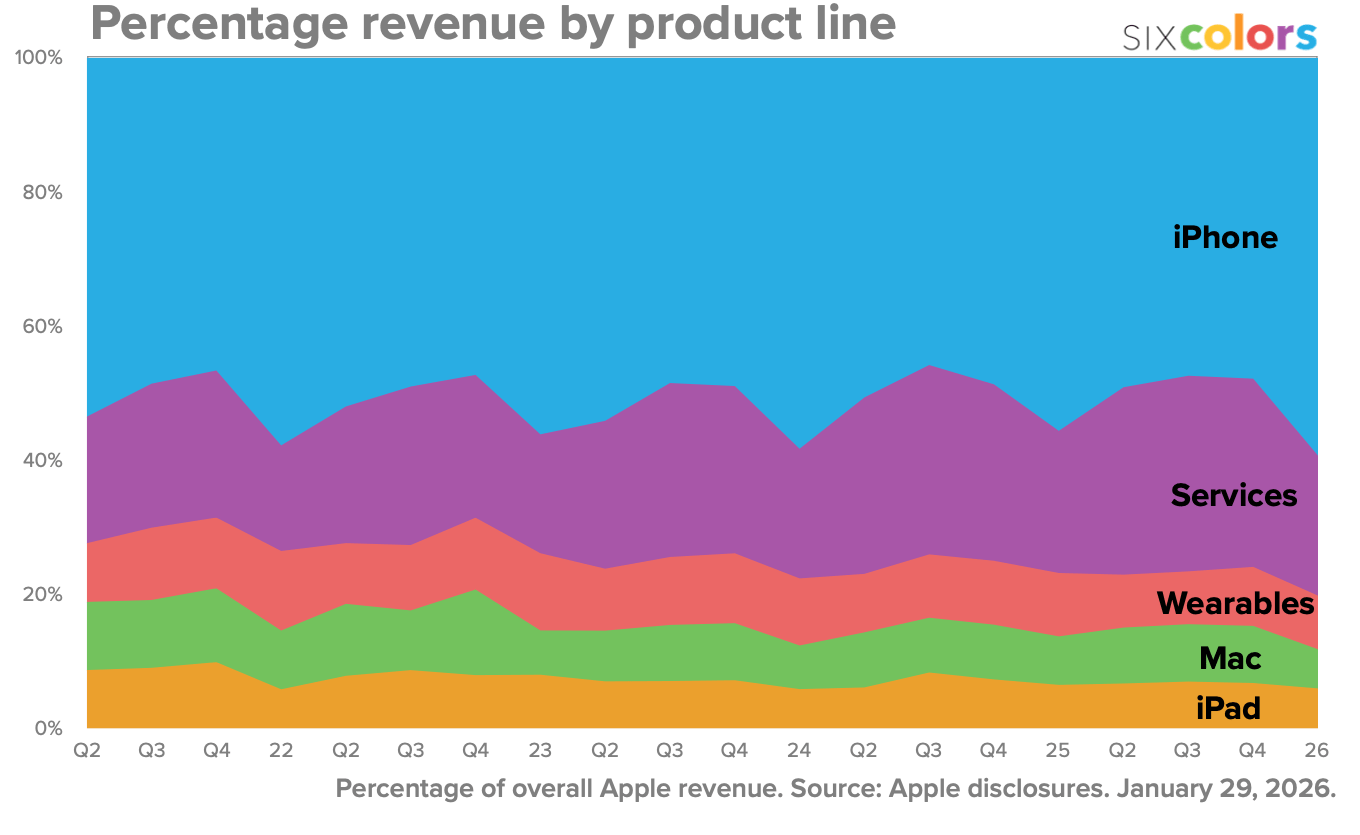
There’s a totally reasonable concern that the growth of Services will pervert Apple’s priorities away from hardware products. I think that’s why naming John Ternus, the head of hardware, as the new CEO is an important statement in and of itself regarding where Tim Cook sees Apple’s North Star: hardware products.
I believe that Cook’s focus on Services over the last decade was in no way about shifting the focus of the company away from its roots. Nor was it about growth for the sake of growth. I think it was about bringing balance to the balance sheet, to protect the company’s core mission of creating devices.
Tuesday, 21 April 2026
- Trump on Tim Apple ★
-
The president of the United States, on his blog this morning (all capitalization, punctuation, and missing/wrong words verbatim):
I have always been a big fan of Tim Cook, and likewise, Steve Jobs, but if Steve was not taken from the Planet Earth so young, and ran the company instead of Tim, the company would have done well, but nowhere near as well as it has under Tim. For me it began with a phone call from Tim at the beginning of my First Term. He had a fairly large problem that only I, as President, could fix. Most people would have paid millions of dollars to a consultant, who I probably would not have known, but who would say that he knew me well. The fees would be paid but the job would not have gotten done. When I got the call I said, wow, it’s Tim Apple (Cook!) calling, how big is that? I was very impressed with myself to have the head of Apple calling to “kiss my ass.” Anyway, he explained his problem, a tough one it was, I felt he was right and got it taken care of, quickly and effectively. That was the beginning of a long and very nice relationship. During my five years as President, Tim would call me, but never too much, and I would help him where I could. Years latter, after 3 or 4 BIG HELPS, I started to say to people, anyone who would listen, that this guy is an amazing manager and leader. He makes these calls to me, I help him out (but not always, because he will, on occasion, be too aggressive in his ask!), and he gets the job done, QUICKLY, without a dime being given to those very expensive (millions of dollars!) consultants around town who sometimes get it done, and sometimes don’t. Anyway, Tim Cook had an AMAZING career, almost incomparable, and will go on and continue to do great work for Apple, and whatever else he chooses to work on. Quite simply, Tim Cook is an incredible guy!!! President DONALD J. TRUMP
Matthew Yglesias, on Twitter/X, first:
You can see in Trump’s take on Tim Cook what he really likes about tariffs, which is nothing to do with economics and everything about how it makes business leaders dependent on his goodwill.
and second:
Also appreciate that Trump threw in a hot take about Apple being better off without Steve Jobs.
The man loves to post!
Yglesias is exactly right re: Trump’s obsession with tariffs. There is zero underlying economic philosophy behind them. He likes tariffs because he sees them as a way to exert political power. I’d add only that Yglesias is being a tad deferential/euphemistic when he says “makes business leaders dependent on his goodwill”. Trump himself used the right phrase to describe why he likes tariffs — they get business leaders to “kiss his ass”. Trump’s own words.
Yglesias’s second point is directly related to the first. There’s no evidence that Trump and Jobs ever met, personally, but Trump admired Jobs and has an intuitive understanding that Jobs would not have kissed his ass, and to Trump, that’s the most important thing about Cook. Rightly or wrongly, Cook took/takes that one for the team. Jobs wouldn’t have (and, if he had lived, would have probably sent COO Tim Cook to do it), and Trump knows it.
Lastly, hat tip to Trump for the self-deprecating reference to his having mistakenly addressed Cook as “Tim Apple” at a public meeting back in 2019. He’s still funny when he’s in the right mood.
Bonus: Mekka Okereke color-coded each sentence of Trump’s post in four categories: (1) praise for Cook; (2) belittling other people; (3) self glorification; and (4) putting his own name in all caps.
Monday, 20 April 2026
- DF Paraphernalia: T-Shirts and Hoodies Are Back ★
-
Daring Fireball t-shirts and hoodies are back. Order now, and we’ll start printing shirts at the end of this week and shipping them out next week. Go ahead and place your order now, while I gather my thoughts about today’s Apple leadership news.
- ‘Community Letter From Tim’ ★
-
Tim Cook, in a letter addressed, simply, “To the Apple community”:
For the past 15 years I’ve started just about every morning the same way. I open my email and I read notes I received the day before from Apple’s users all over the world.
You share little pieces of your lives with me and tell me things you want me to know about how Apple has touched you. About the moment your mom was saved by her Apple Watch. About the perfect selfie you captured at the summit of a mountain that seemed impossible to climb. You thank me for the ways Mac has changed what you can do at work and sometimes give me a hard time because something you care about isn’t working like it should.
In every one of those emails I feel the beating heart of our shared humanity. I feel a sense of deepening obligation to work harder and push further. But most of all, I feel a gratitude that I cannot put into words, that I somehow got to be the person on the other end of those emails, the leader of a company that ignites imaginations and enriches lives in such profound ways it defies description. What an honor and a privilege it has been.
The language here feels looser, more casual, more real than anything Cook has said or written in public since his historic, seminal coming-out essay at Businessweek back in 2014.
Just a wonderful note. This feels like a very happy day for Tim Cook. Where has this guy been?
- Apple: ‘Tim Cook to Become Apple Executive Chairman; John Ternus to Become Apple CEO’ ★
-
Apple Newsroom, with a veritable “boom”:
Apple announced that Tim Cook will become executive chairman of Apple’s board of directors and John Ternus, senior vice president of Hardware Engineering, will become Apple’s next chief executive officer effective on September 1, 2026. The transition, which was approved unanimously by the Board of Directors, follows a thoughtful, long-term succession planning process.
Cook will continue in his role as CEO through the summer as he works closely with Ternus on a smooth transition. As executive chairman, Cook will assist with certain aspects of the company, including engaging with policymakers around the world.
Ternus will become the 8th CEO in Apple’s 50-year history:
- Mike Scott, 1977–1981
- Mike Markkula, 1981–1983
- John Sculley, 1983–1993
- Michael Spindler, 1993–1996
- Gil Amelio, 1996–1997
- Steve Jobs, 1997–2011
- Tim Cook, 2011–2026
At just over 50 years old — the same age Cook was when he took the job — Ternus is young enough for decade-plus run, joining only Sculley, Jobs, and Cook.
In a separate announcement: “Johny Srouji Named Apple’s Chief Hardware Officer”.
This is all very exciting, but also all very low on drama. It’s all very, very Cook-ian.
- Apple’s Annual Environmental Progress Report ★
-
Apple Newsroom:
In its annual Environmental Progress Report released today, Apple marked progress toward Apple 2030, the company’s ambitious goal to be carbon neutral across its entire footprint by the end of this decade. Apple’s greenhouse gas emissions in 2025 remain down over 60 percent compared to 2015 levels, holding constant from 2024 even in a year of significant business growth. The report highlights additional progress in renewable energy, materials innovation and recycling, water stewardship, and zero waste.
On the packaging front:
Apple completed the transition to 100 percent fiber-based packaging last year, fulfilling its pledge to remove plastic from packaging by 2025. Over the past 10 years, Apple engineers and designers have developed alternatives to common packaging components, replacing plastic screen protectors and trays with versions made with recycled or responsibly sourced paper. They also innovated to make packaging more recyclable, designing the largest boxes, like for the new Studio Display XDR, to collapse into smaller pieces that fit into a home recycling bin. Apple avoided more than 15,000 metric tons of plastic in the past five years alone — the equivalent of about 500 million plastic water bottles.
Apple made this shift while not compromising a whit on the design quality of its packaging. If anything, I’d say Apple products have better packaging than ever. How they look, how they feel, the experience of opening them. Some of the company’s most talented and most effective designers work on the packaging team.
Earlier in the announcement:
As Apple celebrates Earth Day with its teams, partners, and customers around the world — including with a special offer for users who bring in their Apple devices for recycling at participating Apple Store locations — here’s a look at the progress the company is making across its environmental initiatives.
That special offer, the 2026 Earth Day Promotion, is a PDF. That PDF file is not the work of Apple’s best designers. Jiminy.
Sunday, 19 April 2026
- Jessica Chastain Says Apple TV Will Finally Release ‘The Savant’ ★
-
Marc Malkin, Variety:
Jessica Chastain says Apple TV is finally going to release her political thriller series “The Savant.” [...]
“Before it was like, ‘I don’t know if we’re going to see it,’ but now I can say, ‘We’re going to see it,’” Chastain told me exclusively on Saturday at the Breakthrough Prize ceremony in Santa Monica.
As for when, sources tell me that Apple is planning for a July release.
Previously, re: The Savant’s limbo release date.
- WorkOS FGA: The Authorization Layer for AI Agents ★
-
My thanks to WorkOS for sponsoring last week at DF. Every AI agent demo looks magical, but most hit a wall in enterprise deployment. It’s not model quality or latency. It’s authorization. Authentication proves an agent’s identity. Authorization defines its blast radius.
The winners in enterprise AI won’t have the most features. They’ll be the ones enterprises can safely trust. Learn how WorkOS FGA scopes that blast radius with resource-level permissions, and read their deep dive for more.
Saturday, 18 April 2026
- Mac Mini and Mac Studio Supply Shortages ★
-
Nicole Nguyen, writing for The Wall Street Journal (gift link):
Mac Minis with larger-capacity RAM chips — a base M4 model with 32GB of RAM, starting at $999, and the M4 Pro models with 64GB of RAM, starting at $1,999 — are “currently unavailable” on Apple.com. And estimated shipping wait times for any other Mini model start at about a month, and in some cases is up to 12 weeks. (This Mini scarcity extends to other retailers as well.)
The more powerful Mac Studio makes up an even smaller share of sales than the Mini — less than 1%, according to CIRP. But its high-memory configurations ($3,499 and up) are also unavailable, and more affordable variations show wait times of up to 12 weeks. Last month, Apple removed the Mac Studio’s mega upgrade — 512GB of RAM — which it had touted as “the most ever in a personal computer.”
Meanwhile, Apple can ship its most popular computer, the MacBook Pro, with 128GB of RAM ($5,099 and up) to your door in early May. MacBook Pro models with less RAM ship sooner, and almost all other Mac models we reviewed on Apple.com will arrive just days after they’re ordered.
Apple declined to comment on what’s happening with these AI-friendly systems, but analysts have three theories.
This situation is rather unusual, and I suspect Nguyen is correct that it’s the result of a combination of factors, including a surge in demand from new “desktop AI” systems like OpenClaw. It’s rather remarkable that pretty much all of these desktop AI systems are Mac-exclusive, including the new Codex app from OpenAI (that’s based on Sky, the never-released AI automation app from the team behind Workflow, which Apple acquired and renamed Shortcuts). Some of these systems will surely arrive on other platforms eventually, but at the moment, they’re only on the Mac. They’re not on Windows, not on Linux, not on Android, and not on iOS. Just the Mac. That’s because the Mac is, and always has been, the best computer platform in the world. It just is. These systems can’t run on iPhones or iPads because those are baby computers. They just are. So if you want to jump in as an early adopter on desktop AI, it needs to be on a Mac. And if you want a headless always-on Mac to do it, the only options are a Mac Mini or Mac Studio.
Obviously Apple is nearing the release of M5-generation models for both the Mini and Studio. Perhaps those models are behind schedule, and Apple already tapered production of the old models. I think it’s just a question of whether we need to wait for WWDC in June, or if they’re going to drop in May.
Friday, 17 April 2026
- Apple’s Developer Guidelines for Ratings and Review Prompts ★
-
Apple Design:
Avoid pestering people. Repeated rating requests can be irritating, and may even negatively influence people’s opinion of your app. Consider allowing at least a week or two between requests, prompting again after people demonstrate additional engagement with your experience.
Prefer the system-provided prompt. iOS, iPadOS, and macOS offer a consistent, nonintrusive way for apps and games to request ratings and reviews. When you identify places in your experience where it makes sense to ask for feedback, the system checks for previous feedback and — if there isn’t any — displays an in-app prompt that asks for a rating and an optional written review. People can supply feedback or dismiss the prompt with a single tap or click; they can also opt out of receiving these prompts for all apps they have installed. The system automatically limits the display of the prompt to three occurrences per app within a 365-day period. For developer guidance, see
RequestReviewAction.There are a lot of apps that eschew a lot of these guidelines. I mean, how do you avoid pestering people when the entire idea of an alert asking for a rating/review is, by nature, pestering? It’s an oxymoron, like saying “Don’t pester people when you pester them.”
I actually knew about the system setting to opt out of these prompts. On iOS it’s in Settings → Apps → App Store: In-App Ratings & Reviews. On MacOS, it’s in the App Store app’s Settings window. On both platforms, it’s on by default. This is one of several settings that I would change, personally, but choose not to, as a critic / pundit / know-it-all, so as to have more of the standard experience that most users get. If you’re annoyed by these prompts though, you should feel free to turn them off.
- Follow-Up Regarding App Store Reviews, Which Are Definitely Busted ★
-
I wrote yesterday:
And the apps that do the right thing — like Godier’s Current — and never solicit a review like a needy hustler are penalized.
On Mastodon, Steven Troughton-Smith responded:
Review prompts are the difference between a great app getting five positive reviews, and thousands of positive reviews. I would never recommend to a developer to not implement the APIs. It’s App Store Editorial suicide for most apps, since Apple tends to only pick things up when they have that body of review data.
I can see how my describing not prompting for reviews as “the right thing” looks like I’m suggesting developers should not prompt for reviews. That wasn’t my intention.
You have to play the game as the game stands, and Apple controls the game. And in the game as it stands, apps need 5-star reviews to gain traction in the App Store, perhaps especially so for apps in crowded categories. And for most apps, the only way to achieve that is through prompting. But the right thing to do, for the user experience in the app, is never to prompt for reviews.
That’s the problem with how Apple has set this up — to be competitive, apps need to do the wrong thing. I’m a competitive bastard. If I had an app in the App Store today, I’d probably prompt for reviews. I don’t begrudge developers who do it today. That’s the game. I admire developers who refuse to play this part of the game. It’s noble. But it’s not a winning strategy. I want Apple to fix the game — that’s the only real solution.
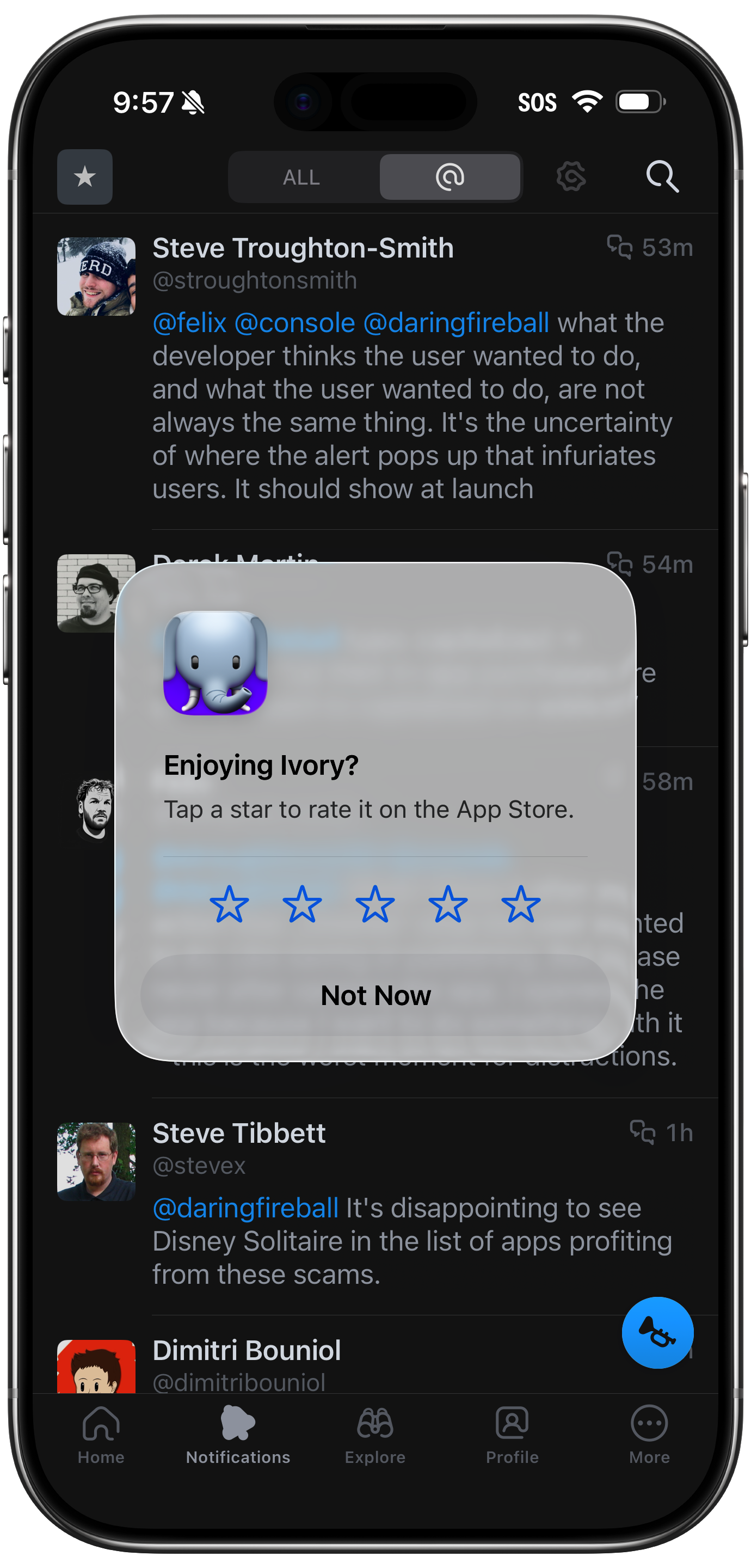
The system is so twisted that even Apple itself begs for these reviews from its own apps, even the system apps built into iOS. When else does Apple ever ask for anything? It looks needy and pathetic. Real Gil Gunderson vibes.
The funny thing is, this morning while I was reading the Mastodon thread with Troughton-Smith’s post, Ivory prompted me for a rating. Which I dutifully submitted. 5 stars, of course. Which brings me to another follow-up point. A few readers have emailed to object to the argument that it hurts developers to give apps anything short of a 5-star rating. (A few of these readers are from Germany, no surprise.) It’s logical, I agree, that a 4-star rating ought to be considered fair and just for a good app with obvious room for improvement. But anything short of 5 stars pulls down any good app’s average, because the overwhelming majority of users who rate apps only ever assign 5 stars for apps they like, or 1 star for apps they’re angry about. In a system where the overwhelming majority of users only ever assigns 1 or 5 stars, assigning 4 stars is effectively a mildly negative review. That sucks. Apple should fix it. But until they do (which, let’s face it, they probably won’t), obstinately ignoring that this is how App Store ratings work does not help good apps get the attention you think you’re helping them get with a 4-star rating.
Thursday, 16 April 2026
- App Store Reviews Are Busted ★
-
Terry Godier:
For example, if you have a 4.1 star rating in the App Store, any 4 star review is going to decrease that average. In other words, leaving a 4 star review is essentially leaving a negative review. [...]
You will see a lot of 4 star reviews that say things like, “This is my favorite app!” or “Gamechanger!” The apps that tend to have these types of reviews are often over a 4.0 in the store and are being actively harmed average-wise by having them, even though the intent was clearly not to do so.
Problem #1 is that star-rating systems absolutely suck for aggregation. If you’re going to collect and average ratings from users, the system that works best is binary: thumbs-up or thumbs-down. Netflix switched from stars to thumbs in 2017, and YouTube switched all the way back in 2009. The App Store should switch to thumbs.
The logical endpoint of apps optimizing for a 5 star review invalidates the system as meaningful on the store. The system becomes a better representation of the sophistication at review prompt execution than it does an accurate reflection of app product quality. The incentive isn’t to create an actual 5 star app, but rather to create a robust system that transmits only 5 star reviews.
Problem #2 is that even if the App Store switched from stars to thumbs, the system would still be gamified by developers, rewarding, as Godier aptly puts it, not the best apps but instead the apps that are best at “review prompt execution”. Apple should remove the APIs that allow apps to prompt for reviews, and forbid the practice of prompting for them. Nothing good, and much bad, comes from these prompts. Imagine being in a restaurant, and in the middle of your entree, the server comes to your table and hands you an iPad and asks you to rate the joint on Yelp. That’s what using most apps is like. And the apps that do the right thing — like Godier’s Current — and never solicit a review like a needy hustler are penalized.
Every time I see one of these prompts it’s like getting hit up by a panhandler — and some of the prompts come from Apple’s own apps. It’s all so greasy. One of the advantages of a walled garden ought to be keeping panhandlers and solicitors out.
- Freecash Was More Like Scamcash ★
-
Sarah Perez, writing for TechCrunch:
If you’ve been on TikTok this year, you’ve more than likely encountered ads for Freecash. The app has been marketed as a way to make money just by scrolling TikTok — and jumped to the top of the app stores in recent months, peaking at the No. 2 position in the U.S. App Store.
In truth, Freecash pays users to play mobile games — all the while collecting a heaping amount of sensitive data, according to cybersecurity company Malwarebytes. [...]
On Monday, after being contacted by TechCrunch for comment, Apple pulled Freecash from its App Store. As of Monday afternoon, the app was still listed in the Google Play store. (It has since been removed).
As I have repeatedly written, it boggles my mind why Apple doesn’t have an App Store “bunco squad” that targets scam and fraud apps that are popular and/or high-grossing. It’s folly to think that the App Store could ever be completely free of scam apps. But it’s absurd that this app Freecash rose to #2 in the App Store, with millions of downloads, and Apple only took a look at and removed it after TechCrunch asked about the app.
Pieter Arntz, writing at Malwarebytes:
The landing pages featured TikTok and Freecash logos and invited users to “get paid to scroll” and “cash out instantly,” implying a simple exchange of time for money. Those claims were misleading enough that TikTok said the ads violated its rules on financial misrepresentation and removed some of them.
Once you install the app, the promised TikTok paycheck vanishes. Instead, Freecash routes you to a rotating roster of mobile games — titles like Monopoly Go and Disney Solitaire — and offers cash rewards for completing time‑limited in‑game challenges. Payouts range from a single cent for a few minutes of daily play up to triple‑digit amounts if you reach high levels within a fixed period.
The whole setup is designed not to reward scrolling, as it claims, but to funnel you into games where you are likely to spend money or watch paid advertisements.
Dystopian. And it’s gross that the follow-the-money chain here ultimately leads to pay-to-win games from established brands like Hasbro (Monopoly Go) and, of all companies, Disney (Disney Solitaire). Look at these games’ App Store listings, and you’ll see: (a) their in-app purchases are clearly meant to capitalize on addicts, and (b) their privacy report cards are appalling. And Apple is taking 30 percent of all this. Honest to god, how would it be any worse if Apple started selling cigarettes in its retail stores? Because there’d be butts to clean up outside the glass doors?
- Colliding With Reality, Indeed ★
-
Anton Troianovski, reporting for The New York Times under the headline “Trump’s Portrayal of the War in Iran Collides With Reality”:
President Trump is trying to cast his Iran war as all but over, a done-and-dusted success.
But after years of trying to impose his own reality on the world, he has now run into a crisis that is not bending to his narrative.
On the one hand, I’m loath to complain about the Times finally stating the obvious and treating Trump like they would any other official. Same goes for a Peter-Baker-bylined piece this week, “Trump’s Erratic Behavior and Extreme Comments Revive Mental Health Debate”. Finally. It was good that the Times’s reporting on Biden’s mental acuity two years ago was sharp enough to draw the ire of the Biden administration. But Biden never once said anything crazy. Forgetful? Slightly confused? Sure. But Trump is saying and tweeting crazy-ass stuff every day now. A steady stream of abject unhinged nuttiness. For chrissake he badgered kindergarteners at the White House Easter egg roll about Biden’s use of an autopen.
But on the other hand, when exactly has Trump “run into a crisis” that did “bend to his narrative”? He’s a bullshitter, and so good at bullshitting that his bullshit often flies. That’s very different from reality bending to meet the bullshit.
The difference with Iran is that war is about as close as anything gets to being bullshit-proof. Trump created a crisis that can’t be bullshitted.
(Also, take it easy on the Oompa-Loompa makeup, sir.)
- How to Format 10-Digit Phone Numbers ★
-
The Associated Press Stylebook, on Threads:
We updated our style for telephone numbers in 2024 to drop parentheses. We now recommend the form: 212-621-1500.
For international numbers use 011 (from the United States), the country code, the city code and the telephone number: 011-44-20-7535-1515.
Use hyphens, not periods. No parentheses. The form for toll-free numbers: 800-111-1000. If extension numbers are needed, use a comma to separate the main number from the extension: 212-621-1500, Ext. 2.
I have long been annoyed that U.S. phone numbers are so often formatted in the outdated (123) 555-1234 format. The use of parentheses for the area code dates back to the old days, when you only needed to dial the area code to call a number outside your own area code. (The same era whence comes the verb dial.) Until 10-digit dialing with mandatory area codes started to become standard in the late 1990s, you only needed to dial seven digits to call a local number.
Apple’s Contacts app (and I think the system-wide Contacts framework, used by third-party apps like Flexibits’s excellent Cardhop), will go so far as to reformat numbers entered in 123-555-1234 format as (123) 555-1234. Apple should update the formatting to go the other way, and turn phone numbers with the area code in parentheses into the 123-555-1234 format. It’s only because area codes used to be optional that they were put in parentheses. Given that 7-digit dialing is never going to return, we should abolish the parentheses too.
- Chance Miller: ‘Netflix Ruined Its Apple TV App by Switching to a Custom Video Player’ ★
-
Chance Miller, 9to5Mac:
The change began rolling out a few weeks ago, and user frustration is mounting. On Reddit, there’s a growing thread of Netflix subscribers saying they are canceling their subscription because of this change to the Apple TV app. [...]
The change also means you lose access to full payback controls using the Apple TV Remote app on your iPhone. You can’t enable Enhance Dialogue from the video player. That clever Apple TV feature that automatically enables subtitles when you rewind? Gone.
One of my most-used tvOS video player features is the ability to tap the Siri Remote to see when what I’m currently watching will end. It’s great for trying to decide whether you have time for one more episode before bed. That feature is gone in Netflix as part of this change.
FlatpanelsHD has a great roundup of all the features on Apple TV that rely on an app using the native video player.
Someone tried to argue with me when I complained about this horrendous regression that Netflix users somehow want consistency across different platforms — that users want the same Netflix player on Apple TV as on Roku, Amazon Fire, Google TV, and whatever crap is built into their “smart” TV. Nonsense. Why would users of one platform care what the Netflix player is like on other platforms? Apple TV users buy Apple TV boxes because they want the Apple TV experience. Maybe Netflix wants to present the same experience everywhere. Maybe Netflix wants to save on engineering costs by having a write-once-run-like-shit-everywhere video player. That’s a Netflix concern, not a user concern.
From the perspective of users, this change to the tvOS Netflix app just sucks. There’s no upside at all. Nothing is better, much is worse, and a slew of cool platform features are now gone.
- Apple Pay Express Mode for Transit, When Used With a Visa Card, Is Vulnerable to Scam Tap-to-Pay Readers ★
-
Juli Clover, MacRumors:
The process requires the victim to have Express Transit Mode enabled for payments, and a Visa card linked for those payments, among other steps. As it turns out, it’s a Visa-related security loophole rather than an iPhone issue, and it doesn’t work with a Mastercard or an American Express card because other cards use different security methods. It also doesn’t work with Samsung Pay on Samsung devices, and it requires the specific combination of a Visa card and an iPhone. Apple told Veritasium that it’s an issue with the Visa system, but something unlikely to occur in the real world.
The video, hosted by the Veritasium YouTube channel, but starring Marques Brownlee as the victim, takes over 15 minutes before clarifying that the exploit only works with Visa cards, and only when a Visa card is set as your card for Express Transit Mode. Until then, the video implies that the exploit can work against any iPhone that has Apple Pay configured, with any sort of credit card. The technical explanation of how the hack works is pretty good though.
As I wrote a year ago (when Apple was looking for a new partner to replace Goldman Sachs as the bank for Apple Card), Visa is the most popular credit and debit card in the U.S., by a significant margin. If you don’t use Express Mode, you’re safe. If you do use Express Mode, I suggest any card other than a Visa.
Update: It’s worth noting that according to Apple, Express Mode is turned on by default “when you add an eligible transit card or other compatible card”.
- Bonus Thought Regarding the Name ‘iPhone Ultra’ ★
-
One more thought re: the item I posted this week speculating on what Apple will name their much-rumored two-screen folding iPhone this year. If they do name it “iPhone Ultra”, I think Apple using that name for the folding iPhone will imply that they have no plans whatsoever to ever make a “rugged” iPhone — a model akin to Apple Watch Ultra.
I suspect Apple has no plans for a dedicated rugged iPhone. People who want that just buy extra-thick cases for regular iPhones. A watch is different. I know some people put their Apple Watches in ungainly protective “cases”, but they look hideous, which is why you see so few people using them. For aesthetically pleasing ruggedness, the watch case itself needs to be designed for it. But maybe there is a large enough potential market for such an iPhone — especially if such a device had significantly longer battery life than any regular iPhone, as an Apple Watch Ultra does relative to a regular Apple Watch.
But if Apple calls the folding iPhone “Ultra”, stop holding your breath for such an Apple-Watch-Ultra-style iPhone. In the same way that “Air” means very different things on Mac, iPad, and iPhone, so too might “Ultra”.
- Rory Goss’s Accessibility Story ★
-
Feature story and short film, well worth watching, from Apple:
One winter day in January 2024, 16‑year‑old Rory Goss experienced something jarring while in construction class at Abbey Christian Brothers’ Grammar School in Newry, Northern Ireland. He could no longer see the whiteboard at the front of the room.
As a straight‑A student in 11th grade, Rory was in the midst of studying for his A‑levels and was about to start applying to university. Passionate about golf and cars, and eager to start driving lessons, he had no idea what was happening to his eyesight.
Within weeks, he was diagnosed with Leber’s Hereditary Optic Neuropathy, a rare genetic condition that damages the optic nerve and can lead to sudden, severe vision loss. Over the next six months, his vision deteriorated by 95%, meaning he was legally blind as he began his 12th grade exams.
Apple just posted this feature this week, but it’s serendipitously aligned with my recent (and not-so-recent) posts about the screen zooming features in MacOS and iOS. Goss zooms in and out with extraordinary dexterity and fleetness. It’s quite extraordinary. Particularly moving for me is his illustration — created on an iPad, using Apple Pencil — where he attempts to illustrate what his vision now looks like.

Wednesday, 15 April 2026
- So Close to Getting It ★
-
David Pierce, last week in his Installer column/newsletter for The Verge, singing the praises of the version 5.0 update to Sofa (the praises of which I just sang):
Sofa 5. A huge update to an Installerverse favorite, this app is now a great way to manage everything you want to watch, read, play, and even do IRL. I never quite made it stick when it was mostly just movies and shows, but now I think of it as like a Notion for my personal life. Apple devices only, alas, but boy do I love this app.
Pierce, I just noted today, also just wrote a feature story at The Verge about his decision to buy a new iPhone — after trying an array of new Android phones and admitting to a (questionable, IMO) personal preference for Android over iOS — because there are so many better apps on iOS that don’t have equivalent-quality counterparts on Android. In that earlier piece, Pierce wrote:
Lots of the apps I use every day — apps like Puzzmo, NotePlan, Mimestream, and Unread — either don’t exist on Android at all or only exist as web apps. Most of the ones that do work on both platforms are better on iOS. And forget about the kind of handcrafted, small-developer stuff — apps like Acme Weather, Current, and Quiche, just to name a few recent favorites — that’s all over the App Store and absolutely nowhere to be found on Android.
These apps don’t just happen to be both exquisitely crafted and exclusive to iOS (and in some cases, MacOS). They’re exquisitely crafted because they are idiomatic native apps designed to adhere to Apple’s platforms. Not all native apps are great, of course, but most great apps are native — and most great native apps are native to iOS or MacOS.
So there ought be no “alas” to describe Sofa being exclusive to Apple devices, but instead a “thank you” to developer Shawn Hickman for keeping it exclusive, and thus keeping it great.
- Sofa 5.0 ★
-
Shawn Hickman:
A show you started last month. A book on your nightstand. A game you keep meaning to get back to. Finding something new is easy. Remembering where you left off is the hard part.
Sofa 5 helps you keep track of this stuff. Progress rings show up on covers throughout the app so you can see where you stand at a glance. Your home screen shows what’s next with one-tap checkboxes to keep things moving.
Five ways to track, depending on what fits: just enjoy with zero setup, tap to log, count pages, check off episodes, or keep a journal as you go. Pick one and switch anytime.
It’s a well-established cliché that no one ever finds the perfect to-do app or “task management system” unless they create it themselves. That’s certainly true for me (and resulted in my co-creating Vesper). Keeping track of things you want or need to do is too close to codifying how you think and remember things in your own mind, and we all think and remember in unique ways. We thus crave unique apps or systems to manage our tasks, ones that fit our minds just right. That’s why there are a zillion to-do apps, including a bunch that are actually good. And, these days, that’s why there are so many people creating their own personal to-do apps using AI coding systems.
Because media-tracking apps are just a subset of to-do apps, all the same things hold true for them. So, just like how I occasionally flit back and forth between general-purpose to-do apps, or become enamored with a new one, I’ve switched between several media-tracking apps over the years. These are apps where you keep lists of movies and shows you want to watch, books you want to read, and then log them, perhaps with notes or ratings, as you watch them.
It’s an endlessly fascinating app genre. Sofa is a really good example, one that I’ve used on and off for years. (Disclaimer: I started using Sofa when it was the weekly sponsor on DF back in 2022, but I’ve kept using it since then because it’s so good.) I’ve been using Sofa v5 for months now, including while it was in beta, and it is a big improvement to an already very good, very thoughtful app. A lot of people use general-purpose to-do apps to track movies and shows to watch, books to read, and games to play. Sofa 5 goes the other way, and expands what started as a dedicated media tracker into something you can use to track, well, anything you want to do.
Sofa is quite useful for free, and super useful with a paid subscription. If you’re even vaguely unsatisfied with your current app or system for tracking media to watch / read / play, you should check it out.
- Lisa Melton: ‘Memories of Steve’ (and Memories of Safari’s Unique Page-Loading Indicator in Particular) ★
-
Lisa Melton, who ran the team that created Safari, regarding her interactions with Steve Jobs:
When Steve asked you a question? You didn’t ramble and, whatever you did, you didn’t make up an answer. If you didn’t know, you just said that you didn’t know. But then you told him when you’d have an answer. Again, this was just good advice to anyone “managing up,” as they say.
This is A+ advice for dealing with anyone, period. If you don’t know, say “I don’t know.” So many people have a deep aversion to saying that. And if you can say “I don’t know, but I’ll find out in «some short amount of time here»”, say that.
Here’s the bit that’s relevant this week:
Steve didn’t like the status bar and didn’t see the need for it. “Who looks at URLs when you hover your mouse over a link?” He thought it was just too geeky.
Fortunately, Scott and I convinced Steve to keep the status bar as an option, not visible by default. But that meant we had a new problem. Where should we put the progress bar to indicate how much of the page was left to load?
Before, the progress bar lived inside the status bar. So we needed to find it a new home. We discussed all sorts of silly ideas including making it vertical along the edge of the window.
Remember, this was back in the day before the spinning gear or other smaller affordances were widely used to indicate progress. In the age of barber-pole blue Aqua, it had to be a bar.
The room got quiet. Steve and I sat side-by-side in front of the demo machine staring at Safari. Suddenly we turned to each other and said at the same time, “In the page address field!”
Smiles all around. Which I followed with, “I’ll have a working version of that for you by the end of the week.” Over-committing my engineering team, of course.
But I didn’t care. I had just invented something with the Big Guy. True, it was a trifle, but there’s no feeling like sharing even a tiny byline with Steve.
This of course, is contra John Calhoun’s offhand recollection (in a Hacker News thread last month) that Steve Lemay “also invented the early Safari URL text field that also doubled as a progress bar”. Melton is a direct source, so there’s no reason to doubt her recollection of having conceived of the idea alongside Steve Jobs. These recollections are not, of course, mutually exclusive — perhaps Lemay was a designer assigned to flesh out the idea, and Calhoun remembers him as a proponent of the idea.
Anyway, this whole essay from Melton just goes down like butter. So good.
- Screen Zooming on iOS and iPadOS ★
-
Steven Troughton-Smith:
If you want to pixel-peep on iOS or iPadOS, it also has the Zoom accessibility setting, and can be controlled via touch, keyboard, or trackpad. It works for display mirroring too, and has other options like a minimap and HUD (‘Zoom Controller’).
These settings are in Settings → Accessibility → Zoom. I prefer switching the Zoom Region from the default Window Zoom (which gives you large magnifier glass window to drag around the screen) to Full Screen Zoom, which is more like how zooming works on the Mac.
On iPadOS, you should go into the Keyboard Shortcuts panel (inside Accessibility → Zoom) and turn on Zoom with Scroll Wheel. This lets you zoom Mac-style, using the Control key, when you have a keyboard and trackpad/mouse connected.
(You can, of course, zoom on VisionOS too.)
Tuesday, 14 April 2026
- Fraudulent Cryptocurrency App in Mac App Store Stole $9.5 Million From 50-Some Users ★
-
Molly White, at Web3 Is Going Just Great:
After a fake version of the Ledger cryptocurrency wallet app made it onto the normally highly curated Apple App store, customers lost $9.5 million dollars to the malicious product. Believing it was a genuine Ledger product, people entered their seed phrases into the app, then discovered their wallets were immediately drained.
One victim, a musician who goes by G. Love, wrote: “I lost my retirement fund in a hack/Scam when I switched my Ledger over to my new computer and by accident downloaded a malicious ledger app from the Apple store. All my BTC gone in an instant.” According to him, he lost 5.9 BTC (~$445,000).
The legit (if that adjective can be used for cryptocurrency apps) Ledger Live Mac app is only available as a direct download from Ledger’s website. They also do have an app in the App Store, but it’s iPhone-only.
- On the Name of Apple’s Foldable iPhone ★
-
Tim Hardwick, last week at MacRumors:
Apple’s first foldable iPhone may not carry the speculative media-derived “Fold” branding after all, according to Chinese leaker Digital Chat Station. In a new post on Weibo, the oft-accurate leaker claimed that Apple’s book-style foldable could launch as the “iPhone Ultra.” Meanwhile, domestic Chinese manufacturers are allegedly deciding whether to follow Apple’s lead by tentatively branding their own upcoming foldables as “Ultra” models, but likely with a lighter price tag — Apple’s version is expected to cost between $2,000 and $2,500.
I have no inside knowledge about what Apple plans to name this device, but I’ll eat my proverbial hat if they name it “iPhone Fold”. That name is so dumb it’s what Samsung calls their foldables. You don’t name a device for what it does, you name it for what it connotes. A good name conveys feeling, not just function. “iPhone Ultra” or “iPhone Max” would both work, and Ultra sounds more luxe. So while unsurprising, that’s probably the best bet, even without the reliable word of Mr. Digital Chat Station.
But if you want my take on a wildcard name, one with some history, how about “iPhone Duo”?
- Speaking of Tips ★
-
The Houston Chronicle:
Kristin Tips, the longtime presiding officer of the embattled Texas Funeral Service Commission, is no longer on the board. “Governor Abbott appreciates Kristin Tips’ service,” Andrew Mahaleris, Abbott’s press secretary, said in an email Tuesday. “An announcement on a replacement will be made at a later date.” [...]
Tips, who has run San Antonio’s prestigious Mission Park Funeral Chapels, Cemeteries & Crematories with her husband, Dick Tips, was appointed to the board by the governor in 2017 and made the presiding officer in May 2024. Tips did not respond to a request for comment.
I don’t have any questions for her, but I have at least one for her husband.
- Apple Has Hidden the Pre-Creator-Studio Versions of Keynote, Numbers, and Pages in the Mac App Store ★
-
Ryan Christoffel, 9to5Mac:
On the iPhone and iPad, Apple made the new Creator Studio features available as updates to the existing App Store releases.
On the Mac though, the rollout was a lot more confusing. Apple kept the old iWork apps for Mac available on the App Store and launched entirely separate iWork versions with the Creator Studio features. Starting today, though, that oddity is no more. Per Aaron Perris, Apple has officially removed the old Pages, Keynote, and Numbers apps from the App Store.
If you’ve previously downloaded these apps, you’ll still find them in your download history and can re-download from there. But new users will only see one option on the App Store: the Creator Studio-compatible apps.
One reason — perhaps the reason? — this was necessarily more complex on MacOS is that the iWork apps used to have different bundle identifiers on iOS and Mac. On the Mac, the old (classic?) version of Keynote has the bundle identifier
com.apple.iWork.Keynote. On iOS, it was always justcom.apple.Keynote, without theiWorkpart. To make the single-subscription bundle work across both platforms, Apple seemingly needed to unify the bundle IDs, and they unified them using the iOS versions, sans theiWorkpart. The new Creator Studio versions of the Mac apps now have the same bundle IDs as the iOS versions. You can see this using Terminal, if, like me, you currently have both versions of these apps installed side-by-side:% mdls -name kMDItemCFBundleIdentifier -r \ /Applications/Numbers.appResult:
com.apple.iWork.Numbers% mdls -name kMDItemCFBundleIdentifier -r \ /Applications/Numbers\ Creator\ Studio.appResult:
com.apple.NumbersYou can also see from the above that while the display names for the new versions remain just “Keynote”, “Numbers”, and “Pages”, the actual names of the .app bundles in the file system are now “Keynote Creator Studio.app”, “Numbers Creator Studio.app”, and “Pages Creator Studio.app”. That’s how two apps that both appear to have the same name can exist next to each other in the same Applications folder.
I’ll leave the final word to Basic Apple Guy:
Goodbye Keynote, Numbers, and Pages, and long live Keynote: Design Presentations, Numbers: Make Spreadsheets, and Pages: Create Documents
-
Google, on their Search Central Blog:
Today, we are expanding our spam policies to address a deceptive practice known as “back button hijacking”, which will become an explicit violation of the “malicious practices” of spam policies, leading to potential spam actions.
What is back button hijacking?
When a user clicks the “back” button in the browser, they have a clear expectation: they want to return to the previous page. Back button hijacking breaks this fundamental expectation. It occurs when a site interferes with a user’s browser navigation and prevents them from using their back button to immediately get back to the page they came from. Instead, users might be sent to pages they never visited before, be presented with unsolicited recommendations or ads, or are otherwise just prevented from normally browsing the web.Why are we taking action?
We believe that the user experience comes first. Back button hijacking interferes with the browser’s functionality, breaks the expected user journey, and results in user frustration.Good for Google to penalize sites playing such dirty tricks, but, if they believe the user experience comes first, why are they only addressing this now in 2026? Here’s a Reddit thread from 15 years ago: “Why the fuck do websites hijack the back button? Its fucking annoying”. And why are they waiting until June to enforce it? Penalize these dickheads now.
I don’t see much back-button hijacking personally, perhaps because I don’t visit sketchy websites, but this entire issue only exists because of JavaScript. If web pages were documents, this wouldn’t even be possible.
- Amazon to Acquire Globalstar, Announces Agreement With Apple to Continue Service for iPhone and Apple Watch ★
-
Amazon:
Today Amazon.com, Inc. and Globalstar, Inc. announced that they have entered into a definitive merger agreement under which Amazon will acquire Globalstar, enabling Amazon Leo to add direct-to-device (D2D) services to its low Earth orbit satellite network and extend cellular coverage to customers beyond the reach of terrestrial networks. In addition, Amazon and Apple announced an agreement for Amazon Leo to power satellite services for iPhone and Apple Watch, including Emergency SOS via satellite. [...]
Greg Joswiak, quoted in Amazon’s press release:
“Apple and Amazon have a long and proven track record of working together through Amazon’s core infrastructure services, and we look forward to building on that collaboration with Amazon Leo. This ensures our users will continue to have access to the vital satellite features they have come to rely on, including Emergency SOS, Messages, Find My, and Roadside Assistance via satellite, so they can stay safe and connected while off the grid.”
The Verge’s headline catches my initial reaction: “Apple and Amazon Are Teaming Up to Challenge Starlink’s Smartphone Ambitions”. Apple owned a 20 percent stake in Globalstar, so they were more than a bystander. But I think the deal speaks to the fact that amongst the tech titans, Apple and Amazon are more allies than rivals.
- John Calhoun on Steve Lemay ★
-
Speaking of John Calhoun, he chimed in on a Hacker News thread last month regarding his experience working with Steve Lemay at Apple:
I think Steve Lemay is a good guy. I kind of fought with him when I was an engineer, he was a young, new designer (at Apple). But I always respected his point of view — even when we argued.
When Jobs came back to Apple in the latter 1990’s “Design” slowly came to have an outsized role. I was one half of the engineering team that owned Preview (the application) when Steve Lemay became a seemingly regular presence in the hallway. As the new “Aqua” UI elements arrived in the OS like the “drawer” and toolbar, Steve and his boss (forgetting his name right now — Greg Somebody?) were often making calls about our UI implementation.
I guarantee that was Greg Christie, who is in my opinion the least-known-but-most-missed person at Apple.
Steve Lemay insisted the drawer live on the right side of the window. This was inexplicable to me. I saw the layout of Preview as hierarchical: the left side of the content driving the right side. You click a thumbnail on the left (in the drawer) the window content on the right changes to reflect the thumbnail clicked on.
Steve said, no, drawer on the right.
“Why? Why the hell would we do that?”
Steve was quick: “The Preview app is about the content. The content is king.”
I admit that I still disagreed with him after the exchange, but I had a new respect for him as a designer because he was able to articulate a rationale for his decision. I suppose I was prejudiced to expect hand-waving from designers.
It’s a good sign when you lose an argument but gain respect for those arguing the opposing side. (And, Calhoun notes, the Preview sidebar eventually did move to the left, after split views replaced drawers in AppKit.)
(Addendum: Steve also invented the early Safari URL text field that also doubled as a progress bar. Instant hate from me when I saw it: it was as if the text of the URL you entered was being selected as the page loaded. So I’m old-school and Steve had some new ideas…)
I had the same reaction as Calhoun when I first wrote about Safari, two days after it was announced and released as a public beta at Macworld Expo in January 2003. (That was a year before I created Markdown, so I had to edit raw HTML just now to update a few broken links to working versions at the Internet Archive.) I wrote then:
Progress Bar Behind Location Field
Hideous. It looks like partially-selected text. Please scrap it.But by 2009, reviewing the public beta of Safari 4, I had changed my mind, and admitted I was wrong in my initial assessment of the progress-bar-in-location-field combo control:
But I quickly grew accustomed to it, and soon grew to miss it when using other browsers. It was, I soon decided, a damn clever way to show progress in a way that was prominent while the page was actually loading, and without taking up any additional space on the screen after loading was complete.
That innovation is a nice feather in Lemay’s cap.
- Richard Moss’s 2010 Interview With John Calhoun on the Origins of Glider ★
-
Richard Moss, back in 2010:
John Calhoun’s Glider games hold a special place in the history of Mac gaming, acting almost as an icon of the platform through much of the 1990s. They spawned a hugely dedicated fan base, which produced a ridiculous amount of original content both for and about Glider — especially Glider 4 and Glider PRO, the later versions.
I caught up with Calhoun over email recently, and quizzed him on the origins and development of the series. This is the first part of that interview. Read on to discover where the idea for Glider originated, how the game came to exist, and how it dramatically altered Calhoun’s future.
Here’s the updated working link to part 2 of the interview, and to Moss’s feature story, “Dreaming of a Thousand-Room House: The History and Making of Glider”. The links to those pages in part 1 of the interview are both out of date and result in 404s.
Moss, of course, is the author of the excellent book The Secret History of Mac Gaming, which features an entire chapter on Calhoun and Glider, aptly titled “Quintessentially Mac”.
- Glider Is Back in the Mac App Store ★
-
John Calhoun, on Bluesky (and also a new blog):
I re-made Glider some years back for MacOS/iOS. It broke at some point (perhaps an Apple change for Retina displays?) so I pulled it from the App Store.
(Claude looked at the code — found some minor coordinate issues. Thanks!) Glider Classic for MacOS is back on.
11 years between version 1.0.4 and yesterday’s 1.1 looks like a long time. But when you consider that Calhoun shipped the original Glider back in 1988, that puts things in perspective. If you’ve never used Glider, it remains an all-time great procrastination utility. There aren’t many Mac apps still in development from that era.
(Calhoun, you will recall, in addition to making a slew of early Mac games, went on to a long career as an engineer at Apple, where, amongst other things, he worked on Preview for many years. He now makes cool personal projects like SystemSix and this excellent model of the Pan Am Orion that was in some old movie.)
Monday, 13 April 2026
- Steven Soderbergh Twice Pitched James Bond Projects ★
-
The Playlist:
The first pitch, he said, goes back to 2008, and it was already pretty radical by Bond standards. “I had pitched in 2008 the idea to Barbara Broccoli of a parallel franchise,” Soderbergh said. “Set in the ’60s, R-rated, violent, sexy. Fictional backstory to real historical events, different actor, different universe.” [...]
That version was designed to open up a different, more lo-fi, stripped-down, and cost-effective way of making Bond movies, but not a replacement for them. “[It would be] cheaply made, where you get people like me, who are interested in that approach to do one of these things,” Soderbergh explained. “It’s just another lane that exists totally separate from the normal Bond movies.”
Broccoli and company, he said, were at least open enough to hear it out. “They were intrigued,” Soderbergh said. “But didn’t move forward.”
This hurts — it hurts to ponder what could have been.
- Apple Frames 4 ★
-
Federico Viticci:
Today, I’m very happy to introduce Apple Frames 4, a major update to my shortcut for framing screenshots taken on Apple devices with official Apple product bezels. Apple Frames 4 is a complete rethinking of the shortcut that is noticeably faster, updated to support all the latest Apple devices, and designed to support even more personalization options. For the first time ever, Apple Frames supports multiple colors for each device, allowing you to mix and match different colored bezels for each framed screenshot; it also supports proportional scaling when merging screenshots from different Apple devices.
But that’s not all. In addition to an updated shortcut, I’m also releasing the Apple Frames CLI, an open source command-line utility that lets developers and tinkerers automate the process of framing screenshots directly from the Mac’s Terminal. And there’s more: the Apple Frames CLI is also designed to work with AI agents, and it comes with a Claude Code/Codex skill that lets coding agents take care of framing dozens or even hundreds of screenshots in just a few seconds, from any folder on your Mac.
I’ve been using this recently and it is super helpful. I must frame dozens of screenshots a week and always looking for more efficient workflows for it.
- Memory, They Say, Is the First Thing to Go ★
-
Welp, turns out I wrote an entire post about the Control-scroll zoom-in-and-out feature all the way back in 2006, when it was a new feature in Mac OS X 10.4 Tiger. Somehow, between 2006 and last year, I completely forgot about it. I don’t think it helps that the settings moved from the Mouse panel to the Zoom sub-section inside Accessibility. But I’ve used it so much in the last year, since rediscovering it, that I can’t believe I ever forgot it. Anyway, after I posted about it earlier today, a few people told me they could swear they learned about it here, long ago. They were right!
- Tahoe Nitpick of the Day: ‘Reduce Transparency’ Makes Layers Harder to See, Not Easier ★
-
Tuomas Hämäläinen, on Mastodon:
We’re at Mac OS 26.4 and seems like the accessibility toggles should be way more considered than they are.
Here’s a comparison between “Reduce transparency” off and on. How does it make sense that turning this setting on actually reduces contrast between the background and the UI elements? Buttons and sidebars get this grey cast, which makes them almost blend in with the drop shadows.
Tahoe looks like Huawei’s rushed rip-off of what Tahoe should be.
- John Martellaro, RIP ★
-
Bryan Chaffin, two weeks ago:
John Martellaro was good man. He was not only a better man than me, he was one of the best people I knew. It is with a heavy heart that I tell you Mr. Martellaro passed away today.
He rose to the rank of Captain in the U.S. Air Force, and he was a NASA scientist. He worked for years at Apple, and most importantly to me, he was a columnist and the voice of reason and humanity at The Mac Observer. He wrote SciFi and a variety of tech columns for several other Mac sites, too.
He wrote for many Mac publications. Just his author page at TMO has 83 pages of article summaries.
One of Martellaro’s columns I most remember was one I linked to in January 2010, “How Apple Does Controlled Leaks”:
Often Apple has a need to let information out, unofficially. The company has been doing that for years, and it helps preserve Apple’s consistent, official reputation for never talking about unreleased products. I know, because when I was a Senior Marketing Manager at Apple, I was instructed to do some controlled leaks.
The way it works is that a senior exec will come in and say, “We need to release this specific information. John, do you have a trusted friend at a major outlet? If so, call him/her and have a conversation. Idly mention this information and suggest that if it were published, that would be nice. No e-mails!”
Inexplicably, the original piece is no longer hosted at The Mac Observer, but thankfully the Internet Archive has it. What’s interesting about this particular leak, to The Wall Street Journal, is that it came just three weeks before the introduction of the first iPad, and this was the story that pegged the price of the “new multimedia tablet device” at “about $1,000”.
The actual starting price of the iPad was $500, which made the purpose of the leak — if indeed it was a deliberate strategy from Apple leadership — pretty obvious. A $500 price looks pretty good if everyone is expecting a $500 price. But a $500 price is cause for celebration if everyone is expecting it to cost $1,000. It’s a way of under-promising and over-delivering without ever having promised a damn thing.
Another one worth revisiting is this post from December 2011, where I linked to a Martellaro column in which he declared that the success of the Amazon Kindle Fire necessitated that Apple build a 7-inch iPad. “Noted for future claim chowder,” I wrote. Well, Apple debuted the iPad Mini in October 2012.
I never did revisit Martellaro’s accurate prediction. Rest in peace, and enjoy the posthumous Being Right Point.
- Marcin Wichary Visits the Large Scale Systems Museum ★
-
I’d never before heard of this museum, but now that I’ve seen Wichary’s photos, I want to go. Unsurprisingly, a lot of his shots are details of vintage keyboards. I keep pausing on this one, a “RE-START” key with the word broken across two lines. It’s clearly wrong but somehow feels right.
I’m linking to his album at Flickr, but he posted a long thread of images to Mastodon too.
- MacOS Tip: Enable the Zoom ‘Peek’ Gesture ★
-
Marcin Wichary, at Unsung:
Go to Settings > Accessibility > Zoom, and then turn on “Use scroll gesture with modifier keys to zoom.”
Then, at any moment, you can hold Control and swipe with two fingers (or use a scroll wheel) up or down to zoom the entire screen.
I’d also recommend turning off “Smooth images” under “Advanced…” so you see individual pixels better.
This is one of the very best MacOS tips. No third-party software. Built into MacOS for several (many?) years now. Incredibly useful.
But I had no idea it existed until last June at WWDC. It was Monday, after the morning keynote and just before the afternoon State of the Union. Beautiful sunny day at Apple Park. I ran into my old friend Cabel Sasser, and, maniac that he is, he’d already installed the first Tahoe developer beta on his MacBook Pro. So I sat next to him and we started examining the UI changes in detail. And Cabel was zooming in and out instantaneously. I was like, “Whoa, how are you doing that?” And Cabel was like, “You don’t know about the Accessibility Zoom gesture? Here, let me show you!” And my mind was blown. Cabel emphasized the importance of going into the “Advanced…” dialog to turn off “Smooth images”, and I agree. This is a fantastic feature, but Apple has the default setting wrong for smoothing (a.k.a. blurring) the zoomed image. I honestly can’t imagine why anyone would want the zoomed image blurred.
Anyway, then we both laughed ourselves silly and made ourselves a little queasy examining, in detail, just how bad the Tahoe UI was. And I thought to myself, I need to post this as a tip on Daring Fireball.
Well, it took 10 months, but Wichary posting it on Unsung reminded me that I never posted about it here. [Update: Actually...] Turn this on, start using it, and you’ll find yourself using it every day if you care about design details.
Bonus tip: Subscribe to Wichary’s Unsung in your RSS reader. He’s only been posting there since early December, and it quickly became one of my favorite blogs in the world. One of those blogs where I’m excited every time I see there’s a new post. I would read a post from Wichary describing what it’s like to watch paint dry, because I know he’d only write about it if he noticed something interesting and nuanced. Because he’s only been writing Unsung for a few months, you can catch up on the whole thing.
- FT: ‘Meta Builds AI Version of Mark Zuckerberg to Interact With Staff’ ★
-
Hannah Murphy, reporting for the Financial Times (paywalled, but Ars Technica has a no-paywall syndicated copy):
The company recently began prioritising a Zuckerberg AI character, three of the people said.
The Meta chief is personally involved in training and testing his animated AI, which could offer conversation and feedback to employees, according to one person. They added that the character is being trained on the billionaire’s mannerisms, tone and publicly available statements, as well as his own recent thinking on company strategies, so that employees might feel more connected to the founder through interactions with it.
This is so straight out of every dystopian sci-fi film about an evil corporation that it’s hard to believe.
Top comment on Hacker News, from “flibbityflob”:
How will a machine ever replace his famous warmth or empathy?
Sunday, 12 April 2026
- Zed – A Font Superfamily ★
-
My thanks to Typotheque for sponsoring last week at DF to promote Zed, their incredible new font superfamily. Zed is a type system that was developed with one question in mind: what do readers actually need? Not what looks good in a type specimen, but what works for the widest possible range of readers. Typotheque tested Zed with visually impaired patients at a French ophthalmology hospital and found that Zed Text outperformed Helvetica in terms of reading speed across all patient groups. Designed from scratch to perform different functions, it comes in two optical versions — Text and Display — with four variable axes and support for 547 languages, including endangered ones.
Zed is extremely practical, both in terms of its extraordinarily broad language support and the stylistic variations available via its adjustable width, weight, roundness, and slant. It even offers Braille characters and an icon font. But Zed is also simply beautiful. It’s a font family and type system that exemplifies the belief that rich accessibility and pure aesthetic appeal are not at odds.
When you purchase a license for Zed, you’re buying it directly from the designers. It’s just lovely, and you should check it out. (Don’t miss the short introductory video, either.)
- Viktor Orban Loses Election in Hungary, Concedes Defeat, Congratulates Opposition Winners ★
-
The New York Times:
In a surprisingly early and gracious concession speech in Budapest, Mr. Orban congratulated the opposition saying, “The responsibility and opportunity to govern were not given to us.” But, he also made a vow: “We are not giving up. Never, never, never.”
His defeat paves the way for Peter Magyar, a former Orban loyalist and the leader of the main opposition party, to take over as Hungary’s prime minister once the newly elected Parliament meets.
Orban said the “election results, although not complete, are understandable and clear. They are painful for us but unequivocal.”
There we have it: Viktor Orban — a MAGA star and general anti-democratic corrupt dirtbag — is a better and bigger man than Donald Trump, who still refuses to concede the 2020 election that he unequivocally lost to Joe Biden.
- Golden Tickets ★
-
More vintage graphic-design weekend fun — this time, a collection of Milwaukee bus tickets from the late 1940s to early 1950s, collected on the Present & Correct blog. So much variety in the colors and typography, but yet they all feel branded together. Think about the care and thought here. Whoever was making these was designing one for each week, every week — and it’s so clear they loved making them. Even something as mundane as weekly bus passes can be exuberant expressions of fun.
(Via Ian K. Rogers, who particularly notes the tickets’ integration of hand-lettering with typefaces.)
Saturday, 11 April 2026
-
Some graphic design fun for the weekend: achingly gorgeous art pieces recreating vintage Pan Am luggage tags, by Ella Freire. I love them all. The colors, the type, the shapes — sublime.
Friday, 10 April 2026
- Ed Bindels’s Apple Museum in Utrecht, Netherlands ★
-
This new museum in Utrecht (about 30–40 minutes south of Amsterdam) seems just astonishing. The rainbow wall of iMacs alone is incredible.
Thursday, 9 April 2026
- MacOS Seemingly Crashes After 49 Days of Uptime – a ‘Feature’ Perhaps Exclusive to Tahoe ★
-
Jason Snell, writing at Six Colors:
Software developer Photon, whose product requires running a bunch of Macs to connect to iMessage, discovered a pretty major bug:
Every Mac has a hidden expiration date. After exactly 49 days, 17 hours, 2 minutes, and 47 seconds of continuous uptime, a 32-bit unsigned integer overflow in Apple’s XNU kernel freezes the internal TCP timestamp clock… ICMP (ping) keeps working. Everything else dies. The only fix most people know is a reboot.
The whole story is wild (albeit technical). Photon says they’re working on a fix, but really, this is something Apple should be working on.
If you keep track of time using milliseconds, and store that in an unsigned 32-bit integer, it overflows after 49 days, 17 hours, 2 minutes, and 47 seconds. That’s the bug.
I think this bug is new to Tahoe. If you look at Apple’s open-source XNU kernel code — e.g. lines 3,732 to 3,745 in tcp_subr.c — you can see that the lines assigning the time in milliseconds to a
uint32_tvariable were checked in just six months ago, whereas most of the file is five years old. Also, I personally ran my MacBook Pro — at the time, running MacOS 15.7.2 Sequoia — up to 91 days of uptime in January. I even mentioned that remarkable uptime in my annual report card, in praise of Apple’s software reliability. Apple’s pre-Tahoe reliability, that is.I was hesitant to link to this at all because the original (unbylined) report from Photon is so hard to follow. It’s downright manic — over 3,500 words with 33 section headings (
<h2>and<h3>tags), with no cohesive narrative. The bug, seemingly, is not that complicated. The whole write-up from Photon just screams “AI-generated slop” to me, and I thus hesitate even to link to Snell’s piece linking to it. But I think the bug is real, and my sympathy for everyone afflicted with MacOS 26 Tahoe is sincere. (And if I’m wrong about the post being AI slop and a human at Photon actually wrote this, I would suggest taking it easy with the cocaine.) - Adobe Diddles With Your /etc/hosts File ★
-
“thenickdude”, on Reddit:
They’re using this to detect if you have Creative Cloud already installed when you visit on their website.
When you visit https://www.adobe.com/home, they load this image using JavaScript:
https://detect-ccd.creativecloud.adobe.com/cc.png
If the DNS entry in your hosts file is present, your browser will therefore connect to their server, so they know you have Creative Cloud installed, otherwise the load fails, which they detect.
They used to just hit http://localhost:<various ports>/cc.png which connected to your Creative Cloud app directly, but then Chrome started blocking Local Network Access, so they had to do this hosts file hack instead.
(Via Thom Holwerda at OSNews.)
They didn’t have to do this, of course. In fact, quite obviously, they definitely should not be doing this. Adobe is just a third-party developer, no better, no more trusted, no more important than any other. Imagine if every piece of software on your computer added entries to your
/etc/hostsfile. Madness. Adobe should be ashamed of themselves. Adobe used to be a bastion of best practices for developers to follow. Now their installer/updater is indistinguishable from malware.See also: Marc Edwards on Mastodon, and Michael Tsai.
- Lickspittle of the Week: Todd Blanche ★
-
Acting Attorney General Todd Blanche, speaking of the president of the United States in a totally normal way:
I love working for President Trump. It’s the greatest honor of a lifetime. And if President Trump chooses to nominate somebody else and asks me to go do something else, I’ll say, “Thank you very much, I love you, sir.”
The phrase Blanche was looking for is “Thank you sir, may I have another.”

Wednesday, 8 April 2026
- Anthropic’s New Claude Mythos Is So Good at Finding and Exploiting Vulnerabilities That They’re Not Releasing It to the Public ★
-
Anthropic’s Frontier Red Team:
Earlier today we announced Claude Mythos Preview, a new general-purpose language model. This model performs strongly across the board, but it is strikingly capable at computer security tasks. In response, we have launched Project Glasswing, an effort to use Mythos Preview to help secure the world’s most critical software, and to prepare the industry for the practices we all will need to adopt to keep ahead of cyberattackers.
This blog post provides technical details for researchers and practitioners who want to understand exactly how we have been testing this model, and what we have found over the past month. We hope this will show why we view this as a watershed moment for security, and why we have chosen to begin a coordinated effort to reinforce the world’s cyber defenses.
“Our new model is so good, it’s too dangerous to release to the public” is a message that sounds like it could be marketing hype. But it seems like it’s probably true. Examples cited by Anthropic include finding and exploiting a 27-year-old OpenBSD bug (that can crash any device running OpenBSD) and a 16-year-old bug in the widely used FFmpeg media processing library.
See also: Techmeme’s extensive roundup.
Tuesday, 7 April 2026
- Solar Eclipse From the Far Side of the Moon ★
-
Kottke:
This shot from Artemis II of the Moon eclipsing the Sun is one of the most breathtaking astronomical photos I’ve ever seen. Holy shit.
Follow NASA on Flickr for more.
Update: In a follow-up post, Kottke has assembled a slew of great iPhone wallpapers from Artemis II photos, along with links to other collections, like Basic Apple Guy’s. Also, The Iconfactory has added a bunch of these images to their wonderful Wallaroo app (which is how I’ve switched to one on my own iPhone).
Update 2: Nils Streedain has made wallpapers for the Mac optimized for OLED displays (HEIC native format, pure
#000black background, etc.). Gorgeous. - Sam Altman, in a Video Released by OpenAI, Apparently Thinks AGI Is Going to Hit Society Like a Once-a-Century Pandemic ★
-
Not sure why they think this comparison is reassuring rather than terrifying.
I also have to say that Altman’s claims, today, that OpenAI employees were obsessed with COVID weeks ahead of the rest of the world feels more than a little like Donald Trump’s repeated false claim that he predicted, pre-9/11, that Osama bin Laden would attack the U.S.
- Om Malik and Ben Thompson on OpenAI Buying TBPN ★
-
“A newspaper is not only a collective propagandist and a collective agitator, it is also a collective organiser.” — Vladimir Lenin
In 1902, Lenin argued that his revolution needed a newspaper of its own, and that newspaper was (unironically) named Pravda, which means truth in Russian.
“The standard communications playbook just doesn’t apply to us. We’re not a typical company. We’re driving a really big technological shift.” — Fidji Simo, 2026
Simo, OpenAI’s CEO of Applications, explained this to OpenAI staff as to why OpenAI had just bought TBPN. Different century. Same logic to explain an emerging new socioeconomic order, a new post-revolution reality.
A confident company doesn’t need to blow $150 million on a YouTube show just to keep the press coverage positive.
Ben Thompson, in a subscriber-only update at Stratechery:
At the same time, I’ve previously wondered if OpenAI might be like Twitter, another text-centric company that fell backwards into a huge market and never developed into a functional business because of it; if Twitter is a clown car that fell into a gold mine, OpenAI might be the short bus at the end of the rainbow. There’s supposed to be a pot of gold there, but it never quite seems to materialize, the colors are fading, and worst of all there just isn’t much evidence that anyone knows what they are doing or that there is any sort of overarching plan. Ads are bad, until they’re the plan; Meta execs are hired en masse, and the ads that launch are low-effort keyword-driven offerings; Apple is a partner until Jony Ive is hired, but he’s still doing projects for Ferrari; meanwhile, Anthropic is focused on the enterprise and shipping, Google is encroaching, and the answer to that is to buy a podcast? What is going on here?
- Flighty Airports Meltdown Map ★
-
Live data with major airport delay times for North America. Available on the web — with a nice “TV Mode” too — and, of course, within the app.
- The Data Drop: Every iPhone ★
-
Just lovely data visualization work from Sheets.works — a consulting firm that specializes in, I swear, Google Sheets.
Monday, 6 April 2026
- Anthropic Accidentally Leaked the Entire Claude Code CLI Source Code ★
-
Samual Axon, reporting last week for Ars Technica:
Early this morning, Anthropic published version 2.1.88 of Claude Code npm package — but it was quickly discovered that package included a source map file, which could be used to access the entirety of Claude Code’s source — almost 2,000 TypeScript files and more than 512,000 lines of code.
Security researcher Chaofan Shou was the first to publicly point it out on X, with a link to an archive containing the files. The codebase was then put in a public GitHub repository, and it has been forked tens of thousands of times.
Anthropic publicly acknowledged the mistake in a statement to VentureBeat and other outlets, which reads:
Earlier today, a Claude Code release included some internal source code. No sensitive customer data or credentials were involved or exposed. This was a release packaging issue caused by human error, not a security breach. We’re rolling out measures to prevent this from happening again.
Not exactly confidence inspiring, given how incredibly sensitive much of the material users give Claude and Claude Code access to. To say the least, it undermines the message that companies should trust their source code to Claude Code when Anthropic accidentally leaked their own source code.
- Little Finder Guy Stars in Nine New Videos on TikTok and YouTube ★
-
Juli Clover, at MacRumors:
Apple has shared nine Little Finder Guy videos this week, and on TikTok, the thumbnails for the videos come together to make a Little Finder Guy mosaic on the Apple TikTok page.
I hope this doesn’t jinx the negotiations, but I’m working on getting Little Finder Guy as my guest for The Talk Show Live From WWDC this June.
Sunday, 5 April 2026
- An Easter Morning Message of Hope From the Winner of the FIFA Peace Prize ★
-
Donald Trump, sitting president of the United States, on his blog:
Tuesday will be Power Plant Day, and Bridge Day, all wrapped up in one, in Iran. There will be nothing like it!!! Open the Fuckin’ Strait, you crazy bastards, or you’ll be living in Hell - JUST WATCH! Praise be to Allah. President DONALD J. TRUMP
The Iranian embassy in Japan, quoting Trump:
This low level of civility and intelligence shown by a leader of a country is regrettable; the shameful fervor with which intentions to commit war crimes are repeated is staggering; and the fact that the Divine is invoked regardless of ill intentions clearly exposes deep fanaticism. Apologies for sharing this language.
It’s getting harder to tell which side is the authoritarian theocratic regime run by demented hateful nut jobs. (You Crazy Bastards would be an excellent title for a book on the Trump 2.0 administration.)
Saturday, 4 April 2026
- Material Security ★
-
My thanks to Material Security for sponsoring this week at DF. Most security teams don’t have a talent problem, they have a noise problem. Manual phishing remediation, chasing risky OAuth permissions, and auditing file shares shouldn’t be a full-time job.
Material Security unifies your cloud workspace, bringing detection and response for email, files, and accounts into one place. It’s security that actually works: augmenting the native gaps in Google and Microsoft without the usual enterprise bloat. Stop fighting fragmented consoles and start focusing on strategy. It’s time to simplify your SecOps.
- Sponsorship Openings for Daring Fireball ★
-
Sponsorships have been selling briskly, of late. Knock on wood. As of yesterday, the next opening on the schedule wasn’t until the very end of July.
However, due to some schedule rejiggering, next week is now open.After that, the next opening remains the week starting July 27.If you’ve got a product or service you think would be of interest to DF’s audience of people obsessed with high quality and good design, get in touch — especially if you can act quick for next week’s opening. I’m also booking sponsorships for Q3 and Q4 2026, and over half of those weeks are already sold.
- iOS 26 Feels Faster Than iOS 18 ★
-
One more follow-up point after I spent two days using an iPhone 16 Pro running iOS 18.7.7 as my main phone. At some point late in the iOS 26 beta cycle last summer, it became obvious that Apple had sped up a bunch of system-level animations. Prime example: the animation when you swipe up from the bottom of the screen to go back to the Home Screen. People noticed. But it hasn’t gotten a lot of attention since.
But man, if you want to notice, do what I did and spend two days back on iOS 18. So many little things feel slower. I don’t know if anything actually is slower, but because the animations are slower, it looks slower, and that means it feels slower. You may not notice if you only use iPhones, but people contemplating a switch from Android definitely notice. Apple should speed up some of these animations again this year. (And/or offer a system-wide setting to make them faster. I do not want to eliminate these animations. I just want them to go very very fast.)
- Class Action Lawsuit Says Perplexity’s ‘Incognito Mode’ Is a ‘Sham’ ★
-
Ashley Belanger, reporting for Ars Technica:
Using developer tools, the lawsuit found that opening prompts are always shared, as are any follow-up questions the search engine asks that a user clicks on. Privacy concerns are seemingly worse for non-subscribed users, the complaint alleged. Their initial prompts are shared with “a URL through which the entire conversation may be accessed by third parties like Meta and Google.”
Disturbingly, the lawsuit alleged, chats are also shared with personally identifiable information (PII), even when users who want to stay anonymous opt to use Perplexity’s “Incognito Mode.” That mode, the lawsuit charged, is a “sham.”
Everything about Perplexity looks like a scam.
Friday, 3 April 2026
- Apple Releases iOS 18 Security Updates for iOS 26 Holdouts ★
-
Jason Snell:
Last December I complained that Apple was withholding iOS 18 security updates from iPhones capable of running iOS 26, leaving users who didn’t want to upgrade to Apple’s latest OS version yet in some security peril.
Well, I have good news and bad news. The good news: As of Wednesday April 1, Apple is pushing out iOS 18.7.7 to all devices running iOS 18. This update, released last month for devices that were not capable of running iOS 26, is now available even for compatible devices. If you’ve got auto-update turned on but have not gone through the steps to do a full upgrade to iOS 26, this update can be automatically pushed and applied. This is good news, as those who have opted not to run iOS 26 will get to take advantage of several sets of security releases.
Now the bad news: This is happening because of some really bad security breaches like DarkSword and Coruna.
It feels a bit spiteful that Apple doesn’t support staying a year behind the major version of iOS like they do — thankfully — with MacOS. The vast majority of iPhone and iPad users just do what Apple encourages — they accept the default setting to auto-update when Apple pushes updates to their devices. People who update manually do so by choice, and if that choice is offered, it ought to be supported.
That said, after buying an iPhone 17 Pro, I left my year-and-a-half-old iPhone 16 Pro on iOS 18, so I updated that phone to 18.7.7 the other day when this became available. I’ve kept that phone on the old OS mostly for comparing what’s changed in iOS 26. I took this opportunity to switch back to that phone, full-time, for two days. It was, to be honest, no big deal. For all the consternation over “Liquid Glass” overall, on iPhone, nothing really sticks out to me switching from iOS 26 back to iOS 18, or vice-versa. iOS 26 just feels visually tweaked, not radically changed.
I like iOS 26 just fine, but I also still like iOS 18, and the differences just don’t seem that significant. For me at least, it’s nothing like switching between MacOS 15 Sequoia and 26 Tahoe. iOS 26 makes some highly opinionated choices, but it feels like it was thoughtfully designed by people who know and love the core longstanding idioms of iOS. MacOS 26 Tahoe feels like it was carelessly designed by people who’ve never used a Mac and wish it would just go away.
See also: Michael Tsai’s roundup.
- Apple Still Has Jessica Chastain’s ‘The Savant’ on Ice, Seven Months After It Was Set to Debut ★
-
John Voorhees, at MacStories:
It’s a new month and you know what that means: time for a roundup of everything coming to Apple TV and Apple Arcade for April 2026.
What’s still not coming: Jessica Chastain’s political thriller The Savant, originally set for September, but rescheduled for “at a later date” out of cowardice.
Apple’s “at a later date” is looking more and more like Trump’s “in two weeks”.
Thursday, 2 April 2026
- John Buck on the Invention of QuickTime ★
-
John Buck at The Verge (gift link), excerpted from his great book, Inventing the Future:
Steve Perlman: Almost everyone at Apple, and definitely everywhere else, assumed that multimedia would always require specialized hardware — and be expensive. A few of us thought otherwise.
One of the few was Gavin Miller, a research scientist in Apple’s Graphics Group, who worked with Hoffert to crack the problem of software compression and decompression, otherwise known as codec.
Gavin Miller, research scientist: We went for a lunchtime walk, and by the end of it, we had generalized the model to include constant color blocks and 2-bit per-pixel interpolating blocks. This allowed us to trade off quantization artifacts in large flat areas for more detail in textured areas. The result was an increase in quality and performance that helped to make the codec practical for really small video sizes.
Just a typical lunchtime walk-and-talk.
Fun anecdote from 1990:
He asked Peppel to create a product plan that he could announce at Apple’s Worldwide Developers Conference on May 7th. That day, Casey took to the stage and announced QuickTime to a stunned audience, saying, “Apple intends to develop real-time software compression/decompression technology that will run on today’s modular Macintosh systems. A system-wide time coding to allow synchronization of sound, animation, and other time-critical processes.”
Casey explained that Apple’s new multimedia architecture would be delivered by the end of the year. He did not say that QuickTime had no budget, staff, or offices.
Worthington: We were dumbfounded.
Konstantin Othmer, QuickDraw engineer: I was standing next to Bruce Leak, and asked him, “What the heck was that?” He said he had no idea.
QuickTime actually shipped by WWDC 1991, teaching Apple the important lesson that anything they announce at WWDC, no matter how premature, will ship as promised.
- Artemis II Crew on Way to Moon ★
-
Great roundup of links from Stephen Hackett:
The crew is made up of Reid Wiseman, Victor Glover, Christina Koch, and CSA (Canadian Space Agency) astronaut Jeremy Hansen. They are now on their way to the moon, set to return in 10 days. Their rocket may be the product of a hugely-flawed program, but right now, that doesn’t matter. They are getting us closer to returning to the lunar surface than we’ve been in 50 years. That’s worth celebrating.
- OpenAI, Supposedly Tightening Its Focus on Its Core Products, Buys Tech-Industry Talk Show TBPN ★
-
Katie Deighton, reporting for The Wall Street Journal (main link is a gift link; also on News+):
OpenAI bought TBPN to encourage constructive conversation around the changes AI creates by helping the show grow, according to a memo sent by Fidji Simo, the OpenAI’s CEO of applications. TBPN will report to Chris Lehane, OpenAI’s chief global affairs officer, and will help with company communications and marketing outside of the show.
“They’ve helped many brands market online and because they have a strong pulse on where the industry is going, their comms and marketing ideas have really impressed me,” Simo wrote in the memo.
But TBPN will remain editorially independent, retaining control over its programming, editorial decisions, guest selection and production schedule, OpenAI said.
Yes, I’m sure they’ll remain totally independent. You know, like The Washington Post under Jeff Bezos, and CBS News under David Ellison. Many news and commentary publications have remained steadfastly independent while reporting to the head of PR for a company they ostensibly cover.
- Axios, Super Popular NPM Package, Was Compromised in Attack on the Module’s Maintainer ★
-
StepSecurity:
If you have installed [email protected] or [email protected], assume your system is compromised.
There are zero lines of malicious code inside
axiositself, and that’s exactly what makes this attack so dangerous. Both poisoned releases inject a fake dependency,[email protected], a package never imported anywhere in theaxiossource, whose sole purpose is to run apostinstallscript that deploys a cross-platform remote access trojan. The dropper contacts a live command-and-control server, delivers separate second-stage payloads for macOS, Windows, and Linux, then erases itself and replaces its ownpackage.jsonwith a clean decoy. A developer who inspects theirnode_modulesfolder after the fact will find no indication anything went wrong.This was not opportunistic. It was precision. The malicious dependency was staged 18 hours in advance. Three payloads were pre-built for three operating systems. Both release branches were poisoned within 39 minutes of each other. Every artifact was designed to self-destruct. Within two seconds of
npm install, the malware was already calling home to the attacker’s server before npm had even finished resolving dependencies. This is among the most operationally sophisticated supply chain attacks ever documented against a top-10 npm package.Could be my bigotry against JavaScript speaking, but I find it unsurprising that this happened to the same framework that this and this happened to.
- ‘No, We’re Not Stupid. Our Dads Just Got Us Crummy Computers.’ ★
-
Back in March 1991, Saturday Night Live ran what I consider the best Apple parody ad ever made: “McIntosh Jr.” Siracusa and I talked about it on The Talk Show this week, celebrating Apple’s 50th anniversary, so I looked it up for the show notes. Alas, this appallingly low-resolution copy hosted on Reddit is seemingly the only free-to-watch copy of it available. (If you can find — or make — a better version, let me know.) If you have a Peacock account, you can watch it in much higher quality in their SNL archive: Season 16, Episode 16, starting at 7:30, just after host Jeremy Irons’s monologue. (It rolls right into a good “Deep Thoughts by Jack Handey”.)
We just recorded tomorrow’s episode of Dithering, and Ben asked me my favorite Apple commercial of all time. I was tempted to say this one, despite the fact that it isn’t real. The best parodies are the ones that hew the closest to the truth of their subject, that exaggerate the least. And the message of “McIntosh Jr.” is, at its heart, the actual purpose of the Macintosh, and of Apple writ large. Computers that enable you to do your best work. Bicycles for the mind. And, yes, the power to crush the other kids. That’s what drew me and Siracusa to Apple computers, and keeps us drawn to them today.
Update: Here’s a high-quality free-to-watch version on Rumble. Nice!
- Jason Snell on Covering Apple for 33 Years ★
-
Jason Snell, writing at Macworld, regarding joining the staff at MacUser back in 1993:
But as amazing and revelatory as the Mac was for me as a writer and editor of print and online publications, I rapidly discovered that the Apple of the period was a mess. My first day as a full-time employee, a copy editor popped his head over the cubicle wall and asked me if I had heard anything about layoffs. Welcome to the media, kid.
- ‘Great Things in Business Are Never Done by One Person. They’re Done by a Team of People.’ ★
-
60 Minutes published a short clip of a 2003 Dan Rather interview with Steve Jobs, and it’s a good one. Seems apt both regarding Apple’s continued success after Jobs’s death, and a refutation of the personality cult in The White House.
- David Pogue: ‘Apple and Me’ ★
-
David Pogue, on his new blog at Substack:
When the iPhone was about to go on sale in 2007, a thousand people lined up around the block at New York City’s Apple Store.
I’d written a parody of “My Way,” with the crazy idea of filming a music video with the participation of people standing in that line. It was a total blast; everyone in line was game. I edited the results together and uploaded it — and for six hours, ladies and gentlemen, it was the most watched video on YouTube. (It’s still there.)
Anyway. That night, I got a call from Jobs’s assistant. “I have Steve on the line,” she said. “Can you take the call?”
I was out to dinner with my family, but I said yes.
“David?” Jobs said when he came on the line. “I saw that song video you posted today.”
Oh GREAT, I thought. I steeled myself for another epic reaming by the CEO of Apple.
“I just wanted to say, it was the funniest fucking thing I’ve ever seen,” he said.
- Trump’s White House Ballroom Design Is Shit ★
-
The New York Times (gift link):
Critics warn it still has many issues — its portico is too big, its stairs lead nowhere, its columns will block views from inside the ballroom.
And that’s just the portico.
This is a really good piece, with animated-as-you-scroll illustrations pointing out specific problems with the design.
Such details affect how people passing by experience these iconic places, and how each structure fits into a capital city that has been planned around civic symbols and sightlines since the 1790s. The deliberation is also an expression of democracy, said Carol Quillen, the president and chief executive of the National Trust for Historic Preservation, which has sued the administration over the ballroom.
“Even if we are slow and we make mistakes and we fight, that process has meaning to us,” Ms. Quillen said. No project belonging to the public should be the vision of just one man, she said.
That is, however, how the ballroom has often been described.
“President Trump is the best builder and developer in the entire world, and the American people can rest well knowing that this project is in his hands,” Davis Ingle, a White House spokesman, said in a statement. Past administrations and presidents have wanted a ballroom for more than 150 years, he said, and Mr. Trump will accomplish it.
The way that these lickspittles talk about Trump exactly the way North Koreans speak of Little Kim, or that anyone in any other cult speaks of the cult leader, is just revolting. Even the Chinese don’t speak of Xi “The Pooh” Jinping like this. No one in China pretends Xi is a genius architect.
Wednesday, 1 April 2026
- Chris Espinosa, Employee #8, Profiled in The New York Times ★
-
Kalley Huang, writing for The New York Times (gift link):
As that happened, Apple laid off staff “again and again and again,” Mr. Espinosa said. His manager told him that he had been spared because he had worked for the company for so long that his severance package would be too expensive.
“I was wondering what I was going to do because I had no college degree and I had only worked at one company,” Mr. Espinosa said. Then he figured: “I was here when we turned the lights on. I might as well stick around until we turn the lights off.”
Lovely read.
- The Talk Show: ‘Apple at 50’ ★
-
Who better to join the show to commemorate Apple’s 50th anniversary than John Siracusa?
Sponsored by:
- Sentry: A real-time error monitoring and tracing platform. Use code TALKSHOW for $80 in free credits.
- Notion: The AI workspace where teams and AI agents get more done together.
- Factor: Healthy eating, made easy. Get 50% off your first box, plus free breakfast for 1 year, with code talkshow50off.
- Squarespace: Save 10% off your first purchase of a website or domain using code TALKSHOW.
- More on Apple’s Fun ‘Rewind’ Video ★
-
Lex Friedman (with an embedded video to prove it):
If you reverse the new Apple video that plays in “rewind,” it’s the Think Different ad music, pitched up.
Of course it is.
And, regarding that “◀︎◀︎ REW” button where the “REW” was set in bitmapped Chicago 12” but the “◀︎◀︎” was modern, Craig Hockenberry fixed it:
I pretended to be Susan Kare and fixed it, bottom is the original, top is my interpretation.

- Ben Cohen of the WSJ Tours Apple’s Archive of Prototype Hardware ★
-
Lots of fun things I’ve never seen before in this 7-minute video. Best not to spoil them.
- New Jersey, the Jackass State ★
-
By far the dumbest Internet Jackass Day “joke” I’ve seen so far is this one from the official New Jersey state account on Twitter/X, claiming that effective immediately, they’re lifting the statewide ban on self-service gasoline. For those of you who’ve never been there, I swear, you cannot pump your own gas anywhere in the state. It’s so ridiculous — and the historical reason so crooked — that people have a hard time believing it. You have to wait for an attendant, who is generally rude and almost always slow. Back in the day, they were extra slow returning with change when you paid in cash, hoping you’d just give up and leave. I’d rather run out of gas and just abandon my car on the side of the road than buy a single gallon of gas in New Jersey. And yet here’s the official state Twitter account yucking it up like the joke isn’t on them.
- Ryan D’Agostino Profiles Tim Cook for Esquire on Apple’s 50th ★
-
Ryan D’Agostino, writing at Esquire (News+ link, in case Esquire stiffs you with their paywall):
Cook was at Jobs’s house the day he died. As he drove back to the office to announce it to the employees and, in so doing, to the world, he felt a strange kind of shock — strange because Jobs had been sick for so long, had even refused medicine when he was first diagnosed, instead trying to cure the disease with fruit juices, and so there should have been no shock at all.
“By that time, unfortunately, there was an inevitability to it,” Cook says. “But I was in denial for so long about the disease and where it would go, because I had watched him bounce back so many times, I assumed he always would. When I took the CEO role, I thought he was going to be executive chairman forever — that’s what I thought literally six weeks earlier. Looking back, I know somebody could say, How could you think that, given the circumstances? But that’s not the way I was wired in that moment.”
D’Agostino, fondly recalling the Apple IIe his family got for Christmas in 1983, wrongly remembers that, “When we turned it on, there was a little trash can in the corner of the screen.” Don’t let that conflation of the IIe and the Macintosh (yet to come in 1983) turn you off. It’s a good profile. Cook’s thoughts on Steve Jobs are touching, and D’Agostino gets Cook to expound upon his strategy of “engagement” with the Trump administration to a degree that I don’t think any other interviewer has. Cook’s answer is over 400 words, and Esquire, to their credit, ran the whole thing.
- Inside Apple’s AirPods Max 2 and the H2 Chip Upgrade ★
-
Jacob Krol, writing at TechRadar:
To understand exactly what that means five years on, TechRadar sat down with Apple VP of Platform Architecture Tim Millet and Director of Audio Product Marketing Eric Treski to unpack how AirPods Max 2 is finally catching up to its own ambitions. [...]
One of the boldest claims Apple makes for AirPods Max 2 is a 1.5× improvement in active noise cancellation — achieved without changing a single physical component. “Getting those improvements to ANC and especially that 1.5 times more powerful ANC, which of course is a feat in itself, considering we didn’t change the actual design of the headphone at all from a form factor or material standpoint,” says Treski.
That improvement isn’t limited to a specific frequency band either. “We take that average at 1.5 times across an average of all frequencies. We’re not cherry-picking individual frequencies or a certain range,” he adds. That means AirPods Max 2 should perform better whether it’s blocking louder, booming sounds or higher-pitched ones — and that’s a high bar, given that the original AirPods Max were no slouches when it came to blocking out sound.
- Hershey Says It Will Shift Back to Classic Recipe for All Reese’s Products After Criticism ★
-
The AP:
Hershey said Wednesday it will use classic recipes for all Reese’s products starting next year, a change that comes after the grandson of Reese’s founder criticized the company for shifting to cheaper ingredients.
Running to the press never works.
(Stick to Trader Joe’s, I say.)
- Apple Marks 50th Anniversary ★
-
The Apple.com homepage has a nice little animation showing sketches of the company’s most iconic products. The video file itself is hosted here, but I’m not sure how permanent that link is.
Tim Cook posted a different video on Twitter/X, a VHS-style “rewind” through Apple product history. This one’s more fun. There’s an absolutely exquisite audio glitch at a certain moment — chef’s kiss. Bit of a shame that it’s only on X as far I know. Update: Ah, Apple posted the same video to their homepage, linked to a “◀︎◀︎ REW” button set in bitmapped Chicago 12, but it’s seemingly only shown when you visit on an iPhone. I don’t see the button from my Mac or iPad. But you should be able to watch the video from any device at this link. (I would have awarded bonus points for making the “◀︎◀︎” triangles pixel art too. I mean, come on!)
And, last night, Paul McCartney played a full concert at Apple Park for Apple employees. Good to see the two Apples burying the hatchet.