
By John Gruber
WorkOS: How SSO works and the fastest way to add it.
Linked List: June 2026
Tuesday, 30 June 2026
- Gnome ★
-
Gnome is a deceptively clever animated GIF app by Lex Friedman:
The truest thing about animated GIFs is that they are a critical pillar of modern human communication, and yet getting one into a Slack message or an iMessage thread or an email reply usually requires opening a browser, navigating to a website, searching, right-clicking, copying, switching back, pasting, and apologizing for the delay. By then the moment has passed, and the joke is dead, and what was the point of any of this, really?
Gnome lives in your Mac’s menubar. You hit a keyboard shortcut. A little search window appears. You type what you’re looking for — weird al, shrug, nailed it, that’s a paddlin’ — and a grid of GIFs appears. Click the one you want. It’s now on your clipboard. Paste it wherever you were typing. Joke saved. World improved.
That’s really the whole app. It does exactly that, and it gets out of the way. No account. No sign-in. No newsletter. Just GIFs, faster.
When Friedman launched Gnome last month, it was Mac-only. Since then he’s already added an iOS version, and they sync/coordinate nicely. And if you have a local folder of GIFs, you can connect that to Gnome and it’ll show results from your personal curated library before those from Gnome’s online partner Klipy. You share the same local library on Mac and iOS, provided you choose a folder in iCloud Drive, Dropbox, or similar. The iOS version of Gnome offers an extension for Apple’s Messages app and an optional system-wide keyboard. On the Mac, you can disable the menu bar icon and just run Gnome like a regular app (if, like me, the last thing you need is another status icon in your menu bar).
It’s a really simple app with a deceptive amount of craft and attention to detail. I can’t say I send all that many animated GIFs, but Gnome is so nice it makes me want to send more. I dig it. $7 one-time payment on the web, or $8 in the App Store, and if you buy it on the web you can unlock it on iOS, and vice-versa.
- Supreme Court Agrees to Review Apple’s Petition Regarding Civil Contempt Finding in ‘Apple v. Epic Games’ ★
-
Speaking of the Supreme Court’s end-of-term rulings, they today agreed to grant certiorari to Apple’s petition from last month, ordering:
APPLE INC. V. EPIC GAMES, INC.
The petition for a writ of certiorari is granted limited to Question 1 presented by the petition.Question 1 regarded the civil contempt finding — basically, whether Apple could be held in contempt for violating the spirit of the injunction by charging a commission on external payments when the letter of the injunction said nothing forbidding commissions on payments. Question 2 raised by Apple regarded the scope of the injunction — arguing that even if the contempt finding were upheld, that it should apply only to Epic, not to all developers in the U.S. App Store.
(I decided against mentioning it in my article last month, “The Fonts of the U.S. Federal Courts”, but in stark contrast to the handsomeness and dignity with which their decisions are typeset (in Century Schoolbook), the Court’s daily orders are, inexplicably, set in Lucida Sans Typewriter.)
- Supreme Court Upholds Birthright Citizenship in 6-3 Decision ★
-
Josh Marshall, writing at TPM (gift link):
As you’ve seen, the Supreme Court upheld the constitutionality of birthright citizenship by a 6 — or perhaps 5½ — vote margin. See Kate Riga’s report on the majority decision and Josh Kovensky’s piece on the dissenters’ goal of doing away with birthright citizenship. I repeat my point from yesterday which is that the occasional non-corrupt decision doesn’t make the Court any less corrupt or in need of reform. In this case, in a sane world, the dissents from Neil Gorsuch, Samuel Alito and Clarence Thomas would on their own be sufficient basis for impeachment and removal from office. One might as well believe or pretend to believe that the federal senate is unconstitutional despite its being unambiguously written into the structure of the document itself. The level of abuse of power that is the basis of these dissents can only be seen as criminal in nature and grows from the culture of corruption and impunity that now reigns on the Court.
The 14th Amendment starts:
All persons born or naturalized in the United States, and subject to the jurisdiction thereof, are citizens of the United States and of the State wherein they reside.
The idea that the plain meaning of the birthright citizenship clause of the 14th Amendment was even debatable would have been laughable just 15 years ago. And, hopefully, soon, will be laughable again. It’s like arguing that the clear language of the 19th Amendment doesn’t guarantee women the right to vote. It’s a farce that this case even went to the Supreme Court, let alone that these three mooks dissented. (Alito and Thomas are lost causes; they’d vote for a Fourth Reich. Gorsuch I’m a little surprised by.) Needless to say, it’s rather unnerving that the majority required two — or one-and-a-half, depending on how you view Kavanaugh’s odd partial concurrence — votes from justices Trump put on the Court.
Marshall wrote a great explainer about this back in April (also a gift link):
Birthright citizenship is the unambiguous and certain law of the land. It is also good policy. What is less appreciated is that it undergirds the entire citizenship system in the United States, a country that keeps very, very little record of who is and isn’t a citizen in the first place. The only people who really have any clear record of their citizenship are naturalized citizens. You or I who were born in the U.S. might appear to have those. We have a passport or maybe some other document that you can only have as a citizen. But that is almost always because we said we were a citizen or we provided some document that only had any significance on the basis of birthright citizenship. Usually, of course, that’s a birth certificate. That’s where the factual conversation ends. It is the lynchpin that makes the entire U.S. citizenship system work in the absence of really any record keeping. [...]
Quite apart from the constitutional and civic merits, the whole fabric of U.S. citizenship falls apart without the anchor of birthright citizenship.
The only proof that I’m a U.S. citizen is that I was born here. My birth certificate names my parents but doesn’t say anything about their citizenship. Likewise with their birth certificates. That’s how citizenship in this most remarkable of nations works.
- Three Players From the Japanese Men’s National Team vs. 100 School Children ★
-
I know there’s been a lot of exciting World Cup action this week, but this 2018 clip from Japan is the best soccer video I’ve seen in a long while.
- CMA Consultation on Mobile App Steering and NFC Access ★
-
The UK Competition and Markets Authority:
‘Steering’ — the ability for developers to engage with customers about off‑platform options — is currently banned by Apple and restricted by Google in the UK. Lifting these constraints would allow developers to bypass mandatory fees set by platforms.
The CMA’s consultation includes principles to ensure that the fees Apple and Google charge for steering are fair and reasonable. Using an evidence-based framework, the CMA would expect steering fees to be lower than current app store charges, with savings passed onto UK customers or invested back into the developers’ businesses to support future innovation.
Japan’s MSCA is a good model for this.
- U.K. Regulator Considers Requiring App Store to Allow Steering to the Web, and iOS NFC to Be Open ★
-
Sam Tabahriti, reporting for Reuters:
Britain’s competition regulator on Tuesday proposed allowing app developers to steer users to alternative payment options outside Apple and Alphabet’s Google app stores to cut fees and boost competition. The Competition and Markets Authority said the proposals would remove restrictions that currently prevent UK developers from directing users to off-platform payment options, which are banned by Apple and restricted by Google.
The watchdog said any fees charged by two of the world’s largest technology companies for allowing such “steering” would need to be fair and reasonable, and should be lower than current app store commissions, with savings passed on to consumers or reinvested in innovation.
How does one mandate that the savings be passed on to consumers? You may recall that last year Apple published a study — that it commissioned itself — suggesting otherwise. I wrote in December:
This all comes back to the argument that Apple’s App Store commission inflates prices. A recent Apple-funded (and Apple-promoted) study suggests this is not true — that with lower commissions mandated by the DMA, prices paid by consumers stayed the same and the difference went to the developers. That’s good if you’re a developer, but it’s not the argument being made by these consumer advocate groups.
That said, I pointed out just the other day that Tiimo, a to-do app that Apple just named as the iPhone app of the year in the 2025 App Awards, charges about 20 percent less for subscriptions on its website compared to its in-app subscriptions. An Apple-funded, Apple-promoted study showing that the App Store’s commissions don’t raise prices ought to be taken with a few grains of salt.
Requiring Apple to allow apps to steer users to the web to make payments is, I’ve long argued, sensible regulation. I’ve also long argued that Apple has been obstinate in disallowing it. If in-app payments — through Apple’s system — can’t compete with out-of-app payments on the web, something is wrong with IAP. But it’s wrong to assume that payments outside IAP will result in lower prices and better policies for users. IAP subscriptions are easy to cancel and listed all in one place. Web subscriptions are often notoriously difficult to cancel and manage.
Back to Reuters:
The CMA said it was also considering requiring Apple to open up access to its near-field communication technology, which is used for contactless payments, potentially allowing developers to offer payment services within their own iOS apps. This could enable UK fintech companies to build alternatives to Apple’s wallet, including account-to-account payments and emerging technologies such as digital currencies, the CMA said.
Even more so than opening up third-party in-app payment processing, this seems like something only “fintech” companies are asking for. For users I think the only result will be a loss of interoperability and increase in confusion. Users get one Wallet app today, with all their credit, debit, and loyalty cards, and all their tickets for things like events and travel. A scenario where each credit card company, airline, and event/ticketing company can mandate the installation of their own app, with access to the iPhone’s NFC, does not strike me as a good outcome.
Monday, 29 June 2026
- Data Breach at Indian Supplier Tata Electronics Exposes iPhone 18 Pro Details and Photos ★
-
Munsif Vengattil, Aditya Kalra, and Stephen Nellis, reporting for Reuters:
Sensitive lists of components and suppliers, and photos of Apple’s upcoming iPhone 18 Pro models are part of files posted on the dark web by the ransomware group that stole data from the U.S. firm’s Indian supplier Tata Electronics, according to documents and a source.
The exposure threatens the carefully negotiated business of building the iPhone, which Apple assembles from a thicket of suppliers worldwide. It could also upset Apple and its relationship with Tata given most of the supplier arrangements are fiercely protected by Apple, and could also hand rivals, counterfeiters and its own vendors a view of who makes what. [...]
Apple considers this detail sensitive and is concerned about the documents being shared on the dark web as they relate to unreleased models, according to the person familiar with the matter. The data maps suppliers to iPhone parts, which Apple does not disclose in its public database of suppliers, the person added.
In all, the documents detail hundreds of parts to be on the upcoming iPhone 18 Pro models. The records also show where Apple draws a part from several suppliers and where it relies on just a few, laying bare both its bargaining leverage and its vulnerabilities.
I’m going to say that describing Apple as “concerned” about this data breach might be the biggest euphemism I’ve heard this year. I’m sure they’re furious. Someone at Apple is responsible for putting this trust in Tata, and executives at Tata are surely panicked that they’ve lost future business with Apple.
Sunday, 28 June 2026
- Auth.md – an Open Protocol for Agent Registration From WorkOS ★
-
My thanks to WorkOS for sponsoring DF last week to promote Auth.md, their new open protocol for AI agent registration. (Who’d have thunk that I’d be getting paid to promote new uses for Markdown 22 years after releasing it?)
Sign-up forms were built for humans in browsers, so how do AI agents programmatically register with services? That’s the question Auth.md aims to answer. It’s a single Markdown file you host at your domain that tells agents how to register your users, which flows you support, what scopes you expose, and how credentials get issued. It’s like robots.txt but for agent registration.
Cloudflare, Firecrawl, and Resend have already adopted it.
An open protocol authored by WorkOS. Read the spec.
- Daniel Agee: ‘Remembering Om’ ★
-
Daniel Agee, an early member of the team at Glass, writing on the Glass blog:
It’s not lost on us that Om’s photography, often taken in frozen lands in or around the arctic circle, was the polar opposite of his personality. While he focused on subtle shapes and hidden landscapes, he was the sun of any group he was in. Folks just naturally fell into his orbit.
Agee’s lovely piece is replete with photos by Om.
A veteran of the internet publishing space, he was one of the first to take the now well-worn path of technology writing into venture capital. When we briefly explored raising a small round of VC funding after our launch to support our growth, Om was our first call. He answered and immediately said, “I love you guys, I’ll invest the money if you want it, but don’t fucking do it. What you have is special. Don’t fucking ruin it.”
That’s Om. Simple and to the point. That simplicity showed up in his photography practice. Strip away everything from a photograph, down to the bare minimum of contrast or shadow. What do you focus on? What do you see? How can something so simple be so fulfilling?
That is exactly how Om spoke. Always. To the point. Why waste time? Why mince words? Why make someone guess what you really think? Our instincts say otherwise, but it’s not rude to be blunt. Unmoderated honesty is a profound courtesy.
- Matt Mullenweg: ‘All Roads Lead to Om’ ★
-
Matt Mullenweg:
Fundamentally, Om was a lover of humanity. He became a fast “regular” everywhere he went. He wouldn’t just buy coffee, he would also learn the name and story of every barista, the dogs and people in South Park. His deep curiosity and respect weren’t just for the fine and famous. It extended to every soul that crossed his path. His encyclopedic knowledge and photographic memory created connections not just in San Francisco, but all around the world wherever we traveled. (I need to pull the stats, but we went to five continents together, including Antarctica.)
He loved people and their stories.
And:
One of the biggest lessons I learned from Om is the deep appreciation of craft. When he took an interest in photography or pens, he would somehow find his way to the most obscure, highest-quality expression of that form. “What Would Om Want?” is a question I will always ponder. I want to craft products that would make Om proud.
If you’re going to get into something, you ought to pursue it to its full extent. If you’re not interested enough to do that, don’t bother getting into it. Find the few things you love; don’t waste your time on the many things you merely like.
Matt is keeping a wonderful list of links to other remembrances and tributes to Om.
- The New York Times: ‘Om Malik, Whose Blog Shaped How Silicon Valley Saw Itself, Dies at 59’ ★
-
Clay Risen, writing for The New York Times (gift link):
Mr. Malik started his blog just as the dot-com bubble burst, leading to a recession that also took down many of the journalism start-ups that wrote about tech, like The Industry Standard and Inside.com. He was among the most prominent of the writers who quickly filled the gap, covering Silicon Valley with a mixture of hot scoops and sharp opinions that quickly made Gigaom a must-read.
“The Android OS leaves me feeling like one feels three hours after having Chinese food: a tad empty,” he wrote in a 2010 post that neatly summarized Google’s struggles to move beyond its roots as a search platform. “Google has to learn the art of engagement — something particularly challenging.”
Lovely, warm, accurate and fair obituary. This pulled snippet is a great one. Early Android as Chinese takeout is such a deft analogy, and the piece really isn’t about Android specifically but Google institutionally. Not speeds and feeds, but can they make products with a soul? With heart? Om’s pessimism was obvious, and I’d say, prescient.
He had a rare ability to see around corners, and to pick out from the horde of new companies the ones that were going to make real change. He was an early champion of Slack, the workplace messaging service, and in 2006 he was the first blogger to write extensively about Twitter. He was not a fan.
Back in the day Letterman had a recurring bit called “Is This Anything?” They’d bring someone or something on stage and then Dave and Paul would render their up/down judgment: was that anything? The answer, more often than not, was no. The Letterman bit was a gag. But that’s basically what tech journalism is — especially back in the heyday of startups. Every startup believes it’s something and wants the press to think it’s something. Most of the time, it’s not something. Once in a while it is. Om was so goddamn good at identifying the somethings.
Long before Facebook came in for attacks from both the political left and right, he called out, during a 2013 interview with Bloomberg TV, what he said was “absolutely an air of amorality” on the part of its founder and chief executive, Mark Zuckerberg. In the same interview, he criticized the venture capitalist John Doerr for “patently trying to hijack the political process.”
He was right early, and right often. You can say now that everyone knows there’s “an air of amorality” at Facebook institutionally and with Zuckerberg personally. In 2013 that was not a common refrain. Just a year earlier, Apple had added Facebook account integration at the system level in iOS 6.
- PuffPal, an App for Accessing Cannabis Clubs, Leaked 1 Million Users’ Passports ★
-
Sean Hollister, writing for The Verge (gift link):
If you’ve visited a cannabis club in Spain, [Sammy] Azdoufal says, chances are your photo ID was among them — and possibly your phone number, address, your favorite strains of cannabis, and how much you consumed each month while there. Azdoufal says celebrities are in the database, too, and visitors from all over the world, including 30,000 from the United States. “They have famous people,” says Azdoufal. “People who don’t want everyone to know they smoke weed.”
But when Azdoufal decompiled that PuffPal app, he explains in his report, he discovered that Nefos had no meaningful level of security. He discovered a secret key for the Stripe payments platform sitting inside the app in plain text. He discovered he could pull up any member’s profile just by changing one number. If those profiles included their phone number, home address, passport, and weed preferences, he now had access to them too.
And then, he discovered that those passports, drivers licenses, and photo IDs were stored at public URLs as simple as this:
https://ccsnubev2.com/v8/images/_{club}/ID/{user_id}-front.jpgThose clubs were uploading 5,000 new photo IDs with these insecure URLs every day, Azdoufal tells me.
Azdoufal’s full report on the leak, including the ease with which he discovered it, is worth reading.
Note what happened. A high-value credential — a passport — was used in an ancillary low-value authentication system: ID verification for cannabis dispensaries. And it’s the low-value system that got hacked, putting the high-value credential at risk.
Access to cannabis clubs has to be age verified. The security ought not be shit, but age verification is part of the industry. But now think about the legislation being proposed and passed around the world requiring age verification for just doing anything online. This sort of identity leaks is the inevitable result. And for a lot of these use cases for age verification, the security expertise is going to be even lower.
Saturday, 27 June 2026
- Micron Executive Sumit Sadana Tells Tim Cook to Stop Hitting Himself ★
-
From the bottom of Rolfe Winkler’s report for The Wall Street Journal Thursday, on Apple’s unprecedented price increases (gift link):
Apple’s price hikes arrived the day after Micron Technology, the big American maker of memory and storage, reported blowout quarterly earnings, touting gross profit margins that topped 80%. Shares jumped 16% after the close and appeared likely to power a Thursday rally among semiconductor stocks. [...]
In an interview Wednesday night, Micron Chief Business Officer Sumit Sadana said the company couldn’t make investments during the memory market’s last downturn, when Micron’s gross profits went negative, in part because certain customers took advantage to pay rock-bottom prices.
“We told a couple of the customers who were being very aggressive with pricing at that time that this is not constructive,” he said, without naming Apple, adding that low prices discouraged capital investments. “A lot of the industry investments got shut down in 2023 because of really poor pricing and really poor margins.”
I overlooked this segment when I read (and linked to) Winkler’s report Thursday. It really does seem clear that Sadana is blaming Apple for not cutting Micron any slack when the supply/demand curve for RAM had a different look in 2023. I’m sure Micron’s current 80 percent margins are here to stay this time, so getting a few jabs in at Apple will never come back to bite Micron and Sadana.
- Apple Faced Bipartisan Opposition When It Last Lobbied to Buy Chinese RAM in 2022 ★
-
From a September 2022 letter to then-Director of National Intelligence Avril Haines, co-signed by Marco Rubio (then a Republican senator from Florida, currently secretary of state) and Mark Warner (Democratic senator from Virginia):
We write to convey our extreme concern about the possibility that Apple Inc. will soon procure 3D NAND memory chips from the People’s Republic of China (PRC) state-owned manufacturer Yangtze Memory Technologies Co. (YMTC). Such a decision would introduce significant privacy and security vulnerabilities to the global digital supply chain that Apple helps shape given YMTC’s extensive, but often opaque, ties to the Chinese Communist Party (CCP) and concerning PRC-backed entities. In addition, we write to convey that any decision to partner with YMTC, no matter the intended market of the product offerings developed by such a partnership, would affirm and reward the PRC’s distortive and unfair trade practices, which undermine U.S. companies globally by creating significant advantages to Chinese firms at the expense of foreign competitors. Last year, the Biden Administration described YMTC as China’s “national champion memory chip producer,” which supports the CCP’s efforts to counter U.S. innovation and leadership in this space.
The “no matter the intended market of the product offerings” bit was a reference to Apple’s plan only to use Chinese RAM chips for iPhones sold in the Chinese market. I wouldn’t want Chinese RAM in my iPhone any more than I’d want to buy a “Chinese DSLR” as my camera.
Anyway, Apple’s 2022 attempt to get an OK for this went over like a lead balloon, meeting sharp bipartisan opposition. Rubio is today the most influential man in the Trump administration in foreign affairs.
- Microsoft Raises Xbox Prices, Drops High-End Storage Model From Lineup ★
-
Microsoft’s Xbox blog:
Effective August 1, 2026, we will be updating prices worldwide. The price of XBOX consoles will increase by US$100 for 512 GB models and US$150 for 1 TB models. We will also be sunsetting our 2 TB model.
Last October, we increased XBOX console price by $20-$70 in the U.S. We hoped another price increase would not be necessary, and we have spent the last several months working with suppliers on options. Unfortunately, console storage and memory prices have increased by more than 2.5× and we expect another doubling by the fall of 2027. The entire consumer electronics industry is struggling with the current components crisis, but the effects are particularly hard on consoles. Unlike phones, computers, speakers, and other consumer devices, consoles are typically not sold at a profit, but instead for less than they cost to make.
I’m not offended they’re increasing prices. I’m offended only that they want people to style “Xbox” in all caps. And cry me a river regarding that “typically not sold at a profit” line they love to pull out.
What’s most telling is that Microsoft is sunsetting the high-end Xbox model with 2 TB of storage, not the low-end 512 GB one. High-end configurations typically have the highest profit margins. Not in this crisis, however. That’s similar to the way that Mac Studios with the M3 Ultra are now only available with the base RAM configuration: 96 GB. When the M3 Ultra chip debuted in March 2025, Apple offered upgrades to 256 and 512 GB of RAM for $1,600 and $4,000 respectively. Now they don’t offer those tiers of RAM at any price. The only way to buy a Mac Studio with more than 96 GB of RAM is to buy a used one — which eBay sellers are offering for $25,000 to $30,000.
- FT Reports That Apple Is Lobbying to Buy Memory Chips From Blacklisted Chinese Company CXMT ★
-
Demetri Sevastopulo and Michael Acton, reporting for the Financial Times (paywalled, alas):
Apple is lobbying the Trump administration for clearance to buy memory chips from CXMT, a Chinese company that the Pentagon has put on a blacklist because of alleged connections to the People’s Liberation Army, according to six people familiar with the matter. [...]
Apple is not barred from buying chips from CXMT, or YMTC, another Chinese memory chipmaker. But the Pentagon has put both companies on its Chinese Military Company blacklist. The so-called 1260H list contains dozens of Chinese groups with alleged ties to the PLA that undermine US national security. [...]
Congress would probably object strongly if the administration blessed Apple purchases from CXMT, which is the Chinese national champion. “Apple choosing to partner with a Chinese military company would be a grave mistake,” John Moolenaar, the Republican chair of the House China committee, told the FT. “Helping the [Chinese Communist Party] succeed in its plans to dominate critical supply chains will make our country’s tech industry and economy more dependent on China at a time when we must build secure tech supply chains with our allies,” Moolenaar said. [...]
One former official warned the US risked losing another industry by letting Apple buy memory from a group that receives Chinese subsidies.
“Trump can show the courage to keep American memory alive for our security and our competitiveness or pour it down the drain so [Apple chief executive] Tim Cook can squeeze out a few more points of margin.”
In Apple’s announcement of the company’s imminent leadership transition, they said that in his new role as executive chairman, “Cook will assist with certain aspects of the company, including engaging with policymakers around the world.” It occurs to me, more and more, that Cook might be no less busy than he was as CEO.
- Grok Is a Generative Porno App ★
-
Grace Kay and Theo Wayt, writing for the paywalled-with-no-gift-links The Information:
xAI launched an upgraded video model last week, highlighting how it’s pushing ahead with its own visual efforts even as it brings in outside help to compete with rivals in areas like coding. SpaceX also touted the popularity of its AI video tools ahead of its blockbuster IPO. What SpaceX didn’t mention, however, is that much of the consumer demand stems from Grok’s looser content rules, which have made it a major destination for generating pornography and other racy content.
Indeed, two recent xAI employees estimated that well over half of Grok’s overall traffic was driven by pornographic images and videos, adult role-play chats or other NSFW activity. On forums for Grok users, many of the most popular posts are porn. Users can generate visuals in several ways, including picking the video models through the consumer app or tapping them through other Grok products.
Maybe that’s a sustainable business model. But I don’t think it’s what SpaceX hype investors think they’re putting their money into. If they renamed the companies to SpaceXXX and xxxAI it might dampen enthusiasm for the stock, but make more clear what they’re selling.
- OpenAI Announces, But Is Blocked From Releasing, New GPT-5.6 Models ★
-
OpenAI yesterday:
We’re beginning a limited preview of the GPT‑5.6 series: Sol, our flagship model; Terra, a balanced model for everyday work; and Luna, a fast and affordable model. Terra has competitive performance to GPT‑5.5 while being 2× cheaper and Luna brings strong capability at our lowest cost.
GPT‑5.6 Sol launches with our most robust safety stack to date. We strengthened protections for higher-risk activity, sensitive cyber requests, and repeated misuse, and spent multiple weeks finding weaknesses, pressure-testing our system, and hardening it against real-world attacks.
We believe in broad access, and we plan to make GPT‑5.6 Sol, Terra, and Luna generally available in the coming weeks. As part of our ongoing engagement with the U.S. government, we previewed our plans and the models’ capabilities ahead of today’s launch. At their request, we are starting with a limited preview for a small group of trusted partners whose participation has been shared with the government, before releasing more broadly.
Stephanie Palazzolo, reporting for The Information (and posted to X) regarding an internal Q&A hosted by CEO Sam Altman:
The reason for the staggered release, Altman explained: The federal government asked it to do so. Altman said that this was the best path for widely releasing the model as soon as possible, said one of the people. In a Thursday memo, Altman told staff that the government would be “approving access customer by customer during this preview period” for GPT 5.6. He added that he hoped there would be a more general release a “couple of weeks later” if all went well. [...]
Even so, after OpenAI had shared its plans for the limited release with top government officials earlier this week, Altman still received a call from Commerce Secretary Howard Lutnick cautioning the company against launching without receiving approvals from other agencies, according to a person familiar with the call.
It is perfectly reasonable to believe that the U.S. government should have regulatory approval over frontier AI models. It’s absurd to think this should be run by an apparatchik with zero AI expertise like Commerce Secretary Howard Lutnick.
AI regulation should be thoughtful, measured, consistent, objective, and deeply informed. It should not be impulsive, impetuous, petty, uninformed, subjective, inconsistent, and transactional. The latter, however, is what we’re getting.
- White House Grants Access to Anthropic’s Mythos Model to 100+ U.S. Institutions; Fable Still Shut Down ★
-
Reed Albergotti and Ben Smith, reporting last night for Semaphor:
The decision, in a letter sent Friday afternoon to Anthropic, is a major de-escalation in the confrontation between the Trump Administration and one of the world’s most valuable private companies. Two weeks ago the administration imposed export controls on Mythos, leading to a shut down of the model and its cousin Fable 5 after warnings from Amazon and other companies that they could be “jailbroken” for malicious purposes.
The letter is silent on Fable 5, a weaker version of Mythos that was briefly the most powerful AI model widely available to consumers. People close to the talks said they are moving toward releasing Fable as well, though that timeline is unclear. [...]
Lutnick’s letter marks the beginnings of a new regulatory regime that gives the US government control over the release of frontier AI models.
A completely ad hoc policy of “Whatever the White House says, goes” is the makings of a terrible regulatory framework for AI. This would be true no matter who was president at the moment. But it’s particularly disastrous for this administration, which is both utterly transactional and staffed from top to bottom with anti-science know-nothings confident that their “ignorance is just as good as your knowledge”.
Howard Lutnick is making these determinations? I mean come on.
- The Steam Machine ★
-
Sean Hollister, writing for The Verge (gift link):
Since the Magnavox Odyssey came out in 1972, game consoles have been built with the same basic goal: to effortlessly play proprietary games on a TV screen. Nintendo, Sony, and Microsoft have spent decades essentially selling the same product. A few consoles could do more, but the formula you know and love remains buy box, plug into TV, insert game, play.
The Steam Machine aims to be something bigger. It’s a vision of a box with fewer restrictions and an almost endless catalog of games — for those willing to spend nearly twice the price of a PlayStation 5.
That’s right. Today, Valve has announced the Steam Machine will start at $1,049 without a gamepad or $1,128 bundled with one, but you aren’t getting a significant boost in performance over the 5.5-year-old Sony PS5 you can still buy today. Even after three price hikes, a vanilla $650 PS5 offers sharper images in Cyberpunk 2077 and Horizon Zero Dawn Remastered in my tests. So how can Valve possibly charge over a grand, you might ask?
It’s because the Steam Machine is, let’s say, a PC-plus. It’s a PC that acts more like a console than any you’ve used before. It’s incredibly cool and quiet, so much smaller than a PS5, surprisingly smooth, and completely navigable with any modern gamepad you own. You don’t need a mouse, keyboard, or even Valve’s own touchpad-equipped Steam Controller to download, launch, or play games. Joysticks do the job.
The price is eye-opening, but that’s the theme across all consumer hardware this year. It’s hard not to root for Valve with its expanding hardware ambitions, but Hollister’s review shows just how far they have to go to achieve “plug it in, insert game, play” simplicity.
Friday, 26 June 2026
- Apple’s Full Statement on Yesterday’s Price Increases ★
-
Apple, in a statement issues to the press yesterday, quoted fully by MacRumors:
The consumer electronics industry is facing an unprecedented challenge. The rapid expansion of AI data centers has created an extraordinary surge in demand for memory and storage. We have never seen a component price increase this much, this quickly. We have shielded our customers from these increases so far, but we have now reached a point where we need to begin raising prices on a number of products, including today’s increases for iPad and Mac. We know this is not welcome news, and we are working tirelessly to find solutions.
I saw a few other publications quote a sentence or two from the statement, but I like to see the whole thing. It’s not long.
- The Price-Hiked Apple TV 4K Is 4 Years Old ★
-
Via MacRumors’s Buyer Guide, the current third-gen Apple TV 4K models were introduced in October 2022, and sport the A15 Bionic chip that debuted with the iPhones 13 in 2021. It’s widely believed that new hardware models are coming this fall. I mentioned yesterday that the steep price increases ($130 → $200 for the 64 GB base model; $150 → $250 for the 128 GB model with Ethernet and Thread networking) move Apple TV further out of line compared to the discount set-top boxes and sticks from companies like Roku and Amazon. But even setting aside the prices of competing devices, it just feels wrong to hike prices this much for four-year-old hardware running five-year-old pre-AI silicon. The higher-end model’s price went up 67 percent!
The only way this makes sense is if these prices are really meant for the upcoming new hardware, and those new models are more ambitious home hubs that warrant $200–250 prices. This makes the current models a really bad deal for the next few months, but come September or October, Apple can introduce next-gen Apple Intelligence-ready Apple TV hardware and the prices can remain $200/250. It’s Apple, so maybe the new hardware will have prices that are even higher, and these increases are just stop-gaps to ease the eventual sticker shock upon the new hardware’s reveal.
But as things stand today, no platform in Apple’s portfolio came out of these price increases looking worse than Apple TV. It’s especially painful to think about people buying one now, at these prices, only to have their purchase obsoleted in September or October.
Thursday, 25 June 2026
- Apple Journal’s Atrocious Undo Bug Has Been Fixed (and SwiftUI, Per Se, Is Not to Blame) ★
-
On the eve of WWDC, in a post arguing that “SwiftUI Only Makes It Easy to Develop Bad Apps”, I wrote about an atrocious bug in Apple’s Journal app:
If you’re running MacOS 26 Tahoe, open Journal and make a new dummy entry. Type something like “The quick brown fox.” Then double-click on the word “brown” and delete it. Now invoke Undo.
What you expect is for the word “brown” to reappear. What happens is ... the whole sentence disappears. Gone. Invoke Redo and you only get back to “The quick fox.” The word “brown” is just gone forever. It’s nowhere in the Undo stack. That’s just profoundly fucked up. I’ve never seen anything like this with an AppKit app, ever. (I’ve never seen it with a UIKit app either — and the same thing happens on iOS with Journal. It’s just that you notice it less often because we don’t invoke Undo and Redo nearly as often there.)
Marcin Wichary, linking to my post from his remarkably good, remarkably prolific blog Unsung, wrote:
Software engineering typically has some categories of bugs and failures that result in immediate action — a night shift, a war room, “sevs,” and so on. Those are, in my experience, things like:
- the app crashes,
- the site doesn’t load,
- there is data loss.
Depending on what you work on, this list will also likely include security problems, regulatory considerations, privacy-leaking bugs, and so on. In a more mature organization, these are all well documented, but even in early startups there is some shared understanding that some bugs are bigger than life and they take immense priority over pretty much anything else.
At any company, a version of this list needs to exist for front-end and user-experience problems, and undo should be on top of that list. If you break undo, you drop what you’re doing to fix it.
This seems to be what exactly happened. I don’t understand how Journal’s data-destroying Undo bug persisted as long as it did, but after I wrote about it two weeks ago, I heard from Apple PR that:
- The text editing component in Journal is in fact UIKit, not SwiftUI, so I was wrong to blame SwiftUI just because Journal is largely SwiftUI-based.
- The bug had been identified and fixed for a future update.
Well, the future is already here, because the buggy Undo behavior in Journal is fixed in developer beta 2 on both MacOS and iOS 27. Nice. I hope it gets fixed for the 26.6 releases too, but at the moment it’s still broken in the current developer beta of 26.6 (and, of course, still broken in all the v26.5 OSes). So be careful while writing in Journal.
- Om Malik, 1966-2026 ★
-
Heartbreaking news, shared by Om’s family:
Om Malik passed away on June 24, 2026, at Stanford Hospital after a long health journey with his heart. He was surrounded by family and friends.
We invite you to share your remembrances of Om in the comments below or by posting and tagging his accounts on X/Twitter, Instagram, Threads, or LinkedIn.
Om kept this battle very private, so this news comes as a terrible surprise for many, and an incomprehensible gut punch for everyone who knew and loved him. Rest in peace, my friend.
So it goes.
- Apple Raises Prices on Most Products by 15–25 Percent, but Not iPhones, Watches, or AirPods ★
-
Rolfe Winkler, reporting for The Wall Street Journal (gift link):
The company briefly took down its Apple Online Store early this morning as it typically does when announcing new products. When it came back online, the price tags for Mac computers rose roughly 15% to 20% and iPad prices rose 15% to 25%.
Among the price increases, the base MacBook Air rose $200 to $1,299; the base MacBook Pro increased $300 to $1,999; the entry-level MacBook Neo increased $100 to $699. The iPad Air increased $150 to $749 and the iPad Pro increased $200 to $1,199.
iPhone prices were unchanged, though the company hinted at more increases in a statement.
“We have now reached a point where we need to begin raising prices,” it said in the statement. “We have never seen a component price increase this much, this quickly.”
MacRumors has a list of before/after prices. Christ, they even raised the price of the poor Vision Pro by 6 percent, from $3,500 to $3,700.
Anyone who purchased a MacBook Neo for $600 (or $500 with education discount) between March and this morning purchased the lowest-price MacBook Apple has ever sold — and perhaps the lowest-price MacBook they ever will sell.
Wednesday, 24 June 2026
-
Jeff Johnson:
Several weeks ago, John Gruber of Daring Fireball asked me whether I could reproduce an issue he was seeing in Safari: when a web page is focused, the Copy menu item in the main menu is always enabled, regardless of whether there’s anything selected in the web page. I could indeed reproduce that issue, and it turns out to be the fault of WebKit. The issue also occurs in Mail app, when an email message is focused.
On Apple platforms, WebKit is a public API, used by third-party apps in addition to Apple’s first-party apps. RSS readers such as NetNewsWire and Vienna, preferred by Gruber and myself, respectively, use WebKit to display articles from RSS feeds. And sure enough, both apps exhibit the same issue: the Copy menu item is always enabled when an article is focused.
What happens if you copy and paste from a WebKit WebView with no selection? Nothing happens, nothing is pasted. However, technically speaking, the clipboard is not empty.
In most Mac apps, since the dawn of time, if there is nothing selected to be copied, the Edit → Copy (and Cut) commands are disabled. If you invoke the ⌘C shortcut while the Copy command is disabled, you hear an alert sound, letting you know that whatever you thought you were copying could not be copied because it wasn’t selected. That beep is useful context. This is proper behavior for all menu items — if they’re not available to do something, they should be disabled, and invoking a disabled menu item keyboard shortcut should beep. In any app that uses WebKit, since early in 2025, the Copy command is always enabled when a WebKit view has focus — but if nothing is selected, you get useless clipboard data that can’t actually be pasted anywhere. (And whatever was on your clipboard is now gone, or pushed back if you use a clipboard history utility.)
This is clearly a bug. It cannot be acceptable that you can copy nothing, wiping out whatever was previously on the clipboard. (Or to be pedantic, to copy a useless inscrutable plist blob that can’t be pasted anywhere.)
Johnson reported this bug in WebKit’s Bugzilla system, but it was erroneously closed as “Won’t Fix”. There’s a conflation in the WebKit team’s closing of Johnson’s bug report between how the Edit → Copy command behaves in any WebKit-using app, and how JavaScript’s
document.execCommand("copy")needs to be available even when there’s no selection in the WebKit view. WebKit engineers introduced the bug in application behavior when they attempted to fix the decade-old bug in the JavaScript behavior last year.I was very glad to read on the WebKit blog, just this morning, that the WebKit team is encouraging the submission of bug reports. Here’s a bug that has already been reported, with copious details, that they merely need to look at again.
- WebKit in Safari 27 Beta ★
-
The WebKit blog (back during WWDC):
If you look through the lists of features and fixes in Safari 27, you’ll notice that, although there are 58 brand-new features and 525 fixes — the largest pile of fixes in any Safari release in recent memory — most of what is released is not about new things.
Most of this work has been about existing features behaving more correctly, handling more edge cases, and fitting together with other features the way you’d expect. We committed our time to increasing quality — that’s the story of this release and the year that led to it. [...]
If something has been bothering you, test it in Safari 27 beta. You might be pleasantly surprised. And if it hasn’t been fixed yet, file a bug report, or add a comment to an existing issue with a concrete scenario, a link to a real site, or a reduced test case. The more concrete the problem, the more helpful it is.
Sounds like it’s a bit of a Snow Leopard year for WebKit, too, not just the OSes.
- Designed in California: An Apple History Podcast ★
-
Kickstarter campaign from Jason Snell and Myke Hurley to fund a 50-episode narrative podcast on Apple’s 50-year history. (Actually, with stretch goals, more than 50 episodes.) The campaign has already hit its primary funding goal but there’s a week left in the campaign and more stretch goals to hit. Jason and I spoke at length about Designed in California on the latest episode of my podcast, and like I said there — if you enjoy podcasts like The Talk Show and Upgrade and aren’t backing this campaign, you’re not hooked up right. Really looking forward to this when episodes start dropping.
Tuesday, 23 June 2026
- The Talk Show: ‘Perp Walk for Selfies’ ★
-
Jason Snell returns to the show for a look back at WWDC 2026, and a look ahead to Designed in California, his and Myke Hurley’s upcoming 50-episode Apple history podcast.
Sponsored by:
- Factor: Healthy eating, made easy. Get 50% off your first box, plus free daily greens, with code talkshow50off.
- Squarespace: Save 10% off your first purchase of a website or domain using code TALKSHOW.
- Finalist — A daily planner for iPhone, iPad and Mac, built on proven paper-based planning methods. DF readers get six months free; see details at the link.
Monday, 22 June 2026
- Ultra-Wide 0.5× Lenses Have Utility Beyond ‘Photography’ ★
-
Some follow-up thoughts on my earlier piece, regarding the second-gen iPhone Air’s additional camera lens being a 0.5× ultra-wide, not a 3× or 4× telephoto:
Ultimately, it’s the fact that I use my 0.5× lens not so much for photography but for scanning documents and notes, and taking “What is this?” images of things in my hand, that explains its utility compared to a telephoto. I think of photography as meaning, roughly, “I’m trying to capture an aesthetically pleasing image that I intend to keep in perpetuity, to enjoy and remember for years to come.”
A telephoto is only good for photography, in that sense. The ultra-wide lens is a tool with additional utility beyond capturing photos you want to keep in any artistic or emotional sense. You can always grit your teeth and use digital zoom if you don’t have a telephoto, but you can’t fake going wider or, importantly, closer. The minimum focal distance of the iPhone 17 Pro 1× lens is 20 cm. The minimum focal distance of the iPhone Air 1× lens is 15 cm. Those extra 5 cm make a difference, but the iPhone Pro’s 0.5× lens has a minimum focal distance of just 2 cm. It can focus on pretty much anything you put in front of it. The iPhone Air’s 1× lens can’t do that. With Apple Intelligence and Siri AI, taking macro photos of objects and text, simply to ask Siri or another chatbot about them, is increasingly important.
One reader, who previously owned iPhone Pro models, but bought an Air last year, emailed to say: “It would be nice to have the telephoto; it’s annoying not having the ultra wide. When I was buying it I thought I’d miss the telephoto but actually it’s the other way around. If they add ultra wide it will be an instant upgrade for me.”
I think that sentiment sums it up.
- Apple Is Going to Raise Device Prices – but When? ★
-
Speaking of Mark Gurman, in the wake of Tim Cook’s unprecedented interview with the WSJ to warn that Apple is going to raise prices in response to the steep rise in RAM and SSD prices, he tweeted (XCancel link):
Regarding Apple price hikes, have to imagine these are fairly imminent. No other reason to flag them now. I’d also note that Apple back to school sale is very imminent, and it could make sense to tie these together as a buffer. Either way this is happening soon. Not a fall thing.
I won a steak dinner from my Dithering cohost Ben Thompson, betting that Apple would not raise the prices on RAM when they introduced the M5 Pro and M5 Max MacBook Pros in March, largely on the basis that Apple considers the pricing part of the product’s brand. For the same reason, I also do not think they’re going to raise the prices of existing products mid-cycle. I think Cook’s warning is about the fall, starting with the iPhones 18 Pro and the folding “Ultra” in September, and he issued the warning months early just to make the bad news “old news” by the time September gets here.
But unlike with the MacBook Pros in March, I wouldn’t bet more than a beverage on my hunch here. However out of character it would be for Apple to raise prices midway through product cycles, the global RAM shortage is unprecedented. I wouldn’t be surprised if Apple pushes price increases moments after I hit “Publish” on this post. (I’m checking right now, before I hit the button, in fact.)
But Cook gave that interview on Wednesday. Now it’s Monday and Apple still hasn’t changed any pricing. If they were going to push out price increases soon, why not last Friday? Why wait at all unless they’re waiting for new hardware? I wouldn’t want to bet on this, but if I had to, I think price increases will roll out with new and refreshed hardware products and they’ll ride the storm in the meantime. I also wonder whether Apple hasn’t yet decided when to increase pricing. Maybe they’re bracing right now for the RAM shortage (and thus RAM pricing) to get even worse, soon, but hoping to hold out until September. And that’s why Cook didn’t offer any hints about when?
- Gurman Says Second-Gen iPhone Air, Coming in Early 2027, Will Sport a 0.5× Ultra-Wide Second Camera ★
-
Mark Gurman, reporting for Bloomberg:
Apple Inc. is preparing a second-generation iPhone Air for spring 2027, aiming to boost the appeal of the slimmed-down device, according to people with knowledge of the matter.
Current prototypes of the new model, code-named V62, add a second rear camera for ultrawide-angle photography, said the people, who asked not to be identified because the product hasn’t been announced. It’s now in advanced testing within Apple, they said.
When Wayne Ma and Qianer Liu of The Information broke the story on the second-gen iPhone Air getting a second camera system back in November, they didn’t say what kind of lens it would be — ultra-wide or telephoto. I speculated that it could go either way. The no-adjective iPhones 11–17 have all sported two lenses: 1× and 0.5×. Pro-tier iPhones have shipped with three lenses (1×, 0.5×, and a telephoto that has varied in length from 2× to 5×) ever since the iPhone 11 Pro introduced the “Pro” adjective in the name. But prior to the iPhone 11 model year, top-tier iPhones with two lenses (7 Plus, 8 Plus, X, XS) shipped with a telephoto 2× lens, not a 0.5× ultra wide, as the second lens.
If Gurman is correct that the additional lens on the second-gen iPhone Air is going to be an ultra-wide 0.5×, I wonder if that is motivated by which type of lens is more popular, or which one fits the Air’s thin form factor better. Could be both — that ultra-wide photography and video is more popular than telephoto, and it fits the constraints of the form factor better. (When I wrote about this in November, a bunch of readers emailed to say that their teenage kids shoot a ton of ultra-wide photos.)
I just ran the numbers on my personal photography with the iPhone 17 Pro over the last nine months. I’ve shot just a hair under 4,000 stills and 90 videos. Still photos by lens:
 0.5x:   6%
   1x:  86%
   4x:   5%
Front:   3%
Videos by lens:
 0.5x:  18%
   1x:  80%
   4x:   2%
Front:   0
By the numbers, I use the ultra-wide 0.5× lens about the same amount as the telephoto 4× for stills, but much more frequently for video — because video is captured with a sensor crop. But flipping through the stills shot with each, an awful lot of my 0.5× photos are macro close-ups of things like receipts and products on store shelves. If I could only have one of the two additional lenses, it’d be a close call, but I’d choose the telephoto 4× — which has become more useful than any previous telephoto lens this year with the sensor crop to get an optical 8× zoom.
Update: “Ultra-Wide 0.5× Lenses Have Utility Beyond ‘Photography’”.
- Criterion Collection: The Complete Kubrick ★
-
30-disc set includes:
- 4K restorations of Kubrick’s thirteen features and three shorts, with their original soundtracks alongside the 5.1 mixes, restored and remastered
- Over twenty-five hours of interviews, documentaries, and
behind-the-scenes materials
- Kubrick’s international version of The Shining
- A new 4K restoration of Vivian Kubrick’s behind-the-scenes documentary Making “The Shining”
- Newly recorded commentary tracks featuring filmmaker Lee Unkrich (editor of the book Stanley Kubrick’s “The Shining”) and author Michael Benson (Space Odyssey: Stanley Kubrick, Arthur C. Clarke, and the Making of a Masterpiece)
All work and no play makes Jack a dull boy.
- Dickover of the Week: The Observer ★
-
Bharat Iyer:
Let’s be real … if The Observer actually cared at all about your privacy, they wouldn’t share your personal data with ONE HUNDRED AND SIXTY ONE FUCKING PARTNERS. [...]
Imagine if, upon purchasing a copy of the Sunday newspaper in 1791, you were followed around town by 161 men, taking note of everything you do throughout the day. Makes you wonder who’s really doing the observing.
It’s bad enough to include 161 third-party trackers on a website. But it’s downright dystopic to declare your 161 third-party “partners” under the heading “We Care About Your Privacy”. That’s like beating someone in the head with a baseball bat while telling them “We care about your skull”, literally adding insult to injury.
Yours truly back in 2020, “Online Privacy Should Be Modeled on Real-World Privacy”:
Imagine if you were out shopping, went into a drug store, examined a few bottles of sunscreen, but left the store without purchasing anything. And then immediately a stranger approached you with an offer for sunscreen. Such an encounter would trigger a fight or flight reaction — the needle on your innate creepometer would shoot right into the red. (Not to mention that if real-world tracking were like online tracking, you’d get the same creepy offer to buy sunscreen even if you just bought some. Tracking-based offers are both creepy, and, at times, annoyingly stupid.)
Sunday, 21 June 2026
- Before and After: MacOS 27 Golden Gate Beta 1’s App Icons ★
-
Basic Apple Guy, back during WWDC:
WWDC always brings a torrent of new content, details, and platform-wide changes. One of the first things I noticed after installing the macOS Golden Gate beta was the updated icon design. The colours are much bolder, several icons have been adjusted, and the refraction in the Liquid Glass effect has changed significantly, especially in icons like Journal.
There’s also a noticeable sharpness to the icons, along with a flattening of the Liquid Glass effect. I’m not sure yet whether this is simply an early-beta artifact or the intended final look.
I think it’s definitely the intended look, and I like it. The changes in these app icons are all subtle, but they’re all changes for the better. I still don’t like the primitive flat shapes and mandated squircle, but at least the trend is finally moving in the right direction again.
- Mux — Video for Developers ★
-
My thanks to Mux for sponsoring Daring Fireball last week. Video is a boatload of data. Every video file in your product contains audio, objects, and scenes that most stacks can’t read or access.
Mux Robots turns that data into video intelligence. Configure your video workflows once, and they run automatically on every new upload: ask questions, summarize, find key moments, and more. No asset webhooks or self-hosted glue code needed.
Mux is video infrastructure for developers, trusted by Synthesia, Shopify, and the U.S. Soccer Federation. Start building for free. Use code FIREBALL at signup for an extra $50 credit.
Friday, 19 June 2026
- Another One for the ‘Sorry, We Used to Be Crap’ Truth-in-Advertising File: Carlsberg Beer ★
-
Ben Chapman, reporting for The Independent in 2019:
After 40 years of advertising its lager as “Probably the best beer in the world”, Danish brewer Carlsberg has confessed that the famous slogan may not be true. Reacting to falling sales and increasingly harsh comments from drinkers about the taste of its beer, Carlsberg has launched a new recipe along with a more honest approach to marketing.
The campaign declares: “Probably not the best beer in the world. So we’ve changed it. Somewhere along the line, we lost our way. We focused on brewing quantity, not quality. We became one of the cheapest, not the best.”
As part of the new ad campaign Carlsberg is sharing negative comments about the old beer including, “Carlsberg tastes like stale breadsticks” and another comparing it to “drinking the bathwater your nan died in”.
I drank a Carlsberg once. Once.
- ‘What’s the Deal With Old Guys and Giant Glasses?’ ★
-
Early adoption of new technology is generally considered a young-person thing, but maybe Snap Specs will turn that notion on its head. Direct sales in retirement homes?
- Trump Mobile T1 Phone Is a Gold-Painted Two-Year-Old HTC U24 Pro ★
-
NBC News:
The Trump Mobile T1 phone, originally marketed as “Made in the USA,” is nearly identical to the two-year-old HTC U24 Pro, a phone made by the Taiwanese company HTC using Chinese parts, according to a technical analysis the repair-guide and parts company iFixit conducted in partnership with NBC News.
That report is paywalled, but NBC News’s five-minute video is on YouTube, and iFixit has a full teardown report of their own. The only thing that’s surprising is that the Trump T1 doesn’t cost much more than the HTC-branded one ($500 vs. $470).
- Fox to Buy Roku Streaming Service in $25 Billion Deal ★
-
The Wall Street Journal on Monday:
Fox Corp. said it is acquiring Roku in a deal valued at around $25 billion, making a major bet on the future of ad-supported streaming. The deal — Fox’s largest to date — brings together a media company known for its live news and sports programming with the biggest provider of streaming platforms for connected TVs.
It will add scale to Fox’s streaming business, currently home to free, ad-supported streaming service Tubi, which the company bought for $400 million in 2020, and subscription-based Fox One and Fox Nation.
In addition to distributing other streaming services through connected TVs and devices, Roku has its own ad-supported Roku Channel. The combined company will better compete with the likes of Amazon.com and Netflix for ad dollars.
I’m late to comment on this, but this seems stupid. Roku sucks. I know they’ve got a 25 percent or so share of the smart TV interface market, but no one is attached to Roku. The entirety of their market share is people who don’t care. That’s not worth $25 billion. Shit platforms seldom last, and the ones that do last achieve monopolies. I think Roku’s share is going to slip, not grow.
- Snap Launches Ad Campaign for Specs Starring Michael Caine ★
-
“They’re about power, aren’t they, and the bloody powerful blokes who wear them.”
Maybe I’m all wet and these things are stylish, no matter what they do to your ears.
- Jerry Seinfeld Tries Out Snap’s Specs ★
-
“Hey buddy, nice frames.”
Seinfeld’s father tried them out too.
- Domino’s Admitted Their Pizza Tasted Like Cardboard ★
-
Re: my post on Verizon flat-out admitting their business practices have resembled a scheme from Dr. Evil, Domino’s did something similar regarding their pizza a while back. This 2021 story for Inc. by Jeff Haden describes the turnaround.
Thursday, 18 June 2026
- Verizon, Formerly Menace Mobile ★
-
Verizon has sprung for a new ad campaign set in the Austin Powers world, with four stars from the cast — Mike Myers, of course, as Dr. Evil; Rob Lowe as Number Two (Robert Wagner is alive but is 96); Seth Green as Evil’s son Scott, and Mindy Sterling as Frau Farbissina — and director Jay Roach. The premise of the two-minute spot is that Dr. Evil is proposing “Menace Mobile”, a wireless carrier with confusing pricing and plans. Scott pooh-poohs the idea on the grounds that “This isn’t evil. This is just typical phone company stuff.” Then, after some back-and-forth, comes this exchange:
Scott: Diabolical phone companies are why we’re all switching to Verizon.
Dr. Evil: I thought Verizon was just like the rest of the wireless organizations.
Scott: Well, they were, but not anymore. They just got rid of activation and upgrade fees. They’re changing everything.
I don’t think the commercial is particularly funny, alas, but I do find it extraordinary, because of the exchange quoted above. “Well, they were, but not anymore” is one the most extraordinary lines I’ve heard in a commercial. They’re just flat out admitting that, until recently, they ran their business like a scheme from Dr. Evil.
I’ve been on Verizon for a long time. It’s expensive, but so was AT&T, and I’ve always felt like I got better service and better coverage from Verizon (which is why I switched in the first place). But just last year I did the wrong thing when I bought my iPhone 17 Pro. I should have bought it unlocked, but instead I bought it as a device upgrade tied to my Verizon account, and the bastards nicked me for a $30 upgrade fee. I’d like to think that will never happen again because they’re actually dropping all of their bullshit fees, but I’ll believe it when I see it.
Austin Powers, by the way, came out in 1997. In the film, Powers was frozen since 1967. That means next year, we’ll be as far removed from the debut of the movie as unfrozen Austin Powers was from the groovy 60s in the film.
- Cotypist – Smart Autocomplete Utility for Mac ★
-
Usually when I link to a new app, it’s something that I find useful personally. Cotypist is something else. It’s an AI-powered autocomplete utility for the Mac, using on-device models and processing, by developer Daniel Gräfe of Accelerated Thought. It is very well-designed, and remarkably Mac-assed (right down to where it stores its local data and AI models). It respects your privacy and all the best conventions of MacOS. Cotypist suggests a few words ahead of your insertion point at a time, and you can accept them by hitting Tab; if you want to ignore them, you just keep typing. The autocomplete suggestions appear inline, in whatever app you’re typing in, using your current font. I wasn’t even aware that was possible, but it is via MacOS’s rich accessibility APIs. Cotypist’s suggestions are eerily good. It’s even got a great name.
Personally, I can’t stand using it.
For me, it’s actually worse that the suggestions are so good, and so often on-point for what I intend to write. That’s why I can’t stand it. It’s like having a voice in my ear whispering my own thoughts before I think them. But are they my thoughts, or are they just close to my thoughts? They’re so close I can’t tell. And thus the experience of seeing these words appear before I’ve typed them feels more like a curse than a blessing, and a never-ending distraction. I’d find Cotypist far less distracting if its suggestions weren’t as good — but in that case it wouldn’t be nearly as interesting or useful, and I wouldn’t be writing about it at all.
But I’m a writer. I enjoy writing. Writing is probably the most satisfying and fulfilling thing I do in life. I enjoy picking every word as I get to it. I find a blinking insertion point in the middle of a good but half-written sentence to be thrilling. But you might feel otherwise. Perhaps you find all writing to be a laborious chore, like washing dishes. Or you might have a job that requires answering a lot of repetitive emails. I’ve done email technical support in the past, and I would have killed for Cotypist then. I would imagine Cotypist is simply marvelous for someone who writes English as a second language.
It’s absolutely worth trying if you think you might want to use it, and probably worth trying just to see it in action even if, like me, you don’t want something like this. Trying it out might change your mind. There’s a free tier for casual use (100 completed words per day), and Plus and Pro paid tiers for $6 and $9 per month. New installations get a 30-day free trial of the Pro tier.
- New Domain for Sign In With Apple and iCloud+ Hide My Email ★
-
Apple Developer:
Later this summer, Apple will unify the email domains used by Sign in with Apple and iCloud+ Hide My Email under a single, shared domain:
private.icloud.com.New addresses generated for both features will be issued on the new domain. For example:
Sign in with Apple addresses, previously issued on
privaterelay.appleid.com, will be issued onprivate.icloud.com.iCloud+ Hide My Email addresses, previously issued on
icloud.com, will be issued onprivate.icloud.com.
Existing addresses on the legacy domains will continue to work and forward mail to users without interruption.
Initial reaction to this change is that it might render “Hide My Email” ineffective, because shitbird services will simply ban the domain, trying to force you to use your primary email address. It seems inevitable that some number of services will do this. But my retort is that a service that won’t accept these email addresses is one that I probably don’t want to have anything to do with. The only reason not to accept
private.icloud.comemail addresses is if you want to do something invasive with users’ actual email addresses.Update, August 2026: Never mind.
- NetNewsWire Status ★
-
Brent Simmons, writing at Inessential:
My hope for retirement was to get a lot of work done on NetNewsWire.
A year ago it was in sore need of modernization, tech debt pay-off, and bug fixes. People were asking for features, but the foundation needed a ton of work before I could get on to adding new rooms.
Here are some highlights of what we’ve done with 2,188 commits in the past year.
NetNewsWire was already one of my favorite, most-used, most indispensable apps. Now it’s much better and improving steadily at a rapid clip. You love to see it.
- SpaceX, Newly Public, to Acquire Cursor for $60 Billion in SpaceX Funny-Money Stock ★
-
CNBC, two days ago:
In November, Cursor said it crossed $1 billion in annualized revenue, according to a release at the time. Cursor was also ranked at No. 37 on the annual CNBC Disruptor 50 list in 2026. The $60 billion in class A common stock that SpaceX has agreed to pay to acquire Cursor represented a 3.4% dilution at the aerospace and tech conglomerate’s IPO valuation.
Shares of SpaceX gained roughly 16% on Tuesday, topping Amazon and Microsoft by market cap and making it the fourth most valuable company in the U.S.
SpaceX is an amazing company but this valuation is insane. The idea that it’s even close to as valuable as Microsoft or Amazon is bananas. SpaceX still isn’t even profitable, so its price-to-earnings ratio is literally infinity. It’s halfway through Thursday as I post this and SpaceX is down ~10 percent on the day, so a touch of sanity is being restored, at least at the moment.
Cursor, with $1 billion in sales, certainly isn’t worth 60× revenue — especially in a business where it too isn’t profitable. But who cares when you’re paying with funny-money stock?
- Tim Cook, in Interview With WSJ: ‘Unfortunately, Price Increases Are Unavoidable’ ★
-
Rolfe Winkler, reporting for The Wall Street Journal (gift link):
Apple plans to raise prices on its products to offset the surging costs of memory and storage chips, Chief Executive Tim Cook said in an exclusive interview with The Wall Street Journal.
“Unfortunately, price increases are unavoidable,” he said. “We’re doing our best to mitigate the huge increases that are being passed to us, and we’ve been trying to shield our customers from the increases, but the situation has become unsustainable.”
Cook declined to offer details on the timing or scale of the planned price increases, nor which products would be affected. Apple’s next major product launch is likely to be in September when it releases the iPhone 18 lineup, expected to include a new foldable iPhone. [...]
Cook said Apple wouldn’t use its cash and silicon expertise to build its own memory and storage factories. “We can’t do everything,” said Cook. “We know what we’re good at.” [...] Cook said during his time working in the electronics supply chain, from IBM to Compaq to Apple, he had never seen a commodity price swing like the one from the past six months. “This is a hundred-year flood,” said Cook. “I’ve never seen anything like it in any area in over 40 years.”
Apple, to my recollection, has never before issued a warning about price increases. Keep in mind that Apple deals with prices in a very different way from its competitors. For Apple, prices are part of a product’s brand, so they don’t fluctuate with component costs. The trash can Mac Pro held its $3000 starting price for six years, despite its specs remaining effectively unchanged in that span.
So when Apple raises prices on the iPhone 18 Pro models this September (and, presumably, launches the folding iPhone “Ultra” with an eye-watering price), expect those prices to stick. And if Apple expects RAM and SSD component pricing to continue rising through 2027 — which is what many anticipate — they might build that into the pricing now. Raise prices by (say) $200 now rather than $100 this year and another $100 next year.
Also, credit to Tim Cook for taking this one personally, months ahead of the iPhone 18 launch, rather than leaving it to John Ternus to serve up a surprise shit sandwich in his first keynote as CEO.
Wednesday, 17 June 2026
- Snap Unveils Specs, Its $2,200 AR Glasses, and They’re Fugly ★
-
Jay Peters, The Verge (gift link):
Snap is finally launching augmented glasses for the public. Specs, which Snap describes as “a wearable computer built into see-through augmented reality glasses,” will cost $2,195. You can preorder a pair of Specs now at specs.com with a $200 refundable deposit, and Snap says they’re expected to ship “this fall” in the US, UK, and France. [...]
The company says that Specs are “fully standalone, with no puck and no tether.” (Which is perhaps a jab at Apple’s Vision Pro, which is tethered to a separate battery pack.) They’ll be offered in two sizes, a 47mm model weighing 132g and a 52mm model weighing 136g, and will have removable inserts that Snap says will support “a wide range of prescriptions.”
Unlike Vision Pro, Snap is presenting Specs as eyeglasses that users will wear out and about in their daily lives. Viewed perfectly straight-on and photographed by a professional fashion photographer — as presented on the Specs website — they’re a bold look. Viewed from any other angle and captured normally, they look like goggles, not glasses. The frames look orthopedic and the lenses are not even close to clear. They make you look like you forgot to take off your goggles leaving the theater after a 3D movie — goggles that are big enough to wear over regular glasses.
Maybe Specs are useful enough to justify looking so orthopedic, but I doubt it.
- Vehicle Motion Cues – a.k.a. Apple’s Weird Anti-Nausea Dots ★
-
Thomas Ricker, writing for The Verge:
I’ll just work from the car, I thought. But after a few minutes of staring at my screen on quick mountain switchbacks I could feel the first signs of cold, coagulated nausea bubbling up from that sweaty place in my gut. I looked to the horizon for relief, but nothing helped... until I remembered Apple’s magic dots.
Introduced in 2024, Apple’s Vehicle Motion Cues promise to tap into your device’s accelerometer and gyroscope to reduce or, in my case, even eliminate the motion sickness felt when trying to use an iPhone, iPad, or MacBook inside a moving vehicle.
My son has suffered from motion sickness in cars his whole life, and Apple’s Vehicle Motion Cues work like a charm for him too. What a great feature.
- Yours Truly on MacBreak Weekly: Is the New Siri AI Good? ★
-
MacBreak Weekly:
John Gruber of Daring Fireball joins the MacBreak Weekly panel this week! A deep dive into Apple’s new Siri following WWDC. Why Apple Intelligence & the new Siri are not coming to the EU initially later this year. And could the iPhone Ultra’s launch be delayed this year?
It’s fun to be the guest, not the host, of a podcast. I took Jason Snell’s usual panelist spot this week, alongside Leo Laporte, Andy Ihnatko, and Christina Warren. Lots to cover, including a week of real-life experience using the new Siri AI. (It’s really good!)
Also, sometimes you just know what the episode title of a podcast is going to be, the moment a phrase is uttered. This was one of those episodes, with “Intimate Functionalities”.
- Yours Truly on The Vergecast: ‘# the **Epic** Story of Markdown’ ★
-
David Pierce, host of The Vergecast:
So where did Markdown come from? It came from John Gruber. John joins the show, along with Anil Dash, to tell the story of where Markdown came from and how it took over the world.
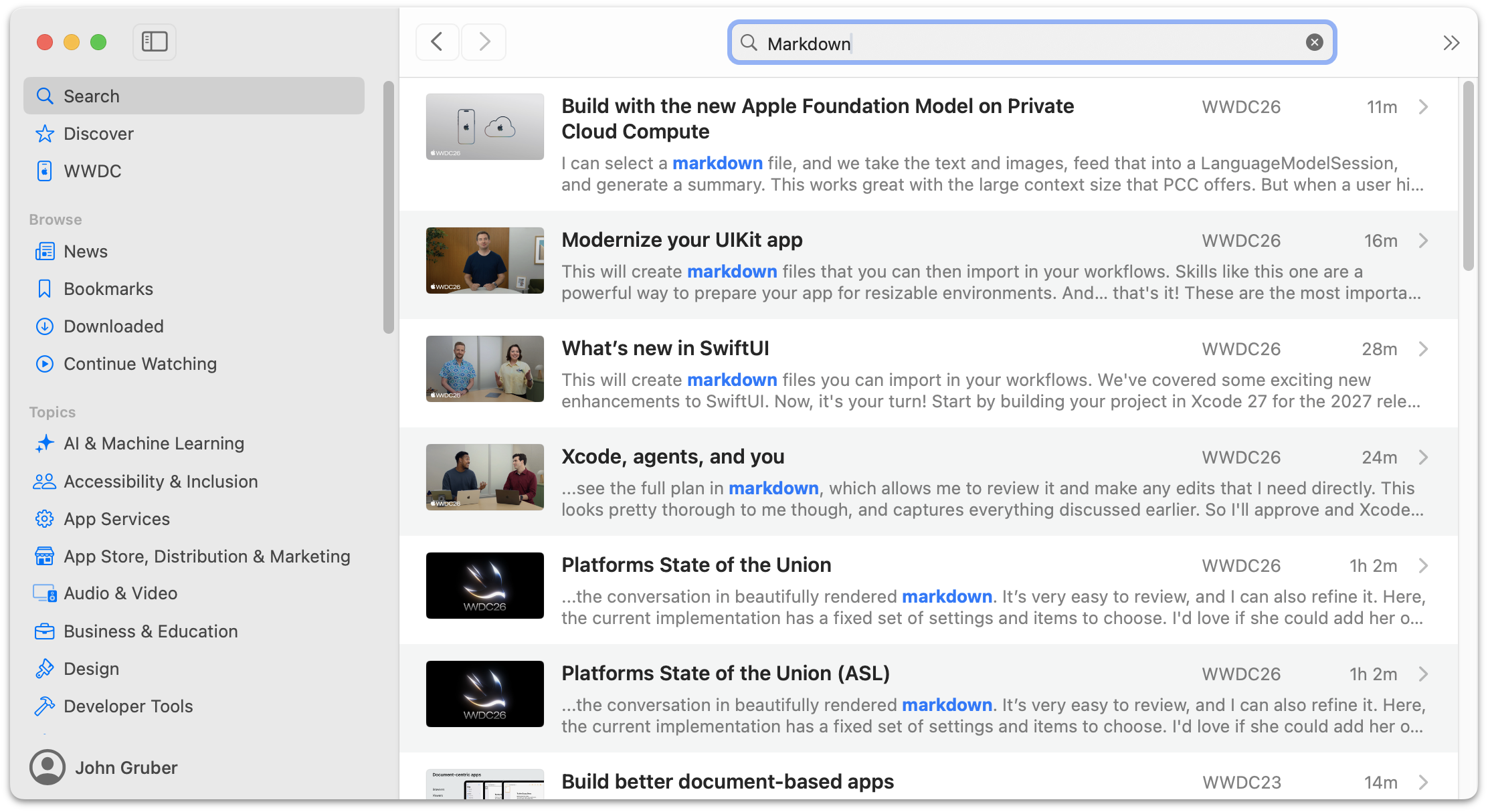
Markdown has been growing steadily for years, but it’s seen a step change in popularity now that it’s been embraced as the lingua franca of LLM agentic systems. I had an interesting all-too-brief chat last week in Cupertino with some people from Apple’s developer tools team about how it feels to see Markdown spread everywhere — including WWDC. In a word, gratifying.
But the biggest reason for Markdown’s continuing success isn’t Markdown itself. It’s the triumph of plain text files, both for system configuration and for the interchange of human-readable (and thus, LLM-readable) prose. Markdown isn’t really a “syntax”. It’s a set of conventions for formatting plain text. If everyone agrees to the same basic conventions, plain text can be significantly more expressive than a string of unformatted characters.
That’s it. So what I find gratifying isn’t that my “language” continues to thrive, because it’s not a language. It’s that the way I like to format plain text when I’m writing, and the way I like to see plain text formatted when I’m reading, has so thoroughly won the world’s mindshare battle. “Ha-ha”, I say, to people who want *this* to mean bold, not italic. (And to Slack and WhatsApp, I say “Fuck you.”)
Tuesday, 16 June 2026
- Checking In on the iOS Continental Fun-Gap Drift ★
-
Yours truly, in September 2024, expressing skepticism that “European iPhones are more fun now”:
Meanwhile no one in the EU will get Apple Intelligence or iPhone Mirroring, both of which features are very useful, and, dare I say, quite fun. Should we judge how much fun each side of the continental divide is having by how much fun they theoretically could be having, or by how much fun they are having?
As it stands, the fun side is not the EU. But hope springs eternal.
Here we are two years later and I think the answer is more clear than ever which side of the continental divide is more fun. It’s not the EU. EU users still don’t have iPhone Mirroring and until and unless the European Commission changes its interpretation of the DMA, they likely never will. It’s a great feature.
Apple Intelligence, as we knew it until last week, eventually came to the EU, about six months after it shipped for the rest of us. One can reasonably argue that EU iPhone and iPad users didn’t miss much during those six months. And that there hasn’t been that much to enjoy since Apple Intelligence debuted in the EU in iOS 18.4. That changed last week with the introduction of the first beta release of iOS 27. Siri AI is really good, truly useful, and genuinely fun. And it is not on pace to come to the EU six months after iOS 27 ships this fall. It is currently on pace to come to the EU never.
- New in the App Store: Personalized Recommendations ★
-
Sarah Perez, writing for TechCrunch:
This week, Apple announced a series of discovery features that will personalize app recommendations based on users’ interests and behavior, providing a new way for developers to have their app discovered.
At Apple’s Worldwide Developers Conference (WWDC), the iPhone maker introduced Personalized Collections in the App Store, which will showcase recommendations tailored to the individual. These will also include new “App Notes” that explain why the specific apps were recommended to you. Starting this week, you’ll find these new personalized suggestions in various places in the App Store, including the Apps or Games tab or on the Search tab.
Security research critics Mysk, posting on Twitter/X (XCancel link), report that the App Store app seemingly sends analytics usage data to Apple with everything you do in the App Store app, including exactly what you type, character-by-character — and that this isn’t for search suggestions, but for analytics. (Via Michael Tsai.)
Monday, 15 June 2026
- The Washington Post on the EU’s DMA Folly ★
-
The Washington Post editorial board yesterday (News+ link), “Why Europe Won’t Have the New Siri”:
Brussels insists the decision is “Apple’s and Apple’s only” and that nothing in its flagship Digital Markets Act forbids the launch. That’s technically true and wholly beside the point.
The law requires that the moment Siri AI ships in Europe, any rival AI agent must get the same sweeping access to a user’s messages, files and chat history. Apple proposed putting in a software security layer to make that safe and offered a phased rollout to build it. According to Apple, the European Commission rejected the proposal.
The DMA was supposed to open markets. But its legal logic was born in the era of browsers, app stores and messaging apps. These components can be swapped like batteries.
The DMA effectively demands everything to be swappable/interchangeable. So while the European Commission is correct that the DMA does not forbid Apple from launching a version of Siri AI, it clearly forbids Apple from launching the version of Siri AI they actually built.
Behind all this lies the dream that Europe could be a “regulatory superpower.” It wanted to create a market too big to skip that would, by virtue of its heft, end up exporting its rules to the rest of the world. That hasn’t worked out.
When adapting a product for Europe costs more than European market access is worth, companies no longer comply. They simply leave out the feature.
That’s the folly of the DMA, or at least the maximal interpretation of the DMA that the European Commission is pursuing. It only makes sense under the assumption that the EU is too big a market to ignore, and the EU’s market might is such that systems will be designed to meet their compliance standards, regardless of whether the makers of these systems support the regulations or not. (And in the case of Apple with iOS and Google with Android, the two companies are in lockstep in their opposition to the EU’s regulations on system-level AI interoperability.)
First, the EU is big but it isn’t that big. The best estimate I’ve seen is that the EU accounts for about 7% of Apple’s worldwide revenue. Plus, because of the DMA, the cost of doing business in the EU is now significantly higher for Apple and Google, because they need to engineer DMA-compliant versions of various features and systems. Unless, that is, they stop bringing (a long and ever-growing list of) new features to the EU.
Which brings me to my second point. What exactly is the motivation for Apple and Google to engineer entirely separate systems for the EU to bring new features into compliance with the Commission’s broad interpretation of the DMA? Because if Apple doesn’t engineer a DMA-compliant version of Siri AI, iOS users in the EU will ... switch to Android, whose system-level AI was deemed noncompliant by the Commission a few months ago?
This doesn’t directly hurt Apple. It doesn’t force Apple to design, engineer, and ship a compliant EU-exclusive version of Siri AI that supports plug-and-play LLM back ends. It only hurts iPhone users who live in the EU, who are stuck with the old dumb version of Siri for the foreseeable future. The European Commission is either stupid or insane.
- The European Commission Ruled Months Ago That Google’s Integration of Gemini in Android Violates the DMA ★
-
Ryan Whitham, writing for Ars Technica back in April:
European regulators are proposing several broad changes to the way AI tools operate on Android phones. Some of this is straightforward, like allowing third-party AI tools to be invoked system-wide via hot words or button presses. This might also include allowing AI tools to view screen context when the user opens them. Context also extends to allowing alternative AI systems to access local data to generate proactive suggestions and summaries. The report actually describes something that sounds like Google’s Magic Cue, which relies on Gemini to offer suggestions based on your activity.
Google has also started experimenting with allowing AI to control certain apps. As we saw when this feature debuted on the Galaxy S26, Gemini is currently pretty bad at using apps on your behalf. The commission wants to explore allowing other AI services to autonomously control installed apps and system features on Android phones. Maybe someone else could do better?
Maybe! But also maybe it’s a bad idea for complex system architecture design to come from non-technical government bureaucrats. One of these maybes strikes me as a lot more likely than the other.
Many of the Gemini AI features in Android, including Magic Cue, rely on running local models, and Google has been slow to allow third parties the system access to make that work effectively. So the EU is also suggesting a mandate that would ensure developers have the necessary hardware access to run local models “with high levels of performance, availability and responsiveness.”
What could go wrong?
Finally, Google may be required under the DMA to create new APIs and offer technical assistance to other AI makers who want to plug into Android. The commission also specifies that these tools must be made available free of charge.
Of course, it’s not free of charge to provide technical assistance to one’s competitors. It’s actually a great expense.
Here’s the European Commission, announcing these “preliminary findings”:
The proposed measures aim to ensure that competing AI services can effectively interact with applications on users’ Android devices and execute tasks accordingly, such as sending an email using the user’s preferred email app, ordering food or sharing a photo with friends. Currently, Google largely reserves these capabilities for use by its own AI offerings on Android phones and tablets. For example, the measures would allow competing AI services to be easily activated by users, using a custom ‘wake word’, a phrase that the user can speak to activate an AI service.
The proposed measures will also enable competing providers of AI services to innovate and offer deeply integrated AI experiences to users on Android phones and tablets, along with Alphabet’s own AI services, such as Gemini. Opening up access to these capabilities will provide Android users across the EU with a wider choice of AI services.
The difference between Google and Apple on this front is that Google just blazed ahead and shipped Gemini integrated into Android in the EU, and is now facing compliance problems after shipping. (Ask forgiveness.) Apple isn’t shipping Siri AI in the EU in iOS 27, knowing that it’s going to be deemed non-compliant. (Ask permission.)
The EC presumes that these measures “will also enable competing providers of AI services to innovate and offer deeply integrated AI experiences to users on Android phones and tablets”. Again: maybe! But really all they can enforce is that “competing providers of AI services” will have the same level of system-level integration that Google’s AI services have. The easiest way for Google to achieve that is by withdrawing Gemini integration in Android from the EU, not by building APIs and privacy protection mechanisms to enable the capabilities for third-party providers that the EC is demanding.
Google is learning the lesson Apple learned the hard way with all the existing features of iOS that were deemed noncompliant with the DMA when it went into effect. The “ship it first and ask forgiveness / hope it’s deemed compliant” strategy is not a good one in the EU.
- WorkOS Launches Auth.md – an Open Protocol for Agent Registration ★
-
My thanks to WorkOS for sponsoring DF last week to promote Auth.md, their new open protocol for AI agent registration.
Sign-up forms were built for humans in browsers, so how do AI agents programmatically register with services? That’s the question Auth.md aims to answer. By exposing a single, machine-readable Markdown file at your service root, AI agents can dynamically discover your OAuth Protected Resource Metadata, parse required scopes, and authenticate seamlessly.
Markdown, baby. Who’d have thunk it?
With native support in WorkOS AuthKit, you can now implement this protocol out of the box, giving AI tools a standardized, secure way to log into your application. Read the Auth.md docs, and watch its on-stage introduction at the MCP Night: Agent Night keynote.
- ‘Anthropic’s Safety Superpower’ ★
-
Ben Thompson, in his weekly free column at Stratechery:
On one hand, I actually don’t begrudge Anthropic not wanting to help its competitors; on the other hand, what should be blisteringly clear is that Anthropic does not think that anyone else other than them should even be making frontier LLMs.
What makes this policy all the more remarkable is the fact that it was enacted only two months after Anthropic had that dispute with the Department of War: the latter wanted to use Claude for any legal use, while the former wanted more stringent controls around surveillance and autonomous weapons. What this degradation represented was both the capability and willingness of Anthropic to silently alter its models to achieve its policy preferences. In other words, Anthropic willfully validated some of its critics’ worst fears in terms of being a supply chain risk.
The broader takeaway from that previous episode, however, is that Anthropic believes that they are the ones who should have final say over how Anthropic is used; given that they think only they should be developing leading edge AI, they by extension think that only they should have final say over AI generally. When you further combine this realization with the company’s pronouncements about AI’s ability to conduct all economic activity, you realize that Anthropic’s leadership effectively wants to have power over everything and everyone.
Anthropic is best seen as a religious organization. Their employees are true believers in a cause, and on a mission. Perhaps every successful company has a religious aspect at its core — like, maybe, Apple’s is design quality and user-centricism, Microsoft’s is market share with no regard for technical or design elegance, Google’s is market share with high regard for technical elegance, and Meta’s is strip-mining the world’s social graph for profit. These companies tend to attract employees who believe in the company’s core mission, and the employees who believe tend to be the ones who thrive and rise within the companies’ ranks to positions of influence.
But Anthropic feels more like a real religion, where the core tenets must be taken on faith, and the priests (Anthropic employees) have a conviction about them. A religious fervor. If Apple gets too taken away by its cultural fervor for design, they do something silly like make a $20,000 solid gold Apple Watch. So what? If Microsoft or Google get taken away by their shared fervor for market share at all costs, they face antitrust remedies. A stifled market and abusive behavior from a monopolist isn’t good, but doesn’t end the world.
A religious fervor that believes the company is building god-like “super intelligence” that will dwarf human intelligence — and that only the company’s priesthood can be trusted to define, create, control, and gate access to it — is something else entirely. I tend to think the Anthropic true believers are all wet — that LLMs, amazing though they are, are not a path toward “super intelligence”. But, they used to be clearly behind OpenAI in technical capability, then caught up, and now with Mythos/Fable, they are clearly ahead. I still think they’re wrong about where this is heading, but I don’t think we can say we know they’re wrong.
Saturday, 13 June 2026
- Trump’s Name (Set in the Wrong Font, of Course) Has Been Removed From the Kennedy Center ★
-
Jonathan Edwards reporting for The Washington Post:
President Donald Trump’s name is off the Kennedy Center.
Crews at the performing arts venue started removing it from the front of the building around 3 a.m., several hours after the center missed a federal judge’s two-week deadline to do so. The judge had ruled that the decision by the center’s board of trustees to rename it was illegal.
A perfect metaphor for the work ahead of us.
- Apple’s Private Cloud Compute Is Severely Limited for Third-Party Developers ★
-
From Apple’s Developer site:
To ensure getting started with a large cloud model is as accessible as possible, developers in the App Store Small Business Program with fewer than two million first time App Store downloads will be able to use Apple Foundation Models running on Private Cloud Compute (PCC) with no cloud API cost. The model provides access to frontier level intelligence with unparalleled privacy protections. This makes it easy for small developers to get started building intelligent app experiences without upfront infrastructure costs.
Eligibility requirements
Access to PCC is available to developers who meet the following criteria:
- Are enrolled in the App Store Small Business Program.
- Have fewer than 2 million first-time app downloads from any of their apps on the App Store.
- Have the Private Cloud Compute entitlement assigned to their account.
Where Apple Intelligence is available, eligible developers can use PCC in their apps distributed on the App Store, and test PCC features via TestFlight or ad hoc distribution. Installs during testing are not counted as first-time app downloads.
If any app subsequently exceeds the 2 million first-time downloads threshold, or the developer is no longer enrolled in the App Store Small Business Program, the developer will be notified and must migrate to an alternative solution within 6 months. Information about first-time downloads is available in Analytics in App Store Connect.
These strict limits don’t seem to be getting as much attention as they should. It’s nice that for small developers who meet the above criteria, access to PCC has no cost. But there’s no way (yet?) to buy your way out of these limits. There are no paid API tiers for larger developers who exceed the above limits, or for developers who qualify now but release a hit app that grows to exceed them. (Users who pay for iCloud+ don’t have any extra quotas for PCC usage in third-party apps either.)
The “fewer than 2 million first-time app downloads from any of their apps” restriction is particularly notable. It’s not 2 million installations for apps that are using PCC, but 2 million downloads for any app the developer has ever released. Developer Gui Rambo writes:
So uhhhh… Apple should really rethink the Private Cloud Compute developer access limitation. I do happen to have an app that’s had more than 2 million downloads. That app is ChibiStudio, an app that’s been in the App Store for over 10 years. It’s not like I’m getting a million new users every year nowadays. And I’m also not making any real money with it 🥲
The bottom line is that — for the OS 27 cycle at least — PCC is primarily a feature for Apple itself to use in Siri AI. Granting access to PCC to any third-party developers at all is better than nothing, but this 2-million-download cap cuts off many developers who are in the Small Business Program. Apple should reconsider that. And I know there are a lot of developers who exceed the eligibility for the Small Business Program who would love to have access to the PCC APIs, even if access was paid. The lack of paid tiers says to me that Apple is worried enough about meeting demand from Siri AI users alone.
- U.S. Government Directs Anthropic to Shut Down Fable 5 and Mythos 5 Models on National Security Grounds ★
-
Anthropic:
The US government, citing national security authorities, has issued an export control directive to suspend all access to Fable 5 and Mythos 5 by any foreign national, whether inside or outside the United States, including foreign national Anthropic employees. The net effect of this order is that we must abruptly disable Fable 5 and Mythos 5 for all our customers to ensure compliance. Access to all other Anthropic models will not be affected.
We received the directive from the government today at 5:21pm (ET). The letter did not provide specific details of its national security concern. Our understanding is that the government believes it has become aware of a method of bypassing, or “jailbreaking” Fable 5. We reviewed a demonstration of this specific technique being used to identify a small number of previously known, minor vulnerabilities. These vulnerabilities all appear relatively simple, and we have found that other publicly-available models are able to discover them as well without requiring a bypass.
Fable 5 and Mythos 5 were announced on Tuesday — that post has detailed comparisons, from Anthropic, on the models’ capabilities.
Having the access ban extend all the way to “foreign national Anthropic employees” is, to say the least, aggressive. Whether that degree of restriction is truly warranted, I don’t think we, on the outside, can say. The Trump administration lacks credibility, to say the least, when it comes to foreign nationals. But it’s Anthropic itself that repeatedly compares the power of frontier models to nuclear weapons. Here’s CEO Dario Amodei, in an essay published just this month:
There may come a time, perhaps relatively soon, when we need to go beyond this, when the most powerful AI systems look less like airplanes or automobiles and more like weaponizable nuclear materials — a threat to humanity rather than “just” a threat to public safety. If that occurs, we may need more aggressive regulatory measures than those I have laid out.
If that occurs — or if it already has occurred — it’s obviously not the place of Anthropic (or OpenAI or Google) to render that judgment. Ben Thompson wrote about this presciently back in March, and linking to his post, I wrote:
Nilay Patel, quoting the same section of Thompson’s column I quoted above, sees it as “Ben Thompson making a full-throated case for fascism”. I see it as the case against corporatocracy. Who sets our defense policies? Our democratically elected leaders, or the CEOs of corporate defense contractors?
Friday, 12 June 2026
- The WWDC 2026 Keynote and State of the Union on YouTube ★
-
Apple’s Developer app lets you download local copies of every session, including the State of the Union, except the keynote. Why this is I don’t know. But if you want a local copy, you can grab it from YouTube.
Speaking of the State of the Union, the full version runs just over an hour, but Apple cut together a 4.5-minute recap. If you haven’t watched the full thing you should at least watch that recap.
- The European Commission Response to Siri AI and the DMA ★
-
Thomas Regnier, spokesperson for the European Commission, in a statement posted to LinkedIn (with edited video, if you’d like to watch him read parts aloud):
What is the true story behind Apple’s decision not to roll out “Siri AI” in the EU?
This decision is Apple’s and Apple’s only.
Because absolutely nothing in the DMA prohibits Apple from rolling out new features in the EU.
Yes, the European Commission and Apple had a few contacts on “Siri AI”.
But instead of offering a compliant solution, Apple asked to be exempted from its interoperability obligations under the DMA — and this for 18 months.
That’s not an option. EU rules are non negotiable.
And it would mean that no AI agent other than “Siri AI” could be chosen by EU consumers.
Apple, like any other gatekeeper, cannot close the market. The DMA is very clear about that.
Our developers have the right to compete. And our consumers the right to choose.
Those who want to keep using Apple products in their current form can of course do it.
But for those who want to use another AI agent, the DMA will give them the possibility to do so.
Why this was posted to LinkedIn and not on the EC’s own press website is as inexplicable as Regnier’s bizarre choice to spread 14 short sentences across 10 paragraphs. I quoted the entirety of the statement nonetheless, to give the EC their full say. I’ll let it speak for itself in this post, but this does not contradict Apple’s position or statements in any way.
Thursday, 11 June 2026
- Apple: ‘Due to DMA, Siri AI Delayed in EU for iOS 27 and iPadOS 27’ ★
-
Apple Newsroom, in an Apple Newsroom post Monday:
According to EU regulators, the DMA requires Apple to give any AI system nearly unlimited access to a user’s device, as well as the ability to act on that access autonomously without a user’s ongoing visibility and control. That includes the ability to read and send messages, make purchases, access files, and execute actions across any app. Security researchers have already shown that AI systems can be hijacked to steal personal data — like passwords and photos — and to permanently alter files and account settings without a user’s consent. As AI systems gain more capabilities, these risks are quickly increasing in frequency and scope.
Given the serious risks to users, Apple designed a solution called Trusted System Agent — an intermediary that would allow virtual assistants to safely access the same features and capabilities as Siri AI for devices in the EU. Apple also shared a plan to launch Siri AI in the EU while gradually rolling out this new solution over an 18-month period. The European Commission said no. In fact, the European Commission did not agree to any of Apple’s proposals.
Apple will continue working to bring these features to the European Union as safely as possible. However, given the clear dangers to EU users and the regulators’ failure to acknowledge these risks, there is currently no timeline for Siri AI’s availability in the EU on iOS and iPadOS.
There’s a lot to unpack here, including more background information — and on-the-record statements — from a briefing Apple held Tuesday that I was invited to at Apple Park. But the bottom line is that Apple’s public statements regarding the DMA and the European Commission have never been this strident before. In its public statements, Apple has always been diplomatic. That’s the word.
Now, they’re a bit more on war footing. There’s a massive gulf between what Apple is willing to do with Siri AI in the EU and what the Commission is demanding from Apple for DMA compliance. As things stand there’s no middle ground. Apple’s offers for compromise have been rejected. Unless one side changes its mind and concedes its current position, Siri AI will never come to the EU, and what Apple is saying here is that they’re unwilling to create the open-access-to-user-data system that the EC is demanding.
And from what I’ve seen so far in a day of testing Siri AI, EU iOS users are going to miss out on something really good.
- Spielberg on Being Repeatedly Turned Down to Direct a James Bond Film ★
-
Steven Spielberg, on The Rest Is Entertainment on YouTube:
I approached Cubby Broccoli after Jaws was a big hit. I’d always wanted to make a James Bond film from the day I saw Dr. No, so I called Cubby after Jaws and volunteered. I said, “If you need a director, I would love to direct one.” And he said no. And he moved on.
And then Cubby called me again after Close Encounters came out. And that was a big hit. And Cubby called me a few years after Close Encounters and said, “We’d like to use the five notes in Moonraker.” And I said, “I’ll make you a deal. I’ll give you permission to use the five notes if you let me direct a Bond film.” And he said “Nope.” But I gave him the five notes anyway.
In Moonraker, the iconic Close Encounters notes are the passcode to the locked door of a secret lab that Bond (Roger Moore) needs to enter. Probably not so secure to play the passcode digits audible, but it’s a fun Easter egg. I always presumed that EON used it as fair-use homage, without bothering to ask Spielberg or Columbia Pictures for permission.
Spielberg, in his interview with The Rest Is Entertainment, goes on to explain the oft-repeated story that his disappointment over his rejection by Broccoli led to his collaboration with George Lucas to make Raiders of the Lost Ark, which I put on my short list for best movie ever made. The whole opening sequence of Temple of Doom — where Indiana Jones is wearing a dinner jacket and chaos erupts at a nightclub while Jones chases a vial of poison antidote while the other characters chase a diamond being kicked around the floor — is more Bond-like than most Bond films. (Oh, and that Shanghai nightclub’s name: Club Obi Wan. No need to ask permission for that one.)
Wednesday, 10 June 2026
- Craig Federighi Details Apple’s Collaboration With Google for Siri AI – Live, on Stage ★
-
Chance Miller, at 9to5Mac on Monday:
Apple’s Siri team, led by Craig Federighi, held a post-WWDC keynote tech talk with members of the press this afternoon to talk through iOS 27 and the new Siri AI. During the talk, Federighi shared more details about Apple’s collaboration with Google. Federighi was joined by Amar Subramanya (vice president of AI), Mike Rockwell (Siri lead), and Sebastien Marineau-Mes (software VP).
On the Google collaboration, Federighi explained:
Of course, we don’t have the Gemini app as our app. In fact, none of that client code is part of how we run on iOS. For these models, we use none of the models that Google deploys to their customers, nor do we use the infrastructure and means by which they deploy models to their customers. And then, when it comes to the knowledge base, we of course don’t use Google Search or anything like that as the foundation of our system. So I hope that’s clear. The amount of the Google Assistant we use is none.
So let’s talk about what we do use, or how our system is built.
This “Tech Talk” was good. It was detailed and technical, and there were live on-stage demos of Siri AI in action from Mike Rockwell. I don’t think Apple is ever going to go back to live on-stage major keynotes, but I do think the company is returning to more live events, including demos. There was a big live Siri AI/Apple Intelligence session for developers Tuesday morning in Steve Jobs Theater, which also had live demos. More like this, please.
Tuesday, 9 June 2026
- Apple OS 27: The Small Things ★
-
Rishi Ó:
My favorite Apple updates are not the flashy new features, but the quiet little touches: annoyances fixed, workflows made smoother, rough edges sanded down, and longstanding flaws thoughtfully reworked. To me, they’re the clearest sign of a company that cares about its craft.
Here’s a collection from a WWDC26 screen-grab, organized for easier reading, on improvements coming later this year.
That’s a lot of bullet points.
- The Talk Show Live From WWDC: Tonight, In-Person and Streaming ★
-
If you can make it in person, you should come. The California Theater is a beautiful big theater and tickets are still available.
You can also watch tonight’s show in live stereoscopic immersive in the Theater app from Sandwich Vision on Vision Pro. A purchase of the ticket to the live show, the Theater app for $12.99, is also good for replay forever — with surprise bonus features included. It’s a fun, truly immersive way to experience the show.
Hope to see you there tonight, one way or the other.
- Apple WWDC 2026 Keynote ★
-
A brisk 76 minutes, including the post-credits Easter egg music video. The past few years ran about a half hour longer.
- Apple’s WWDC AI Demos Were Real and in Real Time ★
-
Julie Bort, TechCrunch:
But the most telling detail wasn’t what Apple announced. It was how it chose to show some things off. Many of the Apple Intelligence demoes featured someone standing, phone in hand, pressing buttons or using voice commands in real time, while another camera showed off the phone’s response.
These weren’t live onstage, anything-could-go wrong demos; they were pre-taped. But they looked far more like proof of working features than what Apple showed at WWDC 2024, when the company unveiled Apple Intelligence and a new Siri to the world through slickly produced videos that turned out to be more promise than product.
The demos were all shot in single takes, with no editing. In fact, I think most of them were single takes of multiple demos back-to-back. That’s the way it should be, even when they feel a little slow. When a demo feels slow, the solution isn’t to edit the video — it’s to make the feature work faster.
- Apple Introduces Siri AI ★
-
Apple Newsroom yesterday:
This new version of Siri is built on Apple Intelligence, allowing Siri to draw on personal context understanding and help users find what they need in the moment across messages, emails, photos, and more. For example, users can ask Siri to find a restaurant recommendation a friend messaged them about, surface a hotel confirmation number from an old email, or pull up photos with friends and family from a recent trip. And personal context understanding extends to third-party apps when developers integrate with Spotlight.
With even more systemwide app actions, Siri AI lets users get things done across apps, like drafting an email from scratch, or editing and sharing a set of photos. Using onscreen awareness, Siri AI can answer questions related to the content on a user’s screen. For example, if a user gets a text about a potluck with friends, they can brainstorm with Siri on what to bring and then add a recipe to the Notes app.
In addition, Siri AI can use broad world knowledge to get up-to-date information from the web on virtually any topic and generate a helpful answer, such as when and where to see the next solar eclipse, or when a musician is coming to town. Users can extend almost any response from Siri into a rich conversation and ask follow-up questions.
I like the name “Siri AI”. “New Siri” wouldn’t have legs because eventually this won’t be new. This should be the dividing line between Siri as we know it and Siri as it should be. The demos I’ve seen so far (I still don’t have access on my iOS 27 testing device) are impressive. Well, impressive compared to old Siri. They’re table stakes for generative AI. But Siri AI is the only system that can draw upon your personal data in the apps on your devices, and perform actions based on the app intents supported by the apps on your devices. It is in some ways less capable than ChatGPT or Claude, but in other ways has more potential. It’s a very different approach and I think it’s the right one for Apple.
They need to execute, they need to prove this can scale, and most of all, they need to get third-party apps on board with App Intents and App Schemas. But it seems like they’re doing all of that. This is not a done deal but it is very realistic.
- Apple’s WWDC Announcement of the New Apple Intelligence System ★
-
Apple Newsroom:
These new capabilities are powered by the next generation of Apple Foundation Models, custom-built in collaboration with Google and its Gemini models for deeply integrated Apple Intelligence experiences. These latest models run on device and on servers using Private Cloud Compute.
Every facet of the new Apple Intelligence architecture is built privacy-first, from the latest Apple Foundation Models to the core operating system technologies that integrate these models deep into Apple’s platforms. Apple Intelligence uses on-device processing and Private Cloud Compute to help protect users’ privacy. Private Cloud Compute gives users access to frontier-level intelligence, while extending the privacy and security of iPhone into the cloud.
What’s confusing about this Apple-Google partnership is that Google pretty much calls all things AI “Gemini”. The models are “Gemini”, the assistant is “Gemini”, and the feature integrations are “Gemini”. So Apple is taking pains to emphasize that they’re building atop the Gemini models, not the Gemini assistant.
One way to think about it is this. Let’s say you’re a Google Gemini app user. That’s the assistant. Now you start using the new Apple Intelligence (that builds atop the Gemini models) and the new Siri AI (that builds atop the new Apple Intelligence). When you go back to the Google Gemini app, nothing you did using Apple Intelligence and Siri AI is visible to the Gemini app. And nothing you continue to do in the Google Gemini app is visible to Apple Intelligence or Siri AI.
Monday, 8 June 2026
- From the Annals of People Having Knowledge of the Matter, Siri AI Extensions Edition ★
-
Mark Gurman, reporting (?) for Bloomberg two short months ago:
Apple Inc. plans to open Siri to outside artificial intelligence assistants, a major move aimed at bolstering the iPhone as an AI platform. The company is preparing to make the change as part of a Siri overhaul in its upcoming iOS 27 operating system update, according to people with knowledge of the matter. The assistant can already tap into ChatGPT through a partnership with OpenAI, but Apple will now allow competing services to do the same.
The company is developing new tools to allow AI chatbot apps installed via the App Store to integrate with the Siri assistant, said the people, who asked not to be identified because the plans haven’t been announced. The chatbots will also work with an upcoming Siri app and other features in the Apple Intelligence platform.
That means, for instance, if users have Alphabet Inc.’s Google Gemini or Anthropic PBC’s Claude installed, they’d be able to send queries to those services from within the Siri voice assistant, just like they have been able to with ChatGPT since Apple Intelligence launched in 2024.
Maybe Apple ran out of time today, and will announce this tomorrow? Maybe they forgot to announce it? Maybe they scrapped the next-generation Siri that existed two months ago and in the last month rebuilt another entirely new next-generation Siri? I’ll bet something like that is what happened.
I mean, people had knowledge of the matter.
Sunday, 7 June 2026
- Mux — Video for Developers ★
-
My thanks to Mux for sponsoring last week at DF. Mux is what developers reach for when they need to do more with video. Video files are packed with data and context waiting to be unlocked.
Mux Robots are AI workflows that unlock that data inside your video for summarization, caption translation, moderation, and more. Configure once and your workflows run automatically on new uploads.
Mux is video infrastructure trusted by Patreon, Substack, and Synthesia. Start building for free. Use code FIREBALL at signup for an extra $50 credit.
- Alberto Romero on Apple’s AI Spending ★
-
Alberto Romero:
AI is like religion. Either you believe it changes everything, or you don’t believe at all. There is no moderate position; nobody believes in AGI “more or less,” just like nobody is “casually religious.” If God exists, the only coherent response is to reorganize your entire life around that fact, as priests do. If you pray sometimes, then you are just an atheist who’s also fearful. When tech companies spend hundreds of billions on capital expenditures to add sparkly AI features to Office, Gmail, and Instagram, I only see fearful atheists — guys who don’t believe in AI but pretend just in case.
In 2026, the four largest cloud and AI infrastructure providers — Amazon, Google, Meta, Microsoft — committed to spending $670 billion on CapEx. Apple, in contrast, spent $12.7 billion on capex last fiscal year and projects $14 billion for 2026, 2% of what its peers are spending. The conventional reading in Silicon Valley is, naturally, that Apple is losing. Siri has been a punchline for years — an internal executive called the delays ugly and embarrassing — and critics say that Apple has not been the same without Steve Jobs. It is falling behind, they say, and moving way too slowly for AI.
I disagree with this portrayal: Apple is the most powerful tech company in the world right now because it’s acting according to what it believes.
Some of you, I bet, will object to Romero’s notion that no one is “casually religious”. Almost everyone I know is casually religious, you might be thinking. But read the whole piece. What he’s saying is that if you’re “casually religious” those are just words. You’re not living your life according to your professed beliefs (casual or not). And that’s how most of Apple’s peer companies seem to be approaching AI.
I’m not sure he’s right, but he might be, and I think his take is at least closer to right than wrong. Apple is making an enormous bet on AI — but their bet is that they don’t need to spend hundreds of billions per year on AI infrastructure (most of it fattening Nvidia’s bottom line) to reap the benefits. If Apple’s right we should start seeing it come together tomorrow.
(Arguably we’ve already seen it coming together — demand for Apple’s products and services has gone up, not down, so far in the AI era. Entrenched leaders often grow during the initial stages of extinctive disruptions — BlackBerry’s biggest year for sales (revenue) and investor confidence (market cap) was 2011, four years after the iPhone debuted — but the disruptors are there. There’s not yet a single threat on the market to the iPhone, iPad, Mac, Apple Watch, or AirPods — nor to Apple’s services revenue.)
Saturday, 6 June 2026
- Halide Mark III ★
-
Ben Sandofsky, writing on the Lux Camera blog:
After decades of shooting digital, I returned to analog photography in 2023. I thought it would be challenging, given the limited selection of film stocks, only to be surprised by how freeing it felt. It felt so much better to have a handful of amazing choices rather than photo-editor with thousands of presets. We owe that to film engineers who spent years developing versatile film stocks that work in a variety of situations.
Inspired by “Less, but better,” we partnered with the renowned Hollywood colorist Cullen Kelly to develop a succinct set of gorgeous, physically accurate processes exclusive to Halide. Each look was engineered with a specific intent. We verified every look thousands of times on real-world reference photos.
Put another way: every look is a banger.
Halide has always been a great — maybe the great — iPhone camera app for shooting RAW, with the intention of developing your images by hand in post. It’s a great camera technically and a great app UI-wise. Mark II introduced Process Zero, which, in their own description, “uses zero AI and zero computational photography to produce beautiful, film-like natural photos”. Process Zero was the first step toward the new built-in “looks” in Halide Mark III. I’ve been shooting with Mark III for a few weeks now, and they are, indeed, all bangers. And I really like that there aren’t that many of them. I wanted more looks than just Process Zero (which remains available, of course), but I feel a bit overwhelmed when faced with a dozen (or worse, dozens) of choices for processing. I feel conflicted enough having to choose between a handful of really good third-party camera apps with which to shoot in the first place — it’s worse when I have to make too many choices within the camera app itself.
What I want is to just point and shoot and be able to instantly share images with the look I want already applied. I’m picky but I’m also really lazy, and don’t want to do any editing in post on most of the shots I keep. But I do want to be able to edit in post if I want to, including changing the look losslessly. This mixture of point-and-shoot ease and pro-level control didn’t use to be possible. Now, though, it is, with apps like Not Boring Camera, Analogue, and, now, Halide Mark III.
It’s been a turbulent couple of months for Lux (to say the least), so I’m glad to see Sandofsky and team get Mark III out the door. If you, like me, had previously been impressed by Halide but didn’t use it because it required too much work in post, you should check out Mark III.
- 60 Minutes Correspondents Lesley Stahl, Bill Whitaker, and the Other Guy Will Stay at Show ★
-
Lesley Stahl, Bill Whitaker, and Jon Wertheim, in a memo to the 60 Minutes staff obtained by The New York Times (gift links):
We have had a hard time deciding whether to stay at 60 Minutes. We’re still deeply upset by the firings of Tanya and Draggan, strong leaders who everyone respected. As far as we can tell — because no explanation has ever been offered, they were expelled because they fought for our 60 Minutes values and stood up to protect our independence and integrity.
Newsrooms are not supposed to be run like dictatorships. Collaboration and argument are the way we have always worked at 60. Don Hewitt actually encouraged loud passionate advocacy for our pieces. [...]
We feared that our returning might be construed as an endorsement of the existing power structure. That is simply, categorically not the case.
Here’s why we’re are staying:
We don’t want to see 60 Minutes die.
We’ll see how long this lasts.
- Trump Lawyer Argues Trump Can Tear Down Statue of Liberty ★
-
Josh Marshall:
In a hearing today about the president’s bulldozing of the East Wing of the White House and plans to build a vast ballroom, a judge asked if the president could also bulldoze the Statue of Liberty and be subject to no legal challenge. The DOJ lawyer, Yaakov Roth, said that yes, President Trump could decide tomorrow to bulldoze the Statue of Liberty and no one could stop him.
It was a good question from DC Court of Appeals Judge Patricia Millett since it brings the arguments and their implications clearly into the open. Reframe the question and the absurdity of this proposition becomes even more clear. If you hire someone to administer your estate, can they burn down the buildings on your estate or chop it up into parcels and sell it off? Presumably not. You hired them to run it, not to destroy it or sell it. It’s not theirs. They were hired for a specific task. That person is your employee. The president is hired to administer the country and enforce its laws for four years. He doesn’t own the country or its properties.
Pathetic lickspittles, one and all.
Friday, 5 June 2026
- Nieman Journalism Lab: Twitter/X Punishes Accounts That Post Links ★
-
Laura Hazard Owen, writing for Nieman Journalism Lab back in April:
I used Claude to help me scrape the 200 most recent tweets from 18 large publishers’ X accounts and track the engagement (likes + comments + retweets) on each. Six of those publishers have paywalls: Bloomberg, CNN, Forbes, The New York Times, The Wall Street Journal, and The Washington Post. Nine don’t: Al Jazeera English, AP, BBC, Breitbart News, CBS News, Daily Wire, Fox News, NBC News, and Reuters. The last three accounts I looked at — Leading Report, unusual_whales, and Globe Eye News — are not news publishers, but aggregate breaking news in tweets without links. (Here, for example, is an example of a Leading Report tweet: “BREAKING: Iran has halted direct talks with the US, per WSJ.” They’re sometimes referred to as engagement-maxing accounts.
These charts make it pretty clear that links in tweets hurt engagement. The connection was so apparent in my analysis that a graph including all 18 publishers is almost unreadable: The traditional, link-loving publishers are clustered in the bottom left corner (lots of links, little engagement) in a nearly indistinguishable mass of bubbles, no matter how large their followings are.
Musk’s Twitter/X is not an aggregator for news. It’s a walled garden. But the type of garden where you need to keep your eyes open and your hand on your wallet. Sometimes it’s fun to visit a seedy neighborhood. But let’s not pretend it isn’t a seedy neighborhood just because, long ago, it used to be nice.
- Elon Musk’s X Is a Freak Show ★
-
Nate Silver, back in April, under the headline “Social Media Is Turning Into a Freak Show”, where by “social media” he mostly discusses Twitter/X:
But what does that remaining traffic consist of? I recently came across a bubble chart depicting the Twitter accounts that had received the most “engagement” in February 2026. It was depressing: most of the top accounts were extremely low-quality and highly partisan. I hadn’t even heard of many of them and only follow a handful of the top accounts. So I tracked down the original data myself and, with help from Claude, made my own improved version of the chart. Here, voilà, are the Twitter accounts with the most engagement so far in 2026:
It’s not hard to notice that Twitter has become extremely right-leaning. But I’d argue there’s an equally important trend: the top accounts are of incredibly low quality. Elon, with the algorithmic boost he built in for himself, is at the eye of the storm, of course. But “Catturd” literally gets far more engagement than the New York Times, for instance.
There’s a common argument from proponents of the Musk-era X that the only problem is that left-leaning people have abandoned the platform. That the X algorithm is a contest and if only right-leaning accounts are playing, of course they’re winning. This is nonsense. The whole thing is rigged. Elon Musk’s outsized prominence as the most-engaged-with account is proof of that. Twitter existed for 16 years before Musk bought it. He wasn’t even close to the biggest account during that era. Then he bought it. Now his account is the biggest.
As Silver’s data analysis shows, Musk’s X is not just dominated by right-wing accounts, it’s dominated by “who the hell is that?” right-wing slop accounts.
The only way not to lose a rigged game is to refuse to play. X is still a thing. A lot of people, companies, and organizations still post there — treat it like their blogs — exclusively. I still wind up linking to posts on X because that’s where they are. That’s a whole separate discussion. But anyone who’s trying to “compete” there with subject matter that is even vaguely political has no chance of success unless what they’re posting is what Elon Musk wants to see promoted. It’s not like his thumb is on the scale, it’s like an anvil is on the scale. The conundrum is that there are still a lot interesting people posting interesting things there.
- Checking in on Perplexity ★
-
Yours truly, last August:
I can’t see why Apple would want to get involved with a company like this though. Gurman’s report makes it sound like his sources are inside Apple, but man, this “Apple + Perplexity” thing feels more like something Perplexity would be seeding than one that Apple executives would be leaking.
Perplexity is still occasionally in the news (often not in good ways), but it seems to me they’ve slipped into the “afterthought” tier of AI startups — which is exactly why they started leaning into clownish stunts last year. Everyone who previously suggested Apple should — or even might — buy them has gone silent.
Thursday, 4 June 2026
- Some People Rooted for The Empire in ‘Star Wars’, Too ★
-
Ed Morrissey, writing for Hot Air, thinks Scott Pelley got what he deserved and Bari Weiss is doing a good job running CBS News:
And Pelley forgot the Golden Rule: He who has the gold makes the rules. Instead, Pelley convinced himself of his own virtue and torched his own position — and if Bilton’s letter is accurate, in as mean-spirited and conceited a manner as possible. Pelley could have chosen a dignified resignation under protest, but instead pulled a power move in an attempt to intimidate Bilton, Weiss, and Ellison, only to discover that no one feared his absence. In fact, they’re probably happy to cut him loose.
There’s always at least one person in these situations who thinks they’re untouchable. A wise executive knows to start by making an example of that person, and then see how many other people think they’re indispensable. It’s not as if TV news jobs are expanding these days, after all. Pelley’s going to find out the hard way that no one’s paying $5 million a year to emote into a camera from other people’s copy.
It doesn’t even enter this man’s little mind that Pelley wasn’t concerned about his job, wasn’t concerned about his salary, but was concerned only with the integrity of the institution to which he’d committed decades of his career, and that he saw as his duty the need to stand up for his remaining and former colleagues. That Pelley himself has integrity. To the Trump lickspittles, everything is performative. They don’t just lack integrity, they don’t believe integrity is real.
The Scott Pelley story to me is a lesson in how if you work hard enough in your career to get Fuck You Money, the real reward is the day you need to say it, you can.
- The Talk Show Live From WWDC 2026: Tuesday in San Jose ★
-
Location: The California Theatre, San Jose
Showtime: Tuesday, 9 June 2026, 7pm PT (Doors open 6pm)
Special Guest(s): For sure
Price: $45The annual live audience episode of The Talk Show during the week of WWDC. If you can make it, you should come. You’ll even enjoy the prelude, mingling with fellow DF readers and listeners.
- ‘The Insider’ ★
-
All this Sturm und Drang surrounding 60 Minutes has me thinking about a re-watch of The Insider, Michael Mann’s great 1999 movie. Letterboxd’s synopsis: “A research chemist comes under personal and professional attack when he decides to appear in a 60 Minutes exposé on Big Tobacco.” It’s a great movie, and feels apt AF at the moment. Here’s the original segment on 60 Minutes, which ran an entire half hour.
What’s going on today is like if — instead of getting shady, threatening, and litigious — the tobacco companies had just purchased CBS, purged the staff at 60 Minutes, and hired a bunch of pro-cigarette stooges to replace them.
- ‘Microsoft and OpenAI Broke Up — Now They’re Ready to Fight’ ★
-
Hayden Field and Tom Warren, writing for The Verge (gift link):
This year’s Build had the vibe of a freshly single divorcée posting a thirst trap on Instagram. “It’s always fun to be at developer conferences in times of great change,” Microsoft CEO Satya Nadella said onstage Tuesday, adding that events like this are about “coming to grips with the new opportunity.”
AI chief Mustafa Suleyman, in an interview with The Verge, put it even more bluntly.
“The goal is to prove that we can become one of the top four labs in the world,” Suleyman said. “There’s three labs that matter, Google DeepMind, OpenAI, and Anthropic. We are not one of them at the moment, and that’s always been my intention. It’s why I came here. I want to build the very best frontier models in the world, fully multimodal, and in order to do that, we have to prove that we can do everything that we need to from the ground up, and we’re not just going to take from others.”
Refreshingly blunt.
But hasn’t that been Microsoft’s plan for Bing since it was announced in 2009? I mean I guess you can say that Bing is one of the top four search engines in the world. Maybe you can even say it’s one of the top two. But it’s irrelevant and uncompetitive with Google Search.
- Lingon and Lingon Pro 10 ★
-
Peter Borg:
Lingon makes scheduling apps, scripts, shortcuts, and commands feel simple. Create a task in minutes, run it on a schedule, and stay in control.
Lingon helps you run whatever you want whenever you want without living in Terminal. Schedule apps, scripts, shortcuts, and commands with a clear, friendly UI.
Run tasks at specific times, on intervals or at login. Optional notifications make it easy to keep control.
Two separate apps. Lingon is the simpler Mac App Store version and free to use, while Lingon Pro is the advanced one-time purchase with extra power.
Lingon and Lingon Pro are great apps. I’ve been meaning to recommend them for a while.
Back in 2023 I wrote about a problem I was having with Maestral, the incredible “works like Dropbox in the old days” open-source Dropbox client, where Maestral would just silently crash once in a while and I wouldn’t notice for a while. Then I would notice, manually re-launch Maestral, and have to wait while Maestral synced. Or, worse, I’d put a podcast recording in a shared folder and walk away from my computer, and my editor would never get the file because Maestral wasn’t running. My write-up described how I solved the problem with a Keyboard Maestro macro that runs once an hour — it checks if Maestral is running, and if it isn’t, launches it (and writes to a log, to satisfy my own curiosity). Borg wrote to me after I posted that and — very politely — explained that Lingon would make that much simpler.
In addition to creating your own scripts and rules that run periodically, Lingon is great for inspecting all the login items and background agents on your system — whether they’re from Apple or third parties. Poking around at everything Google Gemini installed is what made me think to recommend Lingon today. At the very least you should install the free regular version. It’s just a great Mac utility from a great Mac developer. There’s nothing else like it.
- Remember When Chrome Went Bad on MacOS? ★
-
Loren Brichter, back in 2020:
Short story: Google Chrome installs an updater called Keystone on your computer, which is bizarrely correlated to massive unexplained CPU usage in WindowServer (a system process)[1], and made my whole computer slow even when Chrome wasn’t running. Deleting Chrome and Keystone made my computer way, way faster, all the time.
Long story: I noticed my brand new 16” MacBook Pro started acting sluggishly doing even trivial things like scrolling. Activity Monitor showed nothing from Google using the CPU, but WindowServer was taking ~80%, which is abnormally high (it should use < 10% normally).
Doing all the normal things (quitting apps, logging out other users, restarting, zapping PRAM/SMC, etc) did nothing, then I remembered I had installed Chrome a while back to test a website.
I deleted Chrome, and noticed Keystone while deleting some of Chrome’s other preferences and caches. I deleted everything from Google I could find, restarted the computer, and it was like night-and-day. Everything was instantly and noticeably faster, and WindowServer CPU was well under 10% again.
Not all Mac users, but many, found that just having Chrome installed slowed down their Macs dramatically. Completely uninstalling Chrome — and its pernicious background agents — solved the problem. This years-old “Chrome Is Bad” saga came to mind when I wrote about Google’s Gemini Mac app’s background agents.
It seems as though Google eventually fixed these Chrome bugs — or Apple changed something in a MacOS update that fixed the bugs for them — but I’ve never seen a full explanation of the problem and eventual solution. Does anyone know what happened here?
The main point is it never should have happened in the first place. A third-party app should just be a third-party app — not add components to your system software just so it can update itself when it isn’t running. Background agents and extensions are sometimes necessary to the functionality of a product. Checking for software updates to a browser or AI chatbot, when those apps aren’t running, is not necessary. The golden rule applies: imagine if every app on your system installed its own background agent to check for software updates. Chrome is a popular browser on the Mac, but it’s just a web browser. Other web browsers do just fine checking for updates from the browser itself when they’re running. If the user is actually using an app regularly, it’ll get plenty of chances to check for updates when it’s running. If the user isn’t regularly using an app, why in the world should that seldom-used app have software running all the time in the background?
This sort of chaos is why Apple keeps iOS locked down. There are no third-party login items on iOS that run in the background — let alone ones with no option to disable. No third-party app can do anything that causes the iOS window manager to consume 80 percent of the CPU while ostensibly idle. There are obviously trade-offs here. I rely on a Mac for my workstation because the Mac gives me the power to potentially shoot myself in the foot. But one major reason why iOS is an order of magnitude more popular than MacOS is because you cannot shoot yourself in the foot with it, even though that means you can’t use it to do things that would require that power.
- Google’s Gemini Mac App Is Native, in a Distinctly Google Way, But Annoyingly Presumptuous ★
-
Two months ago Google launched a new native Mac app for Gemini. I’ve been trying it, on and off, since. It’s ... not bad. Certainly better than Claude’s Electron shitbox. But the Gemini app isn’t all that good, either. I’m sticking with ChatGPT, which remains far and away the best native Mac client to an LLM. (And ChatGPT is not that great of a Mac app — it’s just the closest to good of the bunch.)
The thing that really turns me off about the Gemini Mac app is Google’s gall. The Gemini app installs a background helper named “GeminiAppLauncher” in your login items. It also installs “GoogleUpdater” as a process with the privilege to launch in the background whenever it wants. Gemini never asks for permission to install either of these, and, most arrogantly, if you, as an informed user, remove either of them, the Gemini app silently adds them back. There is no setting in Gemini to disable this. There’s a mindset from some big companies that your system is theirs to play with at the system software level. Fuck that. Michael Tsai’s post on the Gemini Mac app links to this thread on MacRumors regarding this pernicious auto-installed and auto-reinstalled login item. Here’s another on Reddit.
Google’s approach to its Mac software is disrespectful and entitled.
I’d have been happy to keep the Gemini app installed if it just sat in my Applications folder when I wasn’t using it. But it doesn’t, and Google shows no signs of caring, so I just deleted it and uninstalled its background launch agents (in
~/Library/LaunchAgents/). Feels great, like I took a much needed shower.(Sidenote: The Gemini Mac app is a native Mac app, but it is ... weird. Gus Mueller poked around at it and found that it’s the product of a Java-to-Objective-C converter that Google made, and much of it was originally written for Android.)
- The AI-Driven Resurgence of Native Mac App Development ★
-
Jason Snell at Six Colors, looking ahead to WWDC next week:
These days, I’m getting emails pitching me for an endless stream of new Mac apps. It’s quite remarkable because there was a period five or ten years ago when it seemed like all app development on Apple’s platforms was focused on iOS. Even more interesting, these are all indie Mac apps that seem to be built using native Mac frameworks, not the product of big corporations that are just rolling their cross-platform development system out everywhere. These apps seem to have a point of view and are focused on the Mac.
Of course, it’s happening because of AI. [...]
Mac users — some of them developers, some of them people who have never written software in their lives — are building apps that fulfill their imaginations.
We now live in an era where, if you can dream an app, you can probably build it. Especially Mac utilities. And who cares more about native Mac software than Mac users? Certainly not those companies that gave up on Mac development and focused all their energies on giant cross-platform code bases to attract venture investment and big payouts.
There are pros and cons to everything, but on the whole, AI-assisted programming has rejuvenated Mac development. It wasn’t moribund, but it was stagnant. And stagnation is the first step toward decline. Now it’s resurgent, and that’s a fun thing to see. And, I think, genuinely important for the future of the platform. I’ve been concerned for years that the biggest problem the Mac faces is that so many new apps for the platform weren’t Mac apps. The Mac has never faced a decline in popularity, but truly native Mac application development (and the skills) did. Now it’s turning around. Mac users are thirsty for Mac apps, and with AI, they can quench their own thirst and tell the dullards promulgating Electron bundles to pound sand.
(And Snell, it turns out, has joined the party.)
Wednesday, 3 June 2026
- Another Gem From the Annals of Nick Bilton Jackassery ★
-
I look forward to pseudoscience like this finally getting some airtime on 60 Minutes. For 58 long years the program has been hopelessly biased toward actual science.
- If There’s One Thing Nick Bilton Knows, It’s Television ★
-
Back in 2011, when he was a tech columnist at The New York Times, Nick Bilton figured out that Apple was soon going to launch an Apple branded-television set, with no remote control. You’d just talk to it. This made no sense of course, as I pointed out.
Bilton closed his column thus:
The company is now close enough that it could announce the product by late 2012, releasing it to consumers by 2013.
It is coming though. It’s not a matter of if, it’s a matter of when.
Maybe it’ll launch in time for Bilton’s first season at the helm of 60 Minutes this fall, with his all-new lineup of correspondents.
- Scott Pelley on Leaving ‘60 Minutes’: ‘Incompetence and Unprofessionalism in the New Management Have Wreaked Havoc’ ★
-
Scott Pelley, in a statement posted on Instagram (which I’ll quote in full, as the original is locked behind a dickwall if you’re not signed in to an Instagram account):
There has never been anything in America like 60 Minutes.
The Sunday tradition is the most successful program of any kind in history. For more than a decade, its innovative growth on every major online platform has extended its reach to countless millions around the world. This spring, at the end of our 58th season, 60 Minutes grew rapidly with an unheard-of 9% jump in viewers on CBS.
“60” has been the number-one program in America for decades because our beloved audience finds integrity, quality, and humanity in our stories. When stewardship of the program passed to my colleagues and me, our responsibility was to expand energetically into a new age of media technology while preserving the values our audience expects. Now, the new owner of our network is casting this legend aside, apparently to curry a moment of favor with the Trump administration.
The waste is heartbreaking.
Last month, 60 Minutes lost its DNA when our entire senior leadership and two of our best on-air correspondents were cruelly fired without cause. Good people were silenced because they stood up for our audience. They stood for fairness against the forces of political bias; they stood for professionalism against chaos.
For my part, new management has instructed me to inject falsehoods and bias into a politically sensitive story. I’ve been told to include assertions that are unverified. To date, in every case, I have managed to ignore these instructions or refuse them.
Recently, politicians have been invited to choose correspondents for interviews on the broadcast. Giving politicians control over 60 Minutes interviews is not how honest journalism is done. Finally, incompetence and unprofessionalism in the new management have wreaked havoc. In a case involving one of my stories, the entire program came within 19 minutes of not getting on the air at all.
At 60 Minutes, we have fought harder than anyone knows to save the program that became an American icon. We owed that to our millions of viewers. I am deeply moved by the thousands of wishes we have received to “keep up the good fight.” Most of my colleagues at CBS News are still in that fight. But now the collapse of values at the top has become untenable. The leadership of 60 Minutes is no longer recognizable. The principles I hold dear are gone, and so I must leave as well.
I depart after 37 years at CBS with one emotion — a heart brimming with gratitude for the men and women of CBS News who encouraged and enriched my work, very often at the risk of their own lives. I pray for a day when those people and their ideals are honored again — a day when sanity, competence, and courage return.
- The ‘60 Minutes’ Purge ★
-
Paramount’s “Press Express” page promoting 60 Minutes still lists all eight correspondents from the 2025–2026 season, the program’s 58th. (Perhaps they fired the person responsible for keeping the cast page up to date.) In the order they appear on Paramount’s listing:
- Lesley Stahl
Scott Pelley— fired today- Bill Whitaker
Anderson Cooper— left on his own after 20 yearsSharyn Alfonsi— fired last week- L. Jon Wertheim
Cecilia Vega— fired last week- Norah O’Donnell
A big part of the brand for 60 Minutes is that the show doesn’t change. Someone who last saw it 40 years ago would instantly recognize it today. There’s no silly fucking theme song. There’s no glossy set. There’s a ticking stopwatch, a logotype set in Microgramma/Eurostile, and correspondents sit against a black background. And correspondents measure their tenure not by years but by decades. Of the original hosts, Harry Reasoner was there for 23 years (and left the cast only upon his death at 68 in 1991), Dan Rather was there for 38 years, Mike Wallace for 40, and Morley Safer for 48. 48 years! Of the current hosts, Lesley Stahl has been there since 1991. I graduated high school that year.
In just six months since David Ellison bought CBS and installed Bari Weiss as editor-in-chief of CBS News, they’ve fired or lost half their on-air talent, and of the four who remain, Wertheim and O’Donnell are only part-time (O’Donnell’s title is “CBS News senior correspondent”, not “60 Minutes correspondent”), Whitaker is 74 years old, and Stahl is 84.
Behind the cameras, longtime executive producer Bill Owens resigned in protest of corporate interference a year ago, in the cowardly run-up to Ellison’s acquisition of CBS. Last week Weiss fired Owens’s successor, Tanya Simon, who had been with the program for 30 years, replacing her with Nick Bilton, who not only had never worked at 60 Minutes, but has never worked in TV news period. Weiss also fired executive editor Draggan Mihailovich, who’d been at the show for 28 years.
It seems untenable for Stahl or Whitaker to remain on the show. Pelley called it what it was in Bilton’s ham-fisted staff meeting Monday: the murder of the institution.
- CBS News Fires Scott Pelley of ‘60 Minutes’ ★
-
Benjamin Mullin and Michael M. Grynbaum:
In a formal letter to Mr. Pelley, which was obtained by The New York Times, Mr. Bilton wrote that the correspondent had been “terminated for cause effective immediately.”
The letter is a must-read. No summary of it can capture just how pathetic a man Nick Bilton is. He disputes nothing Pelley said in the Monday staff meeting, and firing Pelley proves that Pelley was exactly right.
Mr. Pelley, in a telephone interview on Tuesday evening shortly after he was fired, said he had devoted decades of his life to “60 Minutes,” which he said he still cared about deeply.
“I have been in combat in Afghanistan,” Mr. Pelley said. “I have been in combat in Iraq. I have been in the war zone in Ukraine multiple times, risking my life and the happiness of my family because of my devotion to the broadcast.” [...]
Earlier on Tuesday, Mr. Pelley sent a statement to The Times that assailed the new leadership of CBS News, writing that “incompetence and unprofessionalism in the new management have wreaked havoc” at the network.” He added, “The collapse of values at the top has become untenable.” Mr. Pelley also wrote that senior managers at CBS News had pressured him to insert bias into stories for “60 Minutes” this past season, though he did not provide details about specific segments.
I look forward to hearing those segment-specific details. It’s not hard to guess the direction that bias went.
- The Underworld Market to Remove the Recording Indicator Light on Meta Glasses ★
-
Joanna Stern, on YouTube:
People across the country are offering a service on Facebook Marketplace to disable the recording light on Ray-Ban Meta glasses. They call it “Stealth Mode.” Joanna paid $100 for the modification and went inside the growing business of turning smart glasses into covert cameras. She investigates who is doing it, whether it’s legal and what some are doing to try and stop it.
Of course there’s a market for this. But the true chef’s kiss is that the market to find people who offer the service is on ... Facebook Marketplace. Using a Meta platform to find people to hack a Meta device so you can surreptitiously record strangers. So perfectly Meta.
Tuesday, 2 June 2026
- Meta Reportedly Has a Slew of New Smart Glasses Planned for This Year ★
-
James Pero, summarizing for Gizmodo this paywalled report by Jyoti Mann for The Information:
But, wait, there’s more: in addition to the fall releases, The Information reports that Meta also has a pair slated for December, codenamed “Mojito VIP.” There are also two prototypes being tested in the fall, according to the report, including one called “Artemis” and another called “SSG,” which is short for “supersensing glasses.”
The Information previously reported that the “supersensing” pair would have always-on cameras capable of looking at your surroundings without you having to prompt the voice assistant or activate the camera with a button. The idea here is that, with a constant stream of visual information, the smart glasses could be a kind of ambient virtual assistant that remembers where you left your keys or other vision-based reminders.
Spitball: Meta’s entire business is predicated on knowing as much about people as possible. Their interest in building out a virtual “metaverse” world was motivated by the fact they could track everything people do, see, say, and hear there. That didn’t play out so they’re pivoting to building out devices that will let them track everything people do, see, say, and hear in the real world.
- Apple, the Anti-‘Metaverse’ VR Company ★
-
One more bit of “metaverse fever dream” follow-up. The one company in the field that Nick Heer doesn’t mention is Apple, makers of the best-known (albeit not best-selling) virtual reality headset. Think and say what you want about the Vision platform (I still think it’s the first inning of a long game), but no one at Apple ever once gave a hint of endorsing “metaverse” hype. In fact, as I’ve noted before, at a 2022 WSJ event, seven months before Vision Pro was announced and over a year before it was released, Joanna Stern asked Greg Joswiak and Craig Federighi:
Stern: You have to finish this sentence, both of you. The metaverse is...
Joz: A word I’ll never use.
“Fever dream” is right.
- The Metaverse Was Snake Oil for Isolation ★
-
A follow-up point from my post yesterday linking to Nick Heer’s blockbuster “The Metaverse Fever Dream”. In particular, the connection Heer draws between the rise of “metaverse” hype and the pandemic.
I always sort of knew that metaverse hype roughly coincided with the Covid lockdown and our collective period of isolation and loneliness, a year-plus stretch when we relied mostly on computer platforms for nearly all socializing. But here in 2026 it’s now clear that metaverse hype and lockdown-induced isolation coincided precisely. They didn’t roughly overlap; they exactly overlapped. So much so that I’m now wondering if any of the “metaverse” hype would have happened if Covid hadn’t happened. Facebook still likely would’ve renamed itself, because they’d so poisoned the “Facebook” brand itself, but maybe to something other than “Meta”.
We allowed the necessary initial emergency lockdown to extend indefinitely because it seemed like maybe we could get by for a long stretch using technology. The extended lockdown never would have happened if the Covid pandemic had broken out 20 or more years earlier. In 2020 and 2021, we could squint and say, sure, maybe kids can “go to school” via Zoom. We never would have kept all kids home for an entire year pre-Zoom. But the truth is Zoom “school” wasn’t much better than no school at all. Same for Zoom “work collaboration”, and Zoom “friend gatherings”. It was an illusion that today’s technology is even close to a sufficient substitute for being in each others’ physical presence. The siren call of “the metaverse” was exactly what we craved — technology that would be a sufficient substitute for real-world experiences and socializing. The best audience for snake oil are people with actual ailments. And during Covid, we were all ailing socially.
- Scott Pelley Accuses CBS News Boss of ‘Murdering’ ‘60 Minutes’ ★
-
Michael M. Grynbaum and Benjamin Mullin, reporting for The New York Times (gift link):
CBS News faced a fresh wave of turmoil on Monday after Scott Pelley, the “60 Minutes” correspondent, laced into the show’s newly hired executive producer during a staff meeting and accused Bari Weiss, the network’s editor in chief, of “murdering” the longstanding Sunday news program.
In an extraordinary exchange, Mr. Pelley, his newscaster’s baritone sometimes shaking in anger, told Nick Bilton, the new executive producer, that he had “slender” qualifications for his new job and questioned the network’s commitment to the future of the program, according to a recording of the meeting obtained by The New York Times.
The 10 a.m. gathering, held at the program’s Midtown Manhattan headquarters, was intended as a formal introduction to Mr. Bilton, a tech journalist and filmmaker who was appointed last week as part of a major shake-up at “60 Minutes.” CBS fired Tanya Simon, the previous executive producer, and her deputy, along with Sharyn Alfonsi and Cecilia Vega, two of the show’s correspondents — an event that Mr. Pelley referred to as “Black Thursday.”
It’s worth noting that the night before the firings, 60 Minutes won two news Emmys. It’s even more worth noting that 60 Minutes’s TV ratings were up 9 percent year-over-year, and digital video views doubled. In both quality and popularity, the show is thriving, not struggling. (See also: The Late Show With Stephen Colbert was, by far, the top-rated late night talk show.)
“Broadcast is an ice cube that is melting, OK?” Mr. Bilton said, saying the show had to adapt. “Bari loves this institution,” he added. “She loves ’60 Minutes.’”
At that, Mr. Pelley interrupted.
“She is murdering ‘60 Minutes,’” the correspondent said. “She does not love this place. She was brought in to kill it, and she’s been doing exactly that.”
Mr. Pelley added: “She has no qualifications for her job; you have slender qualifications for this job. The changes that she’s made at the ‘Evening News’ have been catastrophic, so why should we expect that any of this is going to be any better?”
Oof.
Oliver Darcy obtained a recording of the entire Bilton-Pelley exchange, and transcribed much of it, but it’s behind the (worth it!) Status paywall.
- Three Ways to Get Paid ★
-
Jason Zweig, back in 2018:
My father, who died in 1981, was an inexhaustible font of wisdom and wit. I don’t know when he told me this particular three-part rule, but I’ve never forgotten it. I tweeted it three years ago, but people keep asking for it in one place, so here it is.
There are three ways to make a living:
Lie to people who want to be lied to, and you’ll get rich.
Tell the truth to those who want the truth, and you’ll make a living.
Tell the truth to those who want to be lied to, and you’ll go broke.
The rest is commentary.
Pairs well with Om Malik’s remarkable line about the success of “the grifters and the hucksters and the influencers selling impossible things” in his “We Are Living in Pinocchio’s World” essay that I linked to yesterday.
- The First-Time-Buyer-Discount Dickover Scheme ★
-
Neil Panchal, on Twitter/X (XCancel link):
Of all the dickovers, the dickover that blueballs you with some first-time buyer incentive. “Sign up and get 10% discount, new accounts only”, the dickover boasts.
Never understood why you’d ever penalize returning customers with a dickover, blue-balling them with 10% off teaser that they’re ineligible for. wtf?
And for first time buyers, they’d always feel left out if they don’t shove their email address in the dickover. The choice is an illusion with a penalty of 10%. But wait… there’s more! You only get a discount code if you, after clicking the confirmation email link, also sign up for their SMS marketing. You just got double dicked.
I fell for this racket once, albeit with my eyes open. Last year I bought a cap from New Era’s website. They offered me some sort of discount for giving them my email address. I knew they were going to get my email anyway because I was going to buy the hat, so I figured why not. Only then — exactly as Panchal describes — did they say I also needed to give them my phone number and grant permission to text me marketing messages. Now I was pissed. I did it anyway, just to see what happened (and get the discount). As soon as I bought the hat, discount applied, I rescinded their permission to send me text messages and marketing emails. (They had already texted me like two marketing messages, in addition to the ones confirming my phone number.) Overall I’d have rather paid a few more dollars than go through the hassle, which is why my standard operating procedure is to decline all such entreaties. A real discount is just offering a lower price. Anything else is a scam of some sort.
But the real problem is that it completely soured my impression of New Era. I am far less likely to purchase from them again. I will eventually buy a New Era cap again — their actual products are excellent, and they are the exclusive maker of official MLB on-field caps — but if I can buy it elsewhere, I will. I’ll go out of my way to avoid buying direct from New Era for the rest of my life.
The marketing shitbirds who press for these schemes — and insist on adding dickovers and dickbars to websites — do so by pointing to data that shows that they do convert some number of users. “It works” they claim, pointing to data. What doesn’t show up in their data are interactions like mine. They don’t have analytics that measure that I now consider their website an antagonist to avoid at all costs.
Monday, 1 June 2026
- ‘The Metaverse Fever Dream’ ★
-
Nick Heer, at Pixel Envy, last week published a remarkable essay surveying — with copious receipts — the rise and fall of “metaverse” hype:
The obsession with the metaverse seems to have solidified in Silicon Valley after Matthew Ball published an essay in January 2020 in which he forecasted that, at the very least…
…it is likely to produce trillions in value as a new computing platform or content medium. But in its full vision, the Metaverse becomes the gateway to most digital experiences, a key component of all physical ones, and the next great labor platform. [...]
Ball published this essay with darkly fortuitous timing. A week earlier, Chinese health authorities had isolated a new strain of coronavirus aggressively spreading in Wuhan; a day before, they published its genetic sequence. Within a couple of months, the world had turned upside down and many of us were suddenly spending our days in a space that felt more virtual than physical. We may have only been working from home — or, at least, those of us who had the option and were not laid off — and socializing over Zoom, all while remembering the last concert we went to or the last time we ate a meal in a restaurant.
Just a tremendous piece of writing and reporting from Heer. What a pile of horseshit “the metaverse” as promulgated by Zuckerberg was. To call what Heer has assembled here, in a compelling narrative to boot, “comprehensive” is a vast understatement. These hucksters were selling a bill of goods and now they’re trying to whistle past their own hype:
As for the futurists like Hackl, who confidently proclaimed the metaverse was “for certain”, they have found an out thanks to its flexible definition. Jeff Barrett, of the Shorty Awards’ “It’s No Fluke” podcast, published a glowing profile of “the Godmother of the Metaverse” earlier this year under the headline “Why Cathy Hackl Keeps Getting the Future Right”. “When enthusiasm cooled and narratives collapsed, many distanced themselves from the space”, writes Barrett, noting with seeming approval that “Hackl did the opposite. She reframed it”. Many people — perhaps everyone, come to think of it — could predict the future if they got to retcon their predictions to fit reality.
Bravo.
Follow-up: “The Metaverse Was Snake Oil for Isolation”.
- ‘If You Take the Weasel Job Then You Must Be the Weasel’ ★
-
Hamilton Nolan, writing at How Things Work:
There are only a few reasons why you might be hired for a prestigious job that you are obviously not qualified for. One is “they have recognized you for the genius that you are.” The urge to conclude that this is, in fact, the reason must be overwhelming, if you are the person in question. But this is rarely the explanation.
Another possibility is “the person who hired you is a fucking idiot.” This happens. A number of current United States cabinet secretaries got their jobs this way.
The most likely reason, though — one that often overshadows the other ones — is, “you are willing to carry out the dirty and distasteful things to come.” This is why weird hirings at the top always provoke dread among all the other employees. Maybe you are a hidden gem, sure, but Occam’s Razor says that you are probably just a hatchet man.
Nick Bilton, a former tech writer for the New York Times and Vanity Fair and maker of a few documentaries, was just hired as the new head of 60 Minutes.
Bilton tried to introduce himself to the (remaining) staff at 60 Minutes this morning and it did not go well.
- ‘We Are Living in Pinocchio’s World’ ★
-
Om Malik:
The Adventures of Pinocchio was published in serial form in 1881, aimed at Italian children in the way the 19th century aimed things at children, full of suffering, consequence, and moral instruction delivered through catastrophe. The puppet is hanged. He is swallowed by a giant fish. He watches companions degrade into beasts of burden. The world he moves through is predatory at every level, and the institutions that should protect him are either absent, corrupted, or actively hostile to his interests. [...]
Most people remember Pinocchio as a story about lying. The nose grows. You get caught. Lesson learned. But that reading misses almost everything Collodi was actually doing. The book is a close study of a society where deception has gone ambient, woven into every institution, every transaction. Courts punish victims. Authority figures perform competence without exercising it. Experts are decorative. Society holds together through spectacle and habit rather than accountability. Into this environment, a naive creature is released, constitutionally unable to resist a good story about easy reward.
The nose is the least interesting lie in the book. The interesting lies are the ones that work.
I’m not sure which sphere of interest this essay applies better to: post-AI tech, or post-Trump politics. I mean, goddamn, what a paragraph this one is:
The grifters and the hucksters and the influencers selling impossible things succeed because audiences reward certainty and punish doubt. They honor confidence and resist complication. A clean story about a genius who will fix everything travels faster than a difficult story about tradeoffs. The Field of Miracles stays open because people keep wanting to bury their coins there.
- Amazon Made AI Podcasts for Products ★
-
Katie Notopoulos, a month ago at Business Insider:
Amazon has launched a new feature that uses AI to generate a short, podcast-like audio segment where two “hosts” discuss the merits and reviews of a specific product.
I think it could be one of the funniest, closest endpoints to human civilization we’ve seen yet in our new AI-enabled world. If this sounds a little confusing, here’s an example. I tried it out for diaper rash cream, and, voila! A podcast! (Sound on.)
I don’t know what’s worse: that anyone at Amazon thought actual people would really listen to these, or if actual people really are listening to them.