
By John Gruber
All your customer
data in that nice
California sunnn.
Early access now!
Linked List: May 2026
Sunday, 31 May 2026
- The Talk Show Live From WWDC 2026: Tuesday June 9 ★
-
Location: The California Theatre, San Jose
Showtime: Tuesday, 9 June 2026, 7pm PT (Doors open 6pm)
Special Guest(s): For sure
Price: $45The annual live audience episode of The Talk Show during the week of WWDC. If you can make it, you should come. You’ll even enjoy the prelude, mingling with fellow DF readers and listeners.
Also: at least one sponsorship slot is still available. If you’ve got a product or service you’d like to see me promote at the start of the show, shoot me an email.
- exe.dev ★
-
My thanks to exe.dev for sponsoring last week at DF (with a very cool graphic ad — just love the way it looks). exe.dev is a cloud for the agent era — it gives you a pool of VMs with SSH, root, and web auth by default. Secrets injected at the network edge stay out of the LLM’s hands. Persistent servers, internal tools, vibe coding, disposable devboxes, whatever. You can share your web server as easily as you can share a Google Doc, and your VMs share CPU/RAM — you pay for underlying resources, not per VM.
It’s just a computer.
- Take Two ★
-
Mark Gurman, on Twitter/X (XCancel link)
Kelsey Peterson, the Apple AI employee who introduced the never-launched Siri revamp in 2024, just started at OpenAI — so we’ll be getting someone new next month for Attempt 2 at WWDC.
Pretty sure we were going to get someone different for the second crack at a next-gen Siri introduction at WWDC no matter what. If they had made a Titanic II, they would have hired someone new to host the christening.

Saturday, 30 May 2026
- Meta Is Launching Instagram, Facebook, and WhatsApp Subscriptions for ‘Fun Features’ ★
-
Sarah Perez, reporting for TechCrunch:
Meta is doubling down on its subscription offerings. On Wednesday, the social networking giant announced it’s now rolling out its consumer subscription plans globally for its flagship apps, Instagram, Facebook, and WhatsApp, and beginning tests of new subscriptions for businesses, creators, and Meta AI users.
For a few dollars per month, consumers subscribing to Instagram Plus ($3.99/mo), Facebook Plus ($3.99/mo), or WhatsApp Plus ($2.99/mo) will gain access to extra features, like profile customization, super reactions, and story insights, among other things.
In an announcement, Meta’s head of product, Naomi Gleit, noted that “more fun features” will be added in the future.
My first question about this was whether Meta would be using IAP on iOS and Android. On the one hand, Zuckerberg really resents Meta’s subservient position to Apple and Google in the mobile ecosystem — that’s what drove him to make a big wrong bet on the “metaverse” as the Next Big Thing. But on the other hand, what else are they going to do? Most people only use Meta’s platforms via the phone apps, and if they’re going to allow subscriptions via the apps, they have to pay Apple and Google their commissions.
This point wasn’t addressed in Perez’s article, so I asked her on Mastodon, and she confirmed that they will be using IAP through both the App Store and Play Store. I’m curious how much they’ll try (and get away with) steering people to the web — both to avoid the store commissions and for direct control over the subscription relationship.
- Daniel Jalkut on AI ★
-
Daniel Jalkut, on Mastodon (cross-posted to Bluesky and Threads):
My take on AI is, essentially, everybody who’s against it is too against it and everybody who’s for it is too for it.
I concur with this take completely.
(Sidenote: The different reply threads on the three networks speak loudly to the cultural and algorithmic differences between them. Good lord has Meta steered Threads into “make people argumentative” engagement.)
- Yours Truly on TBPN Yesterday ★
-
Fun show, good questions I thought.
Friday, 29 May 2026
- One Group, Clearly, Is Deranged ★
-
Paul Krugman, describing a few striking data visualizations:
YouGov’s surveys subdivide Republicans into those who do and those who don’t support MAGA — and the economic views of these two groups are very different. A remarkable 65 percent of non-MAGA Republicans say that the economy is getting worse, while only 11 percent say that it is getting better. [...]
Aside from MAGA Republicans, Americans are bunched at the upper left, with few people seeing the economy getting better and the vast majority seeing it as getting worse. Non-MAGA Republicans are much more similar in their views to independents, and even to Democrats, than they are to MAGA.
So how big is the group that believes that we have a good economy? Only 19 percent of Americans.
The MAGA/non-MAGA split amongst self-identifying Republicans is striking. Non-MAGA Republicans have views on the economy that almost exactly mirror those of independents — neither of which are that far from those of Democrats.
And let’s face it, “MAGA” is a euphemism for the Donald Trump cult of personality. These are the people who think it’s fine, just fine for him to be putting his name on buildings, his signature (and perhaps face) on currency, putting his face on “special” edition US passports, erecting gold statues of himself, holding a UFC fight on the White House lawn to celebrate his birthday — not to mention the not-even-trying-to-hide-it-or-excuse-it abject corruption.
It’s rather depressing that 20 percent of the US population is in this cult. But I take solace that it’s only 20 percent. That’s not that much higher than the 13 percent who believe “Bigfoot / Sasquatch is a real, living creature”. This whole thing is a political boil that is starting to burst. Rats leave sinking ships.
Thursday, 28 May 2026
- Footage From the LA-Houston MLS Match That Apple Shot Using iPhone 17 Pro Cameras ★
-
I’m not sure if this link works outside the US, but Apple TV’s MLS Wrap-Up show has highlight from the LA Galaxy vs. Houston Dynamo FC match they shot exclusively using iPhone 17 Pros. Follow the link, choose “English”, and then choose “Full Replay” — then skip to 40m:15s or so.
They show one of the professional camera rigs they used, with a long lens attached. I’d say the match footage looks good, but also definitely does not look as good as usual. Impressive for a phone camera, but I’d be a tad annoyed if I were a Galaxy or Dynamo fan and one of my team’s matches was used for a stunt like this.
- Researchers Publish Method to Surveil Web Page Visitors by Analyzing Their SSD Activity ★
-
Dan Goodin, reporting for Ars Technica:
The technique, laid out in a research paper, exploits a side channel, a form of leak resulting from physical manifestations such as electromagnetic emanations, data caches, or the time required to complete a task. By measuring the manifestations, attackers can decrypt encrypted traffic and infer other confidential data. [...]
“Web browsers have evolved from simple document viewers into complex platforms capable of running sophisticated applications,” the paper authors wrote. “Companies like Google, Microsoft, and Adobe have developed full-fledged office suites, photo- and video editors, or even integrated development environments (IDEs) that run entirely within the browser.” The authors went on to note: “While these features enhance the capabilities of web applications and allow completely novel use cases, they also increase the browser’s attack surface, and some have already been shown to introduce new vulnerabilities.”
Unlike previous contention side-channel attacks on SSDs, FROST runs exclusively in the browser. It uses JavaScript that interacts with the OPFS (origin private file system), an allocated storage space that’s reserved for a specific site to run code needed to complete a given task. Websites can create one with no interaction required by the visitor.
JavaScript, as I have suggested many times, was a terrible mistake for the web. It’s absurd that a web page can access local storage space.
Monday, 25 May 2026
- Awarding Jay Haynes His Being Right Points for Predicting Apple Hitting $3 Trillion in Market Cap ★
-
Here’s a fun one. Back in 2014 I linked to a post by Jay Haynes in which he projected that with a very reasonable level of annual growth, Apple ought to reach a $3 trillion market cap within 10 years. At the time of his writing, Apple’s market cap was “just” $450 billion, and no company had hit the $1 trillion market. So projecting a $3 trillion valuation in 10 years was a bold prediction.
Apple hit $3 trillion in just 8 years.
Haynes’s original blog went belly-up, alas, but he republished the piece on Medium, with a bit of additional commentary up front, in 2016. Re-reading Haynes’s piece today, it holds up extremely well, including his case that the iPhone and iPad are almost textbook examples of Clayton Christensen’s disruption theory (yet Christensen himself got it wrong).
(Thanks to Nathan Peretic, longtime DF reader and owner of a perfect personal homepage, for prompting me to revisit this and award Haynes his well-earned Being Right Points.)
- Thieves Are Texting Threats to Victims of iPhone Theft in London ★
-
Lizzie Dearden and Amelia Nierenberg, reporting for The New York Times (gift link):
The crime Alex Pikula reported to the police was one they had heard before: An e-bike rider had zoomed past as Mr. Pikula left a theater in London’s West End, ripping his phone from his hands. It was frustrating, Mr. Pikula thought, but that was that.
He was wrong.
His mother soon started receiving strange texts, claiming to have her son’s emails and bank information. Then she received a video of a man brandishing a gun. Then came threats of sexual assault and death.
“I know who you are and where you live,” read one, full of obscenities and typos. “I’ve killed or [sic] far less than a phone before,” it went on. “We will see if you value your life over this phone.”
All of the messages wanted her to do one thing: unlink her son’s Apple ID from his stolen phone.
The story only mentions the word iPhone twice, but phone appears over 30 times. “Apple ID” appears four times. There’s zero mention of Android or Google. It’s just implicitly assumed that the only phones worth stealing or threatening victims about are iPhones. The story makes no mention of Apple’s Stolen Device Protection, which Apple recently began turning on by default when users install iOS 26.4.
Dearden and Nierenberg filed a previous report in October about organized iPhone crime rings in London. And in November I linked to a story where a thief, after stealing an Android phone, turned around and handed it back, explaining to the victim, “Don’t want no Samsung.”
- Trump Mobile Website Exposed the Number of Pre-Orders – Both Completed and Abandoned – and the Associated Customer Information ★
-
Catie McLeod, The Guardian:
Trump Mobile said in a statement that it was investigating the issue — “with the assistance of independent cybersecurity professionals” — in which the full names, addresses and phone numbers of people who filled out preorder forms appeared to be exposed. [...]
Jonathan Soma, a programmer and professor at New York’s Columbia University, reviewed the code that the Australian had uncovered and copied from the Trump Mobile website. Soma said the website used a common e-commerce model, in which every potential order added another “1” to a list, the total of which had reached 27,224 possible pre-orders on the available information.
But he said the code reflected the last step before payment, meaning those who didn’t proceed with the purchase were also recorded in the data, even those people who have abandoned their carts without paying the deposit, so the true number of preorders was likely to be even lower.
“I probably started three phone purchases and didn’t buy any of them,” he said.
Auric Goldfinger is surely rolling over in his grave.
- The History of ‘OK’ ★
-
Merriam-Webster:
The 1820s and 1830s shared another linguistic fad with today: an appreciation for deliberate misspellings. (Kewl, rite?) This trend, which had humorists adopting now-cringey bumpkin personas with ignorance manifested in uneducated spellings, turned no go into know go and no use into know yuse (lol). Abbreviations were not immune, and no go became K.G.. So too all right became O.W., as an abbreviation for oll wright. And all correct became o.k., as an abbreviation for oll korrect.
Although OK became one of the more commonly used initialisms, it might have passed into oblivion when the linguistic fad had passed if not for the presidential election of 1840, when Martin Van Buren was given the nickname of “Old Kinderhook” because of his hometown of Kinderhook, NY. The Van Buren stans who joined “OK Clubs” nationwide were themselves, they proclaimed, “OK.” Their campaign was memorable enough to have both popularized the word and to have hijacked the story of its origin: there are today still those who believe that “Old Kinderhook” is the original meaning of OK.
I have a strong preference for OK (perhaps infused by the classic Macintosh Human Interface Guidelines’s adamance on the spelling). Okay is OK in prose, but never as a UI button label. Ok and ok are not OK.
- WorkOS: ‘Agents Need Context. Ship the Integrations That Give It to Them.’ ★
-
My thanks to WorkOS for once again sponsoring DF last week. The context that actually matters isn’t in your database. It’s in the tools your users live in every day. Multi-stage agents stall the moment they hit a step they can’t see. And every missing integration is a different OAuth flow, a different token lifecycle, weeks of plumbing before the agent reads a single record.
WorkOS Pipes connects your agent to the tools your users live in. Pre-built connectors for GitHub, Slack, Salesforce, Google Drive, and more. Pipes handles OAuth, token refresh, and credential storage. You call the real provider API with a fresh token, every time. Your agent pulls context at every step, for as long as the task runs.
Sunday, 24 May 2026
- Why Steve Kerr Stayed With the Warriors ★
-
Terrific, poignant profile of Warriors head coach Steve Kerr by Wright Thompson for ESPN:
Kerr doesn’t want the Warriors to end up like the New England Patriots, marred by grudges and grievances. He watched Michael Jordan retire, then unretire, then retire, then unretire. His friends used to grill him about MJ.
“Why doesn’t he go out on top?”
“Because he can’t,” Kerr told them.
For the past few years, Kerr has watched his mentor, San Antonio Spurs coach Gregg Popovich, struggle through this same decision. Pop once called Steve to tell him he’d finally decided to retire. Steve congratulated him on a Hall of Fame career. A week later Pop signed an extension with San Antonio. Popovich finally officially quit six weeks before our lunch, six months after a stroke diminished him physically. People who loved him had to show him the door, as gently as possible. That hurt Steve. He respects Popovich so much. He loved playing for him and coaching with him. He once told Gregg he was the finest man he’d ever known and thanked him for all he’d done for him. Pop smiled and said his feet were made of clay like everyone else’s. Steve didn’t believe it then. Now he does.
“I realized he couldn’t do it,” Kerr said. “He couldn’t walk away.”
I asked how he’d avoided the trap. He laughed.
“I’m sitting here wondering,” he said.
It sounds so easy to go out on top. But it very seldom happens.
Friday, 22 May 2026
- The Ninth Circuit Appeal Ruling in ‘Epic v. Apple’ That Apple Is Seeking to Overturn at the Supreme Court (PDF) ★
-
Following up on yesterday’s item re: Apple’s petition to the Supreme Court, here’s the Ninth Circuit ruling. It starts with a “Summary” that is specifically intended for the convenience of the reader. Page 50 is where it covers Apple’s argument regarding Trump v. CASA as precedent that an injunction on commissions should apply only to Epic Games, not to all developers in the U.S. App Store.
- Zero Sum Problems and Apple Sports ★
-
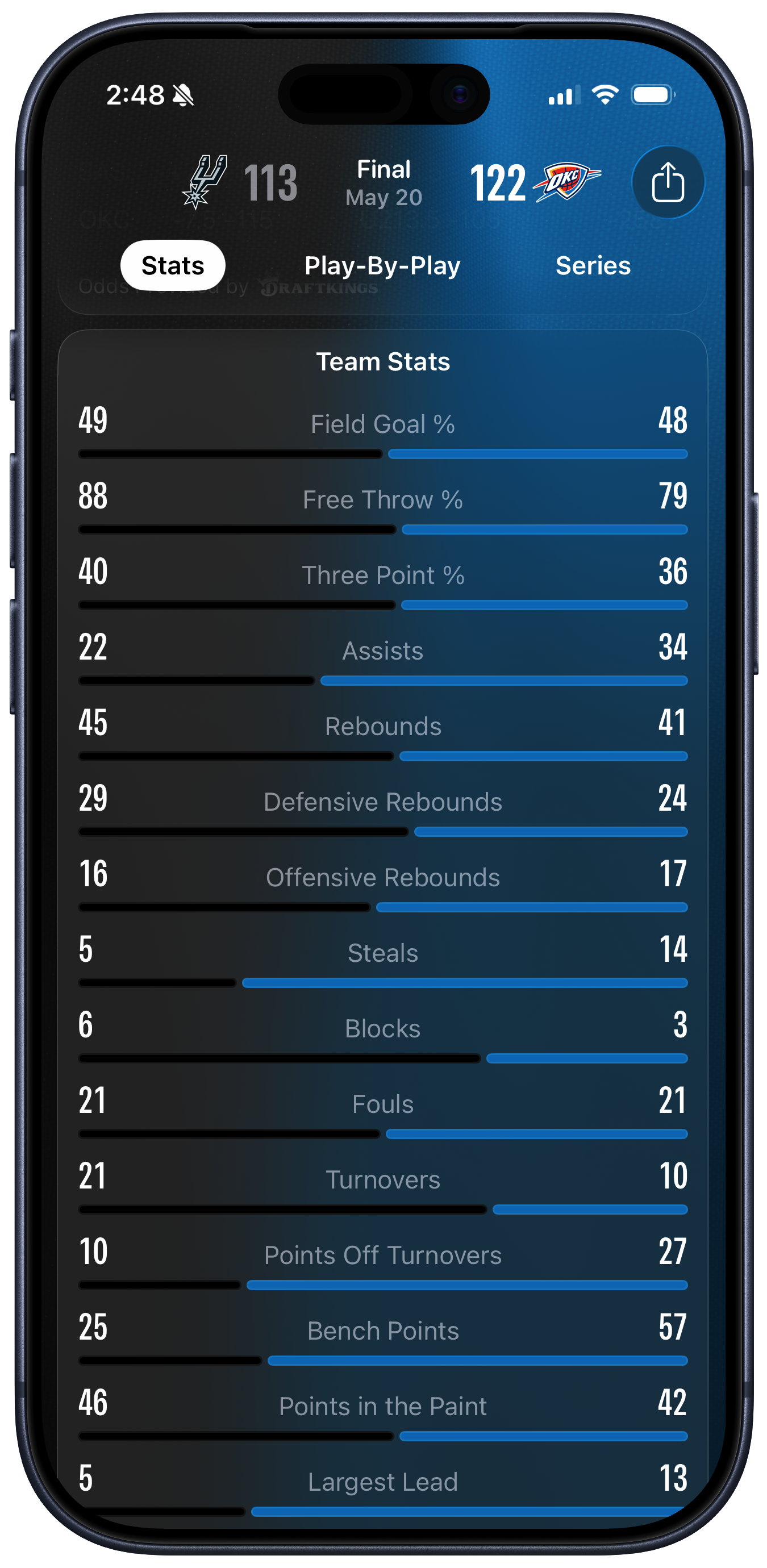
Kieran Healy kindly accepted my implicit homework assignment yesterday, and wrote a piece on Apple Sports’s bizarre “zero sum” team stats visualization:
It also doesn’t do away with the core problem. That problem is principally one of information design rather than data visualization. What I mean is that what we’re trying to organize is, in effect, fifteen pairs of related but fundamentally distinct numbers. If we had fifteen cases and two variables things would be simple. But with fifteen variables and two cases … well, this is not the kind of thing you can make a single effective and non-confusing graph out of. That’s why I kind of sympathize with the designer. In a constrained space they have to show thirty numbers (thirty two, including the score). Lots of information. A straight table seems like it would be boring. Surely there’s some way to thematically integrate the numbers in a visually appealing manner that brings out some of the relationships across the rows. That’s what graphs do; it seems like the right thing to reach for. But at its heart this information is not a graph. It just sort of looks like one, and that ends up confusing people.
Just a crackerjack explanation for why this presentation in Apple Sports is confusing, and for why it is a difficult problem to solve. The problem is further complicated by the fact that Apple Sports shows the same screen for all sports, just with different sport-specific stats. I think the solution is to just present these numbers in a table. Yes, tables are boring. But they’re not confusing. What Apple Sports is doing, in an attempt not to be boring, is confusing.
Sidenote: Healy writes:
I don’t know much about basketball, but I do know a bit about data visualization and in a pleasing coincidence my former student Josh Fink is the A-VP of Basketball Data Science for the Spurs.
I don’t want to get Healy in any trouble, especially after he responded to my prompt with such a remarkably thoughtful, helpfully illustrated little essay, but I was under the impression that it’s illegal for any professor at Duke not to know much about basketball.
- Stephen Colbert’s ‘The Late Show’ Finale ★
-
James Poniewozik, writing for The New York Times (gift link):
He didn’t land the pope, but he got a Beatle. He didn’t have a new project to announce, but he left us with a song (in fact two). He didn’t choose to end his show, but he ended it his own weird, wonderful way.
Stephen Colbert hosted his final “Late Show” on Thursday night, completing the story of the TV year’s most notorious and rancorous cancellation. But his final hour-plus — an emotional and delightfully bizarre wake for a comedy institution — turned it into a cancellebration. [...]
In fact, the episode gradually revealed a story arc, more like the closing episode of a surreal comedy than of a talk show.
Series finales are so difficult to do well. I find them compelling even when they fall a little flat. Colbert’s finale last night was just amazingly good. Good and fun and surprising and perfectly on-brand. And what a song to end on. Perfect.
Thursday, 21 May 2026
- Apple Seeks Supreme Court Review of Contempt Finding and Injunction Scope in Epic Games Case ★
-
Marcus Mendes, reporting for 9to5Mac:
Apple today filed a request with the Supreme Court in an attempt to reverse key lower court rulings over the App Store injunction in its long-running legal battle with Epic Games. [...] In its petition, Apple is asking the Supreme Court to review two questions.
The first is whether Apple should have been held in contempt for charging a commission on purchases made outside the App Store. The second is about the scope of the injunction.
On the first point, Apple argues that the original injunction did not specifically address commissions. Instead, it says the order only prevented Apple from blocking developers from including buttons, external links, or other calls to action directing users to external purchasing options.
According to Apple, that is not the same as saying the company could not charge a commission on those purchases. The Ninth Circuit acknowledged that the text of the injunction did not address commissions, but still upheld the contempt finding by relying on the idea that a party can violate the “spirit” of an injunction, even when the injunction does not specifically prohibit the conduct at issue.
Apple’s argument here is that only the letter of the law matters, and the letter of the injunction did not say anything about charging commissions on external payments, and thus they can’t be held in contempt for violating something that was never spelled out explicitly.
As for the second point, regarding scope, Apple argues that the injunction extends far beyond Epic itself, as it applies to all registered developers worldwide with apps on the U.S. App Store storefront. That includes developers that were never part of the Epic case, and, as Apple has pointed out before, even companies that compete with Epic.
Apple argues that this directly conflicts with the Supreme Court’s 2025 decision in Trump v. CASA, which limited the ability of federal courts to issue broad injunctions that go beyond the parties actually involved in a case.
Apple’s argument here is that even if the Supreme Court upholds the contempt finding, the exemption from commissions should only apply to Epic, not to all developers in the U.S. App Store. I am definitely not a constitutional law scholar, but I think this would have been a long-shot argument pre-CASA. But post-CASA I think Apple might have something here, with this Court.
Apple’s full petition is not yet publicly available, but should be soon from the Supreme Court’s website. I’ve seen a copy, and Mendes’s summary jibes with my reading. In the meantime, here’s SCOTUSblog’s index page for Trump v. CASA, and here’s Mila Sohoni’s analysis of the CASA ruling.
- Apple TV to Broadcast Entire MLS Match Shot Using iPhones ★
-
Speaking of Apple and sports, here’s another one from Apple Newsroom:
This Saturday, May 23, Apple TV will present a special live Major League Soccer match captured exclusively on iPhone 17 Pro — marking the first time iPhone will be used to capture the entirety of a major professional live sporting event broadcast. Developed in partnership with MLS, the milestone broadcast will feature the LA Galaxy vs. Houston Dynamo FC, streaming live on Apple TV from Dignity Health Sports Park in Carson, California, during the final weekend of MLS play before the regular season pauses for the FIFA World Cup 2026 in North America.
The word “major” is doing a bit of work in the phrase “major professional live sporting event” here, but it’s still quite a moment for iPhone photography. Apple started using iPhone 17 Pro cameras during Friday Night Baseball games last year, but this will be the first event to use them exclusively.
- Apple Sports Expands to More Than 90 New Countries on Cusp of World Cup ★
-
Apple Newsroom:
Apple Sports — the free app for iPhone that gives fans access to real-time scores, stats, and more — is now available to download on the App Store in more than 170 countries and regions around the world, including more than 90 newly added markets. Designed for speed and simplicity, the app delivers a personalized experience, putting fans’ favorite teams and leagues front and center with a simple, intuitive interface designed by Apple.
Apple Sports is helping fans get ready for the World Cup by allowing them to explore tournament groupings and customize their scoreboards simply by following the entire tournament or their favorite national teams — making it easier to stay on top of key moments when the tournament kicks off in June. Following a team also enables Live Activities on a user’s iPhone Lock Screen or Apple Watch, letting them follow every moment of a match with just a quick glance.
I’ve got some gripes about certain specific aspects of Apple Sports. Like, where does one even start to explain how much is wrong with their zero-sum visualization of team stats? Has anyone ever even seen a presentation like that before? Anyone?
But overall it really is a good app. I don’t love the UI layout but I don’t hate it, either, and it is interesting. It’s a very modern layout. Apple Sports is fast to load — the primary reason Eddy Cue wanted the app in the first place — and its Live Activities are very good. It remains my go-to for “checking scores” for every sport except baseball, for which I have a much better dedicated app.
Yes, Apple promotes some of its own sports-related properties in the app occasionally. Just now I had a promotion for the F1 Canadian Grand Prix at the top. But the ads that do appear are always sports-related and never obscure content. That’s a fair deal.
I was glad when Apple Sports debuted two years ago and it’s lived on my first or second home screen ever since, depending on which sports are in season. I’m really glad Apple has stuck with it, shipping steady improvements on a regular basis. Expanding now to nearly the entire world is a big step. If you’re new to it, it might take some getting used to, but give it a shot. It stuck with me.
Still kind of curious that Apple Sports remains iPhone-only — not even an iPad version — but in a way I find that charming too. Maybe Apple is tight on money?
- Google I/O Keynote in 54 Seconds ★
-
Tight edit but covers the whole thing. (XCancel link; Threads link.)
- ‘Geography Is Four-Dimensional’ ★
-
Derek Sivers:
When someone speaks of a place, you have to ask, “When?” Geography is four-dimensional. You can’t know a place — only a place as it was at a time. Where is bound to when. Unless you are in a place right now, you can only speak of it in past-tense.
Wednesday, 20 May 2026
- The Verge: ‘The 13 Biggest Announcements at Google I/O 2026’ ★
-
Andrew Liszewski and Stevie Bonifield, writing for The Verge (gift link):
Google’s I/O 2026 keynote today was once again full of AI-related announcements including a new family of Gemini 3.5 AI models, new features for Search and Gmail, and updates about its Project Aura smart glasses.
If you weren’t able to tune into the event’s livestream today or follow along with our live blog, you can catch up on everything you missed in our roundup below.
This roundup was the only way I could really make sense out of Google I/O.
- WSJ: ‘Google Unveils New Gemini AI Agent for Personal Tasks’ ★
-
Katherine Blunt and Rolfe Winkler, reporting for The Wall Street Journal from Google I/O (gift link):
Google is supercharging its Gemini artificial-intelligence model to become more competitive in the era of agentic AI.
The company has started rolling out what it calls Gemini Spark, a personal agent it says is capable of navigating a user’s digital life and acting on his or her behalf. The agent will work across many of Google’s products and run on the company’s cloud infrastructure. [...]
The company has been testing Spark with a limited number of users and plans to make it available next week to those who pay for AI Ultra, a new subscription tier that costs $100 a month.
A different top-level takeaway than the NYT’s, which in turn was different from Bloomberg’s.
Ben Thompson, in a subscriber-only update at Stratechery, sums it up:
Indeed, if you wanted a positive spin on Google’s plethora of announcements, it’s that the company is clearly fully committed to putting AI into anything and everything; if you want to put a negative spin, well, it’s the exact same thing. One of the enduring critiques of Google is that the company is unfocused and unmanageable, which, to the extent this keynote was a manifestation of the company it represents, the shoe fits.
I personally find Google I/O days very hard to follow. My brain doesn’t jibe with the sprawling nature of the company. This year this was particularly so.
- NYT: ‘Powered by A.I., Google Changes Its Search Box for the First Time in 25 Years’ ★
-
Tripp Mickle, Kate Conger, and Brian X. Chen, opening The New York Times’s report on yesterday’s Google I/O keynote (gift link):
For 25 years, Google’s iconic search box was a long, slender bar where people typed in keywords like “World Cup.”
But over the past three years, artificial intelligence allowed people to type in longer, more complex questions like “Who are the top 24 teams in the World Cup and what chance does the United States have of advancing?”
On Tuesday, Google said the A.I. shift had inspired it to overhaul the dimensions of its search bar for the first time since 2001. The box is getting bigger and more interactive so that people can ask even longer questions and upload photographs and videos into queries.
Interesting to me that this is the Times’s biggest takeaway. But it speaks to how unchanged the google.com homepage has been since its earliest days.
In addition, people can ask follow-up questions with a chatbot on Google’s main search page. The company will also offer digital assistants, known as agents, to automate searches so that someone who may be apartment hunting can be notified of a new listing without opening a real estate site like Zillow.
Odd, to me, to paint this only in terms of user convenience (ostensible user convenience at that), and not in terms of this being a de facto attack on Zillow and the rest of the web. Later in the Times report:
Richard Kramer, a financial analyst with Arete Research, said the changes were helping Google make more money from advertising. Last year, Google’s ad clicks rose 6 percent, and it charged 7 percent more for each click. The company’s annual profit has more than doubled since 2022 to $132 billion.
“The open web is on its way out,” Mr. Kramer said, referring to the way internet traffic now often begins and ends with a visit to Google rather than visiting other sites. “With A.I., Google is reducing everyone to raw data providers.”
What an odd statement to include in the middle of an article without any acknowledgement of what a profound loss that would be, if Kramer is correct. It’s as though Kramer said that light mode is on its way out, everyone is into dark mode these days.
- ‘You Do Not Need Fancy Equipment, You Do Not Need a Degree, to Make Money and to Do This as Your Job’ ★
-
22-year-old pop singer-songwriter Brye, on TikTok:
“Lemons”, my biggest song ever, that went like super viral during quarantine back in 2020, was actually produced, if you can believe it, in GarageBand on my school iPad.
My high school gave us all iPads and I produced “Lemons” on there. I used to just like make beats on GarageBand in high school. I wrote musicals for my school with GarageBand on my iPad. And then I made that little demo for “Lemons”, recorded it ... on my iPad ... with my horrible little plug-in mic, posted it to spite a guy who was being horrible to me, and it blew up.
All of this to say, how crazy is it that a song that could be on Sirius XM radio — streamed a hundred million times, literally charted on the global top like viral 50 or whatever — it was literally made on GarageBand. You do not need fancy equipment, you do not need a degree, to make money and to do this as your job.
Obviously it’s good to learn. It’s fun to upgrade. But if you are working on a budget, GarageBand’s free on any Apple device.
If Brye’s story isn’t exactly what Steve Jobs was talking about when he introduced GarageBand in 2004 and GarageBand for iPad in 2011, well, I don’t know what is. Right down to the fact that she did it on school equipment. Her enthusiasm for the simplicity of the kit she used to record “Lemons” is contagious.
John Ternus (or whatshisname ... Tim Cook) should send this video to every single employee at Apple and tell them that this — this — is exactly Apple’s mission. To empower creative people to create great new things they didn’t believe were possible with the tools already in their hands.
Tuesday, 19 May 2026
- Andrej Karpathy Joined Anthropic ★
-
Andrej Karpathy, on Twitter/X (XCancel link):
Personal update: I’ve joined Anthropic. I think the next few years at the frontier of LLMs will be especially formative. I am very excited to join the team here and get back to R&D. I remain deeply passionate about education and plan to resume my work on it in time.
Karpathy is, to say the least, a star in the AI research field. He co-founded OpenAI in 2015, was director of AI at Tesla (reporting directly to Elon Musk) from 2017–2022, went back to OpenAI in 2023, and then left again in 2024 to start an AI education company named Eureka Labs. He coined the term “vibe coding” in February last year.
Monday, 18 May 2026
- Jury Rejects Elon Musk’s Claim Against Sam Altman in Unanimous Verdict ★
-
Cade Metz and Mike Isaac, reporting for The New York Times (gift link):
A nine-person jury found that Elon Musk did not bring his lawsuit against OpenAI and Sam Altman until after the expiration of the three-year statute of limitations.
Mr. Musk filed his suit against the $730 billion artificial intelligence start-up in the summer of 2024, but the jury found that he was aware of the behavior discussed in his complaint against OpenAI as far back as 2021.
This update quoting Judge Yvonne Gonzalez Rogers’s “poetic” jury instructions is just lovely:
“A jury reflects the attitudes and mores of the community from which it is drawn,” she said, paraphrasing another judge. “It lives only for the day and does justice according to its limits. The group of jurors who are drawn to hear a case make a decision and then melt away. It is not present the next day to be criticized. It is the one governmental agency that has no ambition. It is as human as the people who make it up.”
- ‘John Appleseed’ ★
-
Here’s a great take from last month re: the Cook/Ternus transition, from Om Malik:
When he took over from Steve Jobs in August 2011, Apple’s market capitalization was around $350 billion. As of this morning, it sits near $4 trillion. That is more than a 1,000 percent increase. Revenue went from $108 billion in fiscal 2011 to over $416 billion in fiscal 2025, almost four times bigger. Apple under Cook became the most valuable company in human history, multiple times over. It built Services into a $100-billion-a-year business.
Sure, Cook inherited the greatest product portfolio and the greatest brand in modern business. How many times have we seen people screw it up? He ran it with operational ruthlessness. He is no product visionary, and neither is Ternus. They are not Steve. Tim has run Apple for fifteen years, through a pandemic, two trade wars, a supply chain reordering, and the slow grinding shift from hardware-only to hardware-plus-services-plus-silicon. Most importantly, he didn’t mess it up.
Services, as a whole, is now as big a business for Apple as the entirety of the company was when Cook took the helm. And “not screwing it up” is an enormous accomplishment. Success is always precarious. Keeping a good thing going is inordinately difficult. It only looks easy compared to getting the good thing off the ground in the first place.
- Define ‘Boom’ Please ★
-
While I’m linking to pieces on Apple’s CEO transition, here’s an annoying tidbit from Tripp Mickle and Karl Russell’s piece for The New York Times, under the headline “Tim Cook Was Very, Very Good at Making Money” (gift link):
Even though it has largely missed out on the artificial intelligence boom now lifting the sales of its technology peers, the company’s profits and stock value continue to grow.
Which peers have had their “sales lifted” by AI? There’s Nvidia (now the most valuable company in the world). But Apple doesn’t compete directly with Nvidia. What makes Apple different from its peer companies isn’t that the others are profiting from AI while Apple is not, but rather that Apple, seemingly alone, is not funnelling its free cash flow to Nvidia to build out massive AI datacenters.
Apple might wind up missing out on something huge as a result of its decision to stay out of this race. But it’s nonsense to say they’ve already missed out on a boom. To date it’s a money pit.
- Ted Turner’s Small Apartment Above the Former CNN Center ★
-
Simultaneously audacious and humble, a combination that epitomizes Ted Turner’s entire life. (Shades, too, of Walt Disney’s apartment above the fire department at Disneyland.)
- Existing Stakeholders Have a Say in the Future ★
-
A follow-up point on my “AI Is Technology, Not a Product” column over the weekend. Here’s a repeat of Steven Levy’s argument that John Ternus must direct Apple towards building “a killer AI product”:
By the end of this decade, it’s unlikely that people will swipe on their phones to tap on Uber or Lyft. They will just tell their always-on AI agent to get them home. Or that agent will have already figured out where they need to go, and the car will be waiting without the friction of a request. “There’s an app for that,” may be replaced by “Let the agent do that.”
Putting aside whether this is technically feasible or psychologically comfortable, what Levy is arguing here is yadda-yadda-yadda-ing over Uber and Lyft’s say in the matter. Those two companies are now deeply entrenched. They might get disrupted. (Google’s Waymo isn’t operating here in Philly yet, but I see their vehicles around the city all the time now. You can’t miss them.) But I think it’s a good bet that most ride shares at the end of this decade (which is Levy’s own timeline) will largely be Ubers and Lyfts.
Uber and Lyft get to decide the terms of which platforms they’re hail-able from. Here’s a note a friend sent me that prompted this follow-up:
It’s a newbie take to think all deeds will soon be on the blockchain, all newspapers will migrate to RSS, all broadcast companies will put shows out on one service.
Some companies will forge a path into the next medium, some will be replaced, and others will succeed at slowing its adoption.
When people get taken by a wave of technology hype, there’s a strong tendency to assume that not only will other people get taken by the same hype wave, but that entrenched stakeholders will too. That often doesn’t happen. Walmart still doesn’t take Apple Pay, for chrissakes. The idea that Uber and Lyft are going to put their own futures in the hands of OpenAI and Anthropic (or Google, who, through Waymo, is already their direct competitor) seems like folly.
- ‘AI, “Humanity”, and Dr. Manhattan Syndrome’ ★
-
Jim Prosser, back in February:
Let me be clear about causation, because the AI parallel only works if we’re honest about it. The communications failures didn’t kill nuclear power. The disasters did. But two decades of talking over the public meant the industry had built precisely zero reservoir of human-scale trust to draw on when the real crises hit. Nuclear pioneer Alvin Weinberg admitted in 1976 (three years before Three Mile Island) that “the public perception and acceptance of nuclear energy appears to be the question that we missed rather badly.” After TMI and Chernobyl confirmed the public’s worst suspicions, over a hundred planned U.S. reactors were cancelled.
The entire essay is very good, quite thought provoking. But it really shines in drawing the parallels to nuclear power a generation ago, and the need to communicate the benefits to ordinary people in ways that they actually care about. Regarding OpenAI co-founder Greg Brockman:
But think about what the people behind those numbers are actually worried about. They’re not anxious about AI in the abstract, per se, but its implications. They’re anxious about their job, their kid’s homework, their creative work getting scraped without permission, their privacy. Human-scale concerns that are specific, personal, and grounded in the daily texture of individual lives.
And Brockman’s response to this very specific, very human anxiety is to ... float further up into the philosophical stratosphere while writing a mega-checks to a partisan PAC and explaining it in the language of civilizational mission. It’s like a doctor hearing a patient who says, “My knee hurts,” who then delivers a lecture on the elegance of the musculoskeletal system. The patient doesn’t need you to appreciate the beauty of human biology. They need you to look at their damn knee.
- The Alaska Permanent Fund as Loose Precedent for AI Data Center ‘UBI’ Payments ★
-
Wikipedia:
The Alaska Permanent Fund (APF) is a constitutionally established permanent fund and sovereign wealth fund managed by a state-owned corporation, the Alaska Permanent Fund Corporation (APFC). It was established in Alaska in 1976 by Article 9, Section 15 of the Alaska State Constitution under Governor Jay Hammond and Attorney General Avrum Gross. [...] As of 2019, the fund was worth approximately $64 billion that has been funded by oil and mining revenues and has paid out an average of approximately $1,600 annually per resident (adjusted to 2019 dollars). The main use for the fund’s revenue has been to pay out the Permanent Fund Dividend (PFD), which many authors portray as the only example of a basic income in practice. [...]
The PFD is a Basic Income in the form of a resource dividend. Some researchers argue, “It has helped Alaska attain the highest economic equality of any state in the United States... And, seemingly unnoticed, it has provided unconditional cash assistance to needy Alaskans at a time when most states have scaled back aid and increased conditionality.”
Alaska is not exactly a left-wing state. Again, money talks.
- AI Data Centers Are Deeply Unpopular, Across the Political Spectrum ★
-
Jeffrey M. Jones, Gallup:
Seven in 10 Americans oppose constructing data centers for artificial intelligence in their local area, including nearly half, 48%, who are strongly opposed. Barely a quarter favor these projects, with 7% strongly in favor. [...]
The data center question parallels the wording Gallup uses to ask about local nuclear power plant construction. In the same March survey, 53% of Americans say they oppose building a nuclear energy plant in their area, far less than the 71% opposed to data center construction. Since Gallup first asked the nuclear power plant question in 2001, the high point in opposition has been 63%.
It’s hard to overstate how unpopular this polling paints AI data centers. It’s just an absolute messaging and marketing disaster for the entire tech industry. Tellingly, the anti-AI-data-center sentiment is bipartisan:
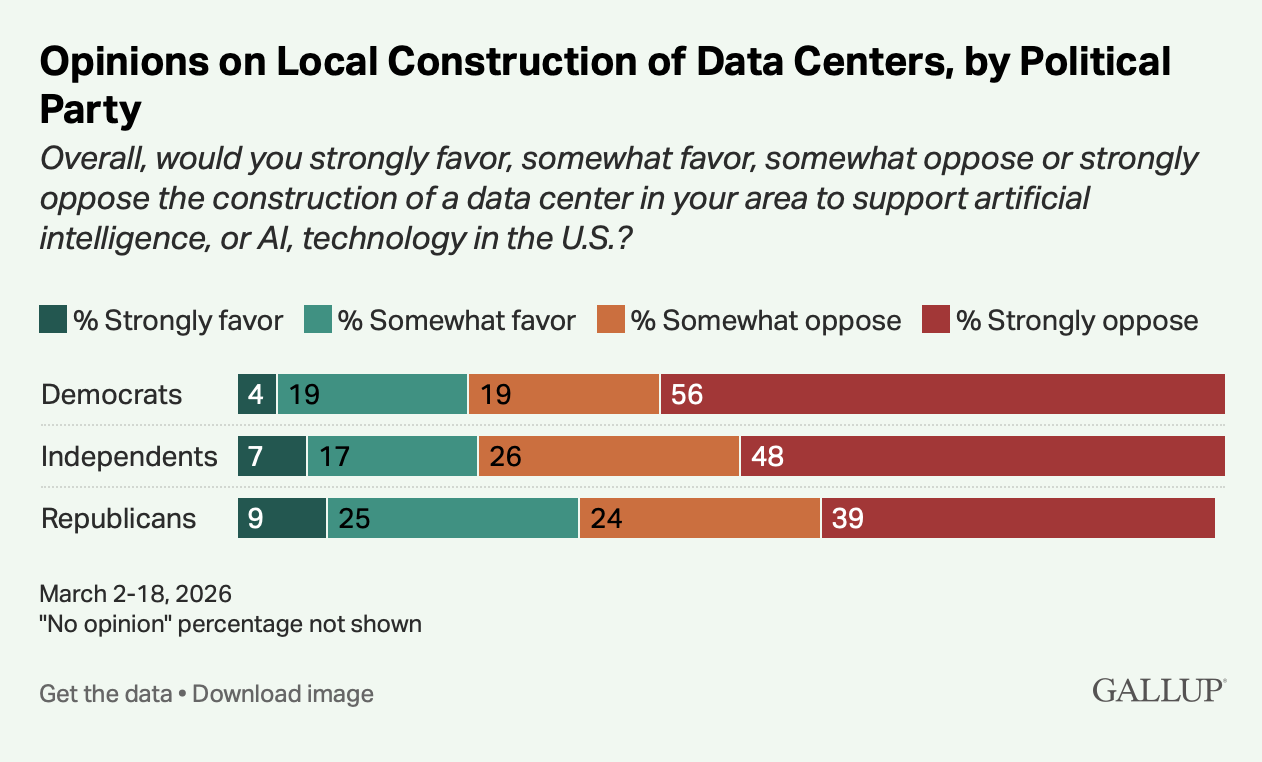
There are partisan differences, but only in slight degree. A savvy politician or party could grab this issue and carve out a broadly bipartisan anti-data-center, anti-AI message. US politics is so polarized in today’s era that the salience of this issue will not go unnoticed. The only thing the hyperscalers have on their side is money, but that fact is a significant factor in the general resentment toward the entire industry.
To that point, Ben Thompson suggests (in today’s subscriber-only Stratechery column) that the industry simply pay residents:
Instead, the most obvious solution is the most crass: simply start giving people money. If data centers are a resource for our AI future, then start paying people for that resource. If that data center up the road weren’t sold to my neighbors based on amorphous tax benefits that my local government may or may not spend appropriately, but rather were to result in a check in the mailbox every year, I suspect you could get a lot more people on board!
Just to put some numbers on this, the data center up the road was expected to be 1.6 GW, which could generate around $3 billion in annual operator revenue. DeForest, the village it was to be built in, has around 11,500 people. You could pay every person in DeForest $10,000 a year for 3.8% of annual revenue grossed by the data center — I bet that proposal would have been approved, and I bet that the operator could very easily pass those costs on to the actual data center users (it also highlights how relatively pathetic QTS’s $50 million commitment was).
I do get how ridiculous this sounds, but ridiculous is how we do things in America.
After mulling the idea for a bit this morning, I’d say it’s unusual, but not ridiculous. Money talks.
Sunday, 17 May 2026
- Drata ★
-
My thanks to Drata for sponsoring last week at DF. Their message is short and sweet: Leverage autonomous AI agents to automate compliance, manage internal and third-party risk, and continuously prove your security posture.
Saturday, 16 May 2026
- Reddit Is Blocking Some Users From Accessing Its Website From Mobile Devices ★
-
Nate Anderson, writing at Ars Technica:
But I was surprised this weekend to suddenly find myself cut off; Reddit simply would not let me visit the site on my mobile phone. Instead, a new overlay popped up, saying, “Get the app to keep using Reddit.”
There was no way to skip, bypass, or close the overlay. It did not provide any instructions or alternatives for continuing to use the mobile web version. What it did offer was a large button I could press to get the app. If I did so, the overlay told me, I would be able to “search better” and “personalize your feed” — two things I don’t care to do. [...]
I reached out to the company to ask what was going on. According to a spokesperson, “We recently started running a test for a small subset of frequent logged-out mobile users that prompts them to download the app after visiting the site. These users are already familiar with Reddit and we’ve seen that the experience is much better for them in the app. The app offers a more personalized experience and users can more easily find communities that match their interests.”
Yes, they’re doing this for the users’ benefit. Sure.
- Santa Clara County Sues Meta Over Alleged Scam Ads ★
-
Brandon Pho, reporting for San Jose Spotlight:
The lawsuit filed Monday alleges that instead of cracking down on deceptive ads designed to trick users out of their money, Meta has hamstrung its own fraud prevention teams and helped fake companies bypass its filters to enable the tech powerhouse to enjoy an estimated $7 billion in ad revenue from the scams every year. [...]
The county lawsuit seeks attorney fees and a ruling barring Meta from further alleged violations of false advertising and unfair competition laws. Much of the lawsuit’s allegations stem from a 2025 Reuters investigation suggesting Meta was at one point involved in one-third of all successful Internet scams in the U.S.
The company has vowed to fight the lawsuit.
“This claim relies on Reuters reporting that distorts our motives and ignores the full range of actions we take to combat scams every day,” a spokesperson for the company told San José Spotlight. “We aggressively fight scams on and off our platforms because they’re not good for us or the people and businesses that rely on our services.”
Reuters’s Jeff Horwitz and Engen Tham were awarded the Pulitzer Prize for Beat Reporting for their reporting on this story. As the adage goes, if the facts are on your side, pound the facts. If the law’s on your side, pound the law. If neither are on your side, pound the table.
I have to say, though, it does not seem scalable for individual counties to be suing Meta.
- ArXiv to Ban Researchers for a Year if They Submit AI Slop ★
-
Samantha Cole, writing for 404 Media:
Late Thursday evening, Thomas Dietterich, chair of the computer science section of ArXiv, wrote on X: “If generative AI tools generate inappropriate language, plagiarized content, biased content, errors, mistakes, incorrect references, or misleading content, and that output is included in scientific works, it is the responsibility of the author(s). We have recently clarified our penalties for this. If a submission contains incontrovertible evidence that the authors did not check the results of LLM generation, this means we can’t trust anything in the paper.” [...]
“The penalty is a 1-year ban from arXiv followed by the requirement that subsequent arXiv submissions must first be accepted at a reputable peer-reviewed venue,” Dietterich wrote. Dietterich told me in an email on Friday morning that this is a one-strike rule — meaning authors caught just once including AI slop in submissions will be banned — but that decisions will be open to appeal.
I see no cognitive dissonance in being pro-AI, in general, but vehemently anti-slop.
Friday, 15 May 2026
- The Talk Show: ‘A Sociopathic Father’ ★
-
Adam Lisagor returns to the show to talk about Hovercraft, his new virtual presentation camera app for Mac, and how he’s developing it with AI coding tools. Also, delicious Japanese spite sandwich cookies.
Sponsored by:
- Parcel: Track your packages in one place, with native apps for iPhone, iPad, Apple Watch, and Mac.
- Scribe: Instantly capture and optimize workflows so your teams and AI agents do their best work.
- Squarespace: Save 10% off your first purchase of a website or domain using code TALKSHOW.
- Greg Brockman Officially Takes Control of Products at OpenAI, a Very Stable Well-Run Company ★
-
Maxwell Zeff, reporting for Wired (News+ link):
OpenAI told staff on Friday that it would reorganize the company as part of an ongoing effort to unify its product offerings, Wired has learned. OpenAI cofounder and president Greg Brockman will now lead the company’s product strategy, in addition to his work on AI infrastructure, OpenAI confirms to Wired. Brockman was previously assigned to oversee OpenAI products on an interim basis while the CEO of AGI deployment, Fidji Simo, was on medical leave; the change is now official. [...]
The company tells Wired that Simo remains on medical leave, and expects her return, noting that she worked directly with Brockman on these organizational changes.
Yours truly, last month:
OpenAI’s work environment seems not merely overwhelming, but torturous. I have no reason to believe Simo’s medical leave is anything but a legitimate medical leave, but I wouldn’t be surprised if she never comes back. (What’s the point of being CEO of AGI deployment when there is no AGI to deploy?)
Her title might as well be “CEO of Technology That Doesn’t Exist”.
- Wanton Destruction of CBS Property ★
-
“Good night and good luck, motherfuckers.”
- Dropover, a Mac Shelf Utility That Makes Clever Use of Mouse Shaking ★
-
Yesterday, regarding the “Magic Cursor” feature Google teased for its upcoming Googlebook/Aluminium OS platform, I wrote:
Shaking your cursor over something is an interesting gesture. The only feature I’m aware of that uses that gesture is MacOS’s feature that makes your cursor bigger when you shake it, to help spot it on the display.
Then, last evening, I selected a few files on my desktop, started dragging them, and shook my mouse cursor to conjure a drop shelf from Dropover, a Mac utility by developer Damir Tursunović that I’ve been using for about two years. As soon I shook my mouse, I smiled and thought, “Well, I should mention that.” So here I am, mentioning the gesture and Dropover.
Years ago I recommended Yoink, which is very much a direct competitor to Dropover. The basic idea with both apps is that sometimes you want a temporary “shelf” on which to drop items — a way station between where you’re dragging the items from and where you want to drop them. Yoink has options to appear only when you drag to the left edge of the screen, or to appear as soon as you start dragging anything. I have always used Yoink with it configured to show its shelf at the edge of the screen, because I only want it to appear when I need it. Appearing on every single drag is, to me, distracting. But sometimes the left edge of the display feels far away.
Dropover has two options for appearing only when you want it, right where your cursor currently is. The first is the aforementioned mid-drag shake gesture. The other is an option to appear, while dragging, only when holding down a modifier key. The default key is Shift, which is what I use, but you can choose between Shift, Command, and Control. When I first started using Dropover, I leaned more on pressing Shift to invoke it. As time has gone on, more and more I use the shake gesture without thinking about it. Like yesterday. It feels like you’re saying “Give me a shelf right here” when you shake mid-drag. It’s clever and convenient, and, unlike using a modifier key, doesn’t require you to involve your other hand. (Dropover also lets you optionally use your MacBook’s notch as a drop target, and both apps let you drop items on their menu bar icons.)
Dropover is a free download from the Mac App Store and unlocking all features costs just $7 (one-time purchase). Yoink costs $9, either from the web or the Mac App Store. Both are terrific apps and are worth checking out. And if you’re not already using a utility of this sort, you probably should be.
- Aluminium OS: Google’s ‘Android for PC’ OS for Googlebooks ★
-
Update: I originally posted this item thinking the aluminium-os.com website was official. It’s not. And the fact that it’s not is only mentioned in small print in the page footer. My bad, and my apologies for not noticing. No wonder I thought the descriptions were so un-Google-like in language and humility. This also explains the incongruity between Google’s statement that “Aluminium OS” is only a codename, and the existence of this site premised on the idea that the platform is named Aluminium OS.]
Aluminium OS — internally codenamed ALOS — is Google’s entirely new Android-based operating system built specifically for laptops and desktop computers.
I like the name and wish they’d stick with it. But The Verge reported this week — re: Google’s Googlebook teaser announcement — that Peter Du of Google’s global communications team told them “We’ll have more to share on the exact OS branding later this year. We can confirm it is not Aluminium — that is the codename, not the official branding.” Maybe they’re going to call it “Google OS” given that they’re calling the devices Googlebooks?
This is not ChromeOS with a Play Store tab. It is not an Android phone app scaling itself to a 15-inch display. Aluminium OS is built from the ground up on Android 17, with a completely custom window manager, a real taskbar, virtual desktops, and Gemini AI baked into every layer of the operating system.
For over a decade, Google ran two separate systems in parallel — ChromeOS for laptops, Android for phones — and it showed. Apps behaved differently across devices, engineering teams were split across two codebases, and Google fell visibly behind Apple’s unified iPhone-iPad-Mac ecosystem. Aluminium OS is the decisive answer to all of that.
I find this description so refreshing, and so un-Google-like. It’s human and humble. I love the flat-out acknowledgement that Apple’s iPhone-iPad-Mac Continuity work has kicked Google’s ass. (It would be fascinating to see Apple acknowledge a similar degree of getting-its-ass-kicked, naming exactly which platforms were kicking its ass, with regard to Siri. I will not hold my breath.)
I’ve been vaguely aware since last year that Google had announced plans to “combine” ChromeOS and Android. There’s two ways to do that: (a) run Android apps in ChromeOS and do away with Android, as an OS, for device classes other than phones; or (b) do away with ChromeOS and build out Android for tablet and PC form factors. Option (a) never made any sense to me. All OSes have built-in browsers and web rendering engines. A web rendering engine does not make for a good foundation for an OS. I never thought ChromeOS sounded like a good idea, and when I’ve tinkered with Chromebooks, the experience was even worse than I expected. Another dose of welcome humility on this Aluminium mini site is the acknowledgement that ChromeOS is a market failure outside K-12:
ChromeOS captured K-12 education but never broke into mainstream consumer or enterprise markets at scale. Aluminium OS is built for all segments.
Reading the rest of this site, I am much more intrigued by Aluminium OS than I expected to be:
On-Device Code Assistance
Write, debug, explain, and refactor code directly in the terminal — no separate paid extension, no cloud subscription for basics.Natural Language Automation
Describe any repetitive task in plain English and Gemini automates it permanently as a saved one-command workflow.They’re saying Aluminium OS is meant to serve as a developer workstation. We shall see how that pans out, but that’s a level of ambition that ChromeOS never even aspired to, let alone reached.
Thursday, 14 May 2026
- ‘Musk v. Altman’ Closing Arguments ★
-
Elizabeth Lopatto, reporting for The Verge (gift link):
Today was closing arguments in the Musk v. Altman trial, and I almost feel bad writing about the unbelievable demolition derby I just witnessed. Steven Molo, Musk’s lawyer, stumbled over his words. He at one point called Greg Brockman — a co-defendant — Greg Altman. He erroneously claimed that Musk wasn’t asking for money and had to be corrected by the judge. He made it clear we’ve heard from many liars over the past few weeks, but offered little evidence for Musk’s actual legal claims.
OpenAI’s lawyer, Sarah Eddy, countered this by simply arranging the mountain of evidence that the company introduced in chronological order. She didn’t spend time trying to pretend anyone in this trial is especially reliable. She did, however, get the zinger of the day, about Musk: “Even the mother of his children can’t back his story.” William Savitt, who took the defendant baton after her presentation, demonstrated the number of times Musk “didn’t recall” some critical detail — and wondered how a sophisticated businessman couldn’t understand or read a four-page term sheet OpenAI had sent to him.
I found myself wondering, again, why we were all wasting our time here. So let’s discuss the gossip, which is the real point of this trial. How good was it? Here are my favorite nuggets.
- Let’s Run a Neologism Poll ★
-
After posting the previous item referencing dickpanels, a term I’ve been using since 2022, it occurred to me that they could also be called dickovers (like popovers, but dickheaded). The latter sounds more clever, but I worry it’s less clear. I’m seldom so indecisive, so I’m running a Mastodon poll.
- The Youth AI Safety Institute Has Margrethe Vestager’s Backing ★
-
Una Hajdari, reporting for Euronews:
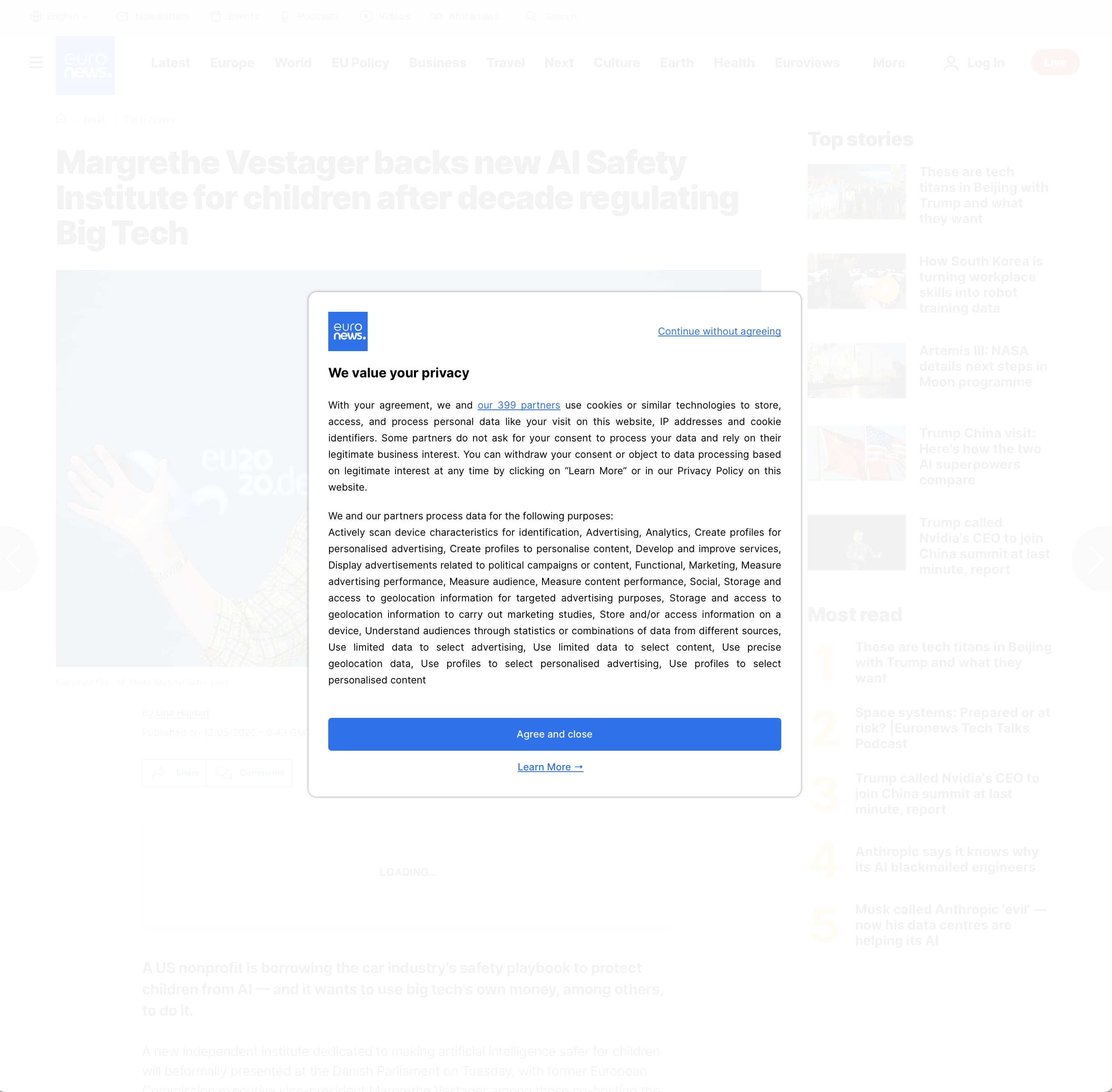
A new independent institute dedicated to making artificial intelligence safer for children will beformally [sic] presented at the Danish Parliament on Tuesday, with former European Commission executive vice-president Margrethe Vestager among those co-hosting the event.
The institute’s approach, as explained in a statement before the launch, is “modelled on independent crash-test ratings” for cars. The idea, ostensibly, is that just as consumers can check whether a vehicle is safe before buying it, parents should be able to do the same for the AI their children use.
Quite what a crash test looks like for a chatbot, the institute does not yet say.
Hopefully their AI crash testing winds up more effective than the GDPR “cookie” initiative overseen by Vestager, which led to the nonsense that required me to click through this ridiculous full-window dickpanel just to read the story. (I love that the dickpanel is titled “We value your privacy” and then begins with the sentence, “With your agreement, we and our 399 partners use cookies or similar technologies to store, access, and process personal data like your visit on this website, IP addresses and cookie identifiers.” If Euronews did not value your privacy, they might have 400 partners.)
- Aided by Mythos Preview, Researchers Announce MacOS Kernel Exploit Circumventing M5 Memory Integrity Enforcement ★
-
Calif, a security research team, on their blog:
Many security experts consider Apple devices to be the most secure consumer platform. The latest flagship example is MIE (Memory Integrity Enforcement), Apple’s hardware-assisted memory safety system built around ARM’s MTE (Memory Tagging Extension). It was introduced as the marquee security feature for the Apple M5 and A19, specifically designed to stop memory corruption exploits, the vulnerability class behind many of the most sophisticated compromises on iOS and macOS. [...]
Our macOS attack path was actually an accidental discovery. Bruce Dang found the bugs on April 25th. Dion Blazakis joined Calif on April 27th. Josh Maine built the tooling, and by May 1st we had a working exploit.
We didn’t build the chain alone. Mythos Preview helped identify the bugs and assisted throughout exploit development. [...] To the best of our knowledge, this is the first public macOS kernel exploit on MIE hardware. Again, we’ll publish our 55-page report after Apple ships a fix.
The Wall Street Journal ran a story on Calif’s announcement today that was heavy on hyperbole and extraordinarily light on technical details. Unsurprisingly, the team’s own blog post was much more informative and interesting. The achievement here is circumventing MIE.
- Wired on the Dark Mood Inside Meta ★
-
Paresh Dave, Lauren Goode, Steven Levy, and Zoë Schiffer, reporting for Wired (News+ link):
As Meta employees brace for layoffs next Wednesday, May 20, many say the vibes are horrifically, historically low. “Everyone is unhappy; the only people who are not unhappy are, literally, executives,” says an employee who works on Instagram.
I’ve never heard of a company bracing for layoffs where the morale was good. But this Wired report — with some all-star bylines — paints a particularly dark picture of the mood in Menlo Park:
“I don’t know anyone having a good time,” says a policy staffer. “The vibe is a bit ‘over it’ — lack of connection to the mission, upcoming layoffs, American employees being used to train the AI models that will replace them.”
Anyone who can afford to leave is hoping to be laid off and receive the 16 weeks minimum of severance and 18 months of paid health care that come with it, several people say. As the Instagram employee put it, “Everyone is just like, do it now, jesus fucking christ.” Only the individuals with the best pay packages and involved in the core development of AI seem to be thriving, a longtime senior leader at Meta says.
Regarding the new employee surveillance tracking software:
Opting out is not possible, according to three employees. “Nobody is happy about it,” says a current employee. “And we have no choice.” Some employees claim they have found workarounds to dodge tracking or have managed to delay installation.
The software, known as Model Capability Initiative, or MCI, suddenly turned people across the company into privacy zealots, a legal staffer says. When employees protested the rollout in internal messages, including by referencing Meta’s history of user data breaches, chief technology officer Andrew Bosworth “belittled and berated” the dissenters, one veteran employee says and another confirms. “These billionaires can’t even feign empathy,” the first person says. “The social contract is completely shattered at this point.”
Unanswered remains my question from earlier this week: is MCI installed on Bosworth’s computer too? (And Zuck’s?)
- Geoffrey Fowler and the Launch of the Youth AI Safety Institute ★
-
Geoffrey Fowler, on his blog, which, alas, he calls “a Substack”:
I’m joining the Youth AI Safety Institute as its first new employee. It’s a research and testing organization launching today under the umbrella of children’s nonprofit Common Sense Media. Backed by a $20 million annual budget, the Institute aims to do something that doesn’t really exist yet: systematically test the AI products kids use, set safety standards, and publicly hold tech companies accountable for meeting them. Think crash test dummies for AI.
On the surface this sounds like a great idea, and Fowler does have a strong background in consumer-oriented product reviews.
My title is Head of Public Engagement — a kind of editor-at-large. I’ll work alongside researchers, computer scientists, pediatricians, clinical psychologists and educators to investigate what happens when kids use AI products, including chatbots, games, educational apps, furry AI toys and whatever comes next. My job is to help turn those findings into something families, educators, policymakers and tech leaders can use.
“We safety-test kids’ PJs. Why not their AI?” says my new colleague at Common Sense, Bruce Reed, who helped craft the Biden White House’s groundbreaking 2023 AI Executive Order.
What exactly did Biden’s AI Executive Order accomplish? As far as I know, absolutely nothing.
Some tech power players, including Anthropic and the OpenAI Foundation, have joined a consortium of foundations and private donors funding the Institute’s work. They get no say over what we publish. (And in my time at The Washington Post, I didn’t let Jeff Bezos’ ownership of the newspaper affect my criticism of Amazon.)
I’m not sure I’ve ever in my life used the phrase “Good luck with that” non-sarcastically, but in this case I mean it: good luck with that. I hope it works out, and someone has to pay the bills (and salaries). But color me skeptical about the foxes funding the henhouse inspectors.
- Tim Cook Is in Trump’s Executive Entourage for China Summit ★
-
Owen Scott, reporting for The Independent:
The list of tech and financial industry titans joining the commander-in-chief during his summit with China’s president Xi Jinping includes Elon Musk, BlackRock CEO Larry Fink, and Apple CEO Tim Cook. [...]
Trump earlier confirmed a number of high-profile attendees in a lengthy post on Truth Social, albeit referring to Cook as “Tim Apple” in the process.
While he’s in such a jocular nickname-y mood, he should drop a reference to Winnie the Pooh into some of these posts on his blog.
- Google Announces Its Chromebook Successor: The Googlebook ★
-
Antonio G. Di Benedetto, reporting for The Verge (gift link):
Google is announcing a new line of laptops coming in the fall called Googlebooks. Details are sparse for now, as the tease is just a small part of various Android announcements during Google’s Android Show. But we do know this is a major new initiative in the laptop space for Google, seemingly designed to succeed Chromebooks with something more capable: a platform running a long-rumored new operating system based on a fusion of Android and ChromeOS.
While there are many outstanding questions to be answered about Googlebooks, the biggest and most obvious ones are what will these laptops look like, what chips will be in them, and what will they cost? We’ve got none of that so far. Google only has some initial renders of a mysterious Googlebook and the promise that it’s working with Acer, Asus, Dell, HP, and Lenovo to make the first models. There are no model names. No specs. Nada. Google isn’t even saying if the laptop in its renders is made by a partner or a tease of some first-party Pixel-like Googlebook to come or is just a cool mockup.
This is so light on details that I was hesitant to even link to it yet. (Di Benedetto is skeptical as well.) But this caught my attention:
Googlebooks will have a Magic Pointer feature that offers contextual suggestions whenever you shake your cursor and point it at something on the screen. Google’s examples include setting up a meeting by pointing at a date in an email or selecting images of furniture and a living space to visualize them together.
Shaking your cursor over something is an interesting gesture. The only feature I’m aware of that uses that gesture is MacOS’s feature that makes your cursor bigger when you shake it, to help spot it on the display. It seems a bit silly to me — why not just add the “Magic” features to a contextual menu? But, then again, here we are in 2026 and the standard gesture to invoke the Undo command on iOS is to shake your whole iPhone like a maraca.
- Gurman Reports that OpenAI Is Unhappy With Apple Deal ★
-
Mark Gurman, reporting for Bloomberg under the headline, “Apple-OpenAI Alliance Frays, Setting Up Possible Legal Fight”:
OpenAI lawyers are actively working with an outside legal firm on a range of options that could be formally executed in the near future, said the people, who asked not to be identified because the deliberations are private. That could include sending the iPhone maker a notice alleging breach of contract without necessarily filing a full lawsuit at the outset, according to the people. OpenAI enlisted the outside firm in recent days to help with the situation.
OpenAI believed that the companies’ partnership, which wove ChatGPT into Apple software, would coax more users into subscribing to the chatbot. It also expected deeper integration across more Apple apps and prime placement within the Siri assistant.
To be fair, Apple expected deeper integration across more Apple apps by now, too.
But what’s curious about this story is that it doesn’t even hint at what grounds OpenAI would have for legal action. Expecting deeper integration is one thing. Being contractually obligated to provide deeper integration is another. I don’t see how you run this story, with sources entirely from OpenAI, without describing what terms of the contract OpenAI considers breached.
Some quotes from Gurman’s unnamed source:
“We have done everything from a product perspective,” said an OpenAI executive who asked not to be identified. “They have not, and worse, they haven’t even made an honest effort.” [...]
“When we heard about this opportunity, it sounded amazing: being able to acquire a giant number of customers and have distribution in such a big mobile ecosystem,” said the OpenAI executive. At the time, though, Apple was unwilling to share exactly what the product would be, the person said. “They basically said, ‘OpenAI needs to take a leap of faith and trust us,’” the executive said, adding that the deal ended up being a failure for the startup.
ChatGPT has been the #1 app in the App Store for most of the last two years. (It’s #2 today, behind Instagram’s new Instants app.) It’s impossible to say how much ChatGPT’s exclusive integration with Siri has helped with that, but it couldn’t have hurt.
Lastly, regarding the deal Apple and Google announced in January to power Apple’s Foundation Models with Google’s Gemini technology (but not Gemini the product), this brave anonymous OpenAI executive says Apple couldn’t break up with them because they wanted to break up with Apple first:
OpenAI wasn’t interested in working with Apple on the new models because it felt burned by the initial relationship, according to the people. “Apple has so much market power that they can dictate terms,” the executive said. “We already took this leap of faith with you, and it didn’t work out well.”
This would be easier to take at face value if they’d said it before the Apple-Google partnership was announced, not months later.
- The Trump T1 Phone Starts Shipping This Week, Supposedly ★
-
Dominic Preston, at The Verge:
Trump Mobile CEO Pat O’Brien first confirmed the release plans to USA Today, telling the outlet that all preorders will be fulfilled within the next few weeks. The company later confirmed the news on its social media accounts, using a very normal number of exclamation marks in the process.
The T1 Phone has arrived!! Those who pre-ordered the T1 Phone will be receiving an update email. Phones start shipping this week!!!
In a press release the company added that demand for the phone had been “incredibly high,” and that “orders are being fulfilled as quickly as possible.” That means that for early buyers, the long wait may nearly be over: it’s now been 11 months since the T1 Phone was announced.
The “Trump Mobile” indicia in the camera plateau is, of course, set in Arial.
The president, I’m sure, will soon switch to one of these from his iPhone.
- Klack ★
-
Well, this is ridiculous. Klack is a $5 Mac utility by Henrik Ruscon that simulates mechanical keyboard clacking while you type. Absurd. My keyboard makes its own beautiful sounds as I type.
So of course I went to buy a copy immediately, because I love an absurd utility, that serves no purpose other than fun, crafted with exquisite attention to detail. But when I did, the Mac App Store informed me that a member of my family sharing group had already purchased it. (I presume that was my son, not my wife.)
Update: From a DF reader who shall remain nameless:
I bought Klack out of spite. One of my colleagues brought a mechanical keyboard to use in an open office space and I figured it’d be funny to troll him by setting my Mac system volume to 10 and letting it rip.
- New Driver for the Old Griffin PowerMate ★
-
James Lockman:
This small driver enables the Griffin PowerMate, a nifty little device from days gone by. What does the PowerMate do? It is a knob that you can twist or that you can press. That’s it. It also has a blue LED in the base that can change intensity based on what you’re doing.
When it was released, it was intended to assist video and audio production by adding a scrollable knob to your desktop. Of course, modern controllers exist that offer many more literal bells and whistles, but there is something... quaint... about this early device.
I never bought a PowerMate but I was always on the cusp. I didn’t have a need for it all but it just seemed cool. What a fun idea to create a modern driver. (Lockman credits Cursor Agent as a co-contributor, so this probably wouldn’t have happened if not for AI coding.)
Tuesday, 12 May 2026
- Kagi Snaps ★
-
Kagi’s documentation:
Typing
@r headphoneswill search for “headphones” but limit the results to reddit.com (ris the short code for Reddit). This allows you to quickly find relevant content on a specific site using Kagi’s powerful index. It is effectively the same as doingheadphones site:old.reddit.com.Its relative, Bangs feature, invoked by using “!r headphones”, would redirect the user to Reddit’s internal search.
I learned about the snaps feature from a Kagi blog post a few months ago, and I’ve been loving it ever since. From that post:
You can also use Snaps to quickly search within Kagi’s knowledge base. For example, the
@helpsnap searches the Kagi help docs, handy for when you want to quickly look into a feature.User tip: “I recommend combining Snaps with the “I’m feeling lucky” bang:
!with no short code. Like searching@gh curl !to go to the curl repo.I’ve never actually looked any of these up. I just guessed at the ones I most want to use and they all worked on the first try.
@nytreturns results from The New York Times;@wsjis for The Wall Street Journal. Take a guess what@dfdoes.And you can add your own custom bangs/snaps in Kagi’s settings. It’s easy. In fact, I created a custom
nytbang/snap shortcut to override Kagi’s default. Kagi’s built-innytbang/snap uses thequery.nytimes.comsubdomain, which is outdated. You get better results just usingnytimes.comwith no subdomain. [Update: One day after posting this, Kagi has updated their built-innytbang/snap to use the top-levelnytimes.comdomain. Nice.]Also: Does your preferred search engine have a well-written comprehensive user manual? Kagi does. Good documentation is a tell-tale sign of a great product and a company that puts users first. There exist good products with bad or no documentation, but there are very few poor products with great documentation.
- Seriously, Give Kagi a Try ★
-
Quoting from a post I wrote a year ago:
Like, even if I use the magic
&udm=14parameter with Google search, to get “disenshittified” results from Google, I find I get better results from Kagi. When I know there’s one right answer (say, a specific article I remember reading and want to find again), Kagi is more likely than Google to list it first. If it’s a years-old article, Kagi is way more likely than Google to find it at all. For me, Google (and, alas, DuckDuckGo too) have largely stopped working reliably for finding not-recent stuff on the web. Not true with Kagi.I used DuckDuckGo for years as my default search, and for those years, I found it largely on par with Google. But it felt like every once in a while — maybe, say, once or twice a month — DuckDuckGo would come up dry in its results. DuckDuckGo pioneered a trick they call Bangs. Include
!gto any search terms, and instead of performing the search itself, DuckDuckGo will redirect that search to Google. They have a whole bunch of these Bangs — “!a” for Amazon search, “!nf” for Netflix. There are literally thousands of them (which of course they allow you to search for). The only one I ever really used though was!g, for redirecting my current search to Google because DuckDuckGo’s own results for the same terms was unsatisfying. My memory may not match with my actual usage, but like I said, I feel like I used this about once or twice a month for the several years I was using DuckDuckGo as my default search engine. Infrequently enough that it didn’t annoy me to the point of considering switching back to Google for default in-browser search, but frequently enough that I was annoyed enough to remember that I needed to use it at all.Kagi supports Bangs too, including
!gfor Google web search. I can’t remember the last time I felt the need to try using it. It’s been months, many months. And, the last few times I’ve tried it, Google’s results were no more help than Kagi’s.In the year since writing the above, I honestly don’t think I’ve resorted to the
!gbang once. For me, Google web search is about as relevant to my life as Yahoo search. Something I used to use, something that used to be better, but which I’ve found a vastly superior alternative to. If Kagi went out of business or changed for the worse, I’d be heartsick. It’s truly one of the best services I’ve used, and it keeps getting better.Google Search is like watching 2001: A Space Odyssey with a goddamn Febreze ad stuck in the famed match cut. Kagi search is like paying for a streaming service with no ads and higher image quality and better sound. It’s just plain better.
- Search Ads as a Vector for Travel Scams ★
-
Dawn Gilbertson, writing for The Wall Street Journal (gift link):
Calder says that he tried to rebook at the given link a few times but that it wouldn’t work. He became worried new flight options were dwindling, so he googled the airline’s customer-service number. (There was a link to customer-service contacts way down in the email that he initially overlooked.)
The rest of the story is sadly familiar to the Better Business Bureau, Federal Trade Commission, airlines and consumer advocates. It’s called an impostor scam. This can occur when a company impersonates an airline’s customer-service number or site, often by buying a sponsored ad on a search platform. The company is hoping that panicked consumers trying, say, to rebook a flight will click on the first link they see, bringing them to unscrupulous parties that try to charge exorbitant fees. I’ve written before about such tactics, and they are only becoming more sophisticated with AI.
“Scammers thrive on that sense of urgency,” says John Breyault, a vice president at the National Consumers League whose coverage area includes fraud.
The person who answered Calder’s call identified himself as a Lufthansa representative and asked for the Lufthansa confirmation number. He found new flights on Lufthansa’s partner Air Canada and Austrian Airlines, a Lufthansa Group subsidiary, on the same late-summer dates.
The kicker, which Calder admits in hindsight is a colossal red flag: He had to pay $12,132 to make the change. That’s more than five times the amount of the original tickets.
In addition to airlines, these scammers often impersonate hotels. Yet another reason to try Kagi as your default web search engine. I’m not saying Kagi is scam-proof in its actual search results, but it’s 100 percent resistant to scammers buying search result ads — because they have no ads. With Kagi, you pay a very small subscription fee and in exchange you get better results with zero ads.
Also, another reason to worry about Apple’s upcoming ads in Apple Maps.
- Teresa Ribera Visited the U.S. and No One Noticed ★
-
Jacob Parry and Laura Greenhalgh, reporting for Politico, one month ago:
The EU’s landmark tech regulations are a “success story” that are beginning to level the playing field between Silicon Valley’s giants and their digital competitors in Europe, said European Competition Commissioner Teresa Ribera on Friday. [...]
Ribera’s comments come as Brussels prepares for a formal review of the DMA to determine what is working and where the law may need to be reformed. The regulation aims to prevent “gatekeeper” firms, including Apple, Alphabet and Meta, from using their dominant positions to stifle competition from smaller players.
The EU’s top antitrust official pushed back against criticism that enforcement has been too slow, arguing that the “rule of law” requires a methodical approach based on evidence and due process. [...]
Ribera recently returned from a diplomatic mission to Washington and Silicon Valley where she met with U.S. officials and tech executives. She said there is a surprising degree of alignment between European and American priorities, despite the differing political climates. In particular, Ribera highlighted a “consistent” dialogue with the U.S. Department of Justice under the current Trump administration.
Again, I only found this story because I went searching for news regarding Teresa Ribera and the DMA after taking note in an earlier post that things have been very quiet on this front for the last year. When Margrethe Vestager visited the U.S. and met with tech executives, it was news. There were press photos. Vestager drew attention to the meetings, and, of course, to herself.
It’s pretty telling that Ribera recently visited both Washington and Silicon Valley and it barely registered in the news. Ribera’s approach to the E.U. competition chief job might actually be focused on genuine competition and consumer welfare, not punishing U.S. companies for their success by weaponizing byzantine layers of bureaucracy that ultimately work against the interests of EU citizens and the stagnant EU economy.
- Broadcasters Urge EU to Use the DMA to Go After Smart TV Platforms, None of Which Are From European Companies ★
-
Foo Yun Chee, reporting for Reuters back on March 23:
Google, Amazon, Apple and Samsung’s smart TVs and virtual assistants should fall under the EU’s toughest tech rules because of their growing market power, the world’s largest broadcasters told EU antitrust chief Teresa Ribera on Monday.
The call by the Association of Commercial Television and Video on Demand Services in Europe (ACT) whose members include Canal+, RTL, Mediaset, ITV, Paramount+, NBCUniversal, Walt Disney, Warner Bros Discovery, Sky and TF1 Groupe underscores the battle between broadcasters and Big Tech for market share in a lucrative industry.
Android TV, which increased its market share from 16% to 23% from 2019 to 2024, Amazon Fire OS whose market share rose from 5% to 12% in the same period and Samsung’s Tizen OS with its 24% market share should be designated as gatekeepers under the EU’s Digital Markets Act, the broadcasters said, citing data from a 2025 market study.
Apple is mentioned only in the context of voice assistants, not Apple TV 4K:
The broadcasters also voiced concerns about virtual assistants, the most well known of which are Amazon’s Alexa and Apple’s Siri, while OpenAI entered the field last year with a beta feature called Tasks for its AI chatbot ChatGPT. The European Commission has yet to label any virtual assistants as gatekeepers under the DMA. [...]
They urged Ribera to subject smart TVs and virtual assistants to the DMA on the basis of qualitative criteria even if they do not meet the quantitative benchmarks which are more than 45 million monthly active users and 75 billion euros ($87 billion) in market capitalisation.
I found this story only after posting the previous item, trying to see if there were any DMA-related actions that I’d missed under Ribera’s leadership. I didn’t find much. And this Reuters story only says the broadcasters sent Ribera a letter asking her to go after smart TV platforms and voice assistants — there’s no suggestion that Ribera intends to do so.
- New DMA Compliance Features for EU Users in iOS 26.5 (and Perhaps the EU Has Finally Come to Their Senses on Tech Regulation) ★
-
Juli Clover, MacRumors:
To comply with the EU’s Digital Markets Act, Apple is letting third-party wearables access some features that have historically been limited to the Apple Watch and AirPods.
Proximity pairing — Third-party earbuds are able to use proximity pairing to connect to an iPhone, similar to the AirPods. Bringing a set of earbuds that support the feature near an iPhone will initiate an AirPods-like one-tap pairing process, so third-party wearables like earbuds will no longer require multiple steps to pair.
iPhone notifications — Third-party accessories like smartwatches are able to receive notifications from the iPhone, and users are able to view and react to them. Interactive notifications from the iPhone have been limited to the Apple Watch, while third-party wearables have only been able to display read-only notifications. Notifications can only be forwarded to a single connected device at a time, so turning on notifications for a third-party wearable disables notifications on Apple Watch.
Live Activities — Live Activities from the iPhone can be displayed on a third-party wearable, similar to how Live Activities are shown on an Apple Watch.
Accessory makers will need to add support for the interoperability updates, so they may not be available right away. Third-party TVs, smartwatches, and headphones will be able to use the features.
Two thoughts. First, I’d love to hear about any third-party devices that begin taking advantage of these EU-exclusive features.
Second, it sure seems as though the European Commission has quietly walked away from using the DMA as a cudgel under the leadership of competition chief Teresa Ribera. I’d even forgotten her name. Margrethe Vestager’s name, I still remember. I haven’t mentioned Ribera, or any new enforcement actions against Apple and iOS, in 13 months. The last was this post regarding a €500M fine imposed against Apple in April last year, the culmination of an investigation that began under Vestager. I wrote then:
This finding — and the scope of the fine (roughly $570M converted from euros) — was completely in line with (at least my) expectations. Apple booked about $184B in profit last year, so this fine is about 0.3% of that. Maybe Apple just considers this the new cost of doing business in the EU? It’s not nothing, but it’s about 1/80th of the theoretical maximum fine the EU could have assessed, $39B.
Something, not nothing, but definitely not a big deal. Teresa Ribera, the EC competition chief, is clearly trying to thread a political needle here. Fines big enough to create the impression that the EU is asserting itself, but small enough not to actually be all that inflammatory amidst the Trump-initiated mad-king trade war. Even Ribera’s job title — Executive Vice-President for Clean, Just and Competitive Transition — seems designed to de-escalate tensions. Margrethe Vestager was adamantly against American companies. Ribera is not.
These new DMA compliance features are the result of requirements imposed in March last year — again, from investigations that began under Vestager, not Ribera. I wrote then:
Apple’s statement makes clear their staunch opposition to these decisions. But at least at a superficial level, the European Commission’s tenor has changed. The quotes from the Commission executives (Teresa Ribera, who replaced firebrand Margrethe Vestager as competition chief, and Henna Virkkunen) are anodyne. Nothing of the vituperativeness of the quotes from Vestager and Thierry Breton in years past. But the decisions themselves make clear that the EU isn’t backing down from its general position of seeing itself as the rightful decision-maker for how iOS should function and be engineered, and that Apple’s core competitive asset — making devices that work better together than those from other companies — isn’t legal under the DMA.
I think that holds up. The EU hasn’t rescinded any of their existing requirements under the DMA. But Ribera has clearly deescalated the EU’s approach to regulating American companies in general, and Apple specifically. No new requirements in over a year, no new investigations, and no inflammatory rhetoric. (Still no iPhone Mirroring in the EU, either, though, because they haven’t rescinded any already-imposed requirements.)
Much better.
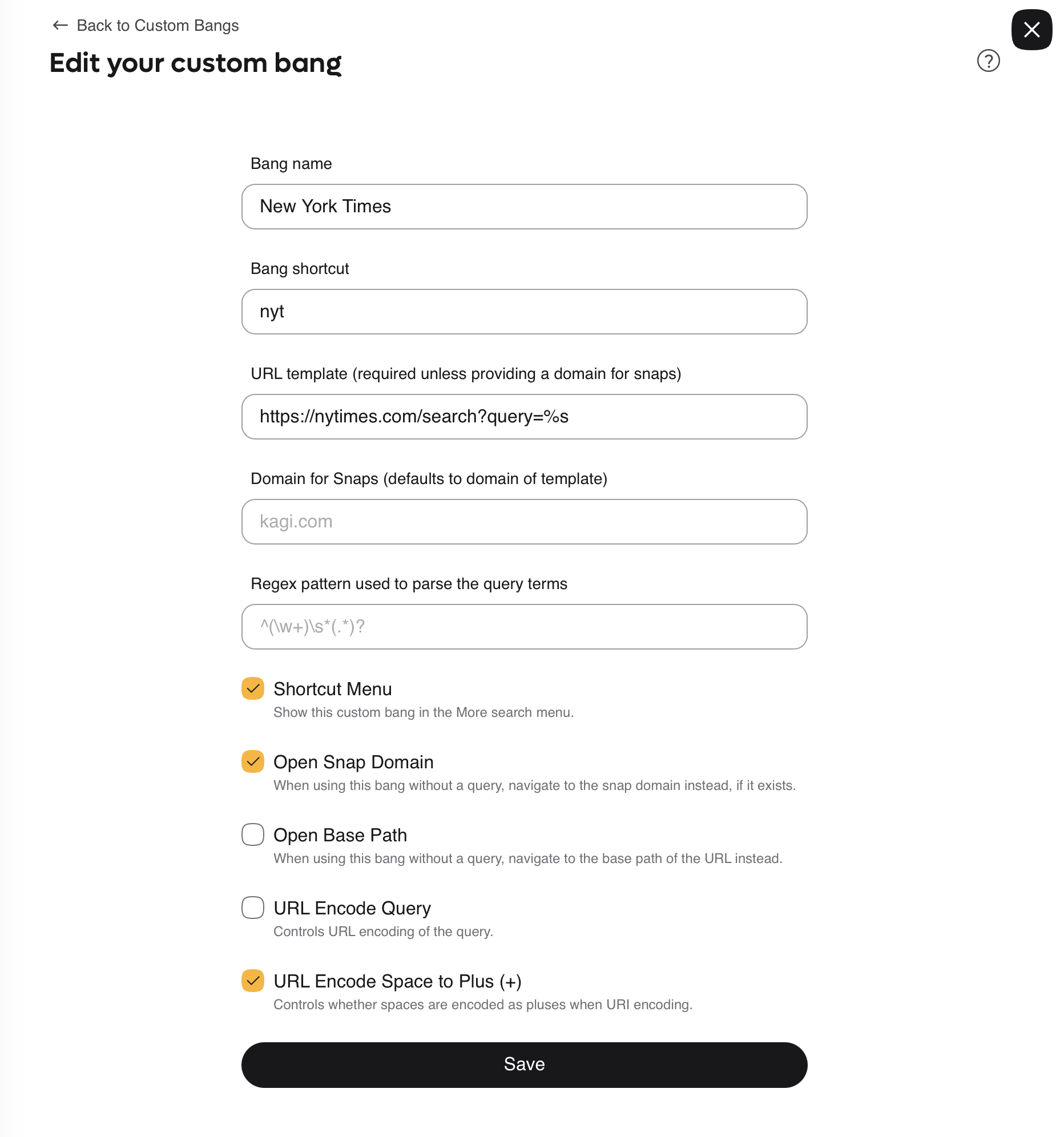
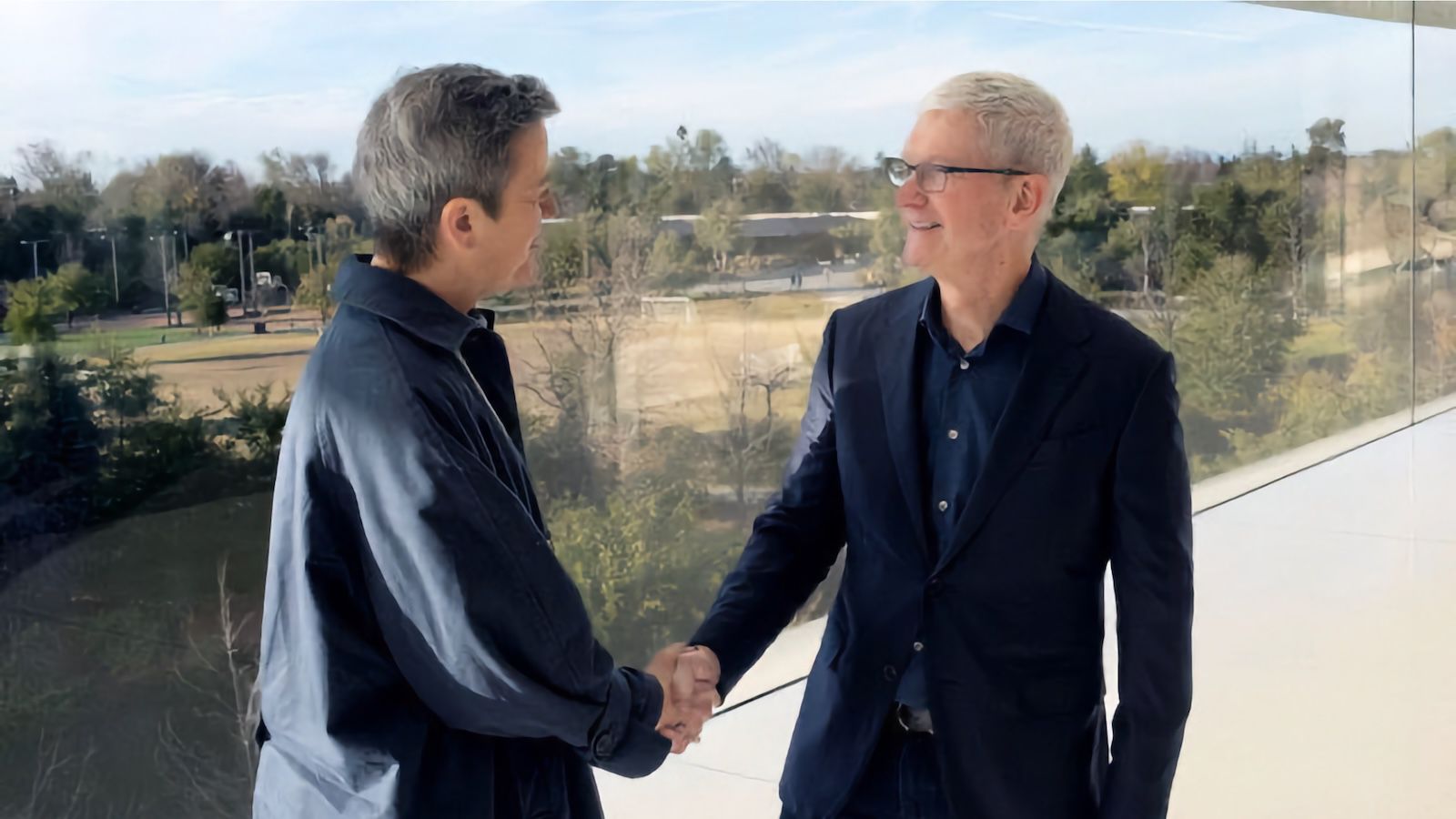
Monday, 11 May 2026
- iOS 26.5 Includes Beta Support for End-to-End Encrypted RCS Messaging ★
-
Apple Newsroom:
Starting today, end-to-end encrypted RCS messaging begins rolling out in beta for iPhone users running iOS 26.5 with supported carriers and Android users on the latest version of Google Messages. When RCS messages are end-to-end encrypted, they can’t be read while they’re sent between devices. Users will know that a conversation is end-to-end encrypted when they see a new lock icon in their RCS chats. Encryption is on by default and will be automatically enabled over time for new and existing RCS conversations.
I hope this leads to a future where all RCS messages are end-to-end encrypted, but I doubt it. Currently this E2EE RCS depends both on the carriers (of both parties) in a direct chat, and the software running on their devices. The carrier list is pretty broad, but as far as I can tell, it still doesn’t include Google’s own Google Fi.
But the indication for this is subtle. You have to read the small print metadata in each chat to see if it’s encrypted. The message text remains the same shade of green. If it’s a group chat and even one single member isn’t on a phone and carrier that supports E2EE RCS, the entire chat will not be encrypted.
With iMessage, all chats are always E2EE, and always have been. iMessage has been exclusively E2EE since it was created. With RCS you have to look in the metadata small print to check. That’s better than not supporting encryption at all, but my recommendation is to assume all RCS chats are not encrypted unless you double-check every time.
Other than bug fixes, encrypted RCS is the biggest new feature in iOS 26.5.
-
Samsung phones took spots 4, 5, 7, 8, and 9. The one phone not from Apple or Samsung in the top 10 was the Xiaomi Redmi A5 at #10. As I always say, take these numbers with a grain of salt, but according to Counterpoint, the bestselling phones, in order, are:
- iPhone 17
- iPhone 17 Pro Max
- iPhone 17 Pro
And Apple’s phone in spot #6 was not the iPhone Air, alas, but the year-old iPhone 16.
- The New PowerMac ★
-
Apple stopped selling the Power Mac G5 (with space) in August 2006, so I’m not sure how much they care about Kraft using “PowerMac” (sans space) as a trademark for protein-enhanced macaroni and cheese. (I feel like there’s got to be a joke to be made here about a “cheese grater”...)
- Tahoe’s UI Issues Have Nothing to Do With Display Technology, and Maybe, Just Maybe, We Should Stop Assuming Gurman Knows Anything About Apple’s Vision Hardware Roadmap ★
-
Mark Gurman, in his Power On newsletter for Bloomberg over the weekend:
Though the Mac software introduced the same Liquid Glass interface seen in iOS 26, the design language hasn’t translated as smoothly to the larger displays and different input methods of desktops and laptops. Part of the reason is that Liquid Glass was created with more modern hardware in mind: the crisp OLED displays that are used on iPhones, some iPads and Apple Watches. The software also will be well-suited to the more glass-centric iPhone 20 coming in 2027.
Most Macs, in contrast, still rely on industrial designs introduced several years ago. The current look of the MacBook Air debuted in 2022, while the latest MacBook Pro and iMac designs date back to 2021. Macs also continue to use LCD displays, which don’t render translucency, shadows and glass effects as effectively as OLED screens.
If you’ve used Tahoe, you’re likely familiar with some of the quirks — particularly the transparency effects and shadows that can make lists and other text-heavy areas harder to read.
Trying to argue that the differences between LCD and OLED displays have anything to do with MacOS 26 Tahoe’s UI problems is like arguing that the reason your undercooked poorly prepared food tastes like shit is that it was designed to be served on higher-quality dinnerware. A nicer display is just a nicer display. A bad UI is a bad UI. Shitty undercooked poorly prepared food is shitty undercooked poorly prepared food.
You can actually see MacOS 26 Tahoe on an OLED display using Sidecar with a recent iPad Pro. It doesn’t help. You can also see iOS 26 and iPadOS 26 on devices that don’t have OLED displays. It looks fine. The notion that anything on MacOS 26 Tahoe was optimized for OLED displays makes no sense — there are no MacBooks or Apple desktop displays that use OLED. OLED MacBooks are purportedly coming at the end of this year or next year, but by the time that happens we’ll be mid-cycle for MacOS 27. Lastly, Apple just came out with the new $3,300 Studio Display XDR, using Mini-LED not OLED technology, in March. Even the future of Mac display technology is only partially OLED.
Last year’s Liquid Glass UI redesigns for iOS and iPadOS 26 were pretty good. The Liquid Glass redesign for MacOS 26 was pretty bad. That’s it. It has nothing to do with display technologies.
I’m happy to see Gurman report that the upcoming MacOS 27 release sports a revised UI, but you don’t need a weatherman to know which way the wind blows. Apple revises their UIs almost every year. Given the obvious problems with Tahoe and the pervasive criticisms from UI critics this year, it’d be absolutely flabbergasting if MacOS 27 did not reflect some noticeable changes.
Elsewhere in this week’s column, Gurman writes:
If a new Vision Pro-like device does end up coming together, I wouldn’t expect it for around two more years at least given the hardware resources are so concentrated elsewhere.
I suggest taking Vision headset product timelines from Gurman with a few grains of salt. In mid-October 2025 Apple announced and began shipping the second-gen Vision Pro, with a speed bump from the M2 to M5 chip. But in January 2025, Gurman wrote:
One thing missing from this 2025 road map is the Vision Pro. As of now, I don’t believe there will be a new headset from Apple shipping this year, though there theoretically could be an unveiling ahead of a release later. Signs point to a second-generation model coming in 2026 with an M5 chip.
Worse, in April last year, Gurman not only whiffed again on the second-gen model with M5 being released later in the year, he actually suggested that the M5 speed bump revision was cancelled:
So the company is pushing forward and is currently working on two new models, I’m told. Though Apple had previously considered doing a more basic refresh of the current hardware (changing the chip from the M2 to upcoming M5), it’s now looking to go further.
That exact “previously considered” product shipped just six months after Gurman wrote that. Signs point to Gurman having terrible sources — or just making shit up — regarding Apple’s Vision Pro hardware roadmap.
Sunday, 10 May 2026
- WorkOS ★
-
My thanks for WorkOS for, once again, sponsoring Daring Fireball for the last week. If you’re ready to sell to enterprise customers, your product may be ready — but is your auth infrastructure?
If you’re building B2B SaaS, especially AI, you quickly need enterprise features like SSO, SCIM, and audit logs. Your developers shouldn’t waste cycles rebuilding that infrastructure. Free them to focus on what sets you apart. WorkOS gives you production-ready APIs for auth and access control that integrate directly into your product. Trusted by over 2,000 companies, including OpenAI, Anthropic, Cursor, and Vercel.
- Meta to Start Capturing Employee Mouse Movements, Keystrokes for AI Training Data ★
-
Katie Paul and Jeff Horwitz, reporting for Reuters in late April:
Meta is installing new tracking software on U.S.-based employees’ computers to capture mouse movements, clicks and keystrokes for use in training its artificial intelligence models, part of a broad initiative to build AI agents that can perform work tasks autonomously, the company told staffers in internal memos seen by Reuters.
The tool, called Model Capability Initiative (MCI), will run on work-related apps and websites and will also take occasional snapshots of the content on employees’ screens, according to one of the memos, posted by a staff AI research scientist on Tuesday in a channel for the company’s model-building Meta SuperIntelligence Labs team.
I love this. Anyone who works at Meta knows who they’re working for. I hope they’re all as creeped out by this as I would be. What I’d really like to know is how far up the chain does this go? If they have any honor, every single employee at the company, right up to Zuckerberg, would get this MCI spyware. What’s good for the goose is good for the gander. I presume that’s not the case, and there’s a two-class system where if you’re high enough in the org chart, you don’t get it. I would love to hear from any little birdies about this, but I don’t have many little birdies in Menlo Park. (Alan, baby, help me out?)
Also:
Meta is planning to lay off 10% of its workforce globally starting on May 20 and is eyeing additional large cuts later this year.
If I worked there I’d raise my hand to get a buyout, but, I’d never work there in the first place.
Horwitz, by the way, won a 2026 Pulitzer for his investigative coverage of Meta.
Thursday, 7 May 2026
- Prolost Watches 1.0 ★
-
Stu Maschwitz:
Prolost Watches is an iPhone app for managing your watch collection. It’s part database, part journal; designed for the detail-obsessed mind of the watch fanatic. As you log each day’s choice of watch, insights are revealed. Wear logs trace a path on the map. Events from the past are resurfaced at opportune times. Finances mange themselves as you buy and sell. Your entire collection lives in your pocket, and you get to enjoy all your watches, even the ones you’re not wearing. [...]
Prolost Watches is a one-time purchase. There’s no subscription, no ads, no account, and no server. Your data is secure and private, and never leaves your device. Pre-order now for US$14.99, with expected release on June 16 at US$19.99.
I’m friends with Stu, I have my own little obsessively curated watch collection, and, for some of my interests in life, I love keeping a log of activity. So I jumped at the chance to beta test Prolost Watches. And it turns out, my watches are not one of those things I want to track in a log or database. I just want to continue doing what I’ve been doing ever since I went from owning only one watch to two: I pick the one I’m in the mood for that morning and I wear it for the day.
I feel the same way about sleep tracking. I’m fortunate in that I sleep great every night. I’ve been sleeping better this past year than I have in my entire life. So while I have my Apple Watch(es) set to track my sleep overnight — because why not collect the data? — I don’t look at it or worry about it most days because all it tends to do is add a little stress to my mind over something I ought not have even an iota of stress regarding. (I like wearing an Apple Watch while I sleep not for the sleep tracking but because it’s easy to read in the middle of the night in the dark.)
But, that’s me. I obsessively track other things that most of you would think are a bit nutty to track. You don’t get to pick your obsessions, but you know what they are. If you’ve got a few watches and you think you’d be interested in tracking how often you wear each one, you should already have the above link to Prolost Watches open in a tab.
Interesting too, is how Maschwitz made Prolost Watches:
Bitrig has changed a lot since I used the iPhone version to create the ill-fated version of Drinking Buddy. It’s now a native Mac app that allows prompt-base creation of native SwiftUI apps for iPhone, as well as iPad, Mac, and Apple Watch. It has a built-in simulator, and can preview your apps on your device as well. If Lovable (which I used to create the shipping version of Drinking Buddy) is at one end of the spectrum — easy for anyone to use with little experience, and Claude Code running in the terminal is at the other, Bitrig is in a sweet spot right in the middle: a little nerdy, but with some well-considered creature comforts that, in my case, made it mostly a delight to craft and refine a complex app.
The iPhone version of Bitrig got swept up in Apple’s infuriating but unsurprising crackdown on iOS vibe-coding apps a few months ago. It’s still in the App Store, but hasn’t been updated in over five months. The Mac app is in active development. It’s kind of bananas that the iPhone is a nearly 20-year-old platform and you still can’t use an iPhone app to make iPhone apps. And when developers, like Bitrig, found ways to build atop LLM capabilities to make iPhone apps that can make iPhone apps, Apple put the kibosh on it.
- The Greatest Match Cut in Cinematic History, Improved by Amazon Prime ★
-
I’m sure there’s a scene marker right at the cut, so that’s why an ad got inserted there. But, my god. Someone at Amazon should go to prison for this.
(I think it’s a total coincidence that the Febreze ad seems roughly color-matched to the sky. But scroll down in the Bluesky thread for some links to the absolute genius campaign from Cerveza Cristal beer, with spots specifically designed to integrate into Star Wars when it was broadcast on commercial TV in Chile. “Your father wanted you to have this when you were old enough” might be the funniest TV commercial ever made.)
Update: Here’s Todd Vaziri’s 2026 HD remaster of the original jump cut, for your comparison. Enjoy.
Wednesday, 6 May 2026
- Broadcast Booths Around Baseball Tip Their Caps to John Sterling ★
-
Great stuff around MLB:
Those around the league quickly honored that legacy during Monday night’s slate of games. Tributes rolled in from across the league, with various play-by-play announcers deviating from their typical routines to give a nod to Sterling’s distinct style.
It started with the Yankees and TV man Michael Kay, who called Aaron Judge’s first-inning home run exactly as Sterling would have: “It is high, it is far, it is gone!” Kay said, continuing: “Aaron Judge, a Judgian blast! Here comes the Judge!”
The Yankees also tipped the cap to Sterling by playing a recording of his iconic post-win call over the loudspeakers in Yankee Stadium once New York wrapped up a 12-1 win over the Orioles — “Yankees win, theeee Yankees win!” — something Judge and manager Aaron Boone each said they hoped could continue to be done moving forward.
The Yankees will wear a commemorative patch for the remainder of the season. I’ve got my beefs with Hal Steinbrenner, but the organization still knows how to do stuff like this right.
Sterling called 5,426 regular-season Yankees games and 225 postseason games. According to this tally, there are only three teams that have even played in at least 225 postseason games in franchise history. He called 5,060 consecutive games from September 1989 to July 2019 — a span that included every at-bat of Derek Jeter’s career and every inning of Mariano Rivera’s. He called five seasons for the Atlanta Braves before getting a real job.
To put that longevity in perspective, how’s this for a factoid:
John Sterling called nearly 3.0% of all games in MLB history — this includes all games, for all teams, even those prior to the first ever radio broadcast of a ballgame on Aug. 5, 1921.
(Vin Scully, the best there ever was, called over 4 percent of all MLB games ever played.)
I listened to Sterling call a lot of games. He never once made it boring.
- Claris CEO Ryan McCann on FileMaker in the Age of Agentic Coding ★
-
That previous item led me to look at Claris’s website for the first time in a while. And, lo, there’s a banner promoting a message from CEO Ryan McCann that was posted just yesterday, under the headline “How Claris Is Building for What’s Next”:
Every AI-generated application creates the same problems: Where does it run, and how is it deployed, secured, and managed?
The app needs a database. It needs user authentication, role-based permissions, and audit logging. It needs backup and recovery. It needs to work on Mac, Windows, iPad, iPhone, and the web. It needs to run on infrastructure your organization controls, whether that is in the cloud or on your own hardware.
This is what FileMaker already is. One unified platform with data, logic, interface, security, and cross-platform delivery, built together from the start. We’ve been solving this problem at scale for over 40 years.
“Mac, Windows, iPad, iPhone, and the web”, huh? Feels like there’s a somewhat popular platform missing from that list. Can’t quite put my finger on it. Oh yeah.
FileMaker 2026 is coming soon. This release focuses on resiliency, productivity, and infrastructure, including native disaster recovery and business continuity capabilities enabled by two new features: FileMaker Server Remote Backup and Standby Server. Additionally, it lays the groundwork for agentic development. We will share specifics in the coming weeks.
Later this summer, following the release of FileMaker 2026, we will deliver the first developer previews of our agentic coding functionality.
I have to admit I very seldom hear about FileMaker, and I’ve never once heard of Ryan McCann before. But it must still be a significant business. Tim Cook certainly doesn’t seem like the sentimental type.
- Luca Maestri Runs the Cafeteria ★
-
Apple Newsroom, back in August 2024:
Apple today announced that Chief Financial Officer Luca Maestri will transition from his role on January 1, 2025. Maestri will continue to lead the Corporate Services teams, including information systems and technology, information security, and real estate and development, reporting to Apple CEO Tim Cook. As part of a planned succession, Kevan Parekh, Apple’s Vice President of Financial Planning and Analysis, will become Chief Financial Officer and join the executive team.
That continued leadership role wasn’t ceremonial. Maestri still has an executive page, which reads:
Luca Maestri is Apple’s vice president of Corporate Services, reporting to CEO Tim Cook. In this role, he oversees a range of functions, including information systems and technology, information security, real estate and development, Caffè Macs, and Claris.
I find the mention of Caffè Macs to be utterly charming. (And the mention of Claris to be at least a little interesting.)
Tuesday, 5 May 2026
- Apple Cuts More Mac Studio and Mac Mini RAM Options as Memory Shortage Worsens ★
-
Juli Clover, MacRumors:
Apple has removed more desktop Macs from its online store as the global memory shortage continues. Mac mini models with 32GB and 64GB of RAM are no longer available for purchase, nor is the M3 Ultra Mac Studio with 256GB RAM.
The M3 Ultra Mac Studio is now available only in a 96GB RAM configuration, with higher-tier options eliminated. Both M3 Mac Studio and M4 Max Mac Studio models have delivery estimates of 9 to 10 weeks.
- Apple Settles Class Action Lawsuit Over AI Features That Were Advertised but Didn’t Ship for $250 Million ★
-
Chance Miller, 9to5Mac:
Last March, Apple was hit with a class action lawsuit after delaying the launch of the “more personalized Siri” that was first announced at WWDC 2024. Apple agreed to settle the case in December, and the full settlement terms are now available. Apple is set to pay $250 million to settle the lawsuit, equating to an estimated $25 per device. That number could reach up to $95 per device, depending on how many users submit claims. [...]
As part of the settlement, Apple is not admitting any wrongdoing. The company continues to assert that “it acted in good faith and in a manner reasonably believed to be in accordance with all applicable rules, regulations, and laws.” In a statement to 9to5Mac, an Apple spokesperson said:
Since the launch of Apple Intelligence, we have introduced dozens of features across many languages that are integrated across Apple’s platforms, relevant to what users do every day, and built with privacy protections at every step. These include Visual Intelligence, Live Translation, Writing Tools, Genmoji, Clean Up and many more.
Apple has reached a settlement to resolve claims related to the availability of two additional features. We resolved this matter to stay focused on doing what we do best, delivering the most innovative products and services to our users.
A $25/device settlement sounds about right. Apple ran ads showing features that still haven’t shipped. That they honestly intended to somehow ship those features, as promised, doesn’t mean the ads didn’t wind up being false.
- The Pentagon Pegs the Cost of the Iran War, So Far, at $25 Billion ★
-
Taegan Goddard, quoting the Financial Times last week:
The Pentagon said President Trump’s Iran war has cost the United States at least $25 billion, driven primarily by the military’s use of munitions, the Financial Times reports.
The New York Times had an interesting piece trying to put that number in context (gift link):
$25 billion is similar to:
- The annual budget of NASA.
- Spending on military aid to Israel after Oct. 7.
- Spending by U.S.A.I.D. before it was disbanded.
- The cost to expand Obamacare subsidies for one year.
These are all comparisons to other aspects of the U.S. federal budget. It’s interesting also to use this in comparison with the current moment in tech:
- OpenAI’s latest valuation of $852 billion (I love the 2) equals 34 Iran Wars.
- Anthropic’s $380 billion valuation equals 15 Iran Wars.
- Apple’s current four-year U.S. manufacturing commitment of “more than $500 billion” equals 20 Iran Wars.
- Google expects to spend between $91–93 billion in capital expenditures this calendar year, mostly related to AI infrastructure. That’s a little over 3 Iran Wars this year.
- Larry Ellison currently has a net worth of $220 billion. That’s just short of 9 Iran Wars. But since the start of the war on February 28, his net worth has grown $46 billion. That’s about 2 Iran Wars during the time of the actual Iran War thus far.
- Pedometer++ 8.0 ★
-
David Smith, “Six Years Perfecting Maps on watchOS”:
I love going on wilderness adventures. I am rarely happier than when I am far off into the mountains without a soul in sight. As a result, I have spent a lot of time learning how to safely explore and navigate when I’m away from civilization. The most important habit I’ve found for not getting lost is to be very regular in checking your location as you go, and the best way I’ve found to do that is to have a map on my wrist.
For more than six years I’ve been working towards creating the best possible mapping experience on the Apple Watch. With yesterday’s launch of Pedometer++ 8, I feel like this design journey has reached a meaningful destination. I would contend that Pedometer++’s watchOS mapping support is the absolute best available on the App Store.
So I wanted to walk through the journey it took to get here.
“I love going on wilderness adventures” is how you start a post about an app update. Or at least my type of update to my type of app. I don’t have any desire for maps on my watch, but reading this makes me want it anyway. Enthusiasm is contagious. (See also: the Pedometer++ blog, and Stephen Hackett at 512 Pixels.)
Monday, 4 May 2026
- Chess Peace ★
-
Chess Peace — a new iOS game by Sam Shepherd — is my kind of logic puzzle. Each puzzle is a board with a few unplaced chess pieces. To solve you need to place all the pieces so that none of them attack each other. There’s a timer if you care, but I don’t. (And you can hide the clock.) Clever name too: the pieces need to be ... at peace with each other. You can download Chess Peace and try it out free of charge, and it’s just a one-time payment of $7 to unlock everything. Great simple premise, really well implemented.
- Adobe’s ‘Modern’ User Interface Is Just Webpages ★
-
Nick Heer:
If you do a little poking around in Adobe’s application bundles, a key reason for the jankiness of these user interfaces becomes apparent: it is because they are little webpages. These dialog boxes are HTML files that reference a chunky CSS file and oodles of JavaScript, and appear to be built with React. [...]
I was going to write about how this stuff should have been tried with people who actually use Adobe’s apps in a high-pressure environment, but I am sure it was and, also, it does not matter. Wichary has it right. These are fundamental principles of user interface design that Adobe is ignoring because its internal tooling has taken precedence.
I will quibble only with this line from Heer’s post:
Also, Adobe’s interface has always been unique and not quite at home on either MacOS or Windows.
You have to go back to the 1990s and classic Mac OS, but Adobe’s best apps used to have exemplary native UIs. Apps like Photoshop helped push the state of the art in Mac UI forward. Tabbed palettes were a revelation. Fire up, say, Photoshop 3.0 on MacOS 7.6 and see what I mean.
Also worth noting is how much this new “modern” UI isn’t just subjectively ugly, it’s objectively breaking the habits and expectations of users with literally decades of experience with Photoshop — users who, like me, remember when Adobe’s UI wasn’t just merely tolerable but actually good. It’s insane when you think about it.
How did Adobe lose that good sense of yore? Two ways. Gradually, then suddenly.
- Paul Thurrott Might Write a Book on Markdown ★
-
Paul Thurrott:
I may or may not write and publish a short e-book about Markdown sometime this year, most likely as part of a monthly focus. But l’ve written small parts of it already, as I do, and I figured it might be interesting for at least some readers. And so here’s an early draft of an introductory chapter that may or may not be called “On writing.” We’ll see.
It’s odd how things turn out in life. Thurrott’s and my careers are almost uniquely parallel, but have seldom intersected. This book would have been a very surprising outcome to me, if you’d told me about it 20 years ago. Sort of a fun outcome, though, and I must admit to being curious what comes of it.
- Google Owns a Big Chunk of Anthropic ★
-
The New York Times, back in March last year (gift link):
To win the artificial intelligence race, Google not only has developed its own technologies, but has also pumped money into prominent A.I. start-ups. And to preserve its competitive edge, Google has kept its ownership stakes in those start-ups a secret.
Court documents recently obtained by The New York Times reveal Google’s stake in one of those start-ups, Anthropic, as well as how its investment in the young company is set to change. Google owns 14 percent of Anthropic, according to legal filings that the A.I. start-up submitted as part of a Google antitrust case. But that investment gives Google little control over the company. The internet giant can own only up to 15 percent of Anthropic, according to the filings, and Google holds no voting rights, no board seats and no board observer rights at the start-up.
Still, Google is set to invest an additional $750 million in Anthropic in September through a type of loan known as convertible debt, according to the filings. The companies agreed to the convertible note in 2023. In total, Google has invested more than $3 billion in the A.I. company.
Anthropic’s latest funding round — a rare Series G — valued the company at $380 billion. So let’s say Google has invested $4 billion to date, and Anthropic really is worth $380 billion. Google’s slice of that would be worth a little north of $50 billion, quite the return on investment. And competitively, there’s a heads-they-win (with Gemini), tails-they-don’t-lose (with Claude) aspect. Maybe that’s not the best metaphor, since OpenAI would make it a three-sided coin, but still.
(Via today’s subscriber-only Stratechery update, where Ben Thompson noted this in the context of Google last week reporting a 30% increase in operating profit year-over-year, but an eye-popping 81% increase in overall profit. The difference was the growth in their investments, almost certainly Anthropic in particular.)
- App Store Search Ads and the Slippery Slope ★
-
Jeremy Provost, on the blog for Think Tap Work, his mobile app development company:
iOS App Store search is no longer about relevance. It’s about ad inventory. With Apple’s introduction of a second search ad, for any query where we weren’t #1, we’ve effectively moved down one position. [...] If you’re counting at home, roughly 70% of the interface is covered in ads. A casino ad, to boot.
That was a month ago. Two weeks later, he posted a follow-up, showing the effect on Think Tap Work’s apps in the App Store:
I wanted to share some updated numbers from our own apps. To isolate the impact, these numbers only include App Store Search impressions from iOS devices, comparing Mar 26–Apr 8 to the prior two weeks. In other words: how much visibility we’ve lost in search.
- Morpho Converter: 26% decrease
- Pop Out Timer: 23% decrease
- Attendant for Zoom: 30% decrease
- Participant: 3% increase. As previously mentioned, we advertise Participant using Search Ads. It’s not surprising that it might be getting a bump from this change.
The screenshot in his follow-up shows another casino ad, this time in a search for “Roblox”. Kinda gross.
Here’s Wikipedia on the “Zero-One-Infinity Rule”:
The zero-one-infinity (ZOI) rule is a rule of thumb in software design proposed by early computing pioneer Willem van der Poel. It argues that arbitrary limits on the number of instances of a particular type of data or structure should not be allowed. Instead, an entity should either be forbidden entirely, only one should be allowed, or any number of them should be allowed.
In Apple Notes, you can only have one main window open. In Apple Mail, however, you can open as many Viewer Windows as you want. Both are compliant with the Zero-One-Infinity rule. An app that allowed you to open multiple viewer windows — but no more than some arbitrary limit — would not be. ZOI is a very good rule of thumb.
I feel like a variation of Zero-One-Infinity is a good rule of thumb for ads, too. From the perspective of users — and probably developers — zero was the best number of ads for Apple to show in App Store search results. One was worse but acceptable. But now that they’re showing more than one, they’re on their way to infinity. They’ve started down the slippery slope. Remember when Google only showed one ad in search results?
Anyway, who’s looking forward to ads in Apple Maps this summer?
-
Jake Adelstein (author of Tokyo Vice) on his blog Tokyo Paladin:
For decades, Japan’s Oreos weren’t made by Nabisco at all. They were produced domestically by Yamazaki Biscuits, under a licensing arrangement with what eventually became Mondelez International. This was, by most accounts, a reasonable arrangement. The cookies were local. The quality was consistent. Nobody was complaining.
Then Mondelez did what corporations do when things are working fine. The license expired, and Mondelez moved production of the Oreos it sells in Japan to China, exporting them to Japanese wholesalers and retailers. A cost decision. A spreadsheet decision. The kind of decision made in a room with no windows and a very good projector.
Sensitive Japanese consumers noticed quickly — the taste had changed. Into that opening stepped the Noir, inheriting the flavor the old Oreo had left behind.
Yamazaki Biscuits launched Noir in December 2017 as the successor nobody had officially asked for and everybody apparently wanted.
I have a great affinity for Newman-O’s, which I’ve previously described as “the cookies Oreos pretend to be”. Turns out though I’ve mostly sung the praises of Newman-O’s on my podcast and social media, not here on Daring Fireball. I love Newman-O’s, never tire of them, and will fight any man who argues that Oreos taste better. In fact, late last night, when a friend texted me with a link to this story from Adelstein, I was by sheer happenstance eating a few Newman-O’s. True story.
But now I’m fascinated by the existence of these Japanese rivals. A spite Oreo called Noir. They look and sound delicious, but they seem difficult to obtain in the U.S.
- Photoshop’s ‘Modern User Interface’ Sucks (and Doesn’t Feel Modern) ★
-
Marcin Wichary at Unsung:
I’m angry. (Clearly.) We should all be angry in face of stuff like this. This is how people get fed up with software — because it feels unstable and deteriorates on its own without needing to.
I know I brought up that an existing power user base can be a huge pain in the ass, and I am a decades-old Photoshop power user. But this is different than other examples where the product needs or at least wants to evolve past its core audience or toward a different market. For Photoshop here, nothing I see indicates any change in course or clientele — and yet all of these good moments in UI that used to help me out no longer exist.
Plus, all those transgressions are solved problems. Those issues are not buried in pages of heavily litigated patents, or in seven collective brains of world-class interface designers whose driveways are presently occupied by cash-filled trucks sent over by frontier companies. This isn’t some long lost art that requires archaeologists to decipher. This feels like carelessness and laziness in face of basic UI engineering; in a likely internally-motivated effort to refresh the interface, the team threw an entire nursery worth of babies with the bathwater.
The before-and-after screenshots look like examples from a lecture on user interface design — if you swap them around make the new ones “before” and the old ones “after”. Better balance, better focus behavior, appropriate platform-native typography.
(Shades of Héliographe’s devastating critique of the history of the app icon for Pages: “If you put the Apple icons in reverse it looks like the portfolio of someone getting really really good at icon design.”)
- Anthropic Executive, One Year Ago: Fully AI Employees Are a Year Away ★
-
Sam Sabin, writing for Axios one year ago:
Anthropic expects AI-powered virtual employees to begin roaming corporate networks in the next year, the company’s top security leader told Axios in an interview this week. [...] Virtual employees could be the next AI innovation hotbed, Jason Clinton, the company’s chief information security officer, told Axios.
Agents typically focus on a specific, programmable task. In security, that’s meant having autonomous agents respond to phishing alerts and other threat indicators. Virtual employees would take that automation a step further: These AI identities would have their own “memories,” their own roles in the company and even their own corporate accounts and passwords.
Unlike Anthropic’s ambitious prediction regarding the vertiginous rise in AI code generation, this one, I think we can say, has fallen flat on its face. This isn’t how companies are using AI — or at least they shouldn’t. But contra Axios’s year-ago headline (“Exclusive: Anthropic Warns Fully AI Employees Are a Year Away”), this wasn’t a warning. It was an advertisement — and exactly the sort of wink-wink-nudge-nudge software-brain “warning” that has tanked public sentiment regarding AI. It wasn’t an indication that Anthropic actually believed there would exist “fully AI employees” today, but rather that they wanted to build enthusiasm amongst the sort of ghoulish “let them eat cake” executives who really wish that they could “hire” fully AI employees.
- Commits on GitHub Are Up 14× Year-Over-Year ★
-
Two months ago, revisiting Anthropic CEO Dario Amodei’s year-prior prediction that AI would soon be writing 90+ percent of all programming code, I wrote:
But where I think Amodei’s remarks, quoted above, are facile is that it hasn’t played out as simply that lines of code that would have been written by human programmers are now generated by AI models. That’s part of it, for sure. But what’s revolutionary — a topic I’ve been posting about twice already today — is that AI code generation tools are being used to create services and apps and libraries that simply would not have been written at all before. It may well be that the total number of lines of code that will be written by people today isn’t much different from the number of lines of code that were written by people a year ago. But there might be 10× more code generated by AI than is written by people today. Maybe more. Maybe a lot more? And a year or two or three from now, that might be 100× or 1,000× or 100,000×.
In that near future, human programmers are likely still to be writing — or at least line-by-line reviewing and approving — code. But as a percentage of all code being generated, that will only be a sliver.
Early in April we kind of got a number we can assign to this: 14×. GitHub COO Kyle Daigle posted on Twitter/X (alternative link):
Yup, platform activity is surging. There were 1 billion commits in 2025. Now, it’s 275 million per week, on pace for 14 billion this year if growth remains linear (spoiler: it won’t.)
GitHub Actions has grown from 500M minutes/week in 2023 to 1B minutes/week in 2025, and now 2.1B minutes so far this week.
No one at Apple is talking about it publicly (yet?), but judging by response times, App Store review is facing a similar deluge. And as for GitHub, yeah.
- ScopeXR – Cataract Surgery Using Apple Vision Pro Mixed Reality ★
-
Press release last week:
SightMD, a leading ophthalmology practice in the greater New England area, today announced a historic milestone in surgical innovation. Dr. Eric Rosenberg, DO, MSE, has become the first surgeon in the world to successfully perform cataract surgery using the Apple Vision Pro, powered by ScopeXR, a groundbreaking mixed reality surgical platform co-developed by Dr. Rosenberg.
The initial procedure was successfully completed in October 2025, and since that time, Dr. Rosenberg and his team have performed hundreds of additional cases using the platform, demonstrating both its scalability and real-world clinical impact.
Not being ready for mass-market popularity is such a different thing from not being ready for niche practical use cases. Would be a weird thing indeed if Apple “gave up” on this platform.
- John Sterling, Beloved Longtime Yankees Radio Voice, Passes at 87 ★
-
Bryan Hoch, reporting for MLB.com:
A colorful personality who engaged and entertained fans with a distinct conversational style, Sterling called 5,426 regular-season Yankees games and 225 more in the postseason from 1989 until his retirement in 2024. After initially stepping away from the microphone in April of that year, Sterling returned to call selected games late in the ’24 season, including each contest of the World Series.
At the time of his initial retirement, Sterling said that he considered himself to be “a very blessed human being,” noting that he had lived out a childhood dream of broadcasting on the radio for more than 64 years.
“It’s your medium. You do what you want,” Sterling once said. “You have to paint the picture, which I love doing.”
That’s baseball, Suzyn.
Sunday, 3 May 2026
- X, the Platform of Free Speech ★
-
Gil Durán, posting on Bluesky:
It’s official! I’m permanently banned from X for tweeting “TLDR: Fascism.” (appeal denied)
“TLDR: Fascism” was Durán’s two-word response to this 1,000-word essay from Palantir describing their vision for a “Technological Republic”. (Alternative link to essay if you don’t want to visit x.com.)
Getting perma-banned from Twitter/X by Elon Musk gives Durán a nice Streisand-effect boost to promote his upcoming new book, The Nerd Reich. If the book is even half as good as its title it should be a bestseller.
- ‘2 Letters From Steve’ ★
-
I don’t want to spoil any of this story from David Gelphman, which he wrote back in 2013, but which I
only came across this weekhad read so long ago I’d forgotten it. Go read it. But before you do, one bit of context you should keep in mind is that the original iPad was unveiled at a special Apple event on 27 January 2010, but it didn’t ship until early April. Gelphman’s story takes place in that interregnum.
Friday, 1 May 2026
- More on Apple’s Logically Elegant Tariff Refund Puzzle Solution ★
-
Regarding my earlier post about the cleverness of Tim Cook’s solution to Apple’s dilemma regarding how to apply for, and accept, a potential tariff refund check without drawing the ire of Donald “Tariff Is My Favorite Word” Trump, at least one reader asked why Tim Cook committing to spending the refund check on “U.S. innovation and advanced manufacturing” doesn’t mean that Apple would — if they get a tariff refund — be spending more than they had previously committed to. Cook even said yesterday, “These would be new investments and would be in addition to our prior commitments in the U.S.” But there’s never been any precise accounting for these commitments. Apple committed to spend “more than $500 billion”. “More than $500 billion” plus their tariff refund check would still be “more than $500 billion”.
Here’s what I wrote when Apple first made this current commitment in February 2025, just weeks after Trump’s second term started:
Apple announced a similar plan four years ago — $430 billion and 20,000 jobs. In the announcement of that 2021 plan, Apple said, “Over the past three years, Apple’s contributions in the US have significantly outpaced the company’s original five-year goal of $350 billion set in 2018.”
So I don’t think this announcement is bullshit, at all. But I also don’t think what Apple has announced today is much, if any, different from what they’d be doing if Kamala Harris had gotten 1–2 percent more of the vote in a handful of states in November. The difference is that everyone is looking for quid pro quo with President Transactional back in office.
Apple first announced a plan in 2018, during Trump 1.0, to spend $350 billion over the next five years. Then in 2021 — midway through those five years, at the start of the Biden administration — they said spending was above that previously promised pace but they were announcing a new five-year plan to spend $430 billion. That plan would have run through 2026 (this year). But, again, right after Trump was re-inaugurated last year, before the period covered by the 2021 five-year plan was up, they announced the current $500 billion plan. The only difference is that this latest spending commitment is a four-year plan, not a five-year one (probably because they know Trump doesn’t give one shit what they do after he leaves office).
This isn’t a shell game or a scam. I believe Apple really has spent what they’ve said they were going to spend, and really plans to spend what they’ve committed to spend in the coming three years. If anything, as they said in 2021, their actual spending has probably exceeded what they committed to, during each of these periods, and will continue to. It’s very Tim Cook-ian and very Apple-like to underpromise and overdeliver. So I’d say it’s a shoo-in that when Apple announced the current plan to spend “more than $500 billion” in the U.S. from 2026–2030, they actually planned to hit that target with room to spare. So saying that they’ll throw the proceeds from any potential tariff refund check into the same fund doesn’t actually change a damn thing about their plans.
And if the pattern holds, they’ll announce a new four- or five-year plan for $600 billion (give or take) after the 2028 election, regardless who wins. There’s never any sort of accounting where they show that they spent exactly, say, $447 billion between 2021 and 2026, or $389 billion from 2018 to 2023. And there’s never going to be any exact accounting like that for what they’ll spend in this current “more than $500 billion” plan covering 2026 to 2030. There’s also no accounting for how much Apple spent last year on Trump’s invalid tariffs. Presumably, if they eventually get a refund check from the Treasury, we will know the exact number. But given that whatever they spent on Trump’s tariffs had only a negligible effect on their earnings last year, we can presume that the money they’re committed to spending on U.S. manufacturing and job creation from 2026 to 2030 remains about $500 billion, and it’s really all just projects that they would have spent the exact same amount of money on if Kamala Harris were now in the White House — just like how they committed to spending $430 billion when Biden was president.
The whole thing is just presented in such a way to make it look like they’re doing what Donald Trump would like them to do, when in fact it’s just exactly what Apple wants to do anyway. That’s what makes it genius. It’s win-win-win. It’s what Apple wanted to do anyway, it pleases Trump, and it’s actually good for the American economy.
- Meta Solved Their Problem With Kenyan Contractors Seeing Footage of AI Glasses Wearers on the Toilet ★
-
Remember the appalling but utterly-unsurprising story two months ago where a team of investigative reporters in Sweden uncovered a company in Kenya contracted by Meta to review video content captured by Meta’s “smart” glasses? They spoke to some of the workers, who told tales of reviewing footage of Meta glasses users getting undressed, having sex, and taking dumps. This is a rather seedy job, and a big surprise to most of the people wearing Meta’s AI glasses, who are under the impression that “AI” does not involve human beings in Kenya seeing what their glasses capture.
Well, Meta has fixed the problem. Chris Vallance reports for BBC News:
Meta is under pressure to explain why it cancelled a major contract with a company it was using to train AI, shortly after some of its Kenya-based workers alleged they had to view graphic content captured by Meta smart glasses.
In February, workers at the company, Sama, told two Swedish newspapers they had witnessed glasses users going to the toilet, and having sex.
Less than two months later, Meta ended its contract with Sama, which Sama said would result in 1,108 workers being made redundant.
Meta says it’s because Sama did not meet its standards, a criticism Sama rejects. A Kenyan workers’ organisation alleges Meta’s decision was caused by the staff speaking out.
There’s no mystery here. The “standard” that Sama didn’t meet was keeping their mouths shut about the dignity-shredding nature of the entire operation. Like that fact that it even existed, let alone the gross privacy-invasive footage they witnessed. The deal wasn’t just for Sama’s workers to do the work, it was to do the work and keep it on the down-low. Go to Meta’s AI glasses website and try to find the part where they warn you that footage is subject to review by teams of contractors in third-world countries, Mechanical Turk-style. If you look hard enough, you’ll find oblique allusion to “review may be automated or manual (human)” in their legal small print, but their large-scale human review of video footage and recordings isn’t part of the brand or marketing image for their glasses.
- Tim Cook’s Clever Solution to the Tariff Refund Puzzle ★
-
One more from Jason Snell, from his analysis of Apple’s quarterly results:
During a complicated question from J.P. Morgan analyst Samik Chatterjee about product margins, Parekh unusually half-answered the question and then stopped and “turned it over to Tim” so that Cook could read an obviously prepared statement about tariffs, which included this bit:
In terms of applying for a refund of tariffs paid, we’re following the established processes, and we plan to reinvest any amount we receive back into U.S. innovation and advanced manufacturing. These would be new investments and would be in addition to our prior commitments in the U.S.
This is the sort of politics Cook will continue to be plying from the boardroom. Sure, Apple’s going to try to get its tariff money back. But it’s going to do so using the perfectly normal and established process, and if it does get billions back from the U.S. government, it double-promises to reinvest that money in the United States, above and beyond its already stated commitments. Trump Administration, take note.
The kind of logic puzzles I enjoy most are ones where, when the puzzle is posed, there’s no obvious solution. But once you see the solution, it seems profoundly obvious. Jason Kottke last week linked to 1D-Chess, a game from Rowan Monk that’s like that. Once you find the solution you can’t unsee it. (Don’t give up and peek at the posted answer!)
The question of tariff refunds is like that. Two months ago the Supreme Court ruled 6-3 that Trump’s obviously illegal tariffs last year, were, in fact, illegal. They left as an open question, however, whether importers who paid those tariffs should get refunds from the federal government. Apple, obviously, is one of those importers. The logic puzzle is this: if it turns out that Apple is eligible for a refund, how do they collect it without infuriating the petulant Donald Trump? Cook just spelled out the answer. Take the money but commit it all to their longstanding plan to spend $500 billion over the next few years to U.S. manufacturing efforts, a program they’ve maintained through the Trump 1, Biden, and now Trump 2 administrations, but which Cook has made dog-and-pony shows out of during both Trump terms to, as Trump himself describes it, “kiss his ass”.
That’s so obvious, now that Cook spelled it out, that it doesn’t even seem like a puzzle.
Update: “More on Apple’s Logically Elegant Tariff Refund Puzzle Solution”.